YouTube is the least-adopted paid channel across the treatment center accounts we manage. Meta, Google Ads, and landing page work take up most of the YouTube Ads budget conversations at QBR.
YouTube shows up as a bullet point at the end of the “we should consider” list, and then never gets activated because the creative production requirement looks steeper than paid social.
That under-adoption is what makes the channel interesting right now. Families researching treatment turn to YouTube for explainers, and few treatment centers are there to answer them.
The concentration of high-intent behavioral health video content on the platform (documentaries, clinician-narrated explainers, family testimonials, condition education) means the audience YouTube can serve ads to is more concentrated on our category than any other paid social channel.
The other reason YouTube is worth another look this year is that AI Mode and AI Overviews are pulling video citations from the platform at meaningful frequency. The organic-side story lives in our companion piece on YouTube AEO.
The paid-side story is that many of the same video assets that produce AEO citation lift on the organic channel are also the highest-performing creative on the paid channel, which means production budget can be shared across both surfaces.
This piece walks the five YouTube Ads campaign types, which types work for behavioral health, the targeting layers that concentrate spend on families in active decision-making, the creative floor that produces admissions rather than views, and the compliance guardrails specific to LegitScript and HIPAA.
Key Takeaways
- YouTube Ads is the least-adopted paid channel in behavioral health but not because the channel does not work. It works. The adoption gap is a production budget question, and treatment centers that solve the production question capture disproportionate audience concentration because most competitors have not.
- The five YouTube Ads campaign types serve different objectives. In-stream skippable is the strongest performer for admits because it targets active search and browse intent. Bumper ads work for brand reinforcement. Video views campaigns build cold family audiences. In-feed video targets high-intent research queries. Shorts is a test surface at 5-10% of budget.
- Clinician-led, family-facing in-stream is the specific creative pattern that produces admissions. A licensed clinician on camera answering a question families actually ask, with no line implying the viewer or their family has a condition. 15 to 30 seconds. Closed captions. No crisis-language framing.
- Targeting layers that concentrate spend on families: contextual targeting on relevant videos (topics, placements, keywords), predefined in-market and affinity audiences, life events, and demographic filters focused on the family payer. Google’s health policy doesn’t allow remarketing, customer match, lookalikes, or custom segments on YouTube for treatment ads.
- Compliance floor: LegitScript certification required to serve, click-based server-side conversion tracking with Google enhanced conversions off, no patient or inquiry lists in audience creation, and closed captions on every video because YouTube’s autoplay default is muted.
- The paid channel compounds with the organic AEO play. The same clinician-explainer videos that produce AI answer citations on the organic side become the in-stream creative on the paid side. Facilities running both surfaces produce disproportionate return on the shared production budget.
DEFINITION
YouTube Ads for treatment centers. Paid distribution of video creative across YouTube’s inventory (pre-roll, mid-roll, bumper, discovery, video views, Shorts) targeted at families in active decision-making about behavioral health treatment. Serves through Google Ads with LegitScript certification required for addiction treatment advertisers.
Distinct from organic YouTube for AEO (which optimizes owned channel content for citation lift in AI answer surfaces) and distinct from YouTube for SEO (which optimizes owned content for ranking inside YouTube’s own search and browse). The paid channel and the organic channel share the same production pipeline but distribute through different mechanics.
COMPLIANCE FLOOR
LegitScript certification is required to serve YouTube Ads for behavioral health treatment. Google verifies certification status before ad approval, and non-certified facilities cannot activate. Individual creative assets are then subject to Google’s BH ad policy review — guaranteed outcomes, comparative-superiority language, and unverified network claims all trigger disapproval.
HIPAA-safe conversion tracking runs server-side on click-based conversions, with Google enhanced conversions off. Patient, VOB, and inquiry lists never go into customer match uploads, hashed or not. Build creative review into the production workflow before upload; catching a non-compliant asset after upload produces rework and delayed activation.
The five YouTube Ads campaign types
YouTube supports five campaign objectives. Each has a different mechanic, different audience access, and different admission economics.
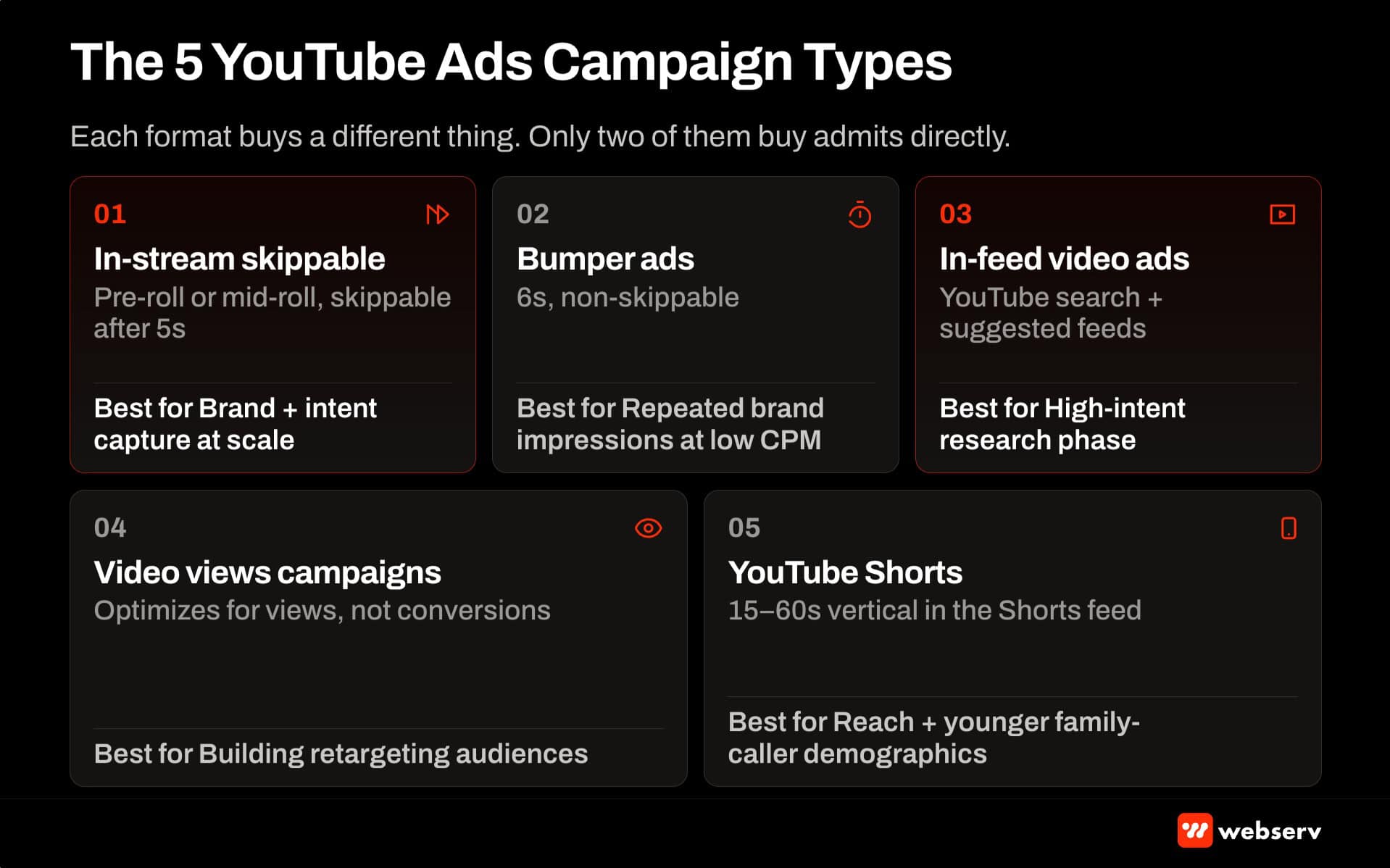
In-stream skippable ads
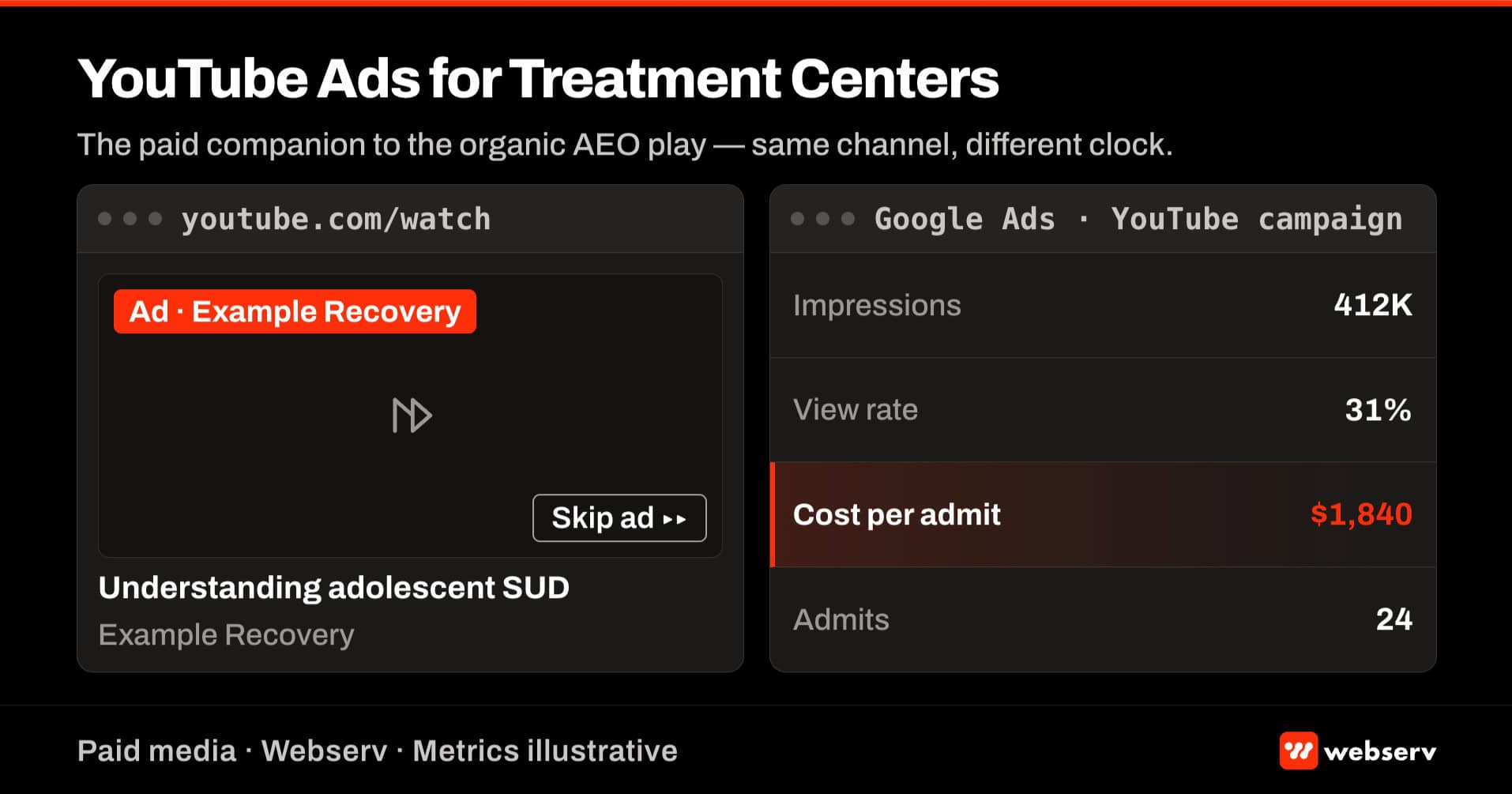
Pre-roll and mid-roll ads on YouTube videos and across the Google Video Partners network. Users can skip after 5 seconds. Advertisers pay when a viewer watches 30 seconds or the full ad (whichever is shorter) or clicks a call-to-action overlay. This is the campaign type that produces admissions.
Bumper ads
Six-second non-skippable ads. Bumpers work for brand awareness and frequency. They do not have room for clinical framing or clinician-led explainers, but they work as a reinforcement layer running alongside in-stream across the same service area. Bumpers are inexpensive per impression and useful for staying top of mind through the family’s decision-making window.
In-feed video ads
Discovery placement in YouTube search results, related videos, and the YouTube home feed. Users see a thumbnail with descriptive text and click to watch. Payment is per click, not per impression.
In-feed video is the closest paid analog to organic YouTube SEO. The ad is served to users actively searching for content on a specific topic, and the click cost is comparable to a well-targeted Google Search ad.
Video views campaigns
Optimized for view volume rather than admissions. Advertisers pay when the video is watched for 10 seconds or clicked. This campaign type serves cold family audiences and builds reach and brand familiarity in the service area. Direct admissions performance is low, but the campaign type is useful in a supporting role.
YouTube Shorts
Vertical short-form video ads shown between organic Shorts content. Emerging surface. Low CPC, thin performance data for behavioral health specifically. Worth testing at small budget to gather data. Not a primary allocation.
Which campaign types work for behavioral health
In-stream skippable is the primary campaign type for treatment centers running YouTube Ads for admissions. The specific reason it works: the skip button filters the audience for you.
Users who skip within 5 seconds are not in the intent state that produces admissions. Users who watch past 30 seconds are engaged with the clinical framing and self-selected for the family-decision-making state.
The cost model only charges for the second group. This produces a paid audience that is already partially qualified before the click, which is why in-stream produces admits at CPAs comparable to well-run Meta Advantage+ campaigns.
Bumpers work in a supporting role. A treatment center running in-stream as the primary vehicle can layer bumpers as brand reinforcement across the same service area. Retargeting viewers who watched but didn’t click isn’t available for treatment ads, because Google’s health policy doesn’t support your data segments. Our retargeting strategy guide covers what is allowed.
Bumpers do not produce admissions directly. They increase the probability that admits produced by other channels (branded search, Meta, referral partners) close.
In-feed video works for high-intent research queries. When a family member searches YouTube for “how does dual diagnosis treatment work” or “what does residential rehab look like,” an in-feed video ad in the search results captures the click at a competitive cost.
This campaign type pairs cleanly with the organic YouTube channel work covered in the companion AEO piece.
Video views campaigns should be limited to specific upper-funnel objectives (audience building for a launch, brand awareness in a new market, seasonal awareness push). They do not produce admissions directly and should not be the primary YouTube spend allocation for a treatment center.
YouTube Shorts is worth 5 to 10 percent of the YouTube budget as a test. The performance data will be thin for behavioral health specifically.
Format constraints (9:16 vertical, 60 seconds max, autoplay attention window measured in seconds) limit the creative options that work for BH. Test it, log the data, and scale only if the data supports it.
The YouTube Ads decision surface at a glance
5
Campaign types: in-stream, bumper, in-feed, video views, Shorts
$5-8K
Minimum viable monthly budget, sustained 60-90 days
$10-20K
Sweet-spot monthly budget for single-facility residential SUD
$150-400
Directional CPA per admit range, well-configured in-stream
The targeting layers that concentrate spend
YouTube supports targeting layers that, stacked correctly, concentrate spend on families in active decision-making about treatment. For treatment ads, Google’s health in personalized advertising policy decides which layers are available: predefined Google audiences and contextual targeting are, advertiser-curated audiences aren’t. The layers that work for behavioral health:
Contextual targeting on relevant content. Topic, placement, and keyword targeting put ads on videos about the subjects families are researching, rather than on audiences built from personal data. Topic targeting around recovery, mental health, and family support, plus placements on relevant behavioral health channels, puts in-stream ads in front of viewers already watching that content. Custom segments built from competitor URLs or condition searches aren’t an option: Google’s policy only lets custom segments pointing to sensitive landing pages serve on Display, to non-sensitive audiences or contextually, so they won’t serve on YouTube.
Predefined in-market and affinity audiences. Google’s predefined audiences stay available for treatment ads because Google automatically excludes sensitive user signals from them. That also means they aren’t condition-intent signals. Use the segments that fit the family decision-maker as reach layers alongside contextual targeting, not as the sole layer.
No customer match or lookalike layer. Google’s health in personalized advertising policy treats addiction and mental health counseling as a sensitive interest category and doesn’t support customer match, your data segments, or lookalike segments for ads promoting it. That rules out VOB-completer and admit lists as a targeting input, hashed or not. Predefined Google audiences such as in-market, affinity, life events, and demographics remain available.
Life event targeting. Google supports life event targeting for specific milestones (new parent, recent grad, new home). None of the standard life events map to a behavioral health diagnosis, so treat life events as a light reach filter rather than an intent signal.
Demographic filters focused on the family payer. The family member paying for treatment is usually the parent, adult child, or spouse of the person entering treatment. Demographic filters that concentrate on the 35 to 65 age range, household income above the median, and specific parent/family life segments align spend with the decision-maker rather than the patient.
Stacking these four layers on a single campaign produces a targeted audience of families in active decision-making at a manageable size for most treatment center budgets.
The creative floor that produces admissions
Clinician-led, family-facing in-stream ads produce the admissions when the creative meets a specific floor. Lower-quality creative produces views without admissions.
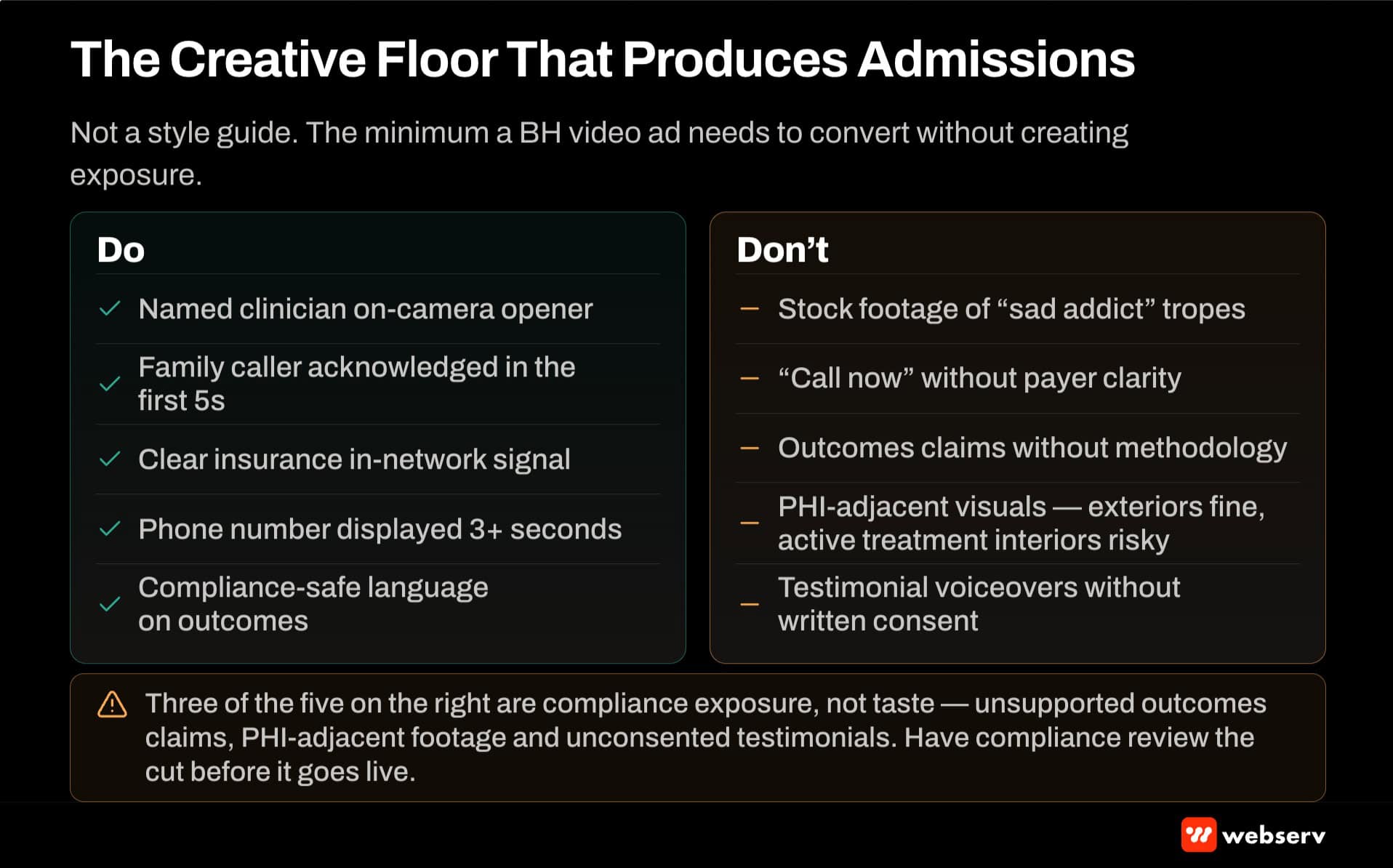
Family-facing, not family-diagnosing. The ad answers the questions families ask (“what happens on the first call,” “how insurance verification works”) without implying the viewer or someone in their household has a condition. Google’s personalized advertising policy bars ads that imply knowledge of a person’s health when they run on audience targeting, and the same line keeps YouTube creative consistent with Meta’s personal attributes rule. Families are often the payer and the decision-maker, so write for them without telling them what’s wrong at home.
Licensed clinician on camera. The clinician is the trust signal that separates a treatment center ad from a generic health ad. The clinician’s specific credentials (MD, LMFT, LCSW, LPC) are stated on screen or in the ad copy. Our author bios that build E-E-A-T piece walks the credential formatting for on-camera clinicians.
Clinical framing that answers the family’s actual question. The video content is not a facility tour or a brand video. It answers a specific question families are asking. “How do I know if my daughter needs residential or PHP.” “What happens in the first 72 hours of treatment.” “How does insurance actually work for a 30-day program.” These are the questions that produce clicks and admits.
15 to 30 seconds for in-stream, 6 seconds for bumpers. Longer than 30 seconds loses the audience past the skip point. Shorter than 15 seconds does not have room for the clinical framing that produces the admission.
Closed captions on every video. YouTube’s autoplay default is muted. Videos without captions play silently and lose the audience. Captions are also a compliance signal (accessibility) and an AEO signal (the transcript feeds retrieval indexing on the organic side).
No crisis-language framing. LegitScript’s addiction treatment advertising standards prohibit crisis-language framing (“if you don’t get help now, you’ll die”). Google’s BH ad policy reinforces the same. The creative should describe the situation calmly with clinical framing, not through crisis appeals.
LegitScript-compliant claims. No guaranteed outcomes, no comparative-superiority claims (“best,” “leading”), no unverified insurance-network claims, no unverified accreditation claims. Our compliant ad headlines guide walks the specific language rules that also apply to video.
Compliance guardrails specific to YouTube
Four compliance considerations apply specifically to YouTube Ads for behavioral health.
LegitScript certification is required to serve. Google requires LegitScript certification for addiction treatment advertising across Google’s ad network, including YouTube. Facilities without LegitScript certification cannot run YouTube Ads for admissions. Our LegitScript certification guide walks the certification process.
HIPAA-safe conversion tracking with click-based conversions. YouTube Ads conversions run through Google Ads conversion actions. Google’s customer data policy says conversions related to health or medical information can’t be used for measurement in enhanced conversions, so keep enhanced conversions off and send click-based conversions server-side with neutral event names and no hashed identifiers. Our HIPAA-safe conversion tracking stack walks the Google-side setup, and our Meta Conversions API HIPAA piece covers the same architecture applied to Meta.
No patient lists in audiences. Don’t upload patient, admit, VOB, or inquiry lists to Google as customer match lists or lookalike seeds, hashed or not. List membership itself reveals treatment status, and Google’s health policy doesn’t support customer match for ads promoting treatment.
Creative claims subject to LegitScript video review. LegitScript reviews video creative for the same claim standards as text creative. Guaranteed outcomes, undocumented outcomes claims, comparative-superiority language, and unverified network claims all fail review. Videos that fail LegitScript review cannot serve regardless of Google’s ad approval.
DO
- Lead with in-stream skippable as the primary vehicle — the skip button filters the audience for you and produces the paid signal that optimizes toward admits.
- Write clinician-led, family-facing creative (answer what parents, adult children, and spouses ask, without implying a condition) with a licensed clinician on camera and specific clinical framing that answers the family’s actual question.
- Stack four targeting layers: contextual targeting (topics, placements, keywords), predefined in-market and affinity audiences, life events, demographic filters on the 35-65 family payer.
- Ship closed captions on every video — YouTube’s autoplay default is muted, and captions are also an accessibility and organic-transcript AEO signal.
- Run one production pipeline serving both paid and organic surfaces — 3-5 min clinician explainers on the channel, recut into 15-30 sec in-stream and 6 sec bumpers from the same footage.
DON’T
- Enter with video views campaigns as the primary vehicle — they optimize for view volume, not admissions, and produce healthy view metrics with zero admits.
- Repurpose Meta ad creative directly onto YouTube — Meta is silent-autoplay + Feed scroll; YouTube in-stream competes with the video the user was already watching.
- Run a single broad predefined audience without stacking contextual targeting, life events, and demographic filters — reach without concentration wastes spend.
- Upload VOB-completer, admit, or inquiry lists as customer match or lookalike seeds. Google’s health policy doesn’t support them, and list membership reveals treatment status.
- Use crisis-language framing, guaranteed-outcome claims, or comparative-superiority language — LegitScript and Google’s BH ad policy both reject this class of creative.
Where YouTube Ads fits against the organic AEO play
The paid channel compounds with the organic YouTube channel work. The compounding mechanism is that both channels reward the same creative asset type: clinician-explainer videos, program walkthroughs, condition education, and family Q&A.
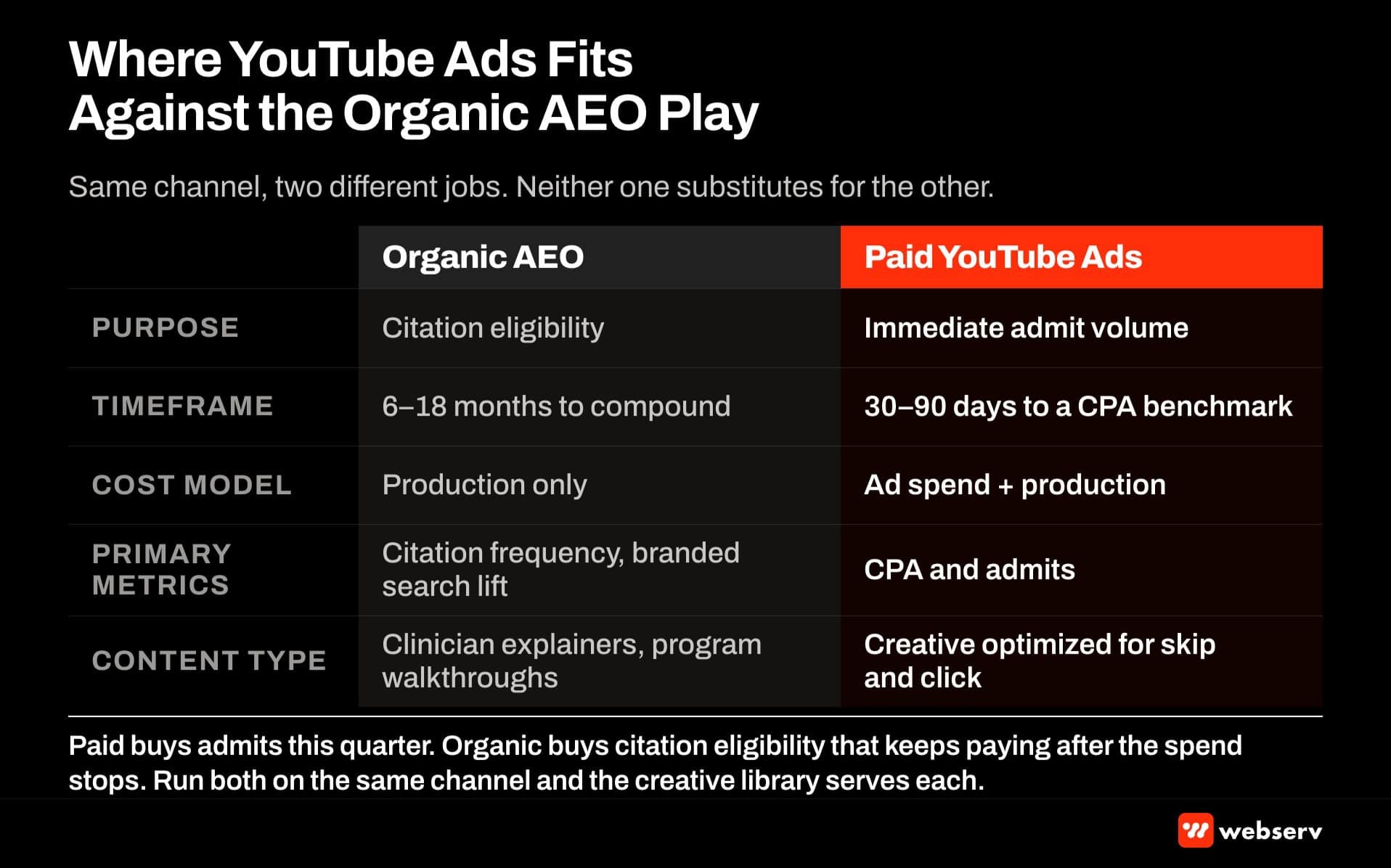
A facility running only paid YouTube Ads produces admissions at a defensible CPA but does not build channel authority. A facility running only organic YouTube builds channel authority slowly (12 to 18 months) without near-term admissions.
A facility running both simultaneously uses the same production budget across both surfaces. That produces near-term admissions from the paid layer while building the organic channel authority that produces AEO citation lift over 12 to 24 months.
The specific production overlap: a 3 to 5 minute clinician-explainer video published organically on the channel can be recut into 15 to 30 second in-stream ads, 6 second bumpers, and 30 second video views campaigns from the same source footage.
The organic transcript republishing on the facility website (which produces the AEO citation lift on the search side) uses the same clinical content that anchors the paid creative.
Facilities that treat paid and organic YouTube as separate initiatives with separate production budgets underinvest in both surfaces. The correct frame is one production pipeline serving two surfaces with different distribution mechanics.
Common failure modes on the paid side
Four failure modes we see when treatment centers activate YouTube Ads without the specific configuration and creative discipline the channel requires.
The first is running video views campaigns as the primary vehicle. Video views optimize for view volume, not admissions. Facilities that use video views as the entry campaign type see healthy view metrics and zero admits, then conclude YouTube Ads does not work.
The right entry point is in-stream skippable with the clinician-led creative floor.
The second is repurposing Meta ad creative directly onto YouTube. Meta ads are optimized for silent autoplay, short attention windows, and Feed-style scrolling.
YouTube in-stream is a different attention pattern: users are already watching video content, and the ad needs to compete with what they were watching. Creative that works on Meta typically does not work on YouTube without a full rework.
The third is targeting too broadly. YouTube’s targeting layers are individually broad. Running a single campaign on one broad predefined audience without stacking contextual targeting, life events, and demographic filters produces reach that does not concentrate on families in active decision-making.
The fourth is uploading a customer match list of VOB completers or admits to seed a lookalike. Google’s health policy doesn’t support customer match or lookalike segments for ads promoting treatment, and the list itself reveals treatment status. Build reach from predefined Google audiences (in-market, affinity, life events, demographics) instead.
Frequently Asked Questions
What budget does YouTube Ads require to work for a treatment center?
The minimum viable budget is $5,000 to $8,000 per month sustained for 60 to 90 days. Below that budget, the campaign does not accumulate enough conversion signal to optimize, and results look random.
The sweet spot for most single-facility residential SUD operators is $10,000 to $20,000 per month. At that budget, the audience layers produce enough impression volume to concentrate on the family decision-maker, the creative can be tested across 2 to 4 variations, and the campaign accumulates 30 to 50 admits per quarter for signal.
Portfolio operators with multiple facilities in different geographic markets can scale beyond $20,000 per month by running separate campaigns per market. Running a single national campaign at $50,000+ per month tends to produce reach spillover into markets that do not convert.
How does YouTube Ads CPA compare to Meta and Google Search?
Directionally, well-configured YouTube in-stream produces CPAs comparable to well-configured Meta Advantage+ campaigns for residential SUD (typically in the $150 to $400 per admit range depending on payer mix and geography). Google Search remains the lower-CPA channel for high-intent branded and category queries.
YouTube’s advantage over Meta is that the audience concentration on behavioral health content is higher, which produces admissions at similar CPA but with a different mix of intent states. Meta produces more family-caregiver-perspective inquiries early in the research process. YouTube produces more inquiries from families in later-stage active decision-making.
Facilities running both Meta and YouTube see the two channels produce complementary inquiries rather than cannibalizing each other, which is why we recommend the two channels together rather than choosing between them.
Do we need a YouTube channel to run YouTube Ads?
Yes. YouTube Ads require an active YouTube channel to serve from, and Google Ads reviews the channel’s content and posting history as part of the ad approval process. A channel with zero organic uploads or a channel that has been dormant for 12+ months produces slower ad approvals and occasionally triggers manual review.
The recommended minimum before activating paid: 6 to 10 organic videos published on the channel across the previous 90 days, covering the same clinical topics the paid creative will address. This produces both a defensible channel presence for ad review and a foundation for the organic AEO channel work the paid layer compounds with.
Facilities that activate paid before the organic channel foundation exists will see the paid channel work but miss the compounding benefit with the organic AEO surface.
How does YouTube Ads interact with LegitScript compliance?
LegitScript certification is required to serve YouTube Ads for behavioral health treatment. The certification process covers the facility as a whole (not individual ads), and Google verifies certification status before approving ads. Our LegitScript SEO piece walks the certification process.
Individual creative assets are subject to Google’s BH ad policy review, which enforces LegitScript-adjacent claim standards. The specific claims that trigger creative disapproval on YouTube are the same claims that trigger disapproval on Google Search: guaranteed outcomes, comparative-superiority claims (best, leading, top-rated), and unverified insurance-network claims. Our compliant ad headlines guide covers the specific language rules.
Facilities running YouTube Ads should build creative review into the production workflow before the video is uploaded, not after. Discovering a creative asset is non-compliant after upload produces production rework and delayed campaign activation.
What conversion tracking setup does YouTube Ads require?
Click-based Google Ads conversions sent server-side, with enhanced conversions off. Google’s customer data policy says health-related conversions can’t be used for measurement in enhanced conversions, so no email or phone goes to Google. The client-side pixel alone does not produce defensible conversion signal for BH because iOS ATT and increasing browser privacy restrictions have degraded pixel accuracy.
The specific setup: server-side conversion tracking through Google Tag Manager Server-Side (or an equivalent server-side layer), enhanced conversions turned off in Google Ads, and a monthly reconciliation between Google Ads reported conversions and CRM admit counts to catch signal drift.
Our Meta Conversions API HIPAA setup piece walks the server-side layer conceptually. The Google side uses the same server-side container, sending click-based conversions without hashed identifiers.
Does YouTube Shorts work for behavioral health?
Data is thin and results are mixed. The format constraints (9:16 vertical, 60 seconds max, autoplay-driven attention window) limit the clinical framing that produces admissions on longer in-stream video.
Facilities testing Shorts see meaningful view volume at low CPC but low admit conversion. The channel appears to work as a top-of-funnel awareness layer for a specific age demographic (35 to 50) rather than as a direct admissions channel.
The correct posture on Shorts as of publication: test at 5 to 10 percent of the YouTube budget, log the data, do not scale unless the CPA math produces admits comparable to in-stream or Meta.
How do we split the YouTube production budget across paid and organic?
The correct frame is one production pipeline serving two surfaces, not two separate budgets.
A production budget of $15,000 to $25,000 per quarter produces 8 to 12 videos of the quality floor described above, and each video can serve both channels. The organic side gets the full-length 3 to 5 minute version. The paid side gets 15 to 30 second in-stream cuts, 6 second bumpers, and 30 second video views versions from the same footage.
Facilities that split production budget into separate paid and organic tracks underinvest in both. The shared production model is why the two surfaces compound.
Keaton Nalle is the Director of Paid Admissions at Webserv, a digital marketing agency for treatment centers.