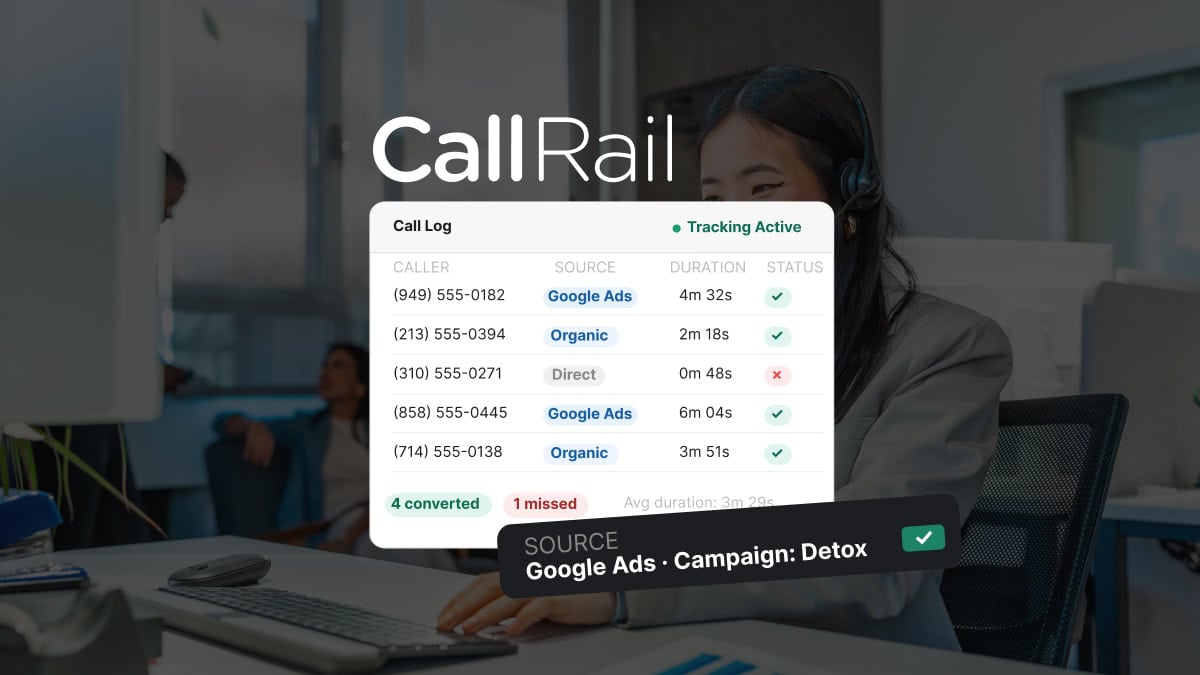
A treatment center we recently audited had CallRail installed. They had paid the subscription for over a year. They told us call tracking was “set up and running.”
When we got access to the account, we found the static phone number their local chamber of commerce had issued for an off-site directory placement was the number serving on their main website.
The treatment center had separately built a CallRail number pool of swappable DNI numbers to track marketing source. They had even reserved a dedicated SwapTarget number for the website. The SwapTarget had never been wired into the site itself. It is the same gap that surfaces in nearly every admission operations audit we run on a new client.
Every call from organic traffic, paid search, paid social, and direct visits routed through the chamber’s static number. The DNI pool sat dormant. The marketing team thought they had channel-level attribution because they were paying for it. What they had was a phone number with no story attached to it.
This is the normal state of CallRail in behavioral health. The subscription is paid. The tool is “set up.” The configuration is operating at a fraction of its capacity.
We see versions of this in nearly every new client audit. Missing Google Ads integration. No GA4 events firing. No differentiation between calls from Google Business Profile and calls from the website. No tracking on paid directory placements (recovery.com, Psychology Today). And almost no call tagging beyond raw call volume.
Treatment center operators in this state have no real ROI data on their marketing channels. They cannot tell which channels drive admits versus which channels drive spam, Medicare callers, or referrals to the wrong level of care. They make spend decisions on phantom signal.
CallRail attribution operates as an admissions intelligence system that paid media happens to use. Conversion events are intrinsic to how a good paid media campaign runs, but that does not make them optional for organic, GBP, paid directories, or any other channel. If you want to know what is actually working, you have to set the tracking up correctly and read the data.
Trevor Gage, Director of Earned & Owned Media, Webserv
Key Takeaways
- 70-85% of qualified treatment center leads come through a phone call rather than a form. If the call side of attribution is broken, every channel decision is being made on the minority of leads.
- A correctly configured CallRail account runs six layers together: source-specific static numbers for off-site placements, a swappable DNI pool for the website, a correctly wired SwapTarget, form tracking, source attribution rules, and reporting. Most accounts we audit have one or two layers active and the rest dormant.
- The GA4 integration and the Google Ads integration close the attribution loop. Without them, GA4 and CallRail each tell partial stories that do not align — and Google Ads smart bidding optimizes on form fills only, even when 70%+ of conversions are calls.
- Call tagging is where attribution stops being a marketing report and becomes an admissions intelligence system. The minimum tag set: VOB tagged, Viable VOB tagged, Admit tagged. Operational tags catch Medicare, spam, referrals, and wrong-service inquiries before they pollute the data.
- HIPAA compliance is non-negotiable: healthcare plan, signed BAA, end-to-end encryption, PII/PHI redaction, automatic 30-minute logoff, and role-based access controls. Substance use programs operating without redaction on transcripts are out of compliance with 42 CFR Part 2 federal law.
This guide walks through how CallRail should be set up for an addiction treatment center. It covers the GA4 and Google Ads integrations that close the attribution loop and the call tagging layer most operators skip. It also covers the HIPAA configuration that has to be in place, and the common audit findings we surface every time.
Why call attribution matters more in behavioral health
Treatment center prospects call more than they form-fill. In most of our client accounts, 70% to 85% of qualified leads come through a phone call rather than a form submission. The pattern is consistent across the vertical because the buying moment is high-stakes and high-urgency. People in crisis pick up the phone.
If the form-fill side of attribution is solid and the call side is broken, the marketing data is reporting on the minority of leads. Every channel decision is being made against the wrong signal.
The vertical also pushes attribution complexity higher than non-regulated categories. Channels converge in patterns most agencies do not model. Organic search drives calls. Paid search drives calls. Paid social drives calls. Google Business Profile drives calls. Paid directory placements like recovery.com and Psychology Today drive calls.
Each one needs its own tracking treatment, and the differences matter because the channels have radically different cost structures and admit conversion rates. The same multi-channel complexity is what makes the local SEO attribution problem so easy to get wrong on GBP-vs-website call routing.
HIPAA adds a regulatory layer on top of the operational one. CallRail’s healthcare plan and Business Associate Agreement are not optional. Generic call tracking platforms cannot sign BAAs, which means any call data tied to patient status (insurance verification calls, intake conversations, admit confirmation) is HIPAA-exposed on a platform that should not be touching it.
The setup work for CallRail in behavioral health takes more time than in other verticals. The payoff is also larger.
The setup: what proper CallRail looks like
A correctly configured CallRail account has six layers running together. Most accounts we audit have one or two layers active and the rest dormant.
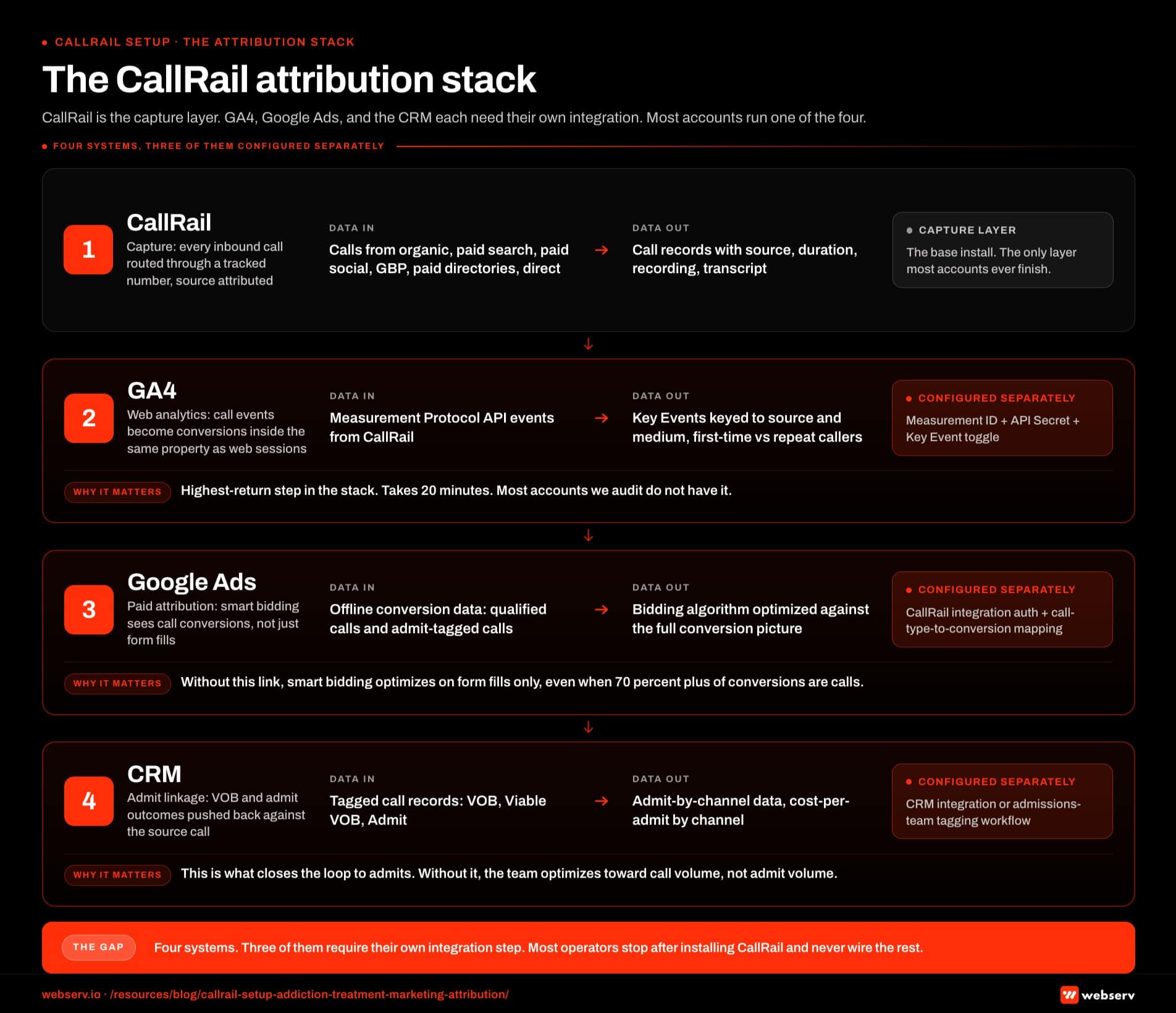 Infographic titled ‘The CallRail attribution stack’.
Layer 1: Source-specific static numbers for off-site placements. Every off-site placement that needs a phone number gets its own static CallRail number. Google Business Profile gets one. Recovery.com gets one. Psychology Today gets one. Print collateral gets one. The number is unique to the placement so every call that comes through it is attributable to that specific source.
Layer 2: A swappable DNI number pool for the website. A pool of CallRail numbers is configured to dynamically swap on the website based on the visitor’s source. Organic Google visitors see one number. Paid search visitors see another. Direct visitors see another. The swap happens via JavaScript in the visitor’s browser; the visitor never knows the number changed.
Layer 3: The website SwapTarget set to the correct destination. This is the single most-missed item we see. The DNI pool needs a designated SwapTarget number on the site itself so the JavaScript has something to swap against.
If the SwapTarget is wrong (a static off-site number, a personal cell, a defunct line), the entire DNI layer is functionally orphaned even when it is technically present.
Layer 4: Form tracking. CallRail does not just track calls. The same tool tracks form submissions on the site with the same source attribution logic. Every form fill carries a record of which channel drove it.
Layer 5: Source attribution rules. CallRail’s attribution rules engine determines how each call is assigned to a channel. The default rules work for simple cases. Behavioral health usually needs custom rules to handle the GBP-vs-website distinction, paid directory referrers, and UTM-tagged paid campaigns.
Layer 6: Reporting and alerts. The Call Attribution report and the Lead Attribution by Campaign report surface what’s working at the channel level. Alerts on no-answer calls or after-hours volume catch admissions-team coverage gaps before they cost admits.
When all six layers are running, the treatment center has a complete picture of which channels drive which calls, which forms come from which sources, and which marketing touches close the loop to actual admits.
GA4 integration
CallRail and GA4 do not talk to each other by default. The integration takes 20 minutes to set up correctly and is the single highest-return step in the attribution stack for treatment center marketing.
Step 1: Get the GA4 Measurement ID. In your GA4 admin under Data Streams, copy the Measurement ID for the web property (format: G-XXXXXXXXXX).
Step 2: Create a Measurement Protocol API Secret. Inside the same Data Stream, open the Measurement Protocol API secrets panel. Create a new secret with a clear name (e.g., “CallRail Integration”) and copy the secret value. You will not be able to view it again.
Step 3: Configure the CallRail GA4 integration. In CallRail under Integrations, find Google Analytics 4 and enter the Measurement ID and the API Secret. Activate the integration.
Step 4: Differentiate first-time and repeat callers. Inside the GA4 integration settings, enable separate event names for first-time and repeat callers. This is the single most useful differentiation in the integration because first-time callers carry intent that repeat callers do not. Optimizing toward first-time callers drives admit pipeline; optimizing toward total call volume drives operational noise.
Step 5: Mark the events as Key Events in GA4. After CallRail starts sending events to GA4, the events appear in the GA4 Events report as standard events. They will not show up in conversion reporting until you mark them as Key Events. Open the Events report, find the CallRail events, toggle them to Key Events.
Step 6: Verify after one week. Check the Key Events report in GA4 to confirm CallRail events are firing with the correct attribution and source/medium data. Cross-reference the count against the same window in CallRail. They should match closely. If they do not, the integration has a configuration error that needs to be diagnosed before the data becomes load-bearing.
The integration produces the data layer that makes everything downstream useful. Without it, CallRail and GA4 each tell partial stories that do not align.
Google Ads integration
Google Ads needs to see call conversions to optimize the bidding algorithm toward them. Without the CallRail-to-Google-Ads link, the bidding algorithm is optimizing on form fills only, even when 70%+ of qualified leads come by phone. See our conversion tracking guide for addiction treatment Google Ads for the broader attribution architecture this integration plugs into.
The integration is one step. In CallRail under Integrations, find Google Ads, authenticate with the Google Ads account, and configure which call types fire as Google Ads conversions. Typically that’s qualified calls (calls over a duration threshold) and tagged admit calls (more on tagging below).
The integration unlocks two things. First, Google Ads’ smart bidding strategies start optimizing toward calls in addition to forms. Cost-per-acquisition drops because the algorithm is seeing the full conversion picture.
Second, the Google Ads call attribution data becomes available inside the Google Ads UI, so paid media managers can see channel performance without exporting CallRail reports.
This is the integration that most directly affects paid media performance. It is also the one most commonly missing from accounts we audit. The same dynamic applies on the Meta side — see our Meta CAPI HIPAA setup guide for how the paid social side closes the same attribution loop.
Call tagging: the layer most operators skip
Source attribution tells you which channel drove the call. Call tagging tells you what the call actually was. This is where attribution stops being a marketing report and starts being an admissions intelligence system.
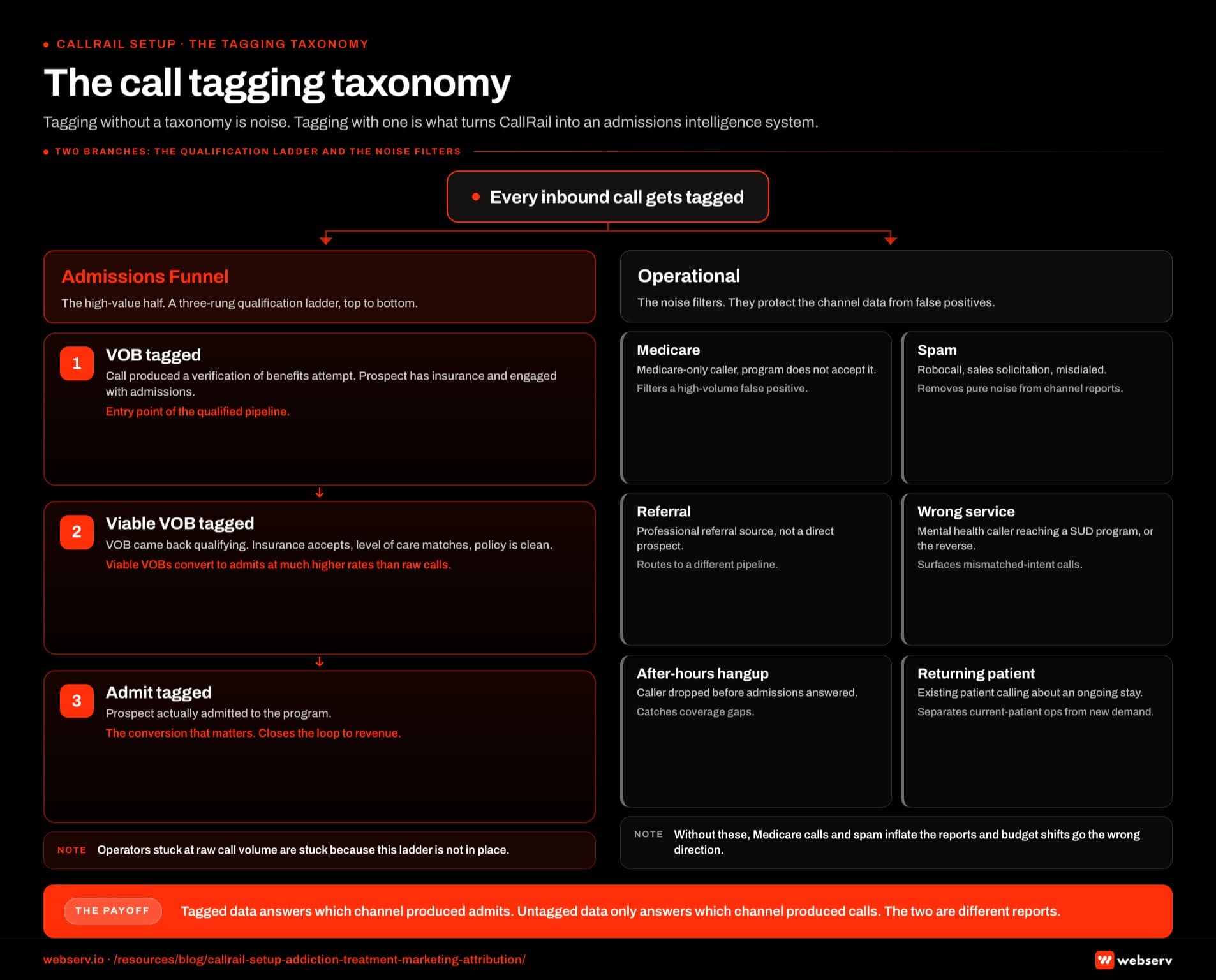 Infographic titled ‘The call tagging taxonomy’.
The minimum tagging set for behavioral health includes three admissions-funnel tags that progressively qualify the lead.
VOB tagged. The call resulted in a verification of benefits attempt. The prospect has insurance and engaged with admissions far enough for a VOB to be initiated.
Viable VOB tagged. The VOB came back qualifying. The insurance accepts at the program, the level of care matches, the policy details are clean. This is the high-value tag because viable VOBs convert to admits at much higher rates than raw calls.
Admit tagged. The prospect actually admitted to the program. This is the conversion that matters. Admit tagging closes the loop between marketing spend and revenue.
Beyond the admissions funnel, there are operational tags that protect the data from noise. Medicare callers. Spam calls. Referral calls from professional networks (these belong in a different pipeline than direct prospects). Wrong service inquiries (mental health caller reaching a substance use program, or vice versa). After-hours hangups. Returning patients calling about an existing stay.
Tagged data unlocks reporting that is qualitatively different from untagged data. The team can identify the top-converting landing pages by admit, not by call volume. The team can find the true source of admissions and reverse-engineer the funnels that produced them.
The team can spot channels that look strong on raw call volume but produce zero admits, and shift budget away from them. The team can identify the funnels that quietly produce the highest admit rates and double down on those.
Tagging is the operational discipline that separates treatment centers that scale paid acquisition from treatment centers that burn through budget without knowing why.
HIPAA configuration
CallRail’s healthcare plan and BAA are non-negotiable for any treatment center using call tracking. Calls and forms in this vertical routinely carry PHI (protected health information) such as insurance details, diagnoses, substance use patterns, and medication history. A platform without a signed BAA cannot legally handle this data. The broader operator-side framework is in our HIPAA marketing compliance glossary.
The configuration requires several specific settings beyond the BAA.
End-to-end encryption. Healthcare-plan accounts encrypt call recordings and transcripts in transit and at rest. The encryption is automatic on the plan but should be verified in account settings.
PII and PHI redaction. CallRail’s redaction feature automatically masks PII and PHI from call transcripts. This is required for substance use programs under 42 CFR Part 2, which adds stricter patient consent requirements on top of HIPAA. Substance use programs operating without redaction on transcripts are out of compliance with federal law.
Automatic logoff. Healthcare-plan accounts log users out after 30 minutes of inactivity. This is HIPAA-required and prevents an unattended session from exposing patient data.
User access controls. Each team member who touches CallRail data should have their own login, with role-based access controls limiting visibility to what their role requires. Admissions can see admit-tagged calls; marketing can see source attribution; clinical leadership can see VOB outcomes. Generic shared logins are a HIPAA compliance problem.
Signed BAA on file. CallRail’s BAA is a separate document from the standard service agreement. Treatment center operators should confirm the signed BAA is on file before any call data flows through the platform.
The configuration is straightforward once an operator knows to look for it. The audit finding pattern is: most accounts have the healthcare plan paid for, but several of the operational settings are not turned on. That gap is the difference between a HIPAA-compliant setup and a HIPAA-exposed one.
Every engagement is built around your north star metric, reviewed quarterly, and adjusted when the industry changes.
No set-and-forget campaigns. No vanity metrics. A five-pillar system built specifically for treatment centers that ties marketing directly to admissions.
What gets revealed once it is set up correctly
A treatment center running CallRail correctly gains visibility into three categories of data that most operators in this vertical have never seen.
True source of admissions. Not which channel produced the most calls. Which channel produced the most admits. The two often look completely different.
A channel that produces high call volume can produce zero admits if the calls are spam, Medicare-only, or wrong-service. A channel that produces low call volume can produce most of the admits if the calls are high-intent qualified prospects.
Funnel-level conversion data. Which landing pages convert calls to VOBs to admits at the highest rates. The team can identify the top three converting funnels and shift content production, paid spend, and CRO investment toward replicating them.
Channel-level ROI clarity. Cost per admit by channel becomes a real number, not an estimate. Paid search admit-CPA can be compared against organic admit-CPA against paid directory admit-CPA. Budget allocation decisions become defensible. Channels that are not producing admits get cut. Channels that are producing admits get more budget.
The transition from “we paid for CallRail” to “we know which marketing channels drive admits” happens once the six layers above are running together. The work is real. The clarity is worth it.
Common mistakes we see in audits
COSTLIEST MISTAKE
SwapTarget pointed at the wrong number. The dynamic number-swap script fires, but the destination is a personal cell, a defunct landline, or a static off-site number — anything but the dedicated tracking number that reports back to CallRail. Every call from paid traffic still connects. None of it gets attributed. The dashboard reports zero calls from the campaign that is actually driving the admits, and Google Ads smart bidding starts pulling budget away from the channel that is working because it cannot see the conversions.
Five mistakes account for most of the audit findings we surface when reviewing a new client’s CallRail setup.
Mistake 1: SwapTarget pointed at the wrong number. The chamber-of-commerce pattern at the top of this article is the extreme version, but lighter versions are common. SwapTarget set to a personal cell, a defunct landline, or a static off-site number rather than the dedicated CallRail tracking number. The fix is one configuration change. The impact is immediate.
Mistake 2: GA4 integration not configured. Calls and forms are tracked in CallRail but never make it into GA4 as events. Reporting in GA4 is missing the call layer entirely. The marketing team thinks the channel mix looks one way; the actual mix looks very different.
Mistake 3: No Google Ads link. Google Ads smart bidding is optimizing on form fills only because calls are not flowing through as conversions. CPA stays elevated because the algorithm cannot see most of the actual conversions.
Mistake 4: No call tagging. Source attribution is in place but no admissions funnel data is being captured. The team knows where calls came from but not which ones became admits. ROI decisions are based on call volume, not admit volume.
Mistake 5: No GBP-vs-website differentiation. Google Business Profile calls and website calls flow through the same number, or get attributed under the same source. The two channels behave completely differently and need different optimization strategies, but the data cannot support that work without separation.
Each mistake has a specific fix. The full audit and remediation typically takes 4 to 8 hours of CallRail configuration work and produces a step-change in attribution clarity.
What success looks like at twelve weeks
A treatment center that builds CallRail attribution correctly should see measurable change inside a quarter.
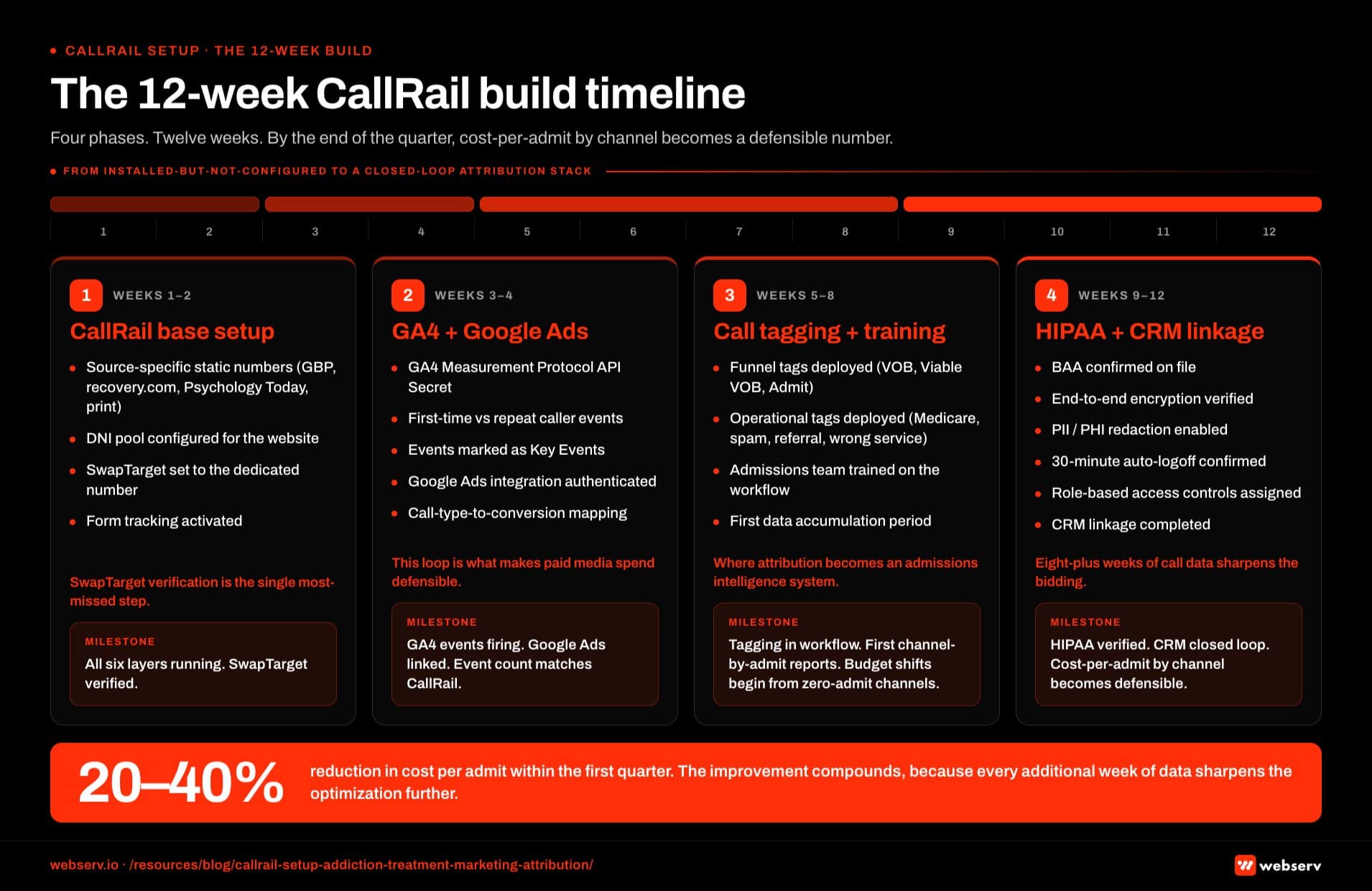 Infographic titled ‘The 12-week CallRail build timeline’.
Week 1: full configuration audit complete. All six layers running. GA4 integration firing events. Google Ads conversions linked. HIPAA settings verified. Call tagging schema documented and admissions team trained on the tagging workflow.
Weeks 2 to 4: data accumulation period. Calls and forms flow through with full attribution. Tagging starts producing the admissions funnel data. The team identifies the first patterns in which channels are producing the most admits versus the most calls.
Weeks 5 to 8: optimization cycle. Budget shifts from channels that produce calls but not admits to channels that produce admits. Landing pages and funnels that convert at the highest admit rates get amplified. The cost-per-admit by channel becomes a defensible number.
Weeks 9 to 12: paid media performance lift. Google Ads smart bidding has been seeing call conversions for 8+ weeks and the algorithm has shifted toward call-producing keywords and audiences. CPA drops. Admit volume climbs at the same budget.
The accounts we have moved through this sequence consistently produce a 20% to 40% reduction in cost per admit within the first quarter. The improvement compounds because every additional week of data sharpens the optimization further.
Frequently asked questions about CallRail attribution for treatment centers
Do we need CallRail if we already have Google Ads conversion tracking?
Yes, and the two solve different problems. Google Ads conversion tracking attributes form fills and on-page actions to specific ads. CallRail attributes phone calls to specific traffic sources, campaigns, and creatives. For a treatment center where 60 to 80 percent of conversions are phone calls, Google Ads conversion tracking without call tracking is blind to most of what is converting.
The combined setup is what produces the actual measurement layer. CallRail captures the call, attributes it to the source (paid search, paid social, organic, direct), and passes the attribution back to Google Ads as an offline conversion. Google Ads then optimizes against the full conversion picture rather than the form-fill subset. Cost per qualified VOB drops meaningfully once the call data feeds the algorithm.
Programs running Google Ads without call tracking typically see 30 to 40 percent of total conversion events undertracked. The algorithm optimizes against the visible subset, which is rarely the same as the highest-value subset. The CallRail layer makes the invisible visible.
What is the cheapest CallRail tier that works for treatment centers?
Most single-location treatment centers can run effectively on the CallRail Healthcare tier at the $145 to $245 per month range, depending on call volume. The Healthcare tier is the minimum that supports HIPAA-compliant configuration with a signed BAA, which is non-negotiable for treatment center attribution. The standard CallRail tiers without HIPAA configuration cannot be used on patient-adjacent pages.
Multi-location programs typically scale into the Healthcare Enterprise tier at $400 to $800 per month, which adds the per-location tracking number management and the multi-account reporting that single-location accounts do not need. The pricing scales primarily by call volume and number of tracked locations, not by feature set.
The cost question is rarely the right one. CallRail at $200 per month captures attribution that informs $40,000 to $80,000 monthly paid media spend decisions. The ROI on call tracking is one of the highest in the marketing stack, and the cost difference between the right tier and a cheaper one is trivial relative to the budget being optimized.
How does HIPAA configuration affect CallRail attribution accuracy?
HIPAA-compliant CallRail configuration strips or hashes the data fields that would otherwise feed Meta and Google more granular signals. The accuracy of the call-level attribution does not degrade, but the audience-building capability does. Specifically, the call-based custom audiences and lookalike audiences that some agencies pitch are not buildable on HIPAA-compliant CallRail configurations.
The trade-off is real but small. Most treatment centers using call-based custom audiences saw modest performance gains over non-call-based lookalikes, and the audiences carried compliance risk that has only increased under the 2024 OCR online tracking guidance. The HIPAA-compliant configuration produces clean attribution without the audience layer; most accounts produce equivalent or better performance once they rebuild the audience strategy from non-PHI signals.
The configuration step that operators most often miss is the BAA execution with CallRail. The Healthcare tier supports HIPAA configuration, but the BAA does not auto-execute; the operator’s compliance officer or counsel has to sign and submit it. Programs running CallRail Healthcare without a signed BAA in their files carry the same exposure as programs running standard CallRail.
Can we use a different call tracking tool than CallRail?
Yes. CallTrackingMetrics is the main alternative with full HIPAA-compliant infrastructure and BAA execution. Invoca is the enterprise alternative used by larger multi-location operations. Both can replace CallRail in a treatment center attribution stack without performance loss. The choice between them is usually about which tool integrates more cleanly with the operator’s existing ad platforms and CRM.
The tools that should not be used in this category are the standard, non-healthcare call tracking products (CallSource, Marchex without HIPAA tier, generic Twilio-based custom solutions). These usually lack BAA execution and treat call recordings as standard data rather than PHI-adjacent. The compliance exposure outweighs any cost savings.
The decision matters less than the discipline around it. A treatment center running CallRail Healthcare correctly produces the same attribution clarity as one running CallTrackingMetrics correctly. Both produce vastly better attribution than a treatment center running either tool incorrectly. Pick one, configure it properly, and document the BAA.
How long until call attribution data is actionable?
Most treatment centers see actionable call attribution within 30 days of correct CallRail setup, with the data depth compounding through months 2 and 3. The first month produces the call-to-source attribution. Month two adds call-to-campaign attribution as Google Ads ingests the offline conversion data. Month three produces call-to-keyword attribution that informs bid and budget decisions.
The variable that compresses or extends the timeline is call volume. A program receiving 200 calls per month produces statistically reliable attribution faster than a program receiving 40 calls per month. Below 30 to 40 calls per month, the attribution data lags meaningful action by 60 to 90 days because the sample size does not stabilize.
The pattern that delays actionable data most often is incomplete tracking number deployment. Programs that only deploy tracking on paid traffic and not on organic, direct, and referral produce a partial attribution picture that distorts cross-channel comparisons. The full deployment across all traffic sources is what makes the data trustworthy.
What to ask your paid media or SEO partner this week
Three questions surface whether your partner has CallRail running at the level it should be.
First, ask for a CallRail account audit. Specifically, ask whether the SwapTarget on the website is the correct dedicated CallRail number, whether the GA4 integration is configured and firing events, and whether the Google Ads conversion link is in place. A serious partner can answer these in five minutes. A weak partner does not know what the SwapTarget is.
Second, ask for the call tagging schema. The right answer references VOB, Viable VOB, and Admit at minimum, plus operational tags for Medicare, spam, and referral. A vague answer means the team is reading raw call volume as if it were qualified pipeline.
Third, ask for the cost-per-admit by channel for the last 90 days. If the partner can produce a defensible number for paid search, organic, GBP, and paid directories separately, the attribution stack is working. If the answer is some version of “we report on calls overall,” the attribution stack is producing channel-level fog instead of channel-level clarity.
CallRail set up correctly is the difference between treatment center marketing that compounds quarter over quarter and treatment center marketing that burns through budget on channels nobody can defend. The configuration work takes a few hours. The clarity it produces lasts for the lifetime of the account. Book an intro call and we will run the audit against your CallRail account before any retainer work begins.
The perspective in this article comes from 9 years working exclusively inside behavioral health.
We are a team built by people in recovery who understand that behind every admission is someone asking for help. If that resonates, get to know us.
Trevor Gage is the Director of Earned & Owned Media at Webserv. Webserv works with behavioral health and addiction treatment centers on SEO, paid media, and full-funnel admissions strategy.