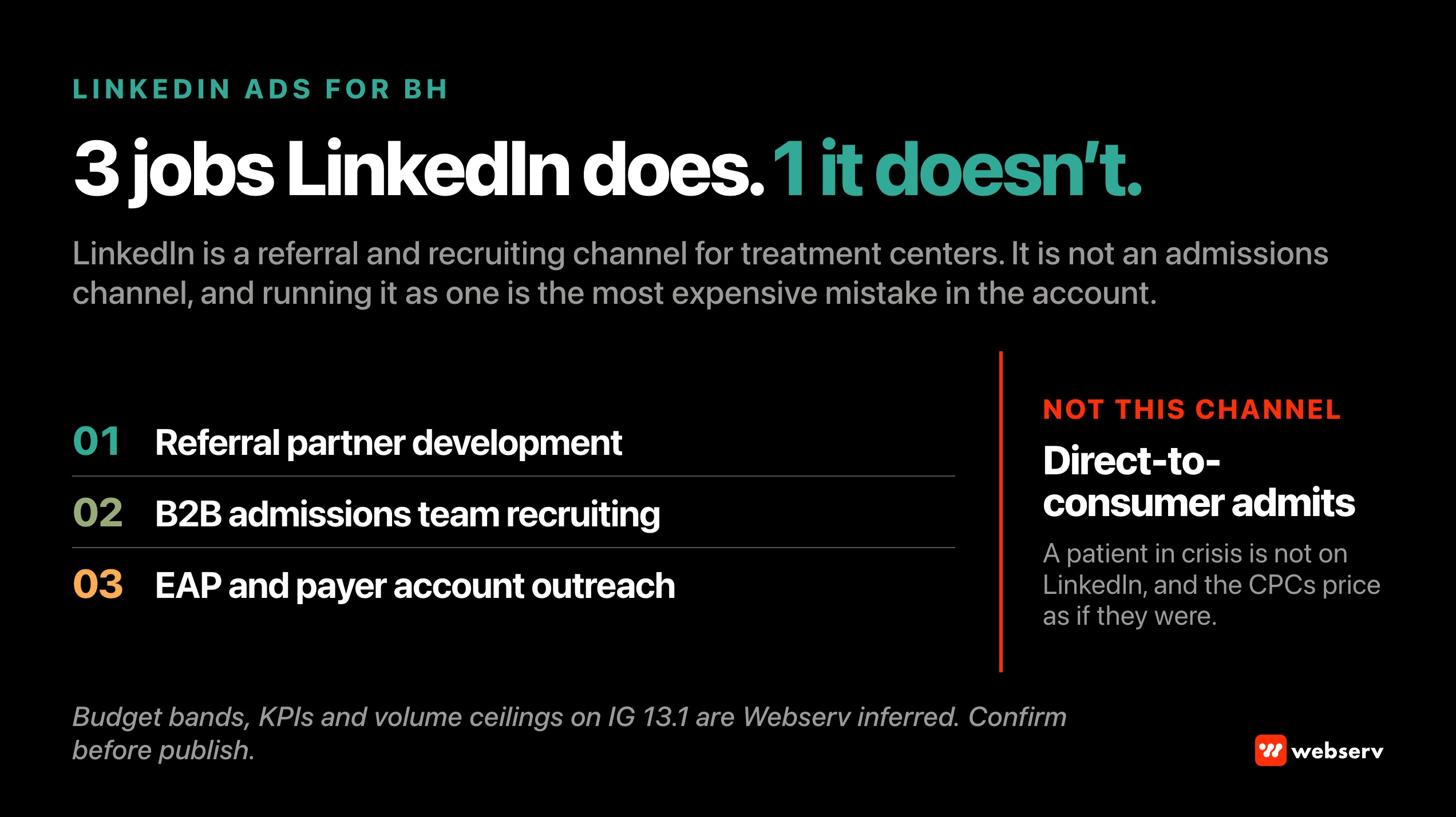
LinkedIn Ads occupies a specific position in the behavioral health paid media mix that is not obvious from LinkedIn’s general performance category positioning. LinkedIn is not primarily a family decision-maker channel or an acute-need channel. It lives inside our LinkedIn Ads capability as a specific-use-case tool, not a universal paid channel.
The LinkedIn Ads capability at Webserv operates against LinkedIn for two specific BH use cases: professional referral partner development and B2B decision-maker targeting for behavioral health agencies (like Webserv itself) that sell services to treatment centers.
Treatment centers running LinkedIn as a family-marketing channel typically produce cost-per-inquiry that materially exceeds Meta and Google. The intent state is wrong for the platform. Treatment centers running LinkedIn as a referral-partner-development channel typically produce meaningful referral partner engagement that pays back over 12 to 36 month windows.
The pattern I see across facility LinkedIn programs: the account either does not exist because someone concluded “LinkedIn doesn’t work for BH” without evaluating the specific use cases where it does, or the account runs against family targeting that produces the exact cost-per-inquiry problem that killed LinkedIn’s reputation for BH.
This piece walks the LinkedIn Ads playbook specific to behavioral health. The specific use cases where LinkedIn produces meaningful results, the audience targeting patterns that work for referral partner development, and the ad format selection that fits the specific engagement patterns LinkedIn produces.
It also covers the compliance considerations that apply differently than Meta or Google, the measurement patterns that reveal LinkedIn’s actual contribution (which is not inquiries at Meta’s cost-per-lead economics), and the common failure modes that produce LinkedIn programs that fail expectations. Third in the paid trilogy alongside our Meta Ads playbook and Google Ads playbook. Sits under the broader social advertising for rehab treatment centers reference. Referral-partner side is walked in our referral partner marketing piece. Full picture in our ultimate guide to behavioral health marketing.
Key Takeaways
- LinkedIn Ads is not primarily a family decision-maker channel or an acute-need channel for BH. Treatment centers running LinkedIn for family marketing typically produce cost-per-inquiry 3 to 8x higher than Meta or Google.
- The two use cases where LinkedIn produces meaningful BH results: referral partner development (therapists, physicians, EAP administrators, corporate wellness leadership) and B2B decision-maker targeting for BH-adjacent agencies and vendors selling services to treatment centers.
- Audience targeting for referral partner development: job title targeting on “therapist,” “psychologist,” “psychiatrist,” “clinical director,” “medical director” combined with geographic targeting matched to facility service area. Company size targeting can add specificity (independent practices vs group practices vs hospital-affiliated).
- Ad format selection matters more on LinkedIn than on other paid platforms because LinkedIn has more format-specific engagement patterns. Sponsored Content works for thought leadership. Message Ads work for direct outreach. Document Ads work for research distribution. Event Ads work for referral partner recruitment.
- Compliance considerations: LinkedIn does not require LegitScript certification, but LinkedIn’s own community guidelines apply plus general BH advertising sensitivity applies. Ad copy targeting professional referral partners has different compliance considerations than ad copy targeting families in acute need.
DEFINITION
LinkedIn Ads for behavioral health treatment center marketing. The paid social program that uses LinkedIn’s professional targeting layer for two specific BH use cases: referral partner development (clinicians, physicians, EAP administrators, institutional referral sources) and B2B decision-maker targeting for BH-adjacent agencies and vendors selling into treatment centers. Runs on job title plus geographic plus company size targeting, format-specific creative (Sponsored Content, Message Ads, Document Ads, Event Ads, Video Ads), LegitScript-free but community-guidelines-bound compliance, and measurement over 12 to 36 month attribution windows.
Distinct from Meta Ads for BH (which serves family decision-makers and self-referral acute-need traffic; LinkedIn family targeting produces cost-per-inquiry 3 to 8x higher than Meta), distinct from Google Ads for BH (which captures bottom-funnel search intent; LinkedIn does not compete for search inventory), and distinct from organic LinkedIn (which builds the named-clinician and executive profile foundation that paid LinkedIn amplifies).
OPERATOR INSIGHT
The account either does not exist because someone concluded “LinkedIn doesn’t work for BH” without evaluating the specific use cases where it does, or the account runs against family targeting that produces the exact cost-per-inquiry problem that killed LinkedIn’s reputation for BH.
The fix is not more spend or better creative. The fix is running LinkedIn only for the two use cases where it produces results (referral partner development plus B2B decision-makers) and skipping the platform entirely for the four use cases where it doesn’t (family targeting, acute-need self-referral, insurance verification lead generation, adolescent parent targeting).
The specific use cases where LinkedIn produces meaningful BH results
Two use cases produce meaningful BH results on LinkedIn. Three additional use cases fail on LinkedIn.
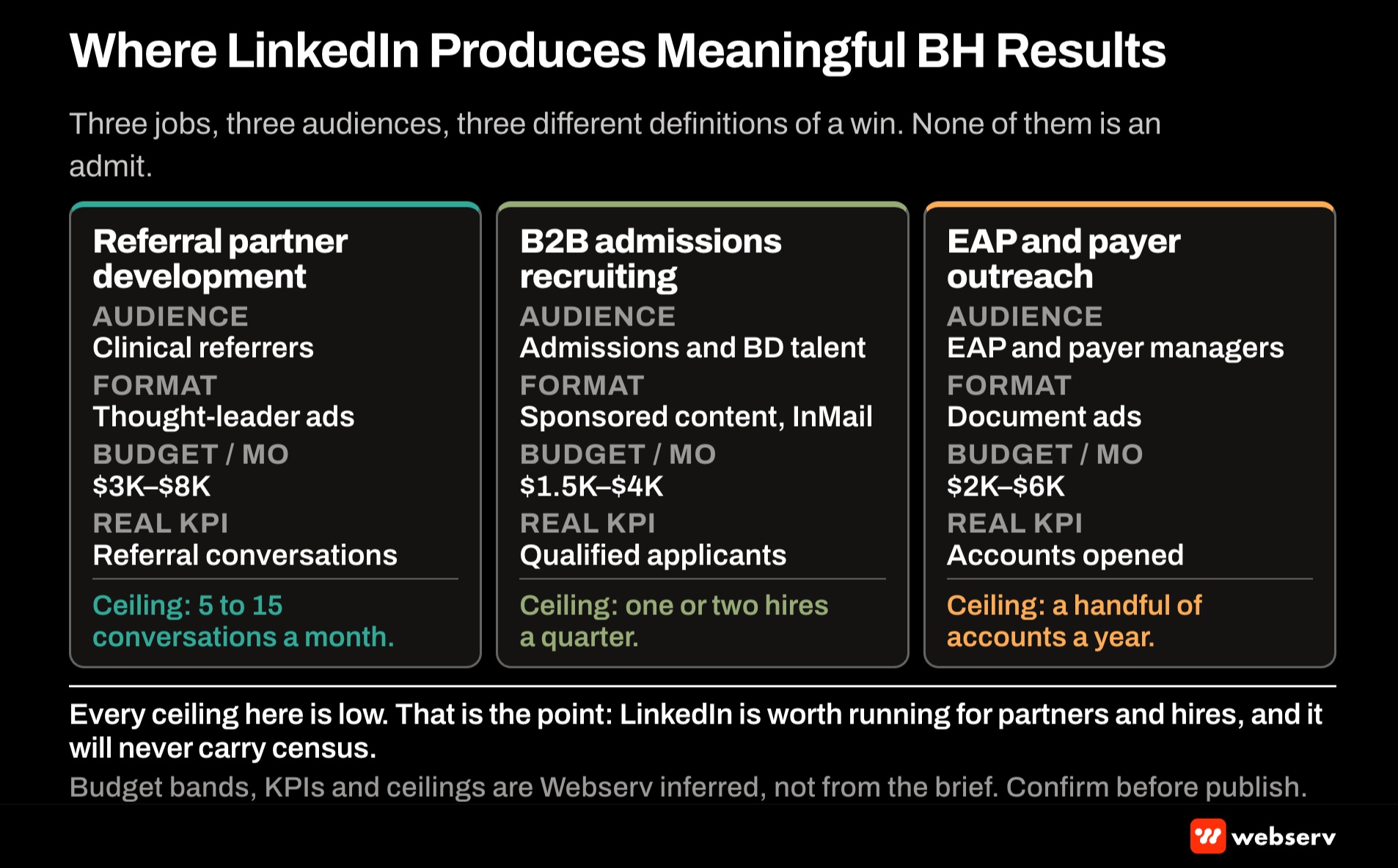
Use case 1: Referral partner development. LinkedIn is the specific platform where healthcare professionals (therapists, psychologists, psychiatrists, physicians, clinical directors) maintain professional profiles and engage with industry content. Referral partner development through LinkedIn produces professional relationships that convert to admit referrals over 12 to 36 month windows.
The specific value: referral partners produce admits at meaningfully higher revenue per admit than paid inquiries because referral traffic arrives pre-qualified. Facilities with strong LinkedIn-driven referral partner programs typically produce 20 to 40 additional referral admits per year per facility beyond baseline referral volume. Our referral partner marketing piece covers the broader program LinkedIn feeds.
Use case 2: B2B decision-maker targeting. BH-adjacent agencies and vendors selling services to treatment centers (marketing agencies, revenue cycle vendors, clinical software providers, EHR platforms) use LinkedIn to reach the specific decision-makers at treatment center facilities. This is exactly how Webserv itself uses LinkedIn.
The specific value: LinkedIn’s job title targeting reaches marketing directors, admissions VPs, CEOs, and CFOs at treatment centers with precision that other platforms cannot match. B2B intent state fits LinkedIn’s platform context.
Use cases that fail on LinkedIn. Family decision-maker targeting for treatment. Acute-need self-referral traffic. Insurance verification lead generation. Adolescent parent targeting. All four produce cost-per-inquiry 3 to 8x higher than Meta or Google because the intent state does not fit LinkedIn’s platform context.
Facilities running these use cases on LinkedIn typically conclude that “LinkedIn doesn’t work for BH” and abandon the platform. The specific fix: run LinkedIn only for the two use cases where it produces results, and skip the platform for the four use cases where it does not.
How Profound Treatment drove 31 admits and a 42% drop in cost per viable in one quarter
Broad match pivot, negative keyword management, and intake-level conversion tracking turned a fragmented paid strategy into a predictable admissions engine.
Read the case study →68 viable VOBs at $4,529 cost per viable
Audience targeting for referral partner development
Audience targeting for LinkedIn referral partner development uses job title targeting combined with geographic and company size filters.
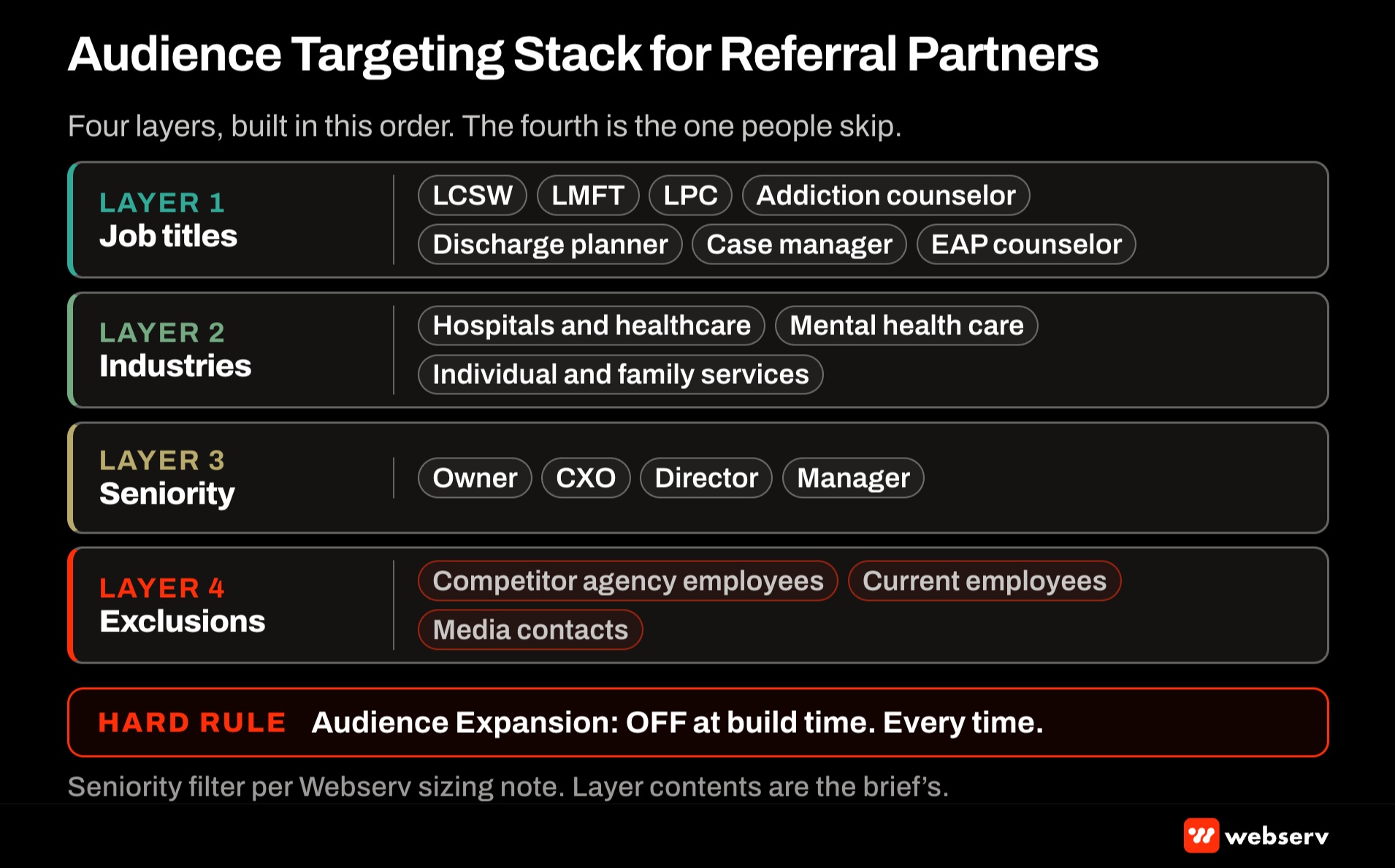
Job title targeting. Specific job titles that map to referral partner categories. “Therapist,” “psychologist,” “psychiatrist,” “clinical psychologist,” “counselor,” “clinical social worker,” “licensed professional counselor,” “marriage and family therapist.”
Physician-side referrals: “physician,” “primary care physician,” “family medicine physician,” “internal medicine physician,” “psychiatrist,” “addiction medicine physician.”
Institutional referrals: “clinical director,” “medical director,” “case management director,” “utilization management director,” “employee assistance program manager.”
Geographic targeting. Match to facility service area. Metro-level targeting typically works for facilities with regional service area. City-level or ZIP-based targeting works for facilities with tight local service area.
Company size targeting. Optional refinement for specific referral partner categories. Independent practice targeting (company size 1-10) reaches solo practitioners and small group practices. Group practice targeting (11-50) reaches mid-size clinical practices. Hospital or health system targeting (200+) reaches institutional referral sources.
Seniority targeting. For institutional referrals, seniority filter adds precision. Director-level, VP-level, and C-suite targeting reaches decision-makers rather than staff who may not have referral authority.
Interests and skills. Optional refinement. Specific clinical interests (addiction treatment, dual diagnosis, trauma-focused therapy, adolescent mental health) narrow to clinicians actively engaged with the relevant clinical area.
The specific audience sizing pattern for a single facility service area: 3,000 to 25,000 clinicians depending on metro size and specificity of targeting. Facilities in top-10 metros typically have 15,000+ addressable clinicians; facilities in smaller metros typically have 3,000 to 8,000.
The LinkedIn Ads BH program at a glance
2 vs 4
LinkedIn use cases that work versus use cases that fail for BH
$2-10K
Monthly LinkedIn spend range for facility referral partner development
3K-25K
Addressable clinicians per facility service area depending on metro size
12-36 mo
Attribution window for LinkedIn referral admits; short-window ROI misleads
Ad format selection for LinkedIn BH
LinkedIn ad format selection matters more than on other platforms because LinkedIn has meaningfully different engagement patterns per format.
Sponsored Content for thought leadership
Standard feed-based ad format. Works for original research distribution, clinical insight posts, industry commentary, and case study content.
Sponsored Content is the workhorse format for LinkedIn referral partner development. Original research from our original research methodology piece produces the specific content type that Sponsored Content distributes effectively.
Message Ads for direct outreach
LinkedIn’s inbox-native format for direct message outreach to specific audiences. Works for specific referral partner recruitment (invitation to educational events, personalized clinical referral introduction).
Message Ads produce higher click-through than Sponsored Content but face specific compliance considerations because the direct message format is more intrusive.
Document Ads for research distribution
LinkedIn’s document upload format that lets users read multi-page content inline without leaving LinkedIn. Works for original research reports, clinical case study collections, and comprehensive playbook content.
Document Ads typically produce meaningful engagement time because users can consume the content inline. High-value for research-heavy content strategy.
Event Ads for referral partner recruitment
LinkedIn’s event-native format for promoting live events (webinars, in-person events, conferences). Works for referral partner educational events, clinical case discussion series, and professional development events.
Event Ads produce the specific action (event registration) that supports downstream referral partner relationship development.
Video Ads for facility introduction
Video content introducing the facility, clinical team, and program approach. Works for facility awareness among referral partners who have not yet engaged with the facility.
Video Ads typically produce lower direct engagement than static formats on LinkedIn but produce meaningful awareness signal that supports subsequent Sponsored Content and Message Ads engagement.
Compliance considerations for LinkedIn BH
LinkedIn’s compliance framework differs from Meta and Google in specific ways that matter for BH advertising.
LegitScript certification is not required. LinkedIn does not require LegitScript certification for BH-adjacent advertising the way Google and Meta do. This reduces the certification overhead but does not remove BH-specific compliance considerations.
LinkedIn community guidelines apply. LinkedIn prohibits content that violates professional community standards. BH advertising that would work on other platforms may face LinkedIn review if the ad copy uses aggressive marketing language or claims that professionals would find inappropriate.
Professional audience compliance considerations. Ad copy targeting clinicians and healthcare professionals should use professional language rather than direct-to-consumer marketing language. Claims should reference specific clinical approaches and outcomes rather than emotional appeals or urgency-based framing.
HIPAA-adjacent considerations for referral partner outreach. Message Ads and other direct outreach formats should not reference specific patient scenarios or specific facility patients. Generic clinical topics and program-level information are safe.
Anti-kickback compliance. LinkedIn ad content promoting referral partnerships should not include any offer of compensation for referrals. Content should focus on clinical fit, program quality, and educational value rather than any compensation framing.
DO
- Uncheck Audience Expansion at build time on every new ad set — LinkedIn defaults it on and off-target delivery costs weeks and hundreds of dollars per campaign before anyone notices.
- Click “Duplicate ad” (not “Reuse”) when copying an ad — Reuse duplicates the same LinkedIn post uneditable; Duplicate makes an editable copy.
- Reach ad sets through the row-hover Edit button in the ad set list, not through direct edit URLs — LinkedIn’s ad-set edit URLs 404 as a known platform bug.
- Start with Sponsored Content for referral partner development; layer Document Ads, Event Ads, and Message Ads once Sponsored Content produces measurable engagement.
- Measure LinkedIn on 12 to 36 month referral admit attribution windows; short-window ROI on a referral-partner-development channel is misleading by design.
DON’T
- Run LinkedIn for family decision-maker or acute-need targeting — CPL runs 3-8x Meta and Google; the intent state does not fit the platform.
- Include compensation-for-referral framing in ad copy — anti-kickback exposure. Focus on clinical fit, program quality, and educational value.
- Reference specific patient scenarios or facility patients in Message Ads or direct outreach — HIPAA-adjacent exposure. Keep it program-level and generic.
- Ship direct-to-consumer marketing language to a clinician audience — LinkedIn’s professional community filters it out and community-guidelines review flags it.
- Judge LinkedIn on 30-60 day ROI and conclude “LinkedIn doesn’t work for BH” — that’s the diagnosis that kills the program before referral cycles complete.
Measurement patterns for LinkedIn BH
LinkedIn measurement patterns differ from Meta and Google because the specific downstream conversion is different.
Referral partner engagement metrics. LinkedIn measurement for referral partner development tracks specific engagement events rather than inquiry volume. Profile visits, connection requests, content engagement, and event registration all serve as meaningful engagement signals.
Downstream referral admit attribution. The specific ROI measurement for LinkedIn referral partner development is admit attribution over 12 to 36 month windows. Referral partners engaged through LinkedIn produce admits months or years after initial engagement, so LinkedIn ROI measurement requires long-window attribution.
The specific pattern: track referral partners engaged through LinkedIn in the CRM. Attribute admits from those referral partners back to LinkedIn as the specific engagement source. Measure cumulative admit contribution over 24 to 36 month windows.
B2B decision-maker measurement. For BH-adjacent agencies and vendors, LinkedIn measurement tracks specific B2B intent signals. Landing page visits, gated content downloads, contact form submissions, meeting bookings.
Webserv’s own LinkedIn program tracks landing page conversions plus meeting bookings through the HubSpot integration as the primary conversion measurement.
Cost-per-lead economics differ from Meta and Google. LinkedIn CPL for B2B decision-makers or professional referral partners typically runs $150 to $500 per lead. Meta and Google CPL for BH inquiry typically runs $50 to $200 per lead.
The specific comparison: LinkedIn CPL is higher but the lead quality is different. Professional or B2B leads convert to different downstream outcomes than family inquiry leads.
Common failure modes
Five patterns produce most of the LinkedIn Ads failures we audit in BH.
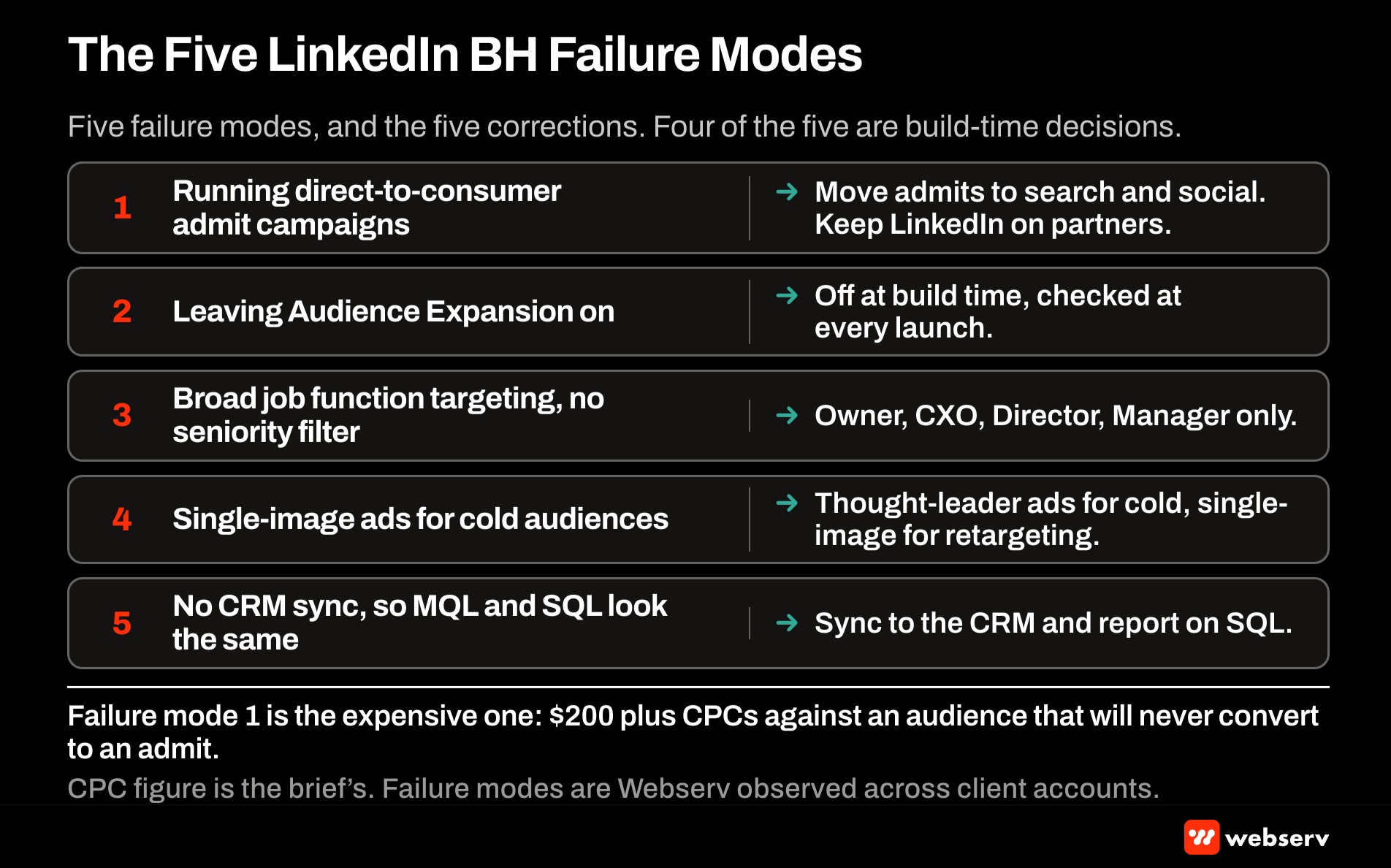
Failure mode 1: Family targeting on LinkedIn. Running LinkedIn campaigns targeting families researching treatment. Fix: shift to Meta (Meta Ads playbook) and Google (Google Ads playbook) for family targeting, use LinkedIn only for referral partner and B2B use cases.
Failure mode 2: Audience Expansion left on. LinkedIn Audience Expansion defaults to on for new ad sets and typically produces meaningful off-target delivery. Fix: uncheck Audience Expansion at build time on every new ad set.
Failure mode 3: Duplicate ad defaults to Reuse. LinkedIn’s ad duplicate function defaults to “Reuse” which produces the exact same post rather than an editable copy. Fix: always click “Duplicate ad” for editable copies.
Failure mode 4: Ad-set edit URLs 404. LinkedIn’s ad-set edit URLs frequently 404 due to platform bugs. Fix: open the ad set list view and use row-hover Edit button rather than direct URLs.
Failure mode 5: Measuring only short-window ROI. Measuring LinkedIn ROI on 30 to 60 day windows and concluding LinkedIn does not work. Fix: measure LinkedIn on 12 to 36 month windows appropriate for referral partner development cycle.
Most in-house teams hit a wall not because they lack knowledge, but because they lack bandwidth.
When you are ready to hand it off, Webserv has spent 9 years executing exactly this for treatment centers nationwide.
Frequently Asked Questions
How much should we spend on LinkedIn Ads for BH?
Between $2,000 and $10,000 per month for facilities running LinkedIn for referral partner development. Below $2,000 typically produces insufficient impression volume to reach the referral partner audience meaningfully.
Above $10,000 typically produces diminishing returns because the addressable clinician audience for a single facility service area saturates.
BH-adjacent agencies and vendors targeting B2B decision-makers typically spend $5,000 to $25,000 per month depending on total addressable market and sales cycle length.
How long does LinkedIn take to produce measurable results?
Between 6 and 18 months for referral partner development to produce measurable admit attribution. Between 3 and 9 months for B2B decision-maker programs to produce measurable pipeline.
Facilities that expect faster LinkedIn returns typically produce misleading conclusions about early performance. The right expectation: LinkedIn is a long-window investment for BH referral partner development.
Our referral partner marketing piece covers the 12 to 36 month build cycle LinkedIn engagement plugs into.
Can we run LinkedIn as a supplement to Meta and Google for family targeting?
Not effectively. LinkedIn family targeting produces cost-per-inquiry that materially exceeds Meta and Google. The budget is better spent on Meta (see our Meta Ads playbook) and Google (see our Google Ads playbook) for family targeting, with LinkedIn reserved for referral partner and B2B use cases.
The specific pattern that works: Meta and Google carry family-targeting spend, LinkedIn carries referral partner and B2B spend, and the two spend categories serve different downstream outcomes.
Facilities that push LinkedIn into family-targeting duty typically produce the cost-per-inquiry problem that convinces the team the channel is broken. It isn’t broken; it’s the wrong use case.
What ad format should we start with for LinkedIn referral partner development?
Sponsored Content with thought leadership and original research distribution. Sponsored Content is the workhorse format that produces sustainable engagement without the intrusiveness concerns Message Ads carry. Our original research piece covers the specific content type Sponsored Content distributes best.
Once Sponsored Content produces meaningful engagement patterns, layer in Document Ads for research distribution, Event Ads for referral partner recruitment events, and eventually Message Ads for specific direct outreach where the recipient has already engaged with the brand.
Facilities that lead with Message Ads before establishing a Sponsored Content engagement pattern typically produce meaningfully lower response rates because the direct message arrives cold.
How does LinkedIn interact with our organic LinkedIn strategy?
Paid LinkedIn amplifies the organic LinkedIn foundation. Facilities with strong organic LinkedIn (named clinician thought leadership posts, executive activity, facility content sharing) produce meaningfully better paid LinkedIn results than facilities running paid without organic foundation.
The specific pattern: build organic LinkedIn presence first (named clinician posting on 2 to 3 times per week cadence, executive posting on weekly cadence, facility page content sharing). Then add paid LinkedIn to amplify the organic content to specific target audiences.
Paid running without organic foundation typically produces higher CPL and lower engagement rates because the target audience lands on a facility page with no recent content signal.
How does LinkedIn interact with our referral partner marketing program overall?
LinkedIn is one channel in the broader referral partner program. In-person meetings, phone outreach, industry conference presence, and clinical case coordination all contribute to referral partner development alongside LinkedIn. Our referral partner marketing piece maps the full program.
The specific integration pattern: LinkedIn produces initial awareness and engagement with clinicians in the facility service area. In-person meetings and phone outreach convert LinkedIn-engaged clinicians into active referral partners. Clinical case coordination and ongoing communication maintain the relationships that produce sustained referral volume.
Facilities that treat LinkedIn as the only referral partner channel typically produce weaker referral programs than facilities integrating LinkedIn with other relationship-building activities.
What is the typical ROI for LinkedIn Ads in BH?
For facilities running LinkedIn correctly (referral partner or B2B focus): 3 to 8x return on ad spend over 24 to 36 month attribution windows. Referral admits produced through LinkedIn-developed relationships typically produce higher revenue per admit than paid channel admits, which supports the ROI multiple.
For facilities running LinkedIn incorrectly (family targeting): negative ROI. LinkedIn family CPL exceeds Meta and Google without producing any offsetting quality advantage.
The specific measurement discipline: attribute admits to referral partners over 24 to 36 month windows. Track LinkedIn engagement as the specific origin event for referral partners engaged through LinkedIn. Calculate admit revenue attribution against LinkedIn spend over the same window.
Keaton Nalle is the Director of Paid Admissions at Webserv, a digital marketing agency for treatment centers.