A treatment center hired me last spring to figure out why their content library was producing ranking but no AI citations. The site had 180 published blog posts.
The bylines on those posts read: “Editorial Team” on 120 of them, “Marketing” on 35, first names only on 18, and one piece bylined to a real licensed clinician with no credentials shown next to her name.
The site ranked well on a dozen commercial queries and earned zero AI Mode citations across 40 representative prompts. The pattern was not random.
Google’s reasoning engines and the LLM retrieval layer needed to know who wrote the content, what credentials backed it, and why those credentials qualified the author for the topic. The site told them none of that.
We rebuilt the author infrastructure over four weeks. We mapped 4 credentialed clinical contributors to the content they had actually informed. We wrote E-E-A-T-compliant bios for each one. We deployed Person schema with jobTitle, knowsAbout, alumniOf, and sameAs links to LinkedIn, ASAM, and state licensing records.
We added inline bylines with credentials, end-of-article author boxes with photos, and an author archive page for each contributor. Inside 90 days the site earned its first AI Mode citation, and inside 180 days the citation rate matched the organic ranking rate on the same queries.
The content had been good the whole time. The author signal had been missing.
Author bios are the most under-invested element of authority content in behavioral health in 2026. The retrieval layer weights author entity signal heavily for YMYL healthcare content, and the operators who write bios correctly produce defensible authority content that compounds across the cluster.
This piece covers what an E-E-A-T-compliant author bio actually looks like, the three tiers of bio deployment, and the specific elements that produce citation lift in the 2026 environment.
Key Takeaways
- Anonymous bylines (Editorial Team, Marketing, first-name-only) are a discount signal in the 2026 YMYL retrieval layer. Top-ranking YMYL pages routinely display detailed author credentials. The operators without them are competing on a different playing field.
- E-E-A-T-compliant author bios need eight specific elements: full name with credentials, years of relevant experience, educational background, professional society memberships, state licensure,
sameAslinks to verifiable profiles, photograph, and date of last review. - Three tiers of author bio deployment matter: inline byline (under the H1), end-of-article author box (fuller bio with photo and links), and author archive page (full profile with all bylined pieces and Person schema).
- Person schema with
knowsAbout,jobTitle,alumniOf, andsameAsproperties is the bridge between the visible bio and the AI reasoning engines’ source authority scoring. Sites without schema deployment lose most of the bio benefit. - Stock photos, missing dates, and unverifiable credentials are the three quickest signals that get a bio discounted. The retrieval layer increasingly distinguishes real author entities from cosmetic attribution.
What a behavioral health author bio actually needs
The 2026 standard for YMYL healthcare author bios is notably higher than the 2022 standard, as we covered in the healthcare content creation framework. Eight elements appear consistently across the bios that perform on both ranking and AI citation surfaces.
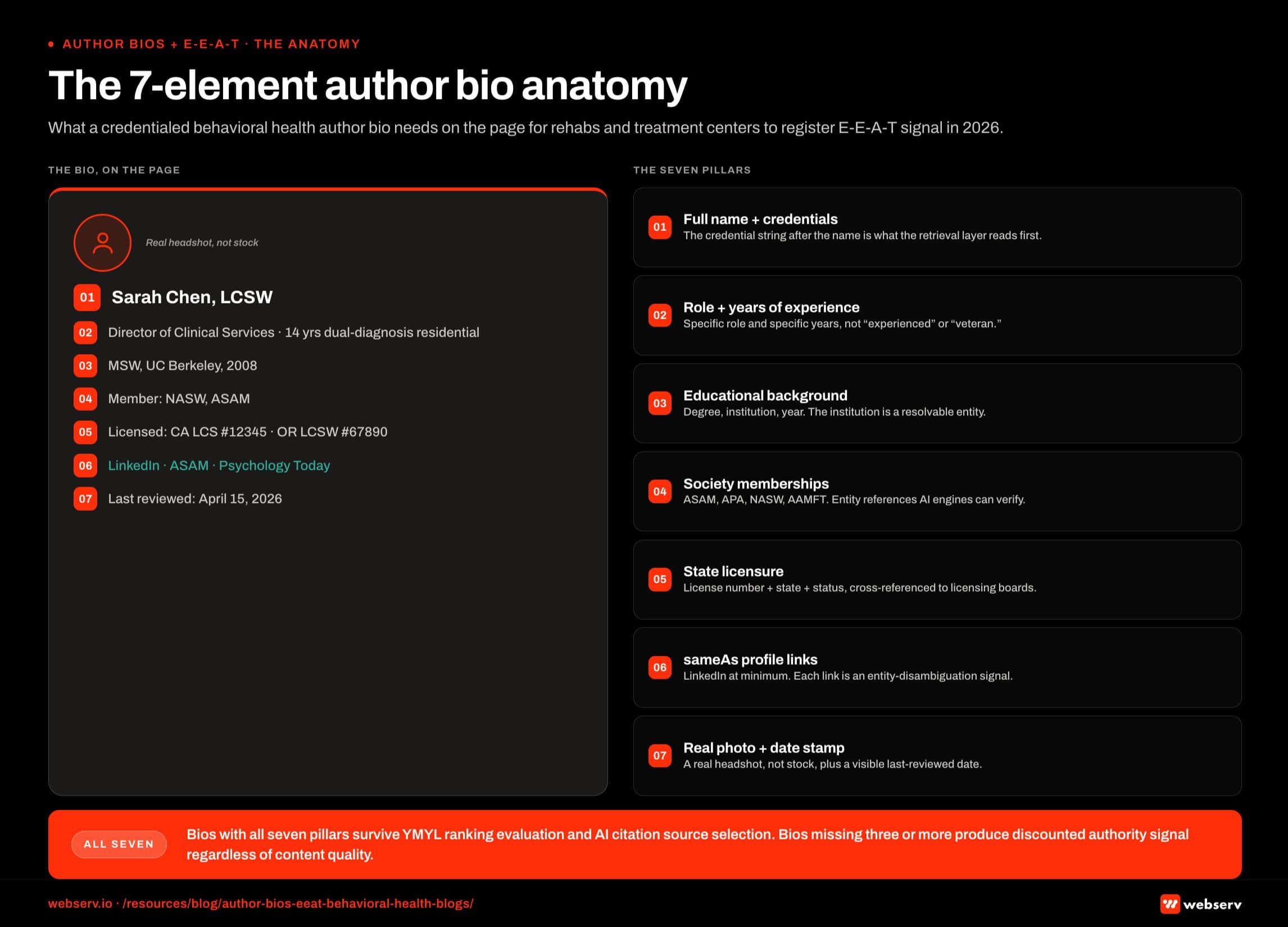 Infographic titled ‘The 7-element author bio anatomy’.
Full name with credentials. “Sarah Chen, LCSW” outperforms “Sarah” or “Dr. Sarah” or “Sarah from the team.” The credential string after the name is what the retrieval layer reads first. Missing it discounts the entire bio.
Years of relevant experience. Not “experienced” or “veteran.” Specific years tied to specific work: “14 years of clinical practice in dual-diagnosis residential treatment” reads as expert testimony. “Experienced clinician” reads as marketing copy. Specificity is the credential signal.
Educational background. Degrees plus institution and graduation year (when appropriate). “MSW, University of California Berkeley, 2008” carries more weight than “MSW.” The institution is part of the entity record the retrieval layer can resolve.
Professional society memberships. ASAM, AMA, APA, NASW, or AAMFT, whichever apply to the clinician’s discipline. These are entity references the AI reasoning engines can verify through external authority profiles. Memberships are also what sameAs properties link to.
State licensure. License number, state of licensure, current status. The retrieval layer can cross-reference state licensing boards to verify the credential is real and current. Operators who claim credentials without verifiable licensure are creating reputation exposure if the claim is challenged.
sameAs links to verifiable profiles. LinkedIn at minimum. Psychology Today, the state licensing board profile, the professional society listing, the author’s published research (Google Scholar, PubMed) where applicable. Each link is an entity disambiguation signal that strengthens the author’s Knowledge Graph entity record.
A real photograph. Stock photos are a discount signal. The image search layers that feed Google’s reasoning engines can identify stock imagery, and the retrieval models treat stock-photo bios as lower-confidence than real-photo bios. The photo does not need to be professionally shot. It needs to be a real person.
Date of last review. “Last reviewed: 2026-04-15” near the byline signals content freshness, which matters for the 13-week citation freshness window in AI search. Bios that have not been updated in 2 to 3 years also signal staleness on the author entity itself.
Bios that include all eight elements are the bios that survive both YMYL ranking evaluation and AI citation source selection. Bios missing 3 to 5 of the elements (the common pattern) produce discounted authority signal regardless of content quality.
The three tiers of bio deployment
Author bios should appear in three places, with different content depths at each tier. The combined deployment is what builds the author entity over time.
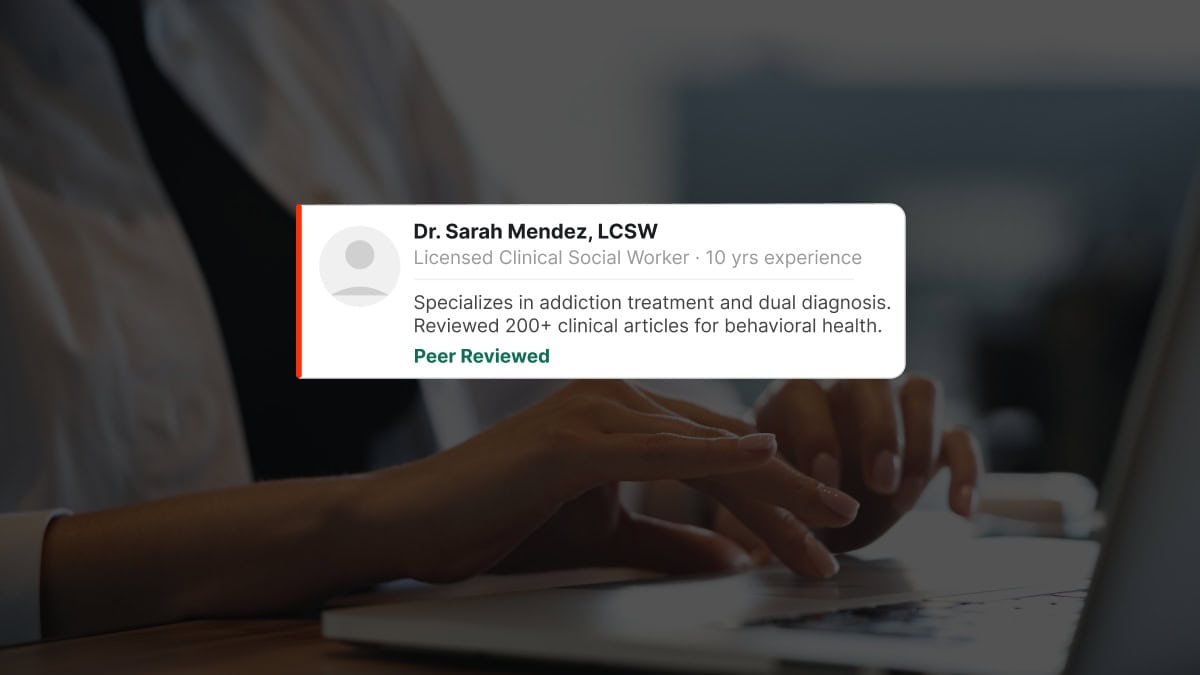
Tier 1: inline byline (every published piece). A short attribution under the H1 with name, credentials, role, and last-reviewed date. This is the credential signal the user sees first and the retrieval layer extracts on the first pass. Format example:
“By Sarah Chen, LCSW, Director of Clinical Services. Last reviewed: April 15, 2026.”
The inline byline should appear above the body content, after the H1 or article subhead. It should not appear at the bottom of the article only.
Tier 2: end-of-article author box. A fuller bio block at the end of the body content (before the FAQ section, or in some patterns between the FAQ and the CTA shortcode).
The author box includes the photograph, a 100 to 200 word bio, links to LinkedIn and professional society profiles, and a link to the author’s archive page on the site.
The author box is what the user reads to evaluate the author after reading the article. It is also where the Person schema deployment lives in most CMS implementations. Google Search Central’s helpful content guidance covers how E-E-A-T signals weight on YMYL pages.
Tier 3: author archive page. A dedicated URL on the site (typically /authors/sarah-chen/ or similar) that hosts the full bio, the photograph, the credential details, the schema, and a list of every piece the author has bylined.
The author archive page is where the entity SEO infrastructure for the author entity lives most thoroughly. It is also what the sameAs profiles can point back to as the author’s professional home on your site.
All three tiers need to be present for the author entity to compound. Sites that only have inline bylines (Tier 1) without author boxes (Tier 2) or archive pages (Tier 3) get partial authority lift. Sites that deploy all three see the lift compound across the cluster.
A working bio example, annotated
Here is what a deployed E-E-A-T-compliant author bio looks like in 2026, with the elements called out.
Inline byline (Tier 1):
“By Sarah Chen, LCSW, Director of Clinical Services. Last reviewed: April 15, 2026.”
End-of-article author box (Tier 2):
About the author
[photograph: real headshot, not stock]
“Sarah Chen, LCSW, is the Director of Clinical Services at [Facility Name] and has 14 years of clinical practice in dual-diagnosis residential treatment. She earned her MSW from the University of California Berkeley in 2008 and is licensed in California (LCS #12345) and Oregon (LCSW #67890). Sarah is a member of the National Association of Social Workers and the American Society of Addiction Medicine (ASAM), and her clinical work focuses on co-occurring trauma and substance use disorders in adult populations.”
[Connect on LinkedIn] [ASAM Profile] [Psychology Today Profile]
Read more articles by Sarah Chen →
Author archive page (Tier 3):
The archive page expands the author box bio to roughly 300 to 500 words, adds the educational background in full, lists all professional society memberships with their respective certifications, and includes a “Published on this site” section with every article Sarah has authored or reviewed.
It deploys the full Schema.org Person schema with jobTitle, knowsAbout for her specific clinical expertise areas, alumniOf for her education, and sameAs links to every authoritative external profile.
The three tiers carry different amounts of content but reinforce the same author entity. The retrieval models read them as a coherent signal.
“The content had been good the whole time. The author signal had been missing. Author bios are the most under-invested element of authority content in behavioral health in 2026.”
Preston Powell, Chief Executive Officer, Webserv
What gets bios discounted
MOST COMMON BIO FAILURE
Author bios that read like resume padding get quietly discounted by both Google and LLMs. The signals that trigger the discount: vague credentials without licensing state or license number, therapy specialties listed without a clinical framework attached, generic bios reused across ten posts with no author-specific context, and bios that name the author but skip the reviewer. Every one of these makes the E-E-A-T claim structurally weaker than a bare byline with a real LinkedIn link.
The common patterns that produce discounted author signal are visible across most BH operator sites I audit.
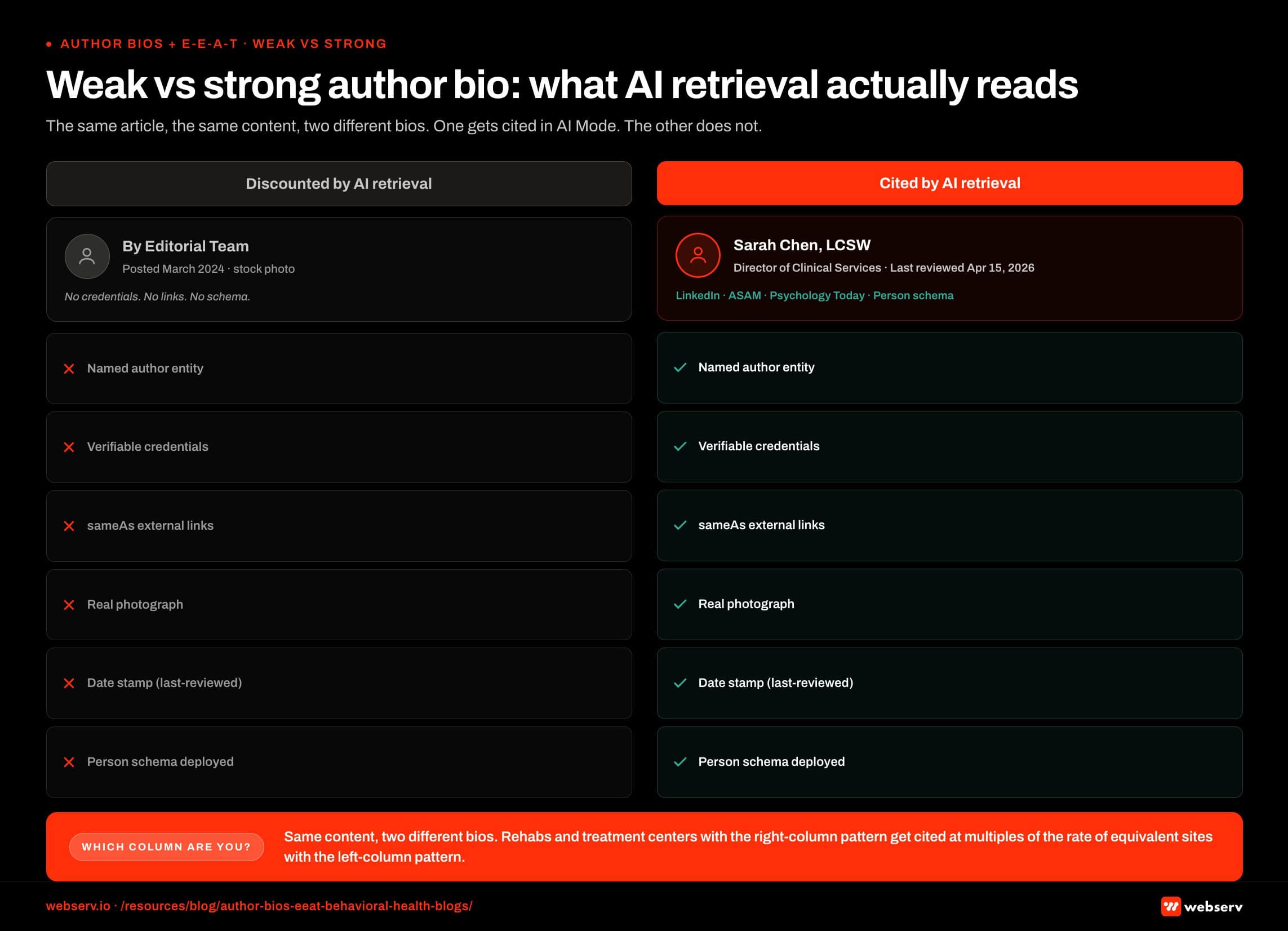 Infographic titled ‘Weak vs strong author bio: what AI retrieval actually reads’.
Anonymous attribution. “Editorial Team,” “Marketing,” “Admissions Team,” “Our Staff.” Anonymous bylines are a 2026 discount signal because the retrieval layer cannot resolve them to verifiable identities. The healthcare blog and article writing standards we recommend never use anonymous attribution on YMYL content.
Even if the content is genuinely written by a credentialed clinician, the anonymous attribution loses the credential benefit.
First-name-only attribution. “By Sarah” or “From the desk of Mike” reads casually and works against the YMYL credibility bar. The retrieval models cannot disambiguate first-name-only bylines without a last name and credentials to anchor the entity.
Credentials claimed but not verifiable. “Dr.” in front of a name without context, or “Certified Recovery Specialist” without a specific certifying body, or “Medical Director” without the medical license details.
The retrieval layer (and human readers evaluating the site) cannot verify these claims, which makes them weaker than no claim at all.
Stock photo headshots. Image-search models can identify stock photography. A bio with a Getty Images headshot reads as marketing fabrication even if the named person is real. Use real photos. They do not need to be polished.
Missing dates. Bios without a publication date or last-reviewed date signal staleness. The 13-week citation freshness window AI search rewards depends on visible date stamps. Bios that hide them get treated as undated, which defaults to stale.
Marketing language in the bio. “Passionate about helping families on their healing journey.” This kind of language is the giveaway that the bio was written by a marketing team rather than the actual clinician. It reads as filler to the retrieval layer and as cosmetic to human evaluators.
Replace with operational specificity: “Has worked with 600+ families on residential admission decisions over 14 years.”
No social proof links. Bios without LinkedIn, professional society, or licensing verification links are bios the retrieval layer cannot disambiguate to a real entity. Even one strong external link (LinkedIn) is much better than zero.
Operators who eliminate these six patterns and deploy the eight elements above produce bios that survive YMYL ranking evaluation and AI citation source selection. The lift compounds because the author entity strengthens with every additional piece bylined under the corrected pattern.
How SoCal Sunrise generated 85 admissions and 2,297% ROI from SEO in 6 months
A ground-up SEO rebuild using the Pathfinder Parents Methodology turned an invisible online presence into a top-ranking admissions engine.
Read the case study →85 admits and 3,152 leads attributed to organic
How to write the bio when the clinician is busy
The constraint operators usually raise is that clinicians do not have time to write their own bios. The fix is structural.
Source from existing materials. Most clinicians already have a bio on LinkedIn, on a professional society profile, on their state licensing application, and possibly on a prior employer’s site. The same approach used by top healthcare SEO agencies saves clinician hours while maintaining accuracy.
The content team can pull from these sources and edit into the E-E-A-T format. Send the draft to the clinician for review and sign-off rather than asking them to write from scratch.
Use a structured interview. A 20-minute interview covering education, licensure, years of practice, clinical specialties, and professional memberships produces enough material for a complete bio at all three tiers. The content team writes the bio from the interview transcript. The clinician reviews and approves.
Update incrementally. A first-pass bio with all eight elements at the basic level is better than waiting for a perfect bio.
Get the credential string right (name + credentials + role), get a real photo, get one external profile link, deploy the schema, and add depth over time as the clinician contributes more content.
Lock in the sign-off process. Each clinical author should have a documented sign-off on their published bio. This is a compliance requirement (the credentials claimed need to match what the clinician actually holds) and a reputation requirement (the clinician needs to be comfortable with what is published under their name).
The sign-off should be documented in writing and stored.
The operating cost of running E-E-A-T author infrastructure for 3 to 5 clinical contributors is roughly 8 to 16 hours of clinician time across the year, plus 30 to 60 hours of content team time for the initial setup and ongoing maintenance.
This is much less effort than the content investment required to produce the articles the bios appear on.
Where bios fit in the broader content architecture
Author bios do not work in isolation. They are part of a layered architecture that includes the cluster-level content, the technical SEO foundation, and the entity signal layer.
Cluster fit. Each clinical author should be the bylined expert on the cluster topics where they have genuine expertise. The Director of Clinical Services bylines the residential treatment cluster pieces. The lead therapist for adolescent programs bylines the adolescent cluster. The medical director bylines the MAT and detox cluster.
Cluster fit reinforces the credential signal because the author entity is consistently associated with the topical authority. The keyword strategy work makes this matching tractable by mapping topics to the right credentialed voice.
Technical SEO deployment. Person schema, sameAs properties, and author archive pages need a clean technical foundation. The technical SEO work that powers schema deployment across the site is the substrate this layer sits on. Schema that does not validate or that conflicts between page types produces partial author signal.
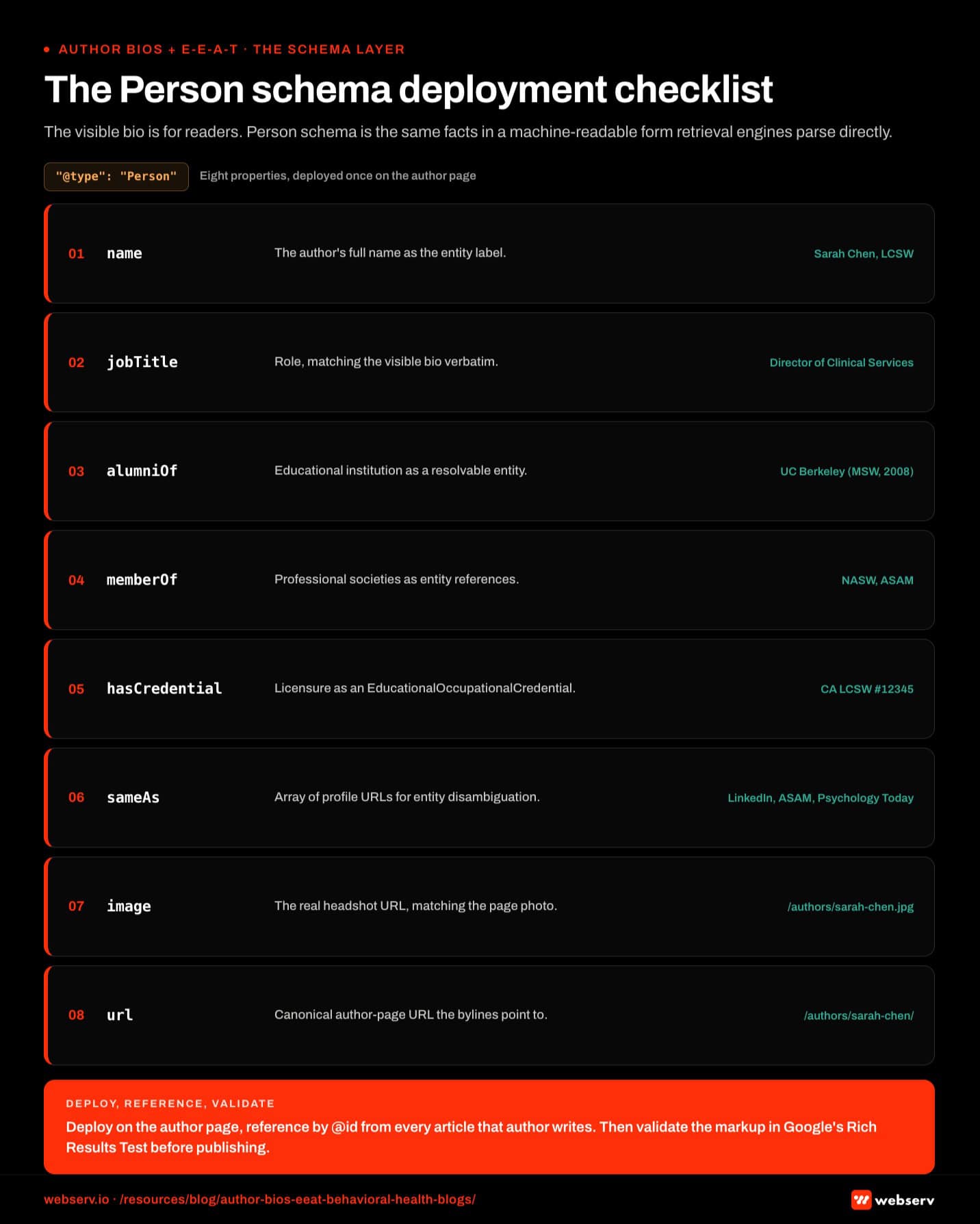 Infographic titled ‘The Person schema deployment checklist’.
Quote attribution within content. The clinician-quote moat framework covers the broader pattern of attributing specific claims and observations to credentialed clinicians inside the article body. The bio at the top and the end of the piece is the trust anchor. The embedded quotes throughout reinforce it. Both layers compound.
The local SEO connection. For multi-location operators, author bios that reference the specific facility location where the clinician practices feed the local SEO signal for that geography.
The named clinician working at the Tucson facility appears as a credentialed local expert, which lifts the local pack visibility on top of the YMYL authority signal.
The combined architecture is what produces the durable authority position. Operators investing in the bio layer without the surrounding architecture see partial lift. Operators investing in all four layers see compounding lift over 12 to 24 months. The broader AI Overviews and ChatGPT citation environment rewards this stack consistently.
Frequently Asked Questions
How many clinical authors should we have published bios for?
For most BH operators, 3 to 6 clinical contributors with published bios produces enough author entity coverage for the cluster. The contributors should represent the major service lines: residential, outpatient, MAT, dual diagnosis.
A solo clinical author (one person bylining everything) is fragile because the author entity is concentrated in one credential record. 3 to 6 contributors diversify the entity stack. Operators with smaller facilities can run 2 to 3 contributors. Larger multi-location operators with multiple distinct clinical specialties often run 6 to 10.
The hours commitment per author is roughly 4 to 12 hours per year for bio maintenance plus whatever hours they contribute to content production. Most clinicians can absorb this without breaking their primary clinical work.
What if our facility is small and we only have one credentialed clinician?
Run the bio for that one clinician with the full eight elements at all three tiers (inline byline, end-of-article box, author archive page). This is much better than running the same content under “Editorial Team” attribution even if it is concentrated in one author.
For supplementary content that the single clinician cannot reasonably author (operational pieces, insurance explainers, family resources), use an “edited by” or “reviewed by” attribution to the credentialed clinician with a non-clinical writer as the bylined author. The clinical reviewer’s credentials still appear and still produce E-E-A-T signal.
Single-clinician operations sometimes also bring in an external clinical advisor (a contracted reviewer) to expand the credential stack. The external advisor signs a BAA where appropriate, has their bio published with full E-E-A-T elements, and provides ongoing review and contribution.
Do AI search engines actually read author bios?
Yes, and the weighting has increased sharply in 2026. Google’s reasoning engines, ChatGPT Search, and Perplexity all use author entity recognition during source selection. The bio’s role is to provide the entity signal the retrieval layer extracts.
Bios with full credentials, schema, and sameAs links produce stronger entity records than bios without. Sites with credentialed bio infrastructure get cited at multiples of the rate of equivalent sites with anonymous attribution, even when the underlying content quality is comparable.
The implication is that bio investment is one of the highest-ROI AI search optimization moves available. Most operators have not made it because the bio work feels editorial rather than technical. The 2026 retrieval environment treats it as a primary signal regardless.
How often should we update author bios?
Annual at minimum. Quarterly is better for active clinical authors who are publishing frequently. The update should refresh the “last reviewed” date (which signals freshness to the retrieval models), add any new credentials or certifications earned in the period, update the years-of-experience number, and refresh the topical expertise statements if the clinician’s focus has shifted.
For authors who have moved between roles or facilities, the bio update should reflect the current role accurately. Bios listing prior roles as current produce credibility issues if a user checks LinkedIn or the state licensing board and finds different information.
The maintenance cycle should be calendared. Most operators set a quarterly review with the content team and a documented annual sign-off with each clinical author. The schema deployment usually updates automatically through the CMS once the visible bio is updated. The author archive page may need a manual refresh.
What is the difference between an author bio and a contributor or reviewer attribution?
An author bio attributes the writing of the piece to a named person. A reviewer attribution credits a credentialed person with reviewing and approving the content without claiming they wrote it. Both produce E-E-A-T signal but the weighting differs.
The strongest pattern for BH is when the credentialed clinician is both author and reviewer (they wrote it and signed off on it). The second-strongest is when a non-clinical writer drafts and a credentialed clinician reviews. Both names appear with the reviewer’s credentials prominent. The weakest is when the byline is anonymous and the reviewer is implied but not named.
For most BH operators, the right operational pattern is a non-clinical writer drafting based on clinician interviews (the human-in-the-loop model) with the clinician credited as reviewer or co-author. The dual byline carries the credential signal while keeping production economics workable.
Should our agency or content team write the bios for us?
The bio content can be drafted by the content team, but the credentialed clinician must review and sign off before publication. The credentials, years of experience, educational details, and licensure information have to be accurate to the clinician’s actual record. Mistakes in any of these elements create both reputation exposure and compliance exposure.
The right workflow is: content team drafts based on a structured interview or existing professional materials (LinkedIn, prior bios, licensing records), clinician reviews for accuracy, content team incorporates edits, clinician signs off in writing, content team deploys with schema.
Agencies that write bios without clinician review produce content the operator cannot stand behind if challenged. Operators who skip the review step often discover errors months later when an external audit or a journalist’s fact-check surfaces the mismatch. The two-hour review per author per year is cheap insurance.
The perspective in this article comes from 9 years working exclusively inside behavioral health.
We are a team built by people in recovery who understand that behind every admission is someone asking for help. If that resonates, get to know us.
Trevor Gage is the Director of Earned & Owned Media at Webserv, where he leads SEO, content strategy, and organic acquisition for behavioral health treatment centers. He has overseen audits of more than 200 behavioral health sites and writes about the technical and editorial SEO standards Webserv applies to client work.