The average treatment center spends $30,000 to $80,000 a month on Meta paid social and runs three to five ad creatives behind it. Meta’s own guidance tells advertisers to diversify their creative so the algorithm has genuinely different ads to choose from. The math is broken before the account even launches.
This is not a creative quality problem. The creatives most rehab accounts ship are technically fine. The problem is volume. The algorithm is starving and the operator does not know it because the dashboard does not tell them.
The dashboard tells them their CPL is $180. It does not tell them that Meta would have given them $120 CPL with three times more creative variants in the same account.
Most rehab marketing budgets are 95% media spend and 5% creative production. The math says it should be closer to 80/20. Operators who fix that ratio win the next 12 months because Meta’s algorithm rewards creative diversity now more than it rewards targeting cleverness.
Mitch Marowitz, Director of Paid Admissions, Webserv
Key Takeaways
- Meta’s Advantage+ system works best with a steady supply of genuinely different creatives, and Meta’s own guidance recommends creative diversification. The average rehab account runs 3 to 5 creatives for six months and concludes “Meta is broken for rehab” when CPL trends up.
- The constraint stack (HIPAA, Meta’s personal attributes policy, Healthcare & Medicines policy) makes creative variation MORE important, not less. The lever set is smaller, so each remaining lever is worth more — under-investment in creative compounds against the constraints.
- Reels and Stories are vertical placements, and much of Meta’s inventory is now vertical. Our working mix, by share of active variants, is 50-60% vertical video (Reels included), 25-35% static, and 10-15% carousel. Operators still producing primarily 1:1 or 16:9 creative are losing inventory share by default.
- The right creative-to-media ratio is 15-20% of total Meta spend. A treatment center spending $40K/month on media should be spending $6K-$8K/month on creative production. Most spend $1,500/quarter and wonder why CPL drifts up.
- Stop reporting account-level CPL. Track hook rate (3-second views/impressions), hold rate (75% views/3-second views), and cost per private-policy VOB by creative variant. The variant with the lowest cost per outcome is the variant Meta should be scaling.
This article is how we fix it. It sits inside our guide to behavioral health marketing, and the strategy layer above it is in our creative strategy guide for rehab marketing.
The under-investment problem, what Meta’s algorithm actually needs in 2026, and the creative testing framework. Format-specific guidance for static, video, carousel, and Reels.
What works specifically for rehab creative and what HIPAA and Meta’s personal attributes policy actually allow. How to budget for creative against media spend, and how to measure whether the creative is doing its job.
A few audit observations before we get into the playbook. We audit a lot of rehab Meta accounts. The most common pattern: media budget at $40,000/month, creative production budget at $1,500/quarter. The same three to five ads run for six months.
The CPL trends up. The operator concludes that “Meta is broken for rehab.” Meta is not broken. The account has run out of creative variation and Meta’s Advantage+ system has nothing new to test against.
Why creative is the most under-invested line in rehab paid social
Three reasons operators systematically under-invest in Meta creative for rehab. None of them are correct in 2026.
The “constraints make creative not matter” trap. HIPAA limits testimonials. Meta’s personal attributes policy limits creative framing. The Healthcare and Medicines policy limits headlines. Operators look at the constraint stack and conclude that creative variation does not have room to operate.
The conclusion is wrong. The constraints make creative variation more important, not less, because the lever set is smaller and each remaining lever is more valuable.
The “creative is a one-time spend” assumption. Most agencies sell creative as a setup deliverable. Five ads at launch, then the agency moves on.
Meta doesn’t publish a weekly variant number, but Advantage+ keeps rotating toward fresh creative, so the pipeline has to keep feeding it. Operators who treat creative as a one-time spend are starving the algorithm by Month 2 of the engagement. Our 18 Meta ads tactics for rehabs shows where creative volume fits in the rest of the account.
The “we tried a video once” miscalibration. A treatment center tests one vertical video, sees mixed results, and concludes that “video does not work for our audience.” This is a sample size problem, not a video problem.
Meta doesn’t declare winners for you. Our working rule is 7 to 10 days or 100+ conversions per variant before calling one. A single test on a single video tells the operator almost nothing.
All three of these have a common root: operators are buying creative the way they bought it in 2019 and the platform changed underneath them. The 2026 version of Meta paid social is a creative volume game with a media-buying layer on top. Most rehab accounts have it inverted.
What Meta’s algorithm actually needs in 2026
Meta has rebuilt the Advantage+ system around an internal AI called Andromeda that pulls creative concepts from a much larger pool than the legacy ad auction did. The implications for operators:
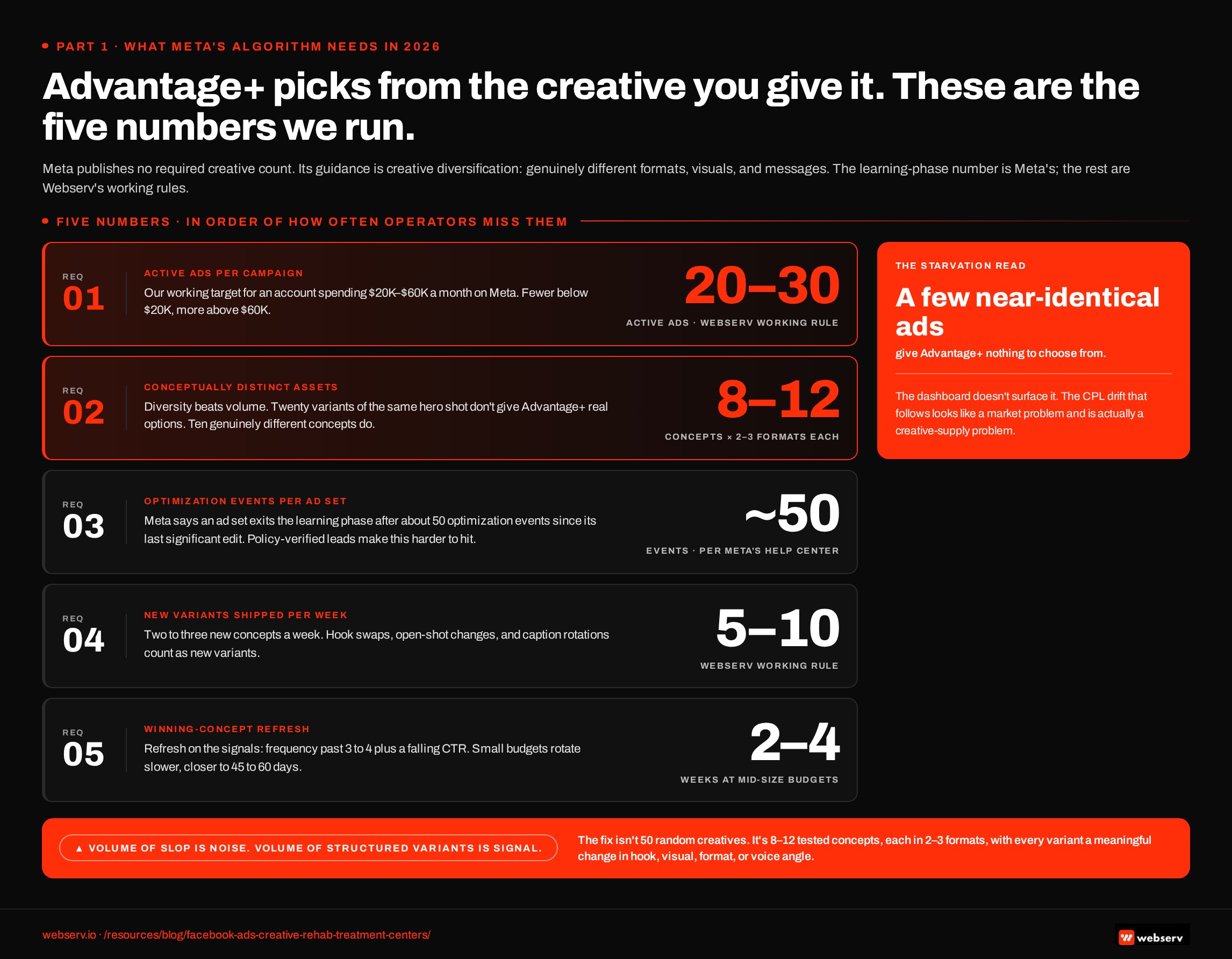
Enough genuinely different creatives per Advantage+ campaign. Meta doesn’t publish a minimum count. Its creative diversification guidance asks for ads that differ in format, visual, and message, not near-copies. Our working target for most BH operators is 20 to 30 active variants at any given time.
10 to 15 conceptually distinct assets. Creative diversity matters more than creative volume. Twenty variants of the same hero shot with different copy do not feed Andromeda. Ten genuinely different concepts (different framing, different speaker, different visual context, different value proposition emphasis) do.
About 50 optimization events per week. Meta says an ad set exits the learning phase after about 50 optimization events since its last significant edit, which in practice means roughly 50 a week. For a BH operator targeting form fills, that is about 50 form fills weekly. For an operator targeting policy-verified leads upstream, the threshold gets harder to hit — the full mechanics of upstream verification optimization are in our VOB explainer.
5 to 10 new variants per week. Top-performing accounts run a continuous creative pipeline. The variants do not need to be brand-new productions. Swapping hooks, changing the open shot, varying the caption hierarchy, and rotating the speaker on a talking-head asset all qualify as variants Meta reads as new Entity IDs.
Refresh winning concepts every 2 to 4 weeks. Even winning creative fatigues. Operators who let a winning ad run six months are paying creative-fatigue premiums on top of their CPCs.
If your account currently has five creatives and you launched them four months ago, you are running a 2019 playbook in a 2026 environment. The fix is volume and refresh discipline, not better targeting.
The creative testing framework for rehab
Here is how we run creative testing inside Webserv accounts. The framework is opinionated and Mitch-tested. Other approaches work. This one consistently produces lower cost per private-policy VOB inside BH accounts.
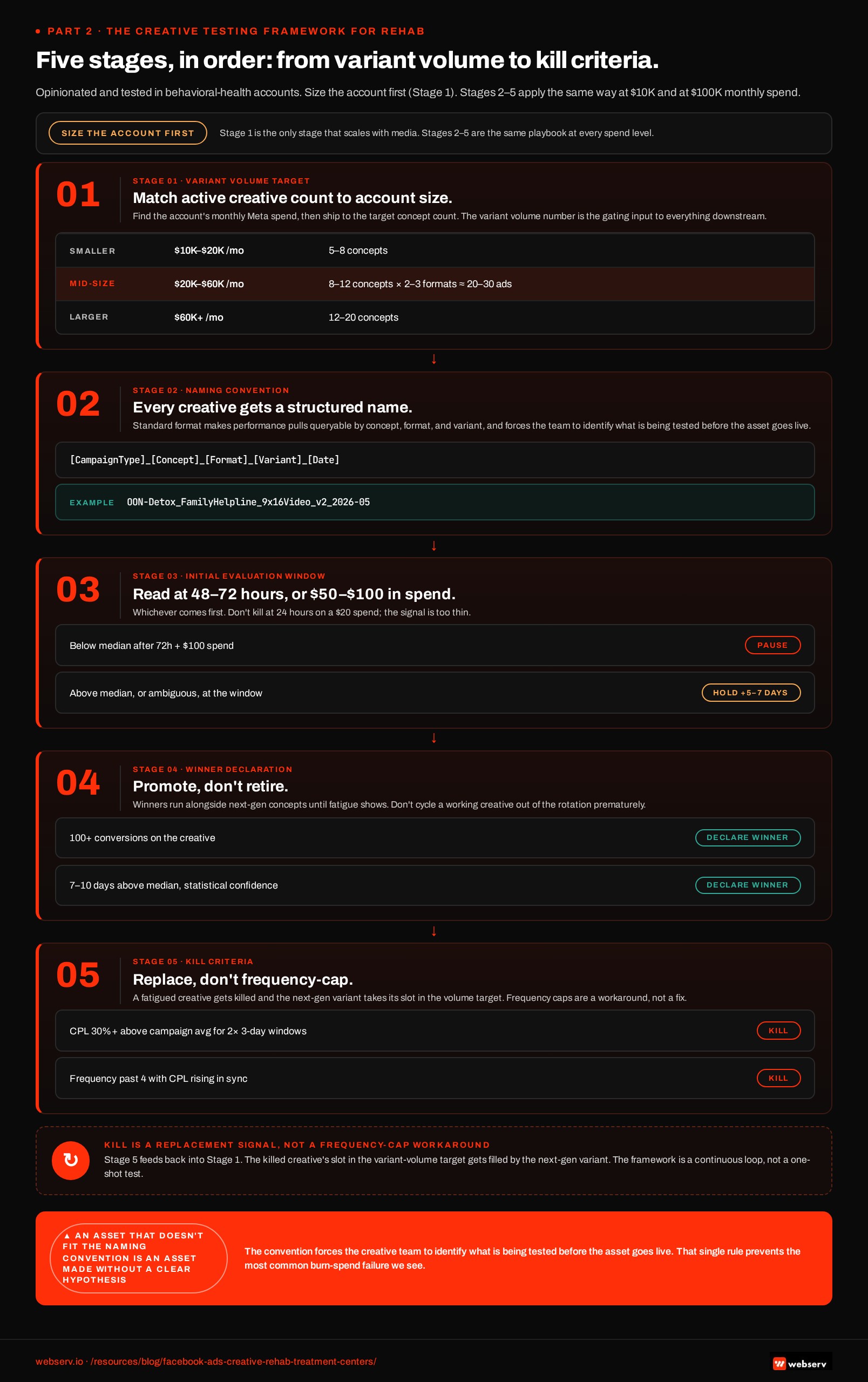
Variant volume target
Our standing target for an account spending $20K to $60K a month on Meta media is 8 to 12 distinct creative concepts in active rotation at any time. Each concept exists in 2 to 3 format variants (static, vertical video, carousel). That puts the total at roughly 20 to 30 active ads per campaign.
For accounts spending $10K to $20K a month, the target is 5 to 8 distinct concepts. Below that, Advantage+ does not have enough to test against.
For accounts spending $60K or more a month, the target is 12 to 20 distinct concepts. The upper end approaches diminishing returns but the additional variants act as creative-fatigue insurance.
Naming convention
Every creative gets a structured name. The format we use:
[CampaignType]_[Concept]_[Format]_[Variant]_[Date]
Example: OON-Detox_FamilyHelpline_9x16Video_v2_2026-05
The naming convention does two things. It makes performance pulls in Ads Manager queryable by concept, format, and variant. And it forces the creative team to identify what is being tested before the asset goes live. An asset that does not fit a naming convention is an asset that was made without a clear hypothesis.
Initial evaluation window
A new creative runs for 48 to 72 hours or $50 to $100 in spend before the first read. That window is enough to identify clear underperformers without burning budget on creative that the algorithm has already de-prioritized.
A creative that is below median performance after 72 hours and $100 in spend gets paused. A creative that is above median or genuinely ambiguous gets another 5 to 7 days to declare itself.
Winner declaration
A creative declares itself a winner when it has produced 100+ conversions OR has run 7 to 10 days at above-median performance with statistical confidence. Most BH accounts do not have the volume to hit the 100-conversion bar quickly. The 7 to 10 day bar is the operational fallback.
Winners get promoted to higher-spend share. They do not get retired. They run alongside the next concept generation until fatigue starts to show.
Kill criteria
A creative gets killed when CPL trends 30%+ above the campaign average for two consecutive 3-day windows. A creative also gets killed if frequency exceeds 4.0 on a single audience and CPL is rising in sync with frequency increase.
That pattern is creative fatigue, and the right response is replacement, not a frequency-cap workaround.
Format-specific guidance for rehab
Reels and Stories are vertical-first placements, and they make up a large share of Meta’s inventory. Operators who are still producing primarily 1:1 or 16:9 creative are losing inventory share by default. Here is the format mix that works.
Static images
Static still works in rehab paid social, but its share of our working mix is 25% to 35%. Static is best for:
• Insurance verification calls to action (“In-network with Aetna, BCBS, Cigna. Free verification.”)
• Joint Commission and accreditation signal
• Confidentiality-forward framing (“100% confidential. Speak with an admissions counselor.”)
• Single-message offers (free family assessment, 24/7 admissions, same-day intake)
Static creative needs strong contrast, mobile-first composition, and trust signals visible in the thumb-stop region (the top third of the image when viewed on a phone). Avoid stock photography that looks like every other rehab ad. The “diverse hand-holding circle on a beach” stock shot is dead.
Vertical video (9:16)
The primary 2026 format, built for Reels and Stories. Vertical video should make up 50% to 60% of the active creative mix for most BH accounts. The format works for:
• Family member testimonials (HIPAA-compliant, with proper consent)
• Clinical staff explainers (medical director, admissions counselor)
• Facility tours (real footage, not stock)
• Process walkthroughs (“Here is what happens when you call our admissions line”)
• Insurance education (“Here’s how out-of-network verification actually works”)
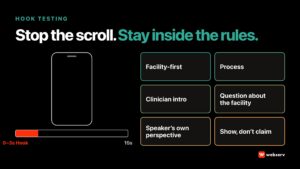
The first 2 to 3 seconds determine scroll-stop rate. Front-load the strongest visual or claim before any branding appears. Many people scroll with the sound off, so captions are mandatory. Burn captions into the video or use Meta’s auto-captioning, but verify the captions are readable on a phone screen.
Carousel
Carousel is the most under-used format in rehab paid social. The format works for:
• Treatment journey walkthroughs (panel 1: assessment, panel 2: detox, panel 3: residential, panel 4: aftercare)
• Levels-of-care explainers (one panel per level)
• Insurance comparison (“These carriers cover residential. These cover IOP.”)
• Frequently asked questions (one Q&A per panel)
Carousel ads tend to produce lower CPMs and longer dwell times than single-image ads. They are a particularly good fit for educational content that does not need to fit in a single hero shot.
Reels and Stories
Reels are 9:16 vertical video, 15 to 60 seconds, audio-forward. Reels are a different animal from in-feed vertical video. The Reels audience is in entertainment-consumption mode. The ads that work in feed often do not work in Reels.
For BH specifically, Reels work best with:
• Audio-driven framing (the speaker leading with voice rather than text)
• Native-style content (the ad does not look like an ad)
• Authentic shooting style (phone-camera footage outperforms studio production)
• Short hooks (“Here is what happens in the first 24 hours after you call.”)
Reels count toward the 50% to 60% vertical video share. Below $20K a month in Meta spend, a separate Reels cut is optional.
What works specifically for rehab creative
After running paid social for behavioral health for nearly a decade, here is the creative-direction shortlist that consistently outperforms within the policy constraints. The headline-language patterns connect directly to our compliant ad headlines guide.
Facility and process framing. Families are often the ones researching, but the ad can’t say so. Meta’s personal attributes policy bars ads that imply the viewer’s condition or a family member’s, so “Are you watching your son struggle?” and “When your son tells you he needs help” both fail. “What the first call to our admissions team covers” works.
Practical next-step information about the program, rather than language about the viewer.
Real clinical leadership on camera. Treatment centers with a credentialed medical director who is willing to be on camera have a creative advantage other centers cannot replicate. A 30-second talking-head explainer from the medical director outperforms stock-photo creative consistently.
The credential layer (Dr., LMFT, PhD) and the named person create trust signals Meta’s algorithm and the viewer both reward.
Real facility tours. A 45-second vertical tour of the actual facility, shot on a phone, with the admissions counselor walking through the building, beats a polished studio production with stock imagery. Authentic environment cues (real beds, real kitchen, real outdoor space) build trust at conversion. Stock imagery does the opposite.
Process explanations. “What happens when you call.” “How insurance verification actually works.” “What the first 24 hours of detox feels like.” These video explainers serve the family member’s actual question, which is process anxiety. Most rehab creative addresses brand awareness. Process explainers convert better because they answer the question the viewer is asking when they scroll past.
Confidentiality emphasis. A short creative element that explicitly addresses confidentiality concerns (“Your call is private. We do not contact employers, insurance, or family members without your permission.”) earns conversions from prospects who would not have called otherwise. Many family members hesitate because they assume the call is not confidential. Saying so removes the hesitation.
Insurance verification calls to action. “Verify your insurance in 5 minutes.” “In-network with [carrier list].” “Out-of-network insurance accepted.” The insurance question is the most common reason families do not call. Addressing it directly in creative converts.
What to avoid
The HIPAA, Meta policy, and FTC overlap produces a specific list of creative anti-patterns. Each one fails for a different reason. The underlying policy frame is in Meta’s Health & Wellness ads policy, and the broader compliance posture is in our HIPAA-compliant Facebook ads playbook.
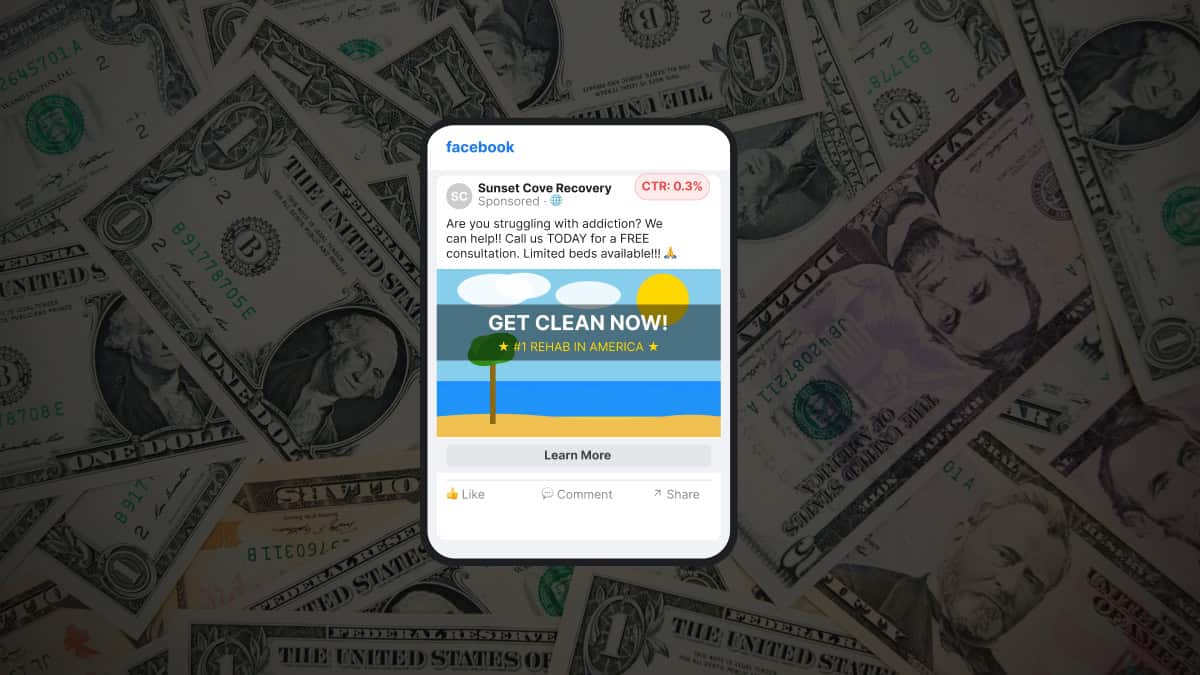
Second-person diagnostic language. “Are you struggling with addiction?” “Do you have a drinking problem?” “Are you addicted to opioids?” Each one asserts or implies the viewer’s condition, which Meta’s personal attributes policy prohibits. Reframe around the facility or the process.
Direct medical condition references in headlines. “Heroin addiction treatment” in a headline gets flagged more often than “specialized residential treatment for opioid use disorder.” The clinical synonym tends to pass review where the direct condition name fails.
Before-and-after imagery. High risk. Transformation imagery implies a health outcome and invites the outcome-claim scrutiny the FTC and Meta’s health ad standards apply. Even with consent, skip it.
Unverified outcome claims. Per the FTC’s health products compliance guidance, health claims need competent and reliable scientific evidence, and the FTC has already acted against deceptive SUD treatment advertising, including a $1.9 million settlement with Evoke Wellness in 2025. “85% sobriety rate after one year” requires evidence Meta and the FTC will both ask to see. Without published outcomes data, the claim is a liability.
Stock imagery that looks like every other rehab ad. The hands-in-a-circle, the silhouette against a sunset, the generic clinical setting. These do not produce trust at conversion. They produce category fatigue. The viewer scrolls past because they have seen the same ad fifty times.
Unlabeled photorealistic AI. Meta adds an “AI info” label to some ads made or significantly edited with its own generative AI tools, and TikTok requires a label on heavily AI-generated ads. For a treatment center, the safer default is to avoid photorealistic AI people entirely and label any AI change a viewer could mistake for reality.
Testimonials without proper consent and disclosure. Patient testimonials require explicit consent under HIPAA. They also require FTC-compliant disclosure if the speaker received compensation. Most rehab testimonials in circulation fail one or both tests. The fix is alumni stories produced with full consent and an FTC-compliant disclosure block.
A unified platform built for multiple locations, programs, and audiences without feeling fragmented
- Reorganized multi-service site architecture
- ADA compliant responsive design system
- Future-ready CMS with modular templates
- Optimized for SEO and lead capture
How to budget for creative
20%
Recommended creative-spend share of media budget for accounts spending $10K-$20K a month on Meta media.
20%
Same share holds at $20K-$60K a month in Meta media. The dollar figure scales; the ratio does not.
15-20%
Range at $60K+ a month in Meta media. Efficiency of scale earns a slight compression, but not below 15 percent.
$2K-$20K
Absolute monthly creative-spend range across the three account sizes. Operators funding below this floor run into creative fatigue inside 30 days.
The under-investment problem is mathematical. Here is how the budget math should work:
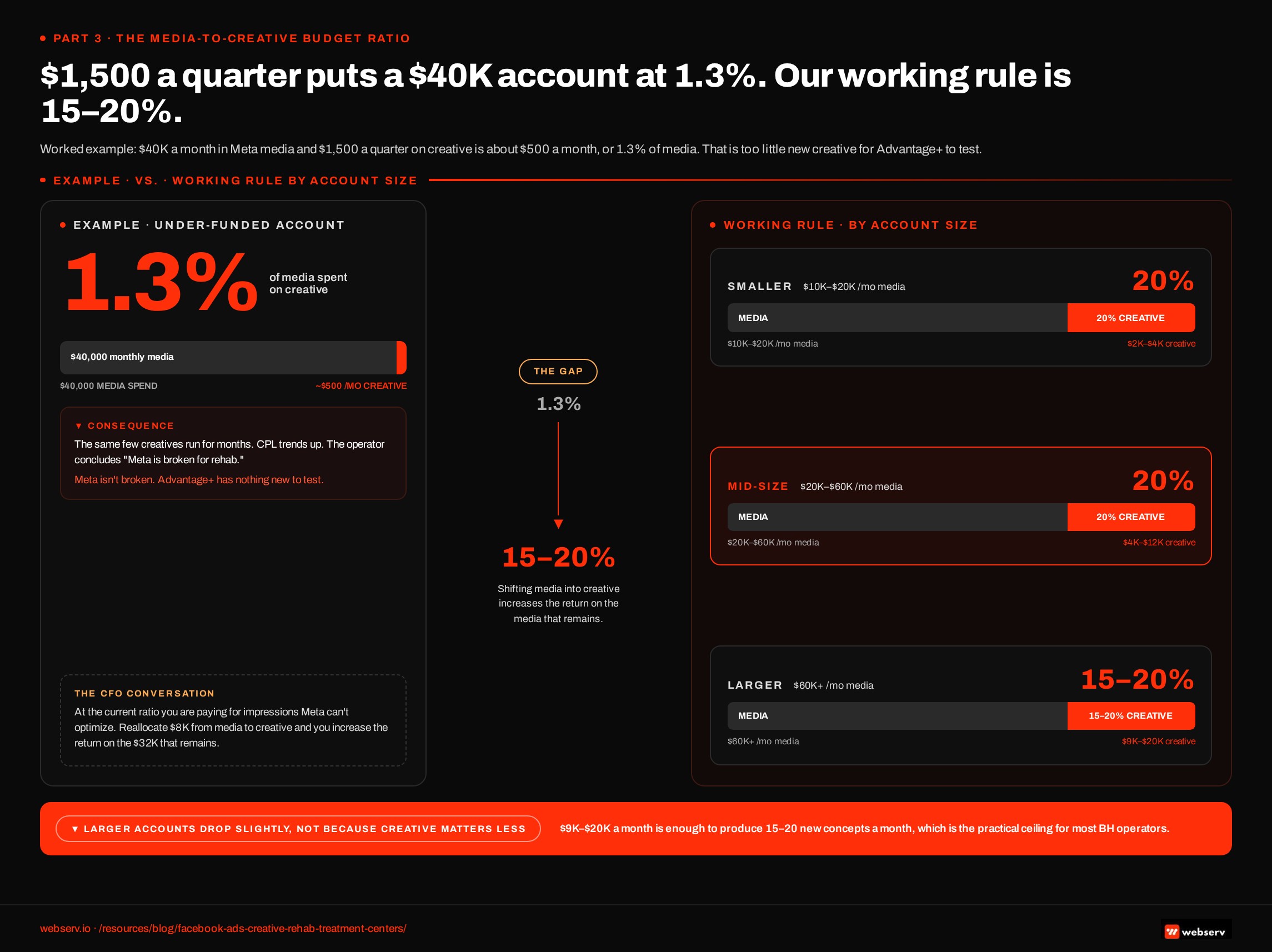
| Account size | Monthly media spend | Recommended creative spend | Creative % |
|---|---|---|---|
| Smaller | $10,000 to $20,000 | $2,000 to $4,000 | 20% |
| Mid-size | $20,000 to $60,000 | $4,000 to $12,000 | 20% |
| Larger | $60,000 and up | $9,000 to $20,000 | 15% to 20% |
The percentage drops slightly above $60K because the absolute dollar amount is enough to produce 15 to 20 new concepts a month, which is the operational ceiling for most BH operators. Above that, additional spend stops producing additional conversion lift.
A treatment center spending $40,000 a month on Meta media and $1,500 a quarter on creative is running a 1.3% creative ratio. The math says they should be at $8,000 a month on creative. The gap is what is producing the rising CPL.
The internal rebalance is hard. The CFO has approved a $40K media budget for two years. Asking for $8K of that to shift from media to creative production is a real conversation.
The right framing is: at the current ratio you are paying for media impressions Meta will not optimize for you. Cutting media to free creative budget increases the return on the media that remains.
How to measure whether creative is working
Four metrics matter. None of them are the metrics most agencies report.
Hook rate (3-second video views / impressions). The percentage of viewers who watched past the 3-second mark. There’s no published benchmark for rehab, so compare each variant against your account’s own median. A hook rate well below the median after 72 hours is a kill candidate.
Hold rate (75% video views / 3-second video views). Among viewers who got past the hook, what percentage stayed for 75% of the video. Compare it against the account median, too. The combination of low hook rate and low hold rate is unambiguous creative failure.
Cost per outcome by variant. Stop reporting account-level CPL. Report cost per private-policy VOB at the creative variant level. The variant with the lowest cost per outcome is the variant the algorithm should be scaling. Most reports do not break this out, which means most operators do not know which creative concept is actually driving admits.
Creative fatigue curve. Track CPL by week for each winning creative. The curve typically stays flat for 4 to 8 weeks, then starts rising as frequency increases. The week the curve inflects is the week the replacement creative needs to be live. Operators who watch the curve replace creative two weeks before the CPL increase shows up at the account level.
Frequently asked questions about creative volume for rehab Meta ads
What is the minimum creative volume Meta needs in 2026?
Meta doesn’t publish a minimum. Its guidance is creative diversification: give Advantage+ genuinely different ads, in different formats, visuals, and messages, so it has real options to test. The more budget a campaign runs, the more distinct creatives it can use before they fatigue, and a campaign with only a handful starves the optimization process.
Most treatment center accounts ship three to five active creatives behind a $30,000 to $80,000 monthly spend. The math does not work. The algorithm cannot find a winning creative when it does not have enough variation to compare against, and the dashboard does not surface the starvation explicitly. The CPA inflation that follows looks like a market dynamic and is actually a creative volume problem.
The fix is not to ship 50 random creatives. It is to ship meaningful variants on three to five tested concepts, with each variant a meaningful change (hook, visual, format, voice angle). Volume of slop produces noise. Volume of structured variants produces signal.
How do we structure a creative testing program without burning Meta spend?
Run two parallel tracks: a stability track that keeps proven concepts running at full budget, and a testing track that runs new concepts at 10 to 15 percent of total spend with structured variant testing inside it. The stability track produces the predictable admit volume; the testing track produces the next generation of proven concepts. Most accounts that fail at creative testing failed to separate these tracks.
Inside the testing track, the smallest viable test is a 14-day run with three to five variants of a single concept across one audience. Smaller variant counts and shorter runs do not produce statistically meaningful results. Larger counts or longer runs burn budget without adding signal. The discipline is to test cleanly and decide quickly.
The biggest waste pattern is testing too many variables at once. A test that changes the hook, the visual, the format, and the call-to-action simultaneously does not tell you which change moved performance. The right discipline is one variable per test, two to three test cycles per month, and results documented per variant so the testing compounds over the year.
What creative formats convert best on rehab Meta?
Reels and short-form vertical video produce the lowest cost-per-VOB across most treatment center accounts in 2026. A 15 to 30 second vertical video built around the facility or a clinician matches mobile-first consumption behavior. Static image creative still has a role for proof and brand awareness, but it has lost primary-acquisition dominance.
The format pattern that consistently underperforms is carousel ads with multiple unrelated images. Meta’s algorithm has trouble optimizing carousels in this category because the rotation produces inconsistent engagement signal. Carousels work when each card is a sequential story (step 1 of admission, step 2 of admission, step 3) rather than a list of features.
The right format mix for most treatment center accounts is 50 to 60 percent vertical video, 25 to 35 percent static image, and 10 to 15 percent carousel or canvas. Adjust based on what the testing track reveals for the specific facility. The mix is not a universal rule; it is the starting point for the testing program.
Should we run UGC-style creative for rehab?
UGC-style creative works for treatment center Meta ads when the source is real (alumni with documented consent, family-member testimonials with FTC-compliant disclosure, named clinical staff). UGC-style creative that is actually scripted with paid actors fails twice: it reads as inauthentic to the audience, and the FTC enforcement environment in 2026 makes the disclosure requirements expensive to get wrong.
The right pattern is to commission real-source UGC with proper consent, compensation disclosure, and HIPAA review. Most facilities have at least a few alumni who would tell their story on camera with proper protections in place. Those stories, produced once and run as testing variants for 6 to 12 months, produce stronger conversion than any scripted alternative.
The wrong pattern is to fake authenticity. We audit accounts running paid-actor UGC every month, and Meta’s review queue and the FTC enforcement environment both increasingly catch it. The risk-adjusted return is poor. Real UGC works. Fake UGC produces short-term gains and long-term policy and regulatory exposure.
How long should a creative concept run before we kill it?
Most treatment center creative concepts hit peak performance at weeks 3 to 6 and start declining at weeks 8 to 12 due to creative fatigue. The right decision rule is to kill a concept when cost-per-VOB has risen 25 percent above its month-two baseline for two consecutive weeks. That signal is reliable enough to act on and conservative enough to avoid killing concepts that are still working.
Some concepts age out faster than others. Promotional creative tied to specific events (holidays, awareness months, news cycle moments) decays within weeks of the triggering event. Evergreen concepts (facility tours, clinical leadership positioning) can run for 6 to 12 months before fatigue dominates. The decay curve matters as much as the absolute performance.
The discipline most accounts miss is documenting why each concept got killed. A concept that died because of audience saturation needs different replacement than a concept that died because of policy review pressure. The kill reason informs what to test next. Without that documentation, the next concept tested is often a variation of the one that just failed.
What this means for treatment center operators
The Meta paid social environment in 2026 is a creative volume game. The algorithm rewards diversity of concepts, refresh cadence, and format mix. Targeting is mostly automated. Media buying is mostly automated. The lever the operator still controls is the creative pipeline.
Most rehab accounts are losing that lever to under-investment. Three to five creatives running for six months in a system built to choose among many genuinely different ads. The CPL trends up not because Meta is broken for rehab. Because the operator is starving the system Meta built.
The accounts that win the next 12 months are going to be the accounts that fixed this. Reallocated 15% to 20% of their Meta budget to creative production. Built a continuous concept pipeline. Established naming conventions, kill criteria, and replacement cadence. Started measuring hook rate, hold rate, and creative fatigue curves at the variant level.
The work runs as operational discipline, not as creative-shop deliverables. The right partner manages the creative pipeline as a continuous process, not as a setup project. The reporting stack treats creative performance as the primary variable, not the media buy. Webserv runs that work inside our creative capability, integrated with the broader paid media program. Operators who want a head-start on identifying paid social ad agencies with Meta policy creative review baked in can work from our scored shortlist of firms running the continuous-pipeline model.
If you want to walk through where your current account sits on the creative volume curve, book a discovery call. We will pull your account and tell you honestly whether the CPL drift is a media problem or a creative-starvation problem. In most cases the answer is the second one. The fix is faster and cheaper than the operator expects.
The perspective in this article comes from 9 years working exclusively inside behavioral health.
We are a team built by people in recovery who understand that behind every admission is someone asking for help. If that resonates, get to know us.
Mitch Marowitz is the Director of Paid Admissions at Webserv. Webserv works with behavioral health and addiction treatment centers on paid media, performance creative, SEO, and full-funnel admissions strategy.