GA4 is the analytics foundation the entire attribution chain sits on. When it is configured correctly, the paid campaigns, organic traffic, phone calls, and form submissions all resolve into a single conversion picture the admission ops billing team can trace against actual admits.
When it is configured incorrectly, which is the default state for most treatment center GA4 properties, the conversion picture is broken in ways that only surface when someone asks a specific attribution question and the numbers do not reconcile.
The three GA4 setup patterns I see repeatedly across BH facilities: the property was set up during the UA migration in 2023 and never tuned, or set up by a general web developer without BH-specific events.
A third pattern: the property was set up correctly at launch but the tracking broke in the past 12 months.
Nobody noticed the break because nobody was running the specific reports that would have surfaced it.
All three produce the same downstream problem. Marketing leadership cannot answer specific attribution questions with confidence. Executives lose trust in the reporting. Paid campaigns get scaled or cut based on incomplete data.
This piece walks the GA4 configuration specific to treatment centers. What the standard setup misses, the HIPAA-adjacent tracking considerations, the custom events for the admissions funnel, and the cross-domain tracking requirements for eligibility verification forms.
It also covers the server-side tagging path that resolves the browser-tracking limitations, and the conversion configuration that produces useful attribution rather than inflated counts.
This piece pairs with our attribution guide, which walks the five-layer attribution chain. Both pieces feed the same downstream reporting the reimbursement intelligence team works with when reconciling paid marketing spend against admits.
Key Takeaways
- GA4 is the foundation the attribution chain sits on. Incorrect configuration produces broken attribution downstream, which produces marketing decisions based on incomplete or wrong data. The specific pattern that produces most attribution failures: default GA4 setup without BH-specific event configuration, without cross-domain tracking on VOB flows, and without server-side tagging.
- The treatment center admissions funnel needs specific custom events that do not exist in default GA4: phone call initiation from the site, VOB form initiation, VOB form completion, insurance verification result, admissions inquiry submission, and downstream admit confirmation. Each event carries specific parameters that connect back to the traffic source.
- HIPAA-adjacent tracking considerations apply differently on landing pages that capture PHI than on top-of-funnel content pages. Facilities that route all tracking through the same client-side gtag path typically produce HIPAA-adjacent risk on the pages that capture insurance and health information.
- Cross-domain tracking for VOB and eligibility verification forms is the specific technical gap that breaks attribution for most treatment center properties. When the VOB form lives on a subdomain or a separate tool (Availity, pVerify, PayerLenz), the tracking session breaks and attribution resolves the visitor as coming from the subdomain rather than the original paid source.
- Server-side tagging through GTM Server-Side or a similar server container resolves three specific problems simultaneously: iOS Safari cookie limitations that break attribution windows, ad-blocker blocking of client-side gtag calls, and the HIPAA-adjacent risk of sending PHI-carrying event parameters to ad platform endpoints from the browser.
DEFINITION
GA4 for treatment center attribution. The specific Google Analytics 4 configuration that produces useful attribution across the treatment center admissions funnel. Six BH-specific custom events (phone_click, vob_initiate, vob_complete, inquiry_submit, admit_confirmed, admit_billing_confirmed), cross-domain tracking that preserves session continuity across VOB subdomains and third-party eligibility tools, server-side tagging that keeps PHI out of ad platforms and resolves iOS ITP + ad-blocker limits, and conversion configuration that scopes primary conversions to bottom-funnel actions rather than every custom event.
Distinct from default GA4 setup (designed for e-commerce product view / cart add / purchase funnels; maps poorly to admissions), distinct from CRM-only tracking (HubSpot / Salesforce track contacts, not sessions), and distinct from dedicated attribution platforms (Rockerbox, Northbeam), which earn their cost only at larger budgets spread across many channels. Sits at Layer 1 (session and inquiry) of the 5-layer attribution chain — CRM (Layer 2), billing (Layer 3), portfolio reporting (Layer 4), reimbursement intelligence (Layer 5) all depend on the GA4 layer being clean.
OPERATOR INSIGHT
Default GA4 was built for e-commerce. Product view. Cart add. Purchase. None of those events exist in treatment center admissions.
The admits that eventually book at the facility trace back through a chain of specific events GA4 has to be configured to track: phone_click, vob_initiate, vob_complete, inquiry_submit, admit_confirmed, admit_billing_confirmed. Without those events, the attribution report shows sessions and page views but cannot connect the sessions to eventual admits. Marketing leadership then cannot answer specific attribution questions with confidence, executives lose trust in the reporting, and paid campaigns get scaled or cut on incomplete data.
What the default GA4 setup misses
Default GA4 setup produces enhanced measurement events (page views, scrolls, outbound clicks, site search, video engagement, file downloads) and the basic e-commerce event schema Google ships out of the box.
That schema was designed for e-commerce sites tracking product views, cart adds, and purchases. It maps poorly to the treatment center admissions funnel.
The specific gap: none of the events that matter for BH attribution exist in default GA4. Phone call initiation is not a default event. VOB form completion is not a default event. Insurance verification result is not a default event.
The admits that eventually book at the facility trace back through a chain of specific events that GA4 has to be configured to track. Without those events, the attribution report shows sessions and page views but cannot connect the sessions to the eventual admits.
The second gap: the enhanced measurement events that GA4 does track by default fire on every page including landing pages that capture PHI. Enhanced measurement sends the page URL, scroll depth, and outbound click destination to Google.
When the page URL contains query parameters that carry PHI (email address from the form autofill, insurance member ID from a URL parameter, admission inquiry identifier), the enhanced measurement events send PHI to Google servers.
The specific fix: custom event configuration replaces the default schema with BH-specific events, and enhanced measurement gets disabled on the pages that capture PHI in favor of custom event configuration that excludes PHI-carrying parameters.
Custom events for the treatment center admissions funnel
Six custom events cover the treatment center admissions funnel from first site visit to eventual admit.
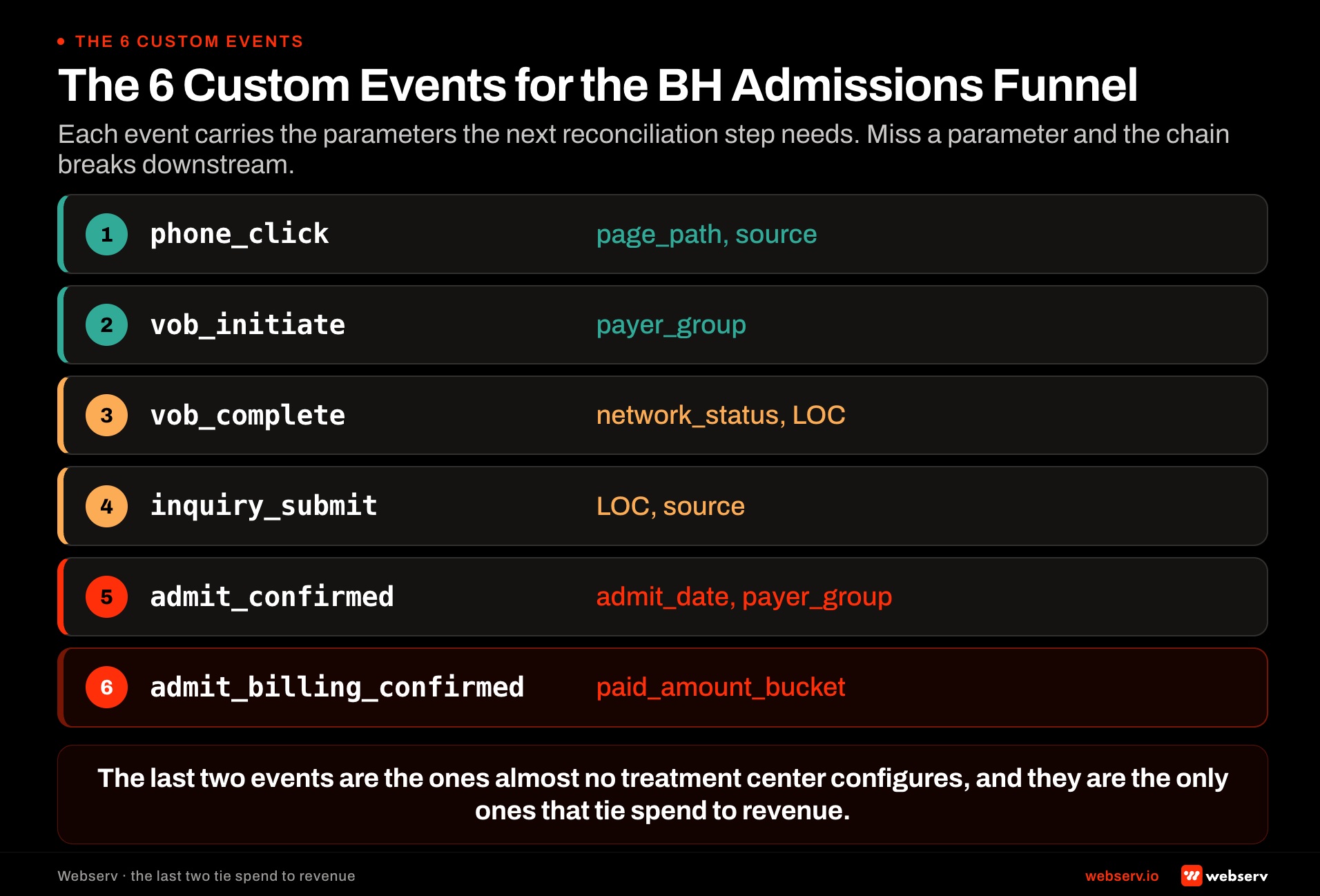
Event 1: phone_click
Fires when a visitor taps a phone number link (tel: link on mobile) or clicks a click-to-call element. Parameters: phone_number (which specific number the visitor tapped), page_location (which page the phone click originated from), session_source (which paid or organic source produced the session).
Event 2: vob_initiate
Fires when a visitor begins the verification of benefits form or eligibility flow. Parameters: vob_type (which specific VOB flow: subdomain form, embedded PayerLenz widget, third-party tool), page_location, session_source.
Event 3: vob_complete
Fires when the visitor successfully submits the VOB form or completes the eligibility flow. Parameters: page_location, session_source. Keep the payer name and network status on the CRM record, not in GA4.
Event 4: inquiry_submit
Fires when the visitor submits the primary admissions inquiry form. Parameters: inquiry_type (self, family member, professional referral), page_location, session_source. Program interest stays in the CRM.
Event 5: admit_confirmed
Fires when the CRM confirms the inquiry converted to an admit. This is server-side because it happens after the visitor has left the site. Parameters: admit_source (which specific paid or organic source produced the eventual admit) and days_to_admit (time from inquiry to admit). The level of care admitted stays in the CRM.
Event 6: admit_billing_confirmed
Fires when the billing system confirms the admit produced billable revenue. Also server-side. Parameters: value (estimated reimbursement), admit_source, days_to_billing_confirm. Billing type stays in the CRM.
Use these names inside your CRM and tag plan. What GA4 and the ad platforms receive should be neutral (tier_1_conversion for admit_confirmed, and so on), with no condition, level of care, or payer detail, as laid out in our HIPAA-safe conversion tracking stack. The six events chain together to produce the full attribution picture. Sessions produce phone clicks, VOB initiates, and inquiry submits. Inquiries produce admits. Admits produce billing.
Each event carries the session_source parameter so downstream events can be attributed back to the original traffic source even when the visitor takes 30 to 90 days to complete the journey.
The GA4 attribution surface at a glance
6
Custom events: phone_click, vob_initiate, vob_complete, inquiry_submit, admit_confirmed, admit_billing_confirmed
iOS heavy
Much BH paid traffic is mobile Safari, where ITP shortens cookie life
Blocked
Ad blockers stop client-side gtag, so browser-only tracking underreports
Scoped build
One-time configuration plus modest monthly server hosting
HIPAA-adjacent tracking considerations
Landing pages and VOB forms that capture PHI have HIPAA-adjacent tracking considerations that top-of-funnel content pages do not.
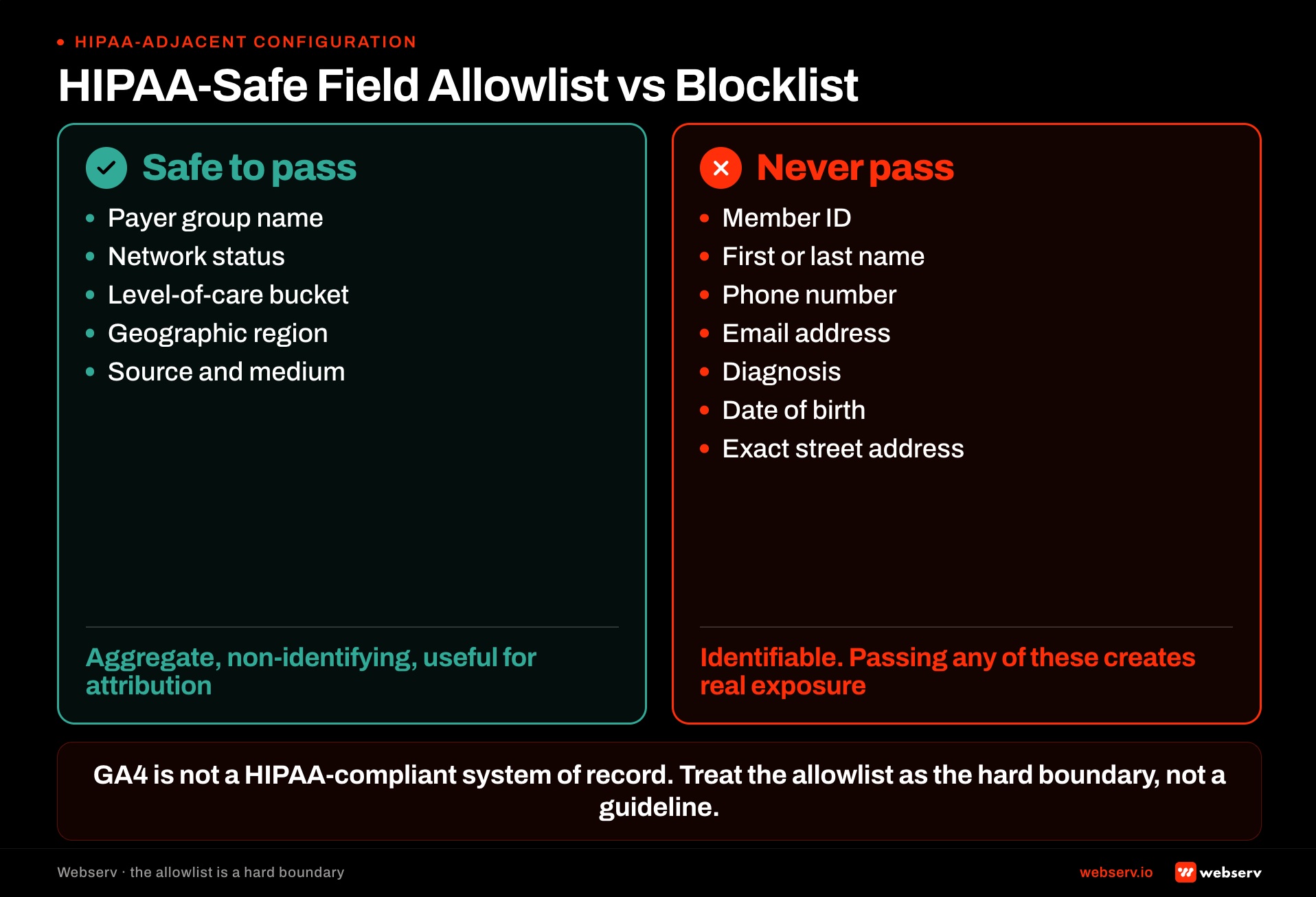
The specific issue: if the tracking payload sent to Google, Meta, or another ad platform contains PHI, the facility carries potential exposure under HIPAA rules that treat marketing analytics as a business associate function.
The specific fields that produce HIPAA-adjacent risk when included in tracking payloads: email address, phone number tied to an inquiry, insurance member ID, insurance plan detail, health condition or diagnosis, medication history, and any identifier that could resolve to a specific individual patient.
The specific fix: server-side tagging on the paths that capture PHI, with a strict allowlist of parameters that get forwarded to the ad platform endpoints. Payer name (BCBS, Aetna) is safe. Network status (in-network, OON) is safe. Member ID is not safe. Diagnosis is not safe.
Our HIPAA-safe conversion tracking guide walks the specific tagging architecture that produces attribution without the PHI exposure.
The general pattern: server-side container receives the event, strips PHI fields, forwards the sanitized event to Meta CAPI, Google Ads offline conversion import, and other ad platform endpoints that need the conversion signal without the PHI payload.
Cross-domain tracking for VOB and eligibility verification
The specific technical gap that breaks attribution for most treatment center GA4 properties: cross-domain tracking on VOB and eligibility verification forms.
When the VOB form lives on the same domain as the marketing site, tracking continuity works out of the box. The session cookie persists across the form flow and GA4 resolves the completed VOB back to the original source.
When the VOB form lives on a subdomain (verify.facility.com), a separate tool (Availity, pVerify, PayerLenz-embedded widget), or a third-party service, the tracking session breaks by default.
The visitor arrives on the marketing site from a paid Meta campaign, clicks through to the VOB form on the subdomain, completes the form, and GA4 resolves the completed VOB as a session originating from the subdomain rather than the Meta campaign.
The specific fix: cross-domain tracking configuration in GA4 admin, plus tag manager setup that preserves the _ga client ID across the domain boundary. GA4 supports cross-domain tracking natively but requires explicit configuration of which domains share tracking.
The gotcha for treatment center properties: cross-domain tracking often gets set up initially and then breaks when the facility switches VOB tools.
Facilities that switched from Availity to PayerLenz in the past 12 months should specifically audit whether cross-domain tracking still resolves the PayerLenz subdomain into the main property. Most audits I run find the tracking broke during the tool switch and nobody caught it.
Server-side tagging path
Server-side tagging through Google Tag Manager Server-Side (GTM-SS), Stape, or a similar server container resolves three specific problems that browser-only tagging cannot address.
Problem 1: iOS Safari cookie limitations that break attribution windows. Safari’s Intelligent Tracking Prevention (ITP) blocks third-party cookies outright and caps first-party cookies set via JavaScript at 7 days, shorter in some link-decoration cases. GA4’s default gtag setup relies on JavaScript-set cookies that ITP truncates.
The specific attribution failure: paid Meta traffic converts 21 days after the ad click. Safari user, cookie expired at day 7, attribution resolves the eventual admit as “direct” or “organic” rather than the Meta campaign that produced it.
Server-side tagging with server-set first-party cookies extends the cookie lifetime beyond the ITP window and preserves the attribution chain for iOS users, who make up a large share of BH paid traffic. Check your own device split in GA4.
Problem 2: Ad-blocker blocking of client-side gtag calls. Ad blockers block the standard gtag.js load and the standard collect endpoint calls. A meaningful share of site visitors run ad blockers, which produces measurable underreporting on client-side GA4.
Server-side tagging through a first-party subdomain (gtm.facility.com) bypasses most ad blockers because the traffic to the first-party subdomain is not recognized as a tracking endpoint.
Problem 3: HIPAA-adjacent risk of sending PHI-carrying event parameters to ad platform endpoints from the browser. Client-side gtag calls send the full event payload from the browser to Google servers. When the payload contains PHI, the browser has already leaked the PHI before any server-side sanitization can intercept it.
Server-side tagging routes the event first to the facility’s own server container, which strips PHI fields before forwarding sanitized events to Google, Meta, and other ad platform endpoints. The PHI never reaches the ad platform.
The implementation path: GTM-SS on Google Cloud Run, or a managed platform like Stape, with hosting cost that scales with event volume.
The setup is a real tag configuration project, and it has to be maintained as tools change.
Conversion configuration
GA4 conversion configuration determines which events count as conversions in reporting and which events get sent to ad platforms as conversion signals. Two specific configurations produce useful attribution rather than inflated counts.
Configuration 1: conversion events limited to bottom-funnel actions. The default GA4 pattern is to mark every custom event as a conversion. That inflates the conversion count and produces attribution reports that show 20 conversions per admit because phone clicks, VOB initiates, VOB completes, inquiry submits, and admits all count as separate conversions.
The specific pattern that produces useful attribution: inquiry_submit is the primary conversion. vob_complete is a secondary conversion for VOB-first funnels. phone_click is a micro-conversion tracked but not counted as the primary. admit_confirmed and admit_billing_confirmed are the offline conversions imported back to Google Ads and Meta CAPI for AI-optimized bidding, sent under neutral tier names through the BAA-covered server-side layer with documented consent and counsel sign-off.
Configuration 2: attribution model set to data-driven attribution. Default GA4 uses last-non-direct-click attribution, which credits the last paid source before the conversion. For BH admissions that take 30 to 90 days from first click to admit, last-click attribution systematically undercredits the top-of-funnel paid sources that introduced the visitor to the facility.
Data-driven attribution uses GA4’s machine learning to distribute conversion credit across the full path. It requires enough conversion volume to train the model (roughly 400 conversions per month across the property) but produces meaningfully better attribution decisions for facilities with mixed paid programs.
DO
- Configure the 6 BH admissions-funnel events with session_source parameter so 30-90 day journeys still attribute to original source.
- Route conversion tracking through a server-side container (GTM-SS, Stape) on a first-party subdomain — resolves ITP + ad-blocker + PHI leakage simultaneously.
- Configure explicit cross-domain tracking every time a VOB or eligibility tool changes — re-audit within 30 days of any switch.
- Set inquiry_submit as primary conversion. vob_complete as secondary. phone_click as micro-conversion. admit_confirmed and admit_billing_confirmed as offline conversions.
- Switch attribution model to data-driven attribution once you clear ~400 conversions/month — data-driven distributes credit better across 30-90 day BH decision journeys.
DON’T
- Leave enhanced measurement enabled on PHI-carrying pages — page URL + form-autofill query params can carry email/member ID to Google.
- Send member ID, diagnosis, medication history, or plan detail as event parameters — payer name and network status only.
- Mark every custom event as a conversion — that inflates conversion counts and produces 20-conversions-per-admit reports.
- Rely on last-non-direct-click attribution for BH — 30-90 day journeys systematically undercredit top-of-funnel paid.
- Ship client-side gtag only, because iOS Safari ITP and ad blockers leave large gaps in attribution.
Common failure modes
Four patterns produce most of the GA4 configuration failures we audit.
Failure mode 1: enhanced measurement enabled on PHI-carrying pages. Enhanced measurement events fire on every page including landing pages that capture PHI. Fix: disable enhanced measurement on PHI-carrying pages and replace with custom event configuration that excludes PHI parameters.
Failure mode 2: cross-domain tracking broken after VOB tool switch. Cross-domain tracking configured for the original VOB tool, then the facility switched tools and the tracking broke. Fix: audit cross-domain tracking every time the VOB tool changes.
Failure mode 3: client-side gtag setup without server-side tagging. iOS Safari ITP truncates the cookie window, ad blockers block the tracking calls, and PHI leaks to ad platforms from the browser. Fix: server-side tagging through GTM-SS or similar.
Failure mode 4: every custom event marked as a conversion. Inflated conversion counts and confused attribution reports. Fix: primary conversion is inquiry_submit, secondary is vob_complete, others are tracked but not counted as primary.
Frequently Asked Questions
How much does it cost to set up GA4 correctly for a treatment center?
Initial configuration cost depends on how much of the existing setup needs to be rebuilt versus tuned. The work splits across tag manager configuration and custom event setup, server-side tagging setup and testing, CRM integration, and documentation and handoff.
Facilities that already have a functional GA4 property with clean historical data typically need the lower end of the range because the work is tuning rather than rebuilding. Facilities running on a broken or default GA4 setup typically need the higher end because the historical data is unusable and the entire tracking chain has to be rebuilt.
Ongoing costs after initial setup: server-side tagging hosting plus regular configuration maintenance as tracking requirements evolve.
Should we use GA4 or a dedicated attribution platform like Rockerbox or Northbeam?
Depends on the paid media spend level and the attribution complexity. GA4 works for most treatment center properties running a handful of paid channels. GA4 strains as spend grows across many channels with meaningful cross-channel interactions.
The specific pattern that signals it is time to add a dedicated attribution platform: paid media spread across Meta, Google, TikTok, YouTube, and connected TV, with the facility trying to answer questions like “what is the incremental lift of the TikTok spend given that the Meta program is running.” GA4 does not resolve incrementality questions well; dedicated platforms do.
For most single-facility operators and small portfolio operators, GA4 configured correctly does what needs doing. Dedicated attribution platforms make sense for larger portfolio operators with meaningful cross-channel paid programs.
Do we still need GA4 if we have HubSpot or Salesforce tracking marketing performance?
Yes. HubSpot and Salesforce track marketing performance at the contact and account level, which is different from GA4 tracking at the session and event level. Both layers are needed for the attribution chain to resolve.
GA4 answers session-level questions: which traffic sources produce sessions, which pages produce inquiry submits, which paid campaigns produce the highest inquiry conversion rate. HubSpot or Salesforce answer account-level questions: which sources produce the highest lifetime revenue per admit, which paid campaigns produce the highest reimbursement realization.
Facilities that try to run marketing analytics on HubSpot or Salesforce alone typically produce good downstream reporting on admits but cannot answer specific session-level questions about paid campaign performance. Facilities that run on GA4 alone typically produce good session-level campaign reporting but cannot resolve to actual admits and revenue. Both layers work together.
How long does it take to see the benefit of the GA4 configuration work?
The reporting benefit shows up within weeks as clean data starts populating the new event schema. The attribution decision benefit takes longer: data-driven attribution needs enough conversion data to train, and executives need time to trust the new reporting enough to make budget decisions against it.
The specific pattern I see: facilities that invest in the GA4 configuration work in Q1 typically start making meaningfully better paid media allocation decisions in Q3 as the reporting stabilizes. Executives internalize what the new data is showing. Facilities that expect immediate decision changes often get frustrated early and abandon the setup work before it pays off.
The right expectation: the GA4 configuration is an infrastructure investment, not a tactical fix. It pays off over time through better paid media decisions and clearer attribution across the funnel.
Can we hire a general GA4 consultant or do we need someone who specializes in behavioral health?
Depends on the specific work. General GA4 consultants can handle standard configuration, cross-domain tracking, and server-side tagging setup. The BH-specific work that general consultants typically miss: the HIPAA-adjacent PHI handling on VOB forms, the specific event schema for the admissions funnel, and the CRM integration for offline conversion imports of admit_confirmed and admit_billing_confirmed.
The specific pattern that works for most facilities: general GA4 consultant for the core configuration work, with a BH-specific reviewer verifying the HIPAA-adjacent handling and the admissions funnel event schema. This produces high-quality technical implementation without paying BH-specialist rates for the general tag manager work.
Facilities running fully in-house should specifically watch for the HIPAA-adjacent gaps because those are the parts general documentation does not cover well and internal teams typically overlook.
What breaks first when GA4 configuration goes wrong, and how do we catch it early?
Cross-domain tracking breaks first, typically when the facility switches a tool. The VOB tool changes, the intake CRM changes, or the phone tracking provider changes, and the cross-domain configuration that was set up against the old tool does not carry over to the new tool.
The specific early warning signal: conversion attribution shifts unexpectedly toward “direct” or “organic” as a source category. When paid Meta’s share of tracked conversions suddenly drops while direct traffic jumps to compensate, cross-domain tracking has almost certainly broken somewhere in the funnel.
The catch is running a monthly audit of source attribution against known ad platform reporting. When GA4 shows meaningfully fewer conversions than Meta or Google Ads report for the same period, the tracking chain is broken somewhere.
How does the GA4 setup interact with the reimbursement intelligence workflow the billing team runs?
The GA4 conversion events feed the top of the reimbursement intelligence workflow. admit_confirmed and admit_billing_confirmed server-side events carry the admit_source parameter that lets the billing team resolve which paid marketing spend produced which specific admits and which admits produced billable revenue.
Without those events, the billing team can measure claim reimbursement by payer and by admit type but cannot connect the reimbursement back to the specific marketing spend that produced the admit. That connection is what lets executives decide whether to scale, hold, or cut specific paid campaigns based on realized reimbursement rather than reported conversion counts.
Our Attribution cluster hub walks the five-layer attribution chain that GA4 sits at the top of. GA4 is layer 1 (session and inquiry data). CRM is layer 2 (admit data). Billing is layer 3 (reimbursement data). Portfolio reporting is layer 4 (blended payer mix and channel efficiency). Our reimbursement intelligence hub covers layer 5 (realized ROI by channel and campaign).
Trevor Gage is the Director of Marketing at Webserv, a digital marketing agency for treatment centers. This piece pairs with our Salesforce for treatment center admissions playbook and our broader work on behavioral health marketing.