


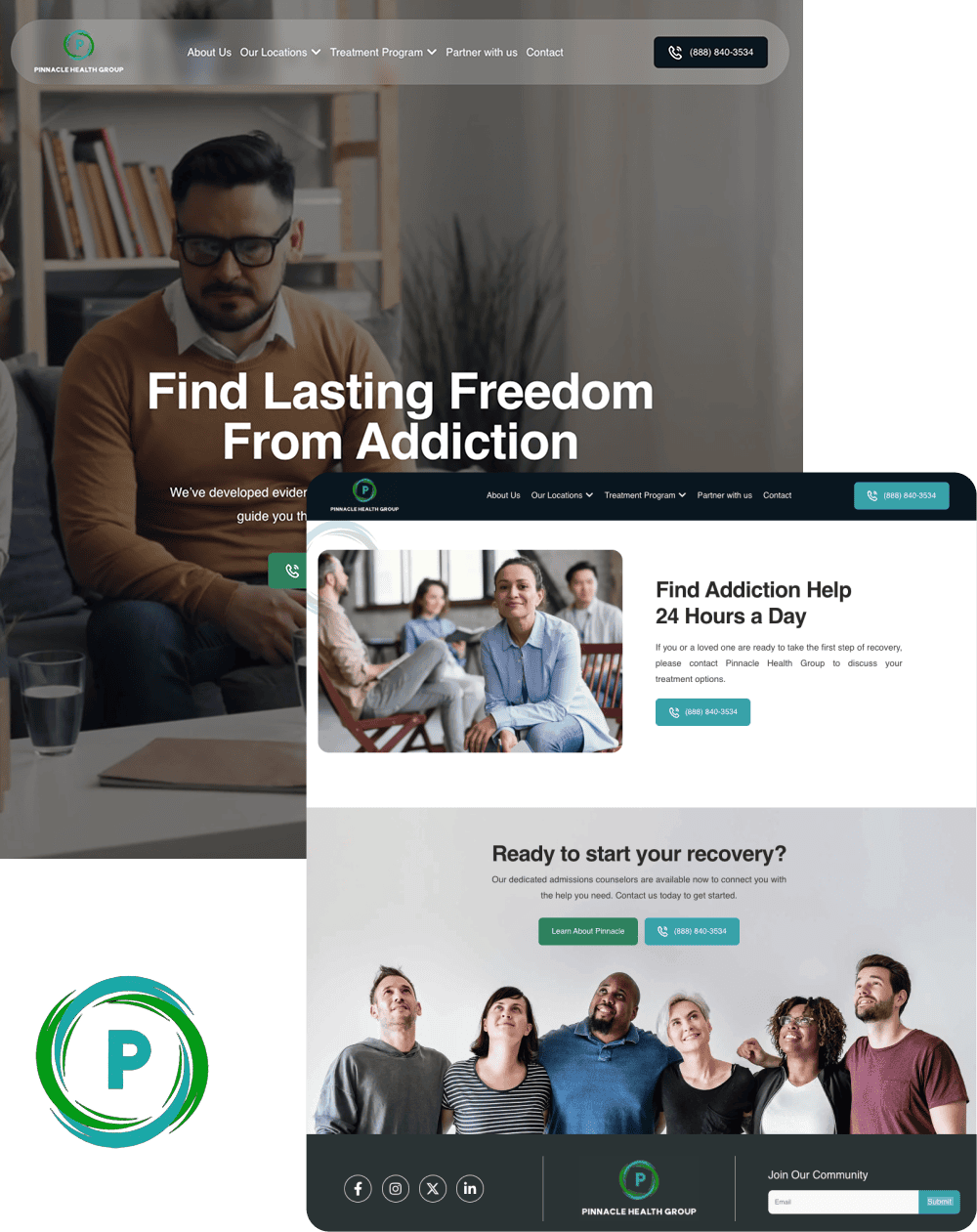
Most rehab websites are built to look good at launch and left alone. We design addiction treatment websites around how families make decisions under pressure. Every page, every layout, every CTA built to earn the call.
Trusted by 200+ Treatment centers nationwide


Why Most Rehab Websites Fail
Most treatment center websites are built by agencies that have never worked in behavioral health. They pick a theme, write some copy about your programs, and hand you a site that looks fine in a demo. What they cannot give you is a site that understands your audience.
People looking for addiction treatment are not browsing. They are deciding. And if your website does not answer the right questions fast, they leave and call someone else.
The design looks professional but nothing on the page tells a family what to do next
Insurance and admissions information is buried or missing entirely
The site loads slowly on mobile where most searches actually happen
There is no clear path from landing on the page to making a call
The agency that built it has moved on and nobody is watching what converts
How We Build Differently
Every addiction treatment website we build is engineered around three things that most agencies never think about.
Most families searching for treatment are on a mobile device at the worst moment of their lives. A slow site is a lost admit. Every website we build is optimized for speed, mobile performance, and core web vitals from day one. Whether you are a single location rehab or a multi-site behavioral health organization, a slow site costs you admits before a human ever gets involved.
What This Means:
Without LegitScript certification your paid ads cannot run on Google or Meta. We build every treatment center website to meet LegitScript standards so your site is ready for certification and your ad accounts stay active. We are one of the only professional web design agencies for behavioral health practices that builds LegitScript standards directly into every project.
What This Means:
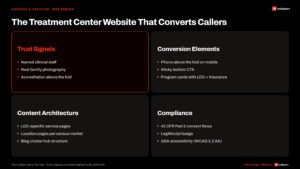
As a rehab center website design partner we build every page around one job — move the visitor closer to a call or form submission. We build clear admissions paths, insurance verification CTAs, and trust elements that answer the questions families have before they will pick up the phone.
What This Means:
What’s Included
From first wireframe to live launch, every project includes the essentials your team needs to convert more admissions from day one.
Built to your identity, not a theme. Every design is created from scratch to match your facility's brand.
Existing content moved cleanly to your new site without losing rankings or breaking internal links.
Built on WordPress and Elementor so your team can manage and update content without a developer.
Scalable site architecture built to grow with your facility as you add programs, locations, and services.
On-page SEO, meta tags, schema markup, and redirects configured so your site ranks from day one.
Fast and responsive on every device. Most treatment seekers find you on mobile and your site needs to be ready.
Conversion-focused messaging written for your programs and audience included in every build.
Insurance verification, admissions calls, and contact forms placed strategically to drive action on every page.
Google Analytics, call tracking, and conversion events configured so you can see exactly what is working.
Pinnacle Health Group needed a site that could handle multiple locations, programs, and audiences without feeling fragmented. We rebuilt their entire platform from the ground up with scalable architecture and a conversion-focused design system.
Coastal Detox needed a site that felt trustworthy and easy to navigate for someone in crisis. We redesigned the full experience around simplicity, trust, and a clear path to calling or verifying insurance.
Refine Recovery wanted to stand out in a crowded Los Angeles market. We built a distinct brand identity and site experience that positioned them as a premium option and made it easy for referral partners and patients to find what they needed.
Back2Basics had years of credibility but a website that did not reflect it. We modernized their brand story, unified their programs under one clear experience, and rebuilt the site to convert the organic traffic they had already earned.
Pricing
One time project fee. Optional ongoing maintenance available after launch.
Up to 10 Pages
Up to 20 Pages
Up to 40+ Pages
The Process
A clear six phase process so you always know where your project stands.
Phase 1
We start with a kickoff meeting to align on your vision, goals, and scope. If you have an existing site we audit it for content worth keeping. You leave with a clear implementation roadmap.
Phase 2
We finalize your sitemap and page architecture, create wireframes for key pages, and set your brand direction and design system. You get multiple mockup review and revision rounds before anything gets built.
Phase 3 & 4
Your full site gets built in WordPress and Elementor. We handle mobile optimization, speed tuning, CRM and call tracking integrations, and copywriting support throughout.
Phase 5
Before we go live we configure on-page SEO, meta tags, URL structure, schema markup, robots.txt, 301 redirects, and analytics tracking. Your site is built to rank from day one.
Phase 6
Final QA across all devices and browsers. Client walkthrough and CMS training so your team can manage the site independently. Site goes live with post-launch monitoring activated.
Marketing
Associate Director, Marketing
Kevin Hall is Associate Director of Marketing at Webserv, where he creates in-depth educational content that helps treatment center operators...
Creative
Web Designer & Creative Specialist
I am a designer with 17+ years of experience helping brands build strong visual identities and grow through strategic design....
Creative
Web Development Project Manager
Gustavo Ganem brings over 6 years of project management experience to his role as Senior Project Manager at Webserv. He's...
COMMON QUESTIONS
Addiction treatment website design is the design and development of websites for behavioral health and rehab centers, optimized for admissions conversion rather than general lead-gen. It accounts for crisis-state visitor behavior, LegitScript readiness, HIPAA-compliant tracking, and the clinical-trust signals — staff licensure, accreditation, level of care — that operators' patients screen for before calling.
Generic web designers build for engagement and aesthetics. Treatment-center websites optimize for a specific conversion: a worried family member or person in crisis picking up the phone within 2 minutes. The design decisions that drive that conversion are different from any other vertical.
The visitor experience also matters. Someone in crisis doesn't read paragraphs — they scan for trust signals, insurance acceptance, and a number to call. Sites that miss this convert at half the rate of sites built for it.
Most addiction-treatment website builds run $25,000–$80,000 depending on scope (number of locations, levels of care, integration depth). Builds under $20,000 typically use pre-built templates that don't accommodate the conversion patterns rehab admits require. Multi-location, multi-program centers regularly land at $50,000–$120,000 for build plus integrated CRM and call-tracking.
The integration layer is where most budget is hidden. CRM integration, call-tracking, VOB form workflow, and HIPAA-compliant analytics each add $3K–$10K to a build. Centers that skip them initially almost always pay more to retrofit later.
We've seen centers come to us after a $15K build that needs $40K of fixes. The cheap upfront price is rarely cheaper at year-end.
Yes — if the program plans to run paid Google or Meta ads. LegitScript-readiness affects URL structure, footer disclosures, ownership transparency, and the call-handling integrations on the site. A well-built treatment-center website is LegitScript-ready by default rather than retrofitted post-launch.
Even programs not running ads benefit from LegitScript-aligned design. The same trust signals (accreditation, ownership clarity, clinical staff) that LegitScript audits are the signals patients use to evaluate the program before calling.
Centers that get LegitScript-rejected on the first application usually have a website problem, not a clinical problem. Fixing the site clears most rejection reasons in one revision.
3–6% of website visitors should convert to a tracked action (call, form, or chat) on a well-built treatment-center website. Programs converting below 2% usually have generic-template builds, weak insurance-acceptance signaling, or slow load speeds. Programs above 6% typically have tight VOB integration and conversion-optimized service-page templates.
The biggest single lever is page load speed. A 4-second load time vs a 1.5-second load time can cut conversions in half. Most pre-built treatment-center themes are too heavy out of the box — the speed work has to happen at build time, not after.
The second lever is insurance signaling above the fold. Patients researching treatment screen for insurance acceptance before reading anything else. If they have to dig for it, they leave.
WordPress with a performance-tuned theme is the right choice for most multi-location treatment centers. It supports rapid content publishing (location pages, blog, glossary), Rank Math schema management, and the admissions-team CMS access most programs need. Custom frameworks are usually overkill and create maintenance debt operators end up paying for in year two.
The exception is enterprise-scale operators with 20+ locations and complex integrations — at that scale, headless or custom frameworks start to make sense. For single-location to mid-size multi-location, WordPress wins on flexibility and total cost of ownership.
Watch out for cheap WordPress builds, though. A $5K WordPress site is almost always built on a heavy multipurpose theme that won't load fast enough to convert. The framework matters less than the build quality.
Insurance-acceptance logos and verification flows above the fold, sub-3-second load speed, click-to-call on every page, level-of-care pages that match ASAM placement language, and trust signals (accreditation badges, staff licenses, clinical leadership). Sites converting under 2% usually miss two or more of these.
The order matters. Patients screen for insurance first, level of care second, trust signals third. A page that buries insurance info below the fold is asking visitors to leave before they qualify themselves.
Click-to-call should appear on every page, sticky on mobile. About 70% of treatment-center website visitors are on mobile. A non-sticky phone number is invisible scrolling.
PPC and paid social drive traffic; the website converts it. Compliant landing-page structures, server-side conversion tracking, and call-tracking integration are required to keep Google Ads and Meta accounts compliant after the 2024 OCR guidance. A website that wasn't built for paid traffic will undercut every dollar of media spend.
The most common failure pattern: a center spends $50K/month on Google Ads but the landing pages don't have proper conversion tracking. Without conversion data, Google's algorithm can't optimize, the bidding stays suboptimal, and CPA is 2–3x what it should be.
Site readiness for paid ads is foundational, not optional. Centers that build the site right first see paid CPA drop 30–50% in the first 60 days post-launch.
Yes — each location needs a unique URL with localized content (local team, photos, level of care availability, contact). Multi-location centers typically structure under /locations/[city]/ or /[city]/ slugs. Pages without location-specific content rarely rank in the local pack and routinely under-convert against single-location sites with the same parent brand.
The most common mistake is duplicating content across location pages with city names swapped. Google sees through it, and only one location actually ranks. Each location page needs unique team photos, local insurance acceptance, and content that reflects the specific program at that site.
Operators with 10+ locations and template-duplicate pages routinely have 8 of 10 sites invisible to Google. Fixing that across the portfolio is one of the highest-ROI moves available to multi-location operators.
MARKETING SERVICES FOR REHABS
Build sustainable, long-term patient acquisition through search visibility and content authority.
Drive immediate results with targeted advertising and optimized conversion experiences.
Streamline your admissions process with data-driven operations and conversion tracking.
Websites, landing pages, and ad creative built as part of the patient acquisition system.
Ready to Start
30-minute strategy session to discuss your census goals, current challenges, and how we can help you scale admissions sustainably.
Trusted by 200+ Treatment centers nationwide