YouTube Ads Agency for Rehabs and Treatment Centers
Be Everywhere Families Are Looking Before They Make the Call.
- Written By: Mitch Marowitz
- Published: June 8, 2026
- Updated: August 4, 2026
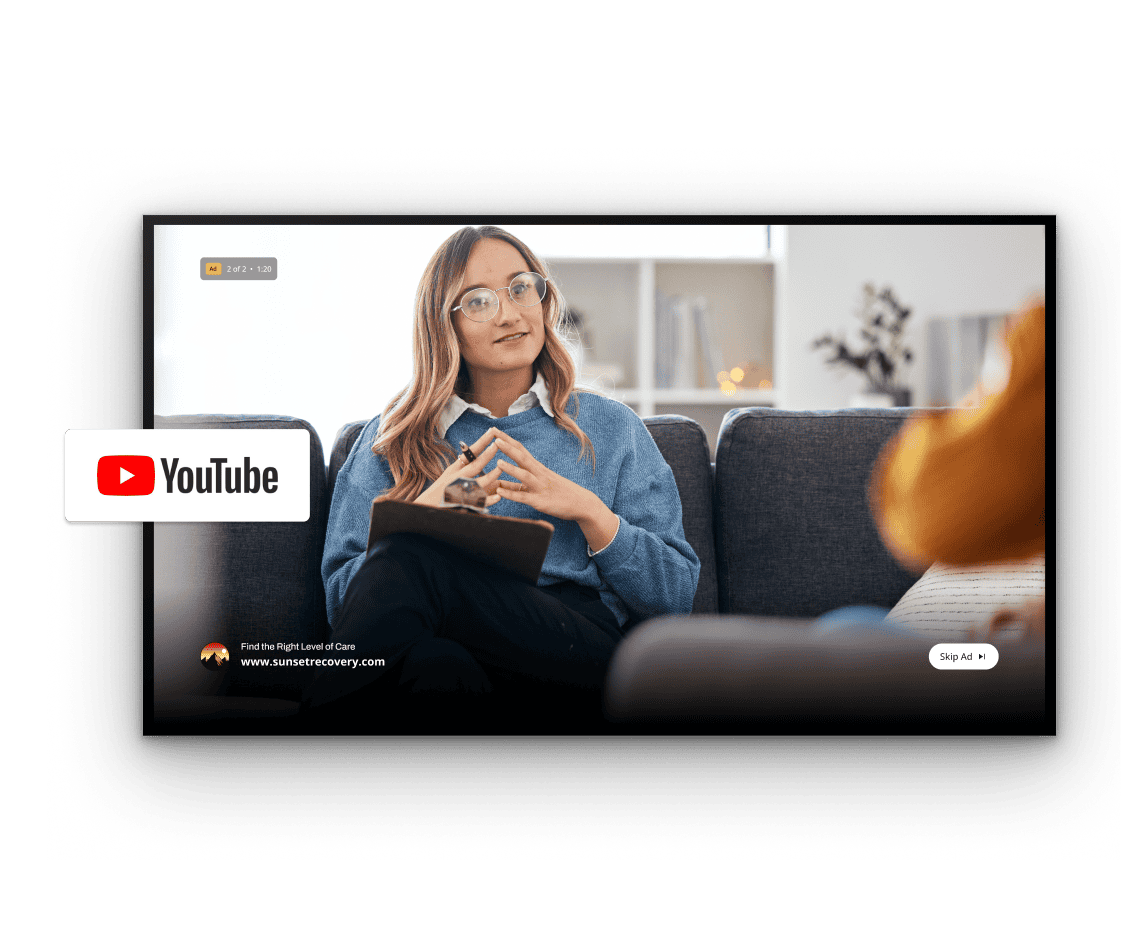
We run YouTube ads for rehabs and addiction treatment centers. Video campaigns built for the platform where families do their real research before calling, with HIPAA-safe tracking, creative produced for healthcare policy, and measurement calibrated to admit volume instead of view counts.
Trusted by 200+ Treatment centers nationwide





THE CHANNEL THE INDUSTRY UNDERUSES
YouTube Is Where Some Treatment Decisions Get Made
Families researching addiction treatment spend hours on YouTube before any of them call a facility. Most treatment center programs don’t have a presence on the platform at all.
The treatment center buyer journey runs longer than almost any other commercial decision. Families research for weeks, watch alumni stories, evaluate clinical credibility, and weigh facility environment before anyone picks up the phone. The platform where most of that watching happens is YouTube.
Most treatment center marketing programs ship search ads and Meta campaigns and skip YouTube entirely. The reason is usually creative cost. Video production for healthcare requires named-clinician content, environment-of-care footage, alumni-perspective storytelling, and policy review. None of that gets built without a real creative pipeline.
The agencies that do run YouTube for treatment centers often treat it as a brand impression channel disconnected from admits. View-through attribution gets dismissed as fluffy. Campaigns get budgeted at $2,000 a month and never produce signal. The platform gets abandoned before it has a chance to work.
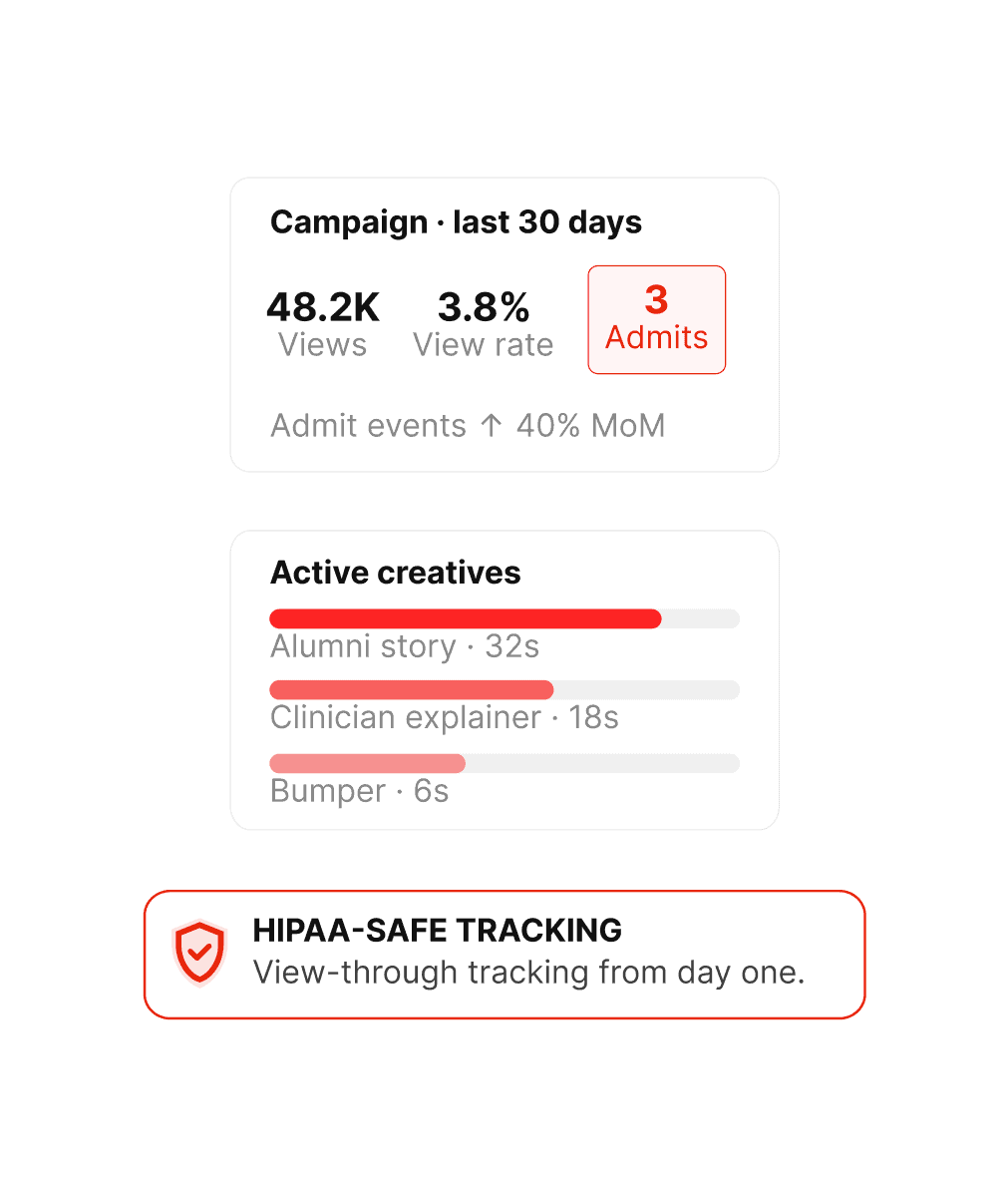
YouTube done correctly for a treatment center is one of the strongest admit channels available. The work is video creative production tuned to the rehab buyer journey, HIPAA-safe view-through and click tracking, and reporting that connects video views to admits months later. We've built those workflows and now run them across treatment center programs across the country.
OUR WORK
YouTube Ad Formats We Run for Treatment Centers
In-Stream Skippable and Non-Skippable
Pre-roll and mid-roll video ads on family-research watch behavior. Skippable for awareness audiences, non-skippable for high-intent retargeting where the message density justifies it.
Outcome: Reach the families doing real treatment research
Bumper Ads (6-Second)
Short-form video built for frequency and brand recall. Used to keep facility recognition active during the multi-week treatment decision window between awareness and inquiry.
Outcome: Top-of-mind recall when the family is ready to call
In-Feed Video Discovery
Discovery placements inside YouTube's recommendation feed, surfacing your facility's content when families are actively searching for treatment information.
Outcome: Show up where the search is happening
YouTube Shorts Ads
Vertical-format placements optimized for the Shorts surface, where Gen Z patients and younger family members increasingly do treatment research.
Outcome: Reach the demographic Meta + Google can't always isolate
HIPAA-Safe Tracking and Attribution
Server-side conversion tracking, view-through window calibration, and CRM integration that connects video views to actual admissions over the treatment center buyer journey window.
Outcome: Attribution that survives the long rehab decision cycle
HOW WE WORK
Build a YouTube Engine That Compounds Admit Volume
A four-step methodology built for the rehab compliance and creative reality, not adapted from generic Meta playbooks.
Step 01
Audience Build and Buyer-Journey Map
Identify the family-member and prospective-patient watch behavior driving treatment decisions in your competitive market. Build custom intent and affinity audiences against that behavior.
Step 02
Compliant Creative Production
Video creative produced for healthcare policy from day one. Alumni stories, named-clinician explainers, environment-of-care footage, family-perspective testimonials, all vetted by compliance before they ship.
Step 03
Campaign Launch and Format Stack
Coordinated in-stream, bumper, in-feed, and Shorts campaigns. Frequency caps tuned to the rehab decision window. Audience segmentation across awareness, consideration, and retargeting layers.
Step 04
Admit Attribution and Optimization
View-through window calibration tuned to the treatment center buyer journey. CRM integration, BAA-covered call tracking, and weekly optimization tied to admit data instead of vanity view counts.
VIDEO ADVERTISING FOR REGULATED HEALTHCARE
Work With the Team That Already Built the Video Creative Pipeline
YouTube ads for treatment centers fail at three predictable points. Video creative that doesn’t clear healthcare policy review, attribution windows too short to capture the multi-week rehab buyer journey, and budget allocations too thin to feed the algorithm enough signal to optimize.
The agencies that run YouTube for treatment centers credibly have three layers in place. The production pipeline to ship clinical-grade video creative at cadence.
The attribution infrastructure to measure view-through admits across long decision windows. And the buyer-journey discipline to know when video is doing its job versus when it’s burning budget.
Most treatment center marketing teams have either skipped YouTube entirely or paid an agency to run it as a brand-impression line item that nobody could attribute to admits. We built the workflows that close those gaps and now run them across rehab operators across the country.
INSIDE THE PLAYBOOK
Five Moments YouTube Owns in the Rehab Buyer Journey
Initial Awareness
A family member realizes treatment is the conversation. The first searches happen on YouTube, not Google. Awareness-phase video ads put the facility in the consideration set early.
Clinical Credibility Research
Named-clinician video content carries weight Google blue-link results can't match. Watching the medical director explain dual diagnosis builds trust at a different layer than reading a service page.
Environment-of-Care Evaluation
Families want to see what the facility looks like. Tour content, alumni stories, and environment footage close credibility gaps that text content can't.
Family-Perspective Storytelling
The decision-maker is rarely the patient. YouTube content that addresses the family member's specific anxieties produces inquiries text content misses entirely.
Re-Engagement During the Decision Window
Treatment center buyer journeys run multiple weeks. Bumper ads and short-form retargeting keep the facility present when the family is ready to act.
QUESTIONS ABOUT YOUTUBE ADS FOR TREATMENT CENTERS
Frequently Asked Questions About YouTube Ads for Rehabs and Treatment Centers
A YouTube ads agency built for treatment centers handles four connected workflows. Video creative production tuned to healthcare advertising policy. Campaign structure across in-stream, bumper, in-feed, and Shorts placements. HIPAA-safe view-through and click tracking deployment. And admit-attribution reporting calibrated to the rehab decision window.
The unique work YouTube requires is the creative pipeline. Video content has higher production cost and longer review cycles than static ad creative, which makes the production workflow the gating factor for most programs.
For treatment centers, properly run YouTube programs produce admits at a lower blended CAC than search-only programs because YouTube reaches the family-research watch behavior search ads miss.
The four formats that consistently produce signal for treatment centers are in-stream skippable, bumper ads, in-feed video discovery, and Shorts ads. Each plays a different role in the buyer journey.
In-stream drives awareness and consideration. Bumpers maintain frequency through the decision window. In-feed surfaces during active research. Shorts reaches younger family members and patients.
Non-skippable in-stream is useful for high-intent retargeting where the message density justifies the format. Most awareness campaigns are better served by skippable in-stream paired with the bumper layer.
The format stack matters more than any single format. Programs running only one format see lower returns than programs that coordinate across the full surface.
YouTube ads attribution for treatment centers requires server-side conversion tracking with PHI-safe parameter passing, view-through window calibration tuned to the rehab decision cycle (typically 30–90 days), and CRM integration that lets admit data flow back without exposing patient identifiers.
The implementation pattern uses Google Ads conversion tracking with custom parameters, BAA-covered call tracking through CallRail, and a structured event taxonomy that connects video views to inquiries to admits without ever passing protected health information through the ad platform.
Most agencies running YouTube for healthcare clients either skip the HIPAA layer entirely or default to short view-through windows that miss the multi-week rehab buyer journey. Both produce data that's either non-compliant or non-actionable.
Most treatment centers running YouTube credibly start at $10,000 to $25,000 per month including creative production amortization. Regional groups operating across multiple locations run $25,000 to $75,000. National networks operate at $75,000+ depending on bed count and target admit influence.
The split typically lands at 60–70% media spend and 30–40% creative production. Programs that under-spend on creative ship the same 2–3 video assets for months and watch performance degrade as audiences saturate.
Sub-$8,000 per month total programs usually fail because the creative production cost amortizes across too small a media spend. YouTube needs creative volume and media velocity in roughly equal measure.
YouTube plays the credibility and consideration layer in a multi-channel treatment center paid program. Google search ads capture in-market intent at the bottom of the funnel. Meta drives mid-funnel awareness and call-to-action conversions. YouTube builds the brand authority and clinical credibility that pre-qualifies the audiences both Google and Meta convert.
The integration pattern uses YouTube to seed the buyer journey, then retargets viewers across Google and Meta as they progress toward inquiry. Attribution analysis typically shows YouTube touches in 30–50% of admit-attributed journeys when the program is structured this way.
Programs that run YouTube as a standalone channel disconnected from search and Meta usually see lower return on investment than programs that integrate the three.
Three measurement layers cover YouTube ROI for treatment centers. View-through attribution tied to inquiries and admits across the buyer-journey window. Multi-touch attribution that exposes YouTube's contribution to admits that close through other channels. And brand-lift measurement on consideration metrics like clinical-credibility recall and facility recognition.
The mistake most operators make is judging YouTube on direct response metrics alone. View-through and assisted conversion data is where YouTube's actual contribution shows up, and ignoring that data understates the channel by 40–70% in most treatment center accounts.
We report against all three layers monthly with clear separation between direct admits, view-through admits, and assisted admits so the program's full contribution is visible.
MARKETING SERVICES FOR REHABS
See The Whole Patient Acquisition System
Organic Admissions
Build sustainable, long-term patient acquisition through search visibility and content authority.
Paid Admissions
Drive immediate results with targeted advertising and optimized conversion experiences.
Admission Ops
Streamline your admissions process with data-driven operations and conversion tracking.
Performance Creative
Websites, landing pages, and ad creative built as part of the patient acquisition system.
Get on Every Platform Where Families Search
YouTube is the platform most treatment center marketing programs skip. Book an intro call to see what a video creative pipeline tied to admit attribution looks like for your facility.
- 9 years exclusively serving behavioral health
- Helped clients generate 2,000+ admits in 2025
- We'll create a custom roadmap for your facility
Trusted by 200+ Treatment centers nationwide