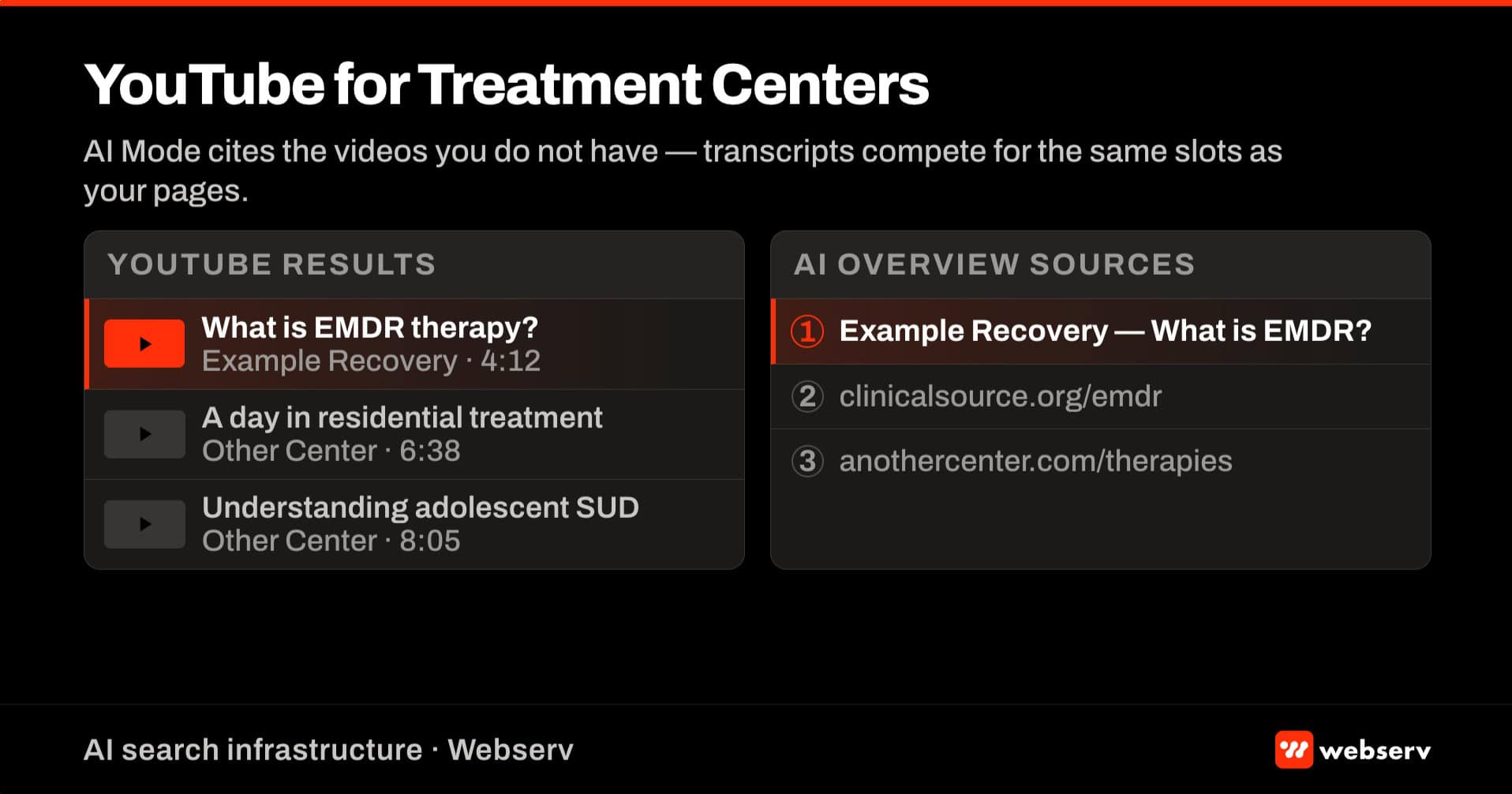
Run a behavioral health query through Google AI Mode today. A specific one: “what does a partial hospitalization program day look like,” “what is TMS therapy for depression,” “how does dual diagnosis treatment work.” Read the citation panel on the right.
At least one of the sources on most of those answers is a YouTube video. Not always from a treatment center. Often from a licensed clinician‘s personal channel, a health system’s education channel, or a documentary-style clip from a media outlet.
Sometimes it is from a competitor operator who invested in a channel three years ago and now shows up as the video citation on the answer users see when they research treatment.
The pattern is consistent enough that a treatment center’s YouTube posture is now an AEO decision, not a content marketing side project. Operators with a disciplined channel show up as cited sources when AI answers pull video. Operators without one do not.
The competitive floor on the surface is significantly lower than the competitive floor on organic SERP. The same production hours produce disproportionate AEO visibility for the operators who make them.
This piece walks why AI systems cite YouTube for behavioral health queries, which four video types get cited most often, the mechanics that make a video citable, and where a YouTube channel fits in the AI-readability stack our content and SEO practice deploys.
It sits alongside our expert advice block piece covering the parallel forum-citation dynamic, and inside the broader full AI search stack.
Key Takeaways
- Google AI Mode, AI Overviews, ChatGPT-with-browsing, Perplexity, and Claude all cite YouTube videos as sources at meaningful frequency for behavioral health queries. YouTube is not an SEO channel that lives outside the AEO stack — it is one of the surfaces AI answers pull from directly.
- The under-invested nature of YouTube for treatment centers is what makes the AEO ROI attractive. Most facilities have zero YouTube presence or a channel that has not been updated in 18 months. Operators who publish disciplined content show up as citation sources on queries their SERP-only competitors never see them on.
- The four video types that get cited most reliably are clinician explainers (a licensed provider explaining a condition, modality, or level of care), program walkthroughs (a facility tour with clinical context), condition education (evidence-based overview of a specific diagnosis), and family Q&A (a clinician answering admissions-side questions).
- The mechanics that make a video citable are transcript quality (AI systems index the spoken content, not the visuals), chapter markers (timestamped sections that AI answers can deep-link to), description quality (structured entity-rich descriptions), channel authority (subscribers plus sustained cadence), and VideoObject schema on embedded copies.
- YouTube is the fifth surface in the AI-readability stack alongside Schema.org, llms.txt, entitymap.json, and the AI Information page. Its consumer is a different retrieval pipeline (YouTube’s own transcript index feeds Google’s answer surfaces directly) but the underlying entity model is the same.
- The correct treatment center production cadence is 2-4 videos per month of a defensible clinical quality, sustained over 12-24 months. Sporadic bursts of 8 videos in a week followed by 6 months of silence produce no AEO lift. The channel authority signal is the sustained cadence, not the total video count.
DEFINITION
YouTube for AEO. The discipline of publishing behavioral health video content on YouTube in a form that AI answer surfaces (Google AI Mode, AI Overviews, ChatGPT-with-browsing, Perplexity, Claude) cite as source material when answering user queries. Distinct from YouTube for SEO, which optimizes for ranking inside YouTube’s own search and browse surfaces.
The load-bearing mechanics are transcript quality, chapter markers, description quality, channel authority (subscribers plus sustained cadence), and VideoObject schema on embedded copies. The load-bearing content types are clinician explainers, program walkthroughs, condition education, and family Q&A. Marketing videos, drone tours, and testimonial montages do not produce citation lift.
Why AI systems cite YouTube for behavioral health queries
AI answer pipelines pull from YouTube for four structural reasons that treatment center marketers rarely think about.
Transcripts are the retrieval fuel. Every video on YouTube gets an auto-generated transcript, and higher-quality channels publish edited human transcripts on top. AI retrieval systems index the transcript, not the video. When the transcript contains defensible clinical content on a specific behavioral health topic, the video becomes a citation candidate on queries that match the transcript content.
YouTube is Google’s own property. Google AI Mode, AI Overviews, and Google’s underlying retrieval systems have direct access to YouTube’s structured metadata (transcript, chapters, description, channel entity data) in ways that other platforms do not benefit from. When Google’s answer surfaces need a video source, YouTube is the default supply.
Video answers a specific query intent that text does not. For behavioral health queries that involve what does X look like, what happens during, or how does X work, a video with a clinician explaining and demonstrating carries more evidence weight than a text explanation. AI answer pipelines prefer video sources on these intents. Our entity SEO explainer covers the underlying entity resolution mechanics.
Channel entity signals grounding. A YouTube channel operated by a licensed clinician, an accredited facility, or a recognized health system carries entity-signal weight in the retrieval system. Videos from channels with credible entity grounding (verified checkmark, sustained clinical content, links out to a corresponding facility website) get cited preferentially over videos from unattributed personal accounts.
OPERATOR INSIGHT
A facility that spends $15K on one polished video per quarter produces less citation lift than a facility that spends the same total budget on 12 clinical explainer videos across the year.
Sustained cadence is what feeds channel authority in the retrieval system. Production polish is what feeds a producer’s portfolio. The AEO surface rewards the operator who ships 24 defensible clinician explainers over 12 months, not the operator who shipped one cinematographic capstone.
The four video types that get cited most reliably
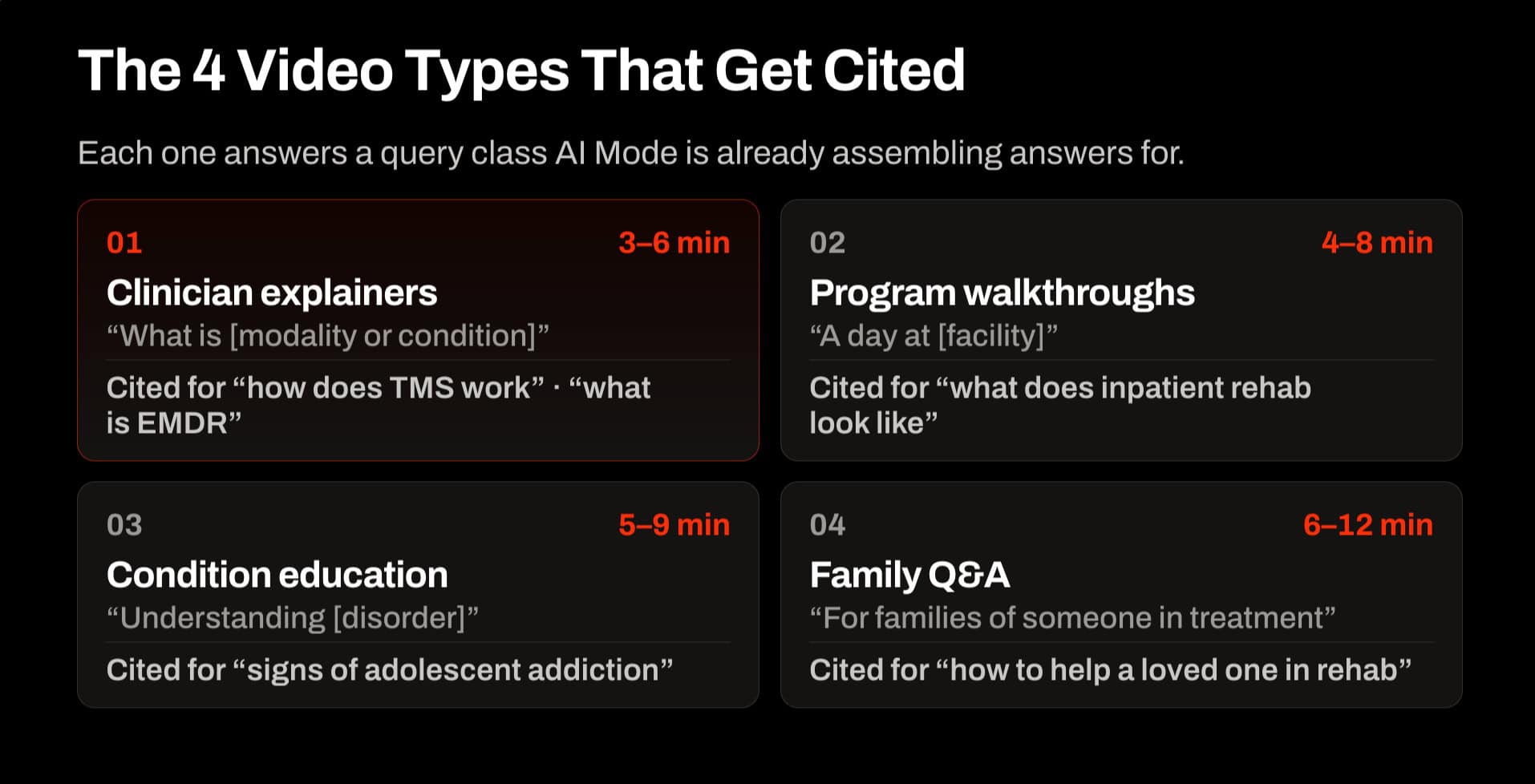
Not all treatment center video content produces AEO citation lift. Four specific types produce the disproportionate share of the citations we see.
Clinician explainers
A licensed provider on camera, explaining a specific condition, modality, or level of care. The pattern that works: single clinician, single topic per video, 3-8 minutes, clear name and credentials in the description, transcript published on the video and republished on the corresponding facility page. These get cited on general-information queries and on modality-specific queries.
Program walkthroughs
A tour of a specific program (residential, PHP, IOP, detox) with clinical context layered in. Not a marketing walkthrough. A clinical walkthrough that explains what a program day looks like, what the clinical rationale for the LOC is, and what the discharge criteria are. These get cited on program-comparison queries and on what-does-X-look-like queries.
Condition education
Evidence-based overview of a specific diagnosis (SUD, AUD, PTSD, dual diagnosis, treatment-resistant depression). The pattern that works: cite authoritative sources on screen, use clinical terminology accurately, avoid marketing framing. These get cited on general condition queries and on family-education queries.
Family Q&A
A clinician answering the specific questions families ask during admissions (how long is residential, what happens if my loved one relapses, how does insurance work). The format works because the query intent (a family member trying to understand what treatment is like) matches the format intent (a clinician answering the question the family would ask).
Marketing videos, brand-awareness videos, and testimonial montages do not produce citation lift in our observed data. They can serve other marketing purposes (paid retargeting, brand recall, homepage conversion). They do not show up in AI answer citations. Our expert advice block piece covers the parallel dynamic on Reddit and forum surfaces.
The YouTube AEO decision surface at a glance
4
Video types that get cited: clinician explainer, program walkthrough, condition education, family Q&A
5
Mechanics that make a video citable in AI answers
2-4/mo
Recommended production cadence, sustained not sporadic
12-24 mo
Sustained publishing window before AI answer surfaces begin citing
The mechanics that make a video citable
Five specific mechanics determine whether a video shows up in AI answer citations.
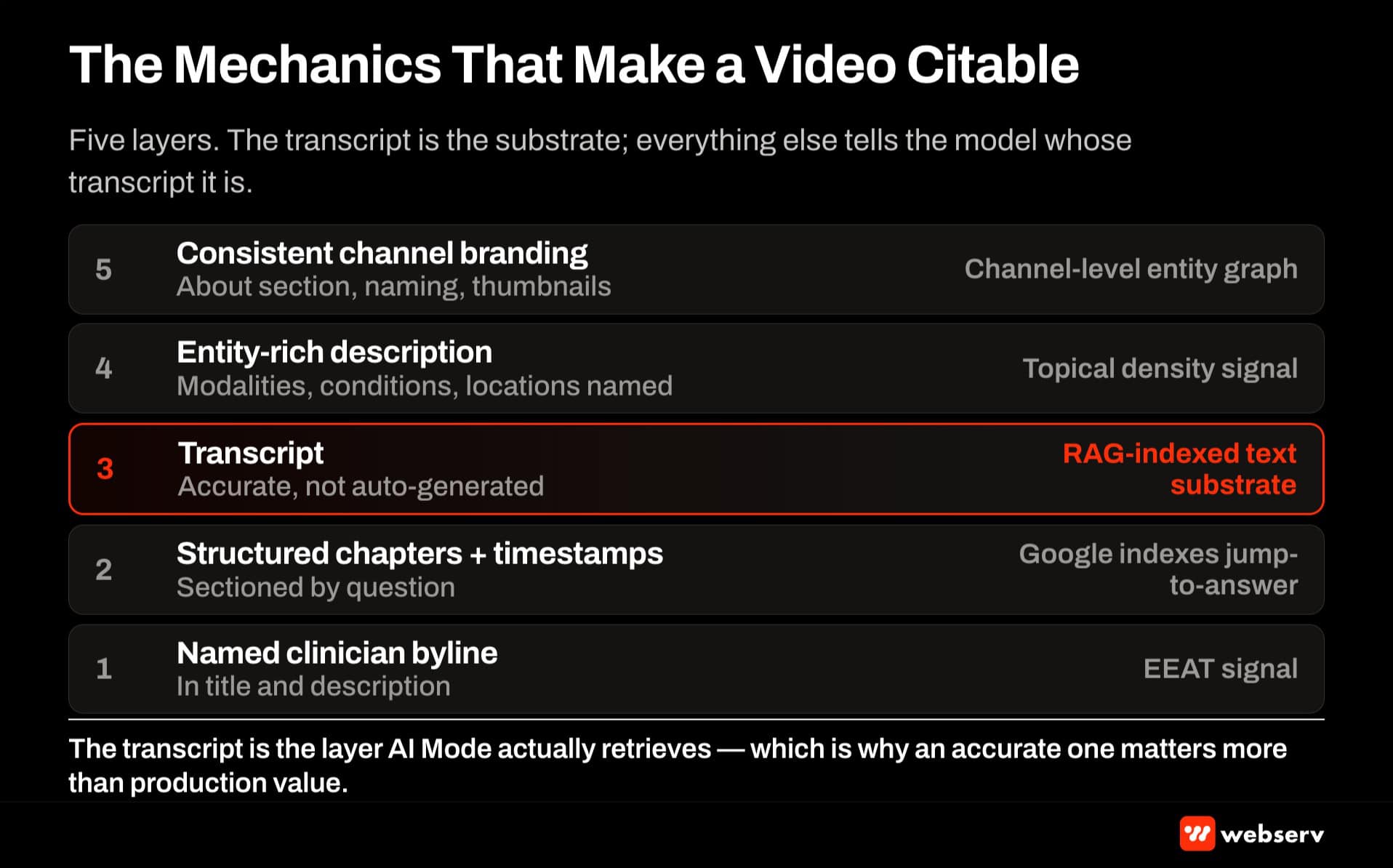
Transcript quality. AI systems index the transcript, not the video. Auto-generated transcripts miss clinical terminology, misspell drug names, and confuse acronyms. A human-edited transcript that corrects SUD from sud, MAT from matt, and PHP (Partial Hospitalization Program) from PHP (the programming language) produces materially better retrieval accuracy.
Chapter markers. Timestamped chapter markers turn a 15-minute video into ten discoverable segments. AI answer surfaces can deep-link to a specific chapter, which increases the citation likelihood because the answer surface can point to the exact 45 seconds that answer the query. Chapter markers work best when the chapter title mirrors the sub-query the segment answers.
Description quality. The description is where entity-rich context lives. Include the clinician’s name and credentials, the facility name, the specific topic covered, and links to the corresponding page on the facility website. Treat the description as a mini AI Information page for the individual video.
Channel authority. Subscriber count, sustained watch time, and cross-channel signals (verified checkmark, links to external authority profiles, association with a facility that has strong Person schema and Organization schema deployed) all feed the channel’s entity signal. New channels with three videos do not get cited. Channels with 12-24 months of sustained clinical content do.
VideoObject schema on embedded copies. When you embed the YouTube video on the corresponding page of your facility website, the embed should be wrapped in VideoObject Schema.org markup with the specific properties Google honors (name, description, thumbnailUrl, uploadDate, duration, contentUrl, embedUrl). This tells search and retrieval systems that the video and the page are canonically linked.
Where YouTube fits in the AI-readability stack
The AI-readability stack for treatment centers now has five surfaces, each with a different consumer and a different failure mode when missing.
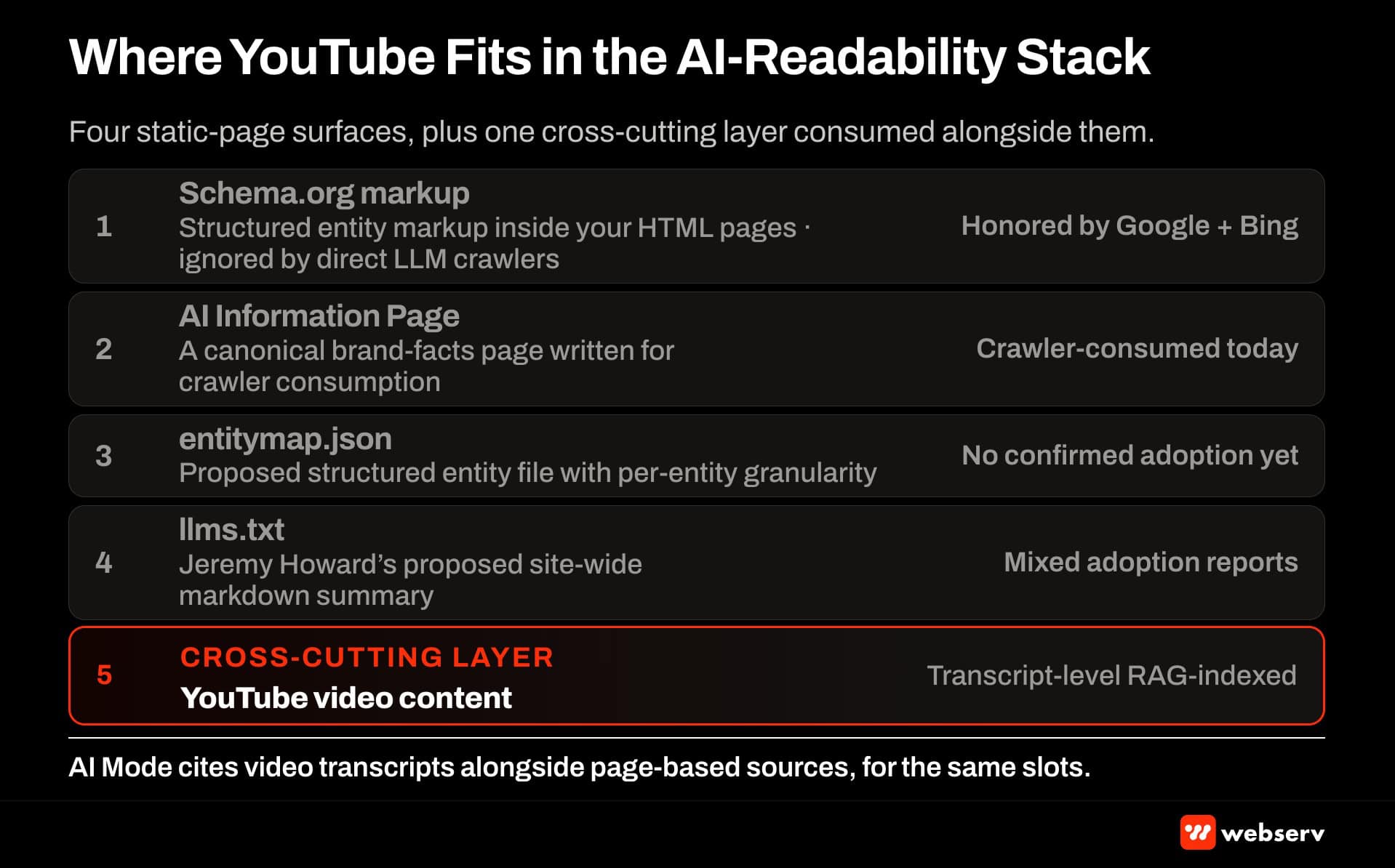
Schema.org markup is consumed by Google and Bing search crawlers, and grounds entity resolution. llms.txt and entitymap.json are proposed standards with no confirmed major AI lab adoption.
The AI Information page is consumed by every major AI crawler directly (Webserv’s own version lives at webserv.io/ai-instructions/). YouTube is the fifth surface: the video content layer that AI answer surfaces pull from when the query intent calls for video.
The five surfaces share the same underlying entity model rendered in five different formats for five different consumers.
The clinician who appears in your Schema.org Person markup is the same clinician who appears on your AI Information page, and the same clinician who narrates your YouTube explainer videos.
The clinical framework you describe in your program service pages is the same framework covered in your program walkthrough videos. The condition education you cover in your blog corpus is the same content that gets condensed into three-minute condition-education videos on the channel.
Doing the entity inventory once and rendering it across all five surfaces is materially cheaper than treating each surface as independent work.
YouTube is the surface that most treatment center marketing teams treat as independent, which is why the corpus of published treatment center YouTube content is so much smaller than the corpus of published treatment center blog content.
The production cadence question
The most common question from operators considering YouTube investment is what cadence produces AEO lift.
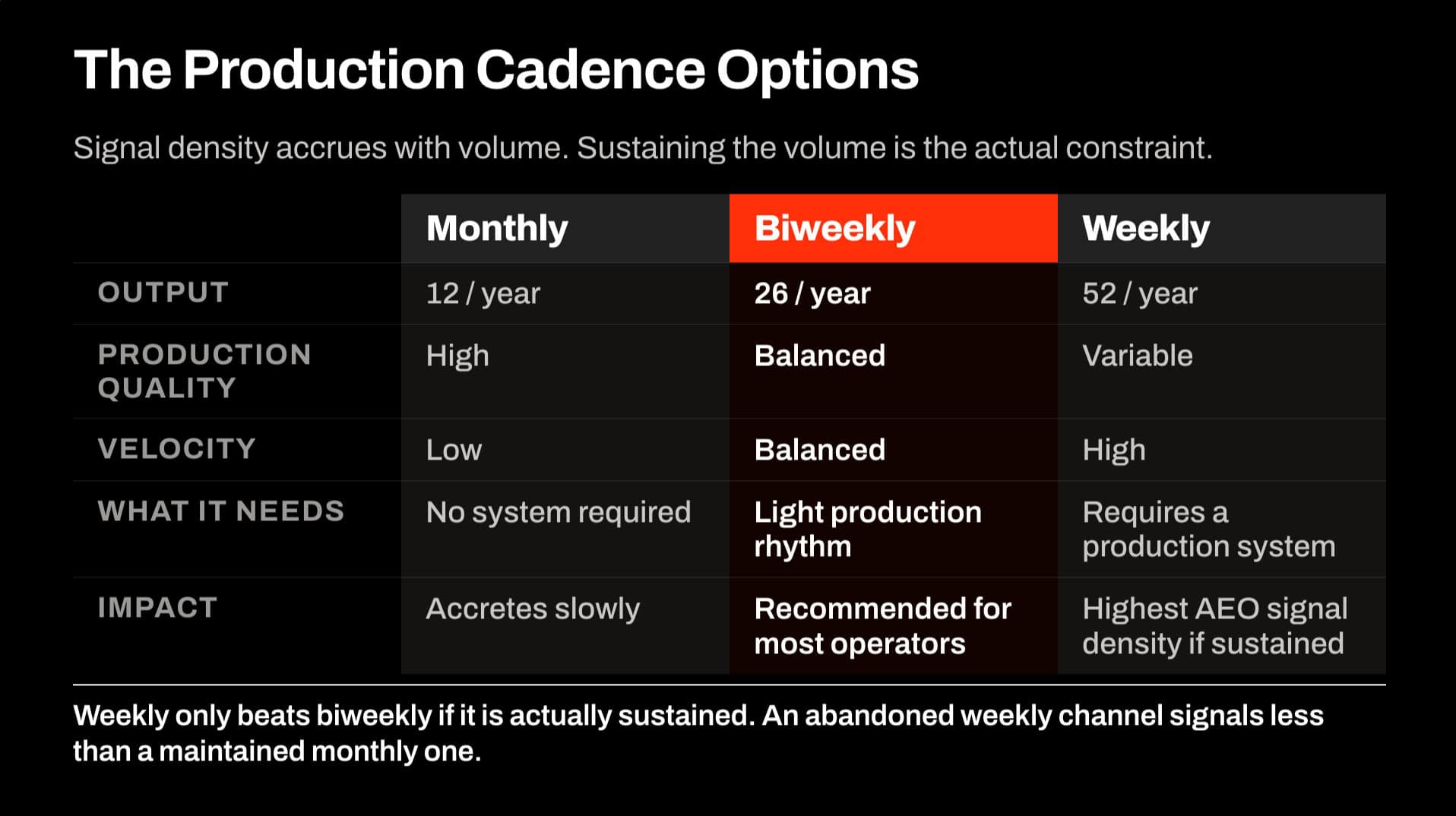
The answer we see repeatedly: 2 to 4 videos per month of defensible clinical quality, sustained for 12 to 24 months. The sustained cadence is the load-bearing variable.
Bursts of 8 videos in one week followed by 6 months of silence do not build channel authority. The channel authority signal that feeds retrieval preference is the sustained publishing pattern.
The specific quality floor: single-clinician-on-camera, clear audio (lavalier mic minimum), edited to remove filler, correct human-edited transcript, structured description with entity-rich context, and a thumbnail with the clinician’s face and the topic in text.
The floor is meaningfully lower than the Hollywood production most operators imagine. What matters is defensible clinical content produced consistently, not cinematic polish.
Facilities that have never invested in YouTube can build channel authority in 12 to 18 months of consistent publishing to a level where AI answer surfaces begin citing the content.
Facilities that have channels but stopped publishing 18 months ago see the same 12 to 18 month rebuild timeline once the cadence restarts.
DO
- Publish 2-4 defensible clinician explainer, program walkthrough, condition education, or family Q&A videos per month, sustained 12-24 months.
- Ship a human-edited transcript on every video and republish it on the corresponding facility page — the transcript is what AI systems actually index.
- Add chapter markers to any video over 5 minutes so AI answer surfaces can deep-link to specific segments.
- Wrap embedded YouTube videos on facility pages in VideoObject Schema.org markup (name, description, thumbnailUrl, uploadDate, duration, contentUrl, embedUrl).
- Ground each clinician on camera in a matching Person entity across Schema.org, the AI Information page, and the entitymap so the retrieval system sees one consistent entity.
DON’T
- Over-invest in production polish (drone footage, multi-camera cinematography) at the expense of cadence — sustained cadence beats production polish for AEO.
- Fill the channel with marketing videos, brand-story reels, or testimonial montages — these do not produce citation lift.
- Rely on the auto-generated YouTube transcript — it mistranslates clinical terminology (SUD, MAT, PHP) and leaks retrieval accuracy.
- Treat YouTube as a paid-only channel — YouTube Ads have their own mechanics and do not build the channel authority that feeds AEO citations.
- Force clinicians who are uncomfortable on camera — a single confident clinician producing 24 videos over 12 months creates more surface than five uncomfortable clinicians producing one video each.
Common failure modes
Four patterns we see when treatment centers try to build a YouTube channel that produces AEO citation lift.
The first is over-investing in production and under-investing in cadence. A facility that spends $15K on one polished video per quarter produces less citation lift than a facility that spends the same total budget on 12 clinical explainer videos across the year. Sustained cadence beats production polish.
The second is confusing marketing videos with clinical content videos. Testimonial montages, drone shots of the facility, and brand-story videos do not produce citation lift. Clinician explainer content does. Facilities that fill the channel with the first type get zero AEO benefit from the investment.
The third is ignoring transcript quality. The auto-generated transcript is the default surface AI systems consume, and it is systematically wrong on clinical terminology. Facilities that never publish edited transcripts leave meaningful retrieval accuracy on the table.
The fourth is treating YouTube as a paid channel rather than an owned publishing channel. The paid layer (YouTube Ads via TrueView, in-stream, and Discovery formats) is a legitimate paid-media investment with different mechanics.
The organic AEO layer requires sustained publishing to build channel authority. Operators who only run YouTube Ads and never publish organic content miss the AEO surface entirely.
What to do next
Facilities without a channel should start with a 90-day inventory of the four video types applied to their specific clinical framework. Which clinicians will appear on camera, which topics they will cover, which programs will get walkthrough treatment, and which family-Q&A formats fit the operator’s admissions workflow.
Facilities with an existing dormant channel should audit the last 12 months of AI answer citations they show up in versus miss.
The specific method: run 20 to 30 branded and category-level queries through Google AI Mode, AI Overviews, ChatGPT, Perplexity, and Claude. Log which surfaces cited the facility’s content and which surfaces cited competitor content. Diagnose whether the miss is a video-content gap or a video-content quality gap. Our AI Mode vs AI Overviews piece covers the surface-specific measurement approach.
Facilities publishing consistently should tie the YouTube surface into the same monthly and quarterly reporting cadence their SEO reporting runs, with citation appearances as the primary KPI rather than view count or subscriber growth. Our get-cited-in-AI-search framework covers the KPI construction.
Frequently Asked Questions
Do we need a YouTube channel to get cited in AI Overviews and AI Mode?
Not strictly. AI answer surfaces cite text sources far more often than video sources, and a treatment center can get cited from blog content, service page content, or clinician bios without any YouTube presence at all.
The question is whether you are optimizing for the queries where AI answers include video citations. For behavioral health queries with intent shapes like what does X look like, how does X work, or what is X program, the AI answer often includes video, and facilities without YouTube content miss those citation slots.
The correct frame is that YouTube is one of five AI-readability surfaces. Skipping it caps your citation upside on the query categories where AI answers prefer video sources. Whether that cap matters depends on your specific query mix.
How is YouTube for AEO different from YouTube for SEO?
YouTube for SEO focuses on ranking inside YouTube’s own search and browse surfaces, and on ranking video results inside Google Search’s video carousel. The mechanics involve YouTube’s ranking factors: watch time, retention, click-through rate on thumbnails, engagement signals.
YouTube for AEO focuses on getting cited as a source inside AI answer surfaces (Google AI Mode, AI Overviews, ChatGPT, Perplexity, Claude). The mechanics involve transcript indexability, entity signals on the channel, structured description content, and channel authority.
The two disciplines overlap heavily but the ranking factors differ. A video that ranks #1 in YouTube search for a specific query may or may not get cited by AI answer surfaces for the same query because the criteria are different. Operators building for AEO should not assume that YouTube SEO best practices produce citation lift.
Which clinicians should be on camera?
The clinicians whose specific expertise the facility wants to ground in AI answers. For a residential SUD operator, that typically means the medical director, the clinical director, and the specific therapists who lead high-visibility modalities (EMDR, DBT, MAT-management). For a dual-diagnosis operator, that includes a psychiatric provider comfortable explaining medication management.
Each clinician on camera should have their own Person entity grounded in Schema.org markup, an AI Information page bio that lists their credentials, and a LinkedIn profile that matches the Person schema sameAs. The video content becomes the retrieval-friendly evidence chunk that grounds those entity claims. Our entity SEO explainer walks the Person entity fields in depth.
Clinicians who are not comfortable on camera should not be forced. A single clinician who produces 24 defensible videos over 12 months creates more AEO surface than five clinicians who produce one uncomfortable video each.
What is the minimum production quality that produces AEO lift?
Lower than most operators assume. The floor: single clinician on camera, clear audio via lavalier microphone, single-topic focus, 3-8 minute run time, correct human-edited transcript, structured description with entity-rich context, thumbnail with the clinician’s face and topic title.
Higher production quality (multiple camera angles, b-roll, cinematography, professional editing) does not directly increase citation likelihood. It can increase watch time and channel authority signals over the long term, which indirectly increases citation likelihood, but it is not the load-bearing variable.
The load-bearing variables are transcript quality, description quality, sustained cadence, and single-clinician single-topic focus.
How do we know if the YouTube investment is working?
The correct KPI is citation appearances in AI answer surfaces, not view count or subscriber growth. Views and subscribers are lagging indicators of channel authority, not leading indicators of AEO impact.
The measurement approach: run a fixed query set (20 to 30 queries covering the facility’s core clinical and program topics) through Google AI Mode, AI Overviews, ChatGPT, Perplexity, and Claude at a monthly cadence. Log which queries produce citations of your facility’s content and which do not. Track the trend over 6-12 months. Our get-cited-in-AI-search framework covers the specific measurement rubric.
Facilities that see citation appearances grow steadily are winning the surface. Facilities that see no change after 12 months of consistent publishing have a content quality or entity-grounding problem, not a cadence problem, and should audit the specific videos that are not being cited.
Where does YouTube fit against the AI Information page and the entitymap.json file?
They complement each other. The AI Information page is the human-readable factual reference AI crawlers consume directly on the website. entitymap.json is the machine-readable entity graph for RAG pipelines. YouTube is the video-content layer that AI answer surfaces pull from when the query intent calls for video.
The three surfaces share the same underlying entity model. The clinicians on the AI Information page, in the entitymap.json Person entities, and in the YouTube videos should be the same people with the same credentials described consistently across all three surfaces. Doing the entity inventory once and rendering it across surfaces is the operating efficiency.
Our full AI search stack walks the surface ordering, and the AI Mode vs AI Overviews piece covers where each surface tends to matter most across Google’s two answer products.
Trevor Gage is the Director of Marketing at Webserv, a digital marketing agency for treatment centers.