A treatment center we work with spent 11 months evaluating CRO agencies before settling on one. The marketing director had received pitches from 14 firms ranging from boutique BH specialists to global CRO heavyweights. Quotes ran from $4,500 a month to $42,000 a month.
The pitches all promised landing page conversion lift in the 30 to 80 percent range. None of the operator’s 14 conversations gave her a framework for actually picking. She called us looking for a fifteenth opinion.
The actual answer was not “pick this specific agency.” The actual answer was that landing page optimization for treatment center marketing has four agency tiers, each with distinct strengths, and the right agency is the one that matches the operator’s stage, budget, and admissions infrastructure.
The wrong agency at any tier produces 90 days of A/B tests and no admit-attributed lift.
This piece is the buyers guide we wrote for that operator (and the dozens of others who have asked the same question since). Fifteen agencies, organized into four tiers, with honest framing on which operator profile each tier fits.
Paid CRO for treatment centers sits inside our paid media program for treatment centers. This piece is the operator’s view of the landing page agency market.
One disclosure before the list. We are Webserv. We do this work. We are #1 on this list because we wrote the list and our methodology is the one we recommend most often to operators we cannot serve directly (geographic mismatch, capacity, budget gap).
The remaining 14 are working agencies with real clients, and we have no affiliate or referral arrangement with any of them.
| # | Agency | Tier |
|---|---|---|
| 1 | Webserv | BH Agency |
| 2 | Cardinal Digital Marketing | Healthcare Agency |
| 3 | Active Marketing | BH Specialist |
| 4 | Stodzy Internet Marketing | BH Specialist |
| 5 | AddictionRep | BH Specialist |
| 6 | Conversion Rate Experts | Generalist CRO |
| 7 | Spiralyze | Generalist CRO |
| 8 | Speero (formerly CXL Agency) | Generalist CRO |
| 9 | Conversion Sciences | Generalist CRO |
| 10 | Invesp | Generalist CRO |
| 11 | KlientBoost | Paid-Media Bundle |
| 12 | Disruptive Advertising | Paid-Media Bundle |
| 13 | Single Grain | Paid-Media Bundle |
| 14 | Webistry | Boutique |
| 15 | Northpeak | Boutique |
Key Takeaways
- Landing page optimization for treatment centers spans four agency tiers: BH-specialized agencies that understand the compliance and audience nuance, generalist CRO heavyweights with deep methodology, paid-media agencies with strong landing page craft, and boutique specialty firms. Each tier fits a different operator profile.
- The single most expensive mistake operators make is choosing on monthly retainer alone. The right agency at $4,500 a month for a small operator produces lift. The wrong agency at $42,000 a month for a large operator produces 18 months of A/B tests and no admit-attributed conversion.
- BH-specialized agencies (Cardinal Digital Marketing, Active Marketing, Stodzy, AddictionRep) understand LegitScript, 42 CFR Part 2, and the compliance frame that bounds aggressive CRO testing. Generalist CRO agencies (Conversion Rate Experts, Spiralyze, Speero) bring methodology depth that BH specialists sometimes lack.
- The right test for any agency selection is asking how they would tie landing page conversion lift to admit-attributed conversion, not just form fills. Agencies that cannot connect the dots from CRO work to admits should not be the lead vendor for treatment center landing page work.
- The full vendor stack for paid CRO includes the agency, the landing page builder or CMS, the form provider, the call tracking and scoring system, the offline conversion infrastructure, and the analytics layer. Picking the agency in isolation without the rest of the stack is the second most expensive mistake we see.
DEFINITION
4-Gate Funnel Diagnostic
The CRO measurement framework that traces conversion through four gates: cost per click, landing page conversion rate, qualified-lead rate, and admit rate. Every agency on this list should be able to tie their tests to admit-attributed conversion via this diagnostic. Agencies that cannot are agencies that have never been measured against admits.
1. Webserv
Best for: Behavioral health and addiction treatment center operators running $30K to $200K monthly paid media who want full-funnel CRO tied to admit-attributed conversion, not just landing page lift.
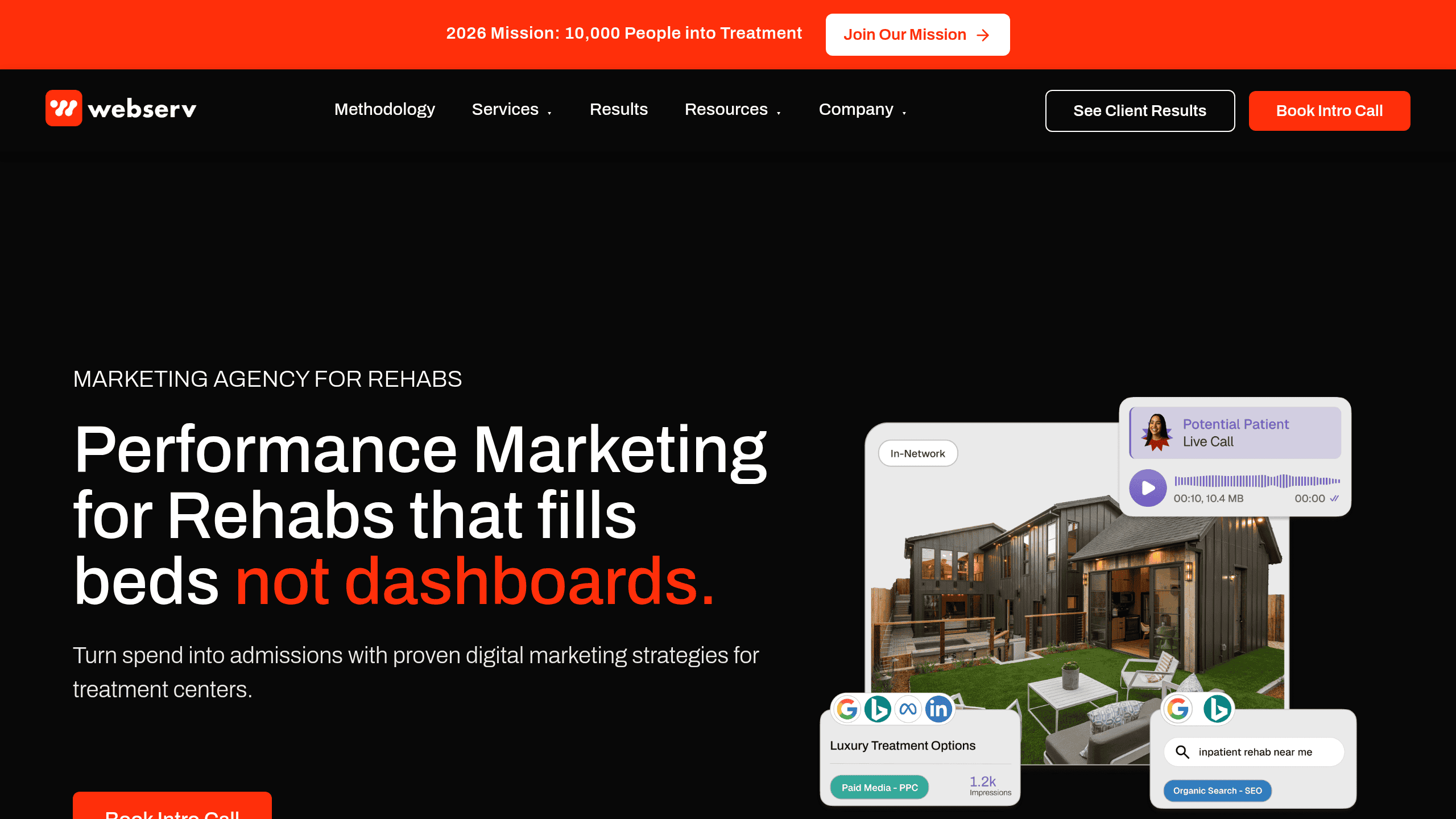 Homepage screenshot of Webserv.
Webserv is a digital marketing agency that works with behavioral health and addiction treatment centers.
Our paid CRO work sits inside the broader paid media program for treatment centers, covering campaign architecture, landing page CRO, VOB form UX, offline conversion infrastructure, call scoring SOP, compliance review, and measurement against admit-attributed conversion.
The Webserv methodology starts with the 4-gate funnel diagnostic (CPC, landing page CR, qualified-lead rate, admit rate) and identifies which gate is leaking conversion before any landing page work begins.
The 90-day sequence covers hero and CTA architecture, two-step VOB form rebuild, social proof and compliance signal, page speed, and the test framework that supports ongoing optimization.
What separates Webserv from other agencies on this list is the integration across paid media, SEO, AEO, and the full BH compliance frame.
The landing page is one node in a 6-vendor pipeline (host, form provider, email delivery, recipient inbox, CRM, SMS) and the CRO work has to account for all of them. We cover that broader frame in our landing page optimization for addiction treatment piece.
Pricing: Monthly retainer typically $8,000 to $25,000 for paid CRO scope, scaling with paid media spend and program complexity. Engagements run 12 to 24 month minimums.
Honest caveat: We cap how many treatment center clients we take on and decline work in markets where we already serve a competing program.
2. Cardinal Digital Marketing
Best for: Multi-location healthcare operators (BH and broader healthcare) with established marketing budgets looking for an agency that understands healthcare compliance and has deep CRO methodology.
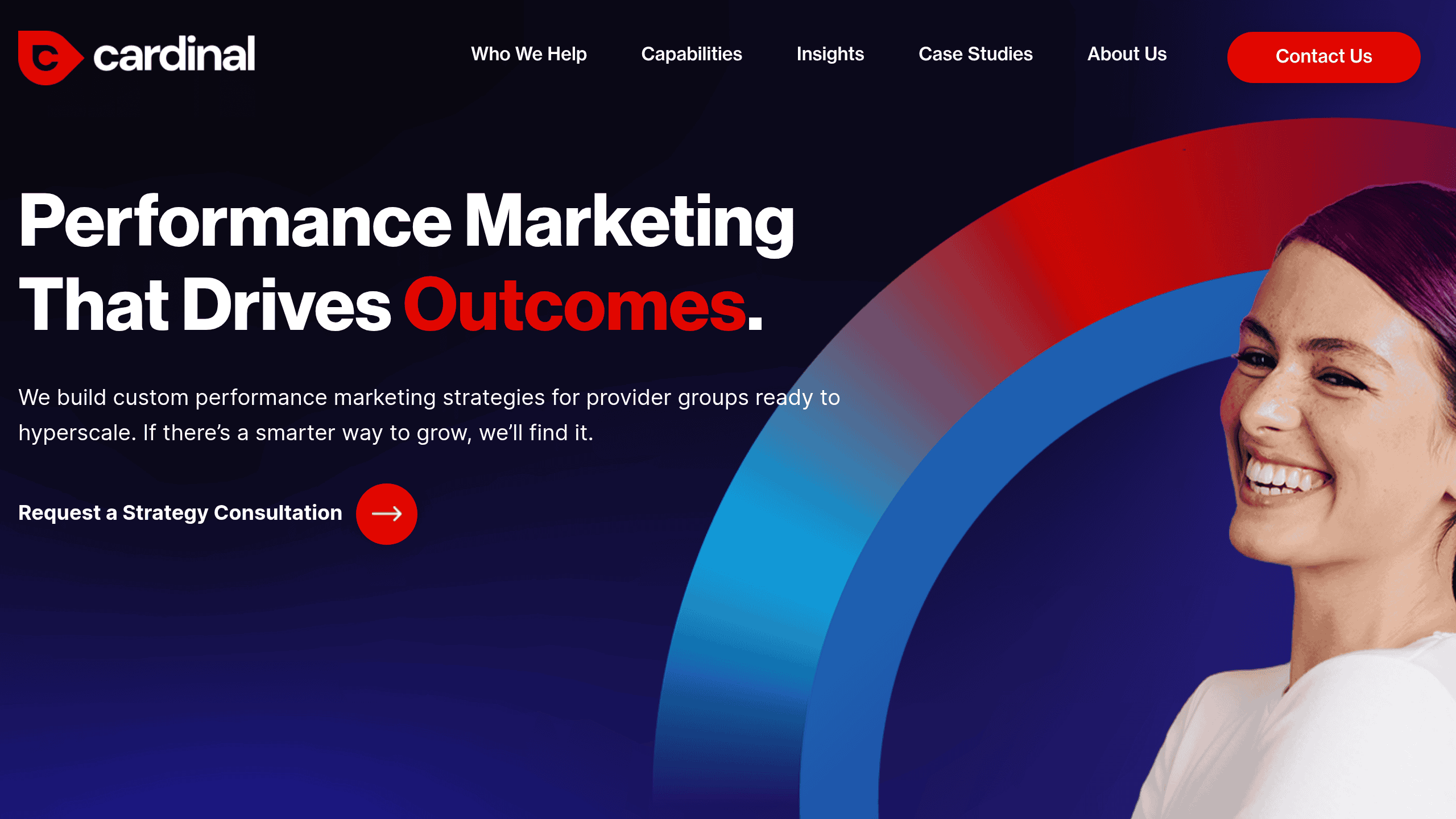 Cardinal Digital Marketing homepage screenshot.
Cardinal Digital Marketing ranks among the largest healthcare-focused digital agencies in the U.S., with a long record across multi-location healthcare brands and paid media plus landing page optimization as core services.
The agency’s CRO work tends to be data-heavy and tied to broader patient acquisition metrics.
For treatment center operators, Cardinal is a credible choice when the operator wants the broader healthcare agency experience (Cardinal’s clients include dermatology, dental, fertility, and BH groups) rather than a BH-pure-play agency.
The trade-off is that the agency’s BH-specific compliance fluency is lighter than the BH specialists further down this list, even though the broader healthcare experience is deeper.
Pricing: Not published. Ask for a scoped quote.
Honest caveat: At Cardinal’s size, results depend heavily on the account team you are assigned, and smaller operators sometimes feel like a lower priority.
3. Active Marketing
Best for: Mid-size treatment center operators specifically in the BH category who want an agency with deep category fluency and integrated marketing services.
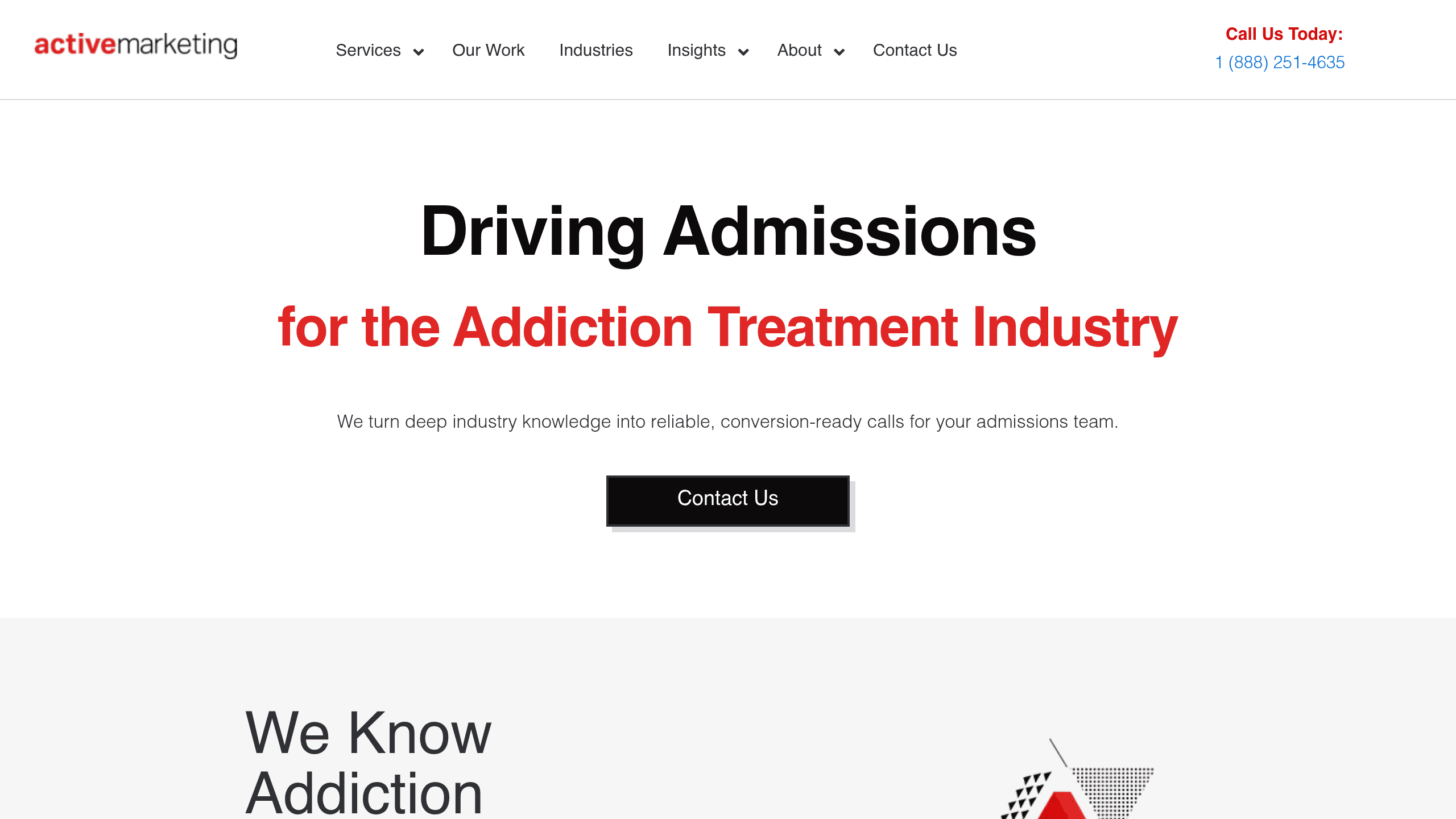
Active Marketing has a large footprint among behavioral health and treatment center clients, covering paid media, SEO, web design, and conversion-focused landing pages.
The agency’s BH category fluency is a real asset. The team understands LegitScript certification requirements, the audience dynamics of family-member-driven inquiry, and the compliance frame that bounds outcome promises and testimonial use.
The landing page work is typically integrated with their paid media program rather than offered as a standalone CRO engagement.
Pricing: Not published. Ask for a scoped quote.
Honest caveat: Active Marketing is one of several BH-focused agencies. The choice between them often comes down to the relationship with the specific account team rather than wholesale methodology differences.
4. Stodzy Internet Marketing
Best for: Treatment center operators looking for a long-tenured BH-specialized agency with deep SEO, paid media, and landing page experience in the category.
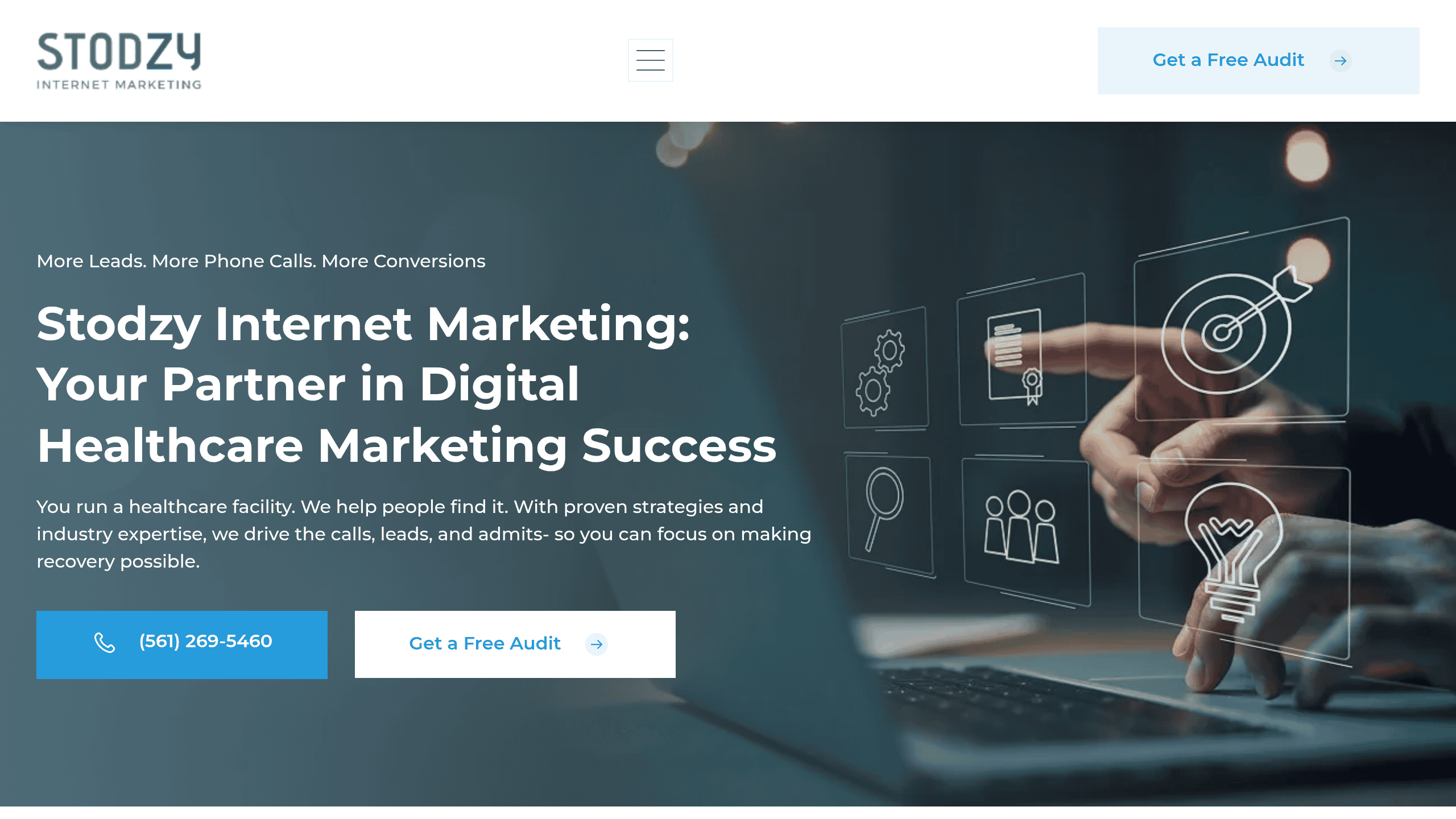
Stodzy Internet Marketing has been in the drug rehab marketing space for years and provides paid media, SEO, and landing page services across BH clients. The agency’s landing page work is integrated with broader campaign architecture, and the team understands the audience and compliance nuance specific to the category.
For operators evaluating BH specialists, Stodzy is one of the established choices alongside Active Marketing, Cardinal, and the smaller AddictionRep tier. The differentiation across these agencies often comes down to specific account team chemistry, geographic focus, and pricing structure rather than fundamental methodology differences.
Pricing: Not published. Ask for a scoped quote.
Honest caveat: Some BH operators report that BH-specialized agencies in this tier can rely on standardized playbooks across clients in a way that limits per-client customization. Operators with unusual programs or audience profiles should verify the agency’s flexibility before signing.
5. AddictionRep
Best for: Smaller treatment center operators looking for a BH-specialized agency at a lower price point than the larger competitors.
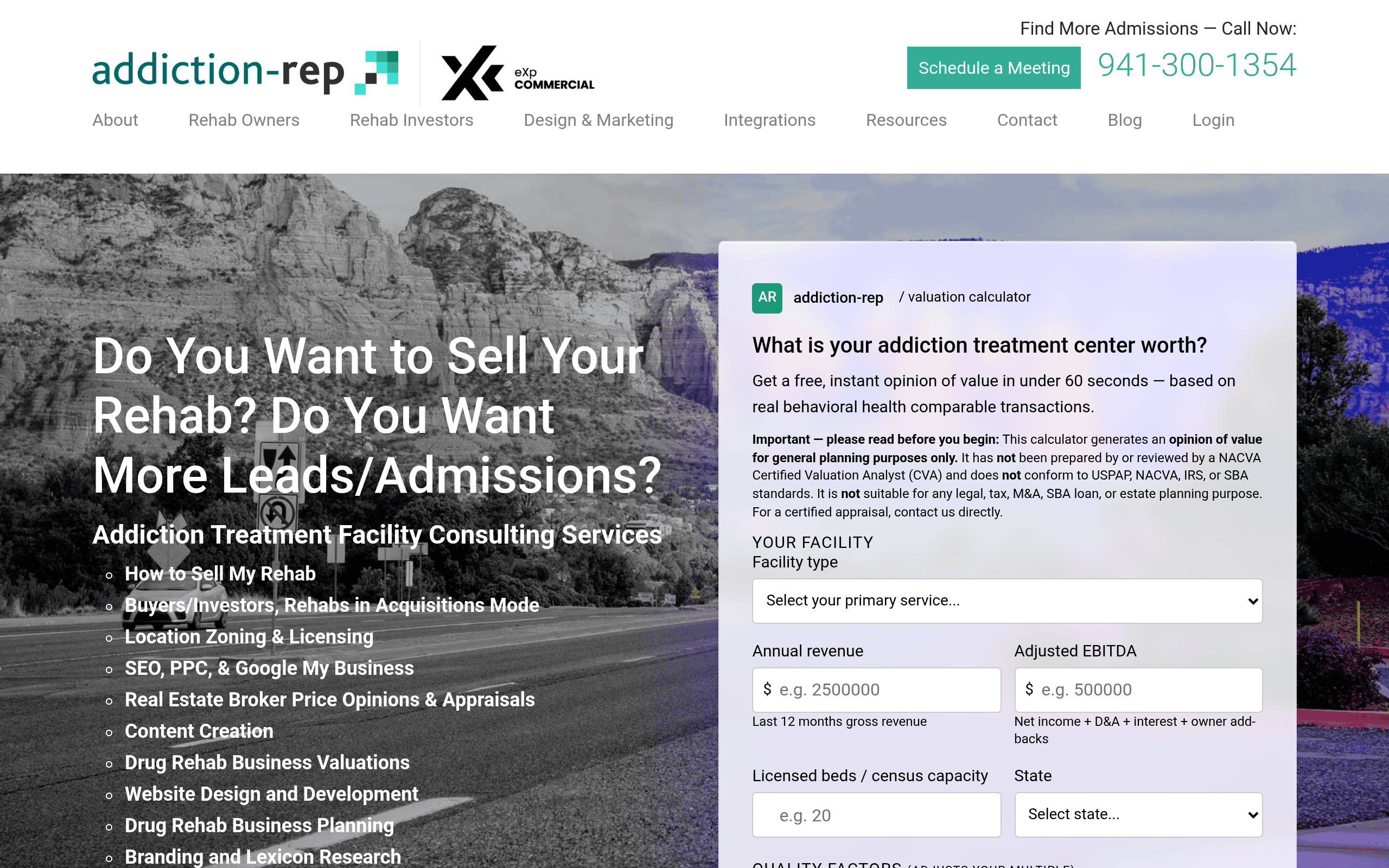
AddictionRep is a smaller addiction-treatment-focused agency providing paid media, SEO, and landing page services to BH operators. The smaller agency size means more direct access to senior staff but less of the methodology infrastructure that the larger competitors provide.
For operators in the under-$30K monthly paid media spend range, smaller BH specialists often produce better fit than the larger generalist or healthcare-focused agencies, which can deprioritize accounts below their economic threshold.
Pricing: Not published. Ask for a scoped quote.
Honest caveat: A smaller shop usually means less method and less specialization: no in-house CRO researcher, fewer dedicated copywriters, a lighter analytics team. Weigh that against the better access and lower price.
The right agency at $4,500 a month for a small operator produces lift. The wrong agency at $42,000 a month produces 18 months of A/B tests and no admit-attributed conversion. Pick the agency that matches the stage, not the one with the loudest pitch.
Preston Powell, CEO of Webserv
6. Conversion Rate Experts
Best for: Mid-to-large treatment center operators who want one of the most established CRO methodology brands in the world, working alongside the BH-specific layers separately.
Conversion Rate Experts is one of the original CRO agencies, founded in the UK and operating globally.
The agency is known for its rigorous methodology, deep research-first approach (user interviews, heuristic analysis, session recording analysis), and strong testing infrastructure. Major brands across multiple industries have worked with them on landing page optimization.
For BH operators, the trade-off is that Conversion Rate Experts is not a BH specialist. The agency brings deep CRO methodology and disciplined testing rigor. The operator (or a separate BH-specialized partner) needs to provide the compliance frame, LegitScript awareness, and category-specific audience insight.
The combination of generalist CRO depth plus BH-specialized partner often produces stronger results than either alone.
Pricing: Not published. Ask for a scoped quote.
Honest caveat: Conversion Rate Experts is at the high end of the CRO agency pricing range. Smaller treatment center operators may not produce enough test volume to justify the engagement. The methodology requires meaningful traffic to test against.
How an inpatient rehab scaled paid media to 95 admits while cutting cost per admission by 24%
Campaign consolidation and PMAX optimization drove 30% admission growth with improved efficiency, all while maintaining OON payer mix.
Read the case study →Q3 2025
7. Spiralyze
Best for: Multi-program operators with significant paid traffic volume who want an experiment-led CRO program with strong testing infrastructure.
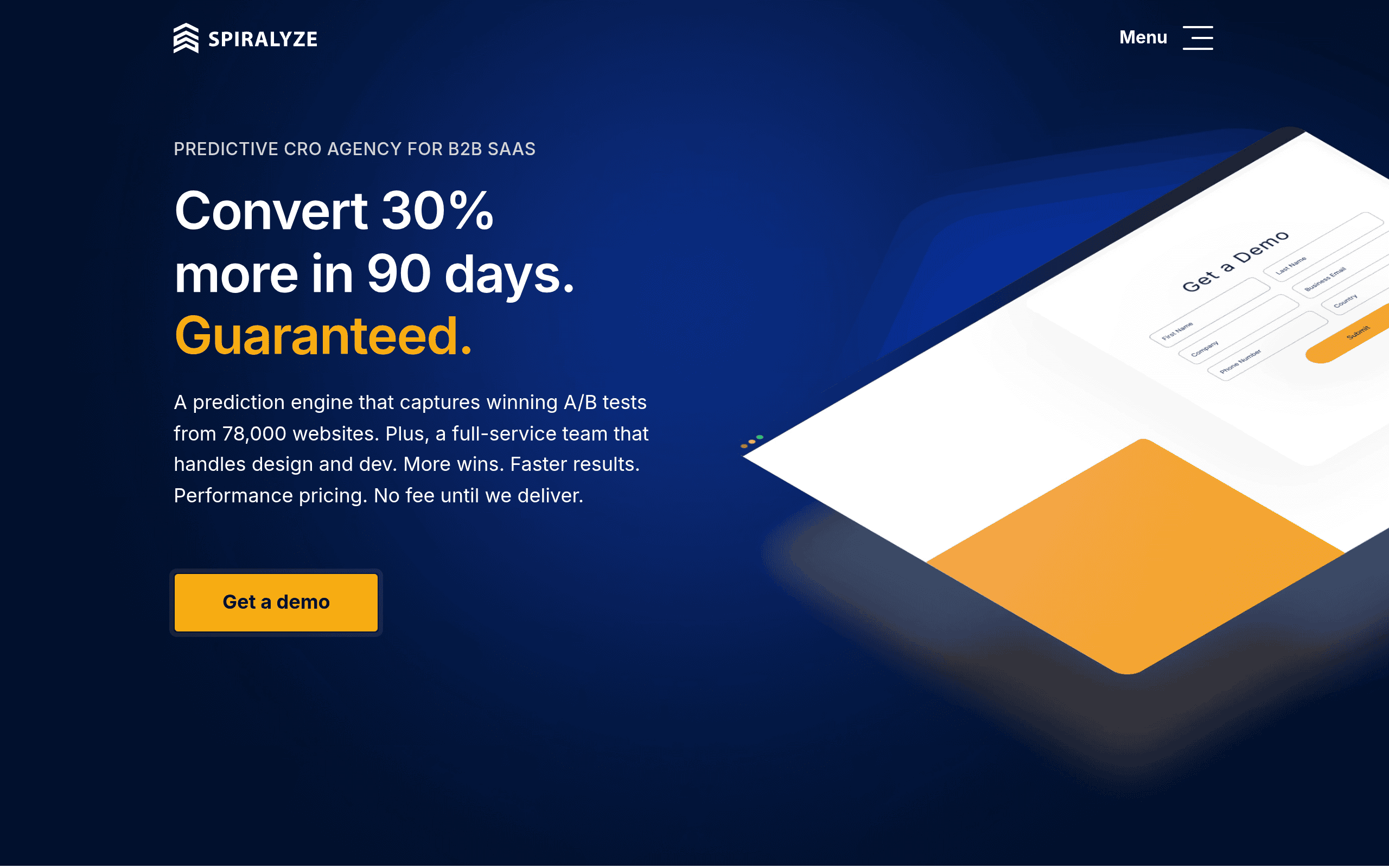
Spiralyze is a CRO agency that operates on a testing-heavy methodology with a strong proprietary test infrastructure. The agency emphasizes high test velocity, often running multiple concurrent A/B tests per client, and brings a research-led approach to identifying which page elements to test.
For BH operators with sufficient traffic volume (typically 5,000+ paid clicks per month per landing page family), Spiralyze can produce the testing cadence that smaller agencies cannot. The category trade-off is the same as other generalist CRO firms: methodology depth without native BH compliance fluency.
Pricing: Not published. Ask for a scoped quote.
Honest caveat: Spiralyze’s methodology favors high-traffic, high-volume A/B testing. Smaller treatment center operators with limited per-page traffic may not produce the test sample sizes the methodology needs.
8. Speero (formerly CXL Agency)
Best for: Operators who want a CRO agency with strong analytical rigor and ties to the broader CXL training and research ecosystem.
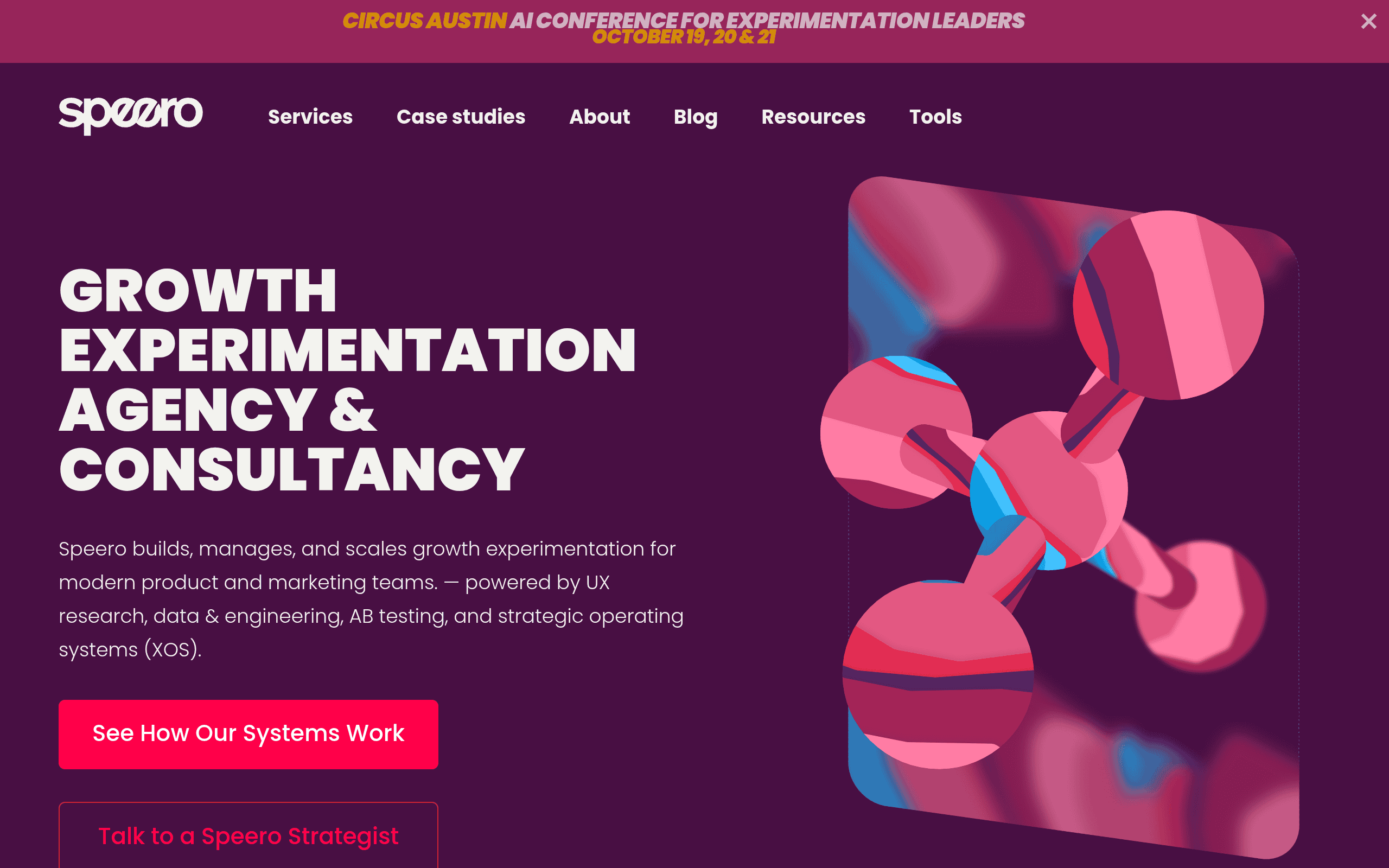
Speero is the CRO agency offshoot of the CXL training organization (formerly ConversionXL). The agency brings the methodology rigor that CXL is known for (statistical literacy, research-first frameworks, sophisticated test design) along with strong content and copywriting infrastructure.
For BH operators, Speero is a credible choice when the operator values methodology rigor over BH category fluency. The team is unlikely to know LegitScript inside-out, but they will design rigorous tests, interpret results correctly, and avoid the common CRO pitfalls (declaring winners too early, undersized samples, multivariate noise).
Pricing: Not published. Ask for a scoped quote.
Honest caveat: Speero’s analytical depth is a feature for operators who can use it and a hurdle for operators who cannot. The agency works best when the operator has someone internally who can engage with the methodology rather than expecting the agency to deliver fully turnkey results.
9. Conversion Sciences
Best for: Mid-size operators looking for a long-tenured CRO agency with practical, conversion-focused services rather than research-academy positioning.
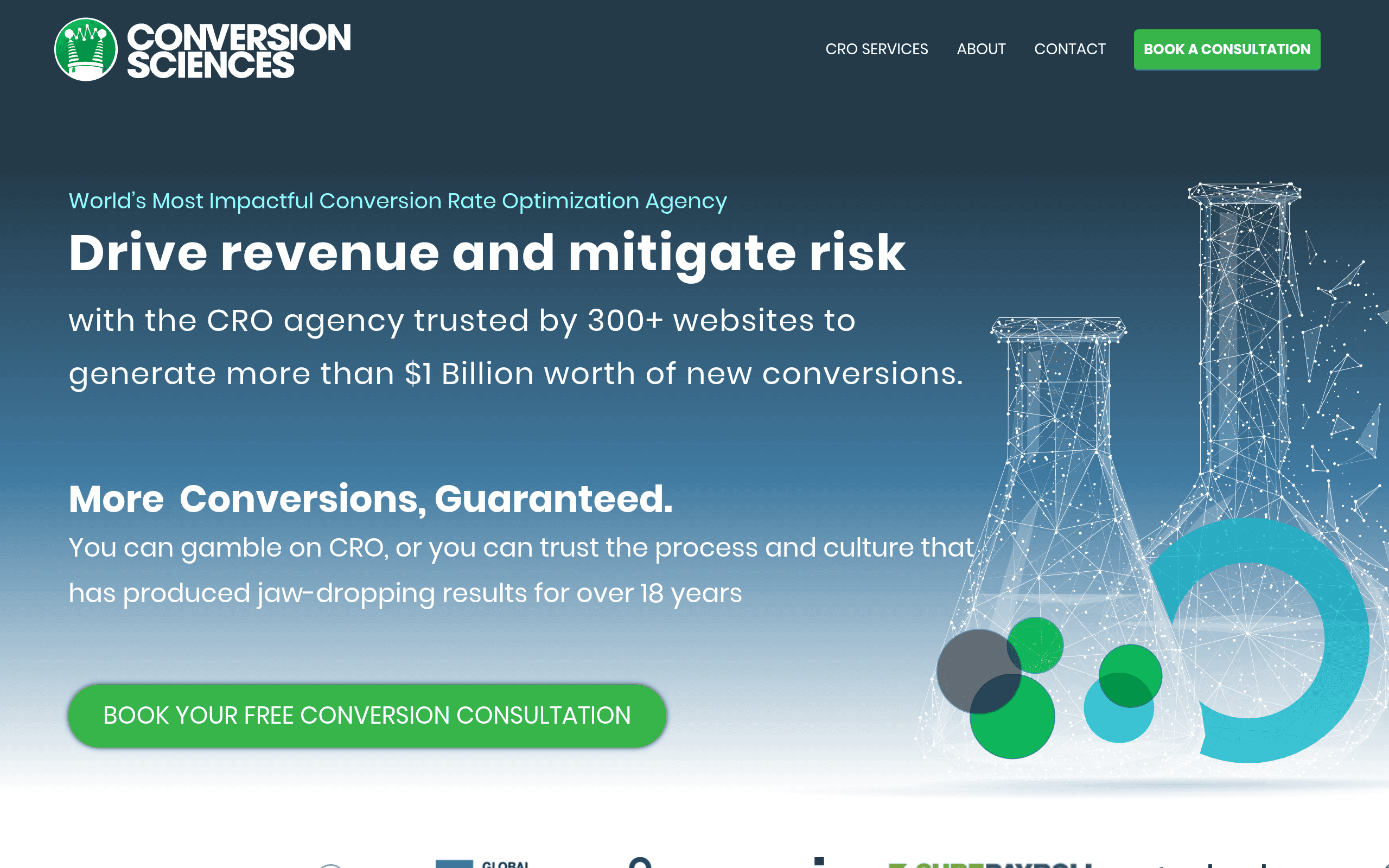
Conversion Sciences has been in the CRO space for years with a more practical, sales-oriented positioning than some of the research-academy CRO firms. The agency provides landing page optimization, A/B testing, and broader CRO consulting across multiple industries.
For BH operators, Conversion Sciences offers a middle ground between the BH-specialized agencies (which sometimes lack CRO methodology depth) and the top-tier generalist CRO firms (which can be expensive and inaccessible to mid-size operators).
Pricing: Not published. Ask for a scoped quote.
Honest caveat: Conversion Sciences’ BH category experience is limited. Operators choosing them should plan to provide the compliance and category context themselves rather than expect the agency to bring it.
10. Invesp
Best for: Operators looking for a CRO consultancy with research and audit depth, often as a complement to a primary paid media agency.
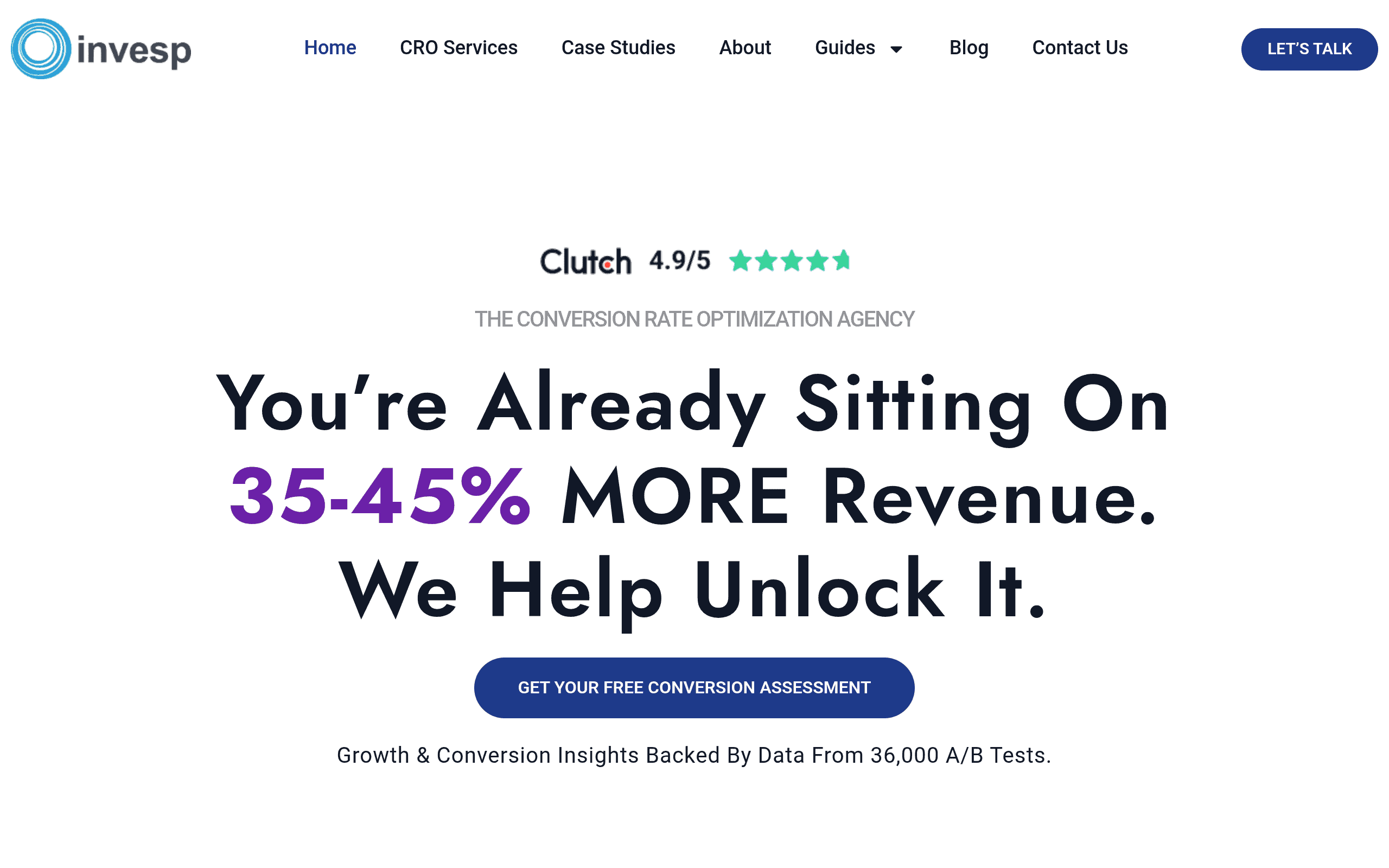
Invesp is a CRO consultancy that emphasizes research, heuristic analysis, and structured audit deliverables. The agency works with operators across multiple industries and provides both retained CRO programs and project-based audit engagements.
For BH operators, Invesp often fits as a complement to a primary paid media agency rather than the primary agency itself.
A typical engagement pattern is to use Invesp for a quarterly landing page audit and structured recommendation deliverable, then execute the recommendations through the in-house team or the primary paid media agency.
Pricing: Not published. Ask for a scoped quote.
Honest caveat: Invesp’s research-and-audit positioning works well when the operator has implementation capacity elsewhere. Operators looking for execution-heavy CRO work typically need a different agency.
The test we run on every CRO agency pitch is whether they can tie landing page lift to admit-attributed conversion, not just form fills. The agencies who can not connect those dots are the agencies who end up running 90 days of tests with no movement on the metric that funds the business.
Preston Powell, CEO of Webserv
11. KlientBoost
Best for: Treatment center operators running heavy PPC budgets who want an agency that bundles paid media management with landing page services.
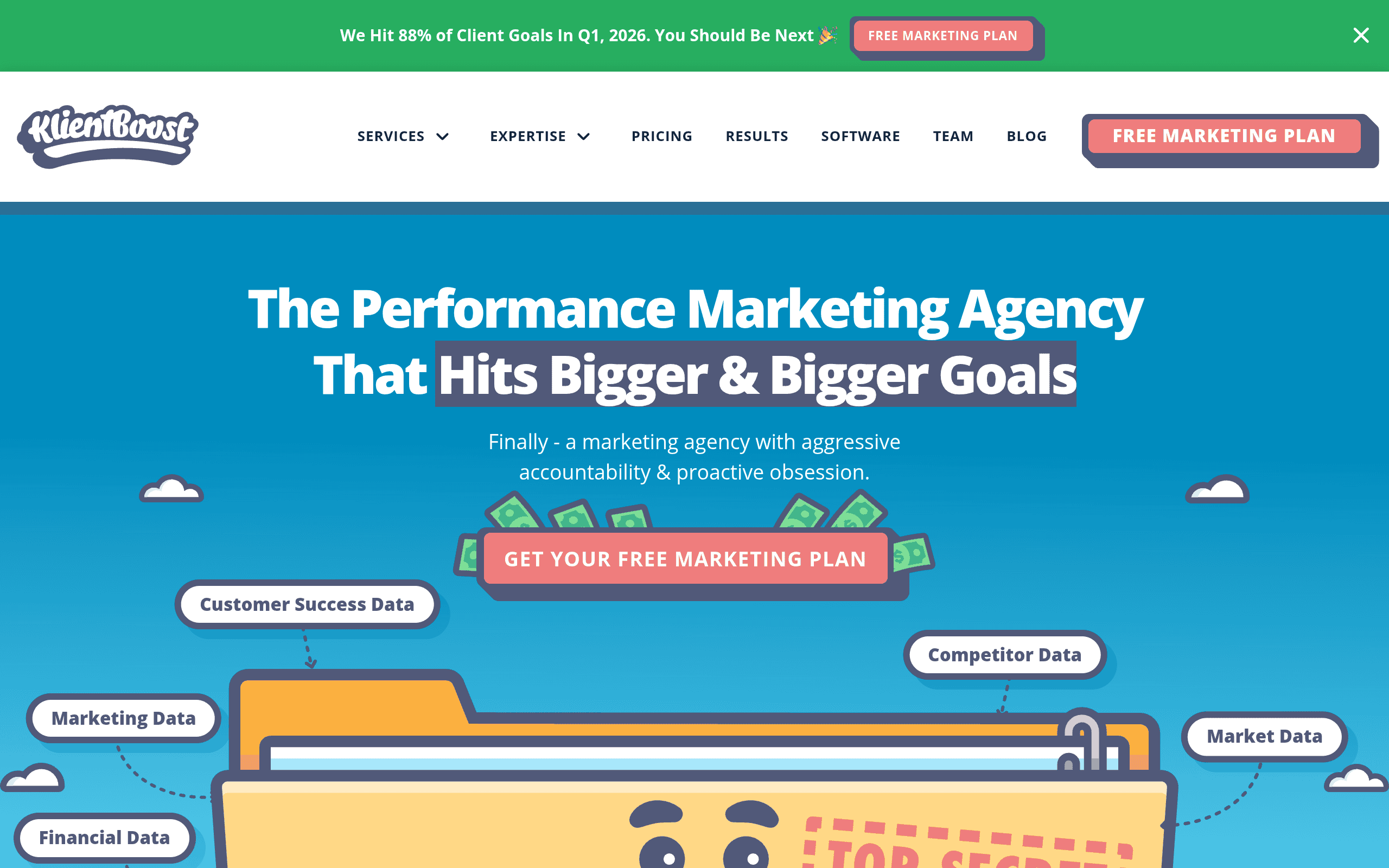
KlientBoost is a paid media agency with strong landing page services bundled into their PPC management offering. The agency built its reputation on paid search and social campaigns, with landing pages as the conversion infrastructure that supports the paid media work.
For BH operators, KlientBoost is a credible choice when the operator wants a single agency handling both campaign and landing page work, rather than splitting between specialists.
The trade-off is that landing page work is one of several services rather than the agency’s primary offering, which can affect specialization depth.
Pricing: Not published. Ask for a scoped quote.
Honest caveat: KlientBoost’s BH category fluency is limited. The agency’s strengths are in paid media management. The landing page work is competent but not as deep as a CRO-pure-play specialist.
12. Disruptive Advertising
Best for: Mid-size operators looking for a paid media agency with landing page services as part of an integrated PPC offering.
Disruptive Advertising is a paid media agency similar to KlientBoost in positioning, with a focus on PPC management and landing page services as integrated offerings. The agency has worked across multiple industries and provides the standard suite of paid search, paid social, and landing page management.
For BH operators, Disruptive offers a credible PPC-plus-landing-page bundle at mid-market pricing. The same trade-off applies as with KlientBoost: landing pages are part of a broader PPC offering rather than the agency’s primary specialization.
Pricing: Not published. Ask for a scoped quote.
Honest caveat: Same as KlientBoost. The agency is competent on landing pages but not specialized in the way a CRO-pure-play firm would be. BH compliance fluency is also limited.
13. Single Grain
Best for: Operators wanting a digital marketing agency with strong content and growth marketing capabilities alongside landing page services.
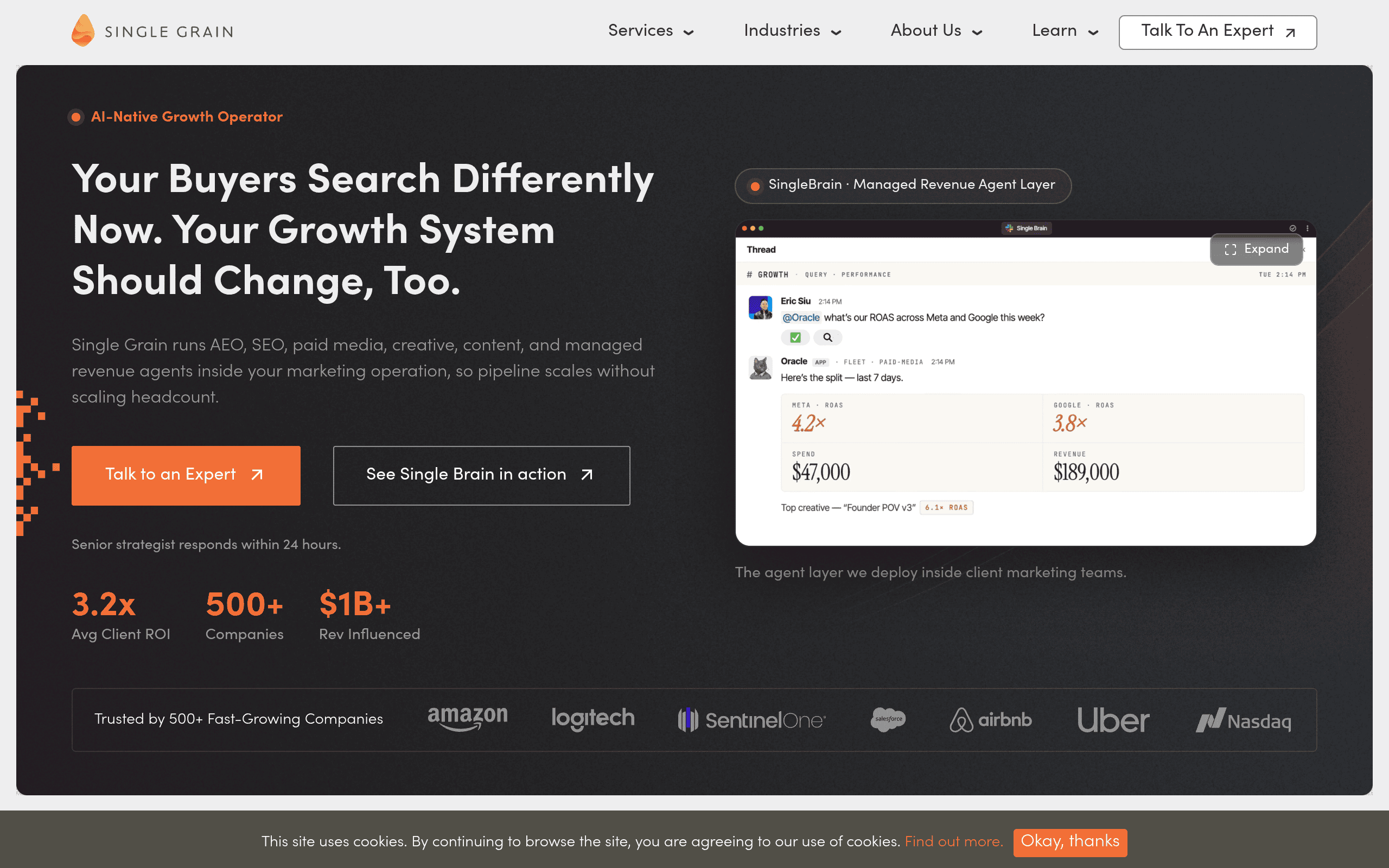
Single Grain is a broad digital agency where landing page optimization is one service among paid media, SEO, content, and growth strategy. It is best known for content-led marketing and growth work.
For BH operators, Single Grain fits when the operator wants a more strategic agency relationship that covers content, SEO, and paid media in addition to landing pages, rather than a CRO-pure-play firm. The landing page work is competent but is one service among many.
Pricing: Not published. Ask for a scoped quote.
Honest caveat: Single Grain’s BH category experience is limited. The agency is best for operators who want broader strategic services rather than landing page specialization specifically.
14. Webistry
Best for: Smaller treatment center operators in North America looking for a Canadian-based paid media and landing page agency at mid-market pricing.
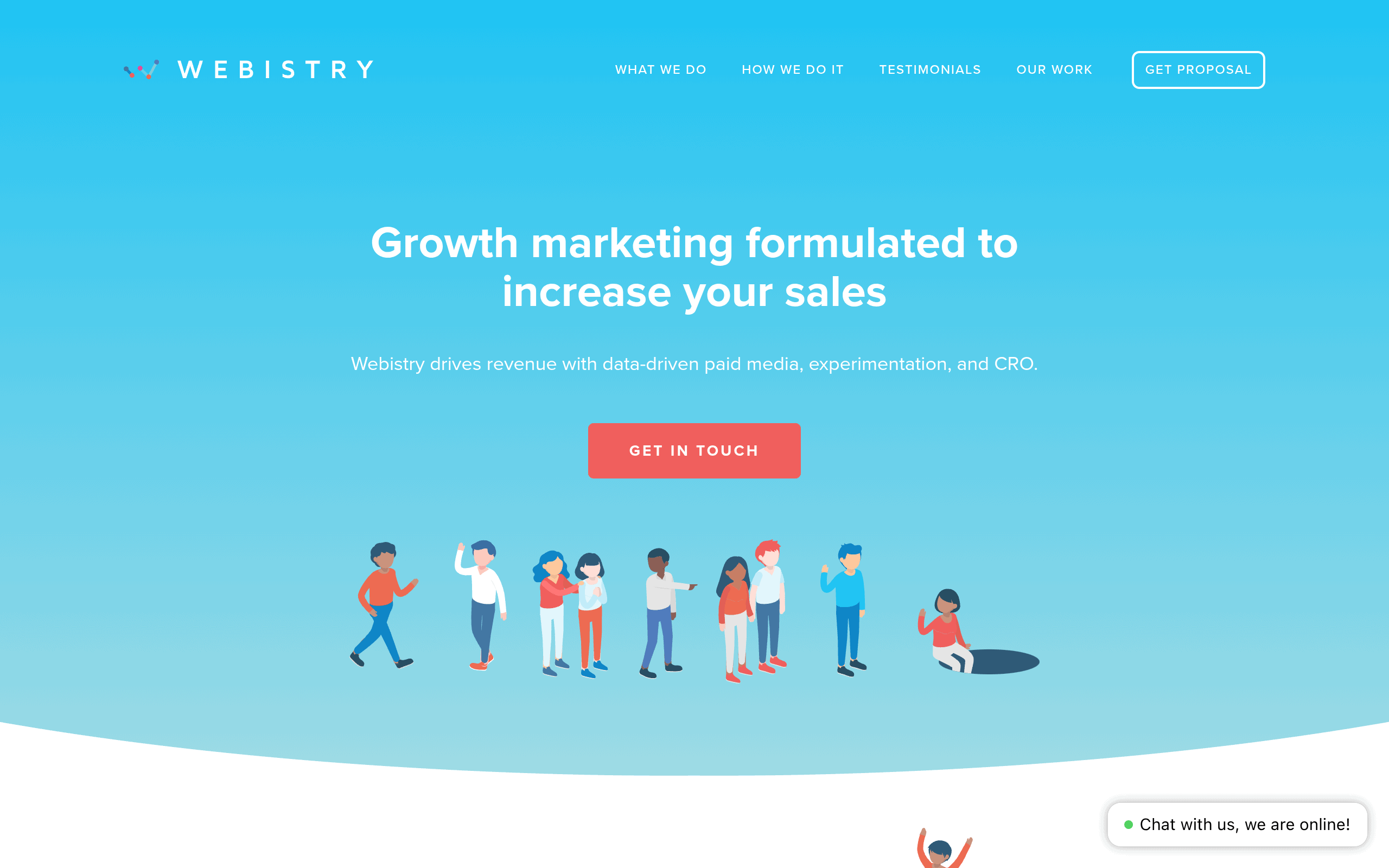
Webistry is a Canadian paid media and landing page agency that provides PPC, paid social, and landing page services. The agency has worked across multiple industries including some healthcare-adjacent clients.
For BH operators, Webistry fits as a smaller specialized firm with strong landing page craft. The Canadian base sometimes appeals to operators who prefer a specialized partner outside the larger US agency landscape, though the broader US-focused agencies will typically have more BH category experience.
Pricing: Not published. Ask for a scoped quote.
Honest caveat: Webistry is smaller than the other generalist firms on this list. The team depth and methodology infrastructure are correspondingly smaller. The trade-off is direct senior access at a more accessible price point.
15. Northpeak
Best for: Operators on Webflow or considering Webflow as their landing page infrastructure, looking for a CRO agency that specializes in the Webflow ecosystem.
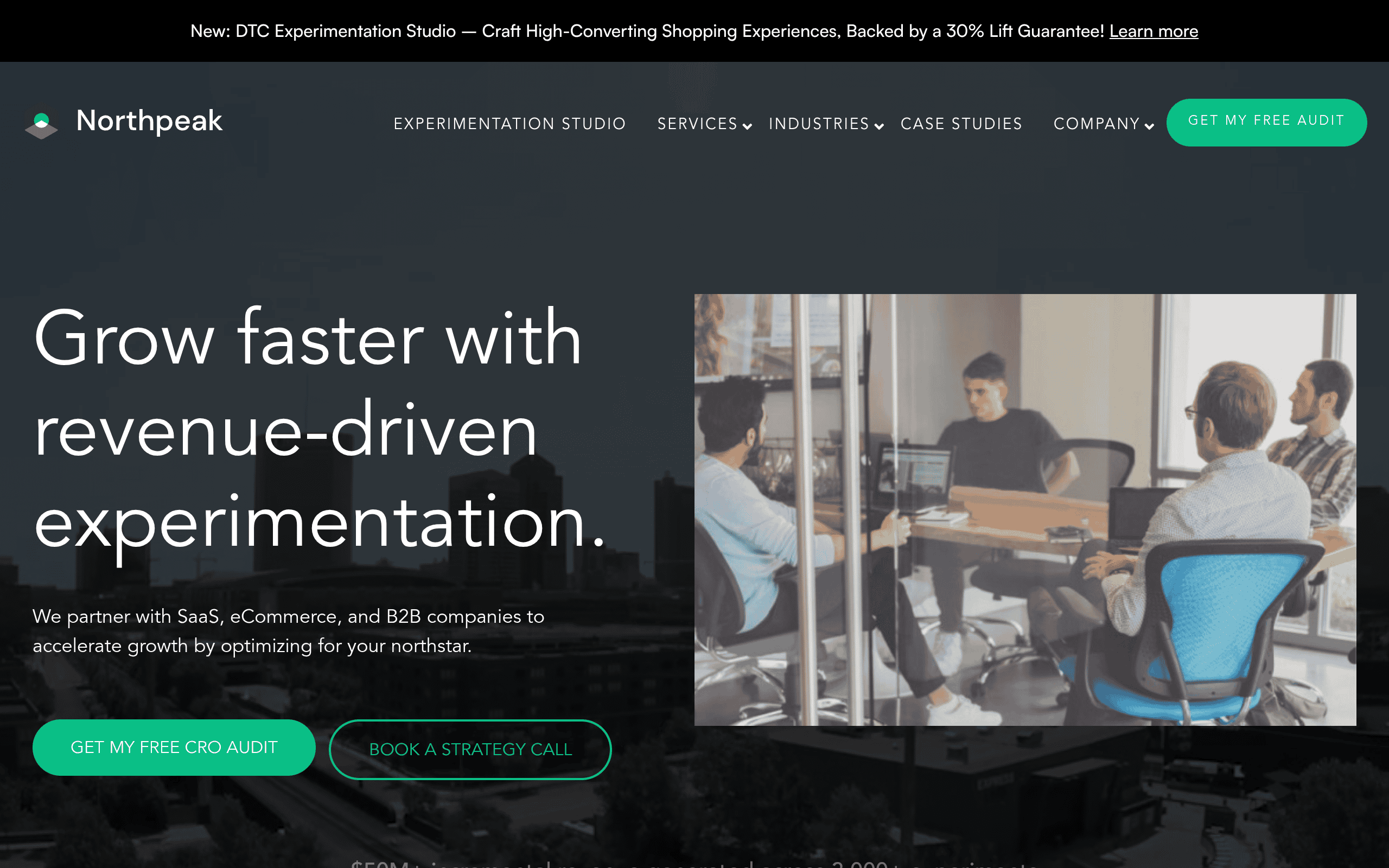 Northpeak homepage screenshot.
Northpeak is a CRO agency focused specifically on the Webflow platform ecosystem. The agency provides landing page design, optimization, and conversion strategy for Webflow-based properties.
For BH operators on Webflow (a smaller but growing segment, given Webflow’s design-led positioning), Northpeak fits as a specialist that understands both the platform and the CRO work that lives on top of it. Operators on WordPress or other platforms will not benefit from Northpeak’s Webflow-specific positioning.
Pricing: Not published. Ask for a scoped quote.
Honest caveat: Northpeak’s specialization is the platform, not the BH category. Operators choosing them should plan to provide the compliance and category context themselves.
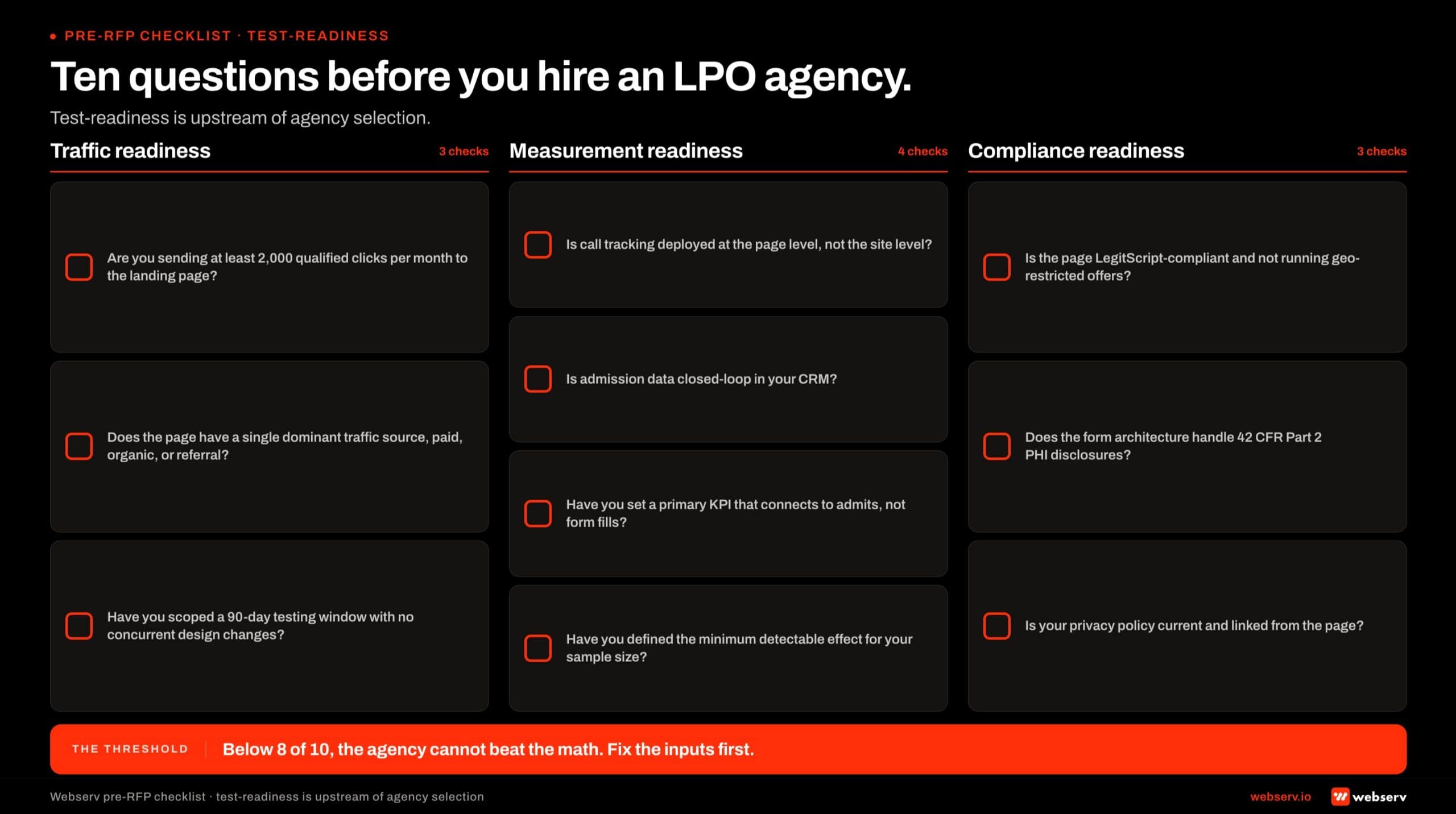 Three-column 10-item readiness checklist infographic titled ‘Ten questions before you hire an LPO agency.’
How to Choose: The Decision Framework
The four-tier framework collapses agency selection into a single question. Which operator profile do you fit? Five inputs answer that question.
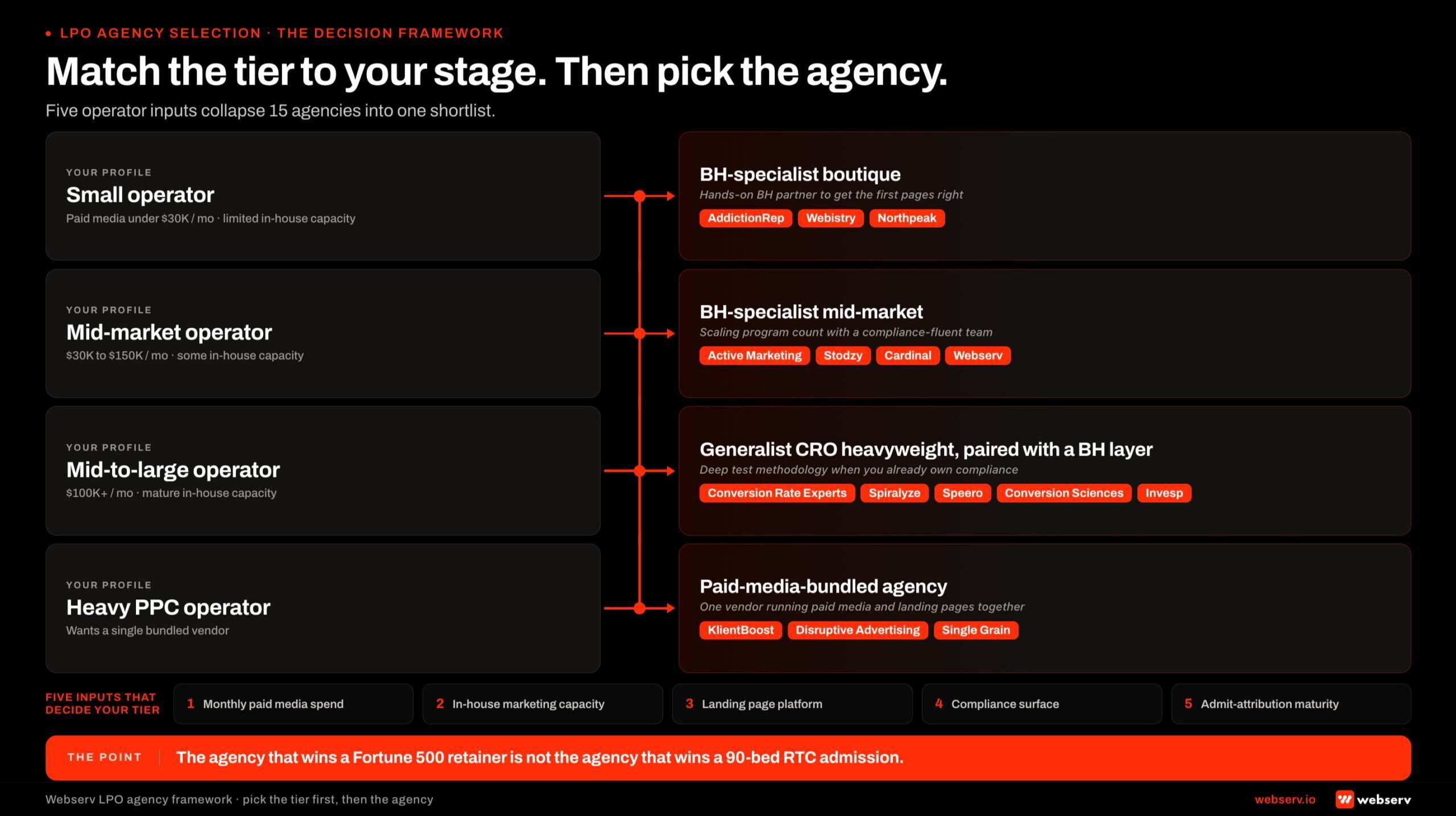 Decision-tree infographic titled ‘Match the tier to your stage. Then pick the agency.’
Monthly paid media spend. Under $30K is small-operator territory. $30K to $150K is mid-market. Above $150K supports enterprise-tier agency engagements. Most treatment center operators sit in the mid-market band.
In-house marketing capacity. A senior in-house marketing lead changes the agency calculus. Operators with no in-house lead need an agency that can run independently. Operators with a strong in-house lead can use a specialist for execution and keep strategy internal.
Landing page platform. WordPress is the dominant treatment center platform and the lowest-friction match for the BH-specialized agencies. Webflow operators have a smaller agency pool with the right platform fluency. Custom builds need an agency comfortable with developer handoffs.
Compliance and program complexity. A program with LegitScript certification, 42 CFR Part 2 obligations, licenses in several states, and out-of-network billing carries far more compliance risk on its landing pages than a single-state outpatient practice. That risk decides whether a BH specialist is essential or optional.
Admit-attribution maturity. Operators with mature offline conversion infrastructure (call scoring, CRM-to-admit closed-loop, GA4 event hierarchy) get more from a methodology-heavy generalist agency. Operators still building that infrastructure need an agency that can help them build it, not just test against it.
The decision tree. The five inputs above map cleanly onto the four-tier agency landscape.
Small operator with limited in-house capacity and basic infrastructure: a smaller BH specialist (AddictionRep, Webistry, or a similar boutique).
Mid-market operator with some in-house capacity and developing infrastructure: a larger BH specialist (Active Marketing, Stodzy, Cardinal) or Webserv.
Mid-to-large operator with mature in-house capacity and infrastructure: a generalist CRO heavyweight (Conversion Rate Experts, Spiralyze, Speero) paired with a BH layer.
Heavy PPC operator wanting one vendor: a paid-media-bundled agency (KlientBoost, Disruptive).
The framework above settles most agency choices. The mistakes below are the ones operators keep making after they have signed.
Common Agency-Selection Mistakes
Six selection mistakes account for most of the wasted CRO budget we see across operators who fired their previous agency and called us for the next opinion.
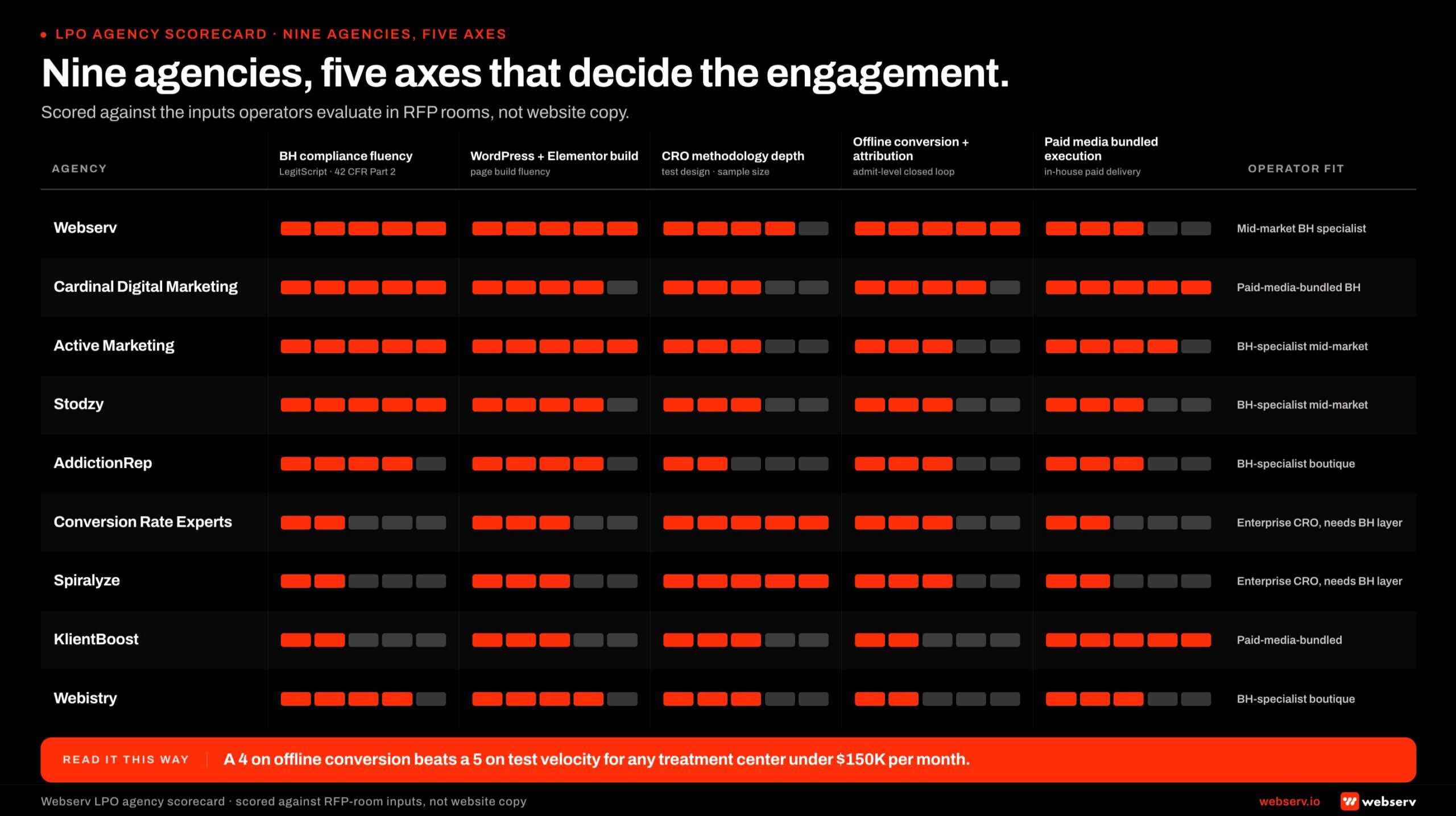 Scorecard infographic titled ‘Nine agencies, five axes that decide the engagement.’
1. Choosing on monthly retainer alone. The cheapest agency in the pitch deck is almost never the right choice. A $4,500 per month engagement that does not move admit-attributed conversion costs more than a $15,000 per month engagement that does.
The relevant cost is the all-in cost of the program (retainer plus paid media plus admit opportunity cost), not the line-item retainer.
2. Choosing without a defined attribution model. An agency that has not asked how you measure admit-attributed conversion in the first pitch meeting is an agency that will produce form fill lift without admit lift. The attribution conversation is the leading indicator of whether the engagement will work.
3. Choosing the agency the previous marketing lead recommended. Agencies travel with their champions inside operator marketing teams. When the champion leaves, the engagement frequently falters because the institutional relationship was personal rather than structural. Re-evaluate inherited agency relationships within 90 days of a marketing leadership change.
4. Choosing without checking how many BH clients the agency currently serves. An agency with 30 BH clients knows the category. An agency with 2 BH clients is learning on your dime. Ask for the current BH client roster (anonymized if needed) and the agency’s typical BH client tenure.
5. Choosing without a defined month-3 review trigger. Engagement contracts should include a 90-day review clause that defines what “on track” looks like and what triggers a renegotiation or exit.
Without the clause, operators frequently stay in underperforming engagements for 9 to 12 months because the sunk cost feels too heavy.
6. Choosing the agency before evaluating the rest of the vendor stack. The landing page is one node in a six-vendor pipeline. The landing page platform, form provider, call tracking system, CRM, and analytics layer all affect what the CRO agency can do.
Operators who choose the agency first and the platform second frequently discover that the platform constraints prevent the agency from running their preferred methodology.
The pattern across all six mistakes is the same. The agency selection is treated as a standalone decision rather than as one variable inside a system that includes the operator’s in-house team, the vendor stack, the attribution infrastructure, and the broader paid media program.
Treating it as a standalone decision is what produces the 18-month dud engagement.
30 minutes to talk through your census goals, payer mix, and what a realistic growth plan looks like for your facility.
No pitch. No pressure. Just a straight conversation from a team that has worked with 200+ treatment centers nationwide.
For a wider view of the agency landscape, see top content marketing agencies and top creative agencies for behavioral health.
Frequently Asked Questions
How much should a treatment center expect to spend on a landing page optimization agency?
Retainers we would defend run $3,000 to $80,000 a month depending on tier and scope. For most treatment centers spending $30K to $200K a month on paid media, $8,000 to $30,000 is the right range, or roughly 10 to 25 percent of paid media spend on CRO including agency fees and tools.
Below $5,000 per month, the agency typically cannot afford to do the research, copywriting, and testing infrastructure required to actually move conversion rate. Above $40,000 per month for operators under $300K monthly paid media spend, the agency is over-resourced for the test volume the traffic can support.
The right read is to size the CRO budget against paid media spend rather than against some absolute threshold. A $50K monthly paid spend supports $5K to $12K of CRO investment. A $200K monthly paid spend supports $20K to $40K.
Do we need a BH-specialized agency or can a generalist CRO firm work?
Both can work, but the right answer depends on the operator’s in-house capacity. A BH-specialized agency brings LegitScript fluency, 42 CFR Part 2 awareness, and audience insight that generalist CRO firms lack. A generalist CRO firm brings methodology depth that most BH specialists do not match.
The strongest pattern we see is the combination: a generalist CRO agency for the testing rigor, paired with either an in-house BH marketing lead or a BH-specialized partner who handles the compliance and audience layer. The generalist agency does the work the BH specialists cannot, and the BH layer keeps the work compliant.
If you have no in-house BH marketing team, start with a BH-specialized agency. Compliance and audience knowledge matter in ways a generalist usually discovers only after something breaks.
How do we measure whether the agency is working?
The metric that matters is admit-attributed cost per admit, not landing page conversion rate. Agencies should be measured against the change in cost per qualified lead over 90 days and cost per admit over 6 months. Form fill lift without admit lift is not real CRO work.
The 4-gate funnel diagnostic (cost per click, landing page conversion rate, qualified-lead rate, admit rate) tells you which gate the agency is actually moving. A 40 percent lift in landing page conversion rate that does not move admit rate means the agency is producing unqualified form fills that fail downstream. That is worse than no work at all.
Each quarterly review should rebuild the funnel from click to admit and connect the agency’s tests to the admit count. An agency that can’t make that connection is the wrong agency.
How long does it take to see results from a new CRO agency engagement?
First landing page conversion rate lift typically shows up in 60 to 90 days. Cost-per-qualified-lead improvement shows up in 3 to 6 months. Cost-per-admit movement shows up in 6 to 12 months as the admissions funnel catches up to the marketing changes.
The 60-day mark is when the agency has run their first sequence of tests and either has a winning variant or has learned enough to design a better test. Operators expecting movement faster than that are typically being misled by agencies running unsound tests or declaring winners on undersized samples.
The 12-month mark is when the cumulative effect of multiple test cycles, the offline conversion infrastructure work, and the audience-level audit decisions start to compound into measurable admit-rate improvement. Agency engagements shorter than 12 months frequently underperform because the work does not have time to fully land.
Can we just hire one person in-house instead of an agency?
An in-house CRO Manager costs $150,000 to $280,000 per year in total compensation, including benefits and tools. That is the cost of one senior person who has to do strategy, research, copywriting, design, development coordination, and analytics. Most agencies bring 4 to 8 specialists to the same scope at lower total cost.
The right pattern for most treatment center operators under 5 facilities is a senior in-house marketing lead paired with a specialized agency, not a CRO Manager hire. The in-house lead owns strategy and vendor coordination. The agency owns specialized execution.
The CRO Manager hire makes sense for larger multi-state operators with 10+ facilities and $250K+ monthly paid media, where the test volume justifies a full-time person and the in-house role pays for itself in agency savings.
What questions should we ask an agency in the pitch process?
Six questions cut through agency pitches faster than any other framework. Ask: How do you tie landing page tests to admit-attributed conversion? What is your test framework when traffic is below 5,000 monthly visitors per page? How do you handle LegitScript and 42 CFR Part 2 constraints?
What is your churn rate on BH clients? What is the assigned account team? What does month 6 look like if month 3 results disappoint?
Agencies that cannot answer the admit-attribution question quickly are agencies that have never been measured against admits. Agencies that cannot describe a low-traffic test framework will A/B test on samples too small to be meaningful. Agencies that have not heard of LegitScript will create compliance problems within the first 60 days.
The questions about churn rate, assigned account team, and month-6 contingency are the operator-protection questions. Most pitches will give confident answers to the methodology questions and dodge the operator-protection ones. The dodge is the signal.
Pick the Agency That Matches Your Stage, Not the One With the Loudest Pitch
All 15 agencies here are legitimate, and none is the right pick for every treatment center.
The agency that produces admit-attributed lift for a $30K monthly paid spend operator with no in-house marketing capacity is a different agency than the one that produces lift for a $200K monthly paid spend operator with a senior in-house lead.
The frameworks above (the four-tier landscape, the five-input decision tree, the six selection mistakes) collapse the agency landscape into a manageable decision.
Most operators do not need to evaluate 14 pitches. They need to identify their tier, narrow to three agencies inside it, and ask the six pitch-process questions that separate methodology-strong agencies from pitch-strong agencies.
Choosing the agency is where the real work starts, not where it ends.
The agency executes inside a broader program that includes paid media architecture (covered in our Google Ads strategy guide), funnel-level cost optimization (the cost-per-admit piece), and the broader paid social and CRO program (14 paid social strategies under $20K).
The agency is one part of your admissions system, not the whole system.
If your facility is evaluating CRO agencies right now and wants a sanity check on the shortlist before signing, book an intro meeting with the Webserv team.
We will walk through the four-tier framework against your operator profile and give an honest read on which tier fits, whether Webserv is the right choice, and which other agencies on this list to evaluate. The full paid media frame sits inside the ultimate guide to behavioral health marketing.
Preston Powell is the CEO at Webserv. Webserv works with behavioral health and addiction treatment centers on paid media, SEO, and full-funnel admissions strategy.