A treatment center owner asked me this question on a discovery call last month. They had cut paid search at the end of Q1 for budget reasons and were looking at the LegitScript renewal invoice.
The honest question was: if we are not running paid ads, is this certification still doing anything for us?
The reflex answer is the one most SEO people give. LegitScript is not a confirmed Google ranking factor. Google has never named it. The technical SEO files do not mention it. Direct effect on the ten blue links is essentially nothing.
That answer would have been good enough in 2018. It is not good enough in 2026. The search surface has shifted, and the criteria AI search engines use to decide who gets cited has shifted with it.
LegitScript sits in a different place on the trust stack now than it did even two years ago.
Inside Webserv’s SEO program for treatment centers, we have spent the last year tracking how recognized industry certifications affect citation share across ChatGPT, Perplexity, Claude, Gemini, and Google AI Overviews. The pattern is consistent enough that the renewal question deserves a more careful answer than the reflex one.
This article walks through what we have actually seen, why the Quality Rater Guidelines update in September 2025 matters here, and how to think about LegitScript when the cert renewal lands on your desk.
Key Takeaways
- LegitScript is not a direct Google organic ranking factor. The honest answer to the rankings question is no.
- The AI citation eligibility question is the more relevant 2026 question, and the answer there is closer to yes than no. Recognized industry organizations are explicitly called out in Google’s September 2025 Quality Rater Guidelines update as a positive E-E-A-T signal for YMYL content.
- BrightEdge healthcare citation data shows distinct platform patterns: ChatGPT pulls 27 percent of healthcare citations from government sources, while Google AI Overviews pulls 33 percent from elite hospital systems. LegitScript-certified entities sit inside the recognized-org tier that both systems evaluate.
- LegitScript sits alongside JCAHO, CARF, ASAM, and SAMHSA recognition as part of the BH trust stack. Each plays a different role; LegitScript is the only one Google explicitly recognizes at the advertising layer, which is why it carries weight inside the trust-signal evaluation.
- For an operator considering whether to keep certification when paid spend drops, the answer hinges on AI citation eligibility, brand search compression risk, and competitive table-stakes positioning more than direct organic ranking impact.
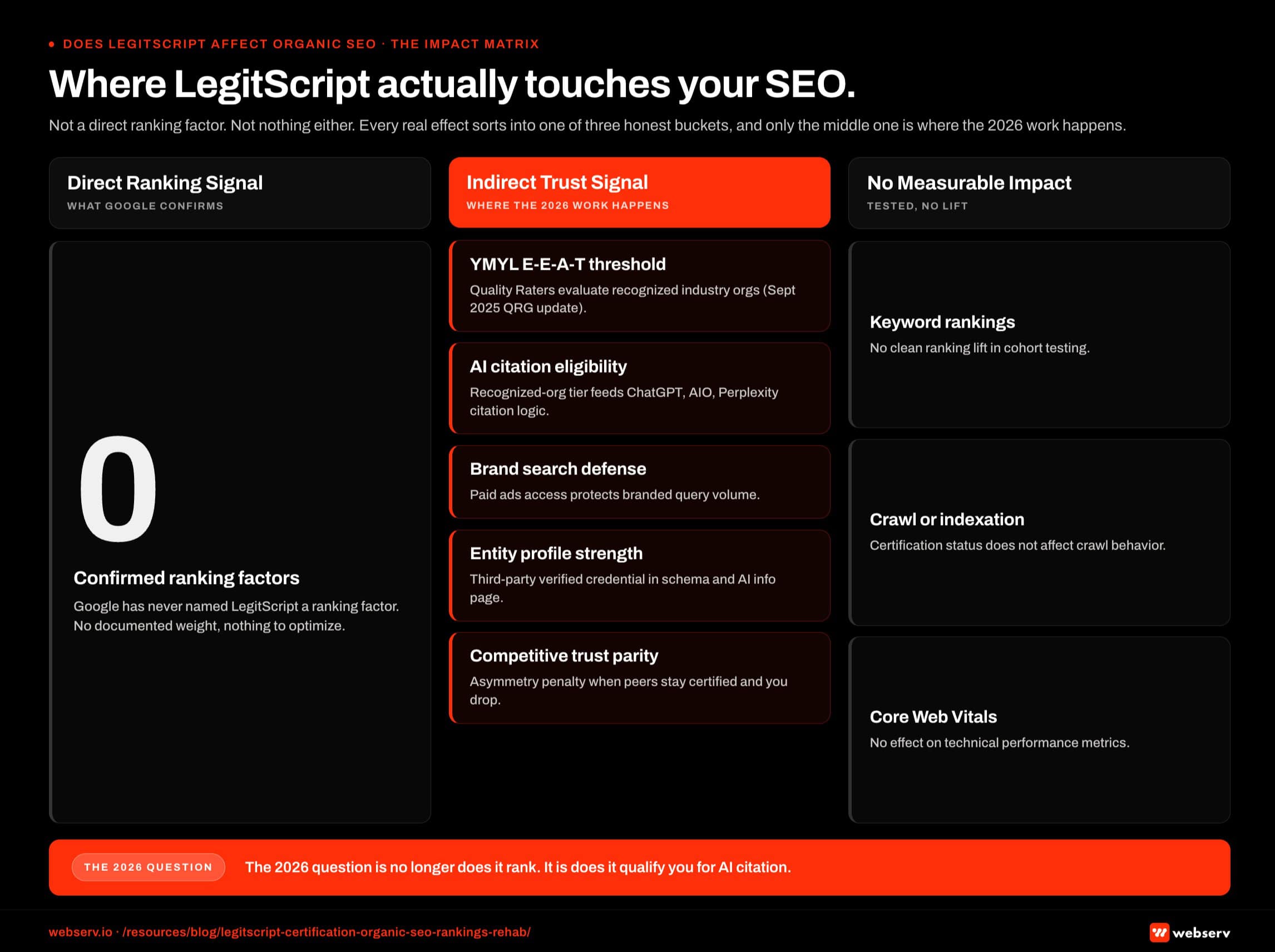 Infographic titled ‘The LegitScript SEO impact matrix’.
The Short Answer: Not a Direct Ranking Factor
Google has never confirmed LegitScript certification as a ranking signal. The Google Search documentation does not reference it. SEO tools cannot find a corresponding metric. Internal analyses of certified versus uncertified BH sites do not show a clean ranking lift attributable to the certification alone.
This matters because most operators assume that the LegitScript fee is partially paying for SEO benefit. It is not, at least not in the direct ranking sense.
The certification is doing other work. Some of that work touches SEO. Some of it touches AI search visibility. Some of it touches brand defense and competitive positioning. The category-level question matters more than the simple yes-or-no.
Why the Question Is Worth Asking in 2026
The “does X affect rankings” question used to have a clean test. You compared two cohorts of sites, controlled for the variable in question, and measured the ranking delta. If the certification did anything, the data showed it.
That test does not work the same way in 2026. AI Overviews now appear on a meaningful share of healthcare queries, with BrightEdge data reported by Search Engine Journal showing AI Overview coverage grew 58 percent from February 2025 to February 2026 and healthcare queries triggering AI Overviews 88 percent of the time by December 2025.
The competitive surface is no longer just position one through ten on the SERP. It includes whether your site is among the citations ChatGPT and Google AI Overviews show when a family member asks about treatment options.
It also includes whether your facility appears inside Perplexity’s answer card, and whether Google AI Overviews pulls from your domain when the searcher uses the natural-language pattern that triggers AI generation.
The same E-E-A-T framework that Google’s Quality Raters apply to organic ranking is now being applied at the citation eligibility layer for AI answers.
This is the part of the shift most operators have not internalized yet, and it is the part where LegitScript starts to matter more than the old direct-ranking question implied.
The Quality Rater Guidelines Connection
Google’s Search Quality Rater Guidelines are the public-facing document that explains how human evaluators score search results to feed Google’s machine learning systems. The September 2025 update did three things relevant here.
First, it expanded YMYL (Your Money or Your Life) to include government, civics, and society alongside the existing health, finance, and legal categories. Behavioral health is still firmly inside the YMYL scope.
Second, it explicitly added AI Overviews to the evaluation criteria. Quality Raters now score AI-generated answers alongside traditional blue-link results, which means the same trust standards apply to citation eligibility as to ranking.
Third, and most relevant to LegitScript specifically, the guidelines instruct raters to evaluate “what third-party sites say about a site, author, and content” when assessing E-E-A-T signals.
Recognized industry organizations are called out as positive signals in the YMYL evaluation. LegitScript is one of the small set of organizations Google has explicitly recognized at the advertising layer.
The mechanism is not “LegitScript certification triggers a ranking boost.” The mechanism is “LegitScript is one of the signals raters look at when deciding whether your facility passes the YMYL trust threshold.” Those threshold decisions feed the AI Overview citation logic and the organic ranking logic at the same time.
AI Citation Eligibility for Behavioral Health Queries
This is the layer where the certification actually does work in 2026.
BrightEdge research analyzing healthcare citations across ChatGPT, Google AI Mode, and Google AI Overviews over 14 weeks (October 2025 to January 2026) found that different platforms cite different source types for healthcare queries.
ChatGPT pulls 27 percent of healthcare citations from government sources. Google AI Overviews pulls 33 percent from elite hospital systems and 10 percent from government. Neither platform pulls heavily from uncertified content sites.
The pattern across platforms is that the AI systems are biased toward sources that pass third-party trust validation. Government recognition counts. Hospital affiliation counts. Recognized industry certifications count. Unverified directory listings and uncited blog content do not.
For behavioral health specifically, the certifications that map cleanly to “recognized industry organization” are LegitScript (advertising and merchant verification), JCAHO and CARF (clinical accreditation), ASAM (medical society recognition), and SAMHSA (federal agency recognition).
A treatment center with all five of these credentials sitting on its AI information page and structured into its schema markup and entity profile is sending the strongest possible trust signal to the AI citation logic.
AthenaHQ’s State of AI Search 2026 Report found that the average AI answer mentions any particular brand only 17.2 percent of the time. Early movers are reaching 56.7 percent, which is roughly 3x the market average.
The early movers in behavioral health are almost universally the operators with the full trust-signal stack visible to AI crawlers, including the structured semantic triples that connect their credentials to their facility entity.
LegitScript alone does not get a treatment center cited in ChatGPT. LegitScript inside a complete trust-signal stack, with schema markup and a clean entity profile, contributes to the citation eligibility decision in ways that the old ranking-factor question never captured.
“The treatment centers that are getting cited by ChatGPT and Google AI Overviews for high-intent BH queries in 2026 share a common pattern. The full credential stack is visible on the page, in the schema, and in the AI information layer. LegitScript is part of that stack, not the answer to it.”
Preston Powell, Chief Executive Officer, Webserv
 Infographic titled ‘The behavioral health trust signal stack’.
How LegitScript Stacks Against Other BH Trust Signals
The trust signal stack for a treatment center spans four layers, and each layer answers a different question.
The advertising layer answers “can this operator legitimately spend on paid media.” LegitScript is the only certification Google, Meta, Microsoft, TikTok, LinkedIn, and Nextdoor recognize at this layer for addiction treatment, telehealth, and compounded GLP-1 categories.
Without it, a facility cannot run paid ads on any major platform. With it, the facility passes the gatekeeper, and the platforms treat the brand as legitimately operating. The certification process itself is a multi-week clinical and operational review.
The clinical accreditation layer answers “is the clinical operation independently verified.” JCAHO (Joint Commission) and CARF (Commission on Accreditation of Rehabilitation Facilities) are the two recognized accreditations for treatment centers. Either or both demonstrate that the program meets established clinical and operational standards.
The medical society layer answers “is this facility aligned with the recognized clinical guidelines for the field.” ASAM (American Society of Addiction Medicine) recognition signals that the facility’s clinical model follows ASAM criteria, which is the de facto national framework for treatment-level placement decisions.
The federal recognition layer answers “is this facility known to the federal regulators of the field.” SAMHSA listing in the federal Treatment Facility Locator and any associated grant or program recognition signals federal-level visibility.
Each layer feeds into the YMYL E-E-A-T evaluation that Quality Raters apply, and each layer feeds into the AI citation eligibility decisions the LLMs make.
LegitScript is the strongest advertising-layer signal, but it does not substitute for the clinical, medical society, or federal layers. The compounding effect is what matters for AI citation eligibility, not any single certification on its own.
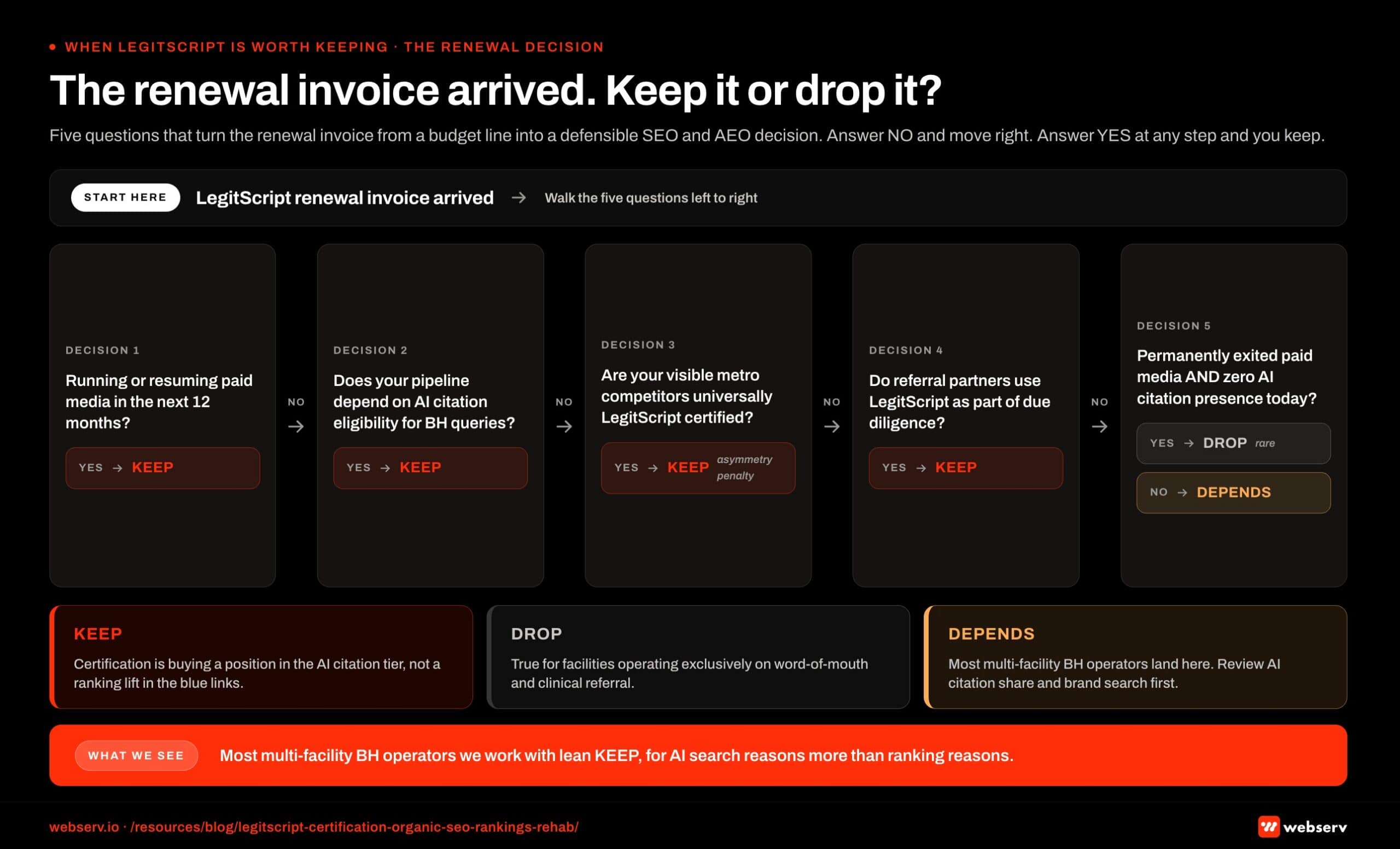 Decision tree infographic titled ‘LegitScript renewal invoice arrived, keep it or drop it.’
When LegitScript Is Worth Keeping for Non-Paid Reasons
The operator question that started this article is the right framing. If you are not running paid ads, is the certification still doing work?
The answer is yes if any of the following apply to your program.
You are running SEO and AEO programs where AI citation eligibility for BH queries matters to your patient pipeline. You expect to resume paid spend in the next 12 months and do not want to go through the certification process again from cold.
You operate in a competitive metro where the visible competitive set is universally LegitScript-certified and dropping the badge creates a trust-signal asymmetry. Your facility relies on referral relationships where the certification is part of the partner’s due diligence checklist.
These are all reasons to keep the certification independent of whether you are actively spending on Google Ads in any given quarter, and they show up in the SEO funnel as compounding trust signals. The broader topical authority framework absorbs these credentials as a trust-signal layer that compounds across the cluster.
The answer is closer to no if you have permanently exited paid media, operate exclusively on word-of-mouth and clinical referral, do not appear in AI Overview or ChatGPT citation queries today, and have no competitive pressure to maintain the badge.
For most multi-facility BH operators we work with, the answer leans yes, but for AI search reasons more than for organic ranking reasons.
The frame that makes the renewal decision easy is “this certification is buying us a position in the AI citation tier, not a ranking lift in the blue links.”
That is a smaller benefit than the marketing material implies and a bigger benefit than the SEO purists allow. The honest answer sits in the middle.
Frequently Asked Questions
Is LegitScript a Google ranking factor?
No. Google has never confirmed LegitScript certification as a direct ranking factor for organic search results. The certification is not referenced in Google’s public documentation on search ranking signals, and SEO testing has not produced a clean signal attributable to certification alone.
The relevant 2026 question is not whether LegitScript directly affects rankings, but whether it affects the broader E-E-A-T trust framework that feeds both rankings and AI citation eligibility. The answer there is that it is one of the recognized industry organization signals Google’s Quality Raters explicitly evaluate for YMYL content.
For most treatment center operators, the practical impact shows up at the AI citation layer (ChatGPT, Perplexity, Claude, Google AI Overviews) more than at the traditional ranking layer.
Does LegitScript certification help with E-E-A-T?
Yes, indirectly. The September 2025 Quality Rater Guidelines update instructs Google’s human raters to evaluate “what third-party sites say about a site, author, and content” when assessing E-E-A-T. Recognized industry organizations are called out as positive trust signals.
LegitScript is one of the small set of organizations Google explicitly recognizes for treatment center and telehealth verification at the advertising layer. Sites with the certification badge displayed and the LegitScript profile linked send a third-party-validated trust signal that raters can use.
The mechanism is not direct ranking lift. The mechanism is contribution to the YMYL trust threshold a treatment center site needs to cross to be eligible for full ranking and AI citation visibility.
Will dropping LegitScript hurt our organic SEO?
Not directly and not immediately. Dropping the certification does not trigger an automatic ranking penalty.
It does compound over time through three indirect mechanisms. First, you lose paid ads access, which compresses branded search volume and weakens brand strength signals.
Second, you lose one of the third-party trust signals AI systems use for citation eligibility, which can quietly reduce citation share in ChatGPT, Perplexity, and Google AI Overviews. Third, competing facilities that maintain certification gain a trust-signal asymmetry on YMYL evaluation. The aggregate effect is real but slow. Most operators who drop certification do not see immediate ranking impact, then notice softness in AI citation share and branded search volume six to twelve months later.
How does LegitScript compare to JCAHO or CARF for SEO purposes?
They serve different layers of the trust stack and they compound rather than substitute for each other.
JCAHO and CARF are clinical accreditations that demonstrate the treatment program meets independent operational and clinical standards. Both carry strong weight inside the YMYL evaluation and inside AI citation eligibility logic, particularly for clinical-question queries.
LegitScript is the advertising-layer certification that demonstrates the operator is a legitimately operating, properly licensed addiction treatment facility recognized by the major ad platforms. It carries weight inside AI citation eligibility for advertising-adjacent queries (how to choose a rehab, find treatment near me, what does treatment cost) where commercial intent overlaps with clinical intent. The strongest SEO and AEO position is to hold both clinical accreditation (JCAHO or CARF) and LegitScript certification.
What about ASAM and SAMHSA recognition?
ASAM (American Society of Addiction Medicine) recognition signals alignment with the recognized national framework for treatment-level placement and clinical protocol design. It carries weight in clinical-intent AI queries.
SAMHSA recognition (federal Treatment Facility Locator listing) signals federal-agency-level visibility. ChatGPT leans heavily on government sources for healthcare citations (27 percent in BrightEdge’s analysis), while Google AI Overviews favors elite hospital systems (33 percent) over government sources (10 percent).
For a treatment center building maximum AI citation eligibility for BH queries, the full stack is LegitScript + JCAHO or CARF + ASAM alignment + SAMHSA listing. Each plays a distinct role in different query types and different AI platforms.
Build a Trust Signal Stack That Earns AI Citation Share
LegitScript is not a Google ranking factor. It is a recognized industry certification that contributes to the YMYL E-E-A-T trust signals Google’s Quality Raters explicitly evaluate, which in turn feed the citation eligibility decisions ChatGPT, Perplexity, Claude, and Google AI Overviews make for behavioral health queries.
The decision to renew is not really an SEO decision. It is a decision about whether your facility wants to remain in the recognized-org tier for AI citation eligibility, defend brand search volume through paid ads access, and hold competitive parity with other certified operators in your metro.
We work with treatment centers across the U.S. on building the full trust signal stack: LegitScript, clinical accreditation, ASAM alignment, SAMHSA visibility, topical authority across the cluster, structured data, AI information pages, and the cluster of supporting content that earns citation share across the major AI search platforms.
Book an intro meeting to walk through what your current AI citation share looks like, where the trust-signal gaps sit, and what the next 90 days of work would produce for your facility.
For the broader picture of how this fits inside a treatment center marketing program, see our ultimate guide to behavioral health marketing.
Trevor Gage is the Director of Earned and Owned Media at Webserv, where he leads SEO, AEO, and digital PR for behavioral health and addiction treatment centers across the U.S. He writes about the cross-platform visibility work that earns treatment centers citation share in AI search alongside organic rankings.