A treatment center marketing director called me last quarter. She had been running her Google Ads program through Unbounce for two years. Smart Traffic was on. The pages were clean. The cost per inquiry had been climbing for nine months, and nobody on the agency side could explain why.
The diagnosis took less time than the discovery call. The Unbounce page was sitting on the agency’s shared Unbounce account. Meta Conversions API wasn’t firing on the back end because the agency had never integrated it.
CallRail was integrated, but the call tracking pool was set up wrong, so admits were being credited to the wrong campaigns. The page was fine. The tracking and integration layer underneath it had been broken for most of the engagement.
That’s the trap with hosted landing page builders for rehab marketing. The page looks right.
The tracking, integration, and compliance layer underneath determines whether the page actually produces admits, and most operators don’t know what to look for until the cost per inquiry climbs past the point of recovery.
Inside Webserv’s paid media program for treatment centers, we have built and tested landing pages across all the major builders.
This guide walks through the six criteria that matter for rehab paid landing pages, compares the seven main options (including the custom WordPress subdomain approach we use by default), and gives a decision framework for picking the right builder for your program.
Key Takeaways
- Most landing page builders are evaluated on the wrong criteria for rehab marketing. The design and template quality matters less than HIPAA compliance, tracking control, and integration depth with Meta CAPI, server-side Google Ads conversions, and CallRail.
- Hosted builders (Unbounce, Instapage, Leadpages, HubSpot, Webflow) have real tradeoffs for treatment centers. None of the mainstream tools offer Business Associate Agreements on standard plans. Heyflow is the only mainstream builder with HIPAA on all plans.
- The custom WordPress subdomain approach is our default for treatment center clients because it provides full tracking control, BAA-covered hosting, no per-visitor licensing at scale, and no platform lock-in.
- Smart Traffic-style ML routing (Unbounce) and AI-assisted design tools across all builders are useful supplements but rarely the primary lever. The integration layer underneath the page determines whether any conversion lift actually attributes to admits.
- Most treatment center paid programs need 10 to 30 landing page variants in market at any time. Per-page or per-visitor licensing fees at scale make hosted builders materially more expensive than custom WordPress subdomain hosting over a 24-month window.
The Six Criteria That Matter for Rehab Landing Page Builders
Most landing page builder comparisons evaluate tools on template count, drag-and-drop ease, and AI features. Those criteria matter for general marketing. They don’t matter much for rehab paid media. The six criteria that actually matter:
HIPAA and BAA support. Whether the platform will sign a Business Associate Agreement that covers your hosted landing pages. Most rehab paid landing pages don’t capture PHI before form submit, which makes this less critical than people assume.
The compliance exposure shows up if PHI ever does enter the system (insurance verification, clinical question fields) and the page isn’t on infrastructure that can handle it.
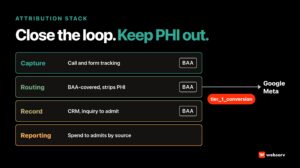
Tracking control. Whether the platform supports server-side Meta Conversions API, server-side Google Ads conversion tracking (with enhanced conversions off for health conversions), CallRail BAA-covered call tracking, and custom GTM container deployment. This is the layer that determines whether your admit data flows back to the ad platforms correctly.
Our deep dive on Meta CAPI for treatment centers without violating HIPAA covers why this matters.
LegitScript and ad-platform compliance. Whether the platform hosts pages cleanly under Google Ads and Meta healthcare advertising policies. Some hosted builders inject scripts that trip ad-platform policy review, or use shared domain reputations that flag your account. Our ranking of the best website development platforms covers the full-site side of that choice.
Mobile performance. Core Web Vitals on mobile devices. Most BH traffic comes from family members on mobile in crisis moments. Pages that load slowly or render poorly on mobile break the conversion path before the form ever loads.
Design flexibility for trust signals. Whether the page can surface LegitScript certification badges, JCAHO accreditation, CARF accreditation, alumni stories, and clinical credentials without forcing them into template constraints that hurt their visual weight.
Cost per page at scale. Most rehab paid programs need 10 to 30 active landing page variants at any time. Per-page or per-visitor licensing fees at hosted builders compound over a 24-month window in ways the entry pricing doesn’t suggest.
Quick Comparison Table
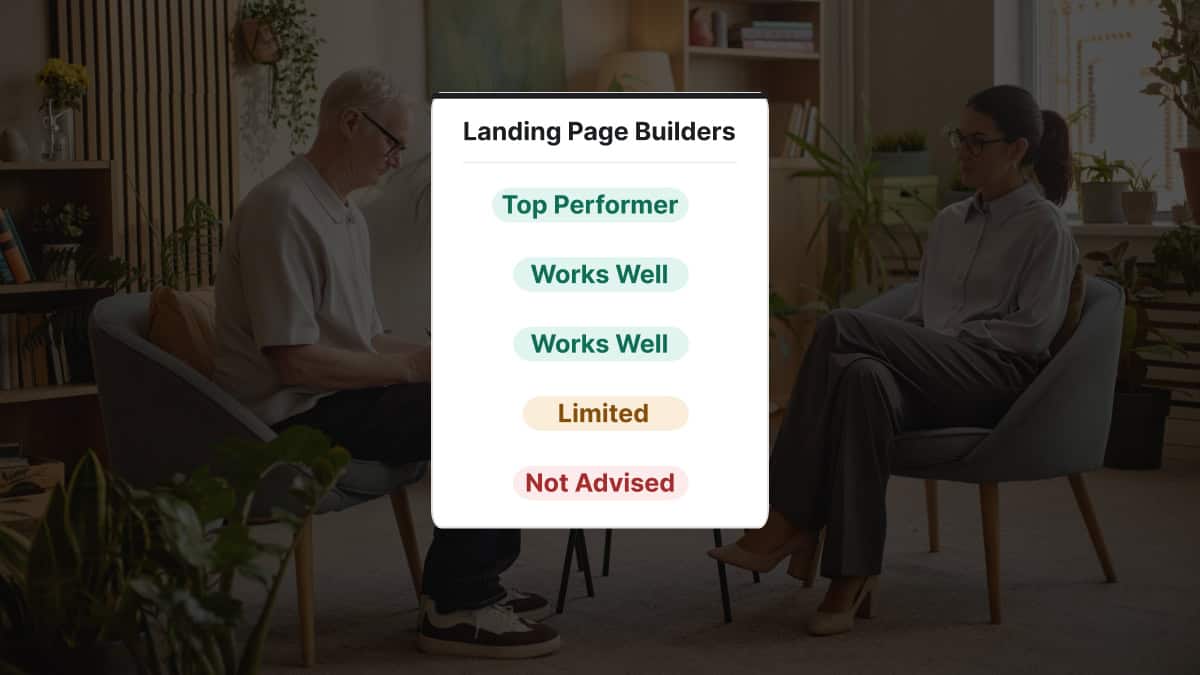
| Builder | HIPAA / BAA | Tracking Control | Pricing | Best For |
|---|---|---|---|---|
| Custom WordPress Subdomain (Webserv approach) | Yes via BAA hosting | Full | Custom build cost + hosting | Rehab paid media at scale |
| Unbounce | No BAA | Moderate | $99-$240/mo per account | Smart Traffic AI routing |
| Instapage | Partial (Enterprise) | Strong | $79-$199+/mo | A/B and multivariate testing |
| Leadpages | No BAA, no SOC 2 | Moderate | $49-$299/mo | Budget-conscious operators |
| HubSpot Landing Pages | Partial (Enterprise BAA) | Native CRM | $20-$3,600/mo | CRM-first programs |
| Heyflow | Yes on all plans | Moderate | Custom pricing | Compliance-heavy use cases |
| Webflow | No BAA | Moderate | $14-$49+/mo | Design-driven brands |
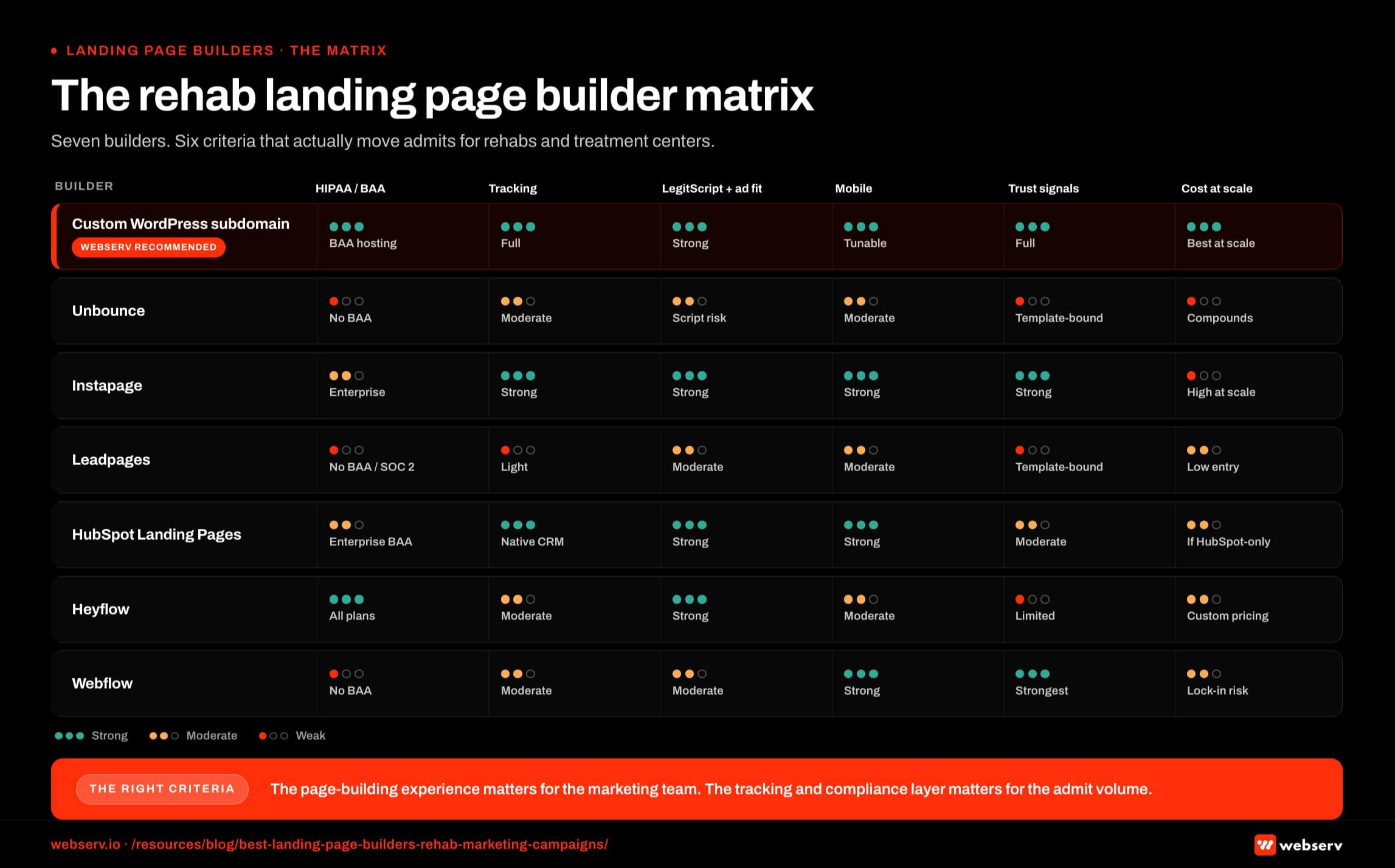 Infographic titled ‘The rehab landing page builder matrix’.
1. Custom WordPress Subdomain: Why It’s Our #1 Recommendation
Our default for treatment center paid landing pages is a custom WordPress subdomain build hosted on BAA-covered infrastructure.
The subdomain pattern (go.webserv.io, campaign.client.com, get-help.client.com) keeps the main client site separate from paid campaign experiments while passing domain authority signals cleanly through the subdomain structure.
The approach solves the seven biggest constraints hosted builders impose on rehab paid programs. Full tracking control means Meta CAPI server-side events fire from the operator’s infrastructure rather than from a shared third-party domain.
Google Ads conversion tracking deploys through the same GTM container the rest of the operator’s analytics stack uses. CallRail integration runs on BAA-covered call routing without depending on a hosted builder’s third-party script.
HIPAA-compliant hosting is available through any of the major BAA-covered WordPress hosts (WP Engine, Pantheon, Cloudways with their compliance tier). The pages live on infrastructure that can absorb PHI exposure if the operator’s intake flow later adds insurance verification fields or clinical questions.
Design flexibility through Elementor, Bricks, or custom blocks allows the trust signal placement, mobile responsiveness, and Core Web Vitals tuning that hosted builders constrain through template structures. Schema markup and structured data deploy cleanly, which matters for organic spillover from paid landing pages that gain authority over time.
Cost per page at scale is the operational economic argument. Hosted builders charge per page, per visitor, or per account in ways that compound across a 24-month rehab paid media engagement.
A WordPress subdomain build runs as a one-time development cost plus standard hosting, with no per-page licensing as the program scales to 20 or 30 variants.
The tradeoff is that the WordPress subdomain approach requires development capacity to set up and maintain. For agencies and treatment centers that have technical depth (or work with an agency that does), the approach produces lower lifetime cost and higher tracking fidelity than any hosted alternative.
2. Unbounce: Best for AI-Powered Optimization (Without HIPAA)
Unbounce is the most widely used hosted landing page builder in paid media, and its Smart Traffic feature is the differentiator most operators evaluate it for.
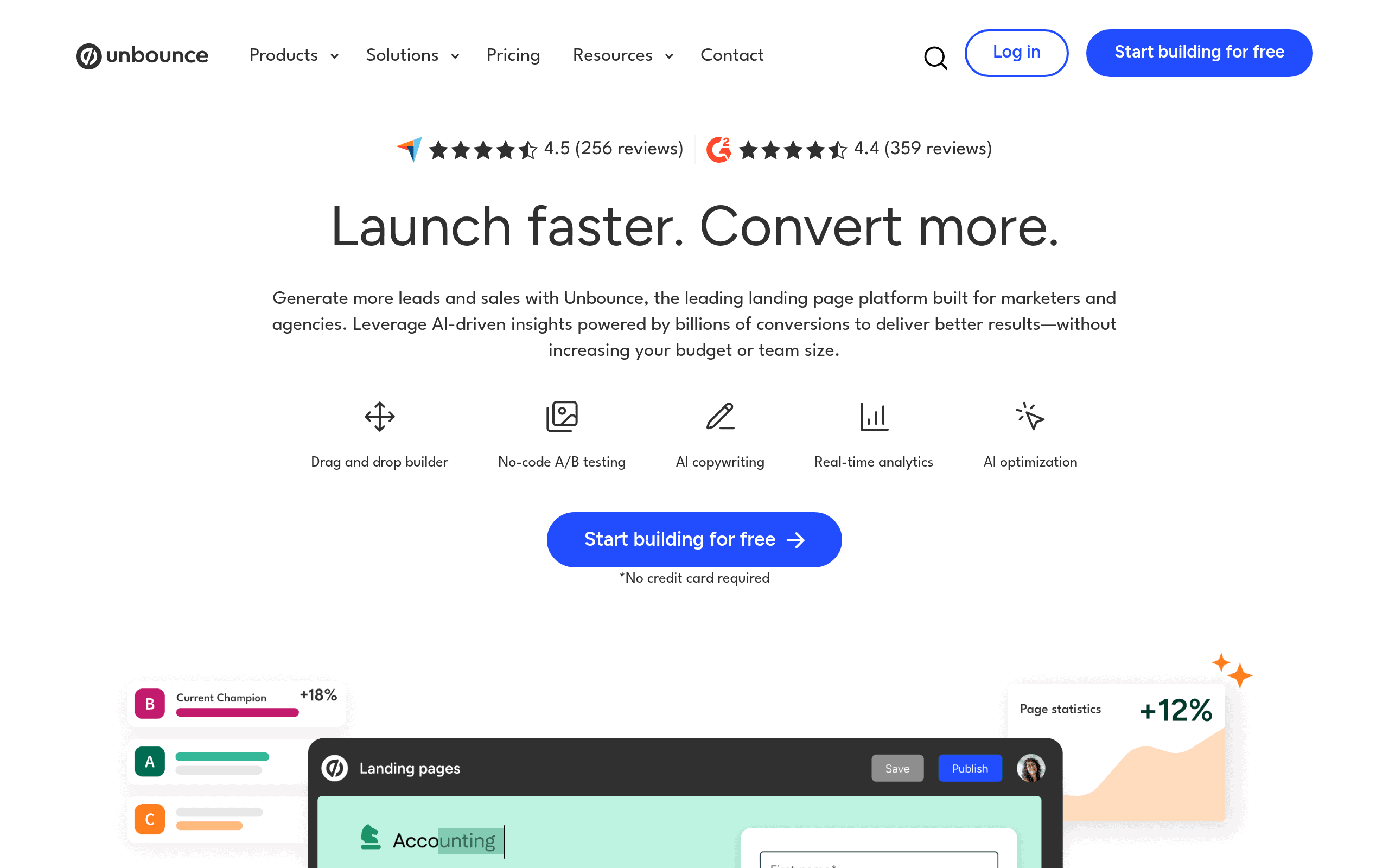
Smart Traffic uses machine learning to automatically route visitors to the landing page variant most likely to convert them based on device, location, referral source, and behavioral signals. Unbounce says marketers who turn on Smart Traffic see about 30 percent more conversions on average, compared with splitting traffic evenly across variants.
Published pricing (billed annually) runs $29 per month for Starter, $99 for Build, $149 for Experiment (A/B testing), and $249 for Optimize, the AI optimization tier. Agency and concierge pricing is quoted separately.
For treatment centers specifically, Unbounce has two real constraints. First, no HIPAA or BAA support. The platform’s terms of service don’t cover PHI handling, and any rehab page that captures more than name and phone needs to be configured carefully to stay inside the Unbounce ToS.
Second, the tracking integration depth is moderate. Meta CAPI server-side events require workarounds, and CallRail integration depends on script injection that occasionally trips Meta’s ad approval review.
The verdict is that Unbounce works for rehab paid landing pages that capture only name, phone, and best-time-to-call (no PHI), where Smart Traffic justifies the price, and where the agency running it has the tracking expertise to configure CAPI and CallRail around the platform’s limitations.
For programs operating outside those constraints, the WordPress subdomain approach produces better total returns.
3. Instapage: Best for A/B and Multivariate Testing
Instapage’s differentiator is testing depth. The platform supports more sophisticated multivariate testing, statistical confidence reporting, and AdMap-driven ad-to-page personalization than any other mainstream hosted builder. For agencies running heavy CRO testing programs, the testing stack is real.
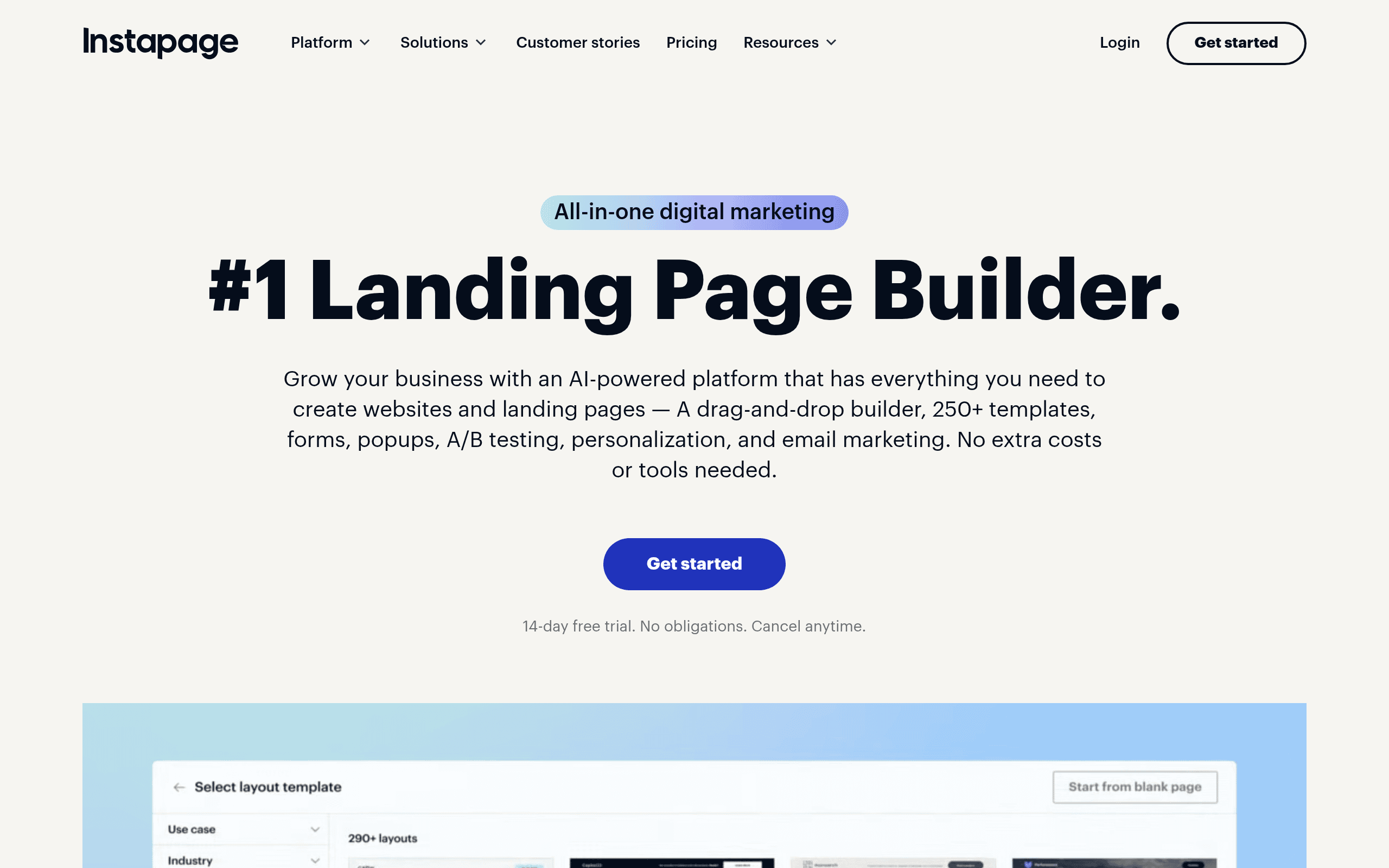
Pricing starts at $79 per month for Create (15,000 visitors), $159 for Optimize (30,000 visitors), and $199+ for Premium and Enterprise tiers. Enterprise plans include partial HIPAA capability and the AdMap feature.
For treatment centers, Instapage works when two conditions hold. First, the program has the testing volume to justify the platform (typically meaning 10,000+ paid sessions per month per facility). Below that volume, the multivariate testing capability sits underused.
Second, the program needs Enterprise-tier HIPAA support, which lifts the cost considerably above the entry tier.
The tradeoff with Instapage at Enterprise is that you’re paying premium pricing for testing capabilities that a WordPress subdomain plus VWO or Optimizely can replicate at similar cost with more tracking control.
The decision usually comes down to whether the operator wants the all-in-one platform (Instapage Enterprise) or the unbundled approach (WordPress + dedicated A/B testing tool).
For running structured A/B tests on treatment center contact forms, Instapage’s testing depth is the strongest hosted-builder option. For programs that prioritize tracking depth over testing depth, the WordPress subdomain approach still wins.
4. Leadpages: Best for Budget-Conscious Operators
Leadpages is the most affordable mainstream hosted builder. Pricing starts at $49 per month for Standard, $99 for Pro, and $299 for the Conversion tier.
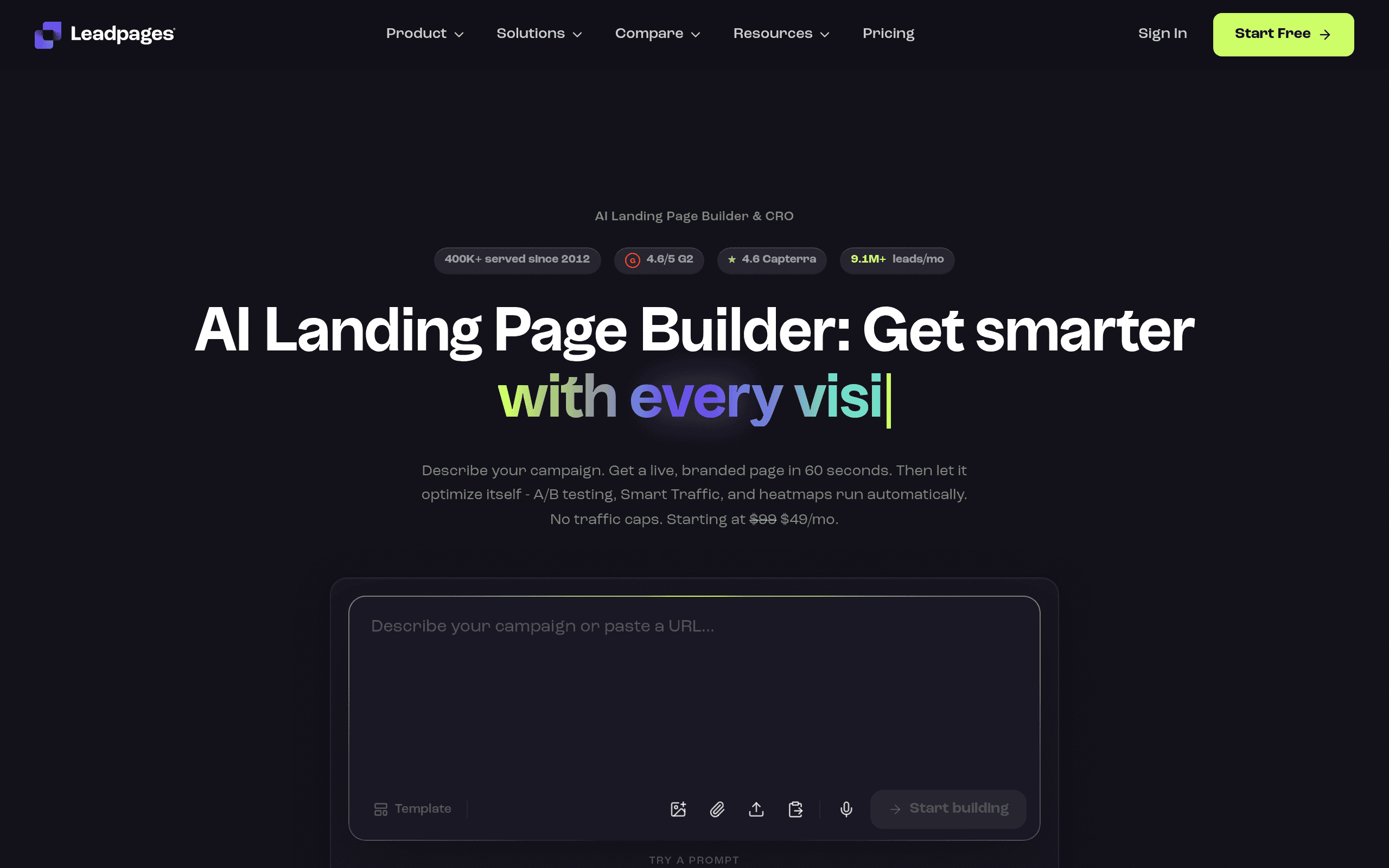
The platform’s Leadmeter feature scores landing page design and copy in real time during the build, which lowers the skill floor for operators without dedicated CRO support.
For treatment centers, Leadpages has two relevant constraints. First, no HIPAA compliance and no SOC 2. The platform’s documentation doesn’t support PHI handling, which puts it in the same constraint band as Unbounce and Webflow.
Second, the tracking integration depth is the lightest of the major builders. Meta CAPI, Google Ads conversion tracking, and CallRail integrations work but require more workaround engineering than Unbounce or Instapage.
The verdict is that Leadpages fits small treatment centers running paid programs under $5,000 per month total budget where the cost difference between Leadpages and Unbounce justifies the lighter feature set. Above that budget level, the platform constraints typically don’t pay back.
5. HubSpot Landing Pages: Best for CRM-First Programs
HubSpot’s landing page builder is integrated natively with the HubSpot CRM, which makes it the strongest option for treatment centers already running HubSpot as their CRM and marketing automation stack. Lead attribution, contact deduplication, and admit-stage workflow automation all flow through the same platform.
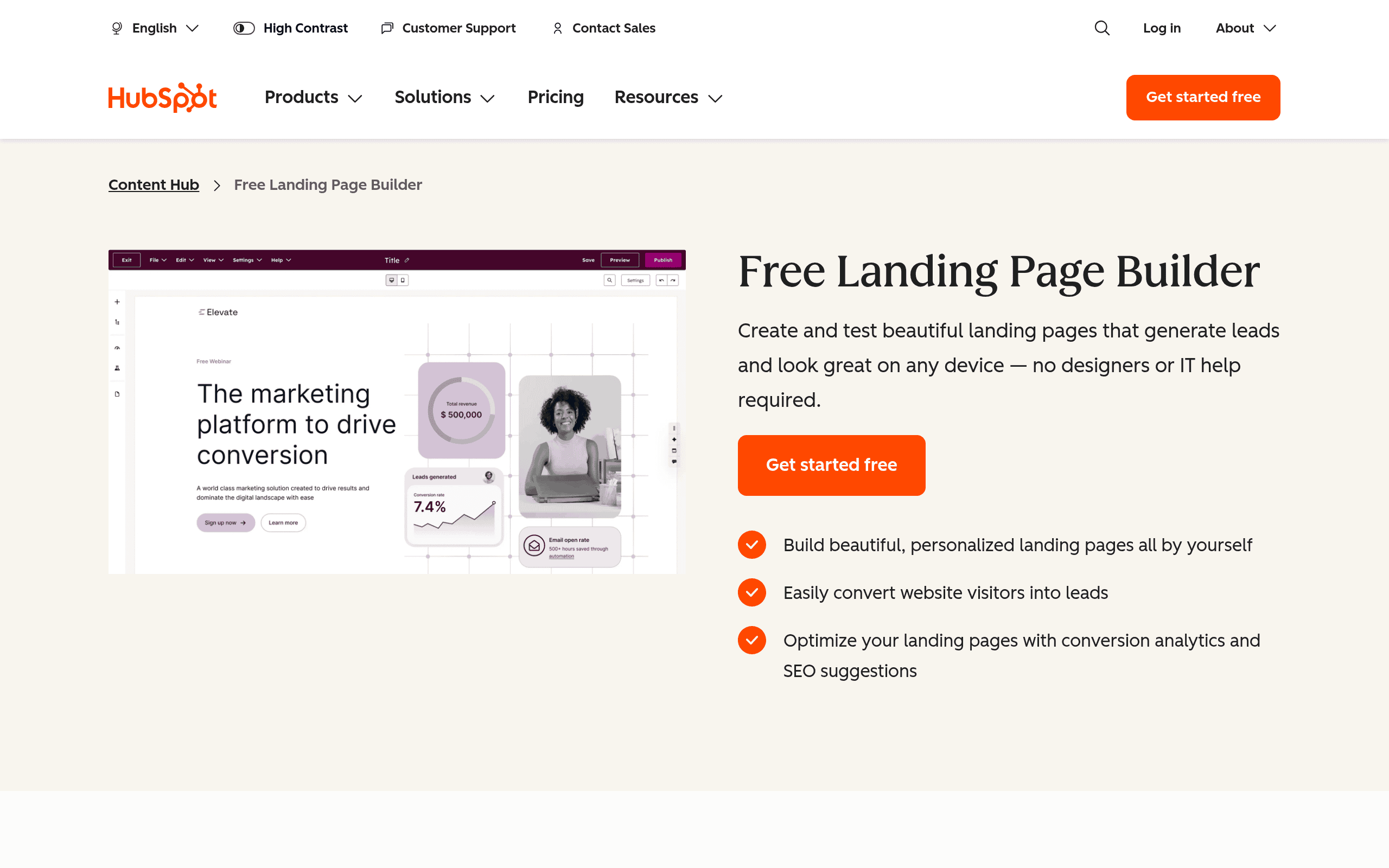
Pricing tiers run from $20 per month (Starter) to $3,600+ per month (Enterprise). Enterprise plans include HIPAA capability via a Business Associate Agreement, which is the relevant tier for most treatment centers.
The constraint with HubSpot at Enterprise is the cost frame. The platform’s value compounds across the full CRM + marketing automation + landing page + email stack. Programs that use HubSpot only for landing pages and run a separate CRM elsewhere overpay for capabilities they don’t use.
For treatment centers already on HubSpot Enterprise and running the full stack, the landing page builder is the obvious choice and integrates cleanly with the rest of the operation. For treatment centers shopping for landing page hosting alone, the WordPress subdomain approach produces better cost economics.
6. Heyflow: Best for Compliance-Heavy Use Cases
Heyflow is the only mainstream landing page builder we tested that includes HIPAA, SOC 2 Type II, and ISO 27001 compliance on all plans.
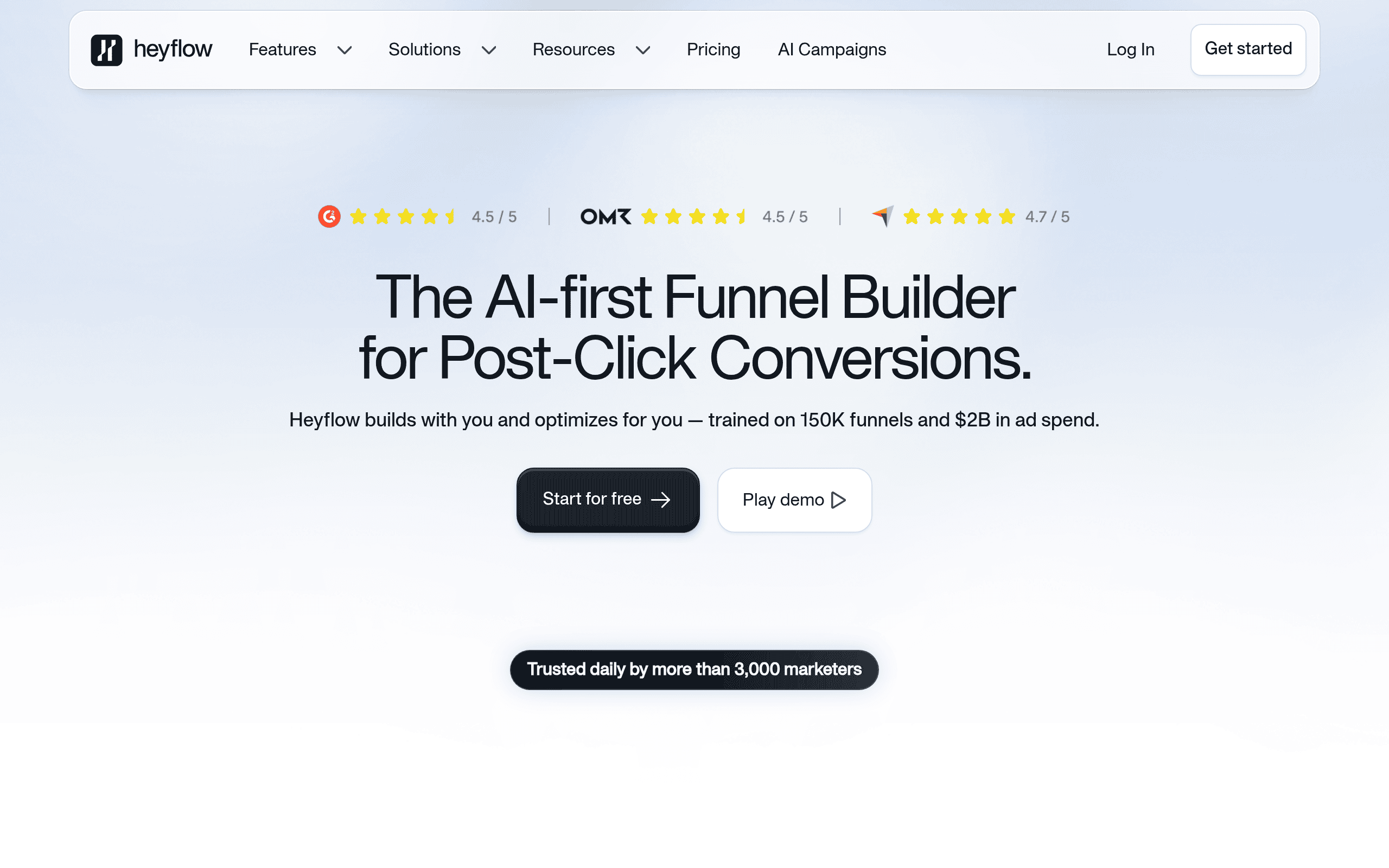
For treatment centers where the landing page captures PHI before the lead form submit (insurance verification, clinical questions, intake fields), Heyflow is the only off-the-shelf option that handles compliance without workaround engineering.
Pricing is custom rather than published, which signals that the platform is positioned for healthcare and other regulated verticals where the standard SaaS pricing model doesn’t fit.
The constraints with Heyflow are visibility and testing depth. The platform doesn’t have the same Smart Traffic or AdMap-style optimization features Unbounce and Instapage ship, and the design template library is more limited.
For programs that need compliance certainty more than they need conversion optimization features, Heyflow is the right call. For programs that can solve compliance through the WordPress subdomain approach and want the optimization features, Heyflow tends to be over-priced relative to the value.
7. Webflow: Best for Design-Driven Brands
Webflow is the most design-flexible hosted builder. The visual development environment produces pages that look custom-built without requiring direct HTML/CSS coding.
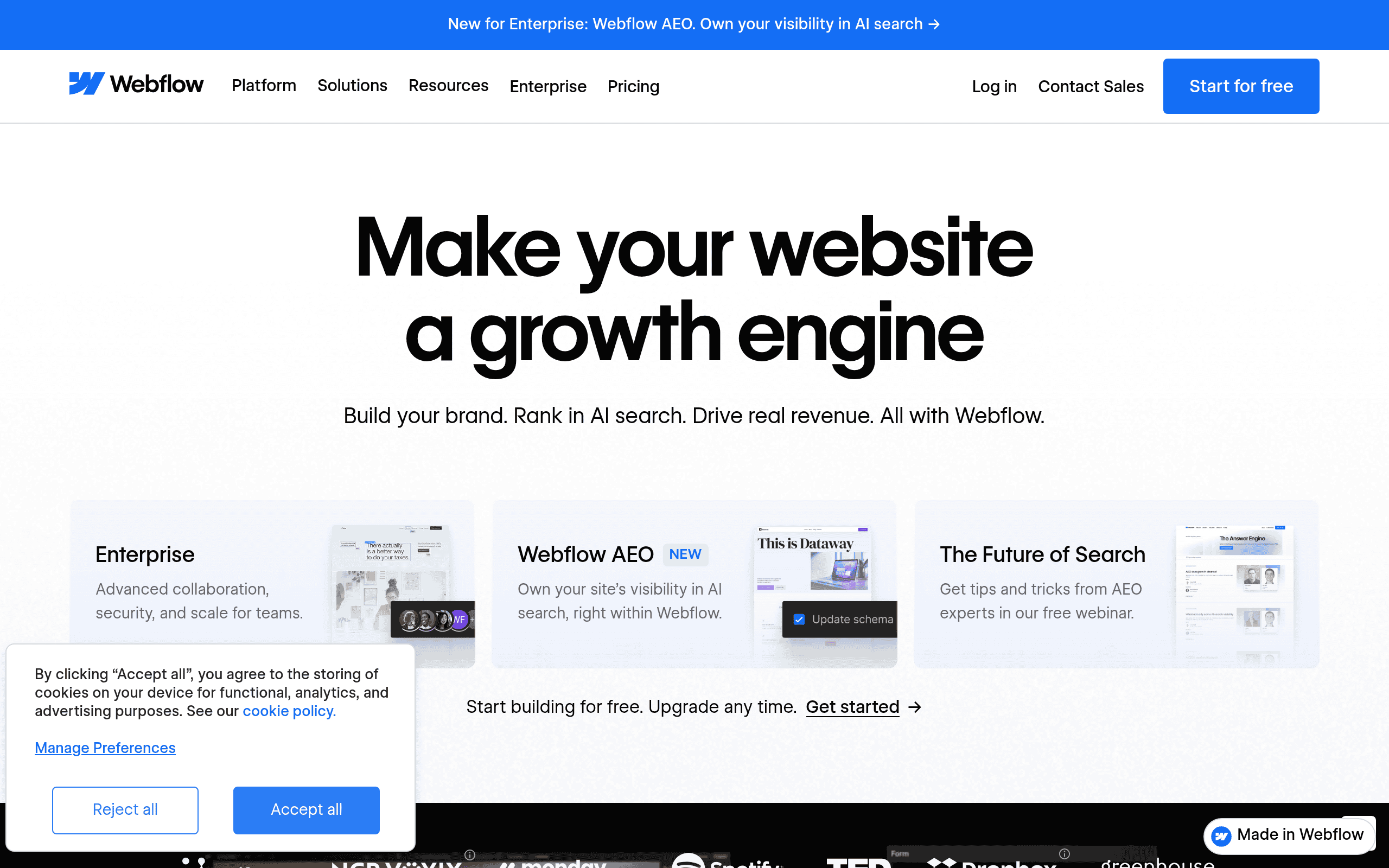
For treatment center brands where the visual standard matters (luxury residential facilities, programs with strong brand investment), Webflow’s design output exceeds what most other hosted builders can produce.
Pricing starts at $14 per month for basic plans, with Workspace tiers for agencies running multiple client sites. The cost frame is the lowest of any builder on this list for what the platform produces visually.
The constraints with Webflow for rehab marketing are HIPAA (no BAA, no SOC 2 by default), tracking depth (moderate; CAPI and CallRail integrations work but require external setup).
Plus platform lock-in: migrating off Webflow is harder than migrating off Unbounce or Leadpages because Webflow’s site structure is platform-specific.
The verdict is that Webflow works for treatment center brands where visual design is the primary differentiator and compliance can be solved at the form-submit layer (e.g., the form posts to a HIPAA-compliant CRM rather than capturing PHI on the Webflow page itself).
For programs that need tracking depth or compliance certainty on the page itself, the WordPress subdomain approach is the better fit.
“The landing page builder choice matters less than most operators assume. The page-building experience matters for the marketing team. The tracking, integration, and compliance layer matters for the admit volume.
“The platforms that win on the first criterion often lose on the second, and the second is the one that determines whether the campaign actually produces admits.”
Preston Powell, Chief Executive Officer, Webserv
How to Pick the Right Builder for Your Program
Six questions narrow the choice down for most treatment center programs.
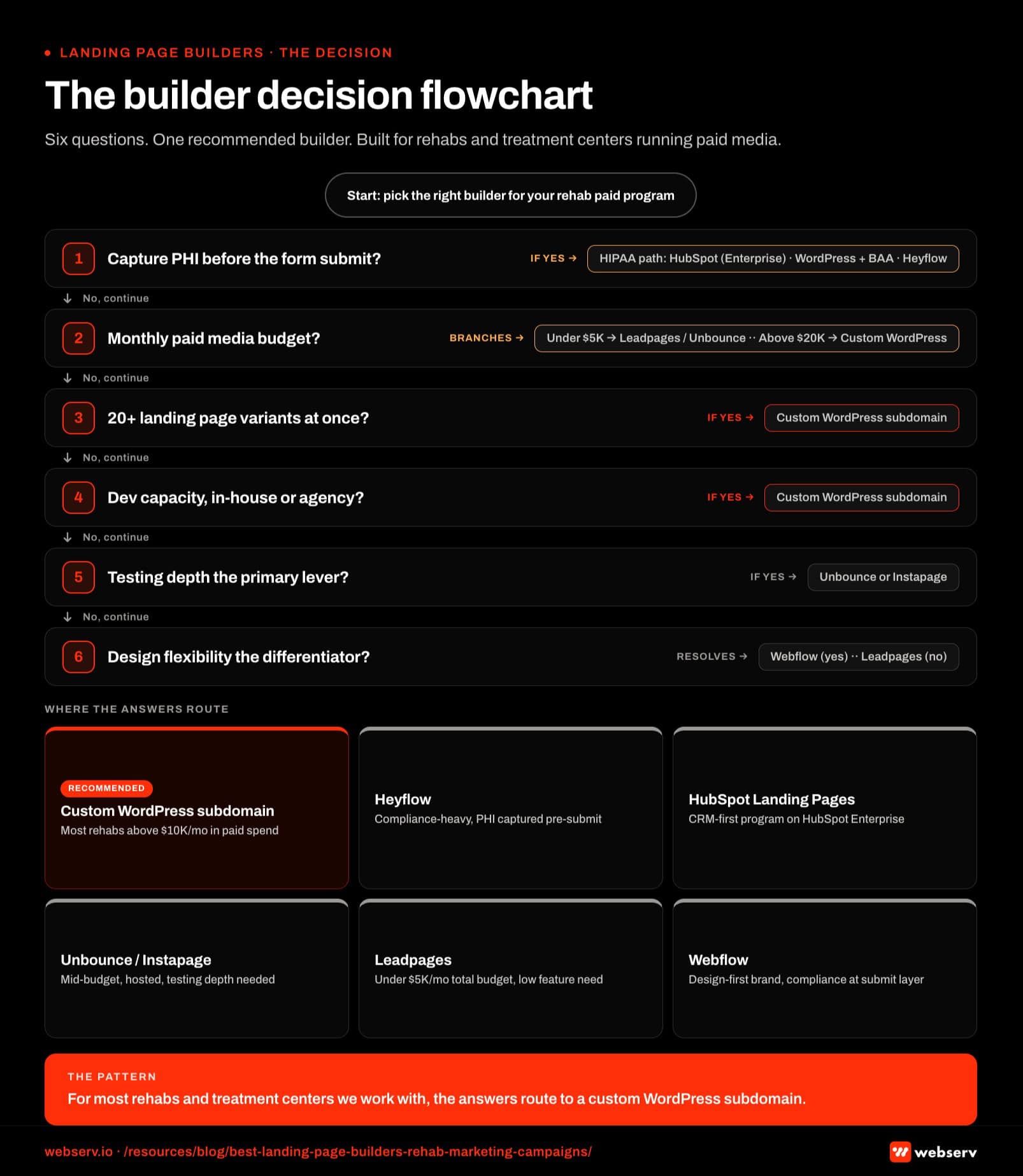 Infographic titled ‘The rehab landing page builder decision flowchart’.
Does the landing page capture PHI before the form submit? If yes, the choice narrows to Heyflow, HubSpot Enterprise, or a BAA-covered WordPress subdomain. The other builders aren’t viable without workaround engineering that usually breaks under audit.
If no, every option on the list is technically viable, and the decision moves to the other criteria.
What is the monthly paid media budget supporting these pages? Under $5,000 per month total spend, the cost frame of Leadpages or Unbounce Build is the right band. Above $20,000 per month, the licensing economics shift in favor of the WordPress subdomain approach because per-page or per-visitor fees compound.
Between $5,000 and $20,000, the choice is more about tracking and testing needs than cost.
How many landing page variants does the program need in market at once? Programs running 1 to 5 variants can absorb hosted builder per-page pricing. Programs running 20 to 30 variants (the typical paid social and PMax-driven setup) hit licensing constraints that the WordPress subdomain approach avoids.
This is the operational economics question that does not show up in the entry pricing.
Does the program have technical development capacity? WordPress subdomain builds require development resources to set up and maintain. Programs without in-house technical capacity or an agency partner that handles the build need to factor that into the choice. Hosted builders trade higher monthly licensing fees for lower development overhead.
How critical is tracking depth? CallRail-integrated call attribution, Meta CAPI server-side conversions, and Google Ads conversion data all work better through custom infrastructure than through hosted builders.
Programs that prioritize tracking fidelity skew toward WordPress subdomains. Programs that prioritize platform-native testing features (Smart Traffic, AdMap) skew toward Unbounce or Instapage.
Is design flexibility the primary differentiator for the brand? Luxury residential facilities and programs with heavy brand investment often need design quality that exceeds what template-driven builders produce.
Webflow or a custom WordPress build serve those needs. Other tools work for performance-driven brands where conversion lift matters more than visual sophistication.
For most treatment centers we work with, the answers point toward the WordPress subdomain approach. The combination of full tracking control, BAA-covered hosting, no per-page licensing at scale, and design flexibility is hard to beat once the program reaches the volume that justifies a custom build.
Frequently Asked Questions
Which landing page builder is HIPAA-compliant by default?
Heyflow is the only mainstream landing page builder that includes HIPAA, SOC 2 Type II, and ISO 27001 compliance on all plans without enterprise-tier requirements.
HubSpot Landing Pages offers HIPAA capability through Enterprise plans with a Business Associate Agreement, but the pricing tier is materially higher than the standard HubSpot plans. Instapage offers partial HIPAA capability through enterprise plans.
Unbounce, Leadpages, and Webflow do not offer HIPAA or BAA support on any tier. For treatment centers running paid landing pages on those platforms, the page configuration has to keep PHI out of the captured data. Custom WordPress subdomain builds on BAA-covered hosting solve compliance independently of the page builder.
Do I need a HIPAA-compliant landing page builder for rehab marketing?
The honest answer is that it depends on what your landing pages capture. If the page captures only name, phone, email, and best-time-to-call, the captured data isn’t PHI on its own and the landing page builder does not need to be HIPAA-compliant.
If the page captures any of the following before the form submit, the platform needs HIPAA support. Insurance verification details. Clinical question fields. Medication histories. Treatment goal fields. Anything that ties a specific health condition or treatment intent to an identifiable individual.
Most treatment center programs we work with use the simpler approach. The landing page captures only contact information. The PHI fields live behind the form submit, in a HIPAA-compliant CRM or intake platform. This lets the landing page run on Unbounce, Leadpages, or a WordPress subdomain without HIPAA exposure.
How does Unbounce Smart Traffic compare to A/B testing on a WordPress subdomain?
Unbounce Smart Traffic uses machine learning to route visitors to the landing page variant most likely to convert based on attributes like device, location, and referral source. Unbounce says Smart Traffic users see about 30 percent more conversions on average than when traffic is split evenly across variants.
On a WordPress subdomain, the same logic can be replicated through VWO, Optimizely, or Google Optimize replacement tools, paired with custom audience routing logic. The setup requires more engineering, but the routing logic can be tuned to the specific operator’s customer segmentation rather than running off Unbounce’s general ML model.
For most treatment centers, Smart Traffic is a useful supplement to a well-structured paid program but rarely the primary lever. Programs that haven’t fixed the structural landing page problems heatmaps reveal don’t see real Smart Traffic lift.
What’s the right landing page builder budget for a treatment center?
Most treatment center landing page programs run between $200 and $2,000 per month on the landing page builder itself, depending on tier and number of accounts. The platform cost is typically 2 to 5 percent of the underlying paid media budget supporting the pages.
The bigger budget question is the total cost of ownership over 24 months. Hosted builders charge predictable monthly licensing fees that compound linearly. Custom WordPress subdomain builds have a higher upfront cost ($5,000 to $20,000 for the initial build depending on complexity) plus standard hosting, but no per-page or per-visitor licensing as the program scales.
The break-even point varies but typically lands around 12 to 18 months at moderate scale. Programs running 5+ landing page variants on Unbounce Optimize for 18 months spend more on licensing than they would have on a custom WordPress build with the same hosting period.
Can I migrate from a hosted builder to a WordPress subdomain mid-campaign?
Yes, and most treatment center programs we onboard go through this migration in their first 90 days. The migration process keeps the campaigns running on the existing builder while the new WordPress subdomain pages get built and tested in parallel. Once the new pages match or exceed the existing performance on a defined prompt set, traffic shifts over.
The migration risk is tracking continuity. Conversion data history from the old platform doesn’t transfer cleanly to the new platform, which creates a measurement gap during the cutover. Programs that handle this well run the two systems in parallel for 30 to 60 days, validate that the new tracking matches the old tracking, then cut over decisively.
Programs that try to flash-cut without parallel running lose the conversion data continuity and end up making campaign decisions on incomplete data for a quarter or more.
What’s the right A/B testing tool for a WordPress subdomain landing page?
Three tools cover most of the market. VWO is the most fully-featured option with multivariate testing, heatmaps, and session recording in one platform. Optimizely is the enterprise-tier choice for programs running heavy testing volume. Google’s Optimize replacement (now folded into GA4) is the budget option but produces lower-fidelity statistical reporting than the alternatives.
For most treatment center programs running 10 to 30 landing page variants, VWO at the Growth or Pro tier ($333 to $1,500+ per month) provides the testing depth without the enterprise-tier overhead.
The integration pattern with WordPress subdomain landing pages is clean. The testing tool deploys through GTM, runs against the WordPress pages, and writes test results back to whatever analytics layer the program uses (typically GA4 paired with the operator’s CRM data).
Build a Landing Page Stack That Actually Produces Admits
The landing page builder choice matters less than most operators assume, and the tracking and integration layer underneath matters more.
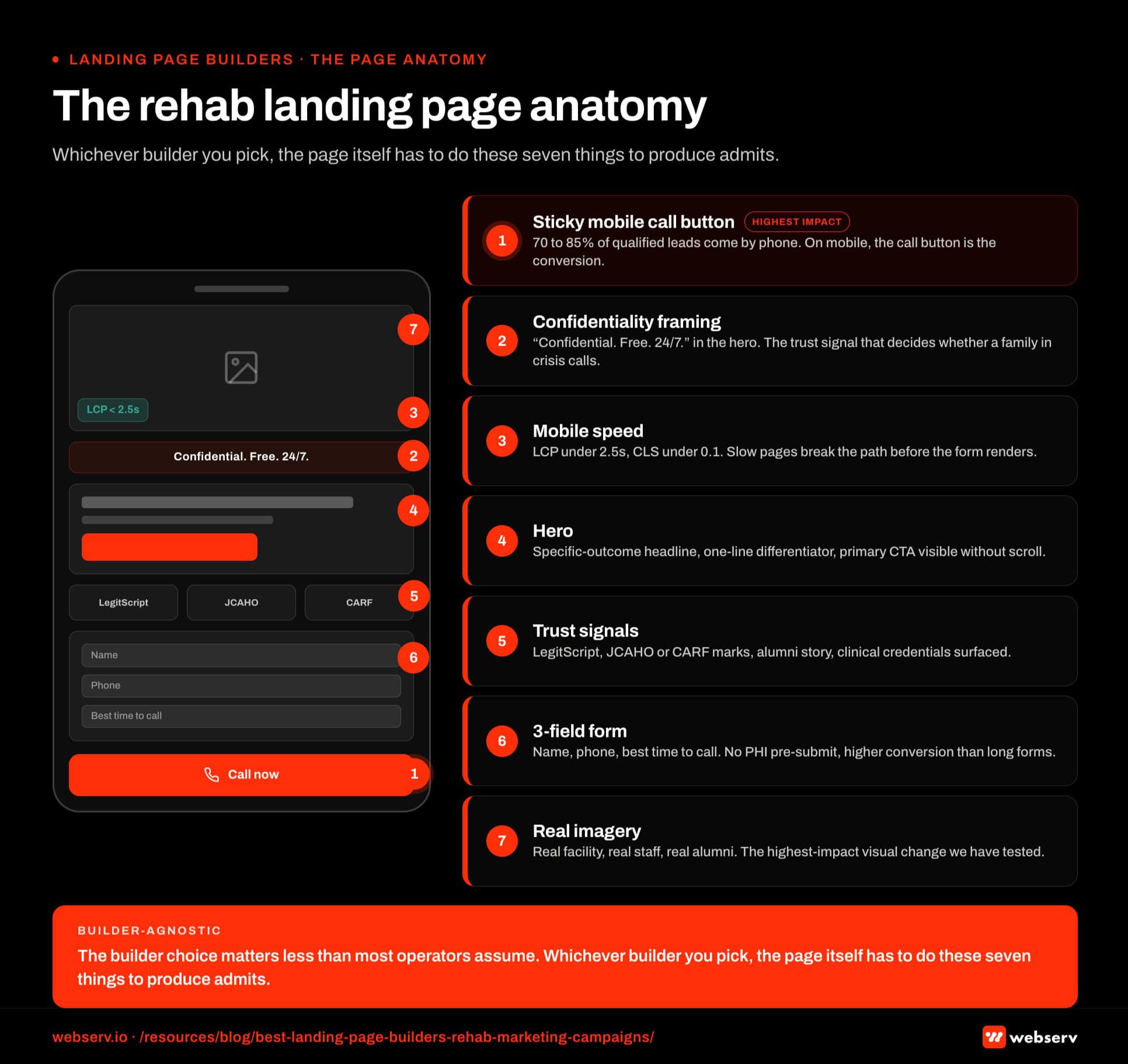 Infographic titled ‘The rehab landing page anatomy: 7 critical fixes’.
We build custom WordPress subdomain landing page programs for treatment centers across the U.S. The setup gives full tracking control, BAA-covered hosting, design flexibility, and no per-page licensing fees that compound as the program scales.
For most rehab paid media programs operating above $10,000 per month in spend, the WordPress subdomain approach produces better total returns than any hosted alternative. The landing page conversion benchmarks for rehab paid traffic reflect what is achievable when the tracking and integration layer is built correctly.
Book an intro call to see what a landing page stack rebuild could produce for your treatment center, what your current tracking and integration setup is missing, and what the cost economics look like over a 24-month horizon.
For the broader picture of how paid CRO fits inside a full treatment center marketing program, see our landing page optimization guide for addiction treatment and our ultimate guide to behavioral health marketing.
Mitch Marowitz is Director of Paid Media at Webserv, where he leads Google Ads, Meta, and emerging paid channel strategy for behavioral health treatment centers. He has overseen more than $45M in managed media spend across the addiction treatment category and writes about paid acquisition for treatment operators.