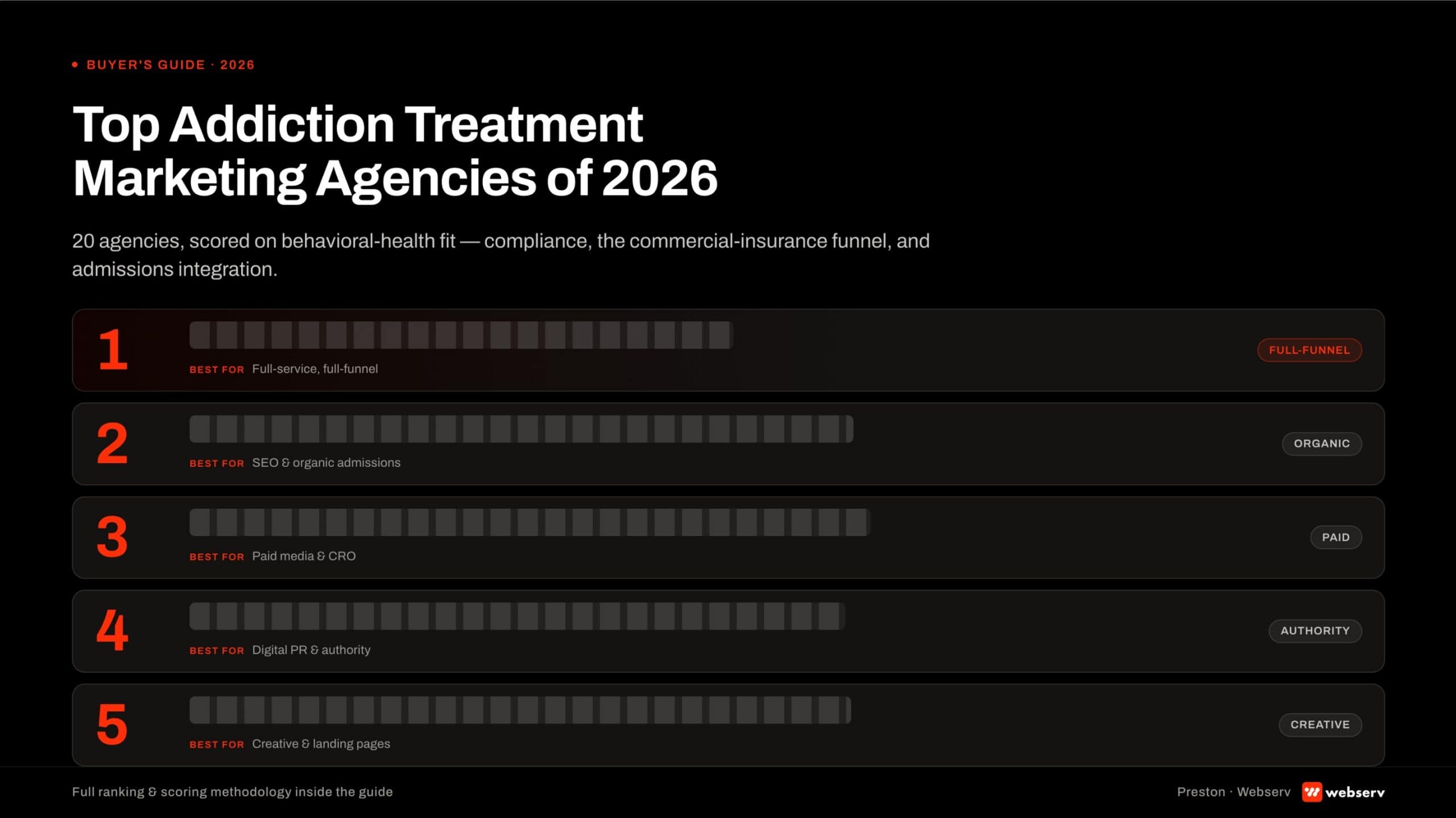
Picking an addiction treatment marketing agency is not the same job as picking a general healthcare marketing agency. Three landmines separate the two categories, and every operator who has been burned by a generalist agency has stepped on at least one of them.
LegitScript certification, 42 CFR Part 2 privacy compliance, and the census-versus-CAC math tied to commercial-insurance admissions are the three lines that separate a vendor who can actually run your marketing from a vendor who will get your ad accounts shut down.
A general healthcare agency knows HIPAA. That is not the same as knowing how to navigate LegitScript approval for addiction treatment ads. A general healthcare agency knows insurance. That is not the same as knowing how to model the census-to-CAC ratio when your admissions mix is 65 percent commercial and 20 percent Medicaid. Getting one of the three wrong doesn’t just hurt performance. It can shut your ad accounts down and route six months of pipeline through paid media that never comes back online.
This piece walks operators through the 20 addiction treatment marketing agencies most worth evaluating in 2026. What each one is best at, where the trade-offs are, and how to run a filter that separates the specialists from the generalists.
The list is ranked, but the ranking is a starting point, not a prescription. Facility size, growth stage, and where the marketing-to-admissions leak actually sits matter more than any general ranking.
One disclosure before the list: Webserv wrote this list, and we put ourselves at #1. We do this work, so read it as our view of the market, not a neutral review. Weigh each agency against your own criteria before you build a shortlist.
If your facility is part of a broader behavioral health portfolio, our ranking of behavioral health SEO companies covers the agencies built for that scope.
Key Takeaways
- The 20 best addiction treatment marketing agencies of 2026 split roughly across full-service partners, paid-media specialists, and content or brand specialists. Match the shape to your top constraint.
- Three vertical requirements separate real addiction treatment agencies from generalists: LegitScript certification familiarity, 42 CFR Part 2 privacy compliance, and commercial-insurance-driven admissions economics.
- Full-service agencies work best for small operators under one director of marketing, or for enterprise portfolios where vendor coordination cost exceeds the value of specialization. Specialists win in the middle.
- The six criteria that matter when picking an agency: LegitScript familiarity, HIPAA and 42 CFR Part 2 comfort, commercial-insurance funnel understanding, LOC-specific pipeline experience, real client volume in the vertical, and a service mix that matches your operation’s actual leak.
- Six sales-call filter questions separate the operators from the sellers. If an agency hesitates on any of the six, they are not the fit.
- The right engagement is a joint operating rhythm, not a service purchase. Weekly reporting, monthly strategic reviews, quarterly business reviews, transparent attribution, and admissions volume as the north star.
What Makes a Marketing Agency Right for Addiction Treatment
Six criteria matter when picking an addiction treatment marketing agency. Every criterion below has a specific reason it exists, and every one of them has a specific failure mode when it is missing.
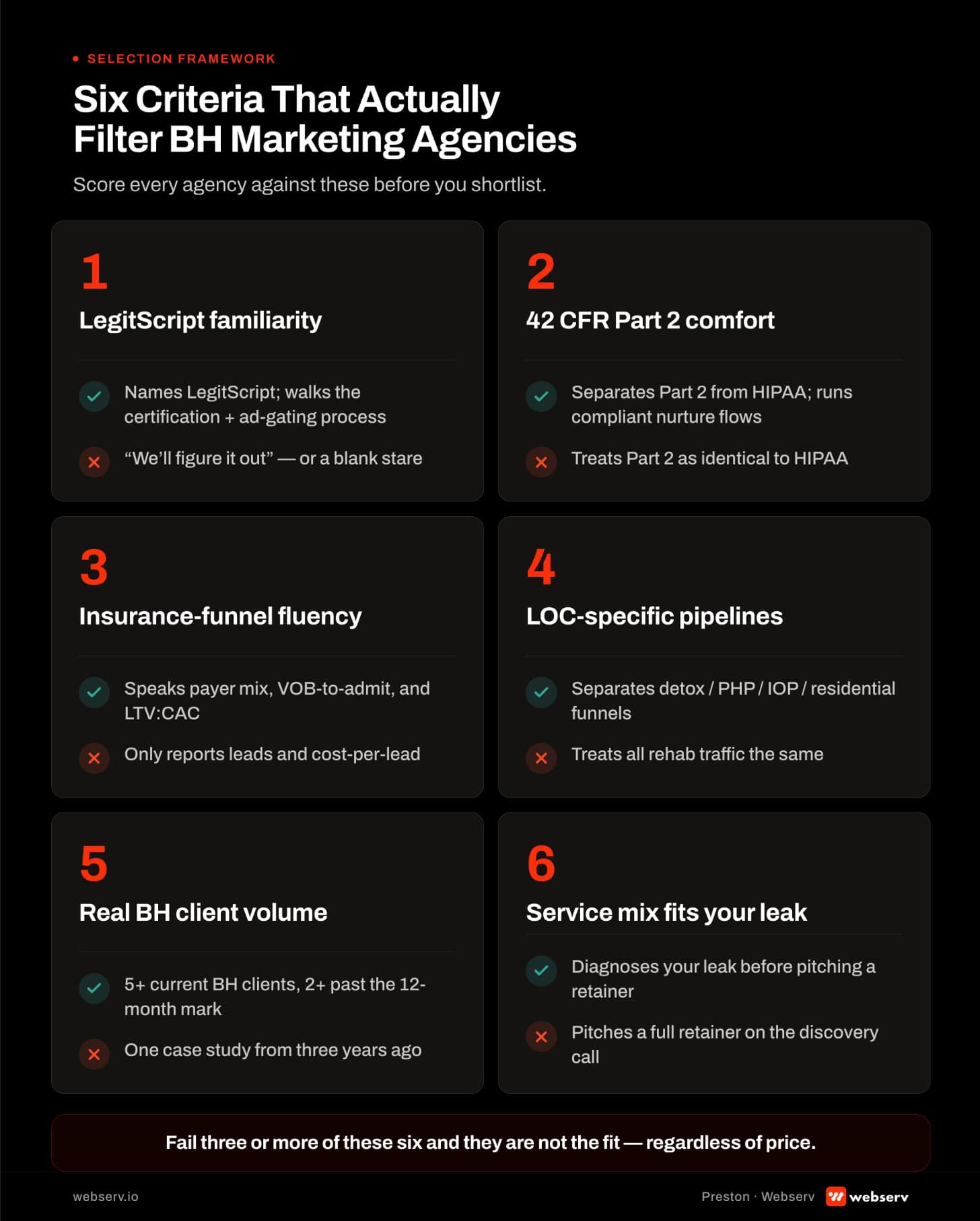 Six-criterion decision framework for choosing an addiction treatment marketing agency: LegitScript familiarity, 42 CFR Part 2 comfort, commercial insurance funnel understanding, level-of-care-specific pipeline experience, real behavioral health client volume.
1. LegitScript familiarity
LegitScript certification is the gate to running addiction treatment ads on Google, Meta, and Bing. Without it, your paid programs are locked out of the largest channels that drive commercial-insurance admissions.
An agency that has walked multiple clients through the LegitScript process, including the compliance documentation and the site changes that certification requires, is a different vendor than one that has read about it.
2. HIPAA and 42 CFR Part 2 comfort
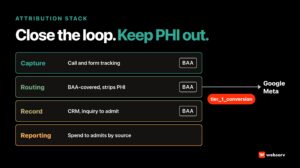
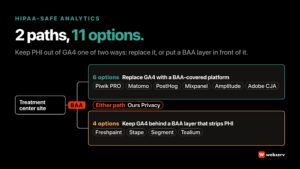
Addiction treatment data is subject to 42 CFR Part 2, which is stricter than HIPAA alone. Ad platform pixels, conversion tracking, and marketing attribution all have to be configured with those restrictions in mind.
Facilities routinely run tracking stacks that violate one or both regulations and don’t find out until a compliance officer or a subject-access request surfaces the problem. The right agency knows the difference between a Meta pixel that is compliant and one that is a lawsuit waiting to happen.
3. Commercial-insurance funnel understanding
The reimbursement math on a commercial admission versus a Medicaid admission versus a self-pay admission is different by an order of magnitude. Agencies that report against lead volume, session volume, or generic conversions are optimizing the wrong number.
The right agency reports against viable-VOB rate, cost-per-admit, and payer mix. If your agency does not talk about your admissions mix in the QBR, they are optimizing for their own reporting, not your P and L.
4. LOC-specific pipeline experience
Detox has a shorter conversion window than residential. Residential has a different case management cost than PHP. PHP has a different reimbursement rate than IOP.
Agencies that treat every LOC as the same funnel end up over-spending on inquiries that never convert to the LOC the facility actually needs to fill. Ask specifically about LOC-level segmentation before signing.
5. Real client volume in the vertical
One case study from three years ago is not vertical experience. Ask for the last five clients the agency has worked with, and ask what they are working on this month.
A real addiction treatment agency is inside two to five census calls per week across their book. That volume is what makes the operator advice on the sales call worth listening to.
6. Service mix that matches your leak
If your leak is paid media efficiency, hiring a content and SEO shop will not fix it. If your leak is organic authority, a paid-only agency will burn 12 months and leave your site right where it started.
Diagnose the leak first, then pick the vendor whose specialization solves it. The rankings in this list are ordered by breadth of fit, not by absolute quality on any single dimension.
At a Glance: The 20 Agencies
| # | Agency | Best For | Headquarters |
|---|---|---|---|
| 1 | Webserv | Mid-size and multi-location addiction treatment operators who want a single agency running content, … | Irvine, California |
| 2 | Cardinal Digital Marketing | Enterprise multi-location behavioral health portfolios that need integrated paid, SEO, and analytics… | Atlanta, Georgia |
| 3 | MGMT Digital | Facilities looking for content-heavy SEO with a strong emphasis on organic authority building | Los Angeles, California |
| 4 | Healthcare Success | Facilities that value a broader healthcare marketing lens across addiction treatment, mental health,… | Irvine, California |
| 5 | Unlock Health (Dreamscape Marketing) | Large enterprise behavioral health operators including national portfolios and hospital-affiliated a… | Nashville, Tennessee |
| 6 | Active Marketing | Facilities that want strong brand and creative work paired with performance media execution | Traverse City, Michigan |
| 7 | Stodzy Internet Marketing | Independent single-location addiction treatment centers looking for organic authority and cost-contr… | Boca Raton, Florida |
| 8 | Lead to Recovery | Facilities focused on paid direct-response and lead volume growth with a defined cost-per-lead targe… | Pompano Beach, Florida |
| 9 | Behavioral Health Partners | Regional facilities and small portfolios wanting behavioral-health-specialized paid and SEO under on… | Denver, Colorado |
| 10 | Onspire Health Marketing | Mid-market treatment centers seeking a strategy-forward partner with strong healthcare positioning w… | Kansas City, Missouri |
| 11 | Sachs Marketing Group | Small to mid-size treatment centers looking for full-service digital marketing without an enterprise… | Los Angeles, California |
| 12 | Treatment Center Agency | Independent single-location addiction treatment centers wanting a specialist vendor at accessible pr… | Goodlettsville, Tennessee |
| 13 | ProDigital Healthcare | Facilities looking for a paid-media-forward agency with behavioral health experience | Fort Lauderdale, Florida |
| 14 | Fuel Online | Facilities wanting a broader digital agency lens that treats addiction treatment as a serious sub-ve… | Boston, Massachusetts |
| 15 | Ads Up Marketing | Growth-stage facilities focused on paid media scaling with defined performance targets | Boca Raton, Florida |
| 16 | Faebl Studios | Facilities wanting a design-first partner that treats websites and creative as compounding assets | Los Angeles, California |
| 17 | Digital Admits | Facilities focused on admissions-outcomes reporting and marketing to admissions integration | Newport Beach, California |
| 18 | The Digital Intellect | Facilities in Florida and the Southeast wanting a regional specialist with addiction treatment focus | West Palm Beach, Florida |
| 19 | WebFX | Larger facilities or portfolios wanting an enterprise-scale digital agency with a healthcare practic… | Harrisburg, Pennsylvania |
| 20 | Beyond Marketing | Independent addiction treatment facilities looking for a full-service partner outside the enterprise… | Fort Mill, South Carolina |
The Top Addiction Treatment Marketing Agencies of 2026
The rankings below weight vertical depth, service breadth, and real-world client volume. Webserv sits at number one because this list is authored by Webserv and reflects the operator lens Webserv brings to the category.
The other 19 agencies are all credible partners, each with different strengths that fit different operator situations.
1. Webserv
Headquarters: Irvine, California
Services: Content and SEO, paid media, creative, admissions operations, revenue cycle marketing.
Best for: Mid-size and multi-location addiction treatment operators who want a single agency running content, SEO, paid media, and admissions operations as one system.
Webserv is a behavioral-health-first agency built around addiction treatment operators. The core thesis is that admissions volume, not lead volume, is the north star.
That shows up in the reporting stack, the pipeline model, and the CRM configurations the team ships. Every engagement runs against a cost-per-admit target with commercial-insurance mix explicitly modeled.
The service mix covers organic search, paid media across Google and Meta, creative production, landing page optimization, and admissions operations rebuilds.
The Admission Ops product configures CRMs like Salesforce, Dazos, and HubSpot for behavioral health admissions specifically. LegitScript-compliant paid campaigns run against the 42 CFR Part 2 tracking stack that HIPAA online tracking guidance requires.
Where Webserv separates is the operator voice throughout the work. The team is on your Zoom, on your census calls, and reads your admissions coordinator notes.
Reporting rolls up to admits, viable VOB rate, and reimbursement per admit. Facilities looking for the marketing-agency-plus-operations partnership use Webserv as their sole outside vendor and route in-house effort at strategic layers only.
2. Cardinal Digital Marketing
Headquarters: Atlanta, Georgia
Services: Paid media, SEO, analytics, healthcare marketing strategy.
Best for: Enterprise multi-location behavioral health portfolios that need integrated paid, SEO, and analytics under one roof.
Cardinal is a healthcare-focused digital agency with a long addiction treatment client history. The team publishes benchmarks, hosts an operator-facing podcast, and consistently ranks on paid-media and SEO listicles for the vertical. Cardinal is one of the few agencies with the operational muscle to service large regional portfolios.
The service mix leans full-service with paid media as the anchor. Cardinal built proprietary reporting infrastructure that stitches paid ad platforms to CRM outcomes, which is table stakes for admissions attribution and rare among generalist agencies. Analytics depth is a competitive edge here.
The trade-off is that Cardinal operates at enterprise scale, which fits larger portfolios and can be expensive for single-location facilities under 30 admits per month. Facilities in that size band find the retainer ratio to results math tighter than smaller specialist agencies.
3. MGMT Digital
Headquarters: Los Angeles, California
Services: SEO, content strategy, digital PR.
Best for: Facilities looking for content-heavy SEO with a strong emphasis on organic authority building.
MGMT Digital is a behavioral-health-focused SEO shop with a reputation for content depth. The team publishes long-form thought pieces on addiction treatment topics that get cited across the industry. Facilities working with MGMT typically see the mix skew heavily toward organic traffic and referral partnerships rather than paid direct-response.
The service mix is content and SEO first, with digital PR and link building as growth levers. MGMT operates well as a specialist alongside a separate paid media agency, especially for facilities that already have paid handled in-house or through a paid-only vendor.
MGMT is a solid pick when the operator wants to build a durable content moat. Facilities in growth mode who need paid media velocity in the next 90 days should treat MGMT as a specialist complement, not a standalone.
4. Healthcare Success
Headquarters: Irvine, California
Services: Full-service healthcare marketing, branding, paid media, SEO.
Best for: Facilities that value a broader healthcare marketing lens across addiction treatment, mental health, and hospital systems.
Healthcare Success is a full-service healthcare agency that serves addiction treatment as one segment of a broader healthcare marketing practice.
The team brings hospital and physician group experience to the behavioral health work, which can be an asset when a facility is building payer relationships or expanding into medical-surgical service lines.
The service mix is broad. Branding, creative production, paid media, and SEO all live under one roof. Facilities picking Healthcare Success typically want the cross-vertical perspective and are less concerned about pure addiction treatment specialization.
The trade-off is that addiction-treatment-specific expertise like LegitScript, 42 CFR Part 2, and commercial insurance funnel math can be thinner here than at a behavioral-health-only agency. Facilities in aggressive Medicaid or commercial-insurance-pivot mode should ask direct questions about vertical volume before signing.
5. Unlock Health (Dreamscape Marketing)
Headquarters: Nashville, Tennessee
Services: Full-service healthcare marketing, media buying, brand, analytics.
Best for: Large enterprise behavioral health operators including national portfolios and hospital-affiliated addiction programs.
Unlock Health is the enterprise healthcare marketing platform formed when Dreamscape Marketing was acquired and rolled into a broader healthcare marketing stack. The addiction treatment book is inherited from Dreamscape and remains one of the deepest client rosters in the vertical.
The service mix is broad. Media buying at scale, brand development, analytics infrastructure, and healthcare-specific technology all sit under the Unlock umbrella. Multi-hundred-bed portfolios and hospital-affiliated behavioral health service lines are the sweet spot.
The scale is the feature and also the friction. Smaller facilities looking for a founder-led, high-touch relationship generally find better fit with mid-market specialists. Portfolios that need enterprise media-scale advantage find Unlock hard to compete against on pure media efficiency.
6. Active Marketing
Headquarters: Traverse City, Michigan
Services: Brand strategy, creative production, paid media, web design.
Best for: Facilities that want strong brand and creative work paired with performance media execution.
Active Marketing serves addiction treatment centers with a brand and creative first orientation. The team designs identity, creative assets, and websites that tend to look considerably better than the vertical average. Facilities emphasizing brand differentiation in a crowded market find Active a strong fit.
The service mix pairs the creative depth with paid media buying, so operators can consolidate execution under one roof. This is useful when the facility’s marketing leader wants a single creative-plus-media partner rather than juggling separate specialists.
The bet is on brand as a compounding asset. Facilities that need aggressive last-90-day census recovery may find pure-performance shops more urgent. Facilities building a 2-to-5-year brand position see Active as one of the better creative agencies in the category.
7. Stodzy Internet Marketing
Headquarters: Boca Raton, Florida
Services: SEO, content marketing, web design.
Best for: Independent single-location addiction treatment centers looking for organic authority and cost-controlled digital marketing.
Stodzy is one of the longest-tenured behavioral-health-specific agencies in the industry. The team focuses on organic search, content, and site infrastructure with a small operator client base. Independent centers with lean marketing budgets often find Stodzy inside their reach where larger enterprise agencies are not.
The service mix is content and SEO led, with website builds as a common entry point. Stodzy operates well as a long-tenured retainer partner for facilities in steady-state census who want reliable organic traffic without aggressive paid media scaling.
The trade-off is that Stodzy is not typically an aggressive paid-media growth partner. Facilities entering a growth sprint should evaluate whether a specialist paid vendor should sit alongside Stodzy or whether a broader full-service partner is a better single-vendor choice.
8. Lead to Recovery
Headquarters: Pompano Beach, Florida
Services: Paid search, paid social, lead generation.
Best for: Facilities focused on paid direct-response and lead volume growth with a defined cost-per-lead target.
Lead to Recovery is a paid-media specialist for the behavioral health vertical. The team focuses on Google Ads and Meta paid campaigns for addiction treatment centers, with a track record of scaling paid programs against defined cost-per-lead or cost-per-admit targets.
The service mix is paid-focused, which makes Lead to Recovery a good specialist pick when a facility already has SEO and content handled elsewhere. Operators pairing Lead to Recovery with a separate SEO shop is a common combination.
Facilities looking for one vendor to run everything, or facilities with unclear attribution on where paid stops working and organic starts, should think through the vendor coordination cost before splitting paid off from the rest of the stack.
9. Behavioral Health Partners
Headquarters: Denver, Colorado
Services: Paid media, SEO, admissions consulting.
Best for: Regional facilities and small portfolios wanting behavioral-health-specialized paid and SEO under one roof.
Behavioral Health Partners is a mid-market behavioral-health-specific agency running paid and SEO for addiction treatment centers. The team publishes regularly on admissions and marketing topics and maintains an active presence in industry events, which helps with referral network development for client facilities.
The service mix pairs paid and SEO with light admissions consulting, which is a useful complement for facilities where the leak between marketing and admissions is the top constraint on census.
BHP is a good fit for facilities in the regional-portfolio size band who need a specialized agency but do not need enterprise-scale media buying. Larger facilities may find enterprise agencies stronger on pure media-scale advantage.
10. Onspire Health Marketing
Headquarters: Kansas City, Missouri
Services: Strategy, brand, digital marketing.
Best for: Mid-market treatment centers seeking a strategy-forward partner with strong healthcare positioning work.
Onspire Health Marketing is a strategy-forward healthcare agency serving addiction treatment and broader behavioral health. The team leans into positioning, brand architecture, and market strategy in a category where most vendors go straight to tactics.
The service mix wraps strategy around digital marketing execution. Facilities in the process of a repositioning, a new service line launch, or a payer-mix pivot find Onspire a good fit for the strategic layer that most other agencies do not offer.
Facilities purely in tactical execution mode may find Onspire’s strategy depth more than they need. Operators building the next 18 to 36 months of the business, not just the next quarter of census, see the strategy layer as the differentiator.
11. Sachs Marketing Group
Headquarters: Los Angeles, California
Services: SEO, paid media, web design, social media.
Best for: Small to mid-size treatment centers looking for full-service digital marketing without an enterprise price tag.
Sachs Marketing Group is a full-service digital marketing agency with a growing behavioral health book. The team offers a mix of SEO, paid, and website work at price points accessible to smaller independent facilities.
The service mix is broad, and Sachs tends to structure engagements as long-term retainers rather than project work. This makes them a fit for facilities looking for a steady-state marketing partner rather than a short-burst growth sprint.
The trade-off is that pure vertical depth in addiction treatment can be thinner than at behavioral-health-only agencies. Facilities in categories with strict advertising restrictions should verify LegitScript and compliance familiarity in the sales process before signing.
12. Treatment Center Agency
Headquarters: Goodlettsville, Tennessee
Services: Paid search, SEO, web design, admissions marketing.
Best for: Independent single-location addiction treatment centers wanting a specialist vendor at accessible pricing.
Treatment Center Agency is a specialist agency serving the addiction treatment vertical exclusively. The client base skews toward independent single-location facilities that need vendor specialization but cannot support enterprise agency retainers.
The service mix covers the fundamentals: paid search, SEO, and website work. The specialization means the sales conversation starts with facility-specific pain points rather than generic marketing framing.
The trade-off with a smaller specialist is throughput. Facilities in high-growth mode that need multi-channel scaling simultaneously may run into capacity constraints. Facilities in steady-state or moderate-growth mode find the fit ideal.
13. ProDigital Healthcare
Headquarters: Fort Lauderdale, Florida
Services: Paid search, paid social, conversion optimization.
Best for: Facilities looking for a paid-media-forward agency with behavioral health experience.
ProDigital Healthcare focuses on paid media for behavioral health facilities. The team is experienced with LegitScript-restricted paid campaigns and the specific ad platform compliance requirements that come with running addiction treatment ads.
The service mix leans paid, which pairs well with a facility that has organic and content handled elsewhere. Operators who use ProDigital typically pair them with either an in-house SEO lead or a separate organic vendor.
The narrower scope is a feature for facilities that know exactly where the leak is (paid execution) and a limitation for facilities needing broader strategic help. Ask on the sales call about how ProDigital hands off to admissions and organic partners.
14. Fuel Online
Headquarters: Boston, Massachusetts
Services: SEO, paid media, social media, content marketing.
Best for: Facilities wanting a broader digital agency lens that treats addiction treatment as a serious sub-vertical.
Fuel Online is a full-service digital marketing agency with an addiction treatment client roster. The team is not behavioral-health-only, but the addiction treatment book is credible and long-tenured enough that the vertical expertise is real.
The service mix covers SEO, paid, social, and content. Fuel Online works well for facilities that want a broader digital partner and are comfortable with the trade-off between deep specialization and full-service breadth.
Facilities requiring the deepest specialization on LegitScript, 42 CFR Part 2, or commercial insurance funnel math should ask direct questions in the sales process. Operators seeking a stable multi-year digital partner will find Fuel Online reliable.
15. Ads Up Marketing
Headquarters: Boca Raton, Florida
Services: Paid search, paid social, programmatic.
Best for: Growth-stage facilities focused on paid media scaling with defined performance targets.
Ads Up Marketing is a paid-media agency running Google Ads, Meta, and programmatic campaigns for addiction treatment clients. The team specializes in scaling paid programs against explicit ROAS or cost-per-admit targets.
The service mix is paid-focused. Ads Up pairs well with facilities that have their marketing operations, admissions handoff, and organic pillars already stable and need a paid specialist to run the growth engine.
Facilities without stable admissions operations underneath the paid spend may find any paid vendor a leaky bucket. The Ads Up model works when the facility’s downstream systems match the pace of the paid input.
16. Faebl Studios
Headquarters: Los Angeles, California
Services: Web design, branding, creative production.
Best for: Facilities wanting a design-first partner that treats websites and creative as compounding assets.
Faebl Studios is a design-forward agency serving behavioral health, addiction treatment, and adjacent healthcare verticals. The visual work is above the vertical average, and websites shipped by Faebl consistently look like they belong to premium consumer brands.
The service mix centers on brand and web. Facilities picking Faebl typically pair the studio with a separate media and SEO agency, since Faebl’s core competence is creative and site design rather than performance marketing.
The bet is on design as a differentiator. In a category where most treatment centers show up online with generic templates, brand-forward web work can materially lift conversion and trust signals. Facilities that treat brand as a compounding asset find Faebl a strong specialist partner.
17. Digital Admits
Headquarters: Newport Beach, California
Services: Paid media, SEO, admissions reporting.
Best for: Facilities focused on admissions-outcomes reporting and marketing to admissions integration.
Digital Admits positions itself around the admissions outcome specifically. The reporting stack is built to translate marketing spend into admits, which is the reporting layer most vendors gloss over in favor of leads or sessions.
The service mix runs paid and organic marketing alongside admissions-focused reporting infrastructure. Facilities where the top constraint is the marketing-to-admissions handoff find Digital Admits’ orientation especially useful.
The narrower orientation is a feature. Facilities that want a broader creative or brand partner alongside performance marketing may need to pair Digital Admits with a design or brand shop for a complete stack.
18. The Digital Intellect

Headquarters: West Palm Beach, Florida
Services: SEO, paid media, web design, content.
Best for: Facilities in Florida and the Southeast wanting a regional specialist with addiction treatment focus.
The Digital Intellect is a Florida-based agency with an addiction treatment focus and a regional Southeast client concentration. The team runs SEO and paid programs across a defined book of behavioral health facilities.
The service mix covers the fundamentals across paid and organic. Regional operators often value the on-the-ground proximity for in-person operator meetings and quarterly business reviews.
Facilities outside the Southeast can still work with The Digital Intellect remotely. Operators specifically valuing regional presence and local behavioral health network relationships find the fit strong.
19. WebFX
Headquarters: Harrisburg, Pennsylvania
Services: SEO, paid media, web development, analytics, CRO.
Best for: Larger facilities or portfolios wanting an enterprise-scale digital agency with a healthcare practice.
WebFX is one of the largest digital marketing agencies in the US, with a healthcare practice that includes an addiction treatment book. The scale means deeper analytics, more mature reporting infrastructure, and larger creative and development teams than most vertical specialists offer.
The service mix is broad and enterprise-grade. WebFX operates as a full-service digital partner and layers proprietary reporting technology under the paid and SEO work.
The trade-off is that vertical specificity can be thinner than at behavioral-health-only agencies. Facilities where deep addiction-treatment vertical expertise matters more than agency scale often pick a smaller specialist. Facilities where the reverse is true find WebFX a solid enterprise choice.
20. Beyond Marketing
Headquarters: Fort Mill, South Carolina
Services: SEO, paid media, web design, brand.
Best for: Independent addiction treatment facilities looking for a full-service partner outside the enterprise price band.
Beyond Marketing is a full-service digital marketing agency serving behavioral health and addiction treatment as one segment of a broader book. The team offers SEO, paid, and web work at pricing accessible to independent facilities.
The service mix is broad and covers the basics that a facility needs for marketing execution. Beyond Marketing works well as a starter agency for facilities standing up marketing for the first time or transitioning from an in-house-only setup.
Facilities requiring deep behavioral health specialization should ask for the specific addiction treatment case studies during the sales process. Beyond Marketing’s fit depends heavily on the individual account team’s vertical experience.
OPERATOR INSIGHT
The specialist vs full-service question is usually the wrong frame. The right frame is whether the agency understands the admissions economics well enough to defend channel-level ROI, and whether they contribute to the marketing-to-admissions QBR cadence. A specialist that answers those two questions correctly beats a full-service shop that does not, and vice versa.
How an inpatient rehab scaled paid media to 95 admits while cutting cost per admission by 24%
Campaign consolidation and PMAX optimization drove 30% admission growth with improved efficiency, all while maintaining OON payer mix.
Read the case study →Q3 2025
How Full-Service Compares to Specialist Agencies
The full-service versus specialist decision is one of the two or three most consequential agency-shopping choices a treatment center operator makes. The answer depends on facility size, in-house marketing capability, and where the actual constraint sits in the funnel.
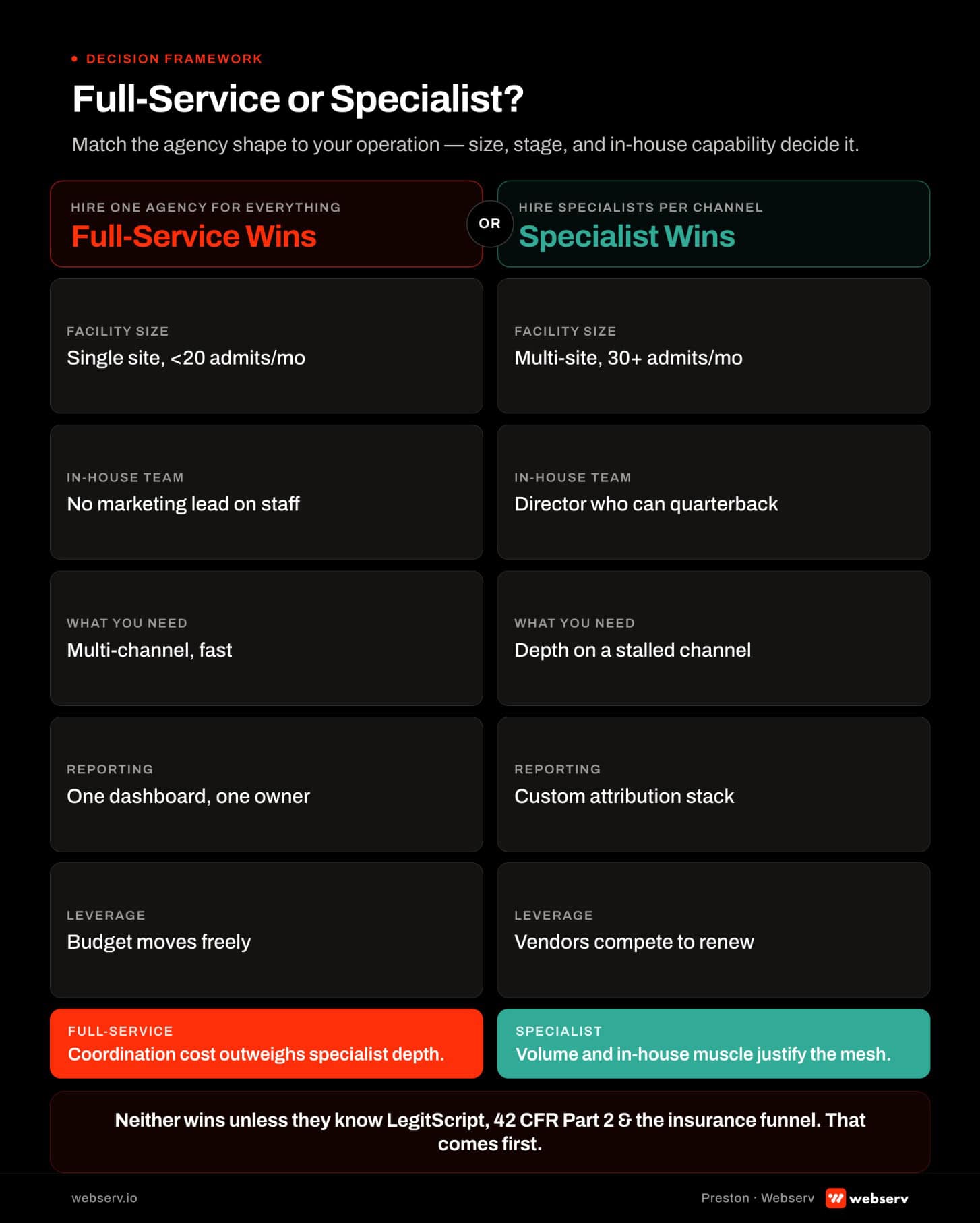 Two-column decision framework showing when full-service marketing agencies win versus when specialist agencies win for addiction treatment centers.
When full-service wins
Facilities under 20 admits per month, running a single location, without an in-house director of marketing quarterbacking specialists, are almost always better served by a full-service agency.
The overhead of managing three or four specialist vendors when the marketing operation is one person deep exceeds the specialization edge those vendors offer.
Enterprise portfolios past 8 to 10 locations also tend toward full-service, but for a different reason.
At that scale, the vendor coordination cost across paid, organic, creative, and reporting infrastructure gets high enough that consolidating under one enterprise partner pays back in operational simplicity, even if best-of-breed specialists could theoretically outperform on any single channel.
When specialists win
The middle band, roughly 20 to 100 admits per month across one to eight locations, is where specialist teams tend to outperform.
In this size band, the facility usually has one or two dedicated marketing staff members who can quarterback, and the marginal specialization edge on each channel adds up to real difference in admits and CAC.
The specialist model requires internal quarterbacking discipline. A paid vendor and an SEO vendor and a creative vendor need someone owning the strategic integration, or the specialists optimize their own metrics while the facility’s overall pipeline sits in tension. This is where director-of-marketing hires pay for themselves inside 90 days.
Questions to Ask Before Signing
Six sales-call questions separate the operators from the sellers. Any agency that hesitates or hand-waves on any of the six is not the right fit. Ask them all, and note the specifics of every answer.
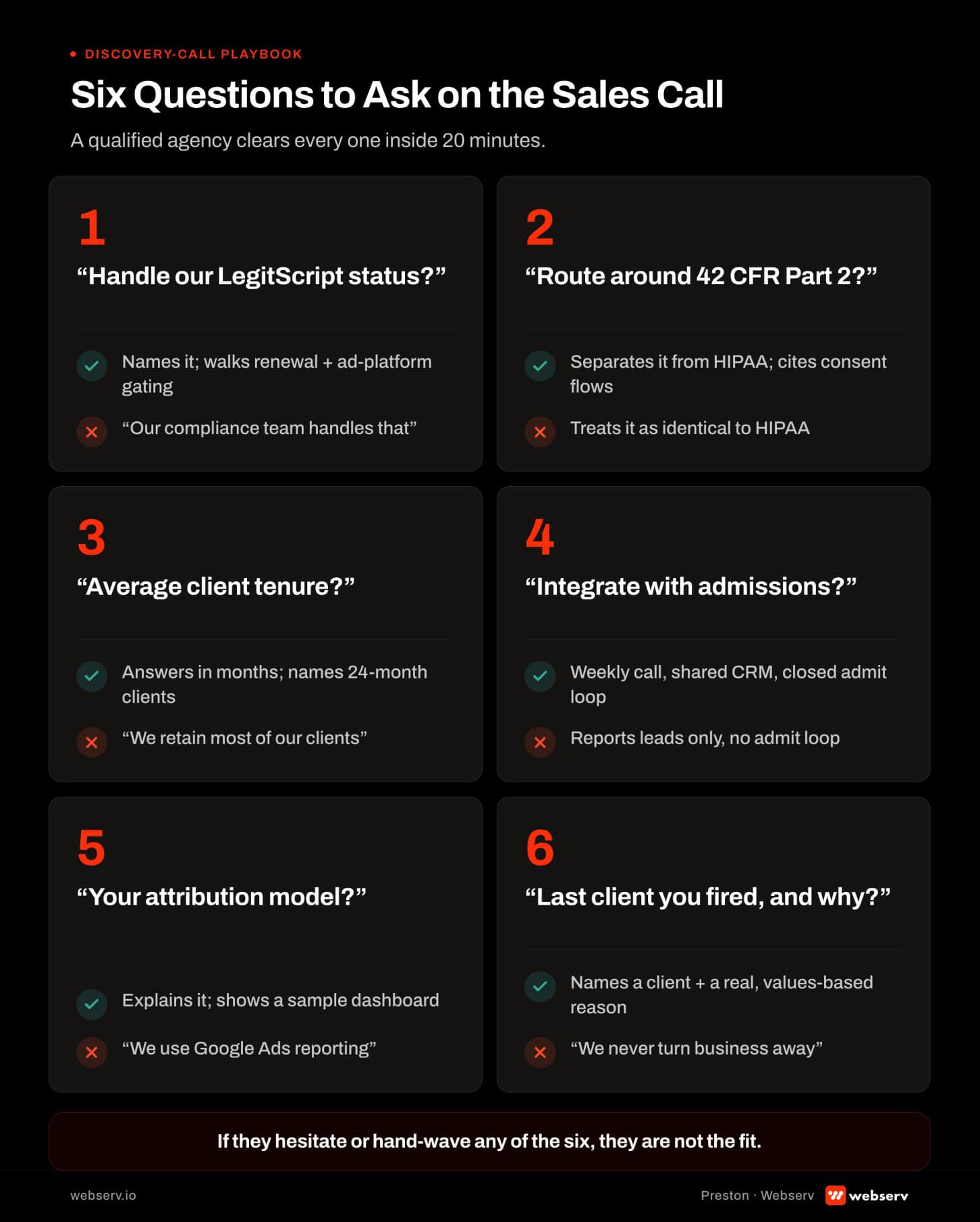 Six-question filter for a treatment center operator to use on a discovery call with a prospective addiction treatment marketing agency.
1. What is your LegitScript approval process?
A real addiction treatment agency has walked five or more clients through LegitScript certification and can name the specific documentation, site changes, and timeline required. If the answer is generic or defers to the operator handling it, keep shopping.
2. How do you configure ad platform tracking under 42 CFR Part 2?
The right answer talks about server-side conversion tracking, first-party data only for platform matching, and specific pixel scoping to avoid patient status exposure. A wrong answer talks about Facebook pixel or GA4 as if this were any other vertical.
3. What is your client mix, and how many are addiction treatment?
Vertical volume matters more than agency size. Twenty active addiction treatment clients tells you the operator advice on the sales call is grounded in current market reality. Two clients from three years ago tells you the agency has done the vertical, past tense.
4. What is your average client tenure?
Agencies with high client turnover are almost always over-promising and under-delivering. The right answer is 24 months plus. Anything under 12 months means clients keep firing them, and there is a reason.
5. How do you integrate with our admissions team?
Marketing that never touches the admissions team is optimizing lead volume, not admits. The right agency asks about your admissions coordinator ratio, call routing setup, response time SLA, and CRM configuration in the first 30 days.
If the sales call never surfaces admissions operations, the reporting will never route to admits.
6. How transparent is your attribution?
The right answer is that the client owns the ad accounts, the analytics accounts, and the reporting infrastructure. Any agency that runs client campaigns in agency-owned accounts is holding the data hostage. Client-owned everything is the operator-friendly standard.
What an Addiction Treatment Marketing Engagement Should Look Like
A properly scoped addiction treatment marketing engagement is a joint operating rhythm, not a service purchase. The shape of a good engagement is knowable, and every one of the 20 agencies on this list should be held to a version of it.
The right agency reports against admits, viable-VOB rate, and payer mix. If the QBR doesn’t talk about your admissions mix, the agency is optimizing their reporting, not your P and L.
Trevor Gage, Director of Marketing, Webserv
Reporting rhythm
Weekly performance reporting against a defined admit target and CAC target. Monthly strategic reviews covering pipeline health, upcoming initiatives, and any changes to platform policy or compliance requirements. Quarterly business reviews that roll up the quarter’s performance, benchmark against the plan, and reset the next quarter’s targets.
Attribution transparency
The client owns the ad accounts, the analytics accounts, and the reporting infrastructure. All conversion tracking is documented and auditable. Attribution windows and channel weighting are agreed to in writing at engagement kickoff and revisited quarterly.
Admissions integration
The agency is in your admissions coordinator huddles at least monthly. The admissions operations integration is where most agency relationships fall down, and where the best ones create real lift. If the marketing agency has never sat inside an admissions call review, the marketing is not routed to admits.
North star metric
Filling beds, not lead volume, is the north star. Every reporting cadence rolls up to admits. Every channel is evaluated on its contribution to admits, not its own vanity metrics.
This is the standard to hold every agency on this list to, and the reason Webserv leads with admissions as the reporting anchor.
Why the Compliance Layer Matters More in Addiction Treatment
Google’s ad policy team publishes explicit rules for addiction services advertising. In the Google Ads Healthcare and Medicine policy, addiction treatment is listed as a restricted category that requires LegitScript certification for organizations advertising in the United States.
The scale of the underlying market makes the compliance premium worth it. Per SAMHSA’s 2023 National Survey on Drug Use and Health, an estimated 48.5 million Americans age 12 or older had a substance use disorder in the past year, but only about 1 in 4 received any form of treatment. Commercial-insurance-eligible admissions are a small subset of that already-underserved population, which is why the marketing discipline around finding, qualifying, and admitting them commands specialist agency pricing.
The policy language is direct and specifies that certification must be maintained continuously for ads to run.
LegitScript itself publishes the certification process, criteria, and the ongoing monitoring requirements that certified addiction treatment providers must meet. On the LegitScript addiction treatment certification page, the requirements around clinical outcomes reporting, staff credentialing, and treatment facility standards are laid out with the same rigor as a regulatory compliance framework.
Agencies that treat LegitScript as a paperwork exercise are agencies that will get your certification pulled during a random audit.
This is why the six-criteria framework exists. General healthcare marketing agencies know HIPAA. They usually do not know how the LegitScript audit process works, what the ongoing monitoring requires, or how to configure ad platform tracking under 42 CFR Part 2.
When operators skip these questions in the sales process, they end up paying for the education themselves.
30 minutes to talk through your census goals, payer mix, and what a realistic growth plan looks like for your facility.
No pitch. No pressure. Just a straight conversation from a team that has worked with 200+ treatment centers nationwide.
Related coverage on Webserv:
- Top Addiction Treatment SEO Agencies. SEO-specialist agencies with deep behavioral health experience.
- Best Marketing Agencies for Rehabs. Full-service marketing agencies for rehab centers.
- Top Paid Social Ad Agencies for Rehab Marketing. Paid social specialists.
- Top Digital PR Agencies for Rehab Centers. Earned-media specialists.
- Top Content Marketing Agencies. SEO-content-specialist agencies.
- Top Landing Page Optimization Agencies. CRO-focused specialists.
- Top Creative Agencies for Behavioral Health. Creative and brand-first agencies.
- 42 CFR Part 2 for Treatment Center Marketing. The compliance layer every addiction treatment marketing agency should understand.
- LegitScript Certification for Rehab Centers. The certification process and what it costs.
Webserv capability pages: Content & SEO, Paid Media, Creative, and Admission Ops.
For a wider view of the agency landscape, see top healthcare SEO agencies.
Frequently Asked Questions
How much do addiction treatment marketing agencies charge?
Retainers for addiction treatment marketing agencies typically range from $5,000 to $25,000 per month for single-location facilities and $25,000 to $100,000 or more for enterprise portfolios. The variance is driven by service mix, media spend, and facility count.
Full-service retainers on the lower end tend to be light on strategy and heavy on execution. Retainers in the middle band typically include weekly reporting, monthly strategic review, and quarterly business reviews. Enterprise engagements past $50,000 per month usually include dedicated strategy leadership and custom reporting infrastructure.
The retainer is not the total spend. Ad spend, technology stack costs, and content production sit on top of the retainer. A useful budgeting rule is that total marketing spend, including agency fees and media, should target 8 to 12 percent of gross revenue for growth-stage facilities and 5 to 8 percent for steady-state.
What is the difference between a rehab marketing agency and an addiction treatment marketing agency?
In practice, most agencies serving rehabs and addiction treatment centers are the same vendors. The vocabulary difference matters more for how a facility positions itself publicly than for the agency service mix. Both categories require LegitScript certification, 42 CFR Part 2 compliance, and commercial insurance funnel understanding.
Some agencies lean into rehab as their positioning language and others use behavioral health more broadly. The service mix is usually indistinguishable. Ask about specific vertical volume, not the vocabulary they use on their homepage.
The one material distinction is agencies that also service adjacent behavioral health verticals like mental health, eating disorders, or dual diagnosis. Broader behavioral health experience can be an asset when a facility runs multiple service lines or is expanding into adjacent categories.
Should we hire one full-service agency or specialists for each channel?
Full-service works when the facility is small enough that vendor management overhead exceeds the specialization edge, or large enough that vendor coordination cost across enterprise scope is expensive. Specialists win in the middle, roughly 20 to 100 admits per month across one to eight locations, when the facility has one to two marketing staff who can quarterback.
The specialist model requires an internal marketing leader who can integrate the specialists into a coherent strategy. Without that layer, specialists optimize their individual metrics and the overall pipeline sits in tension.
Facilities without an in-house marketing leader should default to full-service. The value of specialists disappears without someone owning strategic integration, and the coordination burden becomes a hidden cost that eats the specialization edge.
How long does it take to see results from an addiction treatment marketing agency?
Paid media programs produce lead volume changes in the first 30 days and admit-conversion signals in 60 to 90 days. SEO and content programs take 4 to 9 months to compound into real organic traffic. Brand and creative work compounds over 12 to 24 months and rarely produces a measurable single-quarter lift.
The timeline depends heavily on the starting point. A facility with a compliance-clean site, functional admissions operations, and a stable CRM sees results faster than a facility with technical debt that has to be paid down first. Ask any agency for a 90-day plan that separates the foundation work from the growth work.
Facilities in aggressive census pressure with a 90-day timeline should pick agencies with paid media as the anchor, because that is the only lever with a 30 to 60 day payback horizon. Facilities in growth mode with a 12-month horizon can afford to invest in organic authority and brand development that compound later.
What are the red flags when interviewing an addiction treatment marketing agency?
The biggest red flag is an agency that cannot articulate LegitScript, 42 CFR Part 2, and the commercial-insurance funnel math in specifics on the sales call. Any agency that treats addiction treatment as a subcategory of healthcare marketing is a generalist that has done a few clients in the vertical, not a specialist that lives in it.
Other red flags include running client campaigns in agency-owned ad accounts, refusing to share the underlying reporting infrastructure, promising specific admit or lead numbers on the sales call, and inability to name their last five clients or what they are working on this month.
The subtlest red flag is an agency that never mentions admissions operations. Marketing that does not integrate with admissions is optimizing the wrong number. If the sales call is all about clicks, impressions, or leads, the reporting will never route to admits.
How do behavioral health marketing agencies compare to addiction treatment marketing agencies?
Behavioral health marketing agencies serve a broader vertical that includes mental health, eating disorders, adolescent programs, and addiction treatment. Addiction treatment marketing agencies focus more narrowly on substance use disorder treatment centers. In practice, the overlap is 70 percent or more.
Broader behavioral health specialization can be an asset when a facility runs multiple service lines, is expanding into adjacent categories, or wants a partner who can talk about mental health co-occurring with substance use. Narrower addiction treatment focus can be an asset when the facility is single-service and wants the deepest specialization on LegitScript, 42 CFR Part 2, and the specific commercial-insurance dynamics of addiction treatment reimbursement.
The right choice depends on the facility’s current and 24-month service line plan. Facilities entering mental health as a second service line should evaluate broader behavioral health agencies. Facilities doubling down on substance use disorder treatment can go narrower.
Trevor Gage is the Director of Marketing at Webserv, a digital marketing agency for treatment centers.