A 35-bed residential treatment center came to me last summer running $14,000 a month on Meta with one to two admissions a month. The agency was producing reasonable-looking dashboard metrics. The admissions team was burning out trying to qualify form fills that did not turn into admissions.
The operator was convinced paid social did not work at his budget level. He was wrong, but he had reasons to think so.
We rebuilt the program over six weeks using the strategies in this piece. By month three, the same $14,000 monthly budget was producing 5 to 8 admissions a month. The creative cost had gone up by about $1,200 a month for a batched-shoot library. The compliance setup work was front-loaded.
Beyond that, the changes were almost entirely tactical decisions the prior agency had defaulted incorrectly on. None of them were secrets. Most of them were under-applied in this category because the agencies that serve small BH operators rarely run paid social aggressively enough at the small-budget end to develop the playbook.
This is the playbook. Fourteen strategies that change what is possible on under-$20K Meta budgets for behavioral health.
These 14 strategies are Meta-specific by design. Strategy 1 explains why concentrating budget on Meta beats spreading it across TikTok, LinkedIn, and Reddit at this spend level. If you are running a mature program above $30K monthly and want the advanced operator playbook instead, see our 18 Battle-Tested Meta Ads Tactics. The pattern in our paid social practice is that operators who apply 10 to 12 of these consistently produce admission volume comparable to operators spending two to three times more without applying them. The advantage is in the discipline, not the budget.
Key Takeaways
- Under-$20K paid social budgets for BH need different tactics than over-$40K budgets. Concentrating on Meta, leading with Reels, skipping Instant Forms, and running server-side CAPI from day one are the four highest-impact moves.
- Most small-budget BH paid social fails because operators try to run the playbook designed for $50K+ accounts. Spreading $15K across Meta, TikTok, Snap, Reddit, and LinkedIn produces five underperforming channels instead of one well-funded one.
- The 2026 healthcare sensitive category restrictions on Meta change which conversion events can be optimized on and which audience signals are available. Small budgets cannot absorb the learning cost of fighting those restrictions. They have to work within them from day one.
- Creative production is the biggest small-budget pitfall. The right model is a single batched 2-day shoot producing 12+ Reels variants, not monthly one-off Reels at premium production cost.
- Compliance reserve and refresh discipline are the two operational habits that separate small-budget operators who scale from operators who plateau. Account disables and creative fatigue both happen. Planning for them is cheaper than reacting to them.
1. Concentrate on Meta. Skip the multi-platform pitch.
The single biggest small-budget mistake is spreading $14,000 across Meta, TikTok, Snap, Reddit, and LinkedIn because the agency pitched a “diversified channel mix.” For BH operators under $20,000 a month, Meta should carry 80 to 100 percent of social spend. The other platforms become viable as the budget grows past $25,000.
The reasoning is that Meta’s audience signal layer is more developed than any other social platform for the family-member buyer who drives BH admissions. Household income deciles, parental status, life events, and in-market for healthcare combine in a way TikTok and Snap cannot match.
At small budgets, concentrating on Meta gives the algorithm enough conversion volume to optimize at all. Diluted budgets across five platforms give no platform enough to learn from. The Paid Social Ultimate Guide covers the platform decision in more depth.
The exception is treatment centers focused on patients ages 18 to 29, where TikTok and Snap can carry 10 to 20 percent of spend even at smaller budgets. For adult-population facilities, Meta-only is the right starting point.
2. Lead with Reels at 35 to 50 percent of spend
Reels typically run at a lower CPC than feed placements, and the algorithm rewards Reels with cheaper distribution. For small budgets, this is the single most consequential format allocation decision.
The pattern in our accounts is that Reels carry 35 to 50 percent of Meta spend for BH operators under $20,000 monthly, with the rest split across carousel (20-25%), single-image feed (15-25%), and Stories (10-15%).
The compliant Reels creative pattern for BH is family-perspective: the family member is the narrator, the story is brief and emotionally honest, and the bridge to action is soft. The Meta ad formats framework covers the exact three-frame pattern that works. The fast version is: family-member hook in 0-3 seconds, the story in 3-20 seconds, brand bridge in 20-30 seconds.
3. Retire Instant Forms (lead forms)
Meta’s healthcare sensitive category in 2026 restricts what the algorithm can optimize on lead-form campaigns for substance use treatment. The forms still capture submissions, but the submissions tend to be low-intent users who tap through reflexively from a passive scroll.
The “form-fills look fine on the dashboard, none of them convert to admissions” pattern is almost always a lead-form problem.
The compliant alternative is click-to-site driving to a real conversion page. The friction of clicking through is a feature, not a bug, because it self-qualifies the user before they reach the call-to-action. Most operators who retire Instant Forms see admission rate per click double within 60 days, even on the same creative and budget.
4. Run exclude-zip geo, not include-zip
The default agency move is to pick “wealthy zip codes near the facility” and target only those. For residential treatment, this is backward. The family-member buyer is statistically distributed across thousands of zips, not clustered in the obvious wealth markets.
The exclude-zip framework inverts the default: run national or state-wide geography with thoughtful exclusions (low-historical-conversion zips, documented brokering corridors, low-income census tracts).
At small budgets, exclude-zip matters more than at large budgets because every wasted impression compounds against the limited spend. Operators who flip from include-zip to exclude-zip frameworks typically see admission cost drop 30 to 50 percent inside the first 60 days. The remaining 95 percent of US zips that the inclusion list was excluding produce the bulk of the actual admissions.
5. Build a small batched creative library, not monthly one-offs
The economics of paid social creative at small budgets break if every Reel is treated as a one-off production.
The right model is a single batched 2-day shoot with a family member willing to participate, producing 12 to 18 Reels variants plus 6 to 10 single-image stills plus 4 to 6 carousel concepts. The total production cost lands at $4,000 to $8,000 for the batch, and the variants supply the account for 4 to 6 months.
The monthly one-off model produces 1 to 2 Reels per month at $3,000 to $5,000 each. The math does not work at sub-$20,000 budgets. The batched model produces enough variant volume to keep the Meta algorithm fed and to prevent creative fatigue while keeping production cost manageable.
6. Deploy server-side Conversions API from day one
The Meta pixel as a primary tracking layer is a HIPAA exposure under HHS-OCR’s 2026 guidance on online tracking technologies, and a degraded signal source under Meta’s healthcare advertising restrictions. The Conversions API setup is the right replacement, with server-side identity hashing and no PHI flowing to Meta through URLs or event parameters.
For small budgets, deploying CAPI on day one matters more than at large budgets because the learning curve cannot afford to start with a degraded signal source.
Operators who wait to add CAPI until “after the campaign proves out” usually never get there because the campaign cannot prove out without the tracking infrastructure that makes optimization work.
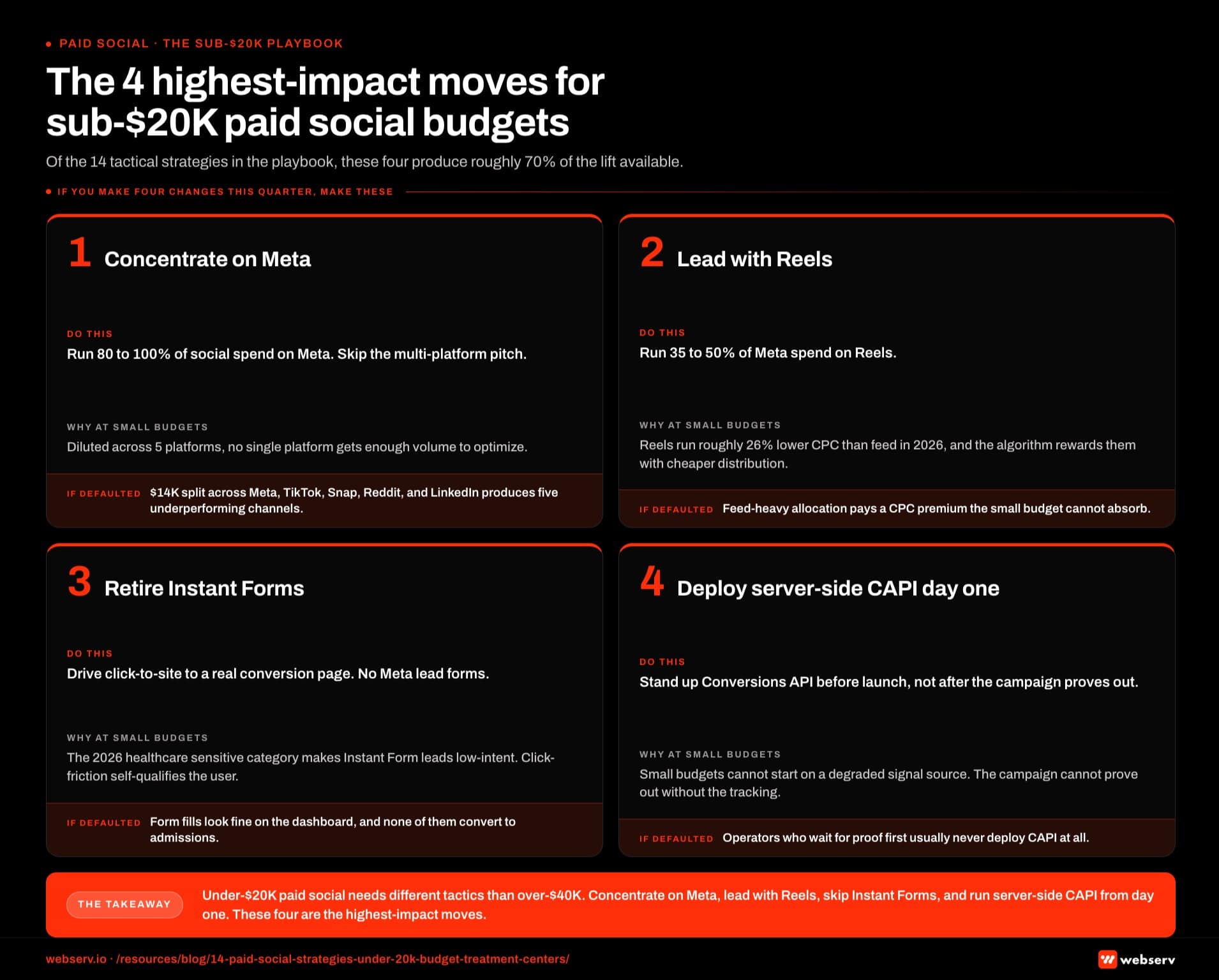 Infographic titled ‘The 4 highest-impact moves for sub-$20K paid social budgets’.
7. Integrate call tracking into the CAPI feed
Roughly 60 to 75 percent of BH admission inquiries come in by phone, not by form. A paid social setup that only tracks form fills is missing most of the conversion signal.
The fix is a call tracking platform (CallRail, CallTrackingMetrics, or equivalent) integrated into the conversion tracking pipeline that feeds CAPI.
At small budgets, this integration is the difference between Meta seeing 6 conversions a month (form fills only) and 24 conversions a month (form fills plus calls). The 4x signal volume changes what the algorithm can optimize toward, which compounds across the rest of the account. Without the call tracking integration, small budgets are stuck below the conversion threshold that Smart Bidding needs to optimize at all.
8. Optimize on upper-funnel events, not Purchase or Lead
Meta’s healthcare sensitive category in 2026 restricts lower-funnel optimization events for substance use treatment. Purchase and Lead are blocked or limited.
The workaround is to optimize the campaign on upper-funnel events (ViewContent, Page View, custom engagement events) and feed the actual conversion signal back through CAPI for the algorithm’s longer-term learning.
For small budgets, this restriction is more painful than for large budgets because the upper-funnel optimization produces noisier signal that needs more conversion volume to settle. The mitigation is the call tracking + CAPI integration from strategy 7, which gives the algorithm a richer downstream signal even when the direct optimization event is upper-funnel.
9. Target family-member audience signals, not patient signals
For residential treatment, the buyer is the family member 70 to 85 percent of the time. The audience signals that find family members are different from the signals that find patients. The right stack for family-buyer targeting on Meta:
- Household income tiers (top 20 to 30 percent for out-of-network economics)
- Life event signals (recently moved, new homeowner, recently divorced)
- Parental status (parents of adult children for adult treatment programs)
- In-market for healthcare signals
- Interest layers (mental health, family support, Al-Anon, addiction recovery)
The healthcare demographic targeting work covers the audience signal layer in more depth. For small budgets, getting this targeting right on day one is more consequential than at large budgets because there is no learning budget to waste on patient-targeting that produces low-converting clicks for residential programs.
10. Disable Advantage+ Creative on brand-sensitive elements
Meta’s Advantage+ Creative enhancements can be switched on by default when you build new campaigns, so check every toggle. For BH, several of those enhancements break compliance or brand integrity:
- Disable the music enhancement on creative featuring real family members
- Disable the text variation enhancement on creative carrying clinical or insurance claims
- Disable the image cropping enhancement on family-narrator creative where composition matters
Enable only brand-safe enhancements (aspect ratio variations, light retouching, brightness). The manual configuration takes 30 to 60 minutes per campaign and prevents the kind of auto-assembled creative violations that get accounts disabled.
For small budgets, an account disable is a 14 to 30 day recovery during which spend is paused. That outage on a $14,000 monthly budget represents lost momentum that cannot be recovered. The 30 minutes of Advantage+ configuration discipline is the cheapest insurance available, and it sits alongside the broader compliance mistakes that get rehab ad accounts banned as the structural defenses small budgets cannot afford to skip.
11. Build lookalikes from non-PHI seed audiences
Meta lookalike audiences built from a custom audience of past patients are a HIPAA violation because the seed audience contains protected health information. The compliant lookalike is built from non-PHI seed audiences:
- Newsletter subscribers who opted in for marketing
- Website visitors who consented to tracking on non-PHI pages
- Engagement audiences (people who watched 50 percent or more of brand video, engaged with Reels)
- Email subscribers from the general marketing list (not the patient CRM)
The seed audience is smaller than the patient list would be, which is why most agencies skip this step. For small budgets, the compliance-safe lookalike is the right move because an account disable is worse than a smaller seed audience. The HIPAA-compliant Facebook ads framework covers the consent infrastructure.
12. Refresh creative every 45 to 60 days
Creative fatigue is invisible to most operators because it compounds slowly across CTR and CPM rather than showing up as a sudden drop.
The right refresh cadence at small budgets is 45 to 60 days for Reels and Stories, 75 to 90 days for carousels, 60 to 120 days for single-image feed.
The refresh signal to watch for is frequency cap above 4 plus a declining CTR trend over 7 to 14 days. When both signals appear together, the creative is fatigued and needs to rotate out.
Operators who let creative run 6 to 12 months (the most common pattern I see) are paying a fatigue penalty without realizing it. The batched-shoot model from strategy 5 produces the variant volume needed to keep the rotation healthy. The same discipline anchors the 18 battle-tested Meta Ads tactics playbook.
13. Hold 10 to 15 percent of monthly spend in compliance reserve
Account disables happen. Meta tightens policies. Creative gets flagged. Landing pages get re-scanned. The operators who survive these events are the ones who hold 10 to 15 percent of monthly spend in reserve specifically for compliance disruption.
The reserve covers the cost of legal review on new creative, the agency time to rebuild campaigns after a disable, additional creative production to replace flagged variants, and the LegitScript and Meta certification work when policy interpretation changes.
Operators who run with zero reserve usually need to pull from non-paid budgets when the disruption hits, which makes everything else worse simultaneously.
14. Run Stories only on warm retargeting, not cold acquisition
Stories carry meaningful cost in cold-audience acquisition that small budgets cannot absorb efficiently.
The format works much better as a retargeting and reinforcement layer for warm audiences (people who have engaged with the brand, watched 50+ percent of a Reel, visited the site, or read 75 percent of an educational article).
The right small-budget Stories allocation is 8 to 12 percent of social spend, all targeted at warm audiences, with creative pulled from edited Reels variants to keep production cost low.
Operators who run Stories on cold audiences usually see CPM 30 to 50 percent above their Reels CPM with worse conversion economics. The format earns its keep on warm retargeting. It does not on cold prospecting at small budgets.
“The advantage is in the discipline, not the budget. Operators who apply 10 to 12 of these consistently produce admission volume comparable to operators spending two to three times more.”
Preston Powell, Chief Executive Officer, Webserv
How Profound Treatment drove 31 admits and a 42% drop in cost per viable in one quarter
Broad match pivot, negative keyword management, and intake-level conversion tracking turned a fragmented paid strategy into a predictable admissions engine.
Read the case study →68 viable VOBs at $4,529 cost per viable
What this looks like all together: a sample $14K month
For a treatment center running $14,000 a month on Meta with the full playbook applied, the allocation typically lands at:
 Infographic titled ‘The $14K sample month: allocation by line item’.
- $5,000 to $6,500 on Reels (cold prospecting + warm retargeting)
- $3,000 to $4,000 on educational carousels (consideration-stage family members)
- $2,000 to $3,000 on single-image feed (retargeting + brand reinforcement)
- $1,200 to $1,800 on Stories (warm retargeting only)
- $400 to $700 on testing (new creative variants, new audience signals)
- $1,000 to $2,000 held in compliance reserve
The creative library underneath this allocation runs 12 to 18 Reels variants, 6 to 10 carousels, 12 to 20 single-image variants, refreshed at the 45 to 60 day cadence covered in strategy 12.
The audience targeting follows the family-first signal stack from strategy 9 with the exclude-zip framework from strategy 4. The tracking layer runs server-side CAPI plus call tracking integration.
Operators who run this configuration consistently produce 5 to 10 admission inquiries per month on $14,000 spend, with admission cost in the $700 to $1,400 range depending on market and payer mix.
The economics work because every dollar in the budget is doing work that contributes to admission volume, not work that produces dashboard metrics without admissions underneath.
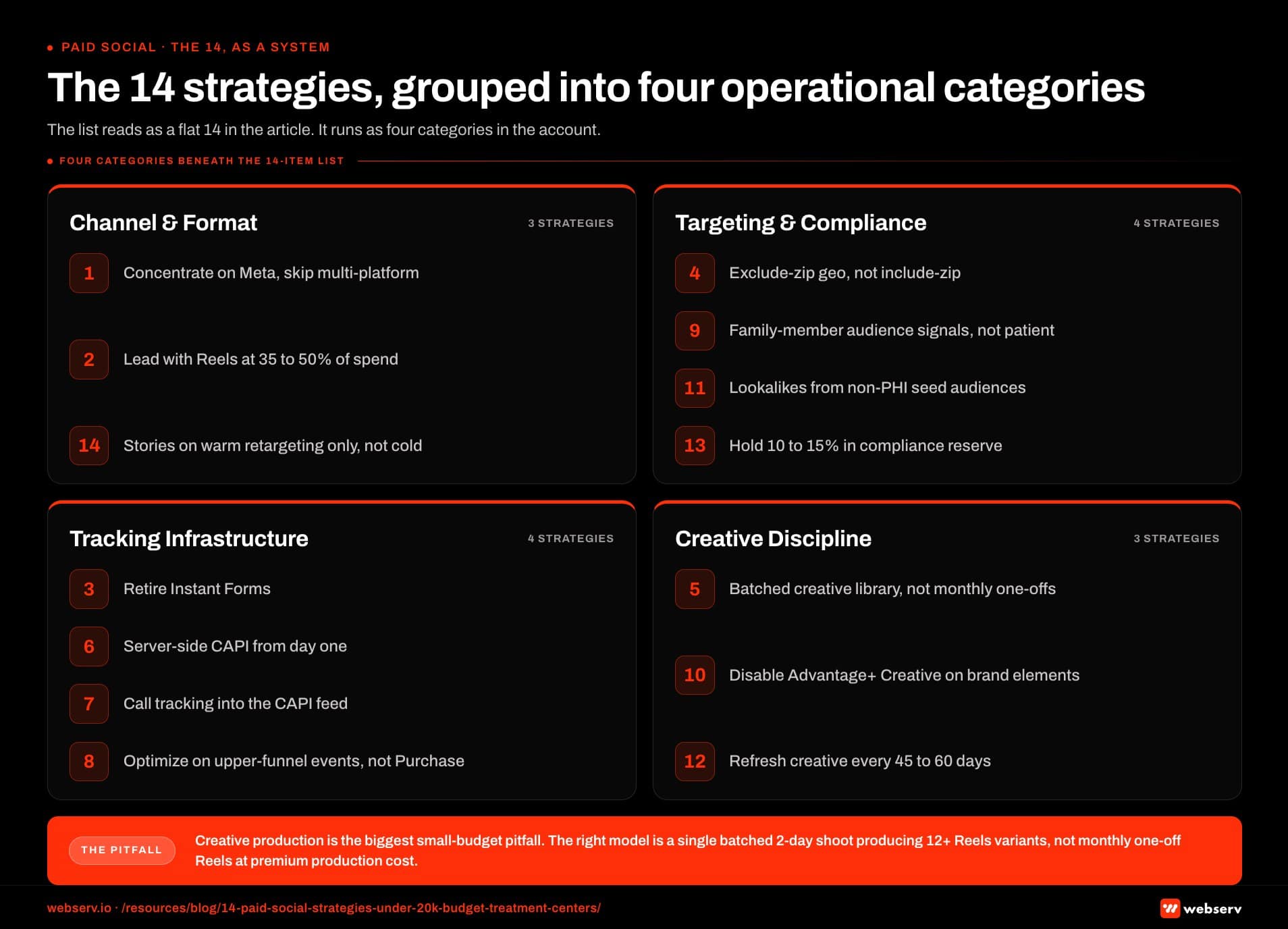 Infographic titled ‘The 14 strategies, grouped into four operational categories’.
The compliance posture this assumes
The 14 strategies assume the foundational compliance work is in place. The two non-negotiables:
LegitScript certification. Meta requires LegitScript for addiction treatment advertising. The LegitScript certification process can take weeks to months, and LegitScript’s published pricing runs $1,395 to $1,595 per facility to apply plus $2,550 to $3,095 per facility per year. Operators trying to run small-budget Meta without LegitScript will get accounts disabled, which makes every other tactical optimization moot.
Meta addiction treatment approval. On top of LegitScript, Meta requires a separate application for addiction treatment advertising under their Drug and Alcohol Addiction Treatment policy. This approval can add another 4 to 8 weeks to time-to-launch.
Operators who skip this and try to run anyway face account-level enforcement that compounds the LegitScript exposure. The HIPAA-compliant Facebook ads framework covers the broader compliance posture needed underneath the tactical strategies in this piece. Operators who skip the compliance work and try to run the tactics on top will produce account disables faster than they produce admissions.
How this fits with the rest of the paid program
Small-budget Meta is one channel in the broader paid admissions stack. The right framing for operators at the under-$20K level is usually:
- $14,000 to $18,000 on Meta (using these 14 strategies)
- $5,000 to $10,000 on Google Ads (separate budget, separate sequencing)
- Reserved budget for compliance, creative refresh, and testing
The Facebook Ads vs Google Ads sequencing decision covers when each channel should launch. For most operators starting from zero, Google Ads launches first and Meta launches 3 to 6 months later. For operators already running both, the 14 strategies in this piece optimize the Meta side independent of the Google sequencing.
The body-brokering competitive dynamics also affect small-budget operators in certain markets. Avoiding the documented brokering corridors via the exclude-zip framework (strategy 4) is part of how small budgets stay efficient against well-funded competitors in those geographies. Operators who would rather hand the discipline above to a vetted shop can start from our list of paid social ad agencies for rehab marketing. The broader behavioral health marketing program compounds when the paid social discipline matches the rest of the stack.
Frequently Asked Questions
What is the minimum budget that makes any of this worth doing?
Around $8,000 a month is the floor where Meta has enough conversion volume to optimize. Below $8,000, the algorithm cannot reliably distinguish signal from noise on healthcare sensitive category campaigns, and the strategies in this piece will not produce the economics they should. Operators below $8,000 should usually concentrate budget on Google Ads first and add Meta when budget supports the floor.
The sweet spot for the strategies above is $12,000 to $20,000 monthly. Above $20,000, the operator can start adding format diversity (more long-form video, broader audience testing) and platform diversity (TikTok, Snap, YouTube).
Below $12,000, the operator should pick 8 to 10 of the 14 strategies rather than all 14, focusing on Meta concentration, Reels priority, retired Instant Forms, server-side CAPI, and call tracking integration. The honest answer is that small-budget paid social has a budget floor below which the math does not work. The strategies in this piece optimize what happens above the floor.
How long does it take to see results once we apply these?
Most operators see meaningful CPA improvement inside 30 to 60 days, with the lift compounding through 90 to 120 days as the algorithm settles into the new configuration. Reels-first allocation and the retired-Instant-Forms move produce the fastest results (visible in 14 to 21 days). CAPI deployment and audience signal optimization produce slower but more durable lift over 60 to 90 days.
The slowest improvement comes from the creative library work (strategy 5). Building a batched-shoot library takes 4 to 8 weeks from kickoff to the first variants going live. The compounding lift from variant diversity takes another 60 days to manifest. Operators who try to skip the library work in favor of “just buy more media” usually plateau within 90 days because the creative becomes the bottleneck.
The 6-month mark is when the full strategy stack typically reaches steady-state performance. Operators measuring on shorter windows than 6 months usually misread the pattern.
What about TikTok, Snap, Reddit, and the other social channels?
At under $20,000 a month for BH, those channels are usually a distraction. Meta carries the load because the audience signal infrastructure is more developed and the conversion economics are cleaner.
TikTok and Snap become viable at $25,000+ a month for adult-population facilities and earlier for adolescent or young-adult focused programs. Reddit and LinkedIn are usually B2B referral surfaces, not direct admission channels.
The right framing is concentration before diversification. A small-budget operator running Meta well will produce more admissions than the same operator spread thin across five platforms running each one poorly. Once Meta is operating at steady-state with healthy economics, the operator can layer additional channels using the same disciplined approach. The exception is operators with specific demographic fits.
Should we still avoid Instant Forms even when Meta is pushing them?
Yes. Meta’s optimization restrictions on lead forms in the healthcare sensitive category make the format much less effective than it was pre-2025. The dashboard volume looks fine because submissions still flow in, but the submission quality is consistently lower than click-to-site users who self-qualify by reading a real landing page.
The exception is small-volume retargeting campaigns on warm audiences. There a lead form can pick up users who are already known to the brand and just need a fast path to contact. Even there, click-to-site usually outperforms because the conversion-page real estate offers more qualification opportunity than the in-form fields do.
For cold acquisition campaigns at any budget, retire Instant Forms. The lift from doing so is consistent enough across the accounts we audit that it has become a default first-week change in every new Meta engagement.
Do we need to hire a creative agency to do the batched shoot in strategy 5?
Not necessarily, but you need someone who can execute the batched-variant model. The work splits into three parts. A director or videographer who can run a 2-day shoot ($2,000 to $4,000 for a competent local hire), plus an editor who can produce 12 to 18 Reels variants from the shoot footage ($1,500 to $3,500), plus a producer who manages family member consent and compliance review ($500 to $1,500 if not handled internally).
Total cost for the batched shoot lands at $4,000 to $9,000 depending on local market rates and creative scope. The variants then supply the account for 4 to 6 months, so the cost-per-month equivalent is $700 to $2,250, a fraction of what monthly one-off production runs at premium agency rates.
The discipline you need is the variant-generation mindset (one shoot produces many variants, not one Reel) and the consent infrastructure (real family members willing to participate with proper HIPAA-compliant creative framing). Operators who try to skip the batched model in favor of monthly one-offs usually underspend on production and end up with creative that does not earn its keep.
What is the single highest-impact change to make first?
Retiring Instant Forms (strategy 3) and deploying server-side CAPI (strategy 6) usually produce the fastest visible improvement, because both shift the campaign from low-quality signal to high-quality signal in a 14 to 21 day window. Concentrating on Meta (strategy 1) and leading with Reels (strategy 2) compound over the following 30 to 60 days.
For operators with no compliance issues blocking the work, those four strategies plus the call tracking integration (strategy 7) cover roughly 70 percent of the lift available from the full 14-strategy stack. The remaining strategies add operational maturity and durability but the early ROI is concentrated in the first cluster.
For operators with existing compliance gaps (no LegitScript, no Meta addiction treatment approval, Meta pixel on PHI pages), the compliance work has to come first. There is no point optimizing tactical execution on a campaign that is about to get disabled.
The perspective in this article comes from 9 years working exclusively inside behavioral health.
We are a team built by people in recovery who understand that behind every admission is someone asking for help. If that resonates, get to know us.
Mitch Marowitz is Director of Paid Media at Webserv, where he leads Google Ads, Meta, and emerging paid channel strategy for behavioral health treatment centers. He has overseen more than $45M in managed media spend across the addiction treatment category and writes about paid acquisition for treatment operators.