A well-structured Google Ads program for behavioral health looks different in 2026 than it did in 2022. Match types have consolidated. Smart Bidding has matured. Broad match has expanded.
Google’s default recommendations now assume conversion volume most treatment centers do not have, and applying those recommendations as written on a thin BH account produces predictable failure.
The structural decisions that matter are upstream of the campaign settings: how to slice the account into campaigns, how to organize ad groups, which bidding strategy fits the conversion volume the campaign actually has.
And how to allocate budget across the campaign mix so high-intent commercial traffic is not subsidizing low-intent informational traffic.
This guide walks through what the inside of a working BH Google Ads account looks like in 2026, including the structural mistakes that cost admissions and the audit framework to assess your current account.
Key Takeaways
- The 2026 best practice is fewer, more data-rich campaigns. Most treatment center accounts should run 4 to 8 campaigns, not 20+. Each campaign needs enough conversion volume to feed Smart Bidding or enough budget to justify Max Clicks.
- Ad group structure should consolidate around 3 to 10 themed groups per campaign, organized by intent and offering, not by single keyword. Single-keyword ad groups in their traditional form fight Google’s broad match expansion and starve campaigns of data.
- Match type strategy in behavioral health requires phrase and exact match for core commercial terms (with aggressive negative keyword discipline) and broad match only on campaigns that have proven Smart Bidding signal volume. Broad match without strong negatives burns budget on job, research, and statistics queries.
- Bidding strategy follows conversion volume. Max Clicks below the 30-conversions-per-month threshold. Max Conversions on campaigns that clear the threshold consistently. Target CPA after 90 days of stable Max Conversions performance.
- Budget allocation should weight high-intent commercial campaigns first (60 to 75% of total spend), with the remainder split between mid-funnel and brand-defense campaigns. Even-budget distribution across all campaigns is the most common allocation mistake.
I audited a 60-bed residential treatment center’s Google Ads account in February. The account had 23 active campaigns, 184 ad groups, and 2,341 keywords.
The agency that built it had used a 2018 single-keyword-ad-group (SKAG) playbook, splitting every keyword variant into its own ad group and every level of care into its own campaign. Spend was $58,000 a month. Smart Bidding had been turned on six months earlier across all 23 campaigns.
Cost per admission was running $1,420 against a target of $650.
The data problem was visible inside 10 minutes. Of the 23 campaigns, exactly 4 had hit the 30-conversions-per-month threshold required for Smart Bidding to optimize reliably. The other 19 were running thin-data Smart Bidding on conversion volumes between zero and 14 a month.
The campaigns Smart Bidding could optimize were doing fine. The 19 that could not were burning budget chasing patterns in noise. The agency’s structural fragmentation was the actual problem, and no amount of bidding adjustment could fix it without consolidating the structure first.
Structural fragmentation like this is the most common reason operators switch shops; our roundup of Google Ads agencies for treatment centers flags which still run the outdated SKAG playbook.
We rebuilt the account into 6 campaigns, 41 ad groups, and 287 keywords inside three weeks. Cost per admission dropped to $610 in 60 days. Conversion volume grew 28% because the new structure gave Smart Bidding the conversion density it needed to actually learn.
The total spend stayed flat at $58,000. The agency before us had been managing 23 campaigns that should have been 6, with 184 ad groups that should have been 40, and the operator had been paying for that fragmentation in admissions never won.
Campaign structure is the most underrated lever in behavioral health paid search. Most operators inherit accounts built on outdated playbooks, and most agencies still pitch those playbooks because the structure looks like work.
The 2026 reality is that consolidated, themed structure with right-sized budgets and the right bidding strategy per campaign produces better economics than fragmented structure built on 2018 best practices. This guide covers how to build that structure for an addiction treatment account today.
The 2026 shift: what Google wants and what behavioral health actually needs
Behavioral health treatment centers running paid search programs in 2026 face a structural decision before any campaign goes live: follow Google’s default recommendations as written, or filter the platform guidance through the reality of a regulated category with thinner conversion data and tighter compliance gates.
Google’s official guidance in 2026 has shifted sharply from the 2020 playbook.
POSITION TENSION
Google’s 2026 default recommendations (broad match, consolidated ad groups, Smart Bidding) optimize for total volume across the whole platform. For behavioral health operators with thin conversion data and tight compliance gates, default recommendations frequently produce more cost than they produce admits. The right read is to filter Google’s guidance through category-specific economics, not adopt it wholesale.
The platform now recommends consolidating ad groups more aggressively than in prior years, using broad match as the default match type for campaigns with sufficient conversion volume, and layering AI Max for Search campaigns on top of the Smart Bidding stack.
Google reports advertisers activating AI Max in Search campaigns typically see 14% more conversions or conversion value at a similar CPA or ROAS.
For an e-commerce account with 500 conversions a month and clean tracking, this guidance is correct as written.
For a treatment center running $15,000 to $40,000 a month with 20 to 60 conversions a month, the guidance has to be filtered through the operational reality of a smaller account in a regulated category.
Three filters matter.
The conversion volume filter. Smart Bidding, broad match, and AI Max all assume enough conversion volume to feed the algorithm. The 30-conversions-per-month threshold from Google’s Maximize Conversions documentation applies at the campaign level, not the account level.
An account with 60 conversions a month split across 23 campaigns has zero campaigns at the threshold. The same account consolidated into 6 campaigns has 4 campaigns at or above the threshold.
The compliance filter. Broad match on “addiction treatment” without strong negatives serves ads against “addiction treatment jobs,” “addiction treatment research,” “addiction treatment statistics,” and dozens of other queries that have zero conversion potential.
The ad restrictions so many treatment centers run into are partly a function of structural sloppiness that lets broad match expand into non-commercial queries.
It is also partly a function of the Google Ads compliance mistakes that come from running aggressive match types without policy review.
The economics filter. A wrong click in BH costs $50 to $200, not $1 to $5 like most e-commerce categories. Match type tolerance for irrelevant queries is much lower because the unit cost of waste is much higher.
The 2026 default broad-match recommendation needs more discipline in this category than in others.
The synthesis is that the 2026 Google guidance is directionally correct, but the implementation for behavioral health requires more structural restraint and more negative keyword discipline than the platform’s default recommendations.
Campaign segmentation: how to slice the account
The first structural decision is how many campaigns to run and how to draw the lines between them. For most treatment centers, the right answer is 4 to 8 campaigns segmented by intent tier and offering, not 20+ campaigns segmented by every variable available.
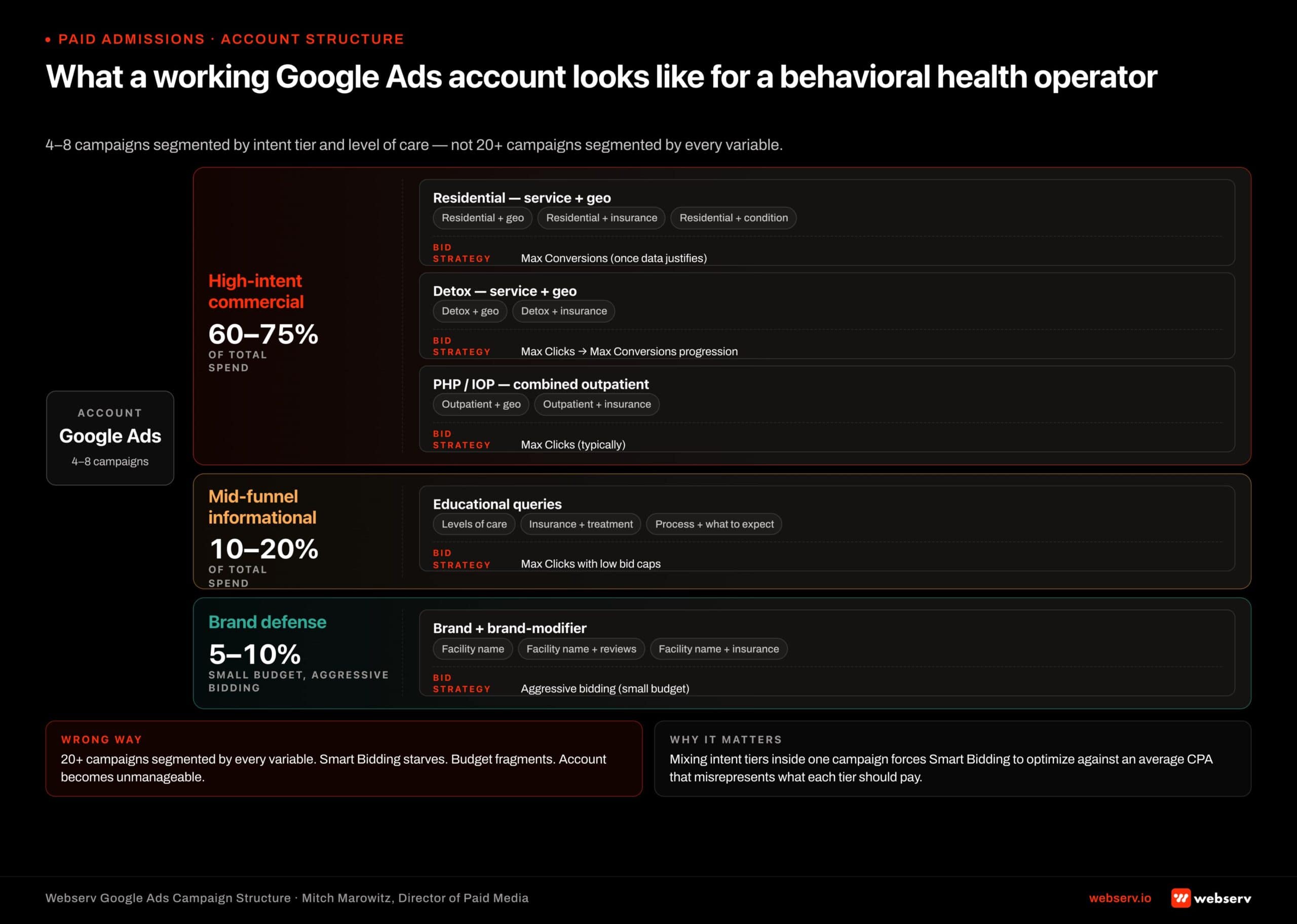 Infographic titled ‘What a working Google Ads account looks like for a behavioral health operator’.
Four segmentation dimensions matter, in priority order.
Segmentation by intent tier (highest priority)
The single most important segmentation dimension is search intent.
High-intent commercial queries (“residential rehab near me,” “[city] detox center,” “addiction treatment that takes [insurance]”) need to live in different campaigns than mid-funnel informational queries (“difference between PHP and IOP,” “what to expect in rehab”) which need to live in different campaigns than brand defense (“[facility name],” “[facility name] reviews”).
This matters because the bidding strategy, budget allocation, and acceptable CPA differ across these tiers. High-intent commercial deserves the highest bids and the largest budget.
Brand defense deserves a small budget and aggressive bidding to avoid competitor poaching. Mid-funnel informational deserves a measured bid that captures education-stage prospects without overspending on top-of-funnel impressions.
Mixing these tiers in a single campaign forces Smart Bidding to optimize against an average CPA that misrepresents what each tier should actually pay. The typical result is high-intent commercial getting underbid (losing impressions) while mid-funnel informational gets overbid (wasting budget).
Segmentation by level of care
Within the high-intent commercial tier, the next segmentation is by level of care. Residential treatment, PHP, IOP, detox, and MAT have different unit economics, different buyer profiles, and different cost-per-admission economics. A residential program admit at $30,000+ in revenue justifies a different CPA than an outpatient admit at $8,000.
The right structural pattern is one campaign per level of care, with the ad groups inside each campaign organized by intent variant (service+geo, service+insurance, brand-adjacent).
Operators with strong residential and weak outpatient often run a single residential campaign at scale and consolidate the outpatient programs into a single secondary campaign to maintain data density.
Segmentation by geo (when relevant)
For multi-location operators or facilities serving distinct regional markets, geographic segmentation goes inside campaigns through location targeting, not through campaign duplication. The same healthcare advertising compliance constraints apply across all targeted geographies.
Running 12 duplicate campaigns for 12 cities fragments data 12 ways and starves Smart Bidding of the volume it needs.
The right pattern is one campaign per level of care, with all relevant geographies layered through location targeting on the campaign. The exclude-zip strategy handles the family-buyer geographic complexity for residential. Single-location outpatient programs use radius targeting around the facility. Multi-location operators use the broadest geography their licensing supports.
Segmentation by brand vs non-brand
The fourth segmentation is brand defense. Branded queries (“[facility name],” “[facility name] reviews,” “[facility name] insurance”) should live in a dedicated campaign with a small budget, Target Impression Share bidding to defend the trademark from competitor poaching, and tight match types (exact + phrase only).
This campaign typically runs 5 to 10% of total spend and produces some of the highest-converting traffic in the account because the searcher is already in your funnel.
The recommended structure
Synthesizing across the four dimensions, the structure for most BH treatment centers lands at:
- Residential campaign: highest budget, service+geo and service+insurance ad groups
- Detox campaign: high budget if offered, service+geo and service+insurance
- PHP/IOP campaign: medium budget, service+geo and service+insurance
- Mid-funnel informational campaign: small to medium budget, explainer and comparison queries
- Brand defense campaign: 5 to 10% of spend, branded queries only
- Optional: Insurance-specific campaign for facilities with strong payer-specific targeting
- Optional: Modality campaign for facilities known for clinical specialties like TMS, ketamine, EMDR
Operators running smaller budgets ($15K-$25K/month) typically consolidate to 4 campaigns. Operators running larger budgets ($50K+/month) sometimes expand to 7 or 8 with the optional campaigns activated.
Ad group structure: the 2026 consolidation principle
Inside each campaign, the ad group structure should follow Google’s 2026 guidance: 3 to 10 themed ad groups per campaign, with each ad group representing a distinct intent cluster. Single-keyword ad groups are the wrong answer in 2026.
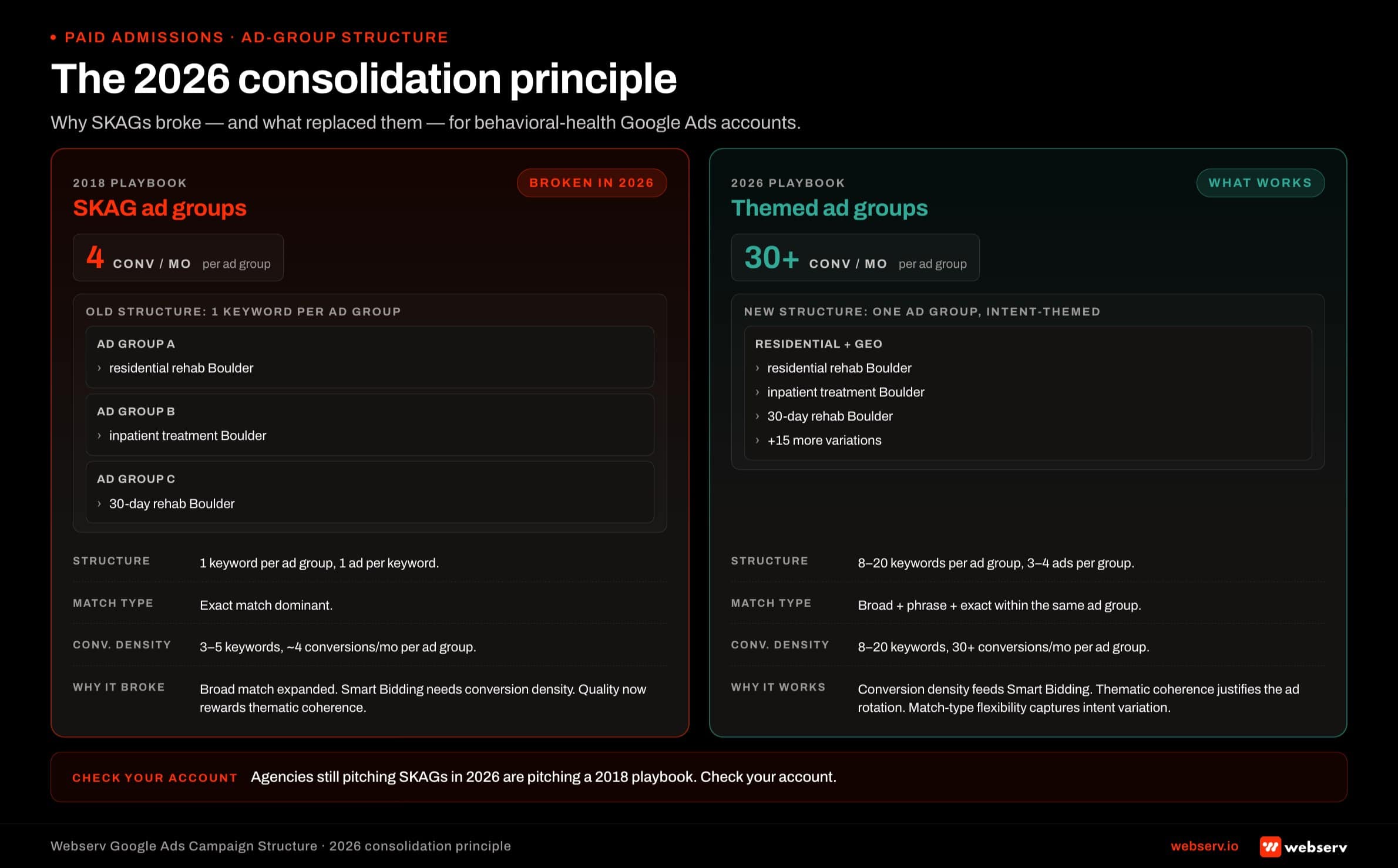 Infographic titled ‘The 2026 consolidation principle’.
Why SKAGs broke
The SKAG playbook was built around exact match keywords with tight one-to-one keyword-to-ad-group mapping. The logic was that each keyword got its own ad copy, its own quality score, and its own bid, which produced higher relevance and lower CPCs.
That logic worked in 2018 when match types were stricter and Smart Bidding did not exist.
It does not work in 2026 because broad match has expanded to cover the variations SKAGs used to capture manually, Smart Bidding needs conversion density per ad group to optimize, and Google’s quality systems reward thematic coherence over keyword-level granularity.
A SKAG with 3 keywords and 4 conversions a month is starving Smart Bidding of signal that a themed ad group with 25 keywords and 30 conversions a month would feed properly.
The themed ad group pattern
The right pattern is to cluster keywords by intent and offering, with 8 to 20 keywords per ad group representing variations on a single concept. Examples for a residential treatment center:
“Residential treatment + geo” ad group: “residential rehab in [city],” “inpatient treatment [city],” “30-day rehab [city],” “[city] addiction recovery program,” and similar variations.
“Residential treatment + insurance” ad group: “residential rehab that takes [insurance],” “[insurance] inpatient drug treatment,” “rehab covered by [insurance],” and similar.
“Residential treatment + condition” ad group: “alcohol rehab residential,” “opioid treatment program,” “polysubstance addiction residential,” and similar.
Each ad group carries enough keyword density to feed Smart Bidding, enough thematic coherence to justify the 3-4 ad headlines the ad group will rotate through, and enough match type flexibility to capture intent variation without losing relevance.
Match type strategy
The 2026 match type recommendation for behavioral health is:
- Exact match for the highest-converting core terms identified through historical search query reports
- Phrase match for the variations that need targeted control
- Broad match only on campaigns that have cleared the 30-conversion threshold AND have a 100+ keyword negative list AND are paired with Smart Bidding
Broad match without those three preconditions burns budget. Broad match with them captures the long-tail variations that exact and phrase miss and that the 2026 algorithm can correctly identify as relevant.
Our ad group structure piece covers the keyword-level mechanics in more depth. The headline is that the consolidation principle (8-20 keywords per ad group) is non-negotiable. The match type mix inside that structure depends on campaign data density.
Negative keyword discipline
The most underweighted operational task in this category is negative keyword maintenance. A treatment center account in 2026 needs:
- A shared negative keyword list at the account level covering the universal exclusions (jobs, careers, salary, volunteer, research, statistics, articles, studies, free, grants, scholarships, social work, internship)
- A campaign-level negative list for queries that may be relevant in one campaign but not another (a residential campaign should negate “outpatient,” “IOP,” “PHP” to keep the level-of-care signal clean)
- Weekly negative additions based on the search term report
The negative keyword list work is the operational tax of running aggressive match types in 2026. Operators who skip the weekly negative-add cycle either run defensive (exact match only, missing volume) or run wasteful (broad match without controls, burning budget on irrelevant queries).
Bidding strategy framework
The bidding decision per campaign follows the conversion volume math more than the platform recommendation.
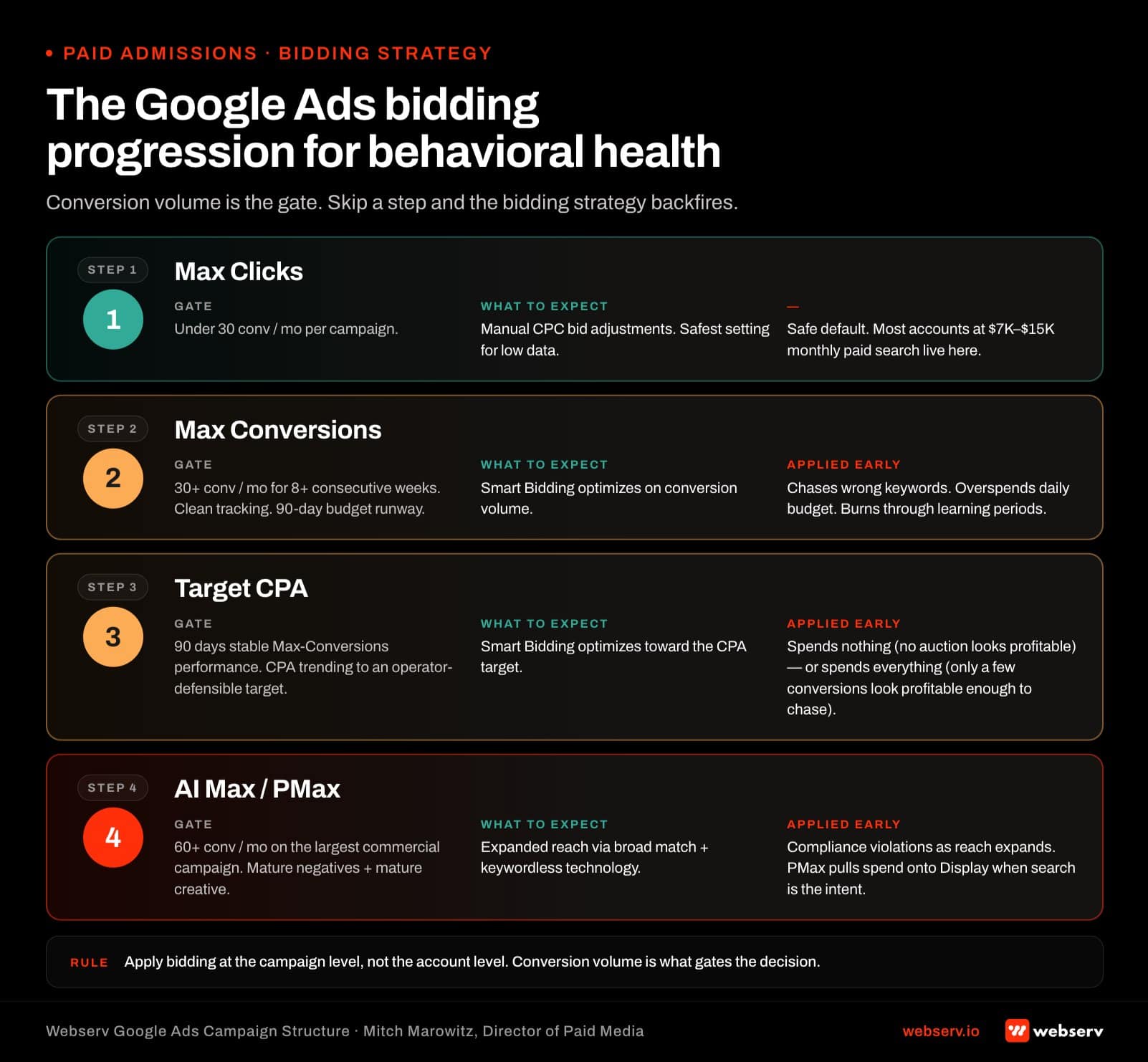 Infographic titled ‘The Google Ads bidding progression for behavioral health’.
Google’s own Smart Bidding documentation states that automated bid strategies need sufficient conversion data to optimize reliably, with minimum thresholds around 30 conversions per month for Target CPA campaigns and 50 for Target ROAS.
The 30-conversion-per-month floor below accounts for the behavioral health reality that conversion quality varies more by intent tier than in most verticals, so the bar for moving off manual bidding needs to be conservative.
Below 30 conversions per month per campaign: Max Clicks
Campaigns with under 30 conversions a month should run Max Clicks with manual CPC bid adjustments. The short version: Smart Bidding cannot reliably learn on thin data, and the failure modes (chasing wrong keywords, overspending daily budget, eating learning periods) are expensive in BH economics.
For most treatment centers with $7K-$15K/month in paid search, this applies to all or most campaigns. Operators running this configuration should not let the agency push them to Smart Bidding before the conversion data justifies the switch.
30+ conversions per month per campaign sustained: Max Conversions
Once a campaign clears 30 conversions a month for 8+ consecutive weeks, with clean conversion tracking and 90 days of budget runway, the campaign is ready for Max Conversions.
The bidding strategy should be applied at the campaign level, not the account level, because conversion volume is what gates the decision.
Most accounts will run a mix: brand defense and the largest commercial campaign on Max Conversions, smaller campaigns still on Max Clicks. The mix is not a problem. The problem is forcing all campaigns to Max Conversions before the data supports it.
90 days stable Max Conversions performance: Target CPA
Target CPA is the next level after Max Conversions. The threshold is 90 days of stable Max Conversions performance on the specific campaign, with CPA trending toward a level the operator can defend as the target.
Target CPA without that history tends to either spend nothing (because no auction looks profitable to it) or spend everything (because the few conversions look profitable enough to chase).
AI Max and PMax considerations
AI Max for Search and Performance Max are the 2026 add-on layers. Both work best on accounts with strong baseline conversion volume and mature creative inventory. For behavioral health treatment centers, the practical guidance is:
Google’s Performance Max documentation lists strong baseline conversion volume and a mature creative inventory as prerequisites for the format.
For behavioral health, those prerequisites combine with HIPAA and LegitScript compliance to make PMax workable only on the largest commercial campaigns, where the negative keyword discipline can keep the reach expansion compliant.
AI Max is worth piloting on the largest commercial campaign once it has 60+ conversions a month and a mature negative keyword list.
AI Max expands reach using broad match and keywordless technology, which works in BH only when the negative keyword discipline is strong enough to keep the expansion compliant.
Performance Max is premature for most treatment centers under $25K/month. PMax allocates across Search, Display, YouTube, and Discover, which means it needs creative assets across all those surfaces.
Most treatment centers do not have video creative or display banners at the quality bar required, and the HIPAA-compliant Facebook ads work that produces equivalent creative for Meta does not directly translate to Google’s surfaces.
The Power Pack approach Google introduced in September 2025 (AI Max for Search, Performance Max and Demand Gen run together) is the right framework for the operators who have the data, budget, and creative inventory to support it.
For the median BH operator, Standard Search with disciplined bidding and structure remains the right backbone, with AI Max as a layered test on the largest campaign.
Budget allocation framework
The dollar-allocation decision across campaigns is where most BH accounts leak the most money. Three principles matter.
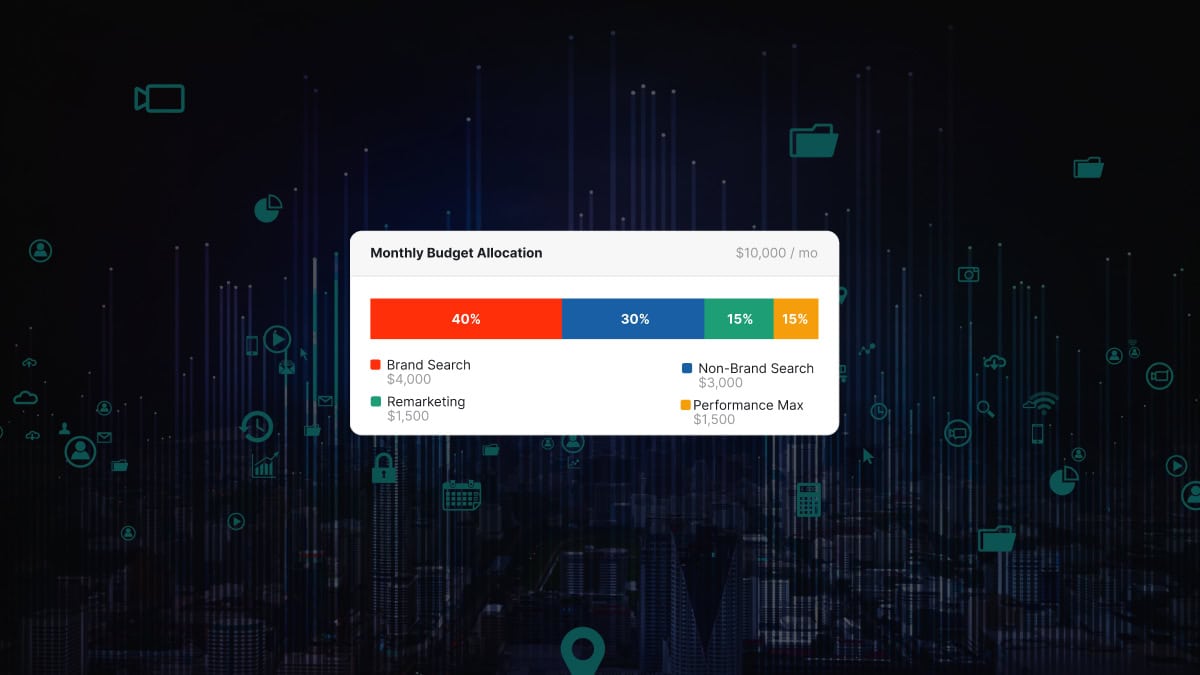
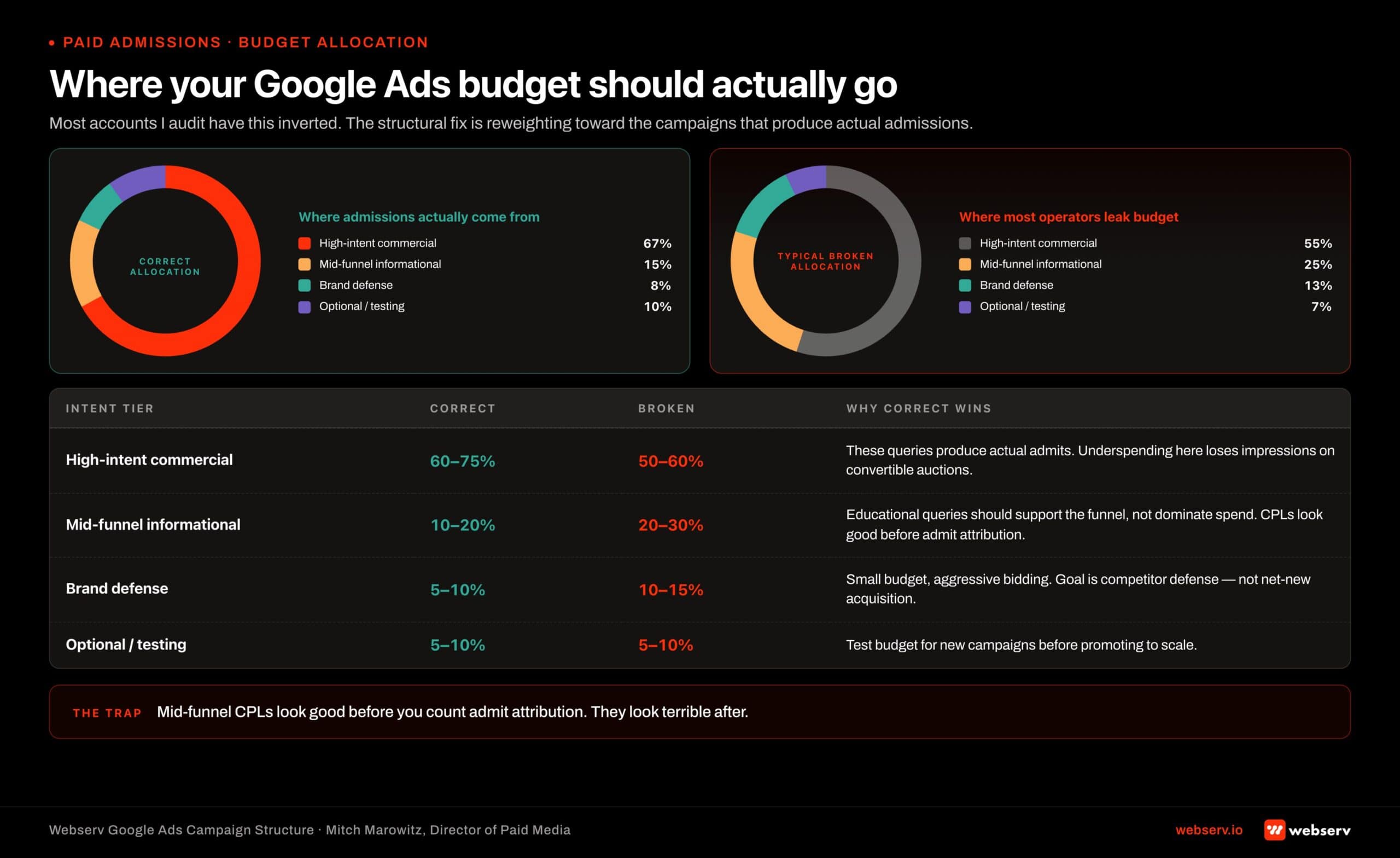 Infographic titled ‘Where your Google Ads budget should actually go’.
Weight by intent tier
The rough allocation pattern for most BH accounts is:
- High-intent commercial campaigns (residential, detox, PHP/IOP service+geo and service+insurance): 60 to 75% of total spend
- Mid-funnel informational campaign: 10 to 20%
- Brand defense campaign: 5 to 10%
- Optional / testing campaigns: 5 to 10%
Most accounts I audit have inverted this: 30-40% on brand and mid-funnel, 50-60% on commercial. The structural fix is to reweight toward the campaigns that produce actual admissions.
Daily budget pacing
Each campaign should have a daily budget set to roughly 1/30th of the monthly target, with Google’s pacing algorithm handling the smoothing across the month.
Setting daily budgets too tight (campaigns hit budget cap by 11 AM) starves the campaign of afternoon and evening conversion volume. Setting too loose (campaigns rarely hit cap) gives Smart Bidding less signal to learn from.
Dayparting (mostly off for residential)
Residential treatment families search around the clock, with significant volume in evenings and weekends when other family members are home. Dayparting that restricts ad serving to business hours (a common mistake from agencies running BH like a B2B account) cuts off a large share of high-intent inquiries, because families search on evenings and weekends.
The exception is admissions teams with limited after-hours coverage. If your intake operation cannot answer calls at 9 PM on a Saturday, you may not want to be serving impressions at that time.
The right answer in that case is to fix the intake operation, not to limit when the ads serve.
Test budget vs scale budget
Across all campaigns, 10 to 20% of monthly spend should sit in testing posture: new ad copy, new audiences, new match types, new ad groups. The remaining 80 to 90% runs on the proven combinations.
Operators who run no testing budget plateau within months. Operators who put most of the budget into tests never reach scale efficiency.
How Profound Treatment drove 31 admits and a 42% drop in cost per viable in one quarter
Broad match pivot, negative keyword management, and intake-level conversion tracking turned a fragmented paid strategy into a predictable admissions engine.
Read the case study →68 viable VOBs at $4,529 cost per viable
Common structural mistakes that cost admissions
Six structural mistakes account for most of the underperformance I see in BH paid search accounts.
- Over-segmenting campaigns. 23 campaigns where 6 would do. Each one starved of data, none of them able to feed Smart Bidding properly. The fix is consolidation.
- Single-keyword ad groups inherited from a 2018 playbook. 184 ad groups where 41 would do. Each one too small to feed the algorithm, all of them fragmenting the conversion signal. The fix is consolidation around themed clusters.
- Broad match without negative keyword discipline. The fastest way to burn $10,000 in a month. The fix is to either pull back to phrase + exact match or to invest in the weekly negative-add operational rhythm.
- Mixing intent tiers in a single campaign. High-intent commercial queries living alongside mid-funnel informational queries in the same campaign forces Smart Bidding to optimize against a mixed CPA average that misrepresents what each tier should pay. The fix is segmentation by intent tier.
- Even-budget distribution across campaigns. Treating each campaign as equal when the unit economics are wildly different. The fix is to weight the high-intent commercial campaigns at 60-75% of spend.
- Smart Bidding turned on across all campaigns regardless of conversion volume. The 19-of-23 problem from the opening story. The fix is to run Max Clicks on the small campaigns until they cross the threshold and graduate to Max Conversions.
The cumulative cost of these six mistakes on a typical $40K/month account is usually thousands of dollars a month in wasted spend, plus a much higher cost per admission than the same account would produce after restructuring.
The compounding effect over a year is six to seven figures of admission revenue that never materialized.
The agency before us had been managing 23 campaigns that should have been 6, with 184 ad groups that should have been 40, and the operator had been paying for that fragmentation in admissions never won.
Mitch Marowitz, Director of Paid Media, Webserv
WHAT WORKING STRUCTURES DO
- Tight match types until conversion data justifies broader
- Separate campaigns for INN and OON with separate budgets
- Manual or Max Conversion Value bidding with verified VOB signals
- Negative keyword discipline applied at the campaign level
- Geo-targeting tied to actual facility service area
WHAT BROKEN STRUCTURES SKIP
- Broad match on day one because Google recommends it
- Single campaign covering both INN and OON traffic
- Smart Bidding running without policy-quality conversion signals
- Default negative keyword list with no BH-specific terms
- Nationwide targeting on a single-state outpatient program
How to audit your existing campaign structure
For operators evaluating their current account, a 90-minute audit will surface most of the structural issues. The audit has four steps.
Step 1: Count campaigns and ad groups. If you have more than 10 campaigns or more than 100 ad groups for a single-facility operator, the account is likely over-segmented.
Pull the campaign-level conversion volume and identify which campaigns are above and below the 30-conversion threshold. Anything below the threshold is a candidate for consolidation.
Step 2: Run the search term report for the last 90 days. Look at the top 100 search terms by impression volume. Are they relevant to your services?
Are there obvious jobs, research, and statistics queries that should be negatives? Are there competitor brand names you should be negating (or, conversely, missing from your brand defense)?
The pattern in this report tells you most of what is right or wrong with the match-type and negative-keyword setup.
Step 3: Check the bidding strategy per campaign. Map each campaign’s monthly conversion volume against its bidding strategy. Smart Bidding on under-30-conversion campaigns is a structural problem. Manual CPC on 100+ conversion campaigns is also a structural problem (left value on the table). The right bidding strategy follows the data.
Step 4: Pull the conversion tracking setup and the call tracking integration. Most BH admission inquiries come in by phone.
If your account is only tracking form submissions, the algorithm sees only a fraction of the conversion signal. Smart Bidding cannot optimize against signal it does not see.
The exclude-zip strategy for geo targeting compounds with the conversion-tracking work because both decisions feed the same algorithmic signal pool.
The audit takes 90 minutes. The remediation usually takes 4 to 8 weeks. Operators who run this audit annually keep accounts in good shape. Operators who never run it pay the cost in admissions that go to competitors with cleaner structure.
How structure interacts with the rest of the program
The LegitScript certification and compliance posture is the gate underneath all of this. No structure works if the account cannot serve ads at all.
Campaign structure connects directly to the work covered in our Google Ads strategy guide for behavioral health providers and to the paid social side of the channel mix. A well-structured account in isolation cannot offset poor channel allocation or tracking gaps elsewhere.
Campaign structure is the spine of paid search, but it does not work in isolation. Three adjacent layers shape what structure can do.
The certification and compliance posture is the gate. No structure works if the account cannot serve ads at all. The 80+% of treatment centers facing ad restrictions in 2024 mostly faced them because of compliance issues, not structural issues. Structure work is wasted on an account that cannot pass compliance.
The Quality Score work that lowers CPCs compounds with structural improvements. A well-structured account with poor Quality Scores still bleeds budget because the cost per click is higher.
The two work together: structure produces consolidation and themed ad groups, which in turn produce higher relevance scores and better Quality Scores, which lower CPCs and improve impression share.
The paid social side is the complement to paid search for most BH operators, with HIPAA-compliant Facebook ad setup being the parallel compliance gate to Google’s.
Paid search captures the high-intent searcher who already knows they need treatment. Paid social reaches the family member in earlier stages and feeds them into the search funnel.
The two channels compound when both are working; one channel without the other underperforms.
Operators who optimize one of these three without the others tend to plateau. Operators who invest across the stack (compliance, structure, Quality Score, paid social complement) produce the compounding admission growth that the platform-only operators cannot match.
For the fuller paid-search bidding picture, see behavioral health marketing guide.
Frequently asked questions about Google Ads campaign structure for treatment centers
Should we just turn on AI Max and let Google handle the structure?
Not yet, for most treatment centers. AI Max for Search is built on broad match expansion plus keywordless technology, both of which work in this category only when the underlying account already has strong negative keyword discipline, mature conversion tracking, and 60+ conversions a month on the campaign you would activate AI Max on.
The accounts that meet those preconditions see real lift from AI Max. The accounts that do not see budget waste because the AI is expanding reach into queries the negative list does not cover.
The right path is to build the structure first (consolidated campaigns, themed ad groups, disciplined negatives, clean tracking), prove it works on Standard Search with Smart Bidding, and then layer AI Max on the largest campaign as a controlled test. Operators who skip the structural work and turn AI Max on as a shortcut usually end up rebuilding the account 6 to 12 months later after the experiment fails. The Google 14-percent-lift number assumes good underlying account hygiene. Without it, the lift inverts.
How many campaigns should a multi-location operator run?
The right answer depends more on conversion volume than location count. A 5-location operator with strong conversion volume per location can run 5 location-specific campaigns at 40+ conversions each. A 5-location operator with thin per-location volume should consolidate to 2 or 3 campaigns with all locations layered through location targeting, to preserve data density per campaign.
The structural test is: does each campaign clear the 30-conversion threshold on its own? If yes, the segmentation is supportable. If no, consolidate until each campaign clears the threshold or until the segmentation logic still makes business sense even with the data fragmentation.
For most multi-location operators, the right pattern is one campaign per level of care across all locations, with location targeting layered on each campaign and ad groups inside the campaign organized by intent variant.
What is the right keyword count per ad group?
The 2026 best practice is 8 to 20 keywords per ad group, with each keyword representing a variation on a single intent. Below 8 keywords per ad group, the structure is too fragmented and starves Smart Bidding. Above 20 keywords per ad group, the thematic coherence breaks down and the ad copy stops being specific enough for the queries.
The 8-to-20 range is the sweet spot for both Quality Score and Smart Bidding optimization. Operators inheriting accounts with 1 or 2 keywords per ad group should consolidate toward this range. Operators with 50+ keywords per ad group should split them by intent cluster.
The match-type mix inside the 8-20 keywords matters too. The right pattern is usually a mix: 3-5 exact match for the highest-converting core terms, 4-8 phrase match for the targeted variations, and 1-3 broad match for the long-tail variation (only if the campaign has cleared the Smart Bidding threshold).
Should we run a brand campaign or just let our brand traffic flow organically?
Yes, run a brand campaign. The arguments against (“we already rank organically for our brand, why pay to serve our own brand traffic?”) underweight the value of brand defense. Competitors will and do bid on your brand terms. Without a brand campaign of your own, those queries serve a competitor’s ad above your organic listing, and the competitor captures admissions that should have been yours.
Brand campaigns are cheap to run (high Quality Score, low CPC because the relevance is perfect), they convert at very high rates (the searcher is already in your funnel), and they prevent competitor poaching.
The right brand campaign structure is one campaign with one or two ad groups, exact and phrase match keywords for the facility name and obvious variants. Target Impression Share bidding defends impression share above 90% on branded queries, with a small daily budget (typically 5-10% of total spend). If you skip the brand campaign, you are not saving money. You are letting competitors capture the highest-intent traffic in your funnel.
What does the right daily budget look like for a residential treatment center?
For a residential treatment center running 60+ admissions a year out of paid search, the right daily budget for the primary commercial campaign typically lands at $200 to $800 a day, depending on market competition and cost per click. The full account daily budget across all campaigns runs $500 to $2,500.
The math comes from working backwards: if you want 5-10 admissions a month from paid search at a $600-$900 cost per admission, you need $3,000 to $9,000 a month in spend per campaign on the high-intent commercial. Multiplied across 4 to 6 campaigns plus brand and informational, the monthly account budget lands at $15,000 to $50,000 for most operators.
The daily budgets per campaign should sum to approximately the monthly budget divided by 30. Setting individual daily budgets too high (campaign rarely hits cap) gives Smart Bidding less signal. Setting too low (campaign hits cap by 11 AM) cuts off afternoon and evening volume.
When does it make sense to restructure an existing account vs build a fresh one?
Restructure in place when the existing account has a clean compliance history (no manual actions, no policy strikes, no LegitScript-related disables) and has accumulated 6+ months of conversion data that is worth preserving. The historical data is valuable for Smart Bidding even after restructuring, and rebuilding from scratch sacrifices it.
Build fresh when the existing account has compliance disables in its history, when the conversion tracking has been corrupted by misconfigured events, or when the structural mess is severe enough that the audit time exceeds 8-10 hours just to inventory the existing setup. In those cases, the rebuild path is faster and the data sacrifice is acceptable.
The middle path is to restructure the account but route new campaigns through a different naming convention, which lets you A/B test the new structure against the legacy structure during the transition. Most operators end up running this middle path for 4 to 8 weeks before fully migrating. If you want a second opinion on whether your campaign structure is supporting your admissions volume or working against it, reach out for a search audit and we can walk through your campaign list, ad group inventory, and bidding strategy mix before recommending the restructure plan.
The perspective in this article comes from 9 years working exclusively inside behavioral health.
We are a team built by people in recovery who understand that behind every admission is someone asking for help. If that resonates, get to know us.
Mitch Marowitz is the Director of Paid Media at Webserv, a digital marketing agency for treatment centers.