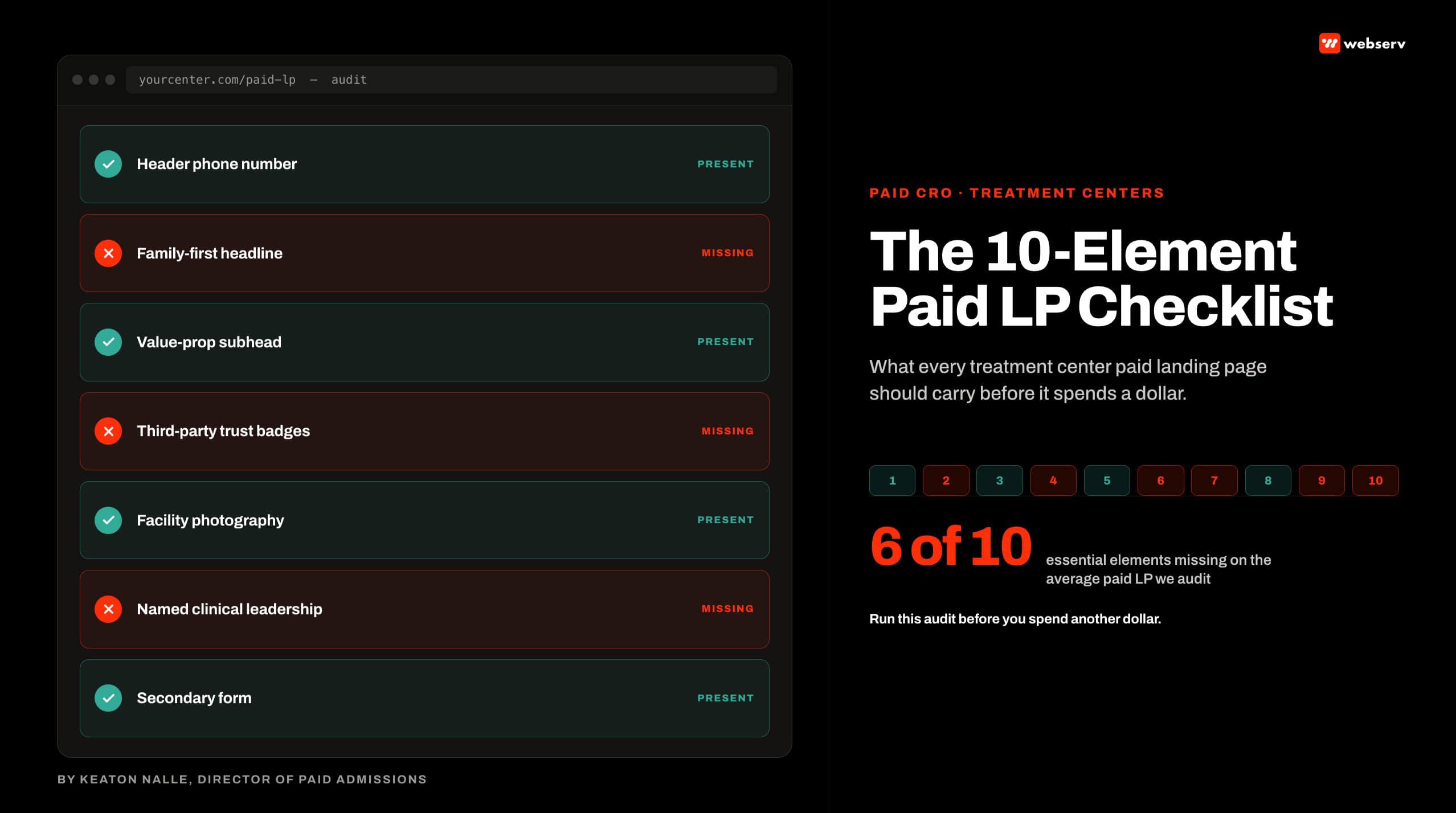
Most of the paid landing pages our team audits for treatment centers are missing 4 to 6 of the 10 essential elements. The ones missing produce measurable conversion drag.
The pattern is consistent enough that we built a checklist we run before any paid campaign spends its first dollar against a new landing page.
This is not a checklist for the treatment center’s main organic site. Those pages carry a different job: clinical depth, E-E-A-T signaling, topical authority. The paid landing page is deployed as a noindexed asset separate from the main site, optimized for one job: converting a paid click into a lead or a call. That focus is what defines our paid CRO program at Webserv.
That focus lets the paid LP get more aggressive on CTAs and tighter on structure without hurting the main site’s organic footprint.
This article walks the 10 elements every paid conversion rate optimization landing page should have for a behavioral health treatment center.
It also covers the elements that treatment centers keep adding to LPs that either do not move conversion or actively hurt it, and the measurement discipline that tells you which elements are earning their space on the page.
Key Takeaways
- Most treatment center paid landing pages ship missing 4 to 6 essential elements. The gap between a checklist-complete LP and a partial LP is usually measurable inside 30 to 60 days of paid spend.
- The 10 elements every paid LP should have: family-first headline, trackable phone number in the header, immediate value prop subhead, third-party trust signals, insurance verification pathway, real facility photography, named clinical leadership signal, secondary conversion form, mobile-first technical performance, and compliance-cleared creative.
- The elements that most treatment centers add and should cut: patient testimonials with identifiers (compliance risk), unmonitored live chat, autoplay video, and cookie consent banners that block above-the-fold content on mobile.
- The paid LP does not need to serve organic search intent, does not need to rank, and does not need clinical depth beyond what supports the conversion. Focus is tighter, structure is simpler. The noindex posture is what enables the aggressive-but-compliant framing.
- Measurement decides which elements are earning their space. Conversion rate by element position, viable VOB rate by CTA type, and cost per admit are the metrics that matter. Cost per lead alone hides which elements are actually contributing.
Element 1: Family-First Headline
Roughly 60 to 80 percent of behavioral health admissions inquiries come from family members, not the patient. The headline has to acknowledge that reality without excluding the patient prospect who is also present in the traffic.
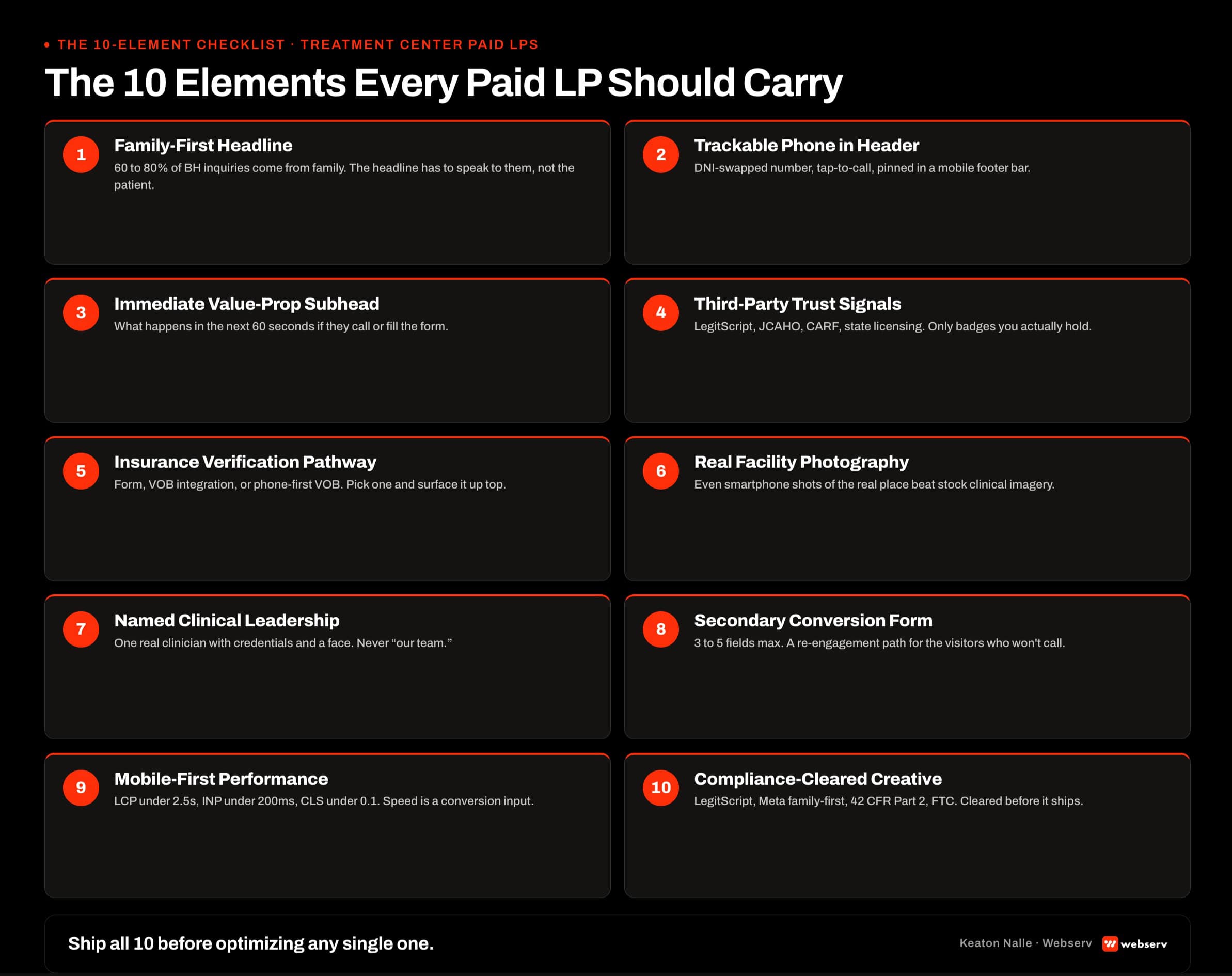 Scannable checklist grid of the ten elements every treatment center paid landing page should carry, family-first headline, trackable phone number in the header, immediate value prop subhead, third-party trust signals.
Working headlines pattern-match against three variants: family-first (“Get Your Loved One Into Treatment This Week”), patient-first (“Ready to Get Help Today?”), and neutral urgency (“Detox and Residential Treatment. Available Now.”).
The best-performing option depends on the campaign’s audience targeting and traffic composition, but family-first pulls stronger conversion on broad-match campaigns because family callers convert at higher rates.
What fails: generic branding headlines (“Welcome to [Facility Name]”), clinical-education headlines (“Understanding Addiction Recovery”), and any language that sounds like a facility brochure. The paid LP is not a brochure; it is a conversion asset.
Element 2: Trackable Phone Number in the Header
DEFINITION
Dynamic Number Insertion (DNI)
A call tracking capability that swaps the phone number displayed on a landing page based on the traffic source. A visitor arriving from a Google Ads campaign sees one tracked number; a visitor arriving from a Meta ad sees a different tracked number; a direct visitor sees a third. All numbers route to the same admissions team, but attribution data captures which source produced each call. DNI is standard practice with CallRail and CTM call tracking platforms and is required for defensible paid media attribution on treatment center campaigns.
The phone number should be visible in the header on desktop and pinned in a fixed footer bar on mobile. Every paid LP needs a trackable number, not the main site’s number. Google Ads documents the offline conversion pipeline that connects call data back to admit attribution.
Trackable numbers allow attribution back to the specific campaign, keyword, or LP variant that produced the call. Untrackable numbers muddy the attribution and lead to budget decisions made on wrong data.
The number should be tap-to-call on mobile, formatted with the area code visible, and displayed at a font size the user does not have to zoom to read. Small technical details, but they move conversion by 5 to 15 percent on mobile traffic. The CallRail vs CTM decision framework covers the underlying call tracking platform choice this element depends on.
Element 3: Immediate Value Prop Subhead
The subhead delivers the specific value the caller gets in the next 60 seconds. Not the treatment center’s overall mission. What happens if they call right now.
Working subheads: “Free insurance verification. Talk to a licensed clinician in 5 minutes.” “Same-day admissions available. Insurance accepted.” “Verified in-network with Aetna, Cigna, Blue Cross, and 40+ other carriers.”
Failing subheads: “Compassionate care since 1993.” “Nationally recognized addiction treatment.” “Our expert team is here to help you.” None of these tell the caller what happens in the next minute of their life if they engage with the LP.
Element 4: Third-Party Trust Signals
Trust badges from external certifying bodies. LegitScript, JCAHO (Joint Commission), CARF, state licensing display, DEA registration if applicable to the level of care. These are the certifications behavioral health prospects check when they research a facility, and displaying them on the LP short-circuits the “is this facility legitimate” question.
60-80%
share of BH admissions inquiries from family callers, not patients
5-15%
typical mobile conversion lift from proper tap-to-call formatting
4-6
essential elements missing on the average treatment center paid LP we audit
Skip badges you do not actually hold. Displaying a JCAHO logo when the facility is not JCAHO-accredited is a compliance and reputational risk that is not worth the trust signal it might have provided. Only display real certifications.
Element 5: Insurance Verification Pathway
A visible insurance verification path is the specific step that converts a browsing family member into a lead. The prospect wants to know two things before they call: will my insurance cover this, and what is the actual out-of-pocket cost. The LP should surface both.
The pathway can be a form (“Verify Your Insurance in 60 Seconds”), a direct integration with a VOB tool (Availity, VerifyTX), or a phone-first VOB offer (“Call now for free insurance verification”).
What matters is that the prospect sees a clear route to knowing their coverage status. Ambiguity on this element loses more prospects than any other single element on the page.
Compliance layer: the VOB pathway has to handle protected health information under HIPAA-adjacent standards. Our companion guide on HIPAA-compliant contact forms in WordPress walks the specific implementation details. Third-party VOB integrations should be reviewed for PHI handling; server-side data flow is generally safer than client-side.
Element 6: Real Facility Photography
Stock photography of clinical settings underperforms real photography of the actual treatment center. Real photos build trust that stock photos cannot.
Prospects and families can tell the difference between a facility’s actual environment and a generic clinical stock image, and they use that visual signal to evaluate whether the facility is legitimate.
REAL FACILITY PHOTOGRAPHY OVER STOCK, EVEN WHEN THE REAL PHOTOGRAPHY IS IMPERFECT
A candid photo of the actual facility with slightly uneven lighting outperforms a polished stock photo of a fake clinical setting. Prospects use visual authenticity as a proxy for facility authenticity. If professional photography is not in the budget, well-composed smartphone photos taken at the facility during good natural light outperform stock imagery.
Compliance layer: no patients or families in identifiable ways in any photos on the LP. Staff-only photos of common areas, exteriors, and program spaces (when patients are not present) are fine. Patient-occupied spaces are off-limits.
Element 7: Named Clinical Leadership Signal
Even though the paid LP is noindexed and does not need to carry the main site’s full E-E-A-T signal, some level of clinical authority signaling helps prospects trust the facility enough to convert. A named medical director or clinical director, credentials visible, brief bio.
This does not need to be as extensive as the main site’s team page. One clinical leader named on the LP is usually enough. What matters is that a prospect scrolling the LP sees a real named clinician associated with the facility rather than a generic “our team” reference.
Compliance: the clinician has to actually be affiliated with the facility. Fabricating clinical staff or using stock names of nonexistent clinicians is both fraudulent and platform-policy-violating on Meta and Google.
Element 8: Secondary Conversion Form
DEFINITION
Hybrid Conversion Pattern
A landing page pattern that offers both phone-first and form-first conversion paths simultaneously rather than forcing all prospects into one CTA type. Phone number pinned in header and fixed footer bar; secondary form present below the fold for prospects who prefer not to call. Roughly two-thirds of the treatment center paid LPs our team manages now use this hybrid pattern because it captures both intent types without forcing the wrong CTA on either audience.
The secondary form catches prospects who are not ready to call. It should be short (3 to 5 fields maximum), request only the information the admissions team needs to follow up (name, phone, insurance, best time to call), and confirm submission with a clear next step.
Longer forms (8+ fields) reduce conversion without adding value. The admissions team can collect additional information on the follow-up call. The LP form is not a qualification tool; it is a re-engagement path.
Element 9: Mobile-First Technical Performance
Treatment center paid traffic is 60 to 75 percent mobile. The LP must load fast, render correctly, and convert cleanly on mobile devices. This is a technical requirement, not a preference.
The Core Web Vitals targets that matter: Largest Contentful Paint under 2.5 seconds, First Input Delay under 100 milliseconds (or Interaction to Next Paint under 200 milliseconds for the newer metric), and Cumulative Layout Shift under 0.1.
LPs that miss these targets lose 15 to 30 percent of mobile traffic to bounces before the prospect ever sees the CTA.
DO NOT DEPLOY PAID LANDING PAGES BUILT ON THE MAIN SITE’S PAGE BUILDER IF THE MAIN SITE IS SLOW
The paid LP inherits whatever performance debt the main site carries. If the main site loads in 4+ seconds on mobile, the paid LP built on the same infrastructure will too, and the paid spend that reaches the LP will lose 15-30% to bounces. Deploy paid LPs on a separate, lightweight stack (Unbounce, Instapage, or a custom lightweight WordPress build) that meets Core Web Vitals independent of the main site’s technical baseline.
Element 10: Compliance-Cleared Creative and Copy
Every element on the LP passes compliance review before publish. LegitScript standards on ad content for addiction treatment advertisers. Meta family-first standards. 42 CFR Part 2 protections on any patient-adjacent language. FTC endorsement guidelines on any testimonial or outcome claim.
The compliance floor is not optional and does not change based on the LP being noindexed. Noindex is a search-visibility choice. The compliance standard is the same as for the main site.
The specific compliance patterns that fail: outcome guarantees (“100% success rate,” “guaranteed recovery”), crisis-exploitation language (“in crisis right now,” “before it’s too late”), unsupported comparative claims (“best treatment center in California”), and any language that could be construed as offering medical advice on the LP itself.
The Prioritization Order
- Ship the 10 Elements First. Before any A/B testing, before any optimization, before any iteration: get all 10 elements onto the page. Most conversion lift comes from having the elements present, not from optimizing the ones that are there.
- Audit for Missing Elements Weekly. The first 4-6 weeks of a new paid campaign, audit the LP weekly against the 10-point checklist. Elements slip out as edits happen (a trust badge gets removed, a phone number stops tracking, an image gets swapped for stock).
- Test Element Variants Once the Baseline Is Complete. Once the 10 elements are stable, start testing variants: headline options, trust badge order, form length, CTA color. Test one element at a time with enough traffic to get statistically defensible results.
- Measure Downstream, Not Upstream. Cost per lead tells you a partial story. Viable VOB rate by LP variant and cost per admit tell you which version is actually earning the paid spend. Optimize on the downstream number, not the top-of-funnel number.
- Recompile Every 90 Days. The 10-element checklist itself gets revisited every 90 days against changes in Meta, Google, and LegitScript policy; changes in the treatment center’s clinical program; and changes in the campaign’s audience targeting. What worked six months ago may not work now.
Most treatment centers we audit skip step 1 (getting the elements on the page) and jump straight to element-level optimization. The result is a well-optimized LP that is missing 4 to 6 of the essential elements, which limits how much optimization can help.
The Elements Most Treatment Centers Add and Should Cut
ELEMENTS THAT EARN THEIR SPACE ON A TREATMENT CENTER LP
- Family-first headline addressing the actual caller (family members are 60-80% of inquiries)
- Trackable phone number in header + fixed mobile footer bar
- Real facility photography (even smartphone shots outperform stock)
- Short secondary form (3-5 fields) for prospects who prefer not to call
- Third-party trust badges (LegitScript, JCAHO, CARF, state licensing) actually held by the facility
ELEMENTS TO REMOVE OR AVOID
- Patient testimonials with names, photos, or identifying details (42 CFR Part 2 risk)
- Live chat widgets that are not staffed 24/7 (worse than no chat)
- Autoplay video that delays LCP and violates mobile UX standards
- 8+ field forms that reduce conversion without producing qualification value
- Fabricated or unearned trust badges that create regulatory exposure
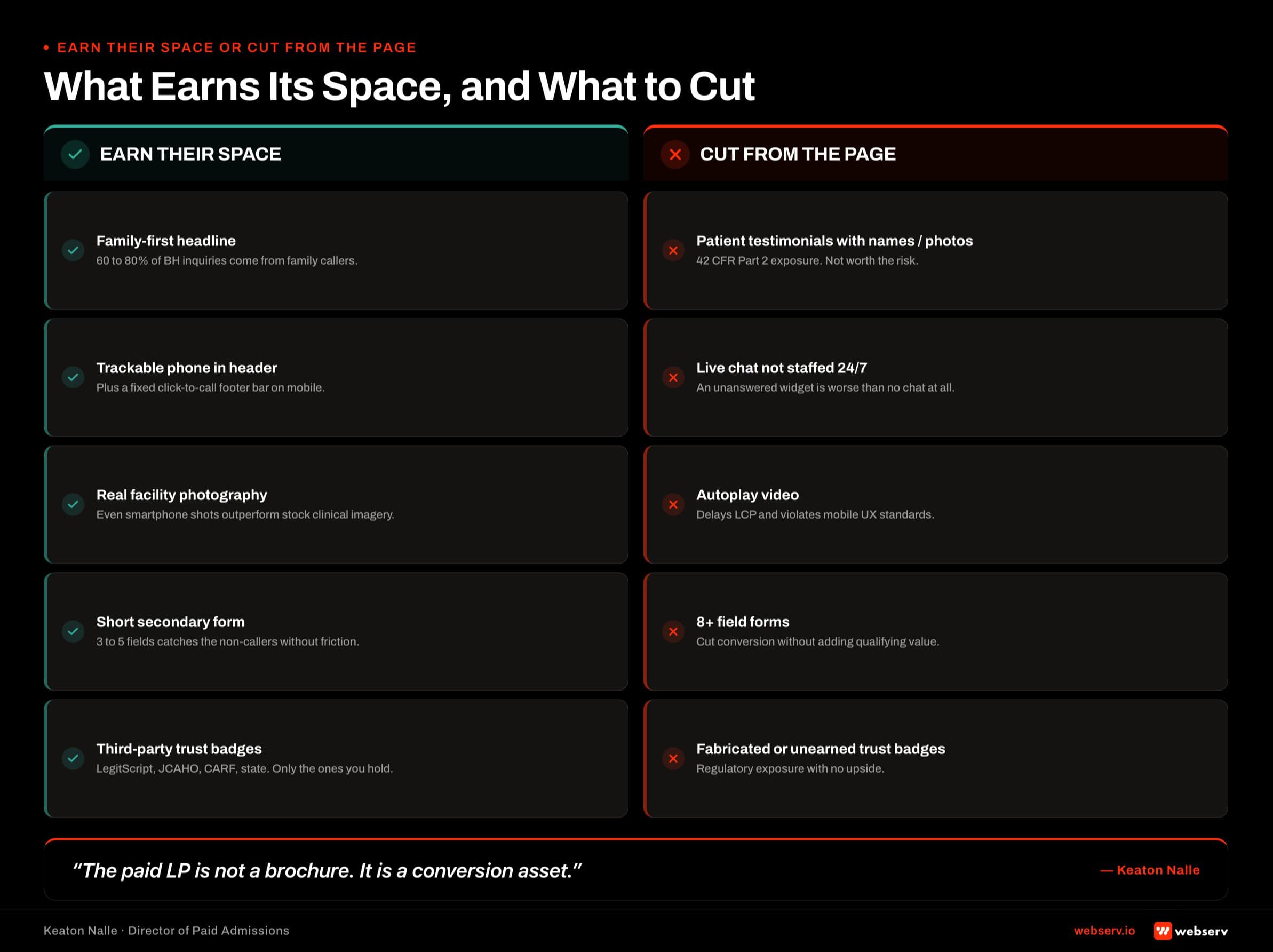 Side-by-side comparison of treatment center landing page elements that earn their space on the page versus elements to cut, five must-keep items including family-first headline, trackable phone number.
The autoplay video pattern is worth calling out specifically. Video on treatment center landing pages can work when the video is optional (click-to-play), compressed, and hosted on a fast platform.
Autoplay video that starts loading on page render delays Largest Contentful Paint, violates most mobile browsers’ autoplay standards (audio muted by default), and adds 3 to 8 seconds of load time that most mobile prospects will not wait through.
The patient testimonial pattern is the most common compliance failure. Testimonials with names, photos, or identifying details create 42 CFR Part 2 exposure regardless of whether the patient consented (the standard is stricter than HIPAA).
Aggregate outcomes framed as facility-level performance are safer. Individual patient stories on the LP are almost never worth the compliance risk.
Measurement: Which Elements Move Which Metric
Not every element affects every metric. The measurement discipline is knowing which element drives which outcome.
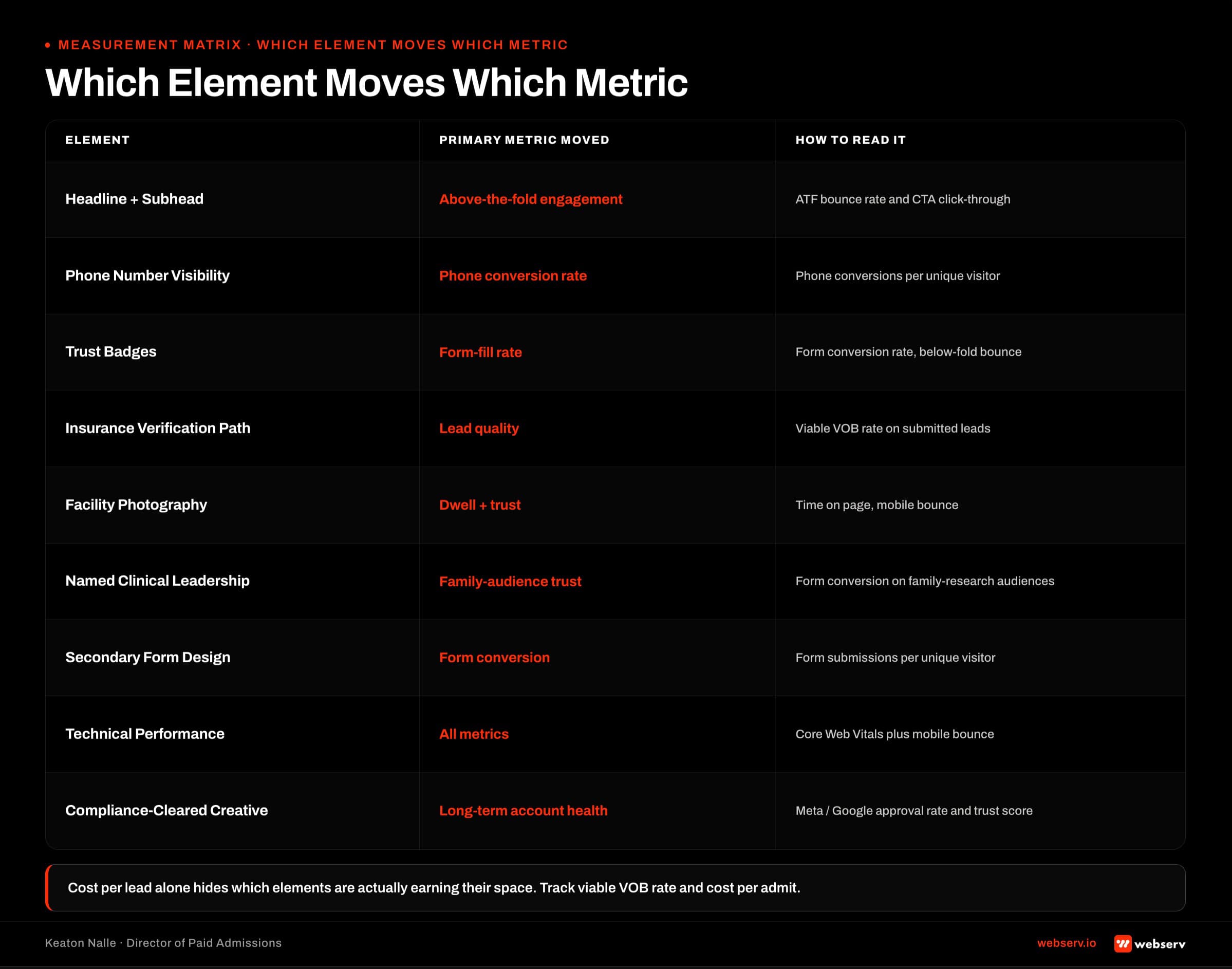 Three-column measurement matrix mapping each of the ten treatment center landing page elements to the KPI it moves and how to read the metric.
Headline and subhead. Drive top-of-funnel engagement. Measured through above-the-fold bounce rate and click-through to the CTA.
Phone number visibility. Drives phone conversion rate specifically. Measured through phone conversions per unique visitor.
Trust badges. Reduce below-the-fold bounce and increase form-fill rate. Measured through form conversion rate.
Insurance verification pathway. Drives high-quality lead volume. Measured through viable VOB rate on submitted leads.
Facility photography. Increases dwell time and reduces bounce. Not directly measurable to admits, but reduces top-of-funnel loss.
Named clinical leadership. Drives trust for slower-decision prospects (family research campaigns). Measured through form conversion on family-research audiences.
Secondary form design. Drives form conversion rate. Measured through form submissions per unique visitor.
Technical performance. Affects all metrics because it determines whether the prospect stays on the page long enough to see anything. Measured through Core Web Vitals and mobile bounce rate.
Compliance-cleared creative. Affects long-term account health. Measured through Meta/Google ad approval rates and account trust score.
The teams that manage paid LPs well know which element moved which metric between last week’s version and this week’s. The teams that manage them badly change several elements at once and lose the ability to attribute conversion changes to specific decisions. The Complete Guide to Conversion Rate Optimization for Rehab Marketing walks the full CRO framework that this checklist sits inside.
Book an intro meeting if you want to walk your current paid LP against this checklist.
This works alongside behavioral health marketing guide and homepage design that converts callers as part of a complete landing page strategy. It’s also worth pairing with website design strategy for treatment centers.
Frequently Asked Questions
How long should a treatment center paid landing page be?
Shorter than most operators assume. A working paid LP is typically 800 to 1,500 words of prose across the full page, with the primary CTA visible above the fold. Longer pages (2,000+ words) work only when the audience is doing extended research and the paid targeting matches that research intent.
The metric to watch is scroll depth versus conversion. If most conversions happen above the fold, the below-the-fold content is not doing enough work. If most conversions happen after significant scroll, longer content is working. Track and adjust rather than committing to a length upfront.
Phone-first LPs skew shorter (300 to 600 words above the fold, phone number and 3 to 5 trust signals) because the goal is to trigger the call fast. Form-first LPs skew longer (600 to 1,200 words above the fold plus supporting content) because the prospect needs more context before submitting. Our companion piece on phone-first vs form-first LPs walks that specific decision.
Should we use different landing pages for different campaigns?
Yes, whenever the audience or intent is materially different. A detox campaign, a residential campaign, a family-research campaign, and an insurance-verification campaign all warrant separate landing pages tuned to the specific audience and intent.
The exception is small facilities running low paid spend where the operational overhead of maintaining multiple LPs outweighs the conversion benefit. For treatment centers running under $15,000 a month in paid media, one well-built LP that covers the primary levels of care is often sufficient.
For treatment centers running $50,000 a month or more, multiple campaign-specific LPs are the standard. The incremental conversion lift on properly targeted LPs is usually 20 to 40 percent versus one generic LP serving all campaigns.
How do we know if our LP is actually working?
The metric that matters is cost per admit, not cost per lead. A landing page can produce a great cost per lead and a terrible cost per admit if the leads are low quality.
A landing page can also produce a higher cost per lead and a materially better cost per admit if the leads are pre-qualified by the LP’s content.
The measurement stack: Google Ads and Meta ad platform data for lead volume and cost per lead, CRM data for lead-to-VOB and viable-VOB rates, billing data for actual admit outcomes. All three sources reconciled weekly. A treatment center that only tracks cost per lead cannot honestly evaluate LP performance.
The benchmark to hold LPs against: viable VOB rate above 25 percent (higher is better), cost per admit under the facility’s target range (varies by level of care), and paid campaign contribution margin positive within 60 to 90 days of launch.
What is the fastest single fix we can make to an underperforming LP?
Depends on which element is missing. The audit sequence: run through the 10-point checklist and identify which elements are absent or broken. Fix the highest-priority missing element first.
Most common single fixes we make on audits: adding a trackable phone number in the header (when the main site number was being used), replacing stock photography with real facility images, shortening a 10-field form to 4 fields, and adding LegitScript / JCAHO trust badges that were being displayed only in the footer.
Each of these single fixes typically produces 10 to 25 percent conversion lift on its own. Multiple fixes compound. A LP missing 4 to 6 elements that gets all 10 in place often produces 40 to 80 percent conversion lift in the first 30 to 60 days of the updated version being live.
Keaton Nalle is the Director of Paid Admissions at Webserv, a digital marketing agency for treatment centers.