In a July 2025 study of real browsing data, Pew Research Center found that Google users clicked a traditional search result in 8% of visits when an AI summary appeared, compared with 15% when one didn’t. They clicked a link inside the summary in 1% of visits.
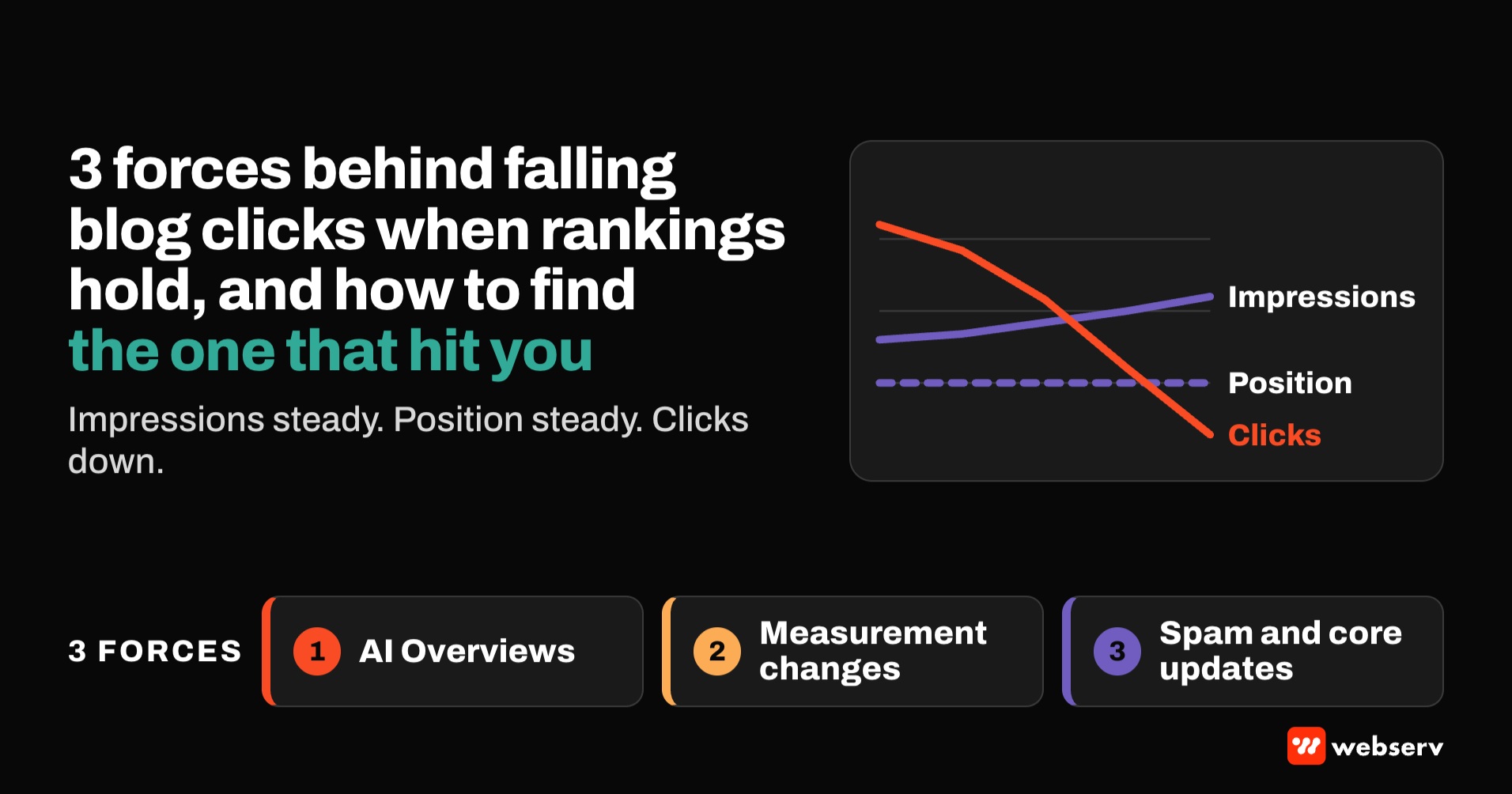
It matches a pattern treatment center marketers keep raising about Search Console: impressions steady or rising, average position steady, clicks down. It looks like something broke. Often nothing did. The results page changed around the ranking.
But “AI Overviews took the clicks” isn’t a full diagnosis either. Search Console measurement changed in the same period, Google ran spam and core updates, and behavioral health queries behave differently from the averages in most studies.
This piece covers what the research shows, why treatment center sites are affected unevenly, the measurement changes behind the numbers, a Search Console diagnostic, and how to re-weight a content program. It’s part of the work inside our AEO program for treatment centers.
Key Takeaways
- Independent studies found lower click-through rates on queries with AI Overviews: Ahrefs measured a 58% lower CTR for the top result in December 2025, and Pew found users clicked traditional results about half as often when an AI summary appeared.
- The trend isn’t one-directional. Seer Interactive’s 2026 update found the 2025 CTR decline didn’t extend into early 2026, and that pages cited in an AI Overview got substantially more clicks than those that weren’t.
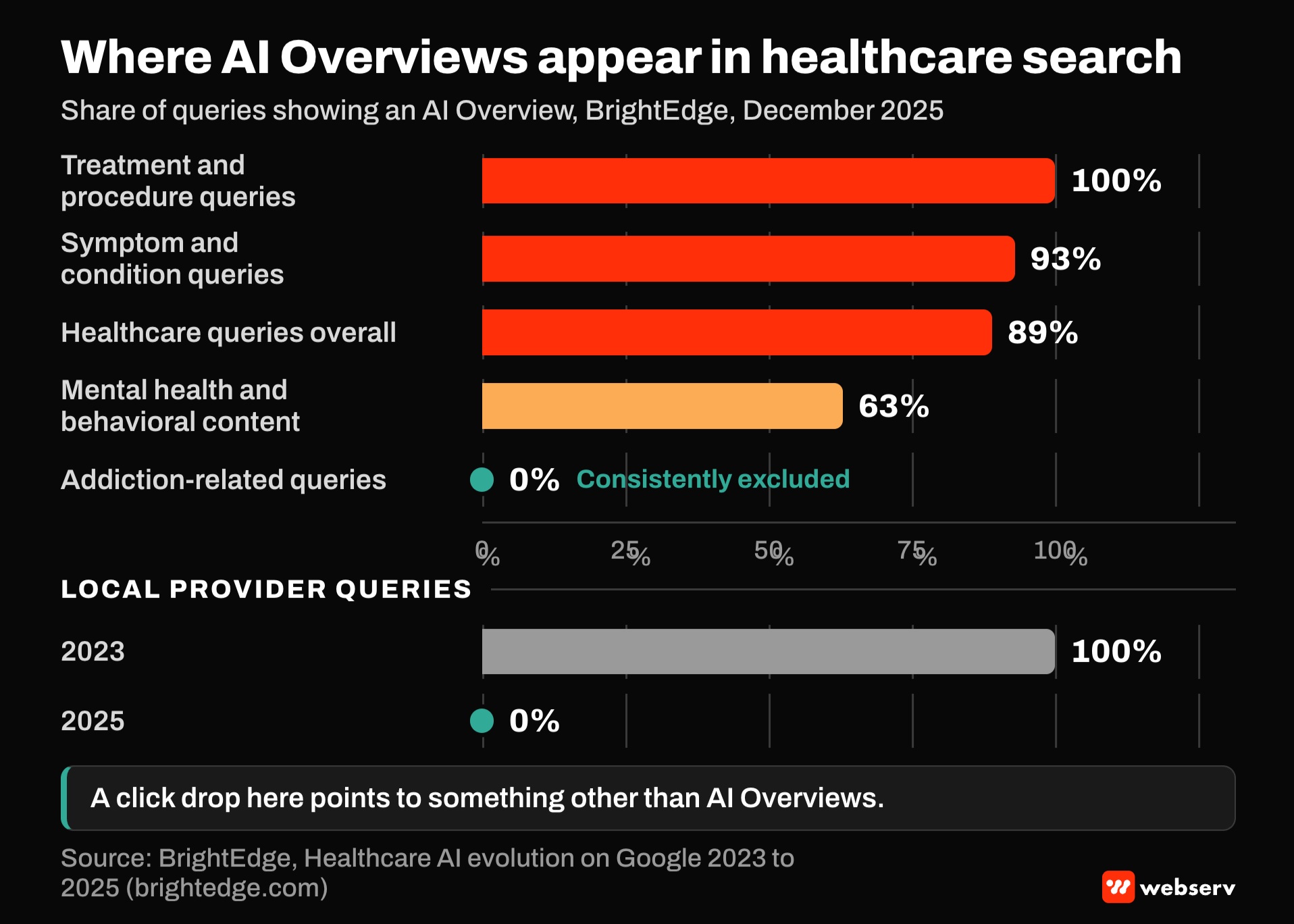
- BrightEdge found AI Overviews on 89% of healthcare queries and 93% of symptom and condition queries in December 2025, but listed addiction-related queries as consistently excluded. Mental health and symptom content is more exposed than rehab-specific content.
- Search Console measurement changed too. An AI Overview counts as one position, impressions count whether or not a result is scrolled into view, and Google’s September 2025 change to the num=100 parameter shifted impression counts.
- Diagnose by segment: branded versus non-branded, informational versus commercial, and page type. Google’s branded query filter and query groups make this easier.
- Re-weight the content program toward pages that serve families ready to act, and measure inquiries and admits, not sessions.
What the research shows
Several independent studies measured clicks on queries with AI Overviews. They differ in method and period, so read them as a range.
What the click studies found
8% vs 15%
Share of visits with a click on a traditional result, with vs. without an AI summary (Pew, 2025)
58%
Lower CTR for the top-ranking page on keywords with AI Overviews (Ahrefs, Dec 2025)
+120%
More organic clicks per impression when a page is cited in the AI Overview (Seer, 2026)
Pew Research Center. Pew’s July 2025 analysis tracked 900 US adults’ Google searches in March 2025. Users clicked a traditional result in 8% of visits with an AI summary, versus 15% without, and ended their browsing session more often after a page with a summary.
Ahrefs. Ahrefs’ February 2026 update compared desktop Search Console data from December 2023 and December 2025 and found a 58% lower average CTR for the top-ranking page on keywords with AI Overviews. Its April 2025 study had measured 34.5%.
Seer Interactive. Seer’s November 2025 update found a 61% decline in organic CTR on informational queries with AI Overviews from mid-2024 to September 2025. Its April 2026 update, using a larger dataset and reported by Search Engine Journal, found the 2025 decline didn’t extend into 2026, and that being cited in an AI Overview meant 120% more organic clicks per impression.
Google. Google’s Liz Reid wrote in August 2025 that total organic click volume from Search to websites was relatively stable year over year, and that clicks were slightly higher quality. Google didn’t publish data behind the statement.
DEFINITION
Zero-click query. A search that ends without a click to any website, because the results page answered the question or the searcher gave up. AI Overviews can raise the share of zero-click searches for informational questions, while Seer’s 2026 data found AI Overviews on far fewer commercial and transactional queries.
Why treatment center sites are affected unevenly
The averages hide a split that matters for behavioral health.
BrightEdge’s December 2025 healthcare analysis found AI Overviews on 89% of healthcare queries, 93% of symptom and condition queries, and 100% of treatment and procedure queries. Mental health and behavioral content was at 63%.
The same analysis listed addiction-related queries among topics consistently excluded from AI Overviews, at 0%. Local provider queries went from 100% in 2023 to 0% in 2025. For what that means for facility searches, see our breakdown of AI Overviews on local rehab searches.
For a typical treatment center blog, that means:
- Symptom and condition posts, such as “signs of depression” or “what is PTSD,” sit in the most exposed category. Click declines there are expected.
- Addiction-specific and local queries were largely excluded in BrightEdge’s data, so a drop there points to something other than AI Overviews.
- Facility and program pages answer questions only the facility can answer, and they’re the pages that turn visits into calls.
BrightEdge put it plainly: traffic declines may not indicate content problems. On many treatment center blogs, the posts most exposed are general symptom and condition explainers, which tend to sit furthest from an admissions call.
The measurement changes behind the numbers
Some of what looks like a traffic change is a reporting change.
AI Overviews in Search Console. Google’s AI features documentation says AI Overview and AI Mode traffic is reported in the Performance report under the Web search type. Its metrics help page says an AI Overview occupies a single position, and that impressions count whether or not a result is scrolled into view. Google also added a dedicated generative AI performance report, rolled out to all sites by August 31, 2026, which shows AI Overview and AI Mode impressions by page, country, and device.
So a page cited in an AI Overview can gain impressions it never earned clicks for. Impressions rise, clicks hold, and CTR falls, without any change in how the page performs for people who see it.
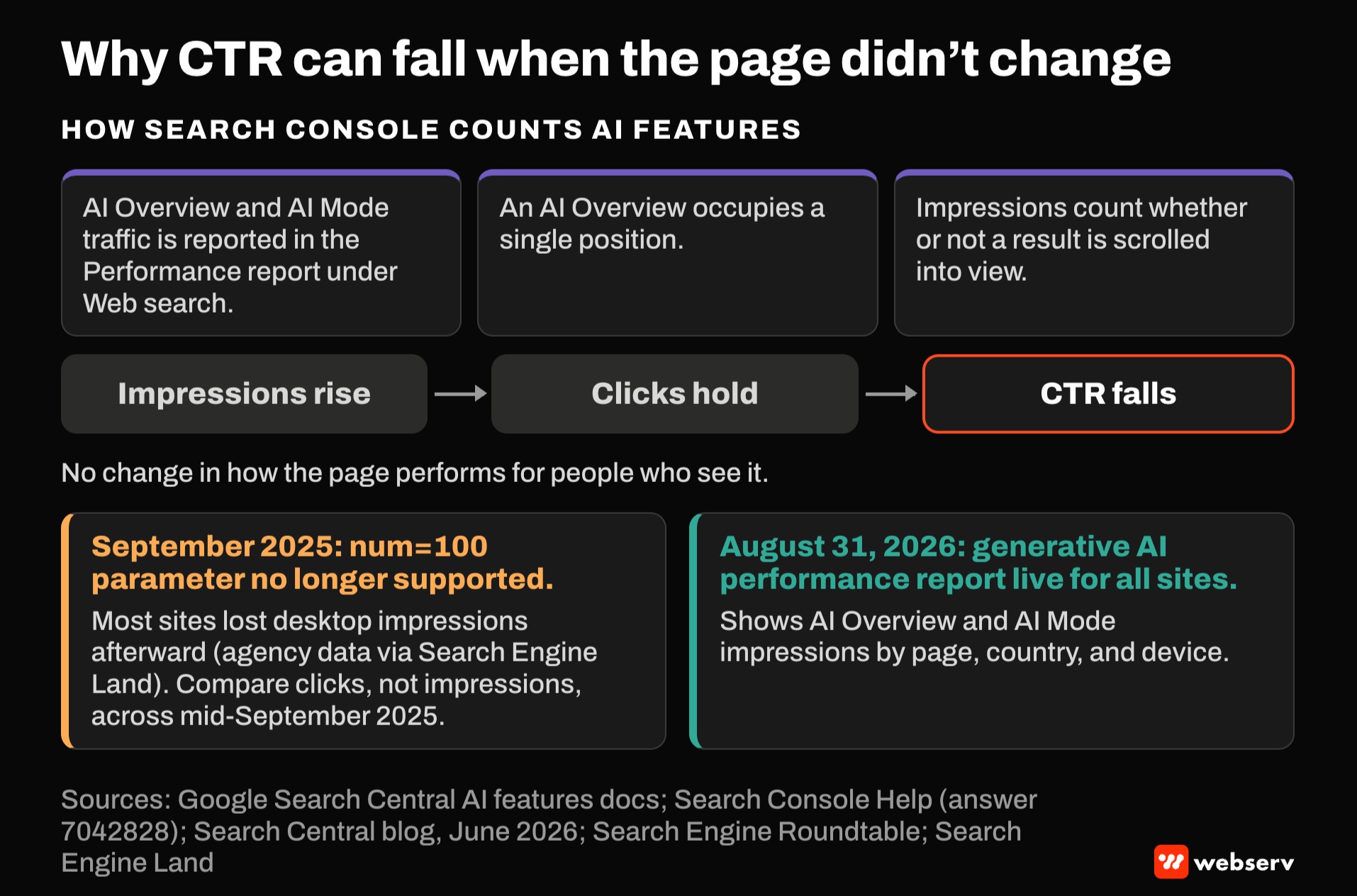
The num=100 change. In September 2025, Google stopped supporting a URL parameter that let tools load 100 results at once, telling Search Engine Roundtable it wasn’t formally supported. Search Engine Land reported agency data showing most sites lost desktop impressions afterward.
Year-over-year impression comparisons that cross mid-September 2025 can be misleading for that reason. Compare clicks, not impressions, across that date.
COMMON MISTAKE
Reading average position as “rankings are fine.” Average position blends every query a page appears for. A page can hold position on its main term while losing ground on dozens of long-tail queries, and the average barely moves.
Look at clicks and position for the queries that matter, not the site-wide average. Google’s September 2026 spam update and its earlier 2026 core updates are listed on the Search Status Dashboard; check whether a drop lines up with one.
A diagnostic you can run in Search Console
Run these six checks in order.
Split branded and non-branded
Google’s branded queries filter separates searches for your facility’s name from everything else. A branded drop is a demand or reputation question; a non-branded drop is a visibility question.
Group similar queries
Google’s query groups cluster related searches, which makes it easier to see which topics lost clicks.
Segment by page type
Compare blog posts, program pages, location pages, and insurance pages separately. The pattern is often concentrated in one group.
Check the results page
For the queries that lost the most clicks, search them yourself, logged out. Note whether an AI Overview appears and whether your site is cited.
Line up the dates
Compare the drop against the num=100 change, Google’s update dates, and your own site changes.
Follow the outcome
Check whether calls, forms, and admits from organic search fell with the clicks. If they held, the lost clicks weren’t the ones producing admissions.
Our guide to Search Console’s AI performance reporting covers the reports in more detail.
How to re-weight a content program
If the diagnosis points to AI Overviews absorbing informational clicks, the response isn’t to write more informational posts.

Shift effort toward action pages. Program pages, insurance pages, admissions pages, and location pages answer the questions families ask once they’re deciding. Our guide to the nine types of content that drive admits covers which formats tend to lead to inquiries.
Make informational posts worth citing. Seer’s 2026 data found pages cited in an AI Overview earned far more clicks per impression than those that weren’t. Clear, sourced, self-contained answers are the citation candidates. Our guide to getting cited in AI Overviews and ChatGPT covers the patterns.
Connect informational posts to the next step. A post on signs of alcohol use disorder should link clearly to the facility’s program and admissions pages, so the readers who do click have somewhere to go.
Refresh before you write. Updating posts that still earn clicks often does more than adding new ones. Our content refresh framework covers how to choose.
Measure the right outcome. Sessions were always a proxy. Report organic inquiries and admits by landing page, so a drop in blog sessions is judged against what it actually cost.
OPERATOR INSIGHT
Before reacting to a traffic drop, pull organic admits for the same period. If admits held while blog sessions fell, the content program is working where it matters and the lost clicks were likely from readers further from a decision.
If admits fell too, the diagnostic above tells you where to look, and the fix is usually on program and location pages rather than the blog.
Where this fits
Traffic diagnosis is one part of a broader AI search strategy. For the full build, see the Full AI Search Stack, and for how AI Overviews and AI Mode differ, our explainer on AI Mode vs AI Overviews. The 12 SEO failure patterns diagnostic and the 5-tier SEO priority framework cover what to fix first.
For how organic search fits the rest of your marketing, see the complete guide to behavioral health marketing. If you want a second look at your Search Console data, book an intro meeting.
Frequently Asked Questions
Why are my impressions up but my clicks down?
Several reasons can combine. Google counts an impression whether or not a result is scrolled into view, and an AI Overview counts as a single position, so a cited page can gain impressions without clicks.
Studies also found lower click-through rates on queries with AI Overviews, though Seer Interactive’s 2026 data showed the decline didn’t continue into early 2026.
Segment by branded versus non-branded queries and by page type to see where the change actually is.
Are AI Overviews affecting rehab searches?
Unevenly. BrightEdge found AI Overviews on 93% of healthcare symptom and condition queries in December 2025, but listed addiction-related queries as consistently excluded.
Symptom and mental health content is more exposed than addiction-specific and local searches.
Check your own top queries logged out to see what appears today.
Did my rankings drop if my average position didn’t change?
Not necessarily, but average position can hide losses. It blends every query a page appears for, so long-tail declines can be masked.
Look at clicks and position for the specific queries that drive inquiries.
Also check whether the change lines up with a Google update listed on the Search Status Dashboard.
Should we stop writing blog posts?
No, but change what they’re for. Informational posts that are clear, sourced, and cited in AI Overviews can still earn clicks, and Seer found cited pages earned substantially more clicks per impression.
Put more effort into program, insurance, admissions, and location pages, which serve families closer to calling.
Link informational posts to those pages.
What should we measure instead of traffic?
Organic inquiries and admits by landing page. Sessions are a proxy, and the clicks AI Overviews absorb are mostly on informational questions.
If admits held while traffic fell, the drop may not need fixing.
If admits fell, use the Search Console diagnostic to find which pages and queries changed.
Trevor Gage is the Director of Marketing at Webserv, a digital marketing agency for treatment centers.