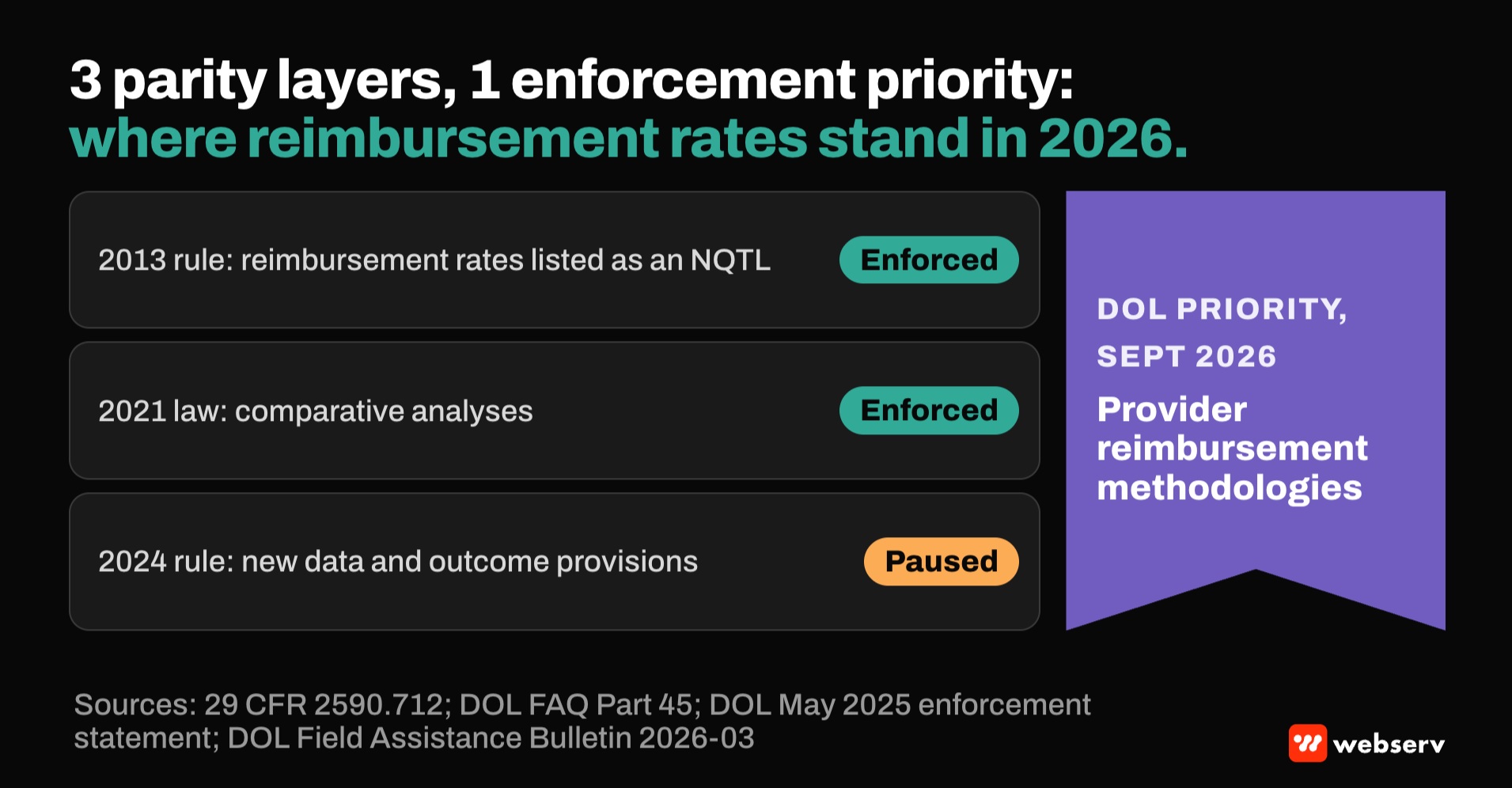
Since 2013, federal parity rules have listed “standards for provider admission to participate in a network, including reimbursement rates” as one of the plan practices that has to meet parity. In September 2026, the Department of Labor named network adequacy and provider reimbursement methodologies among its three enforcement priorities.
That’s the part of mental health parity that matters most to treatment center operators, and it’s also the part most often misunderstood.
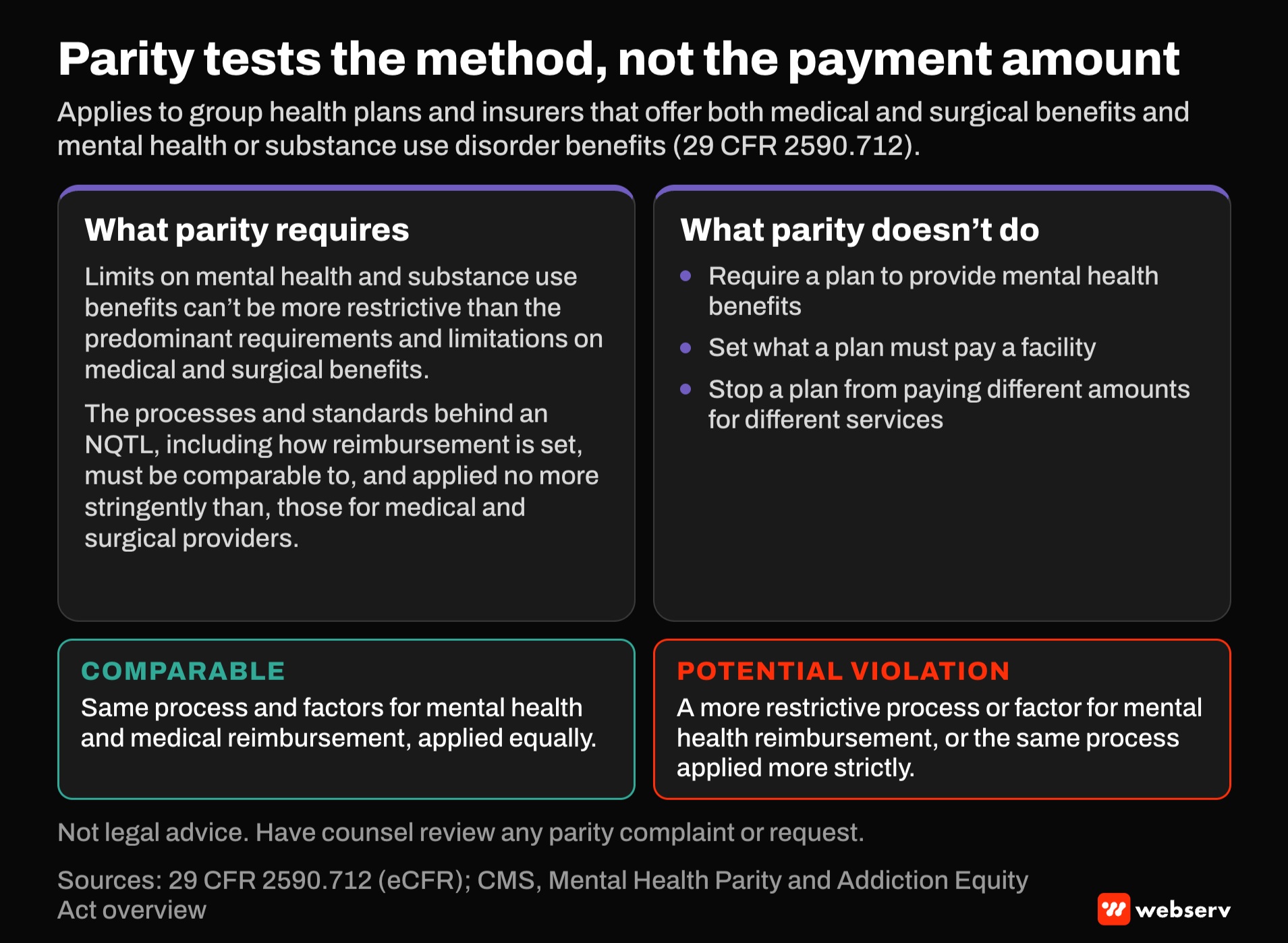
Parity law doesn’t set what a plan must pay a facility. It requires that the way a plan sets reimbursement for mental health and substance use providers be comparable to, and applied no more stringently than, the way it sets reimbursement for medical and surgical providers.
The rules have also been in flux. A 2024 rule added detailed data requirements, the Departments announced in May 2025 that they wouldn’t enforce its new provisions, and a proposed rule is on the regulatory agenda for December 2026.
This guide covers what the Mental Health Parity and Addiction Equity Act requires, where reimbursement fits, what’s enforced and what’s paused, and what a provider can request. It’s part of the reimbursement work our revenue cycle team for treatment centers supports. This isn’t legal advice; have counsel review any parity complaint or request.
Key Takeaways
- The Mental Health Parity and Addiction Equity Act requires that financial requirements and treatment limits on mental health and substance use benefits be no more restrictive than those on medical and surgical benefits. It doesn’t require plans to cover mental health or substance use care.
- Network admission standards, including reimbursement rates, and methods for setting usual and customary charges have been listed as nonquantitative treatment limitations since the 2013 rule.
- Since 2021, plans must perform and document comparative analyses of these limitations and provide them to regulators on request.
- The 2024 rule added outcomes data, including reimbursement rates benchmarked to a reference standard. In May 2025, the Departments said they wouldn’t enforce the 2024 rule’s new provisions while litigation is pending, plus 18 months.
- The Department of Labor’s September 2026 guidance names provider reimbursement methodologies as an enforcement priority and lists different reimbursement methods for mental health providers as a red flag.
- Providers can request plan documents and medical necessity criteria, and comparative analyses as an authorized representative, which gives them a starting point if reimbursement looks out of line.
What parity requires, and what it doesn’t
The Mental Health Parity and Addiction Equity Act applies to group health plans and insurers that offer both medical and surgical benefits and mental health or substance use disorder benefits, under 29 CFR 2590.712.
CMS’s parity overview says limits on mental health and substance use benefits cannot be more restrictive than the predominant requirements and limitations on medical and surgical benefits.
The same regulation says it doesn’t require a plan to provide mental health benefits. Parity governs how covered benefits are administered, not whether they’re covered.
DEFINITION
Nonquantitative treatment limitation (NQTL). A plan practice that limits the scope or duration of benefits without a number attached, such as prior authorization rules, medical necessity criteria, network admission standards, or methods for setting reimbursement.
Under parity law, the processes and standards behind an NQTL must be comparable to, and applied no more stringently than, those used for medical and surgical benefits.
The parity standard applies to the method, not the outcome. A plan can pay different amounts for different services. What it can’t do is set mental health reimbursement using a process or factor that’s more restrictive than the one it uses for medical providers, or apply the same process more strictly.
Where reimbursement fits
The 2013 rule. The 2013 final rule’s list of NQTLs, as it appeared in the eCFR before the 2024 changes, includes standards for provider admission to participate in a network, including reimbursement rates, and plan methods for determining usual, customary, and reasonable charges.
The first covers in-network rates. The second matters for out-of-network care, since a plan’s method for setting the allowed amount drives what an out-of-network facility is paid. Our guide to out-of-network reimbursement for treatment centers covers how allowed amounts work in practice.
The 2021 comparative analysis requirement. The Consolidated Appropriations Act, 2021, requires plans to perform and document comparative analyses of their NQTLs. The Departments’ FAQ Part 45 says plans must produce them on request starting February 10, 2021, and that a general statement of compliance is insufficient.
That FAQ also listed early enforcement focus areas, including network admission standards with reimbursement rates and out-of-network reimbursement rates.
The 2024 rule. The 2024 final rule added data requirements for network-related NQTLs, including provider reimbursement rates benchmarked to a reference standard, and treated material differences in access as a strong indicator of a violation.
The current regulation text includes an example in which a plan addresses a disparity by increasing reimbursement rates for mental health and substance use benefits.
What’s enforced now, and what’s paused
Here’s where each requirement stands as of October 2026.
| Requirement | Source | Status (Oct 2026) |
|---|---|---|
| NQTL parity, including network admission standards and reimbursement rates | 2013 rule | Enforced |
| NQTL comparative analyses | Consolidated Appropriations Act, 2021 | Enforced |
| Outcomes data (including benchmarked reimbursement rates), material differences, meaningful benefits standard | 2024 rule | Paused (May 2025 non-enforcement statement) |
| Provider reimbursement methodologies | DOL Field Assistance Bulletin 2026-03 | Enforcement priority |
Paused. On May 15, 2025, the Departments announced they won’t enforce the 2024 rule’s new provisions until a final decision in the ERISA Industry Committee’s lawsuit, plus 18 months. The relief applies only to provisions that are new compared with the 2013 rule.
The Department of Labor’s September 2026 bulletin lists the paused pieces as the meaningful benefits standard, the ban on discriminatory factors, and the data evaluation requirements.
The litigation is stayed, so the 18-month clock hasn’t started. The federal regulatory agenda lists a proposed rule for December 2026, described as reducing burden.
Enforced. The same May 2025 statement says the statute’s obligations, as amended in 2021, continue to apply, and that plans may continue to refer to the 2013 rule. That means the 2013 NQTL list, including reimbursement rates, and the comparative analysis requirement remain in force.
The September 2026 bulletin names three focus areas for the Department’s Employee Benefits Security Administration, one of which is standards for determining network adequacy and provider reimbursement methodologies.
A companion red-flags guide lists different methodologies for calculating network or out-of-network reimbursement as a potential problem, and suggests comparing medical and mental health provider rates relative to a benchmark.
COMMON MISTAKE
Treating the 2024 pause as “parity isn’t enforced.” The pause covers the 2024 rule’s new data and outcome tests. It doesn’t cover the 2013 rule or the 2021 statute, and reimbursement methodology is on the Department’s current priority list.
Operators who stopped tracking parity in 2025 may be missing a live enforcement focus that lines up directly with reimbursement concerns.
What enforcement has found
The Departments’ reports to Congress show what enforcement on reimbursement looks like in practice.
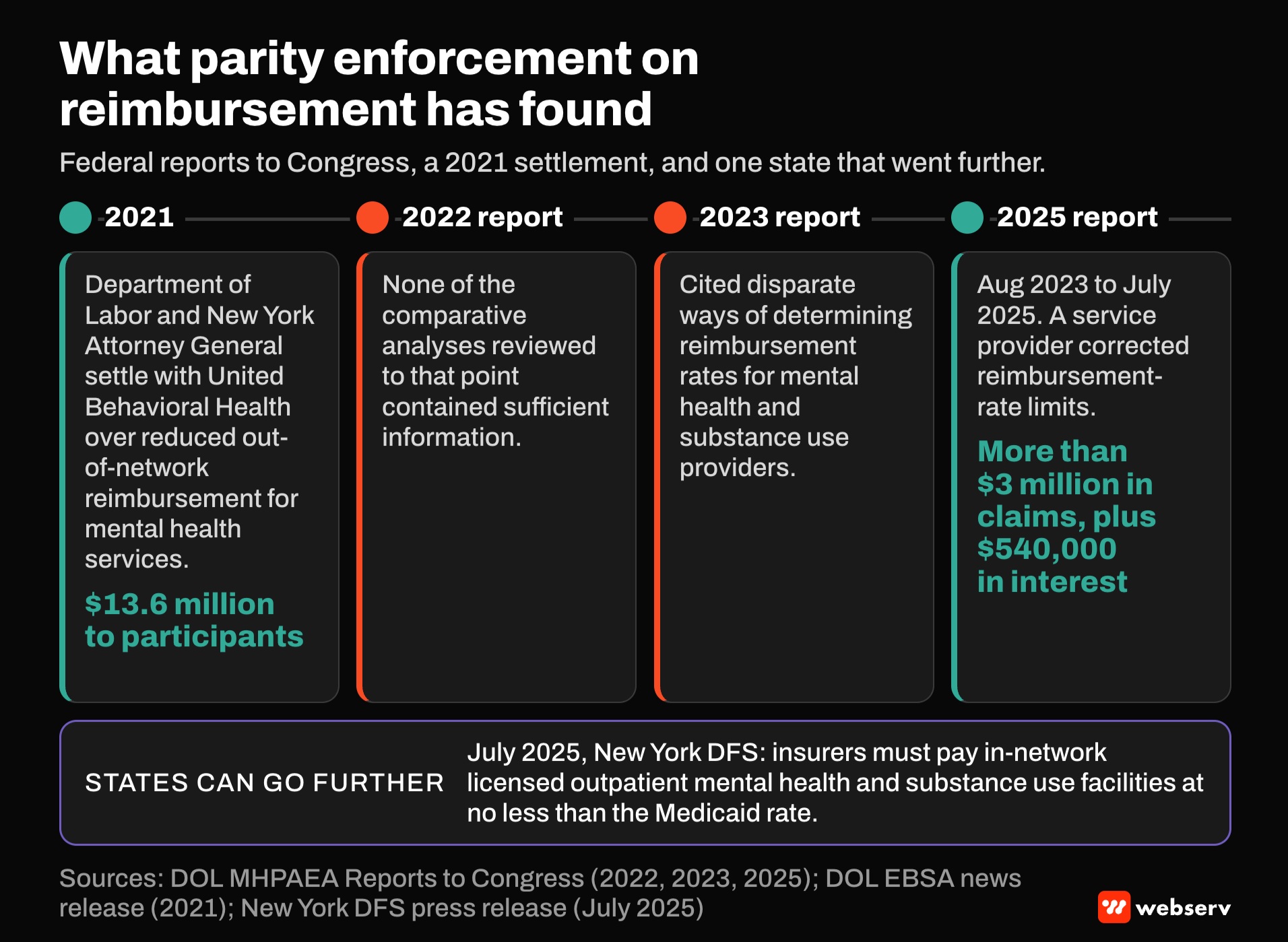
The 2022 report said none of the comparative analyses reviewed to that point contained sufficient information. The 2023 report cited disparate ways of determining reimbursement rates for mental health and substance use providers.
The 2025 report, covering August 2023 through July 2025, shows the Department requested comparative analyses on provider network admission standards 14 times and on out-of-network provider reimbursement three times during that period. Over the same period, it issued initial determinations of noncompliance for those two limitation types 10 times and four times. The counts come from separate tables in the report and don’t map one-to-one.
It describes a national service provider that removed several noncompliant limitations, including on reimbursement rates, and paid more than $3 million in claims plus $540,000 in interest.
In 2021, the Department of Labor and the New York Attorney General settled with United Behavioral Health over reduced out-of-network reimbursement for mental health services, with $13.6 million going to participants.
States can go further. In July 2025, New York’s Department of Financial Services announced that insurers must pay in-network licensed outpatient mental health and substance use facilities at no less than the Medicaid rate.
What a provider can request
Parity enforcement starts with information, and providers have more access than many assume.
WHAT A PROVIDER CAN REQUEST
- Medical necessity criteria. The regulation requires plans to make them available on request to any current or potential participant, beneficiary, or contracting provider.
- Plan documents. ERISA plans must furnish plan documents within 30 days of a request, and FAQ Part 45 says a provider or other authorized representative may request them.
- Comparative analyses. Participants, including through an authorized representative such as a provider, can request the plan’s NQTL comparative analyses, with the participant’s authorization.
The Department of Labor’s Self-Compliance Tool lists warning signs that include paying at or near Medicare rates for mental health and substance use benefits, and reimbursing psychiatrists less on average than medical physicians. It’s a useful checklist for framing a request.
OPERATOR INSIGHT
Build the case from your own claims before making a request. Rate data by payer, level of care, and network status shows whether a plan’s reimbursement is out of line with comparable services, and gives counsel something concrete.
Our guide to reimbursement intelligence covers how to organize that data, and our payer strategy guide covers how to use it in negotiations.
Who parity doesn’t reach
Some plans sit outside the federal parity rules or follow their own.
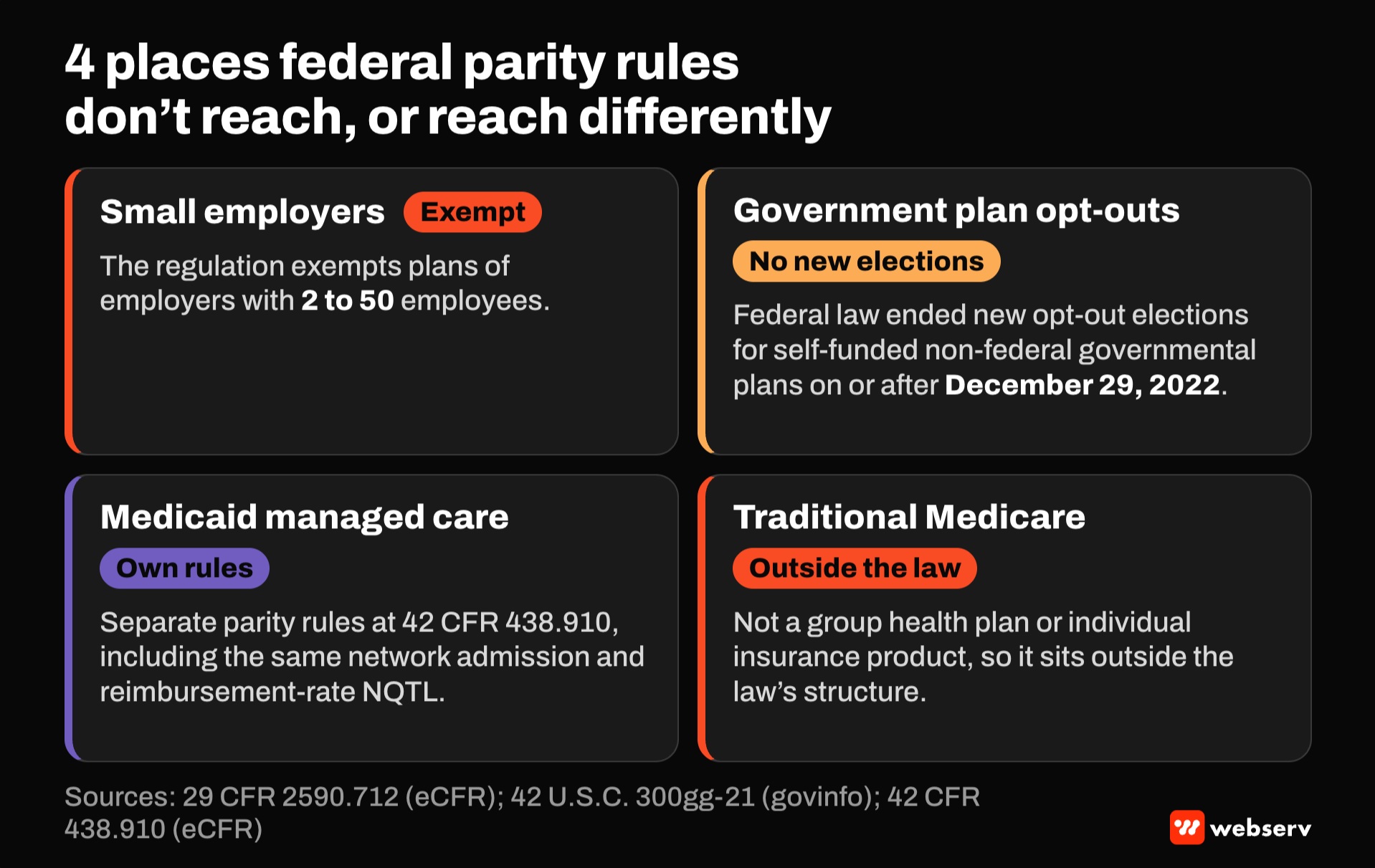
- Small employers. The regulation exempts plans of employers with 2 to 50 employees.
- Government plan opt-outs. Federal law ended new opt-out elections for self-funded non-federal governmental plans on or after December 29, 2022.
- Medicaid managed care has its own parity rules at 42 CFR 438.910, including the same network admission and reimbursement-rate NQTL.
- Traditional Medicare isn’t a group health plan or individual insurance product, so it sits outside the law’s structure.
Where this fits
Parity is one lens on reimbursement. For the rate side, see our guide to the 10% rule for reimbursement intelligence, and for the admission decision, should you admit a patient with an unknown rate. For how medical necessity criteria play out after admission, see our guide to concurrent review and continued stay denials. For out-of-network admissions, see our guide to single case agreements.
For how billing and admissions fit the rest of your marketing, see the complete guide to behavioral health marketing. If you want a second look at how your payers reimburse you, book an intro meeting.
Frequently Asked Questions
Does mental health parity require insurers to pay treatment centers more?
Not directly. Parity law doesn’t set reimbursement amounts. It requires that the process a plan uses to set mental health and substance use reimbursement be comparable to, and applied no more stringently than, the process for medical providers.
Federal rules have listed network admission standards, including reimbursement rates, as a parity issue since 2013.
Where a plan’s methods are more restrictive, enforcement can lead to corrections.
Is the 2024 parity rule being enforced?
Not its new provisions. In May 2025, the Departments said they wouldn’t enforce the 2024 rule’s new requirements until the related litigation ends, plus 18 months.
The 2013 rule and the 2021 comparative analysis requirement remain in force.
The Department of Labor’s September 2026 guidance lists provider reimbursement methodologies as an enforcement priority.
Can a treatment center request a plan’s parity analysis?
Providers can request medical necessity criteria directly, and can request plan documents and comparative analyses as an authorized representative of the patient.
ERISA plans must furnish plan documents within 30 days of a request.
Have counsel help frame the request, especially if it’s tied to a denial or rate dispute.
Does parity apply to Medicaid?
Medicaid managed care has its own parity rules, which include network admission standards and reimbursement rates as treatment limitations.
Traditional Medicare sits outside the law’s structure.
Small employer plans with 2 to 50 employees are exempt from the federal parity rules.
What should an operator do if reimbursement looks lower than for medical providers?
Start with your own claims data by payer, level of care, and network status, so the comparison is concrete.
Request the plan’s documents and, through the patient’s authorization, its comparative analyses.
Review the findings with counsel before filing a complaint with the Department of Labor or your state insurance regulator.
Kyle McHenry is the founder of Revenue Logic, a behavioral health revenue cycle management firm. He has spent 15 years working with treatment center operators on verification, utilization review, and claims management. Webserv partners with Revenue Logic to surface RCM-side guidance for treatment center marketing teams.