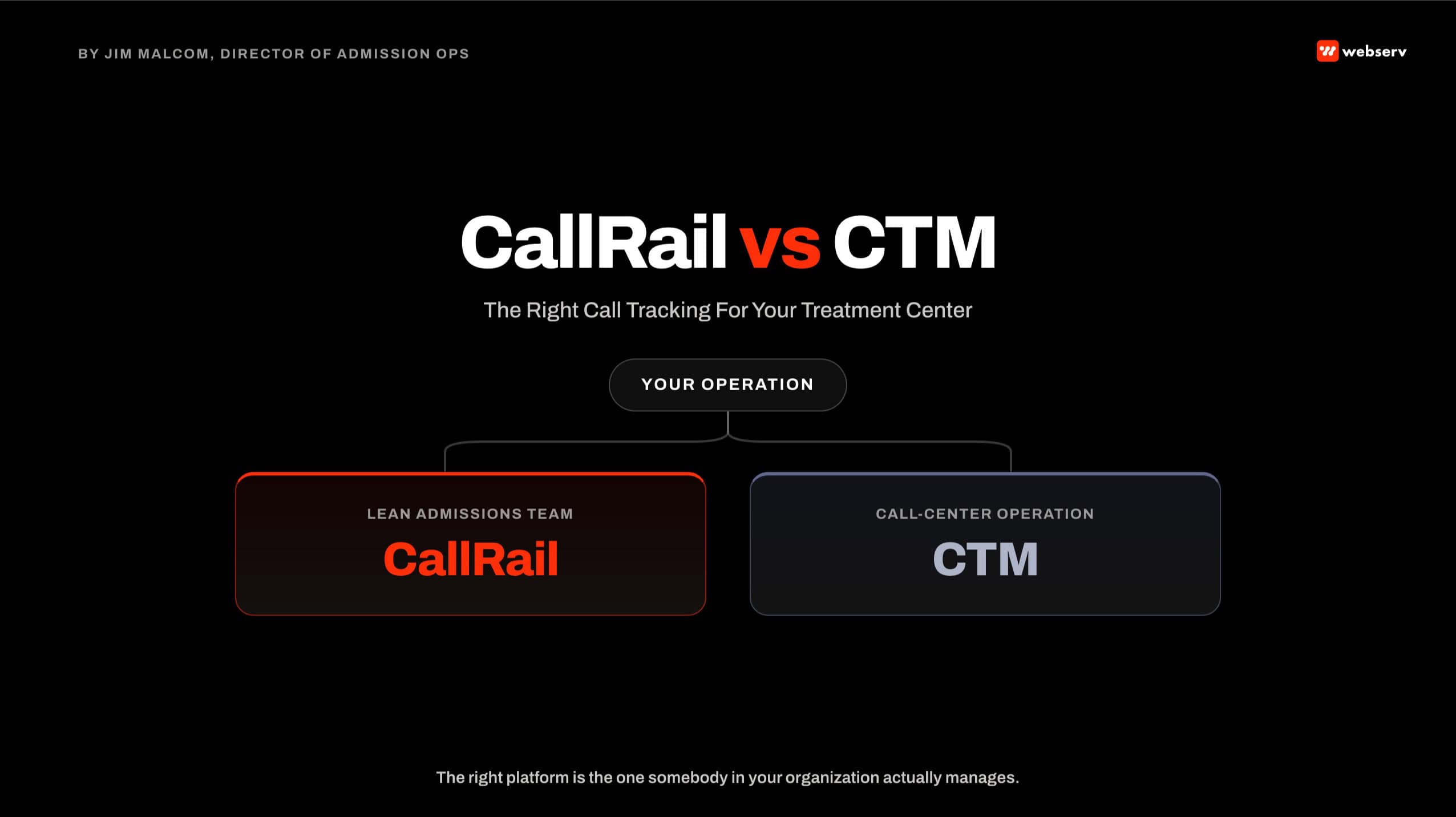
The first question I ask a treatment center operator on our discovery call is usually the same. CallRail or CTM. Their answer tells me more about how they run their admissions operations than most operators realize.
The answer isn’t a preference. It’s a diagnostic. CallRail and Call Tracking Metrics are both good products. They fit different treatment centers.
Picking the wrong one for your operation costs you attribution accuracy on the front end and admissions coordinator time on the back end. Picking the right one saves both.
This is a comparison for treatment center operators either standing up call tracking for the first time or evaluating a switch. I have deployed both platforms across the book of clients we manage inside our admission operations program at Webserv. The same mistakes get repeated by operators who chose based on price or brand recognition instead of on how their admissions team actually works.
Key Takeaways
- CallRail is the right call for smaller treatment centers, single-facility operations, and organizations where one or two admissions coordinators take calls on their cell phones. It is cost-effective and user-friendly. Most operators can run it themselves.
- CTM (Call Tracking Metrics) is the right call for treatment centers running a real call center with multiple agents, heavy paid media spend, and the need for enterprise-grade attribution and softphone functionality. It requires someone in your organization who can manage it. It took me five years to master every nook and cranny of the platform.
- Pricing tells part of the story. CTM’s sales-engaged tier starts around $350 a month. CallRail is cheaper for the same base functionality. The savings evaporate if you outgrow CallRail and have to migrate mid-year.
- The mistake most operators make is not picking the wrong platform. It is failing to assign an owner inside the organization who is responsible for configuration and reporting. Both platforms fail without an owner.
- Trevor’s frame for the two platforms: CallRail is Apple, CTM is Windows. CallRail is easier out of the box. CTM is more customizable and more powerful if you know what to do with it. The trade-off between simplicity and depth is real, and it should drive the decision.
The Discovery Question Reveals the Operation
When an operator answers “CallRail” fast, they usually run a lean setup. One or two coordinators, cell phones, light paid spend, cost-conscious. They picked the tool that fit their scale, and it works.
When an operator answers “CTM” fast, they usually run a call center. Multiple agents, heavy paid media, they need attribution that ties every ring back to a campaign source. They picked the enterprise-grade tool and are willing to pay for the depth.
When an operator can’t answer, or answers “we’re not sure what we use,” that is the actual diagnostic. It means nobody in the organization owns the call tracking.
The platform is running, calls are being tracked somewhere, but no one is looking at the data. That is the problem I fix on the first call, regardless of which platform is deployed.
The best call tracking platform is the one somebody in your organization actually manages. CTM is a superior product to CallRail, period. But most treatment centers do not need superior. They need a tool an admissions coordinator can pull a report from in ninety seconds. That is what CallRail does.
Jim Malcom, Director of Admission Ops, Webserv
Where CallRail Wins
DEFINITION
Call Tracking
The practice of assigning unique phone numbers to marketing channels (paid search campaigns, organic listings, print ads, referral sources) so that every inbound call routes back to a source. In treatment centers, call tracking is what ties marketing spend to admitted patients.
CallRail is built for scale that most treatment centers actually operate at. Not enterprise call centers. Small teams, single facilities, admissions coordinators answering on their cell phones.
The specific scenarios where CallRail is the right call:
- One or two admissions coordinators. CallRail’s lead center works cleanly for small teams. Coordinators can answer on their cell phones, calls route reliably, and reporting is legible without a specialist.
- Light to moderate paid media spend. If you are running under $30,000 a month in paid search and paid social combined, CallRail’s tracking depth is enough. You are not going to hit the ceiling of what it can measure.
- Single facility or small multi-facility. CallRail handles this cleanly. The complexity scales down predictably.
- Cost-conscious operations. CallRail is materially cheaper than CTM for the same base functionality. If the budget matters (and it always matters at smaller centers), CallRail is the right call.
- You do not have a dedicated person to manage the platform. CallRail is user-friendly enough that an admissions coordinator or operations manager can own it part-time. CTM is not.
Where CTM Wins
DEFINITION
Softphone
A software-based phone system that lets admissions coordinators take, transfer, and record calls directly from their computer. CTM’s softphone is more capable than CallRail’s lead center for call-center-style operations. CallRail routes calls to cell phones cleanly; CTM handles multi-agent softphone workflows.
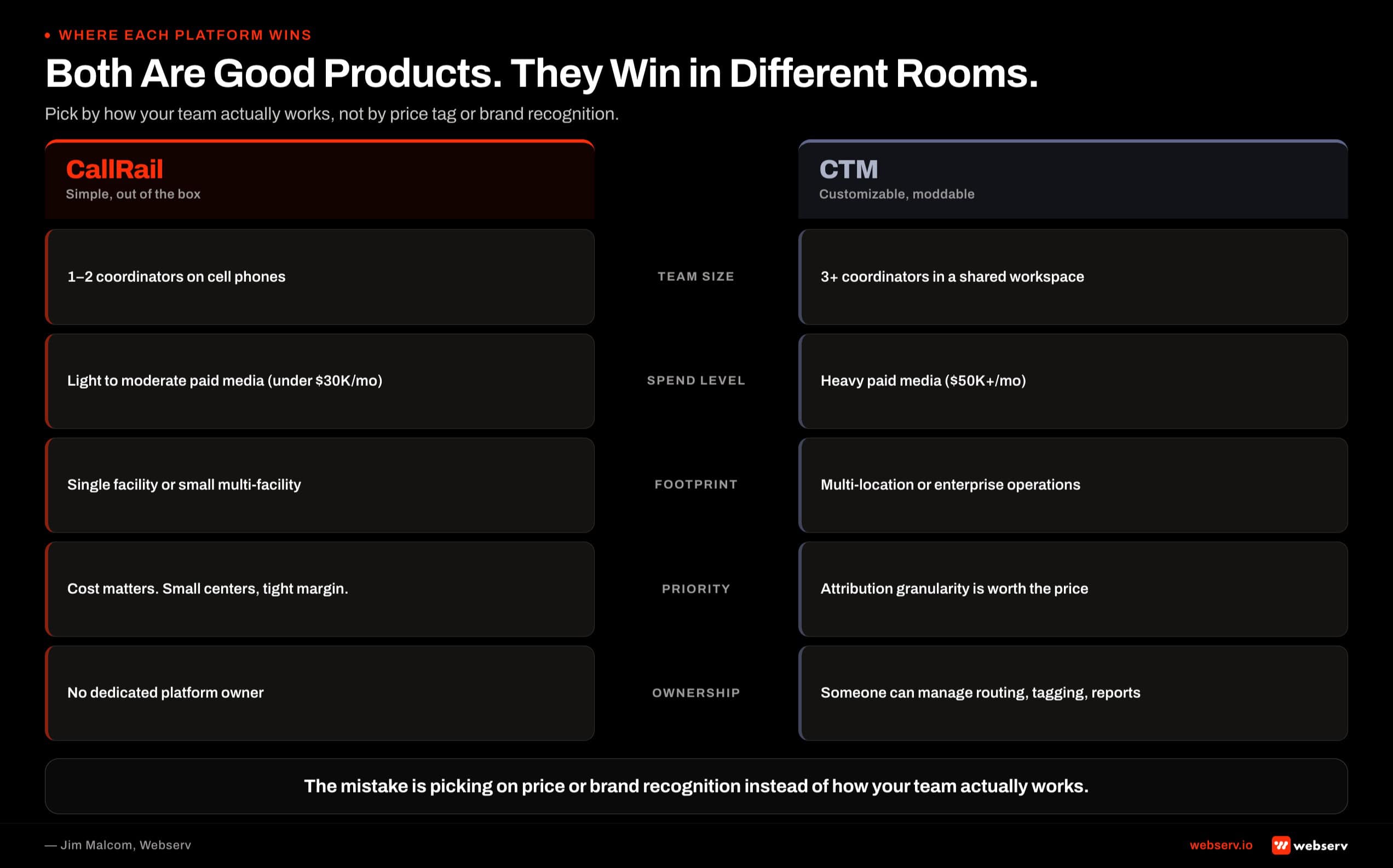 Side-by-side comparison of five scenarios where CallRail is the right call tracking platform for treatment centers versus five scenarios where CTM is the right call.
CTM’s ceiling is materially higher. It is built for treatment centers running a real call center operation.
The specific scenarios where CTM is the right call:
- A real call center with multiple agents. CTM’s softphone handles this cleanly. Multi-agent queues, call transfer between coordinators, whisper prompts, tagging, recording. CallRail’s lead center is not built for this scale.
- Heavy paid media spend. Once you are running $50,000 a month or more across paid search and paid social, CTM’s attribution granularity starts paying for itself. You will make decisions off the data that CallRail cannot surface as cleanly.
- Multi-location or enterprise-scale operations. CTM handles multi-facility complexity better. If you run three or more programs and need attribution segmented by facility, CTM is the tool.
- You have someone in your organization who can manage it. This is the non-negotiable. CTM requires someone who understands routing logic, tagging conventions, and reporting workflow. Without that person, the platform does not deliver.
CTM HAS REAL DEPTH, AND DEPTH COSTS TIME
It took me five years to fully understand every nook and cranny of CTM, and they keep rolling out new features. It is not a platform an operator can figure out over a weekend. Budget for the manager time before you budget for the license. If you cannot commit a person to it, do not deploy it.
The Apple / Windows Frame
Trevor Gage, our Director of Marketing, uses an analogy that lands for most operators. CallRail is Apple. CTM is Windows.
CallRail is the Apple experience. Nice, user-friendly, intuitive out of the box. Most people can use it without training. The interface is designed for the common case. What you give up is customizability. Under the hood, there is less you can tune, but for most treatment centers, that is fine.
CTM is the Windows experience. It is customizable, moddable, and powerful. You can make it do almost anything, but you pay for that power in complexity. Configuration takes longer. Training takes longer. And someone in your organization has to be the CTM person, because it will not manage itself.
The frame helps because it forces the honest question: does your operation need customizability, or does it need simplicity? Most treatment centers we work with need simplicity and pick CallRail. The ones running enterprise-scale admissions need customizability and pick CTM.
Pricing Reality
~$350/mo
CTM sales-engaged tier starting price
5 years
time to master CTM’s full feature set (my honest count)
Owner required
both platforms fail without a designated internal manager
CallRail’s entry-level pricing is materially lower than CTM. The exact numbers move, but the ratio holds: CallRail is the cheaper tool for the same base functionality.
The pricing gap gets smaller if you are actually using CTM’s advanced features. Multi-agent softphone, call scoring, advanced routing logic, sales-engaged workflows.
If you are running a real call center, CTM’s cost is justified by what it enables. If you are running a lean operation, the CTM cost is money that would have been better spent on the admissions team itself.
The pricing gap gets bigger if you outgrow CallRail and migrate to CTM mid-year. Migration is not free. Attribution history does not fully port. Coordinator training has to be redone. Plan the platform choice for where the operation will be in twelve months, not where it is today.
The Configuration Mistakes That Sink Both Platforms
WHAT WORKING CALL TRACKING LOOKS LIKE
- One person in the organization owns the platform and is accountable for reports
- Numbers are provisioned by source (paid search, paid social, organic, referral, print)
- Call recordings are on for admissions QA and coaching, with proper 42 CFR Part 2 handling
- Integration with the CRM captures source through the full funnel to admit
- Weekly review cadence with the operator or admissions leader
WHAT BROKEN CALL TRACKING LOOKS LIKE
- Nobody owns it; the platform is technically deployed but nobody looks at the data
- One generic tracking number captures everything; source attribution is impossible
- Recordings are off, or on with no compliance review, or on and nobody listens to them
- Call tracking data lives in a silo; admits never trace back to source campaigns
- Set-and-forget deployment; nobody looks until something breaks
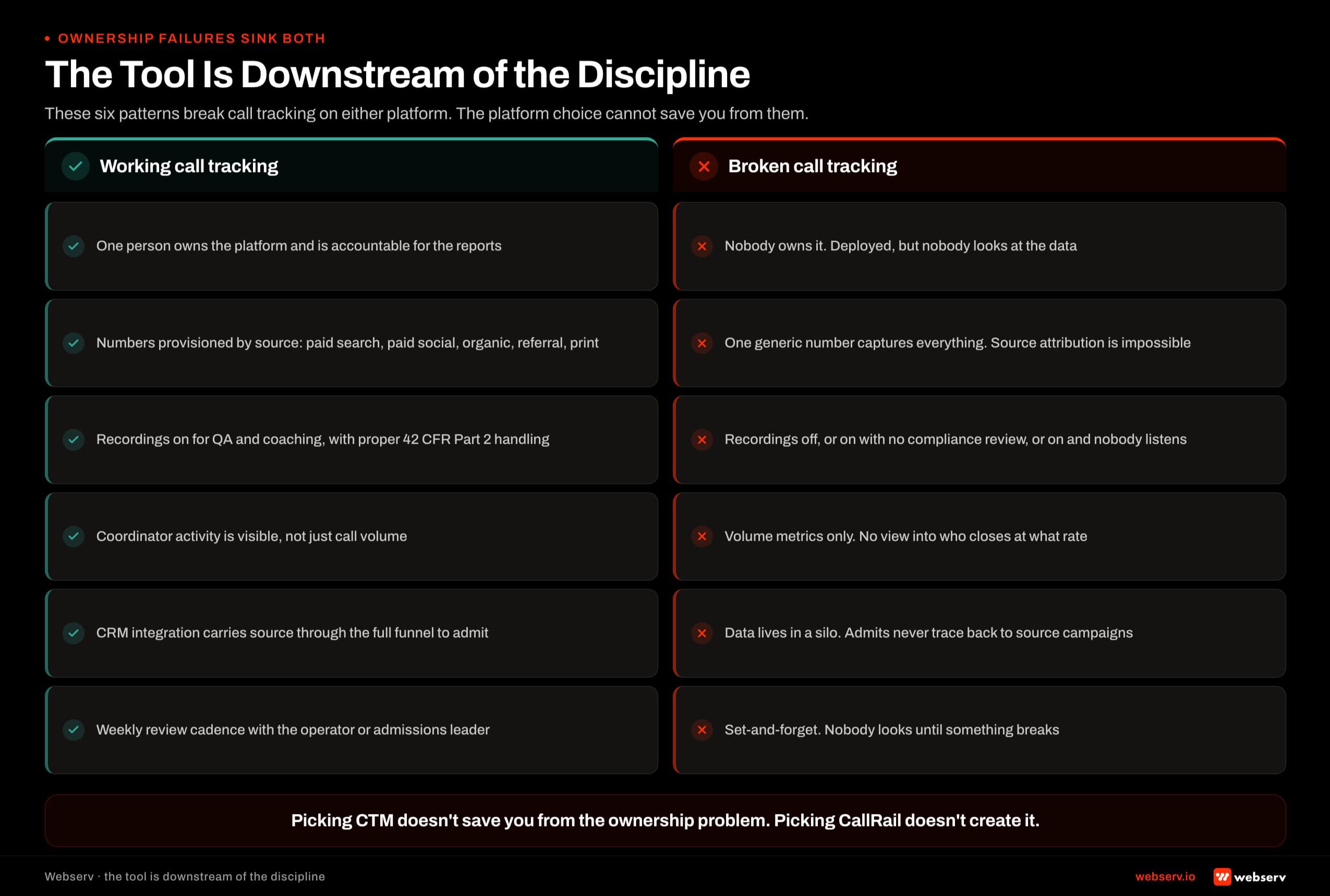 Six side-by-side comparisons of what working call tracking looks like versus what broken call tracking looks like at treatment centers, showing that ownership problems sink both CallRail and CTM equally.
Every one of these failures happens on both platforms with equal frequency. Picking CTM does not save you from the ownership problem. Picking CallRail does not create it. The tool is downstream of the discipline.
When to Actually Pick Which
The decision tree I use with operators:
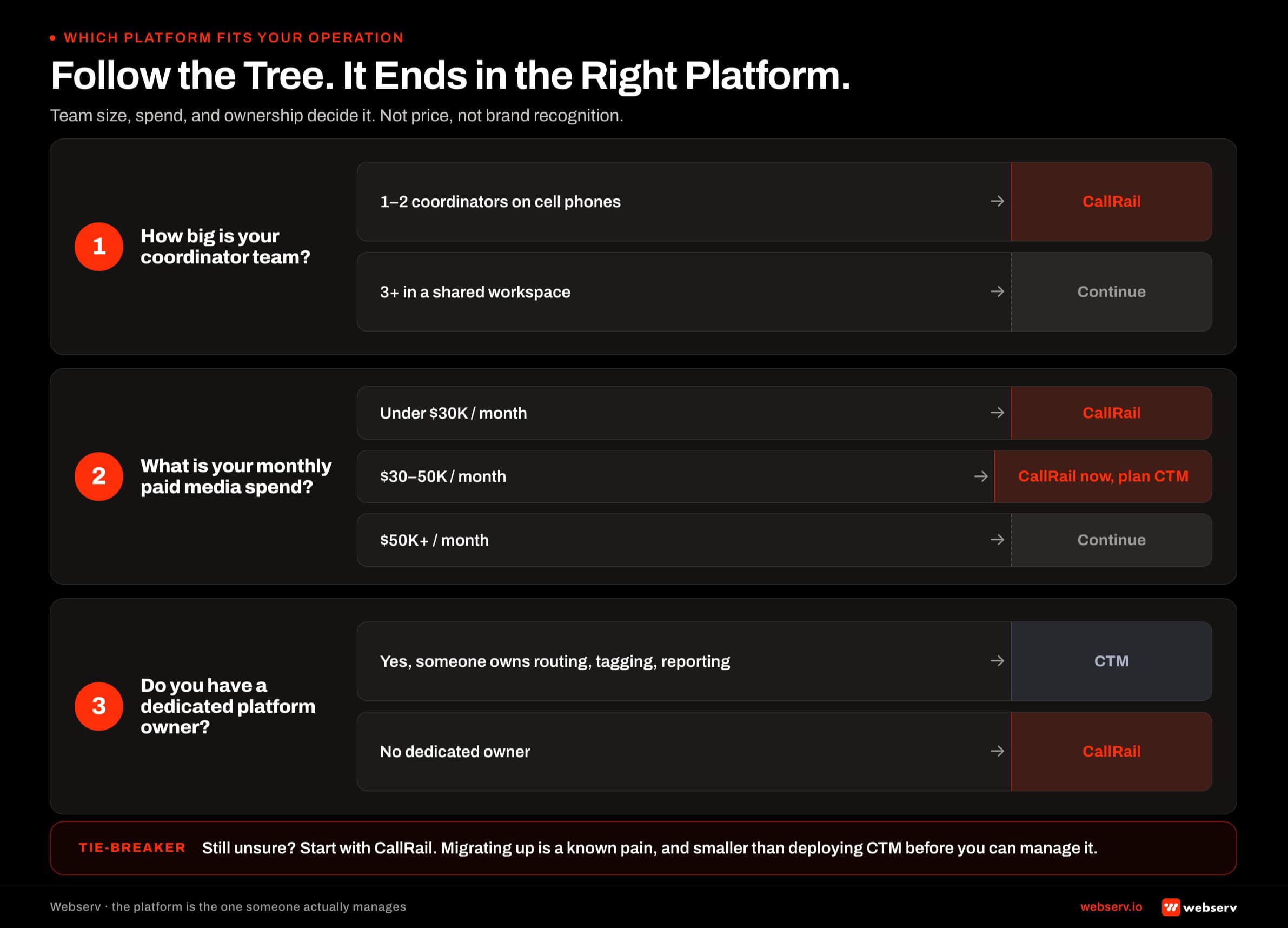 Decision tree for treatment center operators choosing between CallRail and CTM call tracking, based on team size, paid media spend, and whether a dedicated platform owner exists.
- If you have one or two admissions coordinators on cell phones, run under $30,000/month in paid media, and do not have a dedicated ops or marketing person to own the platform: CallRail. This is roughly two-thirds of the treatment centers I audit. CallRail is the correct answer for most operators.
- If you have three or more coordinators working from a shared workspace or centralized call center, run $50,000/month or more in paid media, and have a person in your organization who can own the platform: CTM. This is the enterprise-scale answer, and it is a smaller share of the market.
- If you are in between (two coordinators, a real ad budget, growing toward a call center): CallRail for now, plan the migration to CTM at the point you hire your third coordinator or cross $50,000 a month in paid spend.
- If you are still not sure: start with CallRail. The migration up to CTM is a known pain, but it is a smaller pain than deploying CTM before you can actually manage it. The reverse migration (CTM down to CallRail) is even worse.
THE HONEST TAKE
CTM is a superior product to CallRail, period. That does not mean it is the right product for most treatment centers. Most operators can use CallRail and get everything they need out of it. I am not going to sit here and pretend CTM is something special for the operator running a two-person admissions team. It is really not.
The strongest advice I can give a treatment center evaluating call tracking today is that the platform is downstream of two more important decisions. Who owns the platform inside your organization. And whether your admissions team is set up to make use of what the platform surfaces.
If those two are settled, either platform will work. If they are not, neither will. Book an intro meeting if you want to walk your setup with our team live.
Frequently Asked Questions
Can we switch from CallRail to CTM later if we outgrow it?
Yes, but the migration is not free. Attribution history is the hardest part. Historical calls stay in CallRail; the new platform starts fresh. You lose the year-over-year comparisons for the first twelve months on the new tool.
Coordinator training has to be redone. If your admissions team is comfortable in CallRail’s lead center, they will need three to four weeks to become comfortable in CTM’s softphone. Productivity dips during that window.
The migration works if you plan it for a slower month in your admit cycle and if you assign one person to own the transition from day one. Do not attempt it during a growth push.
Do we need call recording, and does it change the platform choice?
Yes, most treatment centers should have call recording on. It is the single most useful tool for admissions coaching and quality assurance. Both CallRail and CTM support recording.
The platform choice does not change based on recording alone. What changes is whether you have the 42 CFR Part 2 handling in place. Recording addiction treatment calls without proper patient privacy compliance is a compliance risk.
42 CFR Part 2 governs the confidentiality of substance use disorder patient records per SAMHSA, and the 2024 Final Rule updated the framework materially through the Federal Register. Get the legal and compliance side settled before you turn recording on, regardless of platform.
The trade-off is that recordings only help if someone listens to them. If your admissions leader is not going to review three to five calls per coordinator per week, recording is a data pile nobody uses. Own the review cadence before you own the recording feature.
Which platform integrates better with our CRM?
Both platforms integrate with the major admissions CRMs. CallRail integrates cleanly with Dazos, KIPU, Salesforce, and HubSpot. CTM integrates with the same platforms and adds deeper API access if you need custom workflows.
The integration difference matters at scale. If you are running high call volume through a multi-agent call center and pushing attribution through to admit-level reporting, CTM’s integration depth is worth the cost. If you are running a two-person team and need calls to log against contacts in the CRM, CallRail handles it.
The honest observation is that the integration is only as good as the CRM configuration underneath it. If your CRM is set up badly, the platform integration will not save you.
How much should call tracking cost as a percentage of our marketing spend?
Call tracking should run between one and three percent of your total paid media spend. If you are spending $30,000 a month on paid search and paid social, expect $300 to $900 a month on call tracking depending on platform and features. If you are spending $150,000 a month, expect $1,500 to $4,500.
Under that range means you are probably underbuying and missing attribution. Over that range means the platform is oversized for the operation, or you are paying for features you are not using.
The exception is when call tracking is doing double-duty as your call center platform (CTM’s sales-engaged tier). At that point, it is not just call tracking; it is your softphone and call management system, and the cost profile is different.
Jim Malcom is the Director of Admission Ops at Webserv, a digital marketing agency for treatment centers.