Google’s own help center says that discrepancies of up to 20% between Google Ads and Google Analytics conversion data are expected, because the two use different attribution models. And that’s two Google products measuring the same website.
Put Google Ads, Meta Ads Manager, and an admissions CRM side by side, and the gap can be wider. Ads Manager reports one number of leads, Google reports another, and the CRM shows fewer inquiries than either and far fewer admits.
That gap isn’t always a tracking failure. Much of it comes from how each platform counts, dates, and models conversions. Knowing which part of the gap is structural and which part is fixable is what lets a treatment center trust its cost per admit.
This piece covers the main reasons platform numbers and CRM numbers differ, how to measure the gap consistently, the settings and processes that close the fixable part, and a monthly reconciliation routine.
It’s part of the measurement work in our admission ops and attribution practice, and it builds on the complete guide to attribution for treatment centers.
Key Takeaways
- Google Ads reports conversions against the date of the ad interaction, not the date of the conversion, while a CRM usually records the inquiry on the day it happened. Comparing the two by month mixes different days.
- Google Ads defaults website conversion actions to count every conversion per click. For leads, Google recommends counting one, since usually only one lead per click adds value.
- Both Google and Meta include modeled conversions in their reported numbers, estimated for users whose activity can’t be observed directly.
- Attribution windows differ. Google’s default click-through window is 30 days; Meta counts within one or seven days of a click and one day of a view. Each platform can claim the same inquiry.
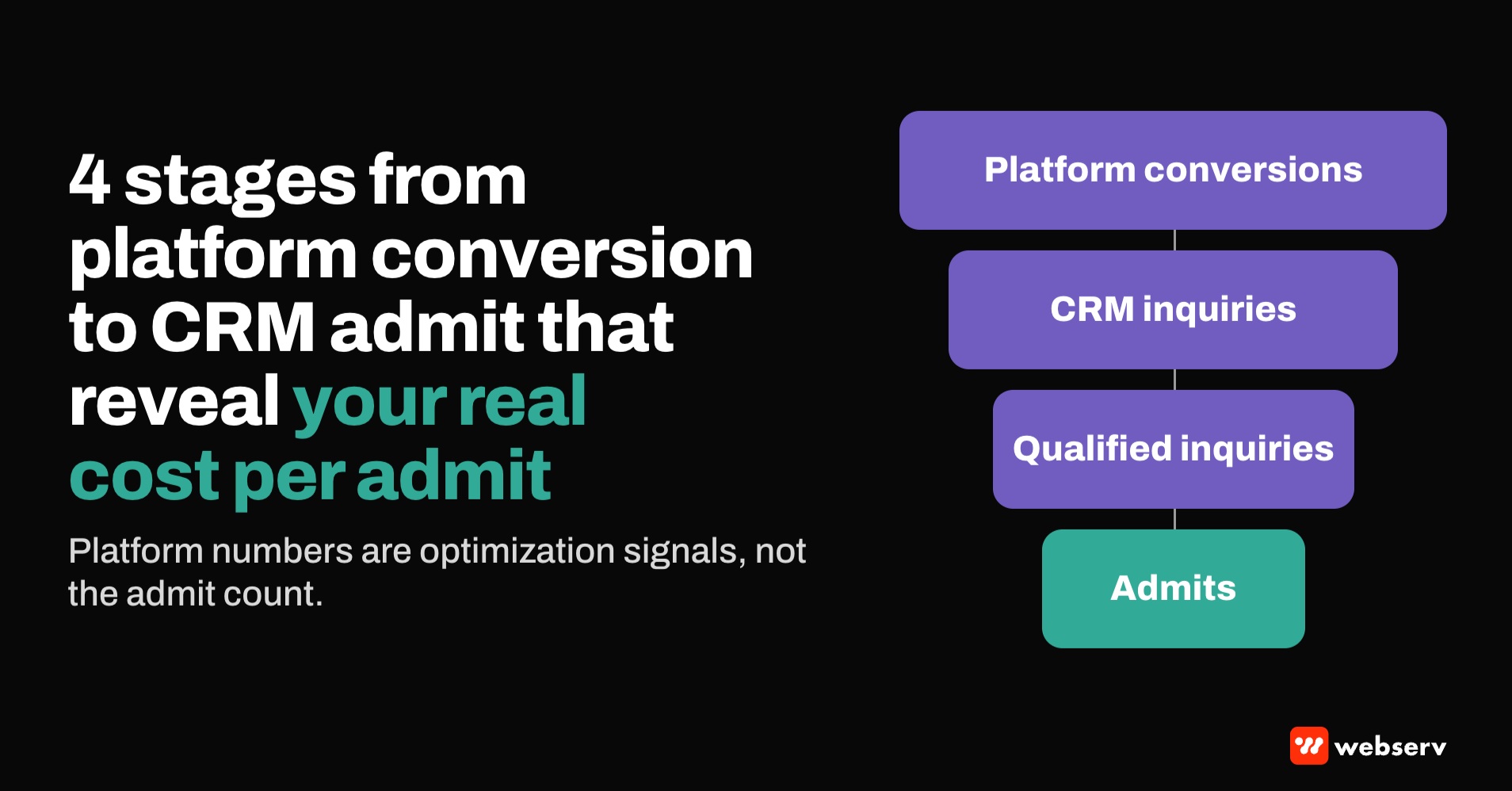
- The CRM is the system of record for inquiries and admits. Platform numbers are optimization signals, not the admit count.
- Reconcile monthly by platform, by the same date basis, from platform conversion to CRM inquiry to qualified lead to admit.
Why the numbers don’t match
Each of these reasons is documented by the platforms themselves. Most accounts have several at once.
| Cause | What the platform does | What the CRM does |
|---|---|---|
| Dates | Credits the conversion to the date of the ad click (Google) | Records the inquiry on the day it happens |
| Counting | Counts every conversion per click by default for website actions (Google) | Keeps one record per inquiry |
| Primary and secondary | Shows only primary actions in the Conversions column | Records every inquiry, whatever action produced it |
| Modeled conversions | Adds estimated conversions for activity it can’t observe | Counts only real inquiries |
| Windows and lag | Credits conversions within its click and view windows | Records inquiries when they arrive |
| Double-claiming | Google and Meta can each claim the same inquiry | One inquiry, one source |
| Call thresholds | Counts calls over the minimum length you set | Records the calls admissions logs |
| Lead quality | Counts every submitted lead | Shows which leads qualified and admitted |
Different dates. Google’s attribution documentation says Google Ads conversions are calculated based on the time of the click, not the time of the conversion. A family that clicks on March 30 and calls on April 2 is a March conversion in Google Ads and an April inquiry in the CRM.
Google also offers conversion columns reported by conversion time, which line up better with CRM dates.
Counting every conversion. Google’s count setting guide says “Every” is the default for website actions, and recommends “One” for leads. A family that submits a form twice after one click can show as two conversions and one CRM record.
Primary and secondary actions. Google’s conversion goals guide says only primary actions appear in the Conversions column and drive bidding; secondary actions are observation only and appear in All conversions. Comparing the wrong column to the CRM can double the gap.
Modeled conversions. Google says the Conversions column includes both modeled and observed conversions, and that modeled conversions can take up to five days to stabilize. Meta says its reporting may involve estimating conversions where data is missing or partial.
Windows and lag. Google’s default click-through conversion window is 30 days, adjustable up to 90. Meta’s attribution settings count conversions within one or seven days of a click, one day of a view, or one day of certain engagements. Recent periods keep filling in as late conversions arrive.
Both platforms claim the same inquiry. A family that saw a Meta ad and later clicked a Google search ad can be counted by both platforms. The CRM records one inquiry.
Call thresholds. Google counts call conversions when calls last at least a minimum length you set. A short wrong-number call can be a Google conversion and no CRM record, and a long call from a non-tracked number is the reverse.
Lead quality. Meta’s instant form types default to “More volume.” Its Higher intent option adds a review screen before submission. Forms built for volume produce more platform leads that never become real inquiries.
DEFINITION
Attribution gap. The difference between conversions an ad platform reports and inquiries and admits the CRM records for the same period. Part of it is structural, from dating, counting, windows, and modeling. Part of it is fixable, from settings, tracking breaks, spam, and inquiries that never get a source.
What the CRM can’t see
The gap runs in both directions. Some inquiries the platforms drive never get credited in the CRM.
- Calls without tracking numbers. A family that calls the number from a Business Profile or a saved contact arrives without a source. Our call tracking guide covers the setup that carries source into the call record.
- Cross-device journeys. A parent who clicks an ad on a phone and calls from a work phone looks like two different people.
- Blocked tracking. Meta notes its pixel may not fire if someone uses an ad blocker.
- Missing intake answers. If admissions doesn’t ask how the family heard about the facility, offline and word-of-mouth starts disappear.
Treatment center data rules add another limit. Meta’s data sharing restrictions can restrict mid- and lower-funnel events for sensitive data sources, so the platform may never receive the events that would let it report closer to admits. Our HIPAA-safe conversion tracking guide covers what can be sent.

How to measure the gap consistently
The gap is only useful if it’s measured the same way each month.
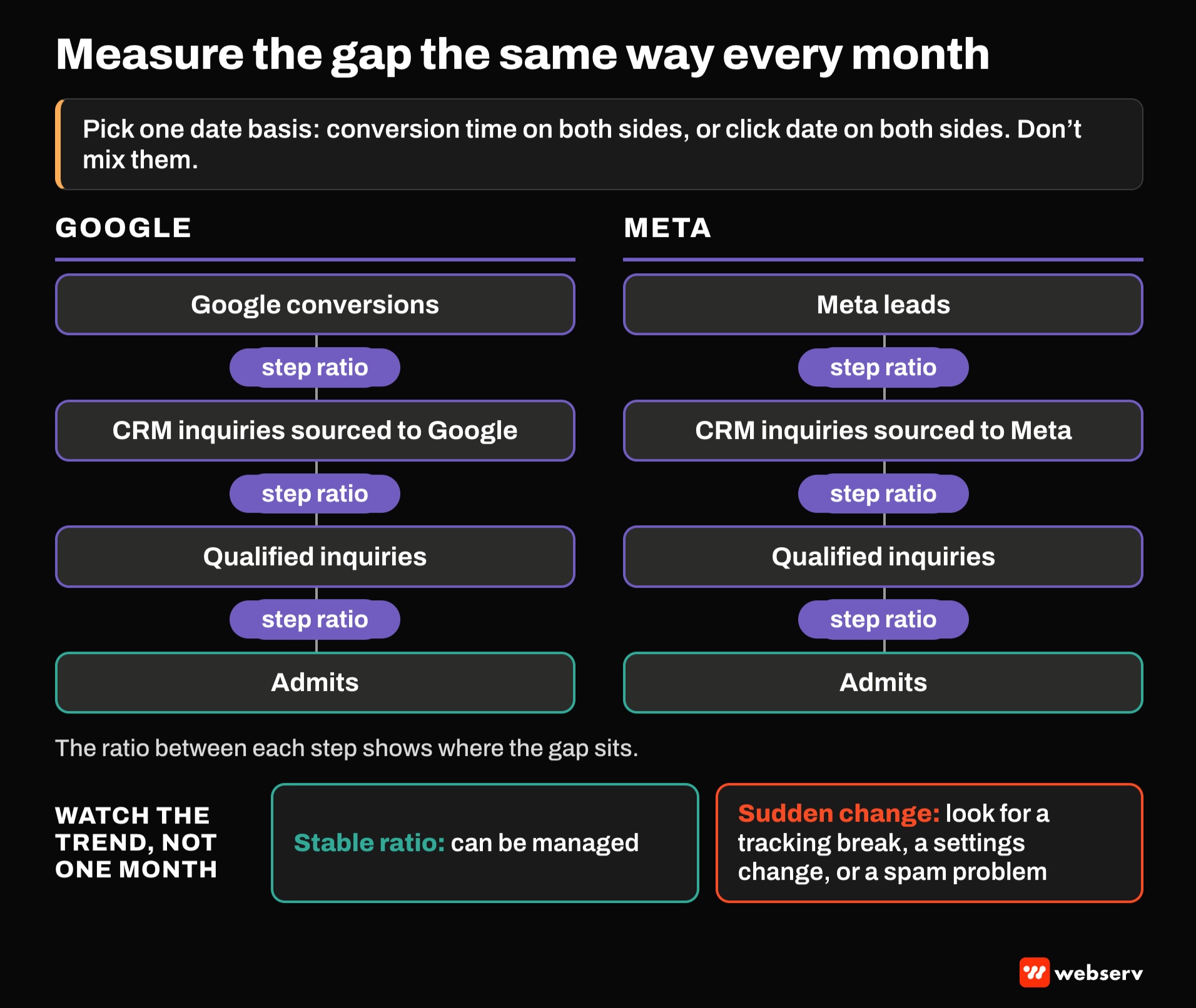
Pick one date basis. Use Google’s conversion-time columns when comparing to CRM inquiry dates, or compare by click date on both sides if the CRM stores the click date. Don’t mix them.
Compare by platform, not in total. Google conversions against CRM inquiries sourced to Google; Meta leads against CRM inquiries sourced to Meta.
Measure each step. Platform conversions, then CRM inquiries, then qualified inquiries, then admits. The ratio between each step tells you where the gap sits.
Watch the trend, not one month. A stable ratio can be managed. A ratio that changes suddenly points to a tracking break, a settings change, or a spam problem.
COMMON MISTAKE
Dividing spend by platform conversions and calling it cost per admit. Platform conversions include modeled, duplicate, and unqualified leads, dated to the ad interaction. None of that is an admit.
Cost per admit comes from CRM admits, sourced and dated consistently, divided by spend for the same period. Platform numbers are for optimizing campaigns inside each platform.
Closing the fixable part of the gap
Some of the gap comes from settings and processes you control.
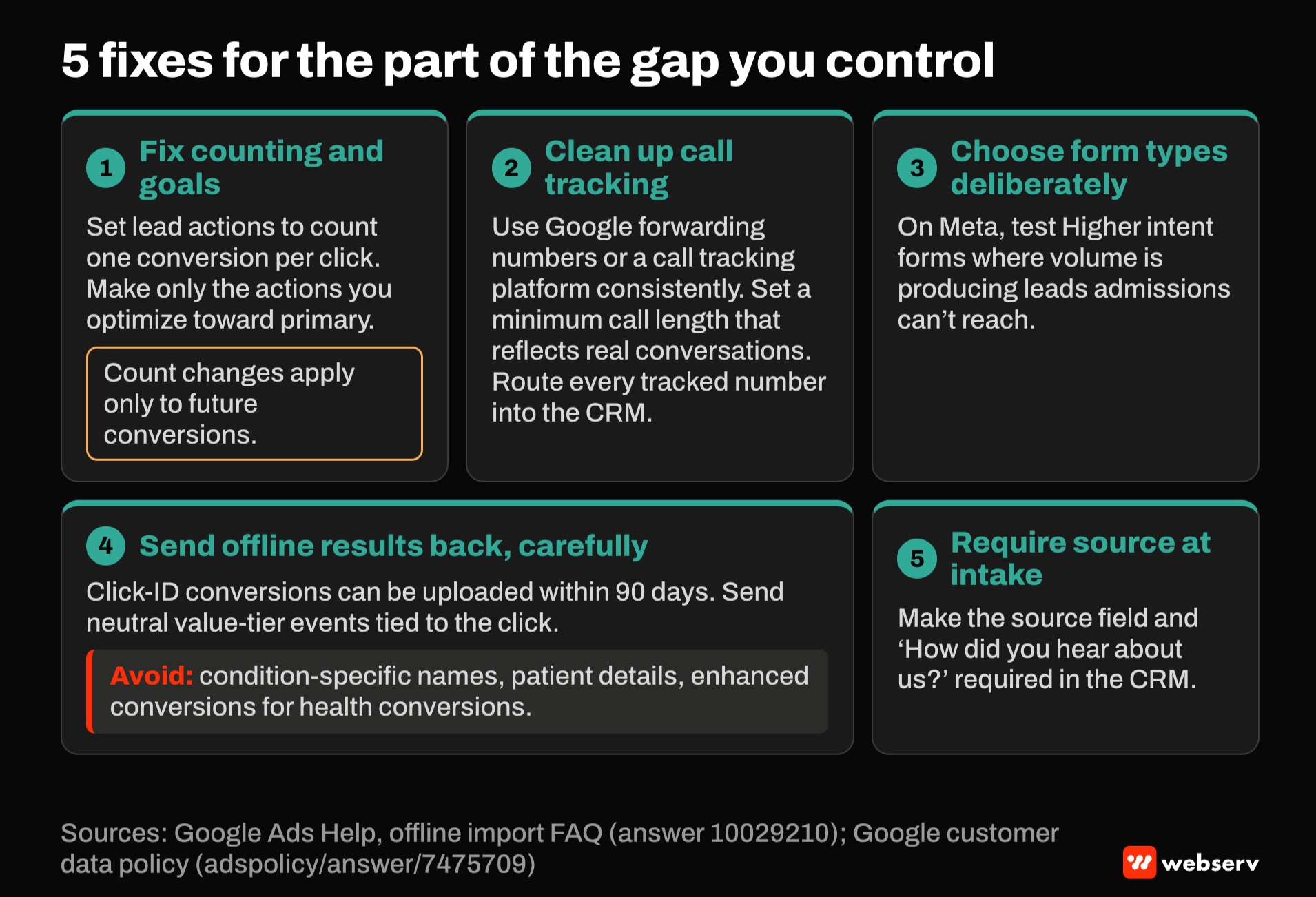
Fix counting and goals. Set lead actions to count one conversion per click, and confirm only the actions you want to optimize toward are primary. Google notes count changes apply only to future conversions.
Clean up call tracking. Use Google forwarding numbers or a call tracking platform consistently, set a minimum call length that reflects real conversations, and route every tracked number into the CRM.
Choose form types deliberately. On Meta, test Higher intent forms where volume is producing leads admissions can’t reach.
Send offline results back, carefully. Google’s offline import FAQ says conversions with a click ID can be uploaded within 90 days. For treatment centers, send neutral value-tier events tied to the click, not condition-specific names or patient details, and keep enhanced conversions off for health conversions per Google’s customer data policy.
Our Google Ads conversion tracking guide covers the setup.
Require source at intake. Make the source field and “how did you hear about us?” required in the CRM, so every inquiry has an answer even when tracking missed it.
A monthly reconciliation routine
Six steps, once a month.
Export platform data
Export platform data by conversion time from Google Ads and by the same date basis from Meta, for primary lead actions only.
Export CRM inquiries
Export CRM inquiries for the same period, with source, qualification status, and admit status.
Match by platform
Match by platform. Build a simple table: platform conversions, CRM inquiries, qualified inquiries, admits.
Calculate the ratios
Calculate the ratios and compare them with the last three months.
Investigate changes
Investigate changes. A sudden shift often traces to a settings change, a broken tag, a new form, or spam.
Report cost per admit from the CRM
Report cost per admit from the CRM, with platform numbers shown separately as campaign signals.
Where this fits
Reconciliation is the check that keeps the rest of the measurement stack honest. For lead-level attribution in the CRM, see our ROI and attribution playbook, and for using cost per admit in budget decisions, our guide on lowering cost per admit without cutting ad budget. For choosing tools, see our list of top attribution tools for treatment centers, and for how credit is assigned, our guide to first-touch vs last-touch attribution. For channel-level budget questions, see our guide to marketing-mix modeling for treatment centers.
OPERATOR INSIGHT
Keep a change log next to the reconciliation: every settings change, new form, tracking update, and campaign launch, with dates. When a ratio moves, the log often explains it quickly.
Google notes that conversion data can take up to seven days to fully appear after significant changes. The change log also keeps a team from reacting to incomplete data.
For improving the share of visits that become inquiries, see our complete guide to conversion rate optimization for rehab marketing.
For platform setup, see the Google Ads playbook and the Meta Ads playbook. For how measurement fits the rest of your marketing, see the complete guide to behavioral health marketing. If you want a second look at your numbers, book an intro meeting.
Frequently Asked Questions
Why don’t Google Ads conversions match our CRM?
Several documented reasons. Google Ads dates conversions to the ad interaction, may count every conversion per click, includes modeled conversions, and can credit conversions within a 30-day window by default.
The CRM usually records inquiries on the day they happen, once per person.
Compare Google’s conversion-time columns to CRM inquiries sourced to Google, for primary lead actions only.
Why do Meta and Google both claim the same lead?
Each platform credits conversions within its own attribution windows, without knowing about the other’s ads.
A family that saw a Meta ad and later clicked a Google ad can count in both.
The CRM, with one record per inquiry and a captured source, is the tie-breaker.
Should we calculate cost per admit from platform conversions?
No. Platform conversions include modeled, duplicate, and unqualified leads, and they’re dated to the ad interaction.
Calculate cost per admit from CRM admits for a period, divided by spend for the same period.
Use platform conversions to optimize campaigns within each platform.
How big should the gap be?
There’s no standard figure for treatment centers. Google says discrepancies of up to 20% between Google Ads and Google Analytics are expected, and the gap to a CRM can be wider because of lead quality and qualification.
What matters is a stable, explained ratio.
Track the ratio each month, and investigate sudden changes.
Can we send admits back to Google Ads?
Google allows uploading conversions tied to a click ID within 90 days of the click.
For treatment centers, send neutral value-tier events rather than condition-specific names or patient details, and keep enhanced conversions off for health conversions, which Google’s customer data policy restricts.
Have counsel review the setup, and route events through a BAA-covered layer.
Keaton Nalle is the Director of Paid Admissions at Webserv, a digital marketing agency for treatment centers.