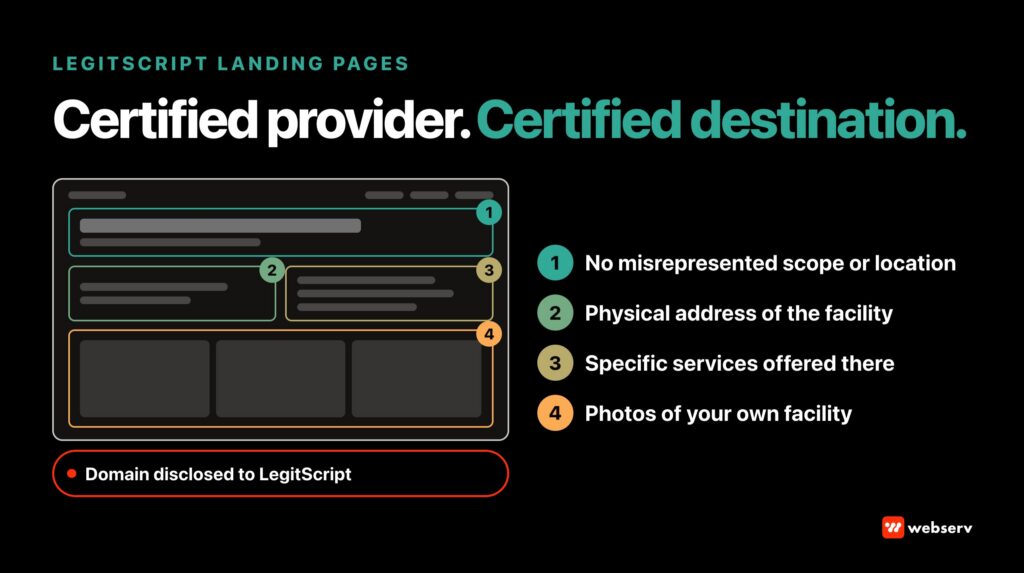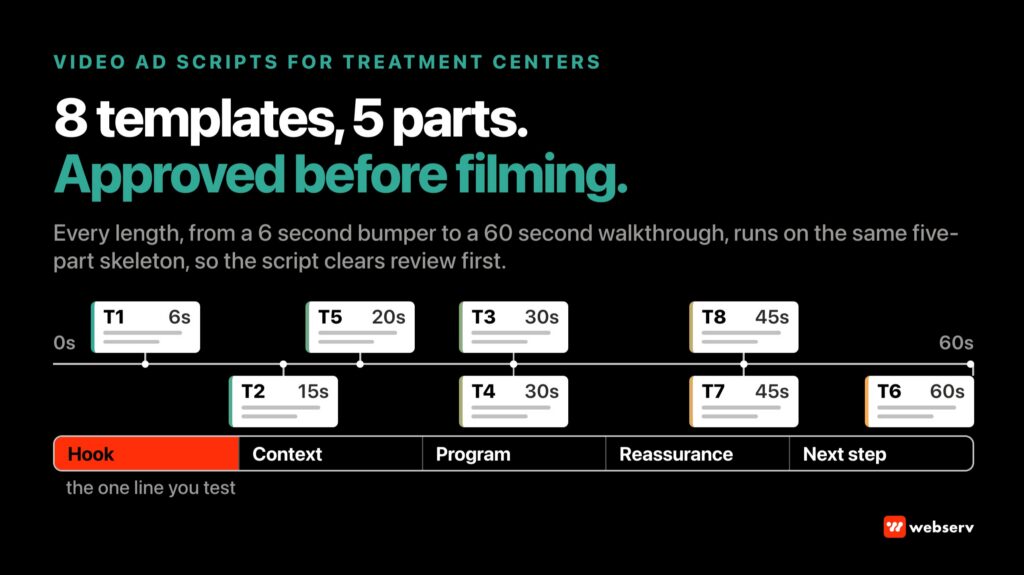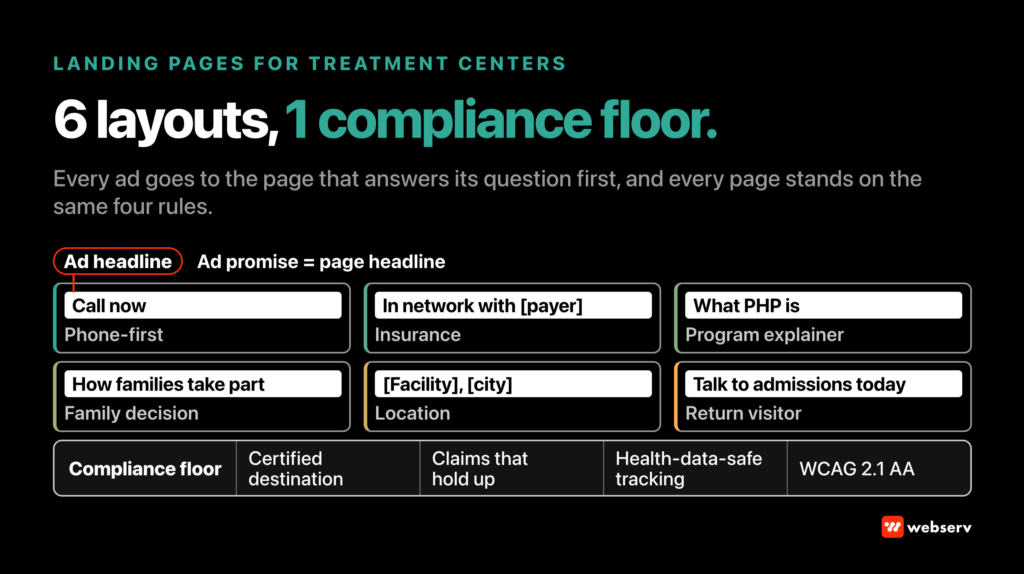
A treatment center we work with came to us last quarter with a familiar request. The operator was running $82,000 a month in paid media across Google and Meta. Click costs were in line with the behavioral health benchmark range.
Lead volume was healthy. Cost per admit was $9,400 and trending the wrong direction. The ask was straightforward: more keywords, more budget, more campaigns.
The actual issue was not the campaign side. The landing pages were converting paid clicks to qualified leads at 1.4 percent. That is well below what a strong behavioral health landing page converts at. The campaigns were doing their job. The landing pages were not.
We did not add a keyword. We did not raise the budget. We rebuilt the landing page hero, restructured the VOB form into a two-step flow, moved the phone number above the fold, and added a clinical-leadership trust strip.
Six weeks later the landing page conversion sat at 3.1 percent. Cost per admit dropped to $6,800.
1.4% → 3.1%
Landing page conversion rate after the 4-lever rebuild
$9,400 → $6,800
Cost per admit moved over the following six weeks
$0 added
No keyword expansion, no budget increase, no new campaigns
This is the load-bearing thing most treatment center operators get wrong about paid media. Budget and bidding are the easy levers, and they have ceilings. Conversion rate optimization is the multiplier that compounds across every other dollar in the program.
A facility doubling its landing page conversion does not double its admits; it cuts the cost of every admit roughly in half.
This guide is the long-form playbook we walk operators through inside our paid media program for treatment centers.
Eleven pillars covering the paid CRO math, the full click-to-admit funnel, landing page architecture for behavioral health, form versus phone CTA decisions, VOB UX, the Smart Bidding feedback loop, compliance constraints, testing methodology, mobile-first, page speed, and the failure modes most behavioral health facilities replicate by default.
Key Takeaways
- The math of paid CRO is multiplicative, not additive. A 50 percent lift on landing page conversion drops cost per admit by roughly 33 percent across the whole campaign. If every gate in the click-to-admit funnel improved by that same 50 percent, admit volume on identical spend would rise more than threefold, because the gains multiply.
- Behavioral health paid CRO is structurally different from generic SaaS or e-commerce CRO. The conversion is a phone call or a VOB submission, not a checkout. The audience is overwhelmingly mobile and overwhelmingly in crisis. Compliance constraints (LegitScript, Google healthcare policy, 42 CFR Part 2) shape what the page can and cannot say.
- Landing page architecture for rehab follows a different template than the standard B2B SaaS landing page. Phone above the fold, LOC-specific framing, real clinical leadership trust signals, accreditation strip, two-step VOB form, and zero “free guide” lead magnets. The standard playbook does not apply.
- Paid CRO interacts with Smart Bidding. Clean conversion signals from the landing page feed Google’s algorithm with the right training examples. Dirty signals (Medicaid calls tagged as wins, spam form fills counted as leads) compound across both the bidding and CRO sides of the program.
- The 90-day paid CRO sequence is hero and CTA architecture first, then VOB form flow, then social proof and compliance signal, then page speed, then test methodology. Reversing the order or testing everything in parallel produces 90 days of effort with no measurable lift.
Pillar 1: The Paid CRO Math (Why a Half-Point Lift Beats a Budget Increase)
Most operators evaluating paid media performance start with the wrong question.
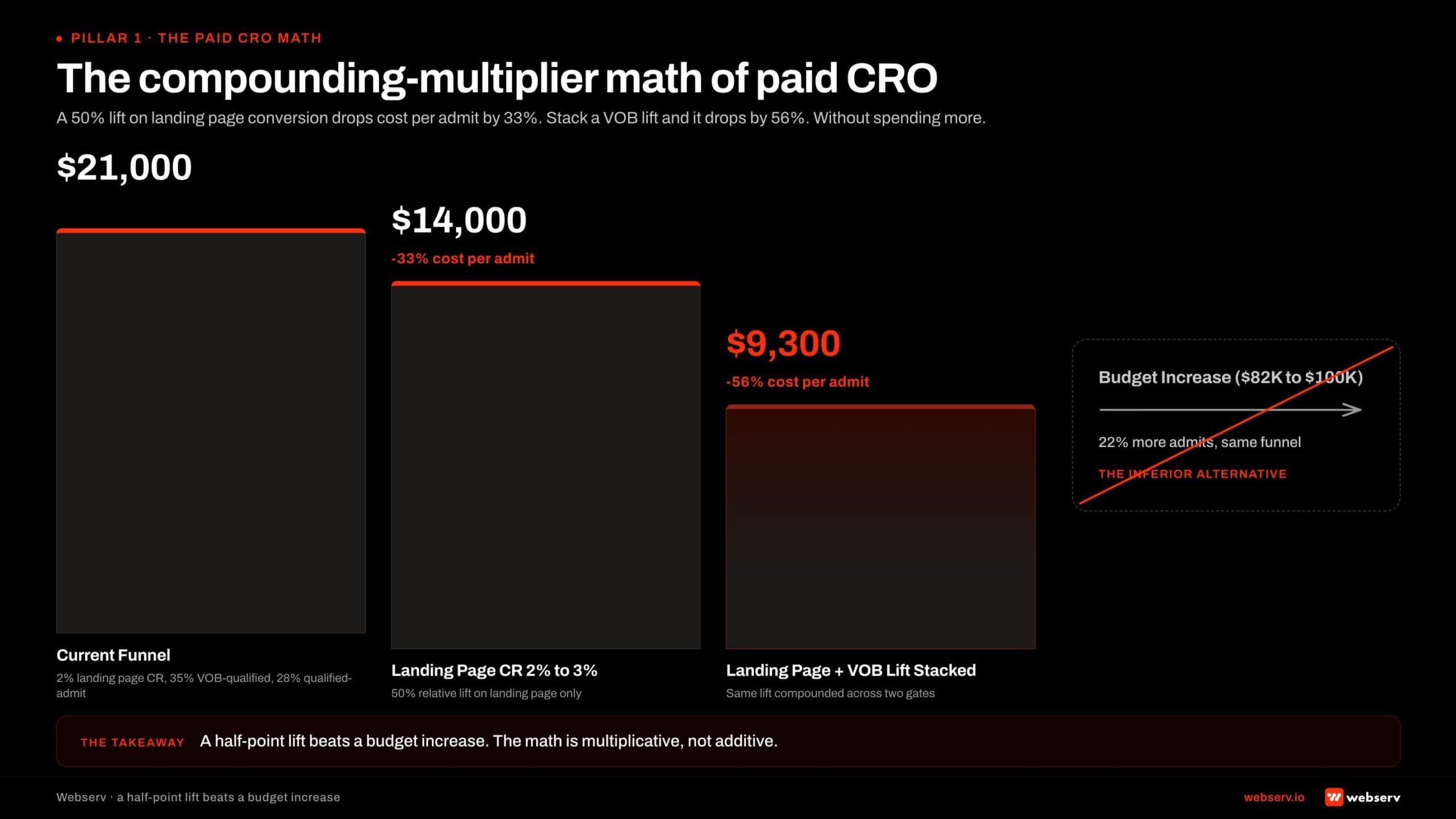 Three-bar comparison chart infographic titled ‘The compounding-multiplier math of paid CRO.’
The question is usually “what is our cost per click” or “what is our cost per lead.” The right question is “what is our cost per admit, and which step in the funnel between the click and the admit is producing the gap.”
The funnel for rehab paid media has four conversion gates. The click pays the cost per click. The click-to-form-or-call gate is the landing page conversion.
The form-or-call-to-qualified-lead gate is the VOB and intake assessment. The qualified-lead-to-admit gate is the admissions team and the clinical fit.
Each gate is a multiplier. A 2 percent landing page conversion compounded with a 35 percent VOB-to-qualified rate compounded with a 28 percent qualified-to-admit rate produces a 0.2 percent overall click-to-admit ratio.
At a $42 CPC, that math runs to a $21,000 cost per admit.
Moving the landing page conversion from 2 percent to 3 percent (a 50 percent relative lift) with the other two gates held constant drops cost per admit to about $14,000, a 33 percent reduction.
Moving the VOB-to-qualified rate by the same percentage at the same time stacks to roughly $9,500, a 55 percent reduction on the original baseline. Without a single dollar of additional spend.
This is the compounding-multiplier property of paid CRO that most facilities under-invest in. A budget increase from $82,000 to $100,000 produces at most about 22 percent more admits on the existing funnel performance, and usually less as incremental clicks get more expensive.
The same money invested into landing page rebuild plus VOB flow optimization plus admissions team scoring discipline works on the multiplier instead, so every gain stacks on the original $82,000.
The 9 ways to lower cost per admit without cutting your ad budget covers the broader funnel-optimization frame this CRO work lives inside. The piece you are reading is the deep version on the landing page and on-site CRO side specifically.
Pillar 2: The Click-to-Admit Funnel (And the Four Places Operators Lose Conversion)
Before pillar work begins, the operator and the agency need to agree on which gate is actually leaking conversion. The diagnostic step matters because the fixes are different for each gate.
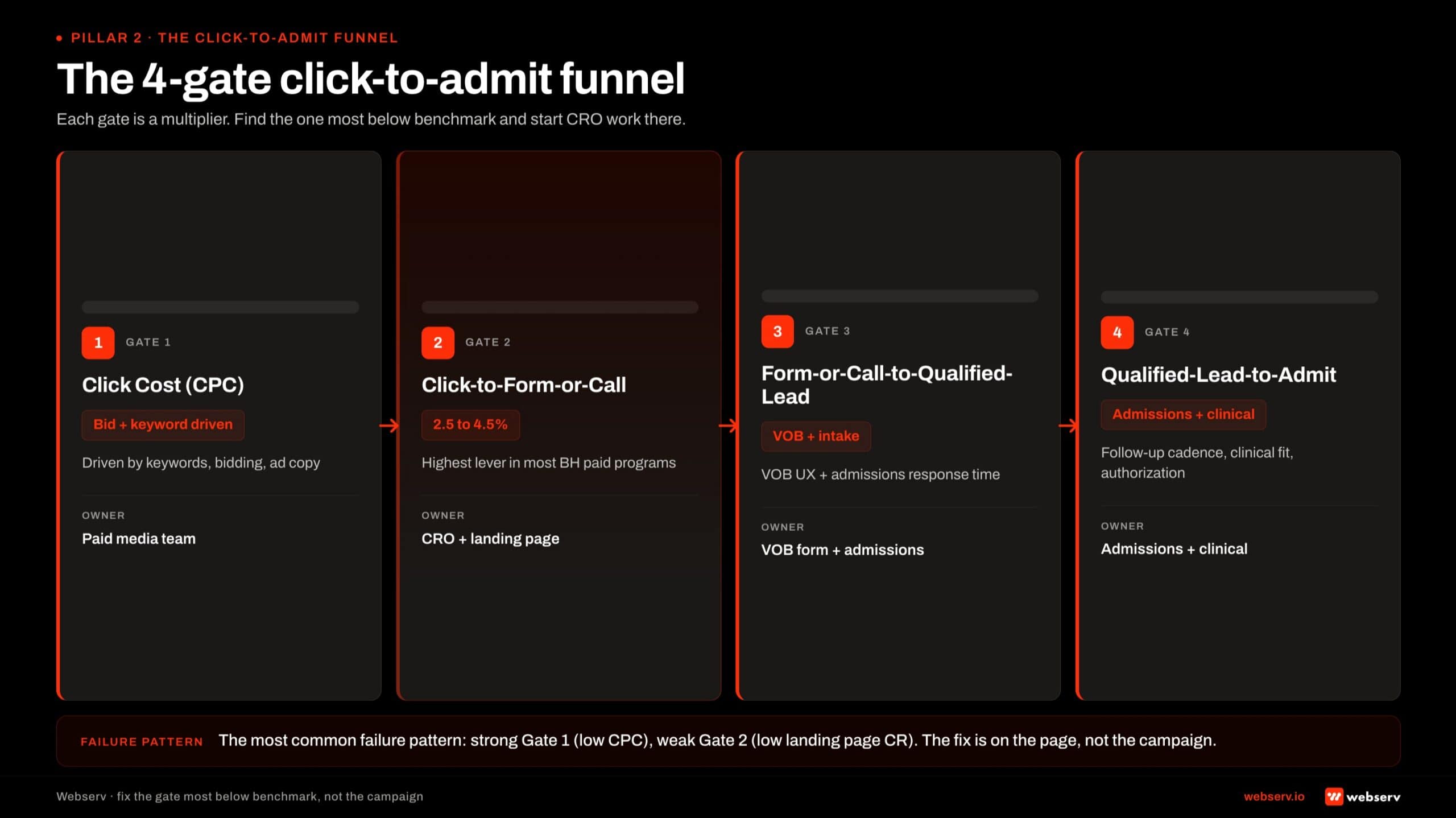 Horizontal 4-gate funnel diagnostic infographic titled ‘The 4-gate click-to-admit funnel.’
DEFINITION
Cost Per Click (CPC)
The price paid to Google or Meta each time a user clicks a paid ad. CPC is set by competitive bidding and is the first gate in the click-to-admit funnel, but it is outside the scope of pure CRO work — landing page optimization changes the gates below it.
Gate 1: Click cost (CPC). Driven by keyword targeting, audience segmentation, ad copy quality, and bidding strategy. Outside the scope of pure CRO, but the gate that operators most often try to fix first because it is the most visible number on the dashboard.
Gate 2: Click-to-form-or-call conversion (landing page CR). Driven by landing page architecture, mobile experience, page speed, CTA clarity, social proof, and compliance signal. This is the core CRO surface and the gate that produces the highest lever in most behavioral health paid programs.
Gate 3: Form-or-call-to-qualified-lead (VOB and intake). Driven by VOB form UX, admissions team response time, call-handling discipline, and clinical-fit screening. Partially a CRO surface (VOB form), partially an operations surface (admissions team).
Gate 4: Qualified-lead-to-admit (admissions and clinical). Driven by admissions follow-up cadence, clinical fit assessment, insurance authorization, and the family-member conversation cycle. Outside the CRO surface but tightly coupled to it; clean lead-quality signal from earlier gates makes this gate easier.
The diagnostic sequence: pull the conversion rate at each gate from analytics. Compare against the category benchmarks. Find the gate that is most below benchmark. Start CRO work there.
A program with strong Gate 1 (low CPC) and weak Gate 2 (low landing page CR) is the most common failure pattern we see. The fix is on the landing page, not the campaign.
Operators who add keywords or raise bids to address what is actually a Gate 2 problem make the cost-per-admit worse, not better.
Pillar 3: Landing Page Architecture for Behavioral Health
The landing page for paid rehab traffic is structurally different from the landing page for B2B SaaS, e-commerce, or generic services. The audience is in crisis or supporting someone in crisis.
The conversion is a phone call or a VOB form, not a free trial or a checkout. The trust threshold is higher than almost any other paid category.
Seven elements should sit on every paid landing page for treatment center marketing.
Above-the-fold phone number. Tap-to-call, large font, prominent on mobile. Behavioral health conversion happens on the call, not in the form. The phone number is the highest-converting CTA on the page and should be visible without scrolling.
LOC-specific headline. A landing page that targets detox traffic should have a detox headline. A landing page that targets PHP traffic should have a PHP headline.
The “we treat addiction” generic headline that tries to be everything to everyone converts worse than the LOC-specific page that matches the search intent the click came in on.
Above-the-fold VOB form or VOB CTA. For non-call traffic, the VOB form should be accessible above the fold or one click away.
The two-step VOB form (4 fields above the fold, 4 more after a “verify now” click) usually completes better than the single-step 8-field form, because the first commitment is small.
Real clinical leadership trust strip. Named clinical director or chief medical officer with credentials, headshot, and link to bio (the clinicians-as-AEO-moat framing covers why named-clinician credibility carries weight on the AI search side too, not just the on-page CRO).
Not a stock photo or a generic “expert team” claim.
The clinical leadership trust signal is one of the load-bearing elements that separates high-converting behavioral health landing pages from weak ones.
Accreditation and compliance strip. JCAHO, CARF, LegitScript, state licensure. Visible logos, not a footer-buried mention. The compliance signal is what tells the family member at 11 PM that the facility is not a fly-by-night operator.
Insurance-friendly framing. Plain language about insurance accepted. No outcome promises about coverage (Google healthcare policy forbids that). A “verify your insurance” CTA that routes to the VOB form.
Most facilities under-invest in the insurance section of the landing page; it is the single most-searched concern in behavioral health paid traffic.
One single CTA path. Resist the temptation to put 5 CTAs on the page. One primary CTA (phone or VOB), one secondary CTA (the other of the two), and no third or fourth options that dilute the conversion path.
The deeper teardown of landing page optimization for addiction treatment covers the element-by-element pattern in more detail, and the best landing page builders for rehab marketing campaigns is the tooling-side companion read.
Pillar 4: Form vs Phone vs Hybrid CTA (The BH-Specific Decision)
The single biggest CTA decision on a treatment center landing page is the relative prominence of form versus phone. The answer for behavioral health is “phone first, form second” for most paid traffic.
Behavioral health conversion is overwhelmingly phone-driven. The active-crisis caller wants to talk to a human in the next 5 minutes, not fill out a form and wait for a callback.
The family member at 11 PM is more likely to pick up the phone than to type into a contact form.
The phone-call conversion rate from paid clicks usually runs well ahead of the form-submission conversion rate on behavioral health paid programs.
When forms work: family-member off-hours traffic (when the admissions team is offline and a callback is acceptable), employer EAP referrals (where the caller wants documentation), and non-urgent informational queries (where the conversation has not yet reached the call-now urgency).
For these segments, a form that captures the inquiry without forcing a phone call right now is the right answer.
When phone works: active-crisis traffic (overwhelmingly the highest-converting paid segment), commercial-intent queries (“alcohol rehab near me,” “rehab covered by Anthem”), and any traffic landing on a page that already establishes the facility’s credibility before the form ask.
The hybrid that works for most operators: phone number above the fold and prominent, with a “or verify your insurance online” secondary CTA below the fold for off-hours and form-preference traffic. The hybrid captures the phone-converting audience without losing the form-preference audience.
What does not work: forms-only landing pages with no phone number visible, phone-only pages with no off-hours capture mechanism, and the “request a free guide” lead magnet pattern that some agencies still recommend for behavioral health.
The free-guide lead magnet converts poorly on rehab paid traffic. The phone-first hybrid converts far better on the same traffic.
For operators running paid social specifically, the platform-mix decision pairs tightly with the CTA decision; our Facebook vs Google Ads decision framework and 14 paid social strategies for sub-$20K budgets both cover the upstream targeting work that informs the right CTA for the page.
Pillar 5: Insurance Verification UX (The Highest-Stakes Form on the Site)
If the landing page conversion is the load-bearing CRO surface, the VOB form is the load-bearing element inside the landing page. Most treatment center sites have a VOB form that converts well below what it could.
Six rules separate VOB forms that convert from VOB forms that leak.
Field minimization above the fold. Four fields maximum on the first step: name, phone, insurance carrier, member ID. Everything else (group number, date of birth, address, presenting issue) belongs on the second step or a follow-up call.
Operators who require 12 fields up front lose a large share of starts to abandonment.
Two-step beats one-step. The first step is the low-commitment ask (4 fields, “verify your insurance”). The second step captures the remaining information after the user has committed to the action.
OPERATOR INSIGHT
Two-step VOB forms outperform one-step forms by 25 to 50 percent on completion rate across treatment center sites we have audited. The first step is the low-commitment ask (4 fields, "verify your insurance"). The second step captures the remaining information after the visitor has committed to the workflow.
The two-step pattern materially outperforms the single-step long form on every behavioral health paid program we have tested.
Real-time vs callback expectation. If the VOB happens in real time, say so explicitly (“verified in 5 minutes”). If it requires a callback, say that too (“a benefits specialist will call you back within the hour”).
The honesty about timing produces higher trust and lower abandonment than the generic “submit your information” framing.
Phone number co-located with the form. A “or call now” link sitting right next to the form gives the user the choice without forcing them through a form they would rather skip. The phone link absorbs the form-resisters and converts them on the call instead of losing them.
No insurance type filtering up front. Do not ask the user to pick “I have insurance” or “I do not have insurance” before the form starts. The screening filter feels like a screening filter and produces drop-off. Take all the form starts and screen on the back end.
Compliance language in the right tone. “We will verify your benefits and contact you to discuss your options” is honest and acceptable. “Our partners help thousands of patients access affordable treatment” is marketing copy that triggers compliance review and undermines trust. Plain language that respects the user wins.
The VOB form is where most paid CRO programs see their largest single-fix improvement. A clean two-step form with a phone alternative usually outperforms a 12-field single-step form on completion rate, with no other change required.
Compliance is part of the CRO. The trust signal is the conversion signal. Treatment centers that try to hide LegitScript, omit clinical leadership, or soften accreditation logos to look more “modern” routinely lose conversion the same page would otherwise produce.
Preston Powell, CEO of Webserv
Pillar 6: The Smart Bidding + CRO Feedback Loop
CRO does not happen in isolation from bidding. The two systems compound when conversion signals are clean and degrade together when signals are dirty.
Google’s Smart Bidding optimizes against the conversion signal the advertiser sends back, and the PMax variant in behavioral health is the most volatile of those campaign types to CRO and signal-hygiene changes.
Every lead conversion that fires to Google teaches the algorithm what a good lead looks like for the facility.
The landing page is one input to that signal; the call scoring, the form quality, the admissions follow-up are the other inputs.
Three interactions matter for CRO work specifically.
Test variant signals can confuse Smart Bidding short-term. When a new landing page variant goes live, the conversion rate often spikes or drops temporarily as the algorithm absorbs the new signal.
Operators who pull tests after 7 to 10 days based on this signal pull good tests. Wait 21 to 30 days before drawing conclusions on Smart Bidding-driven traffic.
Clean conversion signals make CRO improvements compound. A landing page that converts at 3 percent and feeds clean signals (real leads, scored quickly, with disqualifiers suppressed) produces better Smart Bidding optimization.
The same landing page converting at the same rate but feeding dirty signals (Medicaid calls counted as leads, spam form fills firing as conversions) produces less compound benefit.
Dirty signals upstream nullify CRO improvements. A landing page rebuild that produces a 50 percent lift in raw form fills produces zero ranking and bidding lift if those form fills are not real leads or are not getting tagged correctly downstream.
The deeper Google Ads strategy for behavioral health providers covers the call-scoring discipline that makes paid CRO improvements actually compound.
The implication for CRO work: build the test methodology in coordination with the admissions team and the campaign team. Pure CRO that ignores the bidding feedback loop produces short-term lift that does not stick.
CRO inside a clean signal environment produces compounding lift across both the landing page and the campaign.
Pillar 7: Compliance Constraints (LegitScript, Google Healthcare Policy, 42 CFR Part 2)
Behavioral health paid CRO operates inside three overlapping compliance frames. Each shapes what the landing page can say, what claims it can make, and what user data it can collect. Operators who treat compliance as a separate workstream from CRO produce pages that either fail review or convert poorly.
LegitScript certification. LegitScript is the gating certification for Google Ads, Meta, and most major paid platforms to accept addiction treatment advertising. The certification reviews the landing page in detail: hero claims, outcome language, insurance representations, accreditation displays, and the privacy and consent policies.
Treatment centers that try to soften the LegitScript logo placement, omit the certification marker, or hide compliance language to look more “modern” routinely lose ad approval or face suspension. The certification is not optional in the category.
Google healthcare advertising policy. Google’s ads policy for healthcare and medicines prohibits outcome promises, before-and-after testimonial framing, miracle-cure language, and ungated insurance coverage guarantees. The same policy governs Meta with platform-specific variants.
Operators who write landing page copy without reading the policy produce pages that fail Google’s automated and manual ad review at the worst possible moment, usually mid-campaign with traffic already flowing.
The fix is to write copy against the policy on day one. Plain-language statements about services. Honest framing about what treatment involves. Zero language that promises recovery, cure, or guaranteed insurance coverage.
42 CFR Part 2 and HIPAA on the data side. The form on the landing page captures personal health information the second the user submits it.
The page needs HIPAA-compliant data handling, the form needs Part 2-aware consent language for SUD treatment, and any tracking (Meta CAPI, Google Ads conversion tags) needs to be configured to strip identifying data before transmission, with Google enhanced conversions off.
The Conversions API setup for behavioral health is a meaningful piece of CRO infrastructure. Operators sending raw email or phone data to Meta or Google without server-side hashing are creating compliance exposure that often surfaces in audit cycles months later.
The shorthand: compliance is part of the CRO. The trust signal is the conversion signal. Treatment centers that lean into compliance display (LegitScript visible, accreditation prominent, named clinical leadership) convert at higher rates than treatment centers that try to look generic-modern.
The compliance frame is not a tax on CRO; it is one of the load-bearing CRO inputs.
Pillar 8: Testing Methodology (Sample Size, Significance, and the BH Patience Tax)
Behavioral health paid traffic volumes are lower than generic e-commerce, which means the testing methodology has to adapt to the data the program actually produces. Operators who copy CRO test frameworks designed for high-volume DTC sites pull good tests early and chase noise instead of signal.
Three rules separate productive behavioral health CRO testing from wasted effort.
Test windows run 21 to 30 days, not 5 to 7. Most behavioral health paid programs send far less weekly traffic to a primary landing page than e-commerce sites do.
Reaching statistical significance on a 50 percent relative lift requires 21 to 30 days of traffic at those volumes, not the one-week windows generic CRO advice assumes.
The implication is a slower test cadence: 12 to 18 tests per year per landing page, not 50. Pickier prioritization upstream beats faster iteration downstream.
Prioritize structural tests over surface tests. A hero rebuild, a VOB form architecture change, or a CTA hierarchy reordering produces effect sizes large enough to detect at behavioral health volumes. A button-color test or a single-word headline tweak rarely does.
The test backlog should be structured against effect-size potential. Large structural changes early, small copy tweaks later (or only inside a high-volume program that can support them). Our guide to heatmaps for rehab landing pages shows how to find the structural problems worth testing first.
Triangulate against admissions data, not just landing page CR. The landing page conversion metric runs on a 1- to 30-day cycle. The cost-per-admit metric runs on a 60- to 120-day cycle. A test that improves landing page CR but degrades downstream admit rate is a regression, not a win.
Mature testing programs validate every CRO test against admissions data lagged 30 to 60 days. The test is not won when the landing page metric moves; it is won when the cost-per-admit moves. For one test run end to end, see our A/B test of a contact form CTA.
For programs below $10K monthly paid spend, classical A/B testing rarely reaches statistical significance. The alternative is informed iteration: ship the change, monitor trends, validate downstream, and revert if the directional signal is wrong. It is less rigorous but it fits the data the program produces.
The patience tax is real. Behavioral health CRO compounds slower than e-commerce CRO because the test cycles are longer. The payoff is durable lift that survives across Smart Bidding cycles, payor mix shifts, and seasonal admit volume changes.
A facility doubling its landing page conversion does not double its admits. It cuts the cost of every admit roughly in half. That is the math operators trying to add keywords or raise budgets are missing. The campaign work has ceilings; the CRO work has compounding.
Preston Powell, CEO of Webserv
Pillar 9: Mobile-First Is Not Optional in 2026
Most behavioral health paid traffic arrives on mobile. The family member researching at 11 PM is on her phone. The active-crisis caller is on his. Mobile is the primary audience, not the secondary.
Most rehab landing pages we audit are still designed desktop-first and adapted to mobile. The pattern shows up in three places.
The phone number is below the fold on mobile. The hero on desktop fits everything; the same hero on a 414-pixel-wide phone pushes the phone number off the visible viewport. The single highest-converting CTA disappears for the audience that needs it most.
COMMON MISTAKE
The phone number is below the fold on mobile. The hero on desktop fits everything; the same hero on a 414-pixel-wide phone pushes the phone number off the visible viewport. Family members in crisis do not scroll to find a number — they bounce.
The fix is sticky-top phone bar or large above-the-fold tap-to-call button designed for mobile first, then scaled up for desktop. The audience prioritization runs in that direction.
The VOB form expects keyboard input. Forms designed for desktop typing become punitive on mobile. Each form field that requires the soft keyboard, each dropdown that requires precise tap targeting, each required field that the user has to scroll back to verify, compounds friction.
Mobile VOB forms should minimize text entry (use phone-pad inputs where possible, auto-fill where allowed, large tap targets, single-column layout, no fields that require scrolling past visible content).
Trust signals get demoted on mobile. The accreditation badges, the clinical leadership strip, the LegitScript marker that sit prominently on desktop often get pushed below the fold or shrunk to thumbnail size on mobile. The trust signal disappears at exactly the moment it matters most.
Mobile-first design promotes the highest-impact trust signals into the above-the-fold mobile viewport. Two or three core trust markers (named clinical director, one accreditation badge, the LegitScript marker) earn their mobile spots; the rest can wait until the user has scrolled past the primary CTA.
The mobile-first frame also pairs with the AI search interception layer covered in our deeper read on Google AI Overviews and ChatGPT citations for rehab.
The 11 PM family member is increasingly arriving on the facility’s page via AI citation rather than traditional click. Mobile-first design is the surface those citations land on.
The audit question is direct: on a 390-pixel-wide phone, in the first viewport without scrolling, can the user see the phone number, the LOC framing, and one credibility signal? If not, the page is leaving conversion on the table for the majority of paid traffic.
Pillar 10: Page Speed and Core Web Vitals
Page speed is the CRO surface most operators under-invest in because the connection between speed and conversion looks indirect. It is not. A 1-second delay in mobile load time on a paid landing page costs 5 to 15 percent of conversion across the behavioral health programs we audit.
Google’s Core Web Vitals framework measures three metrics that govern most page-speed CRO outcomes.
DEFINITION
Largest Contentful Paint (LCP)
How long it takes the largest visible element on the page (usually the hero image or headline) to render. Google rates LCP under 2.5 seconds as "good" at the 75th percentile on mobile. Pages that miss this threshold lose users before they ever read the hero.
Largest Contentful Paint (LCP) under 2.5 seconds on mobile. The largest visible element (usually the hero image or the headline) needs to render in under 2.5 seconds. Pages that miss this threshold lose users before they ever read the hero.
The common causes on rehab landing pages: oversized hero images, blocking third-party scripts (chat widgets, A/B testing tools, analytics that load synchronously), and CDN configurations that do not serve images from the closest edge.
DEFINITION
Interaction to Next Paint (INP)
The time between a user tap and the next visible response from the page. Google rates INP under 200 milliseconds as "good." Slow INP shows up most often as taps on the phone-call CTA or the VOB form that feel laggy, which crisis-state visitors do not tolerate.
Interaction to Next Paint (INP) under 200 milliseconds. The time between a user tap and the page responding. Slow INP shows up most often as taps on the phone-call CTA or the VOB form that feel laggy, which produces a real conversion drop because the user is in time-pressured mode.
The common causes: heavy JavaScript on tap handlers, long-running tracking scripts, and animation libraries that block the main thread.
Cumulative Layout Shift (CLS) under 0.1. The amount the page visually shifts as elements load. Pages with high CLS show up as the “tap the wrong thing because the page jumped” experience that family members in crisis particularly hate.
The common causes: ad slots without reserved dimensions, web fonts that swap after initial render, and lazy-loaded images without explicit width and height attributes.
Most treatment center landing pages we audit fail at least one of the three Core Web Vitals on mobile.
Closing the gap typically requires image optimization (compression, modern formats like WebP, proper sizing), script load deferral (analytics and chat widgets loaded async), font display strategy (font-display: swap), and CSS that reserves space for late-loading elements.
The conversion lift from closing Core Web Vitals gaps is one of the cheapest CRO wins in the program. It does not require copy changes, A/B testing, or campaign restructuring. It requires engineering work and a mobile-first build discipline.
The interaction with paid CRO is direct. Smart Bidding penalizes slow landing pages in the quality score component, which raises CPCs and reduces ad delivery.
Improving Core Web Vitals lifts conversion rate and lowers cost per click in parallel, which is the kind of compounding lever paid CRO is supposed to produce.
Pillar 11: Common BH Paid CRO Failure Modes
Eleven failure modes show up repeatedly across the behavioral health paid landing pages we audit. The pattern is consistent enough to serve as a self-audit checklist for operators.
1. Stock photo of smiling family on a beach. The single most common rehab landing page failure. Family members in crisis recognize the stock photo immediately and lose trust.
Replace with real facility imagery, named clinical leadership, or no hero photo at all. The author-bios-as-credibility-signal piece covers the same pattern on the content side.
2. “Your journey to recovery starts here” hero copy. Generic recovery-journey language is the marketing-voice failure mode. It tells the family member nothing about the facility’s clinical specialty, level of care, or differentiation. The hero copy should answer one specific question the search query implied.
3. The 14-field VOB form. Long forms above the fold lose a large share of starts. Two-step forms with 4 fields up front and the rest after commitment are the fix.
4. Phone number buried in the footer. The phone number is the highest-converting CTA on the page. Burying it loses the call-preferring majority of paid traffic.
5. No named clinical leadership. Anonymous “our team of experts” framing produces lower trust signal than naming the clinical director or chief medical officer with credentials and headshot.
6. Accreditation logos hidden in the footer. JCAHO, CARF, and LegitScript markers belong above the fold or in the trust strip near the primary CTA. The compliance signal is the conversion signal.
7. Multiple competing CTAs. Five buttons on the page dilute the conversion path. One primary CTA, one secondary, and no third or fourth options.
8. Outcome-promise language. “We help you recover for good,” “100 percent of patients,” “guaranteed success.” Google healthcare policy forbids it, LegitScript reviews flag it, and family members lose trust the moment they read it. The page should be honest about treatment, not promotional about outcomes.
9. Free-guide lead magnets. The “download our free guide to recovery” pattern converts poorly on rehab paid traffic, because a family in crisis wants a person, not a PDF. Skip it. Use the budget elsewhere.
10. Single landing page across all campaign types. Google traffic, Meta traffic, and out-of-network family traffic all need different page architectures. Running them through one page caps the program’s CRO ceiling. The exclude-zip strategy covers one slice of this problem on the targeting side.
11. No re-engagement plan for the large majority who do not convert. Most paid programs spend heavily on first-touch acquisition and ignore the warm audience that already engaged. Re-engaging people who interacted with your ads on Meta (video viewers, page and profile engagers), plus branded search coverage, keeps that audience in play without building audiences from site-visitor health data.
Most operators we audit have 4 to 7 of these 11 failure modes live on their primary paid landing pages. The 90-day sequence below addresses them in priority order.
How Profound Treatment drove 31 admits and a 42% drop in cost per viable in one quarter
Broad match pivot, negative keyword management, and intake-level conversion tracking turned a fragmented paid strategy into a predictable admissions engine.
Read the case study →68 viable VOBs at $4,529 cost per viable
The 90-Day Paid CRO Sequence
Diagnostic
Days 1-15. Pull the 4-gate funnel diagnostic (CPC, landing page CR, VOB-to-qualified, qualified-to-admit). Identify the failing gate before any landing page work begins.
Rebuild
Days 15-45. Hero rebuild with LOC-specific headline, above-the-fold phone number, and the VOB form restructured into a two-step flow. The bulk of the conversion lift lands here.
Compound
Days 45-90. Social proof, compliance signal, Core Web Vitals, and the test framework that supports ongoing optimization beyond the initial 90-day window.
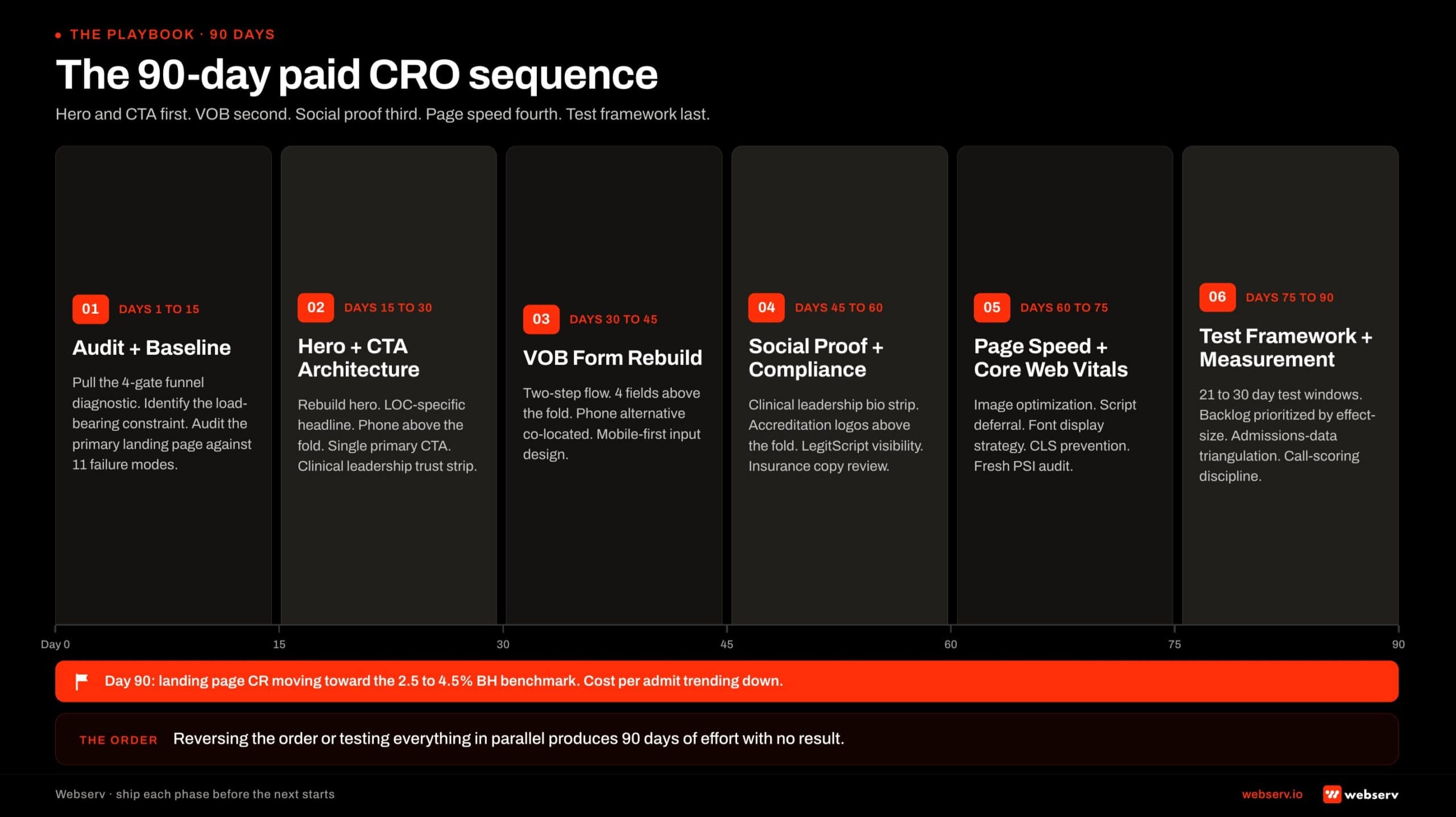 Horizontal 6-phase Gantt-style timeline infographic titled ‘The 90-day paid CRO sequence.’
The 11 pillars do not implement in parallel. The sequence below produces the cleanest CRO lift in the first 90 days. Reversing the order or testing everything at once produces 90 days of effort with no measurable result.
Days 1-15: Audit and baseline. Pull the 4-gate funnel diagnostic (CPC, landing page CR, VOB-to-qualified, qualified-to-admit). Identify which gate is the load-bearing constraint. Audit the existing primary landing page against the 11 failure modes. Establish the testing infrastructure (analytics, heatmap, session recording, conversion tracking).
Days 15-30: Hero and CTA architecture. Rebuild the hero section. LOC-specific headline. Above-the-fold phone number. Single primary CTA. Real clinical leadership trust strip. Accreditation badges visible. This is the load-bearing change and should ship first because it sets up the downstream tests.
Days 30-45: VOB form rebuild. Restructure the form into a two-step flow. Four fields above the fold. Phone alternative co-located. Real-time vs callback expectation clearly stated. Mobile-first input design.
Days 45-60: Social proof and compliance signal. Add or refine the clinical leadership bio strip. Verify accreditation logos are above the fold on mobile. Confirm LegitScript marker visibility. Review the insurance section copy for honesty and compliance.
Days 60-75: Page speed and Core Web Vitals. Image optimization, script deferral, font display strategy, CLS prevention. Pull a fresh PageSpeed Insights audit and close the largest gaps.
Days 75-90: Test framework and measurement. Establish the 21- to 30-day test windows. Build the test backlog prioritized by effect-size potential. Set up admissions-data triangulation to validate CRO tests against cost-per-admit lagged 30 to 60 days. Pair with the call-scoring discipline that makes the Smart Bidding signal clean.
By day 90, the landing page conversion rate should be moving toward the landing page conversion benchmarks for rehab. Cost per admit should be trending down measurably. The testing infrastructure is in place to compound the gains across months 4 through 12.
The 90-day sequence produces 30 to 50 percent cost-per-admit reduction on the same spend across the operators we have implemented it with. The compounding continues across the following 12 months as Smart Bidding optimizes against the cleaner signal and the testing program refines each pillar.
Most in-house teams hit a wall not because they lack knowledge, but because they lack bandwidth.
When you are ready to hand it off, Webserv has spent 9 years executing exactly this for treatment centers nationwide.
This connects to the broader cost-per-admit picture in revenue cycle as a marketing problem.
Frequently Asked Questions
How long does it take to see meaningful results from rehab paid CRO?
Six to 12 weeks for the first measurable landing page conversion lift after a hero, CTA, and VOB form rebuild. Three to six months for sustained cost-per-admit improvement to show up in the admissions data. Twelve to 18 months for the durable baseline shift that compounds across Smart Bidding optimization and admit-attributed conversion.
The timeline depends heavily on test sample size. Behavioral health paid traffic volumes are lower than generic e-commerce, which means test windows run 21 to 30 days rather than the 5 to 7 days generic CRO advice assumes. Operators who pull tests too early on small samples chase noise rather than signal.
The deeper read on funnel-level recovery timing lives in our piece on how to lower cost per admit without cutting your ad budget. The CRO work in this guide is one of the 9 levers covered there.
Should we use the same landing page for Google Ads and Meta Ads?
Almost never. The traffic intent profiles are different enough that a single page underperforms relative to a Google-specific page and a Meta-specific page running in parallel. Google traffic typically arrives on a higher-intent query (“alcohol rehab near me,” “PHP for opioid use”) and expects the LOC-specific headline and the phone-first CTA structure.
Meta traffic arrives from interest-based or lookalike targeting and is typically earlier in the family-member research cycle. The Meta landing page should lead with the family-member voice, more education about what treatment looks like, and a less aggressive CTA structure that respects the earlier funnel position.
The exception is operators below $20K monthly spend where the volume cannot support separate pages. For those operators, our Facebook vs Google Ads decision framework and the 14 paid social strategies for sub-$20K budgets piece both cover how to compress the program into a workable single-page setup.
How many landing pages do we need across our paid program?
For most multi-facility operators, 6 to 12 landing pages cover the working program. The pattern: one Google page per primary level of care (detox, residential, PHP, IOP), one Meta page per primary level of care, plus 2 to 4 condition-specific pages (alcohol, opioid, dual-diagnosis) for high-volume keyword targeting.
Single-facility operators with smaller budgets often run 3 to 5 pages: one per primary LOC plus a generic backup. Operators running 8+ facilities at scale sometimes run 25 to 40 pages with facility, LOC, and condition modifiers all in play. The right count is whatever the spend volume can support with enough traffic per page to test.
The trap to avoid is one page per keyword. Spinning up 50 thin landing pages to match 50 keyword variants is the doorway-pages anti-pattern in paid form. It produces ranking drag on organic, fragmented test sample sizes on paid, and dilutes the Smart Bidding signal across too many landing pages to optimize cleanly.
What’s the right balance between phone and form CTAs on rehab landing pages?
Phone primary, form secondary for most behavioral health paid traffic. Phone-call conversion rates from paid clicks usually run well ahead of form-submission rates because the active-crisis caller and the family member at 11 PM both prefer to talk to a human. The phone number belongs above the fold, large, tap-to-call enabled.
The form is the secondary CTA for two specific scenarios: off-hours traffic (when the admissions team is offline) and form-preference users (typically EAP referrals, employer-routed traffic, and some referral-source segments). A page without a form loses these segments; a page that leads with the form loses the phone-converting majority.
The hybrid that works is phone above the fold with a “or verify your insurance online” secondary CTA below the fold. The phone link absorbs the phone-converting traffic, and the form captures the off-hours and form-preference segments without forcing the majority through a form they would skip.
Should we A/B test on small paid traffic volumes?
Yes, with realistic expectations on test window length. Most behavioral health paid programs send modest weekly click volume to a primary landing page, which means a meaningful A/B test takes 21 to 30 days to reach statistical significance, not the 5 to 7 days generic CRO advice assumes.
The implication is that you can only run 12 to 18 tests per year per landing page. The testing discipline becomes pickier as a result: large structural changes (hero rebuild, form architecture, CTA hierarchy) get prioritized over small copy tweaks (button color, headline word swaps) that need bigger samples than the program can produce.
For very small programs (under $10K monthly spend), classical A/B testing rarely works at statistical significance. The alternative is informed iteration: ship the change, observe trends, validate against admissions data lagged 30 to 60 days, and revert if the directional signal is wrong. It is less rigorous but it fits the data volume the program actually has.
How does CRO interact with Smart Bidding and offline conversion tracking?
CRO improvements compound with clean Smart Bidding signal and degrade with dirty signal. Google’s offline conversion imports let the platform learn from admit-confirmed conversions rather than form-fill or call proxies. A landing page rebuild that lifts form fills 50 percent produces compounding Smart Bidding lift only if those form fills are actually qualified leads on the back end.
The interaction matters for test methodology. New landing page variants temporarily spike or drop the conversion signal while Smart Bidding absorbs the new pattern. Operators who pull tests at 7 to 10 days because of this short-term volatility cancel good tests. Wait 21 to 30 days before drawing conclusions on Smart Bidding-driven traffic.
The takeaway: CRO work is most valuable inside a clean signal environment. Fix the call scoring discipline and the admissions team conversion tagging before or in parallel with the landing page rebuild. CRO compounding without signal hygiene is half the lift it should be.
Build the Funnel That Compounds, Not Just the Campaigns That Buy Clicks
Paid CRO is the multiplier that makes every other paid media dollar work harder. A facility doubling its landing page conversion does not double its admits; it cuts the cost of every admit roughly in half.
Because the gates multiply, the same relative lift applied at more than one gate grows admit volume faster than any budget increase on identical spend.
The 11 pillars in this guide cover the surface treatment center operators actually control: the landing page architecture, the VOB form UX, the Smart Bidding feedback loop, the compliance frame, the testing methodology.
They also cover the failure modes that cap most rehab programs at low landing page conversion when they could convert far better.
We help treatment center operators run the 90-day paid CRO sequence: diagnostic audit, hero and CTA rebuild, VOB form restructure, compliance and social proof layer, page speed work, and the test framework that compounds across 12 to 24 months.
The work pairs with the broader paid media program and the admissions team scoring discipline that makes the Smart Bidding signal clean.
Book an intro meeting to walk through your current paid landing page profile, where the 4-gate funnel is likely leaking, and what a 90-day CRO sequence would produce for your facility.
For the broader picture of how paid CRO fits inside a full treatment center marketing program, see our ultimate guide to behavioral health marketing and our deeper read on PMax for behavioral health for the campaign-side counterpart that makes CRO compound at scale.
Mitch Marowitz is the Director of Paid Admissions at Webserv. Webserv works with behavioral health and addiction treatment centers on paid media, SEO, and full-funnel admissions strategy.