A 50-bed residential treatment center hired me last spring to figure out why their $32,000-a-month Google Ads program was producing inconsistent admissions despite “great Performance Max numbers” the prior agency kept showing on dashboards. I pulled the placement report.
PMax had been serving roughly 40 percent of its impressions on YouTube and Display, including a string of placements on mobile-game ad networks and a few that looked like clear MFA (made-for-ads) sites. The Search component, the only part that produced any admissions, was getting 22 percent of the total spend.
The agency had been reporting on aggregated CPA across the whole campaign, which hid the fact that the actual admission CPA on the Search portion was reasonable while the Display and YouTube portions were burning budget against impressions that did not convert.
We killed the PMax campaign over a weekend and rebuilt the program in Standard Search with disciplined campaign structure and Smart Bidding only on the campaigns that cleared the 30-conversion threshold. Cost per admission dropped from $980 to $510 inside 60 days. Spend stayed flat. Admission volume grew 22 percent because the budget was finally going to surfaces that produced admissions instead of surfaces that produced impressions on mobile games.
That story is not universally true for PMax in behavioral health, but it is more often true than the agency pitches admit. Performance Max is Google’s flagship AI campaign type and Google pushes it aggressively in every account review. For behavioral health specifically, the right answer for most operators is no, not yet, and not the way most agencies set it up.
The wild-card framing in the title of this piece is intentional, because there are narrow exceptions where PMax does work. The spam machine framing is also intentional, because most of the BH operators running PMax in 2026 are running a spam machine and do not know it. The disciplined alternative is what our paid search practice deploys on every account by default. The full multi-brand version of this rebuild — including the third-brand PMax pause and the flagship shift — is documented in our multi-brand behavioral health case study.
Key Takeaways
- Performance Max is mostly the wrong campaign type for behavioral health treatment centers under $40,000 a month in paid search spend. The cross-surface optimization, opaque reporting, and asset auto-generation produce more compliance risk and less admission accountability than Standard Search with disciplined structure delivers.
- PMax needs 30 to 50 conversions per month minimum to optimize reliably. Most BH operators do not clear that threshold at the account level, let alone at the campaign level where PMax actually runs.
- Healthcare cross-network reach creates real compliance risk. PMax serves on YouTube, Display, Gmail, and Discover, where BH creative policy enforcement is less predictable than on Search. Account disables and policy strikes happen more often on cross-network surfaces than on pure Search.
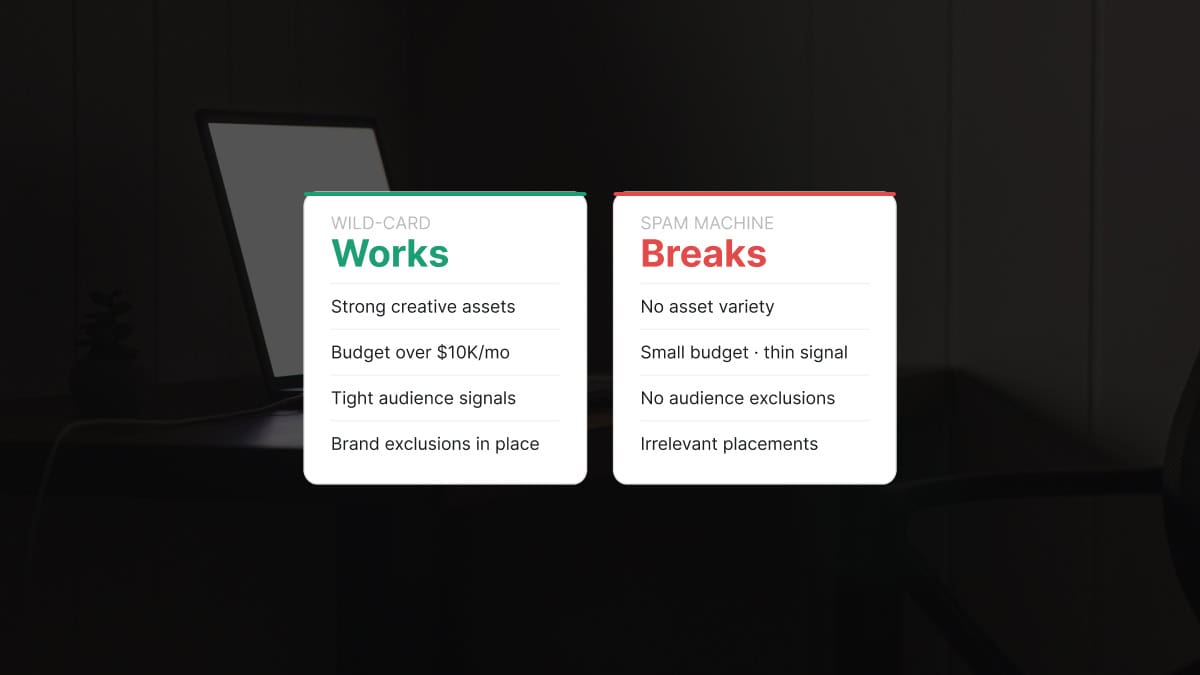
- The narrow wild-card use cases: larger accounts (over $40,000 a month with 100+ conversions), mature creative inventory across all surfaces, and operators willing to accept the reduced visibility into placement-level performance.
- If you are already running PMax, the audit framework is: pull the placement report, check the Search percentage of spend, audit the asset combinations for compliance, and decide whether the campaign is doing work that Standard Search would do better.
What Performance Max actually does
Performance Max is Google’s AI-driven campaign type that runs across all of Google’s surfaces (Search, Display, YouTube, Gmail, Discover, and Maps) from a single campaign. The advertiser provides assets (headlines, descriptions, images, videos) and audience signals. Google’s algorithm decides which surface to serve on, which creative combination to assemble, which audience to target, and what bid to set. Google’s newer AI Max has its own risks; see AI Max failure modes.
The pitch is that PMax handles the optimization complexity automatically, frees the operator from manual campaign management, and produces more conversions per dollar than Standard Search because it can find demand across surfaces a Search-only campaign cannot reach. Google reports advertisers using PMax see incremental conversion lift over Search-only campaigns when both run in parallel.
The reality for behavioral health is more complicated. Three structural features of PMax interact badly with this category.
No keyword control. PMax does not give the advertiser direct keyword targeting. Instead, the system uses Search Themes (an indirect way to suggest query coverage) plus asset content and audience signals to decide which queries to serve on.
For BH, where commercial intent queries have well-understood compliance constraints and educational queries do not, the inability to specify keyword discipline means the campaign serves on whatever the algorithm decides is “relevant,” including queries the operator would never have allowed in Standard Search.
Cross-surface optimization. PMax allocates spend across Search, Display, YouTube, Gmail, Discover, and Maps based on its own optimization logic. In practice, for healthcare advertisers, this often means 50 to 70 percent of spend lands on Display and YouTube placements where compliance enforcement is less predictable and conversion attribution is weaker.
The Search portion of PMax spend is usually the only portion producing admissions, but it represents a small fraction of the total spend in most accounts.
Opaque reporting. PMax’s reporting layer has improved since 2024 but still does not match the granularity of Standard Search. You can see aggregate performance, audience signal performance, and partial search term reporting. You cannot easily see which specific Display placements produced which conversions, which YouTube channels served what creative, or what the actual query-level cost per admission was on the Search portion.
Each of these features is fine for an e-commerce account with consistent product economics, mature creative across all surfaces, and 500+ conversions a month to feed the algorithm. None of them are fine for a behavioral health treatment center running $15,000 to $40,000 a month with 20 to 60 conversions a month.
Why PMax is a spam machine for most BH accounts
MOST COMMON PMAX FAILURE
PMax hands campaign control to Google’s ad-serving algorithm, and Google’s algorithm treats behavioral health like any other paid vertical. That means it will push spend toward display and video placements on non-BH properties, drive to network-hosted landing pages that miss LegitScript audits, and mix junk lead sources into the conversion signal. On a BH account with strong search structure, most PMax spend gets absorbed by the least accountable network placements before campaign controls can catch it.
The combination of features that work for e-commerce works against BH for five specific reasons.
The conversion volume threshold. Like all of Google’s AI bidding products, PMax needs roughly 30 to 50 conversions per month to optimize reliably. Below that threshold, the algorithm cannot distinguish signal from noise. For BH operators, the threshold is usually missed at the account level, and PMax campaigns running thin-data optimization produce the same failure modes as Smart Bidding on small Search campaigns: chasing wrong placements, overspending on the daily budget, and burning a 3-to-6-week learning period on every change. The conversion volume math behind bidding strategy applies here, only worse because PMax is even more data-hungry than Max Conversions.
Asset auto-generation creates compliance exposure. PMax automatically combines headlines, descriptions, images, and videos into ad variations the algorithm tests. For BH, where every creative element has to clear Google’s healthcare advertising policy and the addiction services policy, the auto-combination process can produce ad variants the operator never explicitly approved.
Variants that include before-and-after imagery, outcome claims, or non-compliant language get the entire account flagged. The addiction services policy enforcement does not distinguish between “you wrote this” and “the algorithm assembled this from assets you provided.”
Cross-surface compliance variance. Google’s compliance enforcement on YouTube and Display is less predictable than on Search. A creative that passes Search review can get flagged on YouTube placement. A landing page that passes the Search ad-destination scan can get rejected on the Display placement scan. PMax surfaces these inconsistencies across multiple surfaces simultaneously, which increases the surface area for compliance issues. Standard Search keeps the compliance work concentrated on one surface.
Audience signal restrictions for healthcare. PMax uses audience signals (Customer Match, Similar Audiences, demographic and in-market signals) to inform optimization, layered with the conversion tracking and call attribution infrastructure that feeds the algorithm. For healthcare advertisers, several of these signals are restricted or unavailable. Customer Match can’t be used for health-based targeting under Google’s personalized advertising policy. Similar Audiences was deprecated entirely. The audience signal layer that powers PMax in other categories is much thinner in healthcare, which means the algorithm has less to work with even when the campaign hits the conversion threshold.
The 22-percent problem. In the opening story, 22 percent of total PMax spend was on the Search surface that actually produced admissions. That ratio is consistent across the BH PMax accounts I audit. The Search portion is doing all the real work. The other 70 to 80 percent of spend is producing impressions on cross-network placements that contribute marginal brand lift but minimal admission economics. The same operator running pure Standard Search would have allocated 100 percent of the budget to the surface that converts.
 Infographic titled ‘The PMax surface allocation: where the spend actually lands’.
The compounding effect of these five issues is that most BH PMax campaigns underperform what a well-structured Standard Search campaign with the same budget would deliver. The lift PMax produces in e-commerce does not translate to BH because the constraints that make PMax work elsewhere are exactly the constraints BH advertisers face most acutely.
“Most BH operators running PMax in 2026 are running a spam machine and do not know it. The Search portion does all the real work. The other 70 to 80 percent of spend is producing impressions on cross-network placements that contribute marginal brand lift and minimal admission economics.”
Preston Powell, Chief Executive Officer, Webserv
The narrow wild-card use cases
PMax is not always wrong for BH. Three specific scenarios make PMax worth piloting.
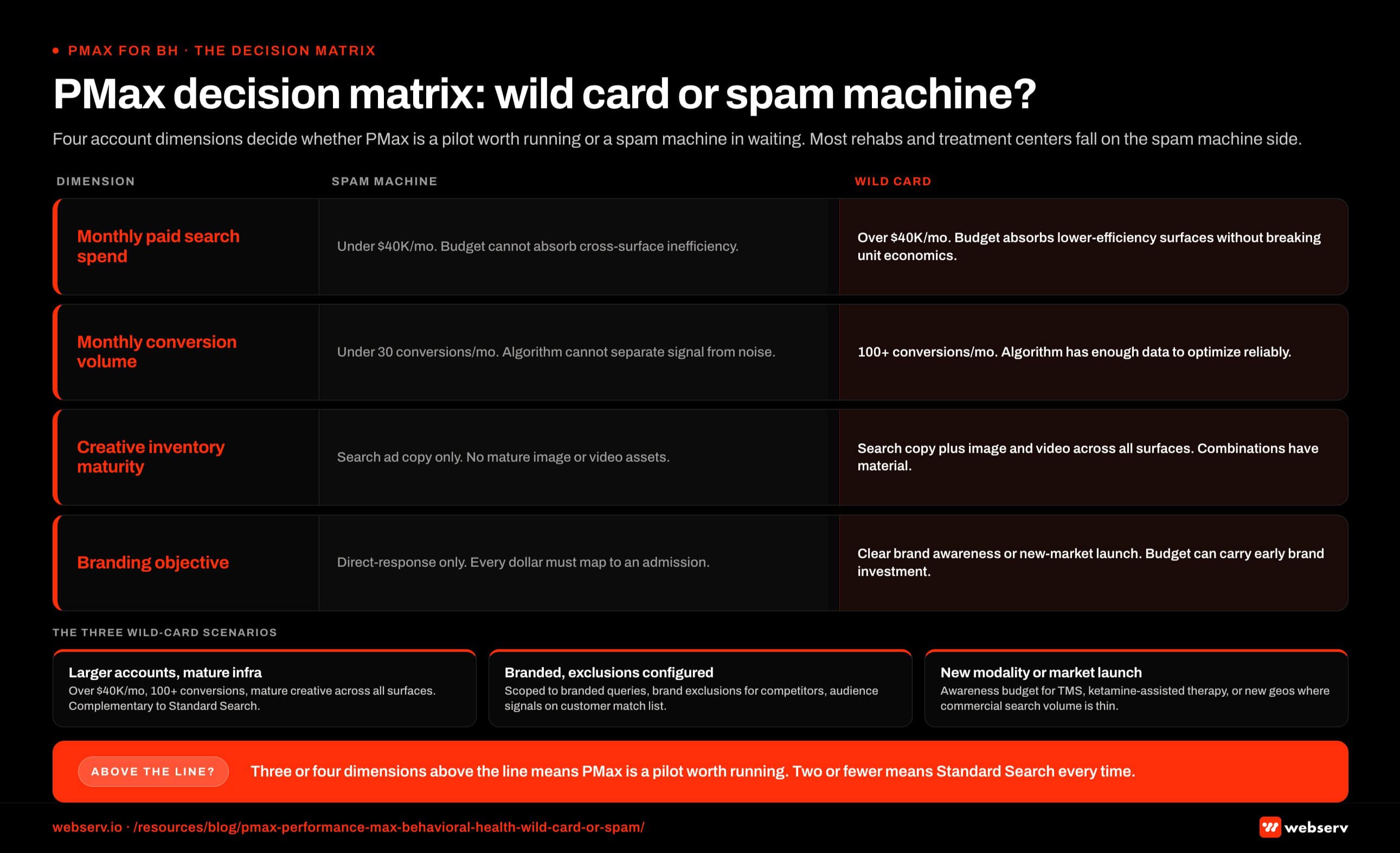 Infographic titled ‘The PMax decision matrix: wild card or spam machine?’.
Larger BH accounts with mature infrastructure. Treatment centers running $40,000 or more a month with 100+ conversions a month, mature creative inventory across Search ad copy, image, and video assets, and a brand that justifies broader awareness investment can run PMax as a complement to Standard Search.
The conversion volume supports the algorithm, the creative inventory supports the cross-surface optimization, and the budget can absorb the lower-efficiency portions of the campaign without breaking the unit economics.
Branded campaigns with brand exclusions configured. For operators with strong brand recognition, a PMax campaign tightly scoped to branded queries with brand exclusions configured for competitor brands and irrelevant terms can be a clean defensive play. The audience is well-defined, the compliance posture is simpler (branded creative is rarely policy-violating), and the cross-surface reach captures branded retargeting across YouTube and Display efficiently.
New modality or new market launches with brand budget. A facility launching a new clinical specialty (TMS, ketamine-assisted therapy) or entering a new geographic market often does not have enough commercial search volume yet to make Standard Search productive.
PMax with educational creative on the new offering can build awareness across surfaces, with the understanding that the campaign is a brand investment rather than a direct-response one. This use case requires accepting that the admission CPA from the campaign will be high in the early quarters.
For operators outside these three scenarios, PMax is not the right campaign type in 2026. The standard recommendation should be Standard Search with the disciplined ad-group structure and the campaign-level configuration framework we deploy on every Standard Search account before introducing PMax as a third campaign type.
The compliance traps specific to PMax for BH
Beyond the general structural issues, PMax carries three specific compliance traps that catch BH operators.
Landing page scanning across all linked URLs. Google scans not only the ad text but also the landing pages on the destination URLs PMax serves. For BH, the policy enforcement specifically targets pages with full information on addictions, symptoms, and treatment methods.
PMax routing ads to multiple landing pages across the site multiplies the surface area for this scanning, which means a page that would have passed a Search-only review can trigger a PMax-wide ad disable if it gets flagged on a cross-surface scan.
LegitScript scope and PMax. Google’s addiction services policy requires LegitScript certification for the advertiser, with Google scanning the destination URLs against the certification. PMax can route to URLs that fall outside the certification’s stated scope, which is a flagging event.
The LegitScript certification process needs to be explicit about which URLs are in scope. PMax campaigns need to be configured to route only to those URLs.
Asset combination liability. As covered above, PMax auto-generates creative combinations the operator did not explicitly write. For BH, the compliance liability for those combinations sits with the advertiser, not with Google.
A combination that pairs a headline like “Take the first step toward recovery” with an image showing a person in distress can read as emotional manipulation under healthcare creative policy, even though neither asset alone would have triggered policy review. The operator finds out about the combination only when the account gets disabled.
The combined effect is that PMax for BH is operating in compliance territory most agencies do not fully understand and most operators do not fully see. The compliance mistakes that ban accounts happen at higher rates on PMax than on Standard Search because the surface area is larger and the operator has less direct control over what the campaign actually serves.
How Profound Treatment drove 31 admits and a 42% drop in cost per viable in one quarter
Broad match pivot, negative keyword management, and intake-level conversion tracking turned a fragmented paid strategy into a predictable admissions engine.
Read the case study →68 viable VOBs at $4,529 cost per viable
The audit framework: is your PMax campaign worth keeping?
If you have an existing PMax campaign and want to evaluate whether it is worth keeping, a 90-minute audit gives you most of the answer.
Step 1: Pull the placement report. In the PMax campaign view, open Insights → Placements (or Asset Group → Placements for newer accounts). Look at the surface distribution: what percent of spend is on Search, what percent on YouTube, what percent on Display, Gmail, Discover, and Maps. The Search share is your most useful number. Under 30 percent Search spend usually means the campaign is allocating most of the budget to surfaces that do not convert at admission economics.
Step 2: Check the asset combinations. Pull the Asset Performance report and review which combinations are serving. Look specifically for combinations that pair high-emotional creative with outcome-claim headlines or with imagery that approaches the before-and-after policy line. Document any combinations that look policy-adjacent. If you have not been reviewing the combinations regularly, this audit will surface combinations the algorithm assembled that the operator did not approve.
Step 3: Calculate Search-attributable admission CPA. Take the total Search spend (from Step 1) and divide by the admissions actually attributable to organic-from-PMax. This is your Search-only PMax CPA. Compare to your Standard Search CPA (if you have one running) or to the industry benchmark for BH Search ($300 to $700 CPA depending on market). If the Search-only PMax CPA is much higher than the Standard Search CPA, the cross-surface portions of PMax are not earning their share of the budget.
Step 4: Audit the URL routing. Pull the destination URLs PMax has served to and verify each one is in scope for your LegitScript certification, is on a clean technical foundation, and does not have content that triggers the full-information scan. Any URL that should not be receiving PMax traffic gets added to the campaign’s URL exclusions.
Step 5: Make the kill-or-keep decision. Most BH operators running PMax on $15,000 to $40,000 monthly budgets will find that the audit produces a kill recommendation. The Search portion is small, the cross-surface spend is producing minimal admission lift, the compliance exposure is real, and the same budget on Standard Search with proper campaign structure would produce better economics.
The kill is a 24-hour migration: pause PMax, increase budget on Standard Search campaigns proportionally, verify conversion tracking is intact across both account types, and monitor for 30 days. Most operators see CPA improvement within 14 days of the migration.
The hybrid setup for operators who insist on running PMax
For operators above the $40,000-a-month threshold who fit the wild-card use cases above, the right PMax setup is a hybrid configuration with strict scoping.
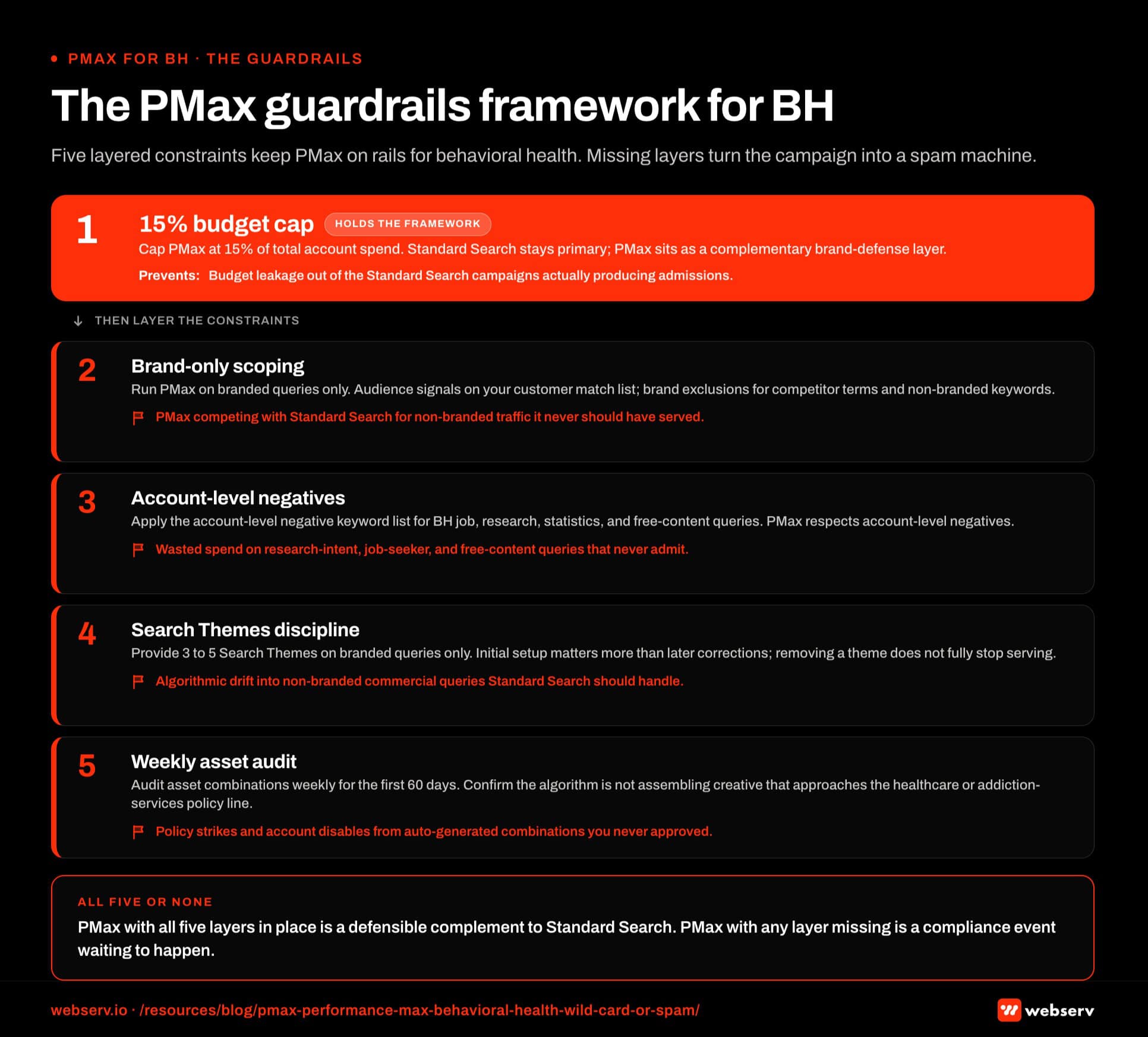 Infographic titled ‘The PMax guardrails framework for BH’.
Constrain PMax to brand-only. Run PMax exclusively on branded queries, with the campaign’s audience signals tightly scoped to your customer match list and your brand-search audience. Add brand exclusions for competitor brand terms and any non-branded keywords you want kept in Standard Search.
This gives PMax a narrow surface to optimize against and prevents it from competing with your Standard Search campaigns for non-branded traffic.
Add account-level negatives. Use Google’s account-level negative keyword list to exclude the universal BH job, research, statistics, and free-content queries. PMax respects account-level negatives, which means this filter applies even though PMax does not allow campaign-level keyword targeting in the conventional sense.
Use Search Themes carefully. Provide 3 to 5 Search Themes that align with branded queries. The Quality Score work you have done on Standard Search continues to matter because the brand themes inherit some of that signal. Avoid Search Themes for non-branded commercial queries, which Standard Search should handle. Remember that removing a Search Theme does not fully stop serving on related queries, so the initial setup matters more than corrections later.
Audit asset combinations weekly. With branded creative running, the combination liability is lower because branded creative is rarely policy-violating. Still, audit the combinations weekly during the first 60 days to confirm the algorithm is not assembling anything that would trigger review.
Cap PMax at 15 percent of total account spend. Standard Search remains the primary surface. PMax sits as a complementary brand-defense layer. Budgets above this allocation tend to pull spend away from the campaigns producing admissions.
The hybrid setup keeps the wild-card upside (cross-surface brand reach when it works) while constraining the spam-machine downside (cross-network spend leakage, compliance exposure, opaque optimization). Few BH agencies set up PMax this carefully because the discipline is more work than the default “launch and let it run” configuration most agencies pitch.
Frequently Asked Questions
Should we run Performance Max if our agency is recommending it?
For most BH treatment centers under $40,000 a month in paid search spend, no. The conversion volume usually does not support PMax’s optimization needs, the cross-surface spend produces weak admission economics, and the compliance exposure is higher than Standard Search. The agency recommending PMax is often defaulting to Google’s pitch rather than evaluating fit for your specific account.
The question to ask the agency is: “Show me the Search percentage of total PMax spend on a current client account, and the admission CPA on the Search portion alone.” If the agency cannot produce that data on a current account, they have not done the analysis. If they can produce it and the Search share is under 30 percent, they are running a spam machine and reporting on aggregated dashboard metrics that hide the issue.
A capable BH-focused agency will have an opinion on PMax that includes specific exclusions, asset audit cadence, and a Standard Search baseline they can compare PMax results against. That depth of practice is rare in this category and worth screening for.
What is the minimum budget that makes PMax viable for a treatment center?
Roughly $40,000 a month with 100+ conversions a month and mature creative inventory across formats. Below that threshold, PMax does not have enough conversion volume to optimize reliably and does not have enough creative inventory to fuel the cross-surface asset combinations. The lift PMax produces in larger accounts comes from the algorithm having enough data to work with. That data does not exist in smaller accounts.
Operators in the $20,000 to $40,000 range are in the gray zone. Some can make PMax work in the narrow wild-card configurations described above. Most cannot, and would produce better admission economics from putting the same budget into well-structured Standard Search with bidding strategy fit to conversion volume.
Operators above $50,000 a month with mature creative and a clear branding objective are the cleanest fit for PMax, but they still benefit from running it as a hybrid layer rather than as the primary campaign type.
Can we just turn on PMax to test whether it works for our account?
Technically yes, but the test is more expensive than most operators realize. PMax campaigns typically need 60 to 90 days to stabilize, which means the test costs 2 to 3 months of budget at potentially worse CPA than your baseline. For most BH accounts, that test cost is $30,000 to $60,000 of degraded performance before you have enough data to evaluate.
The cheaper version of the test is to constrain PMax to brand-only as described in the hybrid setup, run for 60 days, and compare branded-query CPA to your Standard Search branded campaign baseline. This isolates the PMax effect to a narrow surface where the test is cheaper to run and the compliance exposure is smaller.
If you cannot afford the brand-only test cost (under 15 percent of monthly spend for 60 days), you cannot afford the full PMax test. Stay on Standard Search until the budget supports the experiment.
What is Search Themes and how does it relate to PMax in 2026?
Search Themes are PMax’s indirect way of suggesting which search queries the campaign should focus on. Unlike Standard Search keywords, Search Themes are signals to the algorithm, not hard targeting rules. The algorithm uses them alongside asset content, audience signals, and landing page content to decide which queries to serve on.
In 2026, Search Themes are more useful than they were at launch because Google added the ability to remove themes and added campaign-level negative keywords. The combination lets operators direct PMax’s query coverage somewhat, though not with the precision of Standard Search keyword targeting.
For BH, Search Themes should be used to focus PMax on branded queries (when running the brand-only configuration) and avoided for non-branded commercial queries that Standard Search should handle directly. The honest limitation is that Search Themes still do not give the operator full control over query coverage. The system retains the discretion to serve on related queries it deems relevant. This is part of why PMax remains the wrong primary campaign type for non-branded BH advertising.
How does PMax interact with our LegitScript certification?
Google scans the destination URLs PMax routes to against your LegitScript certification scope. If PMax serves an ad routing to a URL outside the certification’s stated scope, the entire campaign can be flagged or disabled. The LegitScript certification process defines which URLs are eligible for addiction treatment advertising. PMax needs to be configured with URL exclusions that prevent serving outside that scope.
The configuration is straightforward but commonly missed by agencies. The PMax campaign settings allow URL exclusions and URL contains-matches that limit which destination pages the algorithm can serve. For BH operators, the URL routing should be tightly scoped to certified service pages, location pages, and the homepage.
Educational blog content, glossary entries, and general resource pages should usually be excluded from PMax routing even if they are technically on the same domain. Operators who skip this configuration step often discover the issue only when the account gets disabled. The recovery is slower than the original setup, so doing it correctly the first time is much cheaper.
If PMax is mostly wrong, what is the right campaign type for BH in 2026?
Standard Search with disciplined campaign structure remains the right primary campaign type for behavioral health treatment centers in 2026. The right configuration involves consolidated campaigns by intent tier, themed ad groups with 8 to 20 keywords per group, match types matched to conversion volume, and bidding strategies that fit the campaign’s data density.
Standard Search wins for BH because it preserves keyword control (which is essential when aggressive negative keyword discipline drives campaign efficiency), keeps the compliance work concentrated on one surface, and gives the operator visibility into which queries and which placements produce admissions. None of these advantages exist in PMax for accounts at typical BH budgets.
The right time to add PMax is when the Standard Search account is mature, the conversion volume justifies the algorithm, the creative inventory supports cross-surface optimization, and the operator has a clear branding objective PMax can serve. Most BH accounts do not reach that threshold in their first 24 months of paid search.
If you want a paid social agencies for rehab marketing on whether your PMax setup is a spam machine or a wild card, request a search audit and we can pull the placement report, asset combinations, and Search-portion CPA before recommending the kill-or-keep decision. For operators starting fresh, the broader behavioral health marketing program compounds when the paid search foundation is built on Standard Search discipline rather than PMax defaults.
The perspective in this article comes from 9 years working exclusively inside behavioral health.
We are a team built by people in recovery who understand that behind every admission is someone asking for help. If that resonates, get to know us.
Mitch Marowitz is Director of Paid Media at Webserv, where he leads Google Ads, Meta, and emerging paid channel strategy for behavioral health treatment centers. He has overseen more than $45M in managed media spend across the addiction treatment category and writes about paid acquisition for treatment operators.