The most successful treatment center operators I talk to are not the ones in crisis. They are the ones who have built something that works and want to know why it stopped getting better. Their census is stable. Their cost per admit is reasonable. Their team is strong.
They have moved from $30,000 a month in paid media spend to $80,000 to $150,000 over two or three years. Then the dashboard stopped moving with the budget.
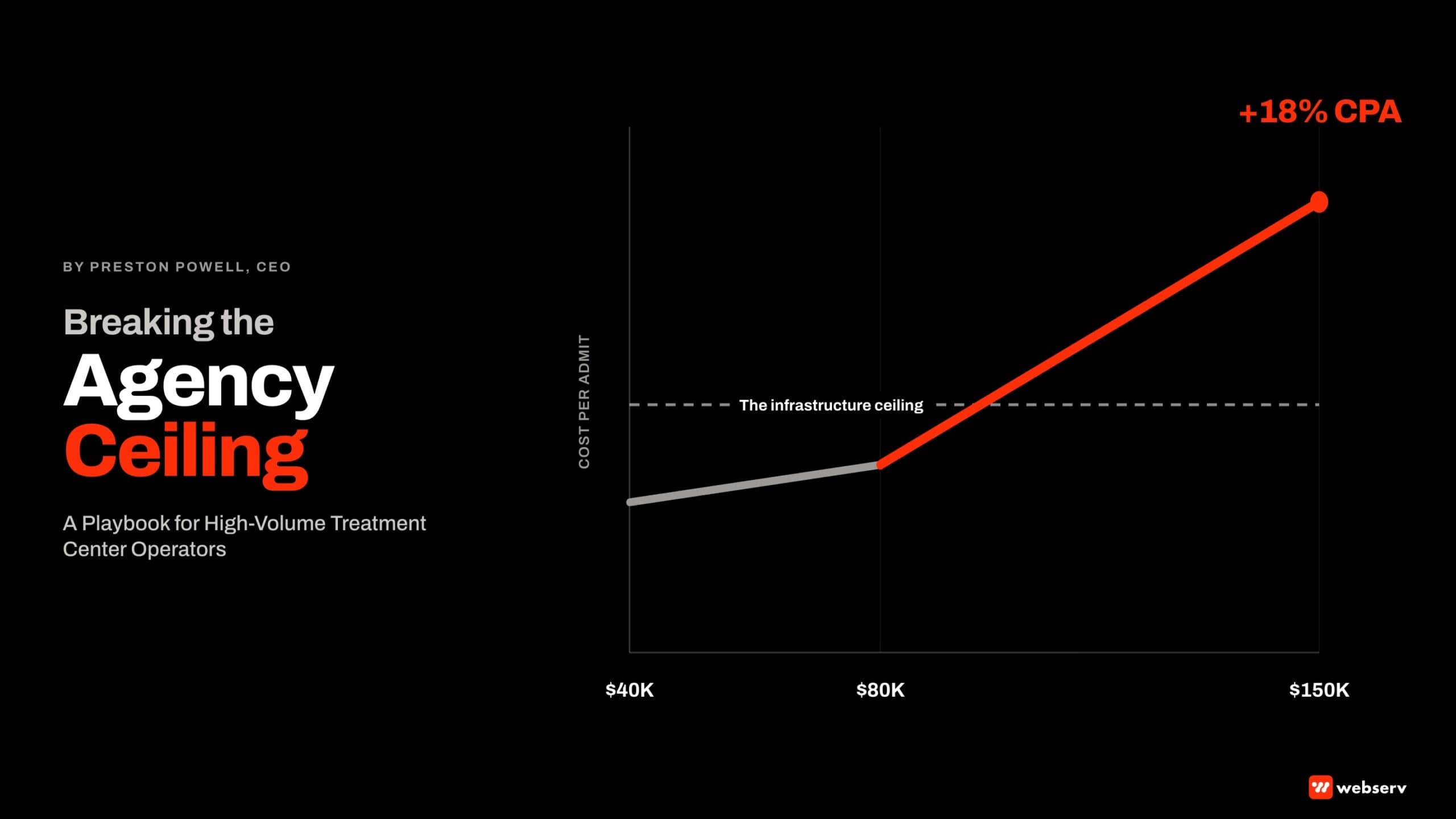
This is the agency ceiling. It is real, it is predictable, and it is rarely a strategy problem. It is an infrastructure problem.
The agency that got you from $30,000 to $80,000 in efficient spend is rarely the agency that takes you from $80,000 to $200,000 without losing 15 to 20 points of cost-per-admit efficiency along the way. The operational architecture that produces efficient scaling sits inside our paid media program for treatment centers at the high-volume tier.
What follows is the diagnostic for whether you have hit the ceiling, the patterns that produce it, and the operational changes that have to land before scaling beyond it produces proportional admit volume. I am writing from the operator side of the table.
The Ceiling Is Real and Predictable
Key Takeaways
- Most behavioral health marketing agencies are organizationally built for $20,000 to $60,000 a month in paid media spend. The infrastructure, team architecture, and reporting cadence that produce efficiency at SMB scale do not produce efficiency at $80,000 to $150,000 monthly. The ceiling is real and predictable.
- The ceiling is rarely a strategy problem. It is an organizational problem. Shared account managers, no specialist depth, SMB-scale tooling, no dedicated creative production, and junior executive sponsorship are the five structural patterns that cause efficiency to break as budget scales.
- Four signals tell an operator they have hit the ceiling: rising cost per admit despite rising budget, new geos producing worse than original geos, account manager turnover or visible burnout, and reporting that was clean at small scale becoming opaque at large scale. Three of four together is the ceiling.
- Five operational changes have to land together to scale beyond the ceiling: rebuilt data architecture, dedicated creative production, specialist depth, weekly reporting cadence, and restructured engagement tier. Each one without the others produces partial lift at best and confused dashboards at worst.
- The right time to move is before efficiency fully collapses, not after. Operators who try to fix the ceiling by pushing their current agency for structural change usually wait too long. By the time the agency rebuilds, the operator has lost 6 to 12 months of efficient scaling. Move while the program is degraded but recoverable.
I have watched the same pattern roll out at fifteen treatment centers over the last three years. The operator runs efficient through $40,000 a month in spend. Adds budget across two new geos and pushes to $80,000. Efficiency holds.
Adds budget again, pushes to $120,000, and the cost per admit jumps 18 percent.
$8K-12K
Typical cost per admit at $40K monthly spend, in-network paid search
$10K-15K
Typical cost per admit at $80K monthly spend, same operator
$13K-19K
Typical cost per admit at $150K spend without infrastructure change
The operator did not get worse at running their treatment center between $80,000 and $150,000 in spend. The agency did not get worse at running paid search. What broke is the operational infrastructure that an SMB-scale agency was running underneath the program.
The same campaign structure, the same creative cadence, and the same reporting rhythm that produced efficiency at small scale stopped producing it at the new scale.
The agency that gets you to your first ceiling is rarely the agency that gets you past it. It is not a failure of intent or competence. It is a question of organizational design. The agency was built for one tier, and the operator has outgrown the tier it was built for.
Preston Powell, CEO of Webserv
All three become harder to maintain as budget scales unless the operational infrastructure scales alongside it.
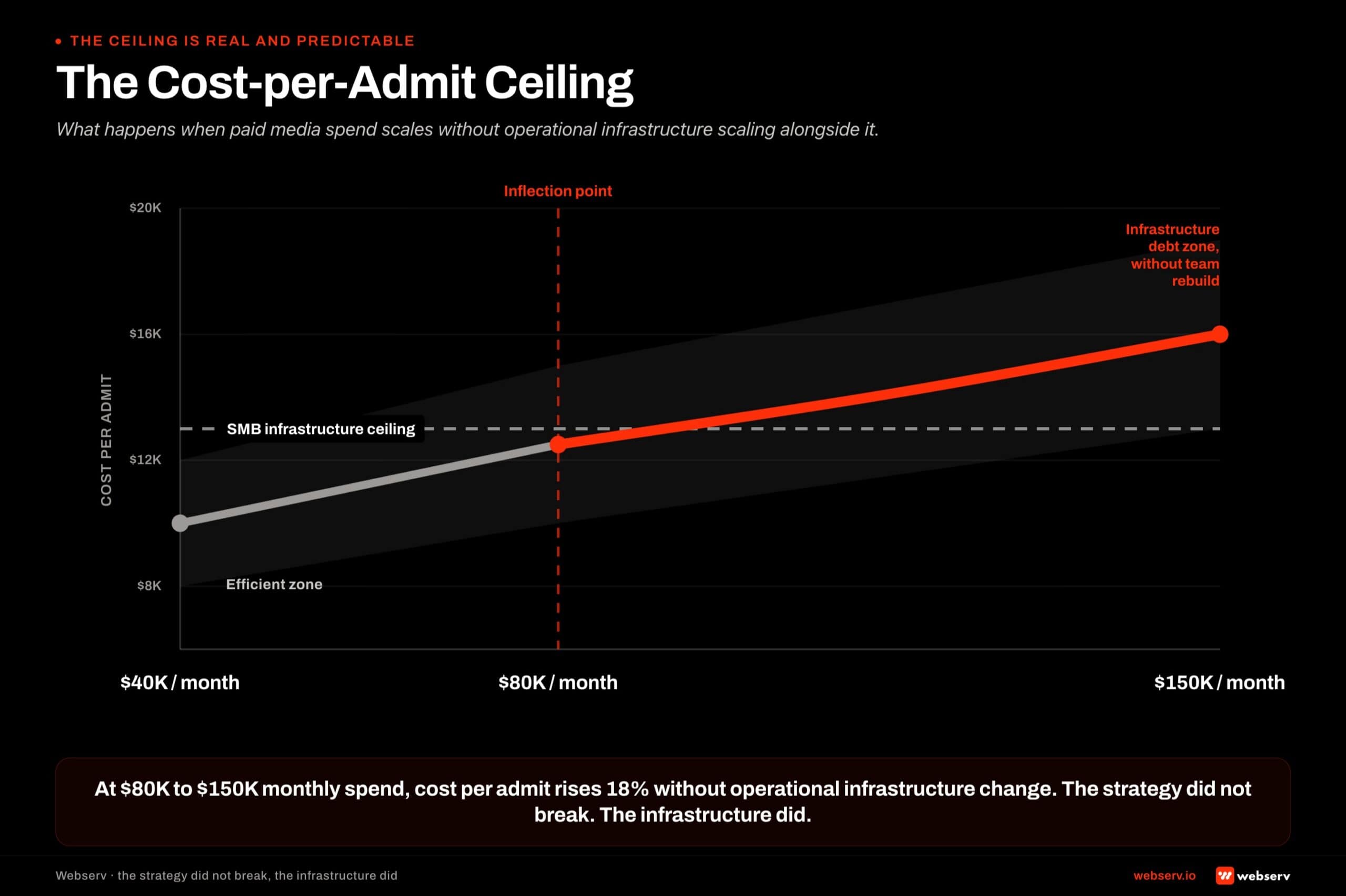 The cost-per-admit ceiling for treatment center marketing programs scaling monthly paid media spend.
How a Ceiling Manifests
DEFINITION
Diminishing Marginal Returns
The economic pattern where each additional dollar of marketing spend produces progressively less admit volume than the dollar before it. At low spend, the pattern is structural and unavoidable. At mid-to-high spend, the pattern is usually operational and fixable if the agency infrastructure underneath the program is rebuilt for the new scale.
The signals operators see before they hear the words “agency ceiling” are usually four:
Rising cost per admit despite rising budget. The dashboard is no longer flat against admit volume. Every $10,000 added to the budget produces fewer incremental admits than the last $10,000 did. Some of this is structural diminishing return. Most of it, at this stage, is operational.
New geographies producing worse than the original geos. The original markets the program was built in are still efficient. The expansion markets are not. The agency points to market dynamics.
The actual cause is usually that the campaign architecture, audience signal, and admissions team scripting that worked in the original markets were never properly rebuilt for the new ones.
Account manager turnover or visible burnout. The single AM who has been on your account for two years is suddenly unreachable, or has been replaced by a junior, or has been “elevated” to a role that means they are off your account.
At the agency, this is what it looks like when a high-volume account has outgrown the org structure underneath it.
Reporting that was clean at small scale becomes opaque at large scale. At $30,000 in spend, a single PDF report shows what is working. At $130,000, the same report is misleading because the averages now hide more than they reveal.
The campaign-level breakouts the operator needs to scale further are not in the report.
If three of the four are showing up at once, the ceiling is already here. The question is what to do about it.
Why Your Current Agency Caps Out
ORG CHART, NOT STRATEGY
Most agency ceilings are about the org chart, not the strategy. The strategy that produced efficient spend at $40,000 is usually still right at $150,000. What breaks is the agency’s ability to execute the strategy with the team architecture and tooling stack they built for SMB-scale accounts. Diagnose for org problems before considering strategy changes.
The reasons are organizational, not strategic. The five most common at the SMB-agency scale:
Shared account managers across mismatched accounts. The single AM handling your $130,000 account is also handling six $20,000 accounts. They do not have the focus or hours to give your account what it now requires. The math at the agency level does not let them.
No specialist depth. At small scale, one generalist running paid search and paid social and CRO and content is workable. At enterprise scale, each of those needs a specialist with dedicated bandwidth. Most SMB agencies do not have a paid social specialist who only does paid social.
Tooling stack built for SMB. The reporting and attribution stack that works for $30,000 accounts is rarely built for the data volume of a $150,000 account. The infrastructure was never designed for cleanroom integration, server-side conversion APIs at scale, or the audience modeling that high-spend programs require. Think with Google has documented the operational maturity model required to run automated and machine-driven bidding at scale, and the gap between SMB-scale and enterprise-scale infrastructure is the main driver of efficiency loss as budget scales.
No dedicated creative production. Creative refresh at scale needs a production cadence with its own roadmap and its own producer. Borrowing the agency’s shared design pod between five accounts produces creative that lags the campaign by two weeks.
Executive sponsorship is junior. At small scale, the agency CEO knows your account. At large scale, that relationship has usually been delegated three times down the org chart. The executive sponsorship that gave the relationship its quality early no longer applies.
 Five organizational patterns that cause behavioral health marketing agencies to cap out at the operator’s growth ceiling.
What Changes at the Next Tier
- Data Architecture First. Before scaling beyond the ceiling, the attribution stack has to be rebuilt for the volume. Server-side conversion API, clean source-to-admit tracing in the CRM, campaign-level breakouts that go deeper than monthly PDF reporting. Everything downstream relies on the team being able to see what is actually happening.
- Decouple Creative Production. Move creative production off the shared agency design pod and onto a dedicated producer with their own roadmap. Creative variance is the lever most likely to be capped at the current cadence; uncapping it requires production capacity that is not shared across five other accounts.
- Add Specialist Depth. Separate the paid search lead from the paid social lead from the CRO lead from the analytics lead. At this scale, each role needs dedicated bandwidth, not a generalist AM rotating across all four. The agency’s team architecture has to match the operator’s volume.
- Move to Weekly Reporting. The monthly review cadence that worked at small scale is too slow when each week of budget represents $30,000 to $40,000 in spend. Tactical reporting weekly, strategic review monthly. The pace has to match the spend.
- Restructure Engagement Tier. Scope, fee structure, and executive sponsorship all need to reflect the volume. A retainer designed for SMB does not match the team depth required at enterprise scale. The contract structure has to fund the architecture the operator now needs.
These five changes have to land together. Doing only the data architecture work without the team depth produces clean reporting on a still-broken operation. Adding specialists without rebuilding the data architecture produces specialists working from the same opaque dashboard that hid the problem in the first place.
The sequence matters too. Data architecture comes first because everything else relies on the team being able to see what is actually happening.
Creative production is next because creative variance is the lever most likely to be capped at the current cadence. Specialist depth, weekly cadence, and engagement tier restructure follow.
What Stays the Same
The pivot to the next tier rewrites a lot of the operational machinery. It does not rewrite the mission. The clinical excellence, the family-first ethical posture, the LegitScript and 42 CFR Part 2 compliance baseline, and the admitted-patient-as-the-only-metric reporting frame stay constant across the move.
Operators who scale well preserve the brand voice and the patient outcomes north star. They do not become a different facility on the website to pursue more volume. The treatment is the same. The reasons people choose the facility are the same.
What changes is the operational machinery that puts the facility in front of the right people at the right scale.
Operators who scale poorly chase volume at the expense of fit. The marketing produces more leads. The admissions team converts a smaller proportion. The cost per admit holds because the volume covers it, until it does not.
The Move-or-Stay Diagnostic
SIGNALS YOU HAVE HIT THE AGENCY CEILING
- Cost per admit has risen for three consecutive quarters despite budget growth
- Account manager has been replaced or quietly de-prioritized in the last 12 months
- Reporting has become harder to interpret as the program has scaled
- New geographic markets produce materially worse than original geos
- Creative refresh cadence has slowed visibly as budget has grown
SIGNALS YOUR CURRENT TEAM NEEDS ADJUSTMENT, NOT REPLACEMENT
- Cost per admit is volatile month-to-month but trending flat over six months
- Account manager has been stable and responsive but is asking for support hires
- Reporting is clear but missing one or two specific metrics you need to see
- New markets produce comparably to originals after a standard ramp period
- Creative refresh is on schedule but the variance could be wider
If three of the six signals on the left column apply, the ceiling is real and a move is likely the right call. If two or fewer apply, the right move may be to push your current agency for specific structural adjustments before considering a replacement.
TIMING THE MOVE
The right time to move is before efficiency fully collapses. Operators who try to fix the ceiling by rebuilding within the current agency for two or three quarters usually lose more than they save. The transition pain of moving while the program is degraded but recoverable is smaller than the opportunity cost of staying through full collapse.
The wrong reason to move is short-term frustration. Account manager turnover is uncomfortable but recoverable. A single bad month is not the ceiling. The ceiling is a sustained, structural pattern that the org chart on the other end is no longer built to fix.
How Webserv Operates at the Next Tier
Our high-volume treatment center engagements are structured around a dedicated team rather than a shared account manager. Each high-spend account gets a paid search lead, a paid social lead, a CRO lead, an analytics lead, and a creative producer with their own bandwidth and roadmap.
The reporting cadence is weekly at the tactical level and monthly at the strategic level, with direct executive sponsorship from the Webserv senior team. The data architecture is built for server-side conversion APIs, clean source-to-admit tracing through the CRM, and campaign-level decisioning rather than monthly averages.
The work is also structured for the operator side of the table. The companion piece on the Medicaid-to-commercial pivot walks the strategic question that becomes load-bearing at high-volume scale when payer mix is shifting at the same time.
The admissions operations workstream runs as a parallel track at this tier because the bottleneck at high spend is usually intake quality and conversion, not media buying.
This is the Predictable Patients methodology applied to operators who have already proven their facility can produce admits.
The question at this scale is not whether marketing can produce volume. It is whether the operational architecture is built to keep producing it at the next tier. Book an intro meeting if you want to walk your current ceiling with us live.
Frequently Asked Questions
How do I know if my current agency is capped or just having a bad quarter?
Look at the trailing six months. A bad quarter is volatile cost per admit, a missed campaign launch, a delayed creative refresh, or a temporary account manager change. The program returns to baseline within 60 to 90 days.
A capped agency is a sustained, three-quarter pattern of rising cost per admit despite rising budget, combined with one or more structural signals: AM turnover, opaque reporting, slowed creative cadence, or new markets underperforming.
If the pattern has been visible for two quarters and is not improving, the ceiling is real. If it has been visible for one quarter only, give it one more quarter with specific corrective asks before considering a move.
What does it cost to move agencies at high volume?
The direct cost varies, but the typical pattern is 60 to 90 days of efficiency drop during the transition while the new agency builds the data architecture, rebuilds the campaign structure, and onboards the team. Operators should plan for 10 to 15 percent higher cost per admit during the transition window before efficiency stabilizes at the new tier.
The indirect cost is opportunity. Each month of an underperforming program at high spend is six figures of marketing budget producing below its potential. Moving while efficiency is degraded but recoverable is usually cheaper than waiting until efficiency has collapsed.
The longer cost is data and learning loss. If the previous agency operated inside their own ad accounts, the conversion history and audience modeling go with them. Confirm account ownership before any move begins.
Should I split my media buying across two agencies to compare?
Generally no, at this scale. The split-agency model produces noisy attribution, duplicate audience targeting, and operational drag that costs more than the comparison is worth. Treatment center marketing is small enough as a category that the same audiences are being targeted by both agencies through the same platforms, creating self-competition in the auction.
A better diagnostic is a defined trial period with one new agency on a portion of the budget, with clear scope, conversion definitions, and a predetermined evaluation window. The single-agency comparison gives you cleaner data than running two in parallel.
If a parallel pilot is the only way to move forward, structure it so the two agencies are running entirely different channels (one paid search, one paid social) rather than the same channels in parallel, to keep the attribution clean.
How do I evaluate an agency claiming they can handle high-volume treatment center work?
Ask three things. First, what is their largest active treatment center engagement by monthly media spend, and how long has that engagement been running. The answer should be a substantial percentage of what your account would be.
Second, what does their team architecture look like at that scale. Generalist AMs handling everything is the wrong answer at this tier. Specialist depth across paid search, paid social, CRO, analytics, and creative is the right answer.
Third, what is their data architecture and reporting cadence. The answers should include server-side conversion APIs, source-to-admit tracing, and weekly tactical reporting with monthly strategic review. Any agency that defaults to monthly PDF reporting at this scale is not the right partner.
Preston Powell is the CEO at Webserv, a digital marketing agency for behavioral health and addiction treatment centers.