Census is 12 points under plan. The admissions manager says marketing is not sending qualified leads. Marketing says admissions is not converting the leads it already has. The CFO wants an answer by Friday.
Everyone in the room genuinely believes their side of the story, and none of them are equipped to diagnose which side is correct because nobody has named the layer where the diagnosis actually lives.
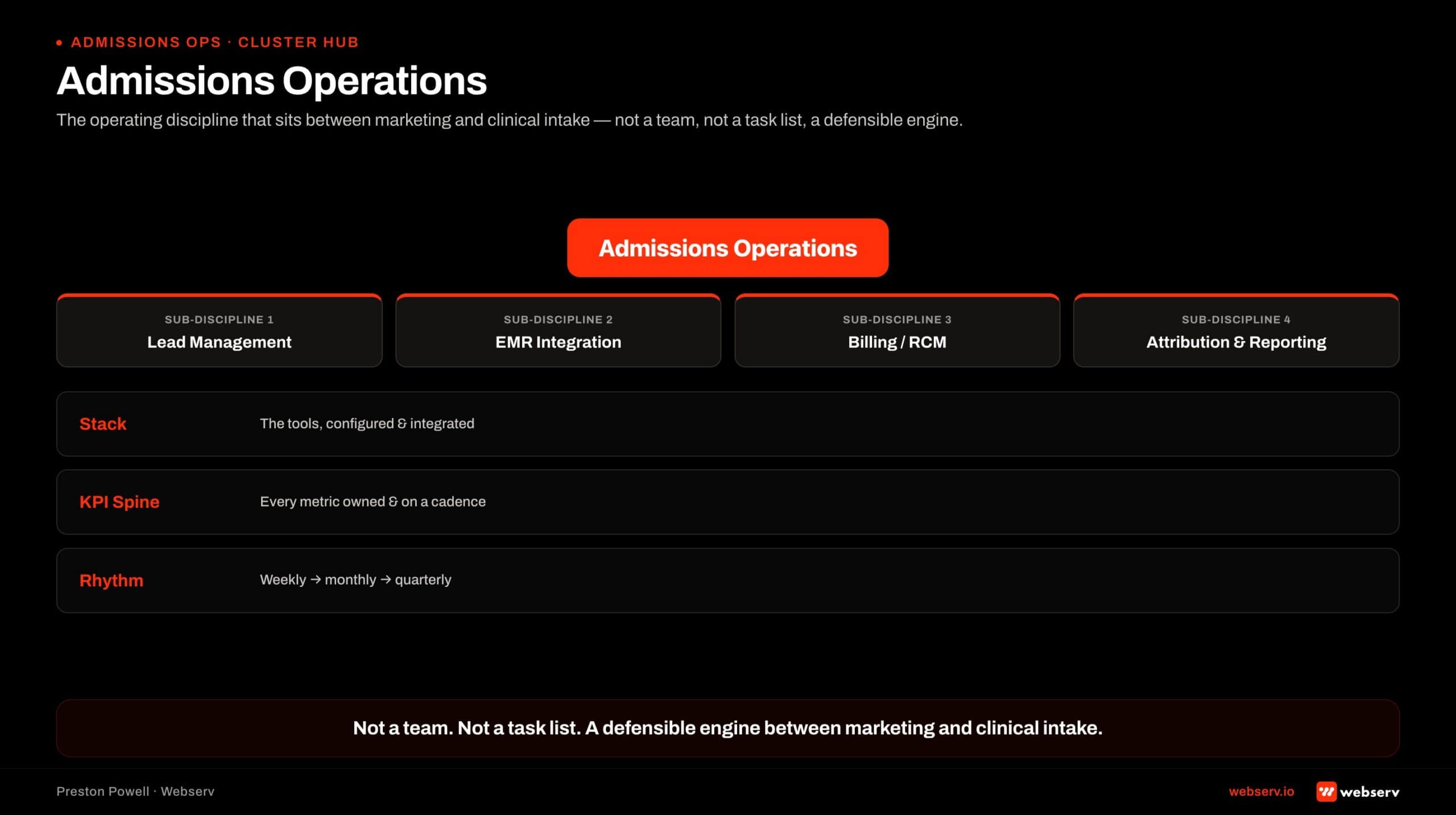
That layer is admissions operations. It is not the admissions team. It is not marketing’s job. It is not clinical’s problem. It is the operating discipline that sits between marketing and clinical intake and turns qualified inquiries into scheduled admits, admits into paid claims, and paid claims into forecastable census.
When it is running well, the argument about whose fault census is does not happen. When it is running poorly, that argument happens every Monday and nobody can settle it.
I have been running admissions ops for treatment centers for over a decade, first inside a treatment operator, then as CEO of Webserv working with residential, outpatient, and telehealth providers across the country.
The pattern is consistent. Owners and directors run admissions as a series of tactical fires (VOB is slow, CRM is bloated, referral partners are opaque, the CFO wants a QBR) without a mental model that names what admissions ops actually is as a discipline.
This piece supplies that mental model. It names the four sub-disciplines inside admissions ops, walks the stack, the KPI spine, and the reporting rhythm, and routes to the deep dives that solve each sub-part when you find the one that is broken.
It sits inside our broader behavioral health marketing framework and anchors the admissions ops capability we run alongside operators.
Key Takeaways
- Admissions ops is an operating discipline, not a team. It sits between marketing and clinical intake and governs how qualified inquiries become paid admits.
- The discipline breaks into four sub-disciplines: Lead Management, EMR Integration, Billing and Revenue Cycle Management, and Attribution and Reporting. Each has its own stack, KPIs, and cadence.
- The stack is four physical infrastructure layers: CRM, phone system with call tracking, EMR with integration to the CRM, and a reporting layer that pulls from all three.
- The KPI spine is 8 to 10 metrics anchored on admits and cost per admit, with speed to lead, VOB-to-admit conversion, payer mix, and denial rate as the operating indicators.
- The rhythm is weekly stand-up, monthly funnel review, quarterly business review. Without it, the discipline decays back into firefighting inside 60 days.
- Every sub-discipline has a canonical deep-dive on Webserv. This piece is the map.
DEFINITION
admissions operations (admissions ops) is the operating discipline that sits between marketing and clinical intake and governs how qualified inquiries become paid admits. It is not the admissions team; it is the layer above the team that decides how the tools, cadences, and KPIs connect the team’s work to census outcomes.
What Admissions Ops Actually Is
Admissions ops is not the group of people who work admissions inquiries. That group is the admissions team. It is not the daily task list of that team. It is not marketing’s job to run, or clinical’s.
It is the operating layer that decides how work moves between marketing and clinical intake, how the tools that carry that work talk to each other, how the results get measured, and how the whole system stays accountable to a monthly and quarterly cadence.
The distinction matters because operators without the discipline confuse team performance with operating performance. When an admissions coordinator quits and census drops 15 points the next month, the instinct is to hire another coordinator faster.
The correct diagnosis is that the operator never had admissions ops. What they had was a person doing the job of a discipline, and when that person left, the discipline left with them.
Admissions ops exists as a distinct discipline in behavioral health specifically because the vertical carries a set of constraints that other verticals do not.
Payer mix is complex and shifts by market. Intake is regulated by state and federal frameworks including 42 CFR Part 2 governing substance use disorder patient records.
PHI boundaries limit what attribution can carry. Census pressure translates directly into revenue and clinical capacity utilization.
The operator who tries to run admissions inside a general marketing operations framework built for e-commerce or SaaS discovers that the framework does not survive contact with any of these constraints.
The admissions team does not fail because the people are bad. It fails because the operating layer above them was never built.
Every week I spend on the operator floor with a treatment center that thinks it has an admissions problem, we discover in the first hour that it actually has an ops problem the admissions team has been trying to solve without a framework.
Jim Malcom, Vice President of Admissions at Webserv
The reframe operators need is the one Jim named. The admissions team is doing the work. Admissions ops is the discipline that decides whether the work adds up to a defensible census plan. Those are two different things and they need separate diagnoses.
The Four Sub-Disciplines
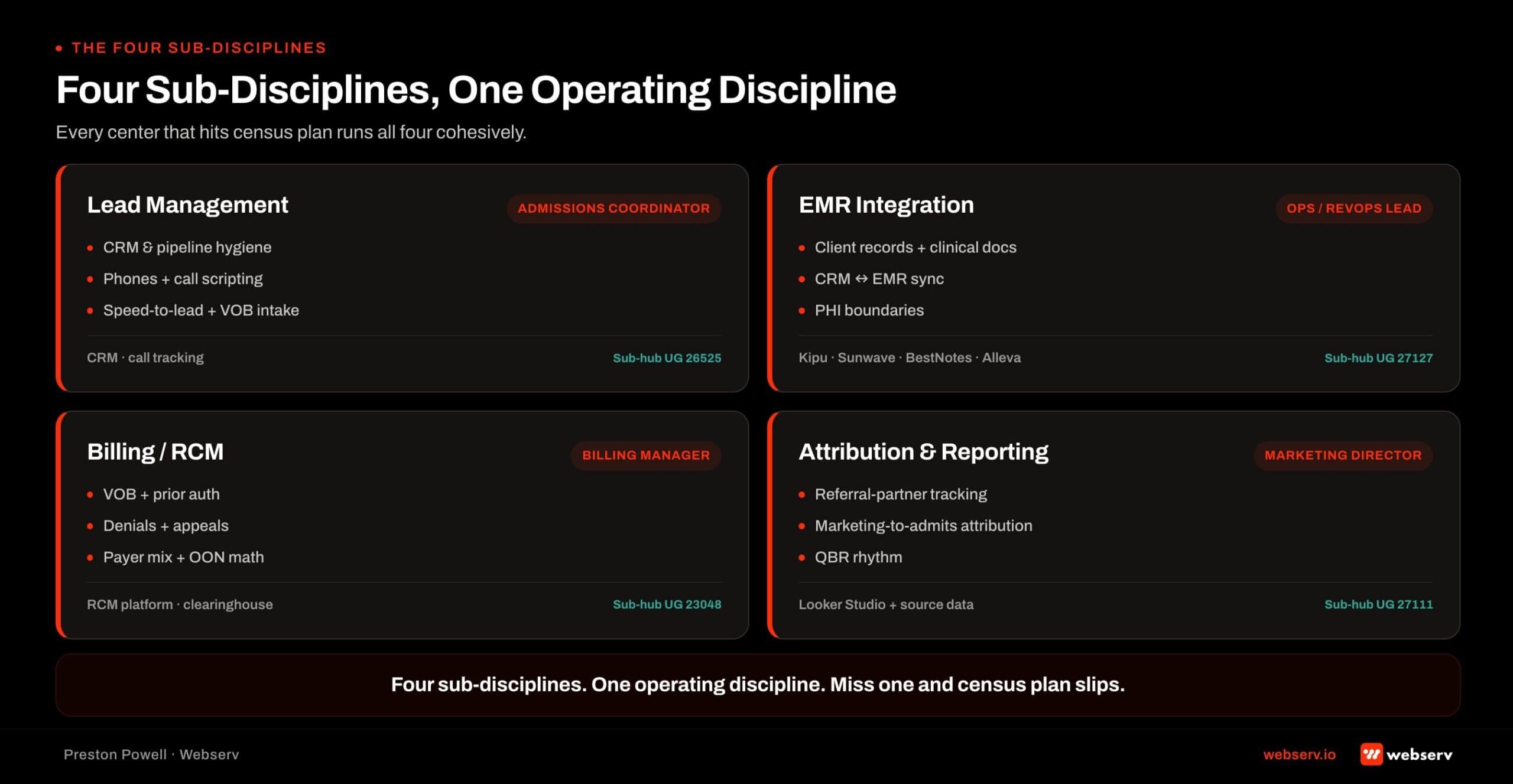
The discipline breaks into four sub-parts, each with its own stack, KPIs, and cadence. Recognizing which sub-part is currently broken is usually more valuable than trying to fix the whole discipline at once, because operators can name the failing sub-part inside 30 seconds if they know the four exist.
Lead Management
Lead management covers everything from the first inquiry (call, form, chat, referral) through the point where an inquiry becomes a scheduled admit or a qualified pass. The sub-discipline touches call routing, script structure, speed to lead, VOB workflow, coordinator KPIs, and the CRM configuration that ties it all together.
The failure modes here are visible fastest. Missed calls that never got returned. VOB requests sitting in queue for six hours before someone acts. Coordinators using the CRM as a notes system instead of a workflow tool. Speed to lead measured in hours instead of minutes.
The canonical deep-dive for the sub-discipline is our Admissions Process UG, which covers the process design end to end. For CRM selection specifically, the Best CRM Software for Treatment Centers Buyer’s Guide walks the four platforms behavioral health operators actually run on (HubSpot, Salesforce, Dazos, and native EMR admissions modules). For the call itself, our script for the first 60 seconds of an admissions call and our guide to setting up an admissions call center cover the front line.
The platform-specific deep-dive that most treatment centers land on when scoping a new CRM is the HubSpot for Treatment Center Admissions implementation guide.
EMR Integration
EMR integration is the layer where the marketing and admissions side of the operation hands off to the clinical side.
It covers CRM-to-EMR data sync, PHI boundaries at the handoff, field mapping between systems, native versus middleware integration decisions, and the accountability rules for who owns which data after the handoff.
The failure modes are less visible than lead management but more expensive. Coordinators double-entering data. Insurance information dropping between systems.
Handoff timing that delays scheduled admits by 24 to 48 hours because clinical intake cannot see what admissions verified. Attribution breaking because the admit that closed in EMR was never linked back to the marketing source that started it.
The canonical deep-dive is our EMR Selection Framework which walks the four platforms behavioral health operators run on (Kipu, Sunwave, BestNotes, Alleva) and the decision criteria for choosing between them.
For the specific integration mechanics on the most-adopted EMR in the space, the Kipu Integration for Treatment Center Admissions deep-dive covers the actual field mapping.
Billing and Revenue Cycle Management
Billing and RCM is the sub-discipline that turns paid admits into paid claims. It covers verification of benefits, prior authorization, denials management, alpha prefix routing for payer identification, out-of-network reimbursement math, payer mix decisions, and days-in-AR discipline.
Behavioral health specifically has RCM constraints that push complexity above general medical billing. Payer denial rates in this vertical run higher than the healthcare average. Length-of-stay authorization is renegotiated multiple times inside a single admission. OON reimbursement patterns shift quarterly and require dedicated operator attention.
The canonical deep-dive is the Revenue Cycle Management for Rehab Centers Complete Guide, which walks the discipline end to end. The checks that happen before a claim exists are covered in our pre-admission eligibility verification playbook and our guide to VOB versus pre-authorization.
Webserv’s Admissions Ops Billing capability covers where our practice touches this layer.
Attribution and Reporting
Attribution and reporting is the sub-discipline that makes the other three measurable. It covers marketing-to-admits attribution, referral partner tracking, PHI-safe reporting frameworks that respect 42 CFR Part 2 boundaries, KPI dashboards, and the quarterly cadence that ties operator conversations to data instead of opinion.
The failure mode here is invisible until an operator tries to answer a specific question. Which referral partner generated our top five admits last quarter.
What is our cost per admit by insurance type. Which paid channel produced admits versus just inquiries. Answers to those questions require attribution and reporting infrastructure that most treatment centers do not have configured.
The canonical deep-dive is the Marketing and Admissions QBR Playbook, which covers the quarterly review structure that pulls all four sub-disciplines into one measurable conversation. For referral partner attribution specifically, the Referral Partner Attribution for Treatment Centers piece covers the PHI-safe tracking framework. When the CRM and the marketing report disagree on how many admits happened, our CRM-vs-reporting reconciliation guide walks the fix.
The Stack: What Every Treatment Center Needs Configured
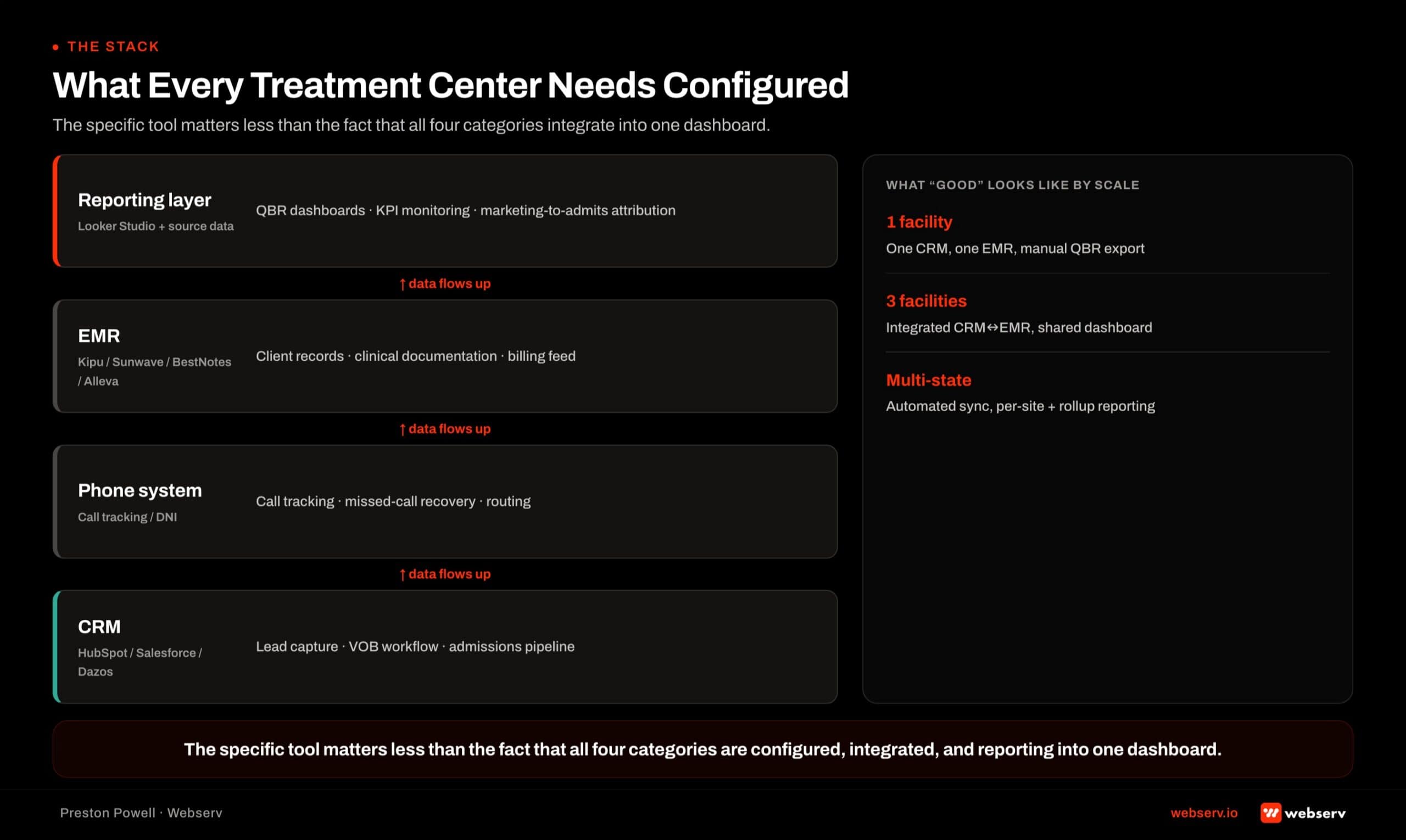
Underneath the four sub-disciplines sits the physical infrastructure that carries the work. Four categories of tooling, and every treatment center running admissions ops as a discipline has them all configured, integrated, and reporting into one dashboard.
The CRM is the operating system for lead management. HubSpot, Salesforce, and Dazos are the three platforms behavioral health operators run on at substantial scale.
The specific platform matters less than the fact that it is configured for admissions workflow (call queues, VOB status fields, appointment scheduling) rather than being used as a contact database.
Treatment centers running under 40 admits per month can typically operate on HubSpot. From 40 to 80 monthly admits, the decision often flips to Salesforce for multi-site coordination. Above 80, Dazos or a Salesforce Health Cloud implementation is common.
The phone system with call tracking is what makes speed to lead measurable and missed-call recovery possible. CallRail and CTM (CallTrackingMetrics) are the two platforms most treatment centers use.
The CallRail vs CTM comparison covers the trade-offs. What matters at the discipline level is that call tracking is present, integrated with the CRM, and reporting into the same dashboard as form fills and referral touchpoints.
The EMR is where the admit becomes a clinical patient. Kipu, Sunwave, BestNotes, and Alleva are the four platforms with real behavioral health adoption.
The EMR integration decision (native connector versus middleware versus manual sync) is where most treatment centers make an expensive mistake, and the EMR Selection Framework walks the trade-offs.
The reporting layer is where the four sub-disciplines become measurable together. Looker Studio, Google Data Studio, or an equivalent BI tool pulling from the CRM, phone system, EMR, and paid media platforms.
This is the layer most treatment centers leave underbuilt, and it is the layer that determines whether the other three sub-disciplines are being run with discipline or on instinct. Our admissions ops software stack map shows how all four layers connect.
For a single-facility treatment center, total tool spend across the four categories runs $2,000 to $5,000 per month. Multi-location operators add another $2,000 to $4,000 per month for the reporting layer complexity.
That is the floor for a working operating layer. Anything less and the discipline is under-resourced for the census plan the operator is trying to hit.
CRM
The operating system for lead management. HubSpot, Salesforce, or Dazos at BH scale. Configured for admissions workflow, not just as a contact database.
Phone + call tracking
CallRail or CTM. Makes speed-to-lead measurable and missed-call recovery possible. Integrated with the CRM.
EMR + CRM integration
Kipu, Sunwave, BestNotes, or Alleva. Native connector vs middleware vs manual sync is the decision most operators get wrong.
Reporting layer
Looker Studio or equivalent BI pulling from CRM + phone + EMR + paid media. The layer most treatment centers leave underbuilt and the one that determines whether the other three sub-disciplines are being run with discipline or on instinct.
The KPI Spine
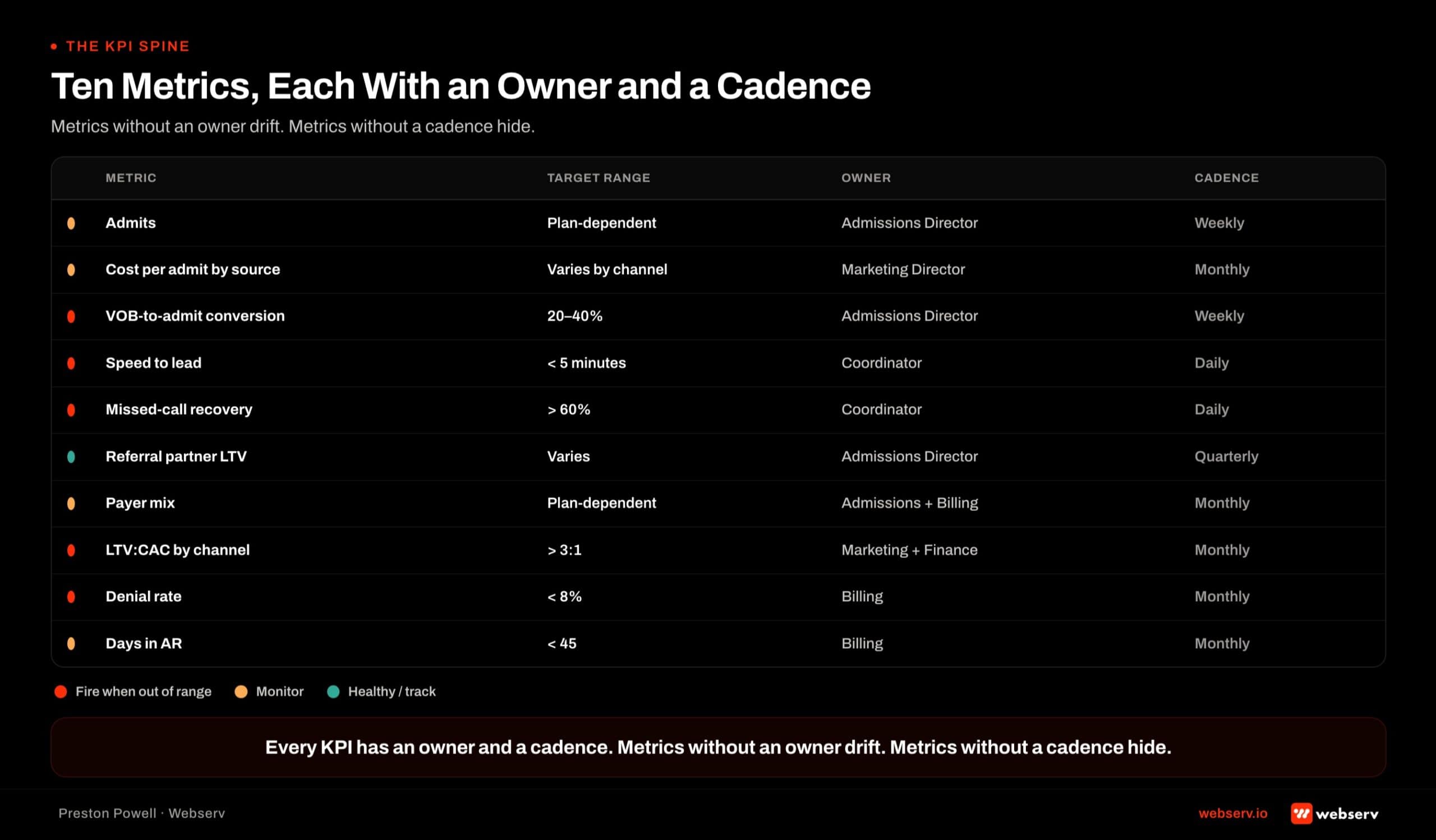
The KPI spine is the set of 8 to 10 metrics that define whether admissions ops is working. Every metric has a definition, a target range, an owner, and a cadence. Treatment centers that report on fewer than six of these metrics monthly are running admissions ops without instrumentation. For deeper definitions, see our admissions team KPIs and benchmarks and the CRM metrics that make up the KPI spine.
Admits is the primary business metric. Weekly cadence, admissions director owns it, target is set at the annual census plan divided by 52 with seasonality adjustments.
Cost per admit is the primary marketing-to-admissions metric. Weekly cadence, marketing director and admissions director both own it, target range varies by market and payer mix but healthy programs land between $1,500 and $6,000 for commercial insurance admissions.
VOB-to-admit conversion rate is the primary operating indicator for the lead management sub-discipline. Weekly cadence, admissions manager owns it, target range is 25 to 45% depending on payer mix and admission acuity.
Speed to lead is the fastest failure detector. Measured in minutes from inquiry to first outbound touch. Weekly cadence, admissions manager owns it, target range is under 5 minutes for high-intent inbound calls and under 30 minutes for form submissions.
Missed-call recovery rate is the sibling metric to speed to lead. What percentage of missed calls result in a callback and a completed VOB. Weekly cadence, admissions manager owns it, target above 70%. The Hostage Dynamic on treatment center admissions teams covers the specific failure mode where this metric collapses.
Payer mix is the strategic metric for billing and RCM. Monthly cadence, admissions director and CFO both own it, target is the operator’s negotiated payer strategy expressed as a percentage split.
Denial rate is the operating indicator for the RCM sub-discipline. Monthly cadence, RCM lead owns it, target is under 10% first-pass denials for the majority of behavioral health programs.
Days in AR is the cash-flow metric attached to RCM. Monthly cadence, RCM lead and CFO own it, target is under 45 days for a well-run RCM operation.
Referral partner LTV is the metric that separates functioning referral relationships from opaque ones. Quarterly cadence, admissions director owns it, and the fact that most treatment centers cannot calculate it at all is the signal that the attribution sub-discipline is underbuilt.
LTV to CAC ratio by channel is the composite metric that ties marketing spend to admissions outcomes. Quarterly cadence, marketing director and CFO own it, target above 3:1 for a sustainable growth program.
The Rhythm: Weekly, Monthly, Quarterly
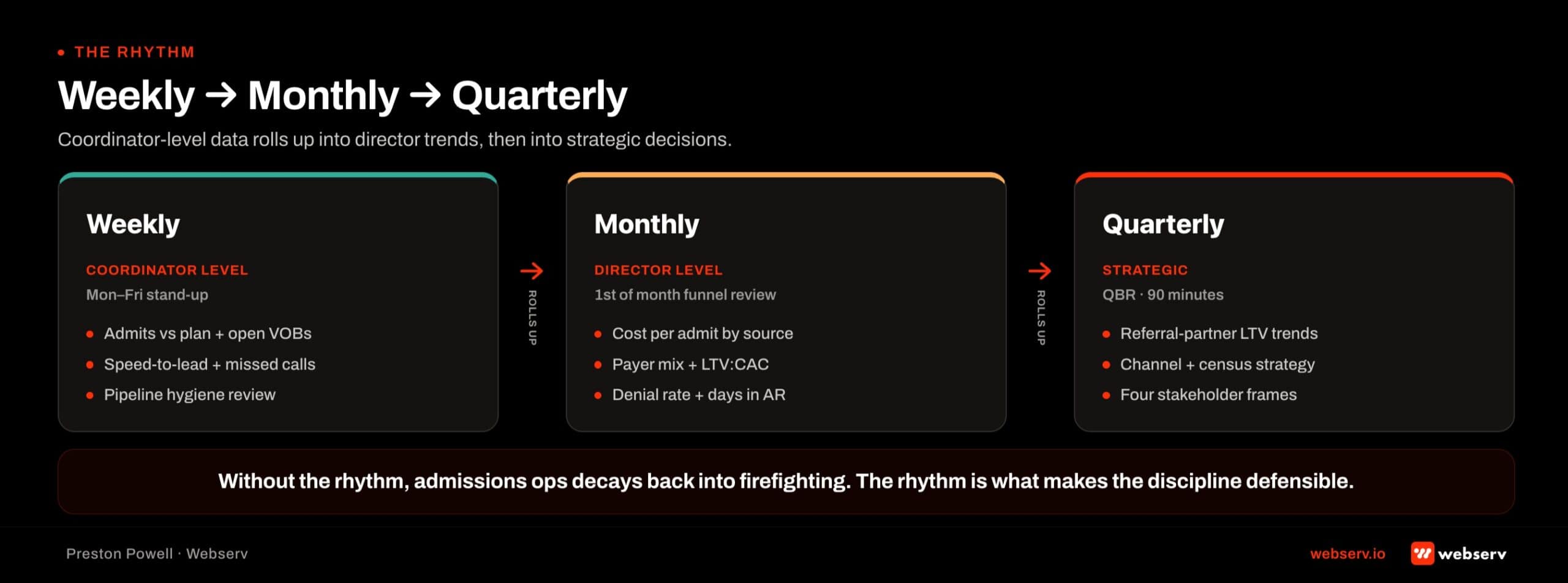
The rhythm is the accountability layer. Without it, admissions ops decays into firefighting inside 60 days because there is no cadence forcing the diagnostic questions.
The weekly stand-up covers admits, cost per admit, speed to lead, missed-call recovery, and VOB-to-admit conversion. It is a 30-minute standing meeting on Monday morning with the admissions manager, marketing director, and operator.
The meeting exists to catch small failures inside seven days instead of letting them compound. Treatment centers that skip the weekly stand-up default to monthly emergency conversations that would not have been emergencies with earlier detection.
The monthly funnel review is a two-hour working session that covers the full funnel from marketing spend through admits, plus a payer mix and denial rate check.
The audience is the operator, admissions director, marketing director, and RCM lead. Deliverable is a monthly report to ownership that names what is working, what is not, and what the plan is for the next 30 days.
The quarterly business review is the discipline-level accountability moment. Every metric on the KPI spine gets reviewed. Every sub-discipline gets a green-yellow-red assessment. Referral partner relationships get named individually.
The QBR is where operator conversation moves from tactical to strategic. Our Marketing and Admissions QBR Playbook covers the specific structure we use with treatment center clients.
Skipping any of the three cadences produces the same failure pattern. Weekly slippage compounds into monthly firefighting. Monthly gaps compound into quarterly surprise.
Quarterly gaps produce annual plans that were never grounded in operating reality. The rhythm is not administrative overhead. It is the discipline that keeps admissions ops from decaying.
How a Tennessee treatment center tripled its paid media close rate and cut missed calls to 1%
Full CRM configuration, system integrations, and call tracking metrics unified a fragmented admissions process into a single high-converting workflow in two months.
Read the case study →Up from 17% — missed calls cut from 15% to 1%
Build vs. Hire vs. Consulting: The Decision Framework
Treatment centers arrive at the discipline from three directions, and each has a different right first move.
Under 40 monthly admits, the operating layer is small enough that the admissions director can run the discipline directly with tooling support from an agency partner. Building in-house is the correct move at this scale.
The infrastructure is manageable, the team is small, and the operator’s attention is available to run the discipline personally. The First 30 Days Triage Playbook covers the specific work an operator does in the first 30 days of building the discipline from scratch.
From 40 to 80 monthly admits, the discipline complexity outgrows in-house capacity in most cases. A consultant engagement covering six to twelve months, with a defined deliverable that the in-house team can operate after the engagement ends, is the correct shape.
Consultant retainers at this stage run $7,500 to $15,000 monthly. The trap at this scale is retaining the consultant indefinitely, which usually means the wrong consultant was hired. Our breakdown of what admissions consulting costs covers how to scope that engagement.
Above 80 monthly admits, most operators run a permanent in-house admissions director plus a multi-year agency partner on the marketing-to-admits alignment side.
Webserv sits in this role for a substantial share of our client book. The in-house director owns the operating discipline, the agency partner owns the attribution layer, the reporting layer, and the marketing-to-admissions handoff.
The failure pattern at every scale is trying to skip the direction one tier below. Operators at 60 monthly admits who try to run pure in-house without any external structure often end up with a burned-out admissions director inside 12 months.
Operators above 100 monthly admits who try to run without external attribution and reporting infrastructure end up making channel decisions on incomplete data.
COMMON MISTAKE
Treating admissions ops as the admissions team’s job. When a coordinator quits and census drops 15 points the next month, the instinct is to hire another coordinator faster. The correct diagnosis is that the operator never had admissions ops. What they had was a person doing the job of a discipline, and when that person left, the discipline left with them.
What Webserv Owns in Admissions Ops
Webserv’s practice sits alongside admissions ops, not inside it. We do not staff the admissions team, run intake calls, do the actual billing, or configure your EMR. Those are your team’s responsibility, or a consultant’s if you are building the discipline from scratch.
What we do own is the attribution layer that ties marketing spend to admissions outcomes and the reporting layer that produces the weekly and monthly cadence the discipline requires.
We also own the marketing-to-admits handoff that ensures paid and organic traffic converts into inquiries the team can work, and the QBR structure that pulls the whole discipline into one operator conversation quarterly.
The engagements that produce the best results pair Webserv on the marketing plus attribution layer with a strong in-house admissions director who owns the operating discipline.
When both roles are in place and both are running with the KPI spine and rhythm above, census plans tend to get hit. The Admissions Ops capability page covers our specific service scope in more depth.
What a Webserv Engagement Looks Like
A Webserv admissions ops engagement typically starts with a baseline audit that names which of the four sub-disciplines is currently the constraint, walks the existing stack for gaps, benchmarks the KPI spine against comparable operators in our client book, and produces a 90-day plan for closing the highest-impact gap first.
From there, the ongoing engagement operates on the weekly stand-up, monthly funnel review, and quarterly QBR cadence described above.
The specific work varies by which sub-discipline needs the most attention at any given time. Attribution build-outs, reporting layer configuration, marketing-to-admissions QBR facilitation, and paid channel work all move through this same rhythm.
The right time to bring us in is when your admissions ops discipline is either being built for the first time or has decayed to the point where the weekly and monthly cadences are not producing operator-actionable data.
If your current setup is producing that data cleanly, the engagement value is smaller and the timing is probably not right yet. The Findable First infrastructure playbook is the companion read for operators still building the discipline for the first time.
Most in-house teams hit a wall not because they lack knowledge, but because they lack bandwidth.
When you are ready to hand it off, Webserv has spent 9 years executing exactly this for treatment centers nationwide.
For the fuller admissions technology stack, see Salesforce for admissions teams and Dazos implementation guide.
Frequently Asked Questions
What’s the difference between admissions ops and the admissions team?
The admissions team is the group of people who answer inquiries, verify insurance, and schedule admits. Admissions ops is the operating discipline that governs how they do it: the CRM configuration, the phone routing, the EMR sync, the reporting cadence, and the KPIs that hold everything accountable.
A treatment center with a great admissions team but no admissions ops discipline runs on individual heroics. Every problem gets solved once, then re-solved the next time it happens because there is no system underneath. Admissions ops turns individual heroics into repeatable process.
The tell: if your top admissions coordinator quits and census drops 15 points the next month, you do not have admissions ops. You have a person doing the job of a discipline.
Which sub-discipline should a treatment center fix first?
Whichever one is bleeding the most census today. If VOB is broken or slow, fix Lead Management first because that is where the leaks are visible. If admits are happening but claims are not paying, fix Billing and RCM.
If you cannot explain why cost per admit doubled, fix Attribution and Reporting. If your EMR and CRM are out of sync and coordinators are double-entering data, fix EMR Integration.
The exception: if you do not know which one is bleeding, fix Attribution and Reporting first. Without visibility into which channel is delivering admits at what cost, every other sub-discipline is being optimized blind.
How do you know if your admissions ops is broken or just having a bad month?
Three signals, in order of severity: census is off plan by more than 10 points for two consecutive months, cost per admit is trending up while lead volume is flat or growing, and you cannot answer “which referral partner generated our top 5 admits last quarter” without calling three people and looking at a spreadsheet.
Any one of those is worth investigating. All three together means your admissions ops discipline needs a full audit, not a tune-up.
A bad month with clean signals in all three areas is just a bad month. Bad seasons, insurance denials clustering, one referral partner drying up, a competitor opening down the street. These happen. Broken admissions ops is different, because it is the inability to diagnose what is actually going on and route to a fix.
What tools do you actually need to run admissions ops?
Four categories: a CRM (HubSpot, Salesforce, or Dazos), a phone system with call tracking (CallRail or CTM), an EMR that integrates with the CRM (Kipu, Sunwave, BestNotes, or Alleva), and a reporting layer (Looker Studio or equivalent) that pulls from all three.
The specific tool matters less than the fact that all four categories are configured, integrated, and reporting into one dashboard. Treatment centers that spend six months evaluating CRMs and then never integrate them with the EMR waste the whole investment.
Total tool spend for a single-facility treatment center runs $2,000 to $5,000 monthly across the four categories. Multi-location adds another $2,000 to $4,000 monthly. That is the floor.
When should a treatment center hire an admissions ops consultant?
When one of three conditions is true. Your admissions manager is telling you the system needs to change and you do not have the internal expertise to design the new one. You are moving from one CRM or EMR to another and need someone who has done the migration before.
The third condition: you are growing from 1 facility to 3+ and the ops model that worked for one location breaks at three.
A consultant is a bridge, not a permanent fixture. Six to twelve month engagement, deliverable is a designed system your in-house team can operate. If the consultant becomes indefinite, you hired the wrong person. Consulting costs run $7,500 to $15,000 monthly for the engagement.
How does Webserv work with a treatment center’s existing admissions team?
Webserv sits alongside admissions ops, not inside it. Our work covers the attribution layer (which channels are delivering admits), the reporting layer (marketing-to-admissions QBR alignment), and the marketing-to-admits handoff (making sure paid and organic traffic converts into inquiries the team can actually work).
We do not staff the admissions team, run intake calls, do the actual billing, or configure your EMR. Those are your team’s responsibility, or a consultant’s if you are building the discipline from scratch.
The engagements that work best pair Webserv on the marketing plus attribution layer with a strong in-house admissions director who owns the operating discipline. When those two roles are both in place, census plans tend to get hit.
Closing Note From the Admissions Floor
The single change that separates treatment centers with admissions ops from treatment centers without it is what happens on Monday morning.
Operators with the discipline walk into a stand-up with numbers, sub-discipline diagnoses, and a routed next move. Operators without it walk into an argument about whose fault the census gap is.
That difference compounds every week. Over a quarter, it produces measurably different census outcomes. Over a year, it separates operators who hit plan from operators who spend the following year trying to figure out what happened.
If you are unsure which sub-discipline is currently costing you the most census, start with the QBR framework. It will surface the answer inside one review cycle, and the answer will route you to the right deep-dive to work next.
Preston Powell is CEO of Webserv, a behavioral health marketing agency working with residential, outpatient, and telehealth treatment providers across the United States. He founded Webserv in 2015 and works directly with operators on admissions ops, growth strategy, and marketing-to-admissions alignment.