Pre-admission eligibility verification is the workflow that determines whether an inquiry becomes an admit. It is not the same as prior authorization. It is not the same as post-admit utilization review. It is not the same as claim adjudication.
It is the specific set of steps between “family provides insurance information” and “admissions coordinator has defensible rate confidence to schedule the admit.”
Done well, verification happens inside the first 4 to 6 hours of inquiry. The coordinator carries the rate data into the family conversation. The scheduled admit day carries a rate expectation both the facility and the family agree on.
Done poorly, verification takes 24 to 72 hours, families lose intent during the wait, admits scheduled without rate confidence produce reimbursement surprises 60 to 90 days later, and the pattern repeats.
Most treatment centers I audit run verification workflows that were built years ago against a different payer landscape and never updated. BCBS alpha prefix routing changed. Payer plan structures shifted. Real-time eligibility API options expanded. The verification workflow the facility runs today is not the workflow that produces the four-hour standard current tooling supports.
This piece is the operator-facing guide we run every pre-admission eligibility and reimbursement engagement against, and it covers the pre-admission scope specifically.
It walks what verification actually is (and what it is not), the five-step workflow that produces defensible rate confidence, the two verification tooling paths operators choose between, and the BH-specific challenges that break standard verification workflows.
It also covers the four-hour standard our team runs against, the integration between verification data and the admissions coordinator conversation, and the failure modes that consistently undermine even well-configured verification operations.
Our reimbursement intelligence guide covers the post-admission side of the same discipline: utilization review, claim adjudication, underpayment recovery, and the operational reporting cadence that surfaces reimbursement gaps. Both pieces sit inside our broader work on revenue cycle management and our behavioral health marketing guide. The two are complementary. This one covers what happens before the admit. The other covers what happens after.
Key Takeaways
- Pre-admission eligibility verification is a distinct discipline from prior authorization, utilization review, and claim adjudication. It runs between family inquiry and admit day scheduling. Its job is producing defensible rate confidence the coordinator can act on inside the family conversation.
- The five-step verification workflow: capture member ID and date of birth at inquiry, run eligibility check via 270/271 transaction, verify benefits detail (deductible, OOP max, coinsurance, prior auth requirements), determine network status against the facility’s contracts, and produce rate estimation with confidence scoring at Step 5.
- Two tooling paths cover most treatment center operations. Direct eligibility API integrations (Availity, pVerify, Change Healthcare) return raw payer data at the eligibility layer. Reimbursement intelligence platforms (PayerLenz and equivalent claims-data-pooled services) return raw data plus confidence-scored rate estimation.
- The four-hour verification standard is achievable with modern tooling and defensible workflow. Facilities running verification at 24 to 72 hours are operating against constraints that no longer exist in the current tooling landscape. The specific gap between four-hour and 24-hour verification produces the meaningful drop in lead-to-admit conversion.
- Five BH-specific challenges consistently break standard verification workflows: BCBS alpha prefix routing (~21,800 prefixes mapped to home plans), OON rate estimation without contract data, payer-specific level-of-care restrictions, prior authorization requirements that vary by state and plan, and family payer complexity for dependent coverage.
- The measurement signal that separates working verification from performative verification: rate confidence data reaches the coordinator seat and gets referenced in the family conversation. Facilities with strong verification infrastructure that does not reach the coordinator produce the same conversion rate as facilities without verification infrastructure.
DEFINITION
Pre-admission eligibility verification. The specific pre-admit workflow that runs between family inquiry and admit day scheduling. Produces four outputs the admissions coordinator carries into the family conversation: confirmed coverage status, verified benefits detail (deductible, OOP max, coinsurance, prior auth requirements), determined network status, and rate estimation with confidence scoring.
Distinct from prior authorization (payer approval to admit at a specific LOC — days, clinical documentation), utilization review (ongoing during-treatment clinical engagement — post-admit), and claim adjudication (payer’s post-service payment determination — 30-90 days after service). Verification typically happens in hours. Done in 4 hours or less keeps families engaged; done in 24-72 hours produces the delay that loses family intent and forces admits without rate confidence.
OPERATOR INSIGHT
Verification data that does not reach the coordinator seat produces zero operational value.
Facilities with strong verification infrastructure that lives in the verification team’s tools or the CFO’s reports produce the same conversion rate as facilities without verification infrastructure at all. The integration to the CRM coordinator view — where rate estimation and confidence score are visible during the family conversation — is what makes the verification investment produce measurable conversion lift.
What verification actually is
Pre-admission eligibility verification is often conflated with three adjacent workflows that carry different scope. Understanding what verification covers and does not cover is the prerequisite to running it well.
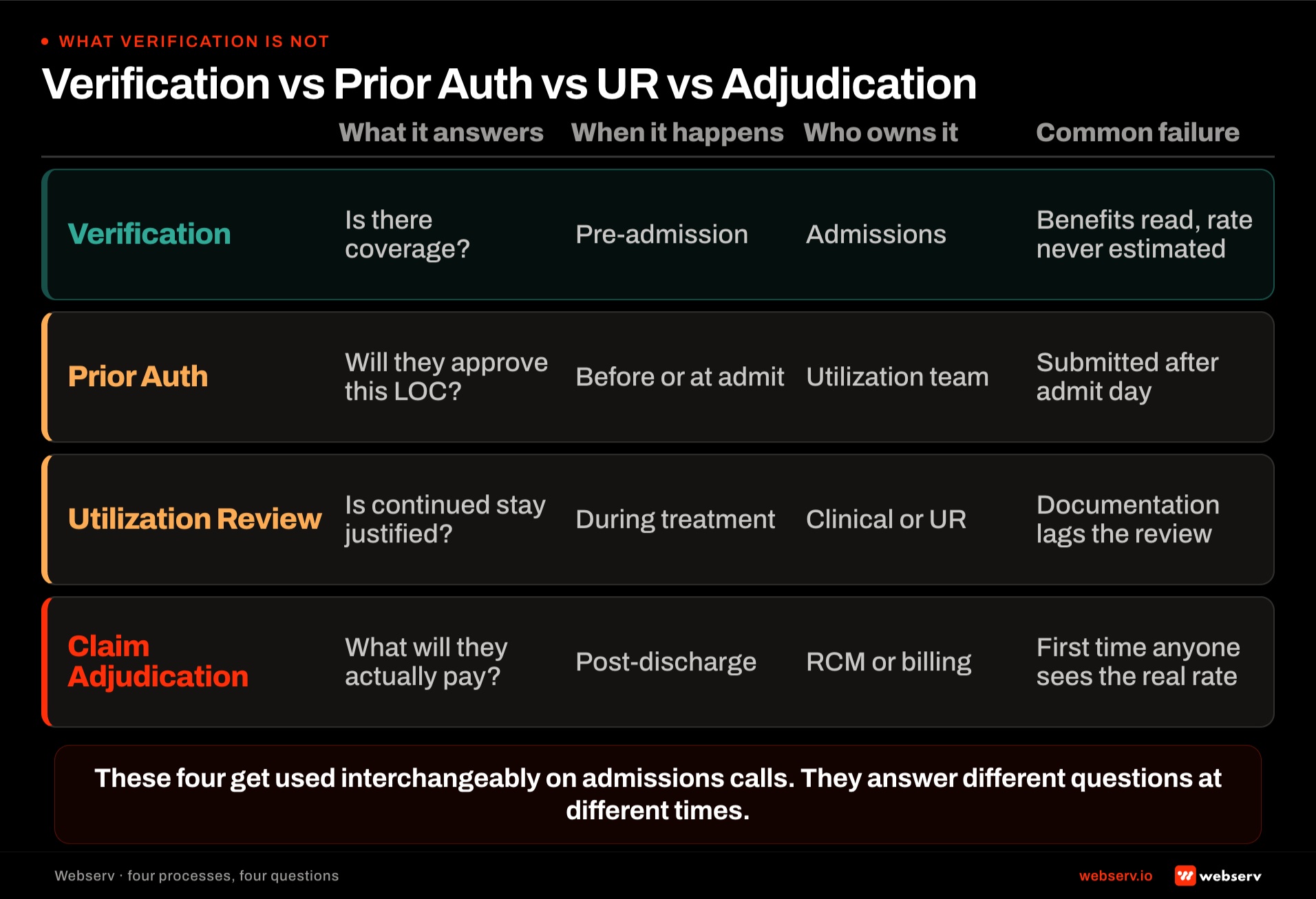
Verification is not prior authorization. Verification confirms the coverage exists and what the coverage looks like. Prior authorization is the payer’s approval to admit a specific patient at a specific level of care. Verification typically happens in hours. Prior authorization typically takes days and requires clinical documentation.
Verification is not utilization review. UR is the ongoing clinical documentation and payer engagement that maintains authorized coverage during the treatment stay. UR happens after the admit. Verification happens before. UR is typically owned by clinical documentation staff or a UR nurse. Verification is typically owned by admissions coordinators or a dedicated verification team.
Verification is not claim adjudication. Claim adjudication is the specific process the payer runs after the claim is submitted to determine whether and how much to pay. Adjudication happens 30 to 90 days after the service date. Verification happens before the service. Verification data feeds the expected reimbursement calculation that later gets compared against actual adjudicated payment. When the two diverge, the result is the VOB-to-admit revenue gap.
Verification is the specific pre-admit workflow that produces: confirmed coverage status, verified benefits detail, determined network status, and rate estimation with confidence scoring. Those four outputs are what the admissions coordinator carries into the family conversation and what the scheduled admit day is calibrated against.
The five-step verification workflow
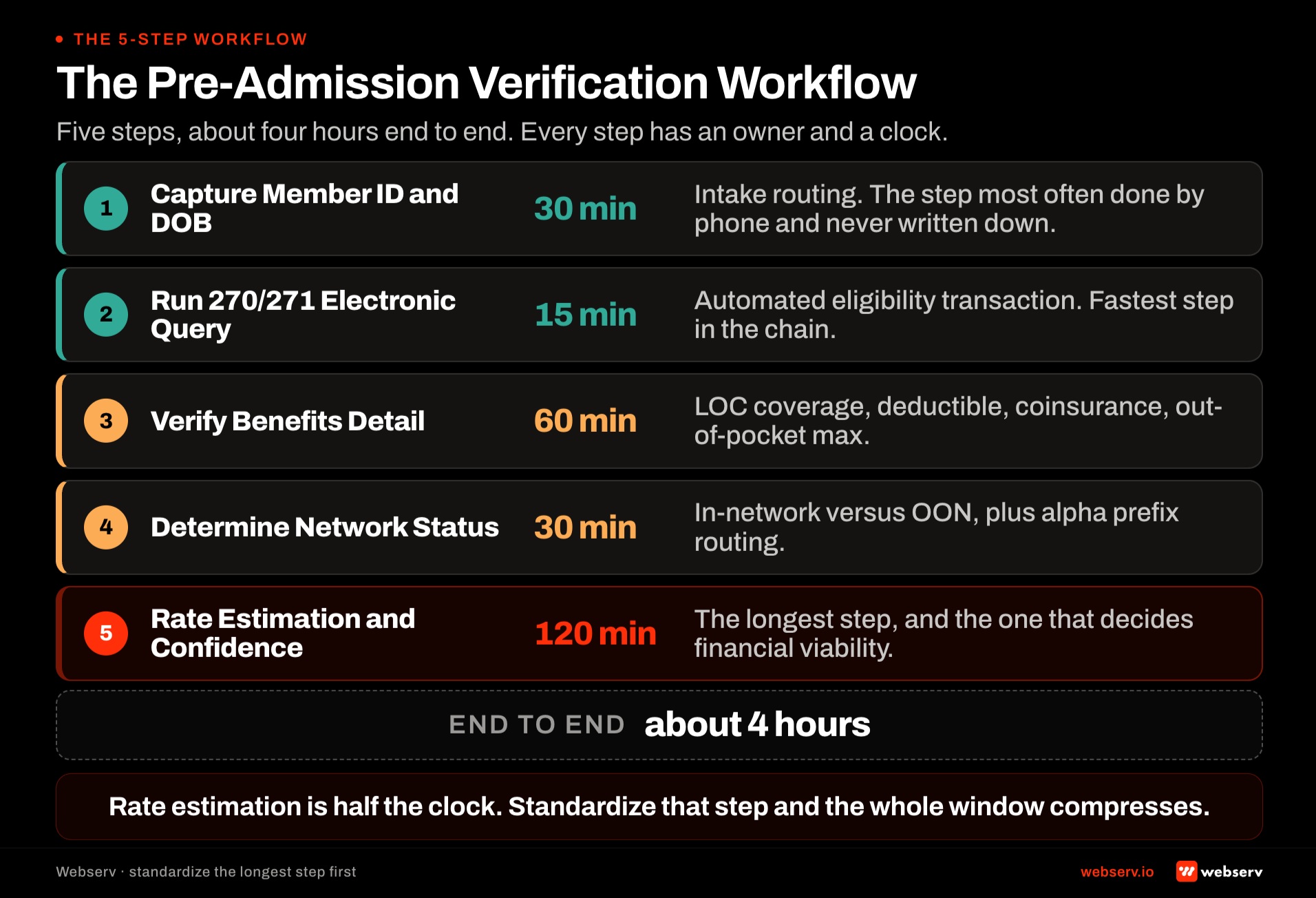
The workflow that produces defensible rate confidence has five steps. Each step has a specific output that feeds the next step. Skipping steps or reordering them produces verification that is technically complete but does not support the admissions decision.
Step 1: Capture member ID and date of birth at inquiry
The admissions coordinator asks for the specific member ID as printed on the insurance card, the group number, and the patient’s date of birth. The specific gotcha: some coordinators ask for insurance carrier name and stop there. The carrier name is not sufficient to run the 270/271 transaction.
For BCBS specifically, capture the full alpha prefix (typically three letters before the numeric portion of the member ID). BCBS operates as 33 independent licensees across the country, and the alpha prefix identifies which BCBS home plan the coverage sits under. Our BCBS alpha prefix piece covers the specific resolution logic.
Step 2: Run eligibility check via 270/271 transaction
The 270 is the eligibility request. The 271 is the payer response. The transaction confirms whether coverage is active as of the date of service, what plan the patient is enrolled in, and returns benefits detail depending on the payer’s implementation. Modern eligibility clearinghouses (Availity, pVerify, Change Healthcare) run the 270/271 through their API and usually return the response within minutes.
The specific data the 271 response should include: coverage active status, plan type (HMO, PPO, EPO, POS, HDHP), effective date, termination date if applicable, network category, and typically benefits detail for specific service categories.
Payer implementations vary. Some payers return comprehensive benefits detail in the 271 response. Others require follow-up transactions or portal lookups to complete the benefits picture.
Step 3: Verify benefits detail (deductible, OOP max, coinsurance, prior auth requirements)
The 271 response usually returns partial benefits detail. The full picture requires additional lookups: individual and family deductible amounts, individual and family out-of-pocket maximum, coinsurance percentage for the specific service, deductible met and OOP max met to date, prior authorization requirement flag, and any specific LOC or modality restrictions.
The specific gotcha: benefits reset annually (or on plan-specific dates), and the current deductible and OOP max met amounts affect the immediate reimbursement expectation. A patient who has met their deductible produces a different immediate reimbursement expectation than a patient who has not.
Step 4: Determine network status
Confirm whether the facility is in-network with the patient’s specific plan, in-network with the underlying payer but not the specific plan network, or fully out-of-network. Network status affects reimbursement rates, patient financial responsibility, and prior authorization requirements. For BCBS specifically, network status has to be evaluated against the home plan the alpha prefix resolves to, not the BCBS entity handling the transaction.
Step 5: Rate estimation with confidence scoring
Combine the network status, benefits detail, and payer-specific historical reimbursement data to produce a rate estimation with confidence scoring. The rate estimation answers “what will this facility likely be paid for this patient at this level of care.” The confidence score answers “how defensible is this estimate given the data underlying it.”
For in-network patients, rate estimation is grounded in the facility’s contracted rates and the specific benefits structure. For out-of-network patients, rate estimation requires access to historical claim payment data from other facilities on the same plan structure. Our OON reimbursement math piece walks the OON estimation methodology in depth.
The two tooling paths
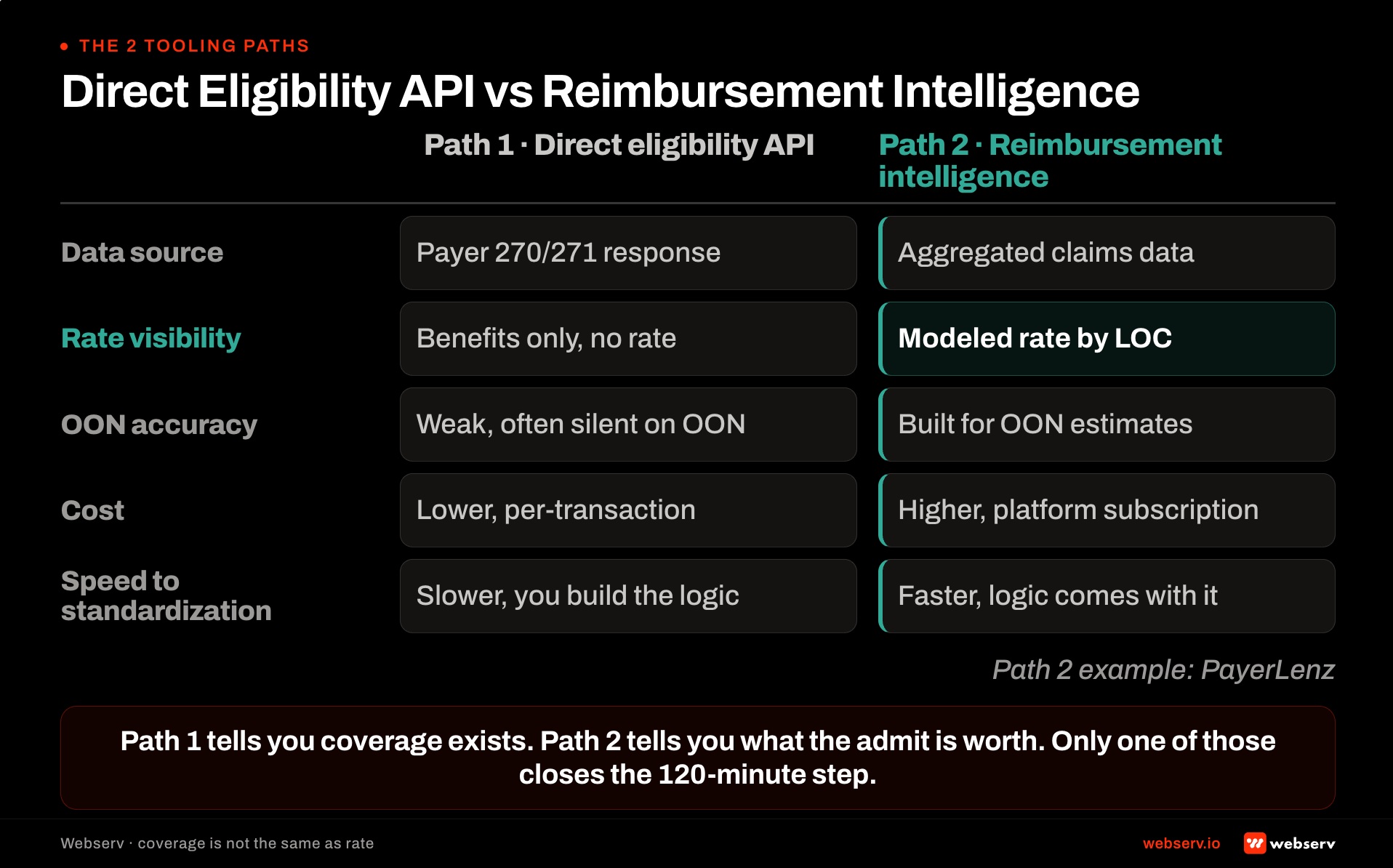
Treatment centers operate verification on one of two tooling paths. Each path produces different verification outputs and supports different downstream operations.
Path 1: Direct eligibility API integration
Facilities integrate directly with Availity, pVerify, Change Healthcare, or an equivalent eligibility clearinghouse. The API returns 270/271 transaction data. The verification team uses that data to complete Steps 3 through 5 manually or through internal lookup tables.
Path 1 advantages: lower per-transaction cost at scale, direct control over the workflow, integrations with most CRM and EMR platforms.
Path 1 challenges: rate estimation at Step 5 requires the facility to build and maintain internal payer intelligence, which is typically not a core competency for admissions operations. Facilities running Path 1 typically produce rate estimation that is either conservative (understating expected reimbursement to protect against surprises) or aspirational (overstating expected reimbursement based on the best-case scenarios). Neither produces the defensible confidence scoring the coordinator needs for the family conversation.
Path 2: Reimbursement intelligence platform integration
Facilities integrate with a reimbursement intelligence platform (PayerLenz or equivalent) that layers rate estimation with confidence scoring on top of the raw eligibility data. The platform pools claim payment data across multiple facilities to produce statistically defensible rate estimation at Step 5.
Path 2 advantages: rate estimation and confidence scoring at Step 5 come from actual claim payment data rather than facility-specific assumptions. The confidence score itself is a defensible output the coordinator can reference.
Path 2 challenges: higher per-transaction cost, dependency on the platform’s data pool coverage for the specific payers and plans the facility encounters. Our PayerLenz claims data pool piece walks the specific network effect that makes reimbursement intelligence platforms work. Facilities running Path 2 typically produce verification that supports admissions decisions with defensible rate confidence. Facilities running Path 1 typically produce verification that supports admissions decisions with less defensible rate estimation.
The verification surface at a glance
5
Steps: capture, eligibility 270/271, benefits detail, network status, rate estimation
2 paths
Tooling: eligibility clearinghouse vs reimbursement intelligence platform
4 hrs
Verification standard from inquiry to defensible rate confidence
Faster wins
Families hold intent better when verification comes back the same day
The BH-specific challenges
Five specific challenges consistently break standard verification workflows in behavioral health.
Challenge 1: BCBS alpha prefix routing. BCBS operates 33 independent licensee organizations across the country. The alpha prefix on the member ID identifies which BCBS home plan the coverage sits under, which determines network status, benefits structure, and reimbursement patterns. There are approximately 21,800 alpha prefixes mapped to home plans. Facilities without alpha prefix resolution logic produce network determination and rate estimation errors on meaningful share of BCBS inquiries. Our BCBS alpha prefix piece covers the resolution playbook.
Challenge 2: OON rate estimation without contract data. In-network verification is straightforward: the facility has contracted rates, the patient’s plan structure determines cost share, and rate estimation is a mechanical calculation. Out-of-network verification is harder because the reimbursement depends on the payer’s OON policy for the specific plan structure and the facility’s billing approach. Our OON reimbursement math piece covers the estimation methodology.
Challenge 3: Payer-specific level-of-care restrictions. Some payers cover residential SUD only after step-through failure at IOP or PHP. Some payers require specific medical necessity criteria documentation for adolescent residential. Some payers restrict length of stay to specific durations without concurrent review. Verification has to identify these restrictions at Step 3 rather than surfacing them at prior authorization.
Challenge 4: Prior authorization requirements varying by state and plan. Prior authorization requirements are not standardized. Some plans require prior auth for all BH services. Some require it only for specific LOCs. Some require it only for out-of-state facilities. State parity law implementation varies. Verification has to identify prior auth requirement before the admit day scheduling conversation.
Challenge 5: Family payer complexity for dependent coverage. The patient is often a dependent on a parent’s or spouse’s insurance. The dependent status affects which coverage rules apply, which network the patient sits under, and how benefits stack across primary and secondary coverage when both exist. Verification for dependents requires additional data capture and additional benefits lookups beyond the primary-adult-patient scenario.
The four-hour verification standard
Modern verification tooling and workflow discipline produces verification inside four hours of inquiry during business hours. Facilities running against that standard keep more families engaged than facilities running verification at 24 to 72 hours, and your own inquiry-to-admit data will show the difference.
The specific workflow that achieves the four-hour standard:
Inquiry arrives with member ID capture at the coordinator seat (either through the intake form or through the coordinator’s first call). Coordinator triggers the eligibility check inside the first 30 minutes of inquiry.
Automated eligibility API returns the 270/271 within minutes. Benefits detail verification runs against the payer portal or the reimbursement intelligence platform inside the next 30 to 60 minutes. Network status determination and rate estimation complete inside the following 60 to 120 minutes.
Total elapsed time: 2 to 4 hours during business hours. The coordinator carries the rate confidence data into the second family conversation, which typically happens within the same business day.
Facilities running against 24 to 72 hour standards typically have workflow gaps rather than tooling gaps.
The specific gap patterns: verification requests batched at end of day, verification staff scheduled independently of admissions coverage, verification handoff between shifts, or verification tooling that requires manual data re-entry across systems. Fixing the workflow gaps produces the four-hour standard without new tooling investment.
Integration with the admissions coordinator conversation
Verification data that does not reach the coordinator seat produces zero operational value. Facilities with strong verification infrastructure that does not integrate with the CRM produce the same conversion rate as facilities without verification infrastructure at all.
The specific integration pattern: verification data writes to specific CRM fields per lead record. The coordinator sees rate estimation and confidence score inside the CRM as part of the standard lead view. Our rate intelligence admissions call script piece walks the specific coordinator conversation pattern that uses the confidence score during the family call.
The specific coordinator use case: family asks “what will this cost with our insurance.” Coordinator has rate estimation with confidence score visible in the CRM view.
Coordinator can respond with a specific range grounded in the confidence score rather than the generic “we will verify and get back to you” pattern that produces the family disengagement most facilities see at this exact moment in the conversation.
Facilities that build verification infrastructure without the coordinator-seat integration typically produce verification reports for the CFO or the admissions director without operational impact on lead-to-admit conversion. The integration to the coordinator seat is what makes the verification investment produce measurable conversion lift.
DO
- Capture member ID + group number + DOB at the first coordinator touch — carrier name alone is not sufficient to run the 270/271.
- Capture the full BCBS alpha prefix and resolve to the home plan before Step 2 runs — 33 BCBS licensees, ~21,800 prefixes, wrong plan = wrong network + wrong rate.
- Write verification outputs (network status, deductible met, coinsurance, prior auth flag, rate estimation + confidence score) to specific CRM fields visible in the coordinator lead view.
- Run against the 4-hour standard for business-hour inquiries — inquiry → member ID capture within 30 min → 270/271 → benefits verification → rate estimation total elapsed 2-4 hrs.
- Document your internal rate methodology if running Path 1 (clearinghouse only) — otherwise you’re running Path 1 without the Path 2 output you’re missing.
DON’T
- Treat verification the same as prior authorization — verification confirms coverage in hours; prior auth takes days and requires clinical documentation.
- Run OON verification the same workflow as in-network — OON rate estimation without pooled claim data produces the conservative-vs-aspirational miss the family conversation cannot recover from.
- Batch verification requests at end of day or split coverage schedule from admissions — 24-72 hour turnarounds are workflow gaps, not tooling gaps.
- Store rate estimation in a CFO report or verification team spreadsheet — if the coordinator can’t see it in the CRM lead view, the investment produces zero conversion lift.
- Flow verification PHI downstream to ad platforms or non-BAA analytics — CRM is BAA-covered; ad platforms are not.
Common failure modes
Five patterns produce most of the pre-admission verification failures we audit.
Failure mode 1: Verification runs at 24 to 72 hours without recognized cause. Facility runs verification workflow that takes 24 to 72 hours because that is what the workflow has always done. Nobody has audited the specific gaps that produce the timeline. Fix: 4-hour standard workflow audit with specific gap identification.
Failure mode 2: Rate estimation is facility-assumption rather than data-grounded. Verification produces rate estimation based on internal facility assumptions rather than actual claim payment data. Estimates are either conservative or aspirational. Family conversation uses the estimate but the actual reimbursement varies materially. Fix: reimbursement intelligence platform for defensible rate estimation. Our 10% Rule case study documents the recovery yield that grounded rate estimation produces.
Failure mode 3: Verification data never reaches the coordinator seat. Verification infrastructure produces defensible rate data. Data lives in the verification team’s tools or the CFO’s reports. Coordinator does not see it during the family conversation. Fix: CRM integration surfaces rate estimation and confidence score in the coordinator lead view.
Failure mode 4: BCBS alpha prefix resolution missing. Facility treats all BCBS coverage as equivalent. Verification produces the wrong network determination or the wrong rate estimation for meaningful share of BCBS inquiries. Fix: alpha prefix resolution tool integrated at Step 2 of the workflow.
Failure mode 5: OON verification treated as equivalent to in-network verification. OON coverage requires different rate estimation methodology, different network status determination, and often different prior authorization workflow. Facilities that run OON verification the same way as in-network verification produce the specific rate-assumption problems that surface at billing 60-90 days later.
Frequently Asked Questions
How long does it actually take to move from a 24-hour verification workflow to a four-hour workflow?
Between 45 and 90 days for most treatment centers. The specific breakdown: 14 to 21 days on workflow audit and gap identification, 14 to 21 days on tooling integration where needed, 14 to 21 days on staff training and coverage schedule adjustment, and 14 to 30 days of post-deployment monitoring to confirm the four-hour standard is holding.
Facilities with existing verification tooling that runs against a well-configured workflow typically move faster (30 to 45 days) because the gap is workflow-only. Facilities that need to layer reimbursement intelligence tooling on top of existing eligibility APIs typically take 60 to 90 days because the tooling integration adds implementation time.
Portfolio operators typically extend the timeline because each facility runs its own verification workflow and needs its own audit-and-remediation cycle.
What’s the difference between Availity, pVerify, and Change Healthcare for eligibility?
All three are eligibility clearinghouses that run 270/271 transactions against most commercial and government payers.
The specific differences: Availity has the strongest coverage of the major commercial payers and is often the fastest for BCBS transactions. pVerify has particularly strong behavioral health specialty payer coverage. Change Healthcare (now part of Optum) has the largest coverage but has been affected by service disruptions in the trailing 24 months that facilities should factor into vendor selection.
For most treatment centers, the practical choice depends on the facility’s specific payer mix. Facilities with heavy BCBS exposure often prefer Availity. Facilities with heavy specialty BH payer mix often prefer pVerify. Our best real-time eligibility tools comparison covers the platform decision in operational depth.
Do we need a reimbursement intelligence platform if we already have Availity or pVerify?
Depends on the specific verification output the coordinator needs. Availity and pVerify return raw 270/271 data plus benefits detail. They do not return rate estimation with confidence scoring at Step 5 of the workflow. Facilities that need defensible rate estimation for OON coverage or for complex plan structures typically layer a reimbursement intelligence platform on top of the clearinghouse. Our PayerLenz claims data pool piece walks the specific network effect.
Facilities with heavy OON exposure benefit most from reimbursement intelligence layering, because OON rate estimation without pooled claim data produces the rate assumption problems documented above. Facilities with predominantly in-network mix may run defensibly on the clearinghouse alone plus internal contract data.
Facilities running eligibility clearinghouses alone should document their internal rate methodology and confidence scoring approach. Facilities without a documented methodology are effectively running Path 1 without the Path 2 output that path is missing.
How does verification interact with prior authorization?
Verification identifies whether prior authorization is required. Prior authorization is a separate downstream workflow. The verification workflow completes at Step 5 (rate estimation). Prior authorization begins where verification identifies the requirement and typically involves clinical documentation submission through the payer’s UM process.
The specific handoff pattern: verification identifies prior auth requirement and initiates the process. Clinical intake or UR staff complete the prior auth submission. Prior auth response arrives 24 to 72 hours later (sometimes longer for expedited or non-standard cases). Prior auth outcome feeds the admit day scheduling decision.
Facilities that treat prior auth as part of verification typically produce four-hour verification standards that immediately extend to 48 to 96 hours as the prior auth process runs. Facilities that separate the two workflows can produce four-hour verification standards that support admit day scheduling in parallel with the prior auth process running.
What data should verification write back to the CRM?
At minimum: coverage active status, plan type, network status determination, deductible met, out-of-pocket max met, coinsurance percentage, prior auth requirement flag, prior auth status (if applicable), rate estimation with confidence score, and verification completion timestamp.
Facilities running against the four-hour standard also write the specific eligibility API used, the 270/271 transaction reference, and the specific reimbursement intelligence platform reference where applicable. This produces audit trail data that supports the monthly reconciliation workflow the attribution discipline requires.
The specific gotcha: writing PHI-heavy data to the CRM produces HIPAA-compliant use cases (the CRM is a covered entity under BAA) but the same data cannot flow downstream to ad platforms or non-BAA analytics platforms. Verification data flow through the stack requires careful architecture to preserve PHI protection while producing the reporting the CFO and admissions director need.
Should verification workflow be centralized or distributed across admissions coordinators?
Depends on facility scale. Single-facility operators with 3 to 5 coordinators typically run distributed verification where each coordinator handles verification for their own inquiries. Portfolio operators or single facilities with 8+ coordinators typically run centralized verification where a dedicated verification team handles verification while coordinators focus on family conversations.
The specific tradeoff: distributed verification produces faster individual-inquiry response but variable quality across coordinators. Centralized verification produces consistent quality but requires handoff workflow between coordinators and verification staff.
For facilities running against the four-hour standard, either model works when the workflow discipline is in place. The specific failure mode for distributed verification is quality variance across coordinators. The specific failure mode for centralized verification is handoff delay between coordinator inquiry and verification submission.
How does pre-admission verification connect to post-admission reimbursement?
Verification produces the expected reimbursement calculation that post-admission billing measures actual reimbursement against. The gap between expected and actual is the specific measurement signal that surfaces underpayment recovery opportunities.
The specific workflow: verification produces rate estimation with confidence score at Step 5. Billing produces expected reimbursement calculation based on that verification data. Actual reimbursement arrives 30 to 90 days after service. The variance analysis between expected and actual surfaces payer-specific underpayment patterns that feed the underpayment recovery workflow. Our underpayment recovery workflow piece covers the specific downstream reconciliation logic.
Our reimbursement intelligence hub covers the broader post-admission reimbursement discipline this pre-admission workflow feeds into. The 10% Rule case study documents the compounding recovery yield when the pre- and post-admission workflows integrate.
Kyle McHenry is the founder of Revenue Logic, a behavioral-health revenue cycle partner. Webserv partners with Revenue Logic to surface RCM-side guidance for treatment center marketing teams.