I audited a call recently where a viable prospect called in, a real one with commercial insurance, and the coordinator got off the phone in four minutes. She said “I’m going to give you a call back, check your benefits.” She never called back. Nobody in the organization called back.
That call was an admit. It’s gone.
I have seen this pattern hundreds of times across the audits I run inside our admission operations program at Webserv, and it almost always traces back to the same thing.
The first 60 seconds of the call was not scripted. The coordinator did not know what question to ask next. She let the caller drive the conversation, and the conversation drove itself off a cliff.
This article is the 8-step opening protocol I teach every admissions team I coach. It’s the script we deploy in the first 60 seconds of every call, no matter what. Same opener, same questions, same expert insert, same frame. When you deviate, you don’t close at a high level. Period.
Key Takeaways
- Every call is the same for the first 60 seconds. Same opener, same three questions, same frame, same insurance question that transitions into VOB. When your coordinators deviate from the script, the close rate collapses.
- The single biggest failure pattern I see is coordinators letting the caller drive the conversation. The caller asks where you are located and what levels of care you offer, the coordinator answers, and the call ends before the assessment ever starts.
- Never reveal your location or your level of care before the phone assessment is complete. Being militant about this rule is what separates working admissions teams from broken ones.
- The first 60 seconds ends with the same question every time: “What type of health insurance do you have?” That question transitions the call from control to VOB, which is milestone one on every call.
- Coordinators pitching in the first five minutes close 10 to 15 percent of viable calls. Coordinators running the full protocol close 33 to 40 percent on paid media leads and closer to 50 percent on SEO leads. The difference is millions of dollars in admit volume, not thousands.
Why the First 60 Seconds Is the Whole Call
Every admissions call at a treatment center goes through a predictable structure. There is a discovery phase, a benefits check, a clinical assessment, and a recommendation. The evidence base for structured screening and brief intervention in substance use disorder is well-established at the federal level through SAMHSA’s SBIRT framework. The first 60 seconds is where the coordinator establishes control of the conversation, or gives it away.
If the coordinator establishes control, the rest of the call moves through the protocol. The prospect answers questions instead of asking them. The VOB gets pulled. The assessment happens. The recommendation lands. The full protocol is in our guide to building an admissions process that converts.
If the coordinator gives control away in the first 60 seconds, everything downstream collapses. The prospect asks where the facility is located, hears “Southern California,” says “I can’t travel,” and the call ends.
The coordinator never got to the assessment. Never learned that the prospect’s family would fly them out. Never had a chance to recommend a program.
Every call is the same, no matter what. The first five minutes, every call is the same. When you deviate from it, you’re not going to close at a high level.
Jim Malcom, Director of Admission Ops, Webserv
The consistency is the point. Prospects call in different states, from different geographies, with different levels of urgency, with different insurance situations. What has to stay identical is what the coordinator does in the first 60 seconds. That is the only variable the treatment center actually controls.
The Setup Before You Pick Up the Phone
DEFINITION
Non-Verbal Cues
The tone, energy, facial expression, and body language that carry meaning in a face-to-face conversation. On a phone call, all non-verbal cues are lost. Coordinators have to compensate through tonality alone, which is why audio quality and vocal energy matter more than most treatment centers realize.
The technical setup determines whether the coordinator sounds like an expert or sounds like someone in a call center. Both are the same person. The audio makes the difference.
Every coordinator needs a noise-cancelling headset with a quality microphone. Internet connection with low latency and no packet loss. A quiet workspace. This is not optional.
When a prospect calls a treatment center for the first time and the audio sounds like a boiler room, they hang up. When the audio sounds professional, they stay on the line.
The vocal register matters as much as the equipment. High energy on the pickup. Confident tone. Warm, not aggressive.
Coordinators who sound tired at hour four of a shift are converting at half the rate they were converting at hour one. Rotate agents through phones. Give them recovery time. The voice is the product.
The 8-Step First 60 Seconds
- Audio and Tonality. Noise-cancelling headset on, mic checked, workspace quiet. Vocal energy high. You are compensating for lost non-verbal cues through tonality alone. If the audio is bad, the call is over before it starts.
- The Opener. “Admissions, this is Jim. Who am I speaking with, please?” Same words, every call. Get the caller’s name, then use it throughout the conversation. Rapport starts with the name.
- Yourself or Loved One. “Are you calling for yourself or a loved one?” This tells you which persona you’re working with. The answer changes how you frame every subsequent question, but the question itself is asked the same way every time.
- Open the Door. “Tell me how I can help.” Or: “What’s going on?” Or: “How can I be of service today?” The prospect will start talking. They will also try to ask questions: where are you located, do you offer this, are you this place. That is expected. You are about to take back control.
- Take Back Control. Do NOT answer their location or level-of-care questions yet. You will answer them later. Right now you are qualifying. Be militant about this rule.
- The Expert Insert. “I’m really happy you called today, because we’re going to get you some help. I help a lot of people that call just like you.” This is the moment you establish authority. The prospect stops driving the conversation and starts following you.
- Frame the Process. “We have a network of treatment facilities and this is how it works. We’re going to check your insurance benefits, we’re going to do a phone assessment, and our clinical team is going to recommend the treatment program that’s the best fit for you.” The prospect now knows what happens next. They will follow.
- The Transition Question. “What type of health insurance do you have?” This closes the first 60 seconds and opens the VOB. Question, question, question, insurance. Same order, every time.
That is the full protocol. Eight steps. Under 60 seconds when a coordinator runs it cleanly. It ends with the transition to VOB, which is milestone one on every call.
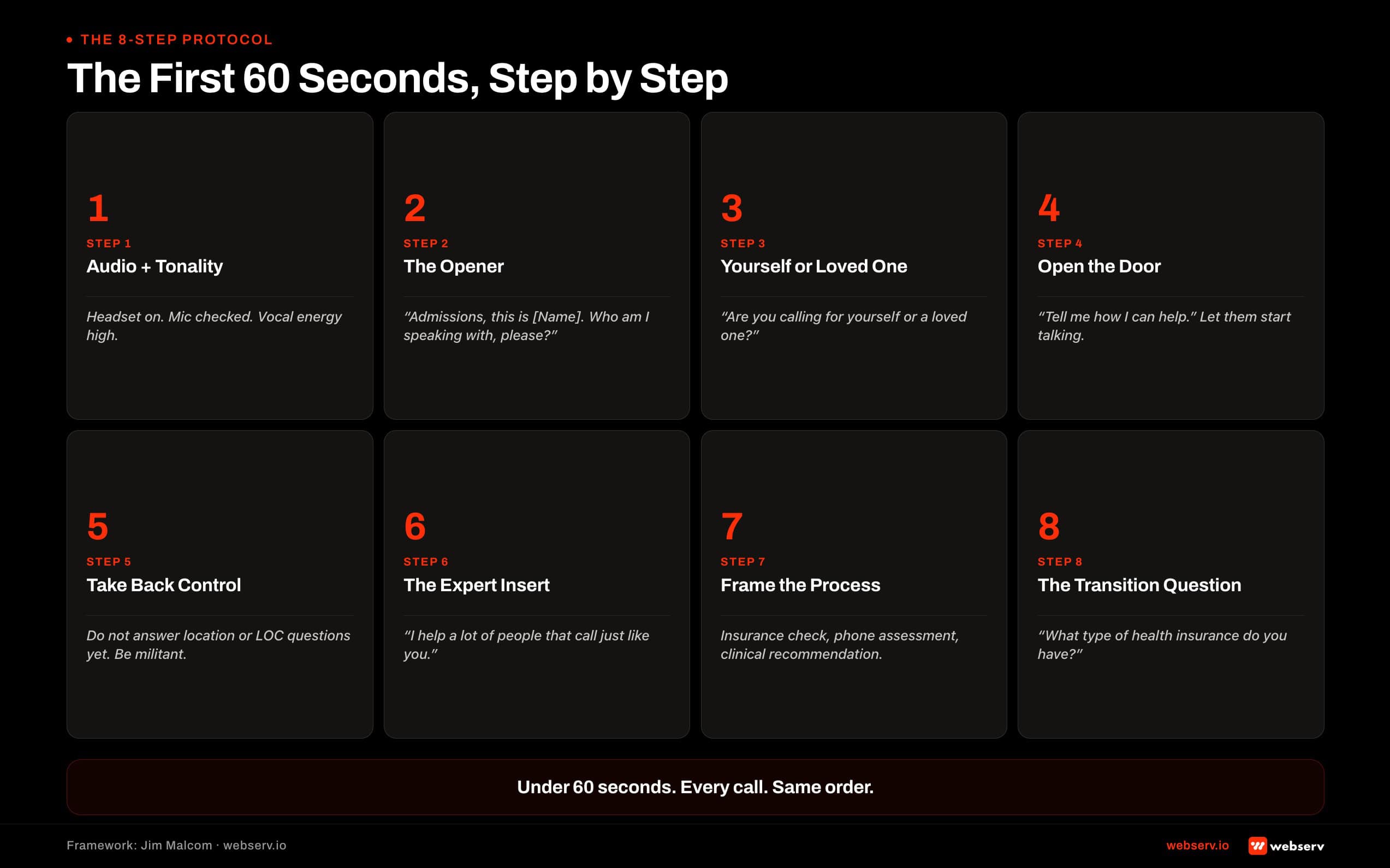 Jim Malcom’s 8-step protocol for the first 60 seconds of a treatment center admissions call, from audio setup and the opener through to the transition question about insurance.
The Militant Rule: No Location, No Level of Care
NEVER REVEAL YOUR LOCATION OR YOUR LEVEL OF CARE BEFORE THE ASSESSMENT IS COMPLETE
Being militant about this rule is what separates working admissions teams from broken ones. Prospects will ask both questions in the first 30 seconds of every call. Coordinators who answer either question before the VOB and assessment are done lose the call.
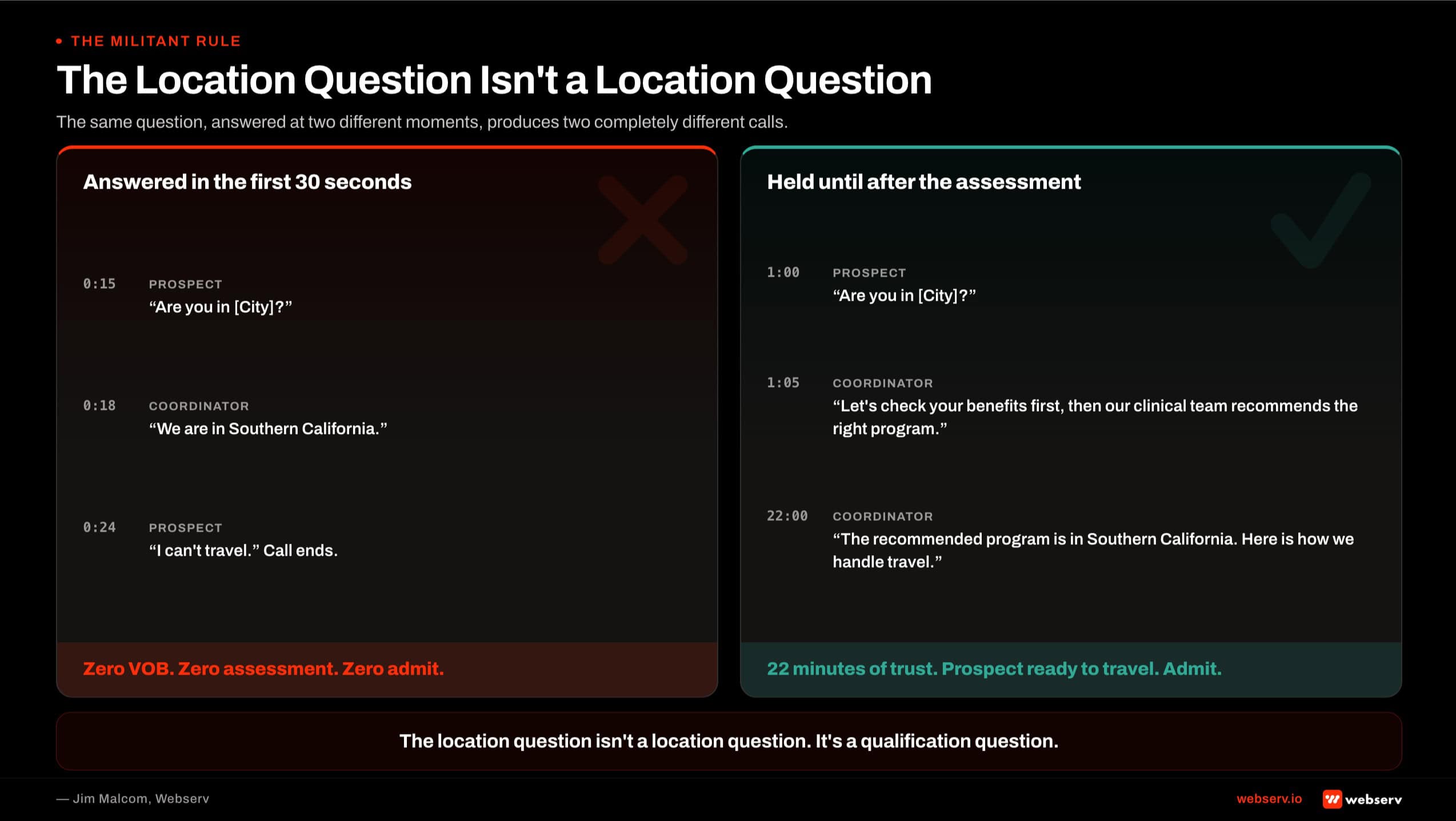 Two-panel comparison showing what happens when a treatment center admissions coordinator answers the prospect’s location question in the first 30 seconds versus holding the answer until after the assessment is complete.
Prospects call in Ohio and ask if you are in Ohio. If the coordinator says “we’re in Southern California,” the call ends.
What the coordinator should do is take back control: “We have a network of treatment facilities, and here is how it works. Let’s check your insurance benefits, and then our clinical team will recommend the right program for you.”
The coordinator answers the location question later, after the assessment, when the recommendation is made.
By then the prospect has invested 20 minutes in the conversation, they trust the coordinator, they have talked openly about their use, and they are ready to hear that the recommended program is 2,000 miles away.
If the coordinator answers the location question in minute one, the prospect never gets there. The call is over.
The same rule applies to level of care. Prospects call and ask “do you do IOP?” Answering that question directly is a losing move.
The right answer is that the clinical team makes the level-of-care recommendation after the assessment. This is not evasion. It is preserving the coordinator’s ability to make the right clinical recommendation instead of matching the prospect’s guess.
What Bad First 60 Seconds Sound Like
WHAT A WORKING FIRST 60 SECONDS SOUNDS LIKE
- “Admissions, this is Jim. Who am I speaking with, please?”
- Coordinator drives the conversation with the 3-question sequence
- “We have a network of treatment facilities and this is how it works…”
- Coordinator transitions to the insurance question inside 60 seconds
- Coordinator’s tone is high-energy, warm, confident
WHAT A BROKEN FIRST 60 SECONDS SOUNDS LIKE
- “Hello? Yeah? What do you need?”
- Prospect drives the conversation with location and level-of-care questions
- “We’re in California. Is that going to be a problem?”
- Coordinator is still explaining the facility at minute 4
- Coordinator sounds tired, transactional, or unprepared
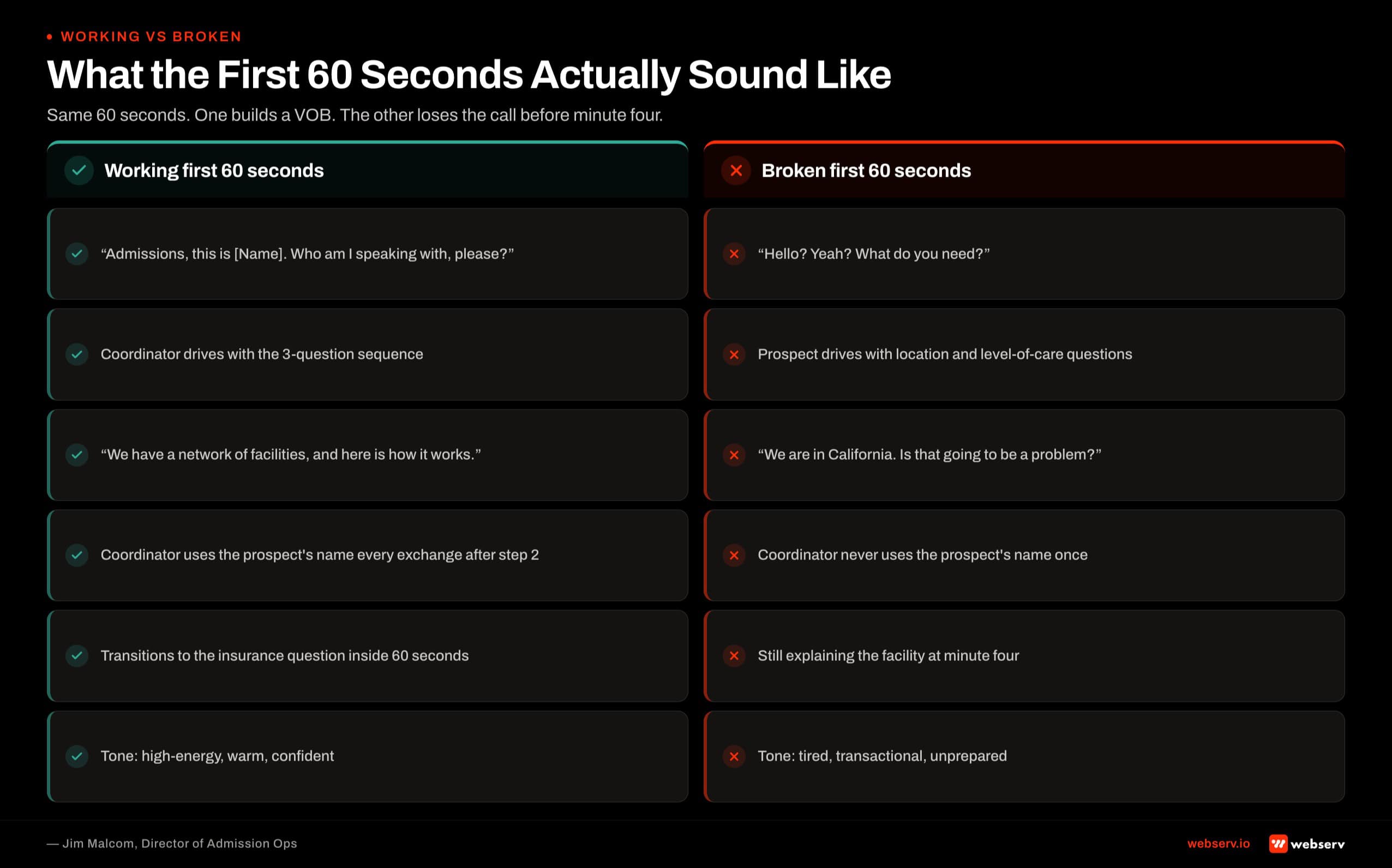 Six side-by-side comparisons of what a working first 60 seconds of an admissions call sounds like versus what a broken first 60 seconds sounds like at a treatment center.
The four-minute call I opened this article with hit almost every column on the right. The coordinator picked up flat. She asked no qualifying questions. She let the prospect talk at length about their situation without steering.
She said “let me check your benefits and call you back,” which is a broken handoff. No VOB ever got pulled because the call ended before it started. The prospect never heard from her again.
That call was a viable admit worth $12,000 to $16,000 in acquisition value. It was thrown away in four minutes.
The Cost Math
10-15%
close rate when coordinators pitch inside the first 5 minutes
33-40%
target close rate on paid media leads with the full protocol
~50%
target close rate on SEO leads with the full protocol
An underqualified admissions rep is the most expensive person in your organization by far. A 10 percent closing rate compared to a 40 percent closing rate is millions of dollars in revenue at any real ad spend.
The cost math is straightforward. If your paid media is producing $4,000 viable prospects, and your team closes at 10 percent, your cost per admit is $40,000.
If the same team closes at 40 percent on the same leads, your cost per admit is $10,000. Same marketing spend, same leads, different admissions execution.
Most treatment center operators are surprised when I run these numbers on their own account. They think the marketing is the problem. Usually it isn’t. Usually it’s the first 60 seconds. Our complete guide to behavioral health marketing covers the other half of the funnel.
Coaching Your Team Into This
THE PROTOCOL IS THE PROTOCOL, BUT THE DELIVERY IS THE COORDINATOR
Some coordinators run the script perfectly and still convert at 20 percent because their tonality is flat. Others run the same script and convert at 45 percent because their energy is on. Once the script is in place, the coaching move is on delivery: energy, warmth, confidence, pacing. That is where the second half of the close-rate lift comes from.
The transition from unscripted calls to protocol-driven calls takes a treatment center about four to six weeks. Week one is teaching the script. Week two is drilling the script. Week three is call recordings and coaching. Week four is measurement and refinement.
The most common resistance comes from senior coordinators who have been doing intake calls their own way for years and believe they close at a high rate. Sometimes they do.
More often they close at a lower rate than they think, and the protocol lifts them 8 to 12 points once they buy in. Check your feelings and work off actual data. Everyone says they’re willing to do it. Not everyone actually is.
The other common resistance comes from clinical directors who see the protocol as sales-y. It isn’t. The protocol is designed to get the prospect through a proper clinical assessment, not to close them. SAMHSA’s TIP 35 on enhancing motivation for change in SUD treatment is the clinical framework these coordinator conversations lean on.
The recommendation at the end is a clinical recommendation. The prospect either follows it or doesn’t. The protocol just makes sure they get to the recommendation instead of hanging up in minute four.
The rewrite pays back inside the first month for most centers. Book an intro meeting if you want to walk your current call recordings with our team.
Frequently Asked Questions
Isn’t this too scripted? Won’t callers feel like they’re talking to a robot?
The script is invisible to a well-trained coordinator. The words are consistent, but the delivery is warm, human, and adaptive. Prospects do not perceive a scripted opening as robotic when the tonality is right. They perceive it as professional.
The alternative to a scripted opening is not a natural conversation. It is a chaotic conversation where every coordinator is improvising, every call goes differently, and the treatment center cannot train or measure anything. The chaos feels more human to the coordinator running it. It does not feel more human to the prospect.
The centers that convert at 40 percent are running scripted openings that sound completely natural because the coordinators have practiced them into fluency. Fluency is what makes a script invisible.
What about calls that come in outside business hours?
The protocol applies to every call, including after-hours calls. If your admissions team is not covered outside business hours, the calls go to voicemail or an answering service, and the protocol falls apart at the exact moment your prospect needed it most.
Most treatment centers should be staffed from early morning to past sundown, seven days a week. Not full 24-hour coverage, but a real coverage window that captures the calls that matter. Sunday morning calls close at the same rate as Wednesday afternoon calls if the coordinator is on the phone and running the protocol.
Missed calls do not come back at the same rate they came in the first time. Every missed call is a permanent loss unless the callback happens inside 60 seconds. Staff for the volume, or accept the miss rate as a fixed cost of your operation.
How do we get a resistant admissions team to adopt a new script?
Start with the data. Pull call recordings from the last 30 days and score them against the protocol. Show the team where the calls broke and what the close-rate impact was. Most coordinators are willing to change once they see their own recordings.
Move to weekly call reviews with the team. Not annual training. Weekly. Play one good call and one broken call. Discuss what worked and what did not. This is how the protocol becomes the culture, not just the policy.
The last resort is compensation redesign. Some agencies move to a bonus structure tied to VOB pulls or to closing rate. Compensation aligns behavior faster than any other tool, but it only works if the underlying script is teachable and fair. If the script is right, comp restructuring accelerates adoption.
What role does the CRM play in the first 60 seconds?
The CRM should be open before the phone rings. The coordinator should be logged in, ready to create a new prospect record while the call is happening. Fumbling with the CRM in the first 30 seconds of a call is a common failure mode that a scripted opening covers cleanly.
The protocol captures the name in step 2, the caller’s context in step 3, and insurance in step 8. Those three fields go into the CRM record immediately. The prospect never notices because the coordinator is running the script while typing.
The CRM matters because every downstream action (the VOB pull, the assessment, the recommendation, the follow-up cadence) depends on the record being clean from the start. Coordinators who skip CRM entry in the first 60 seconds are producing untraceable admits, which is a separate problem for the marketing team and the reporting system.
Jim Malcom is the Director of Admission Ops at Webserv, a digital marketing agency for treatment centers.