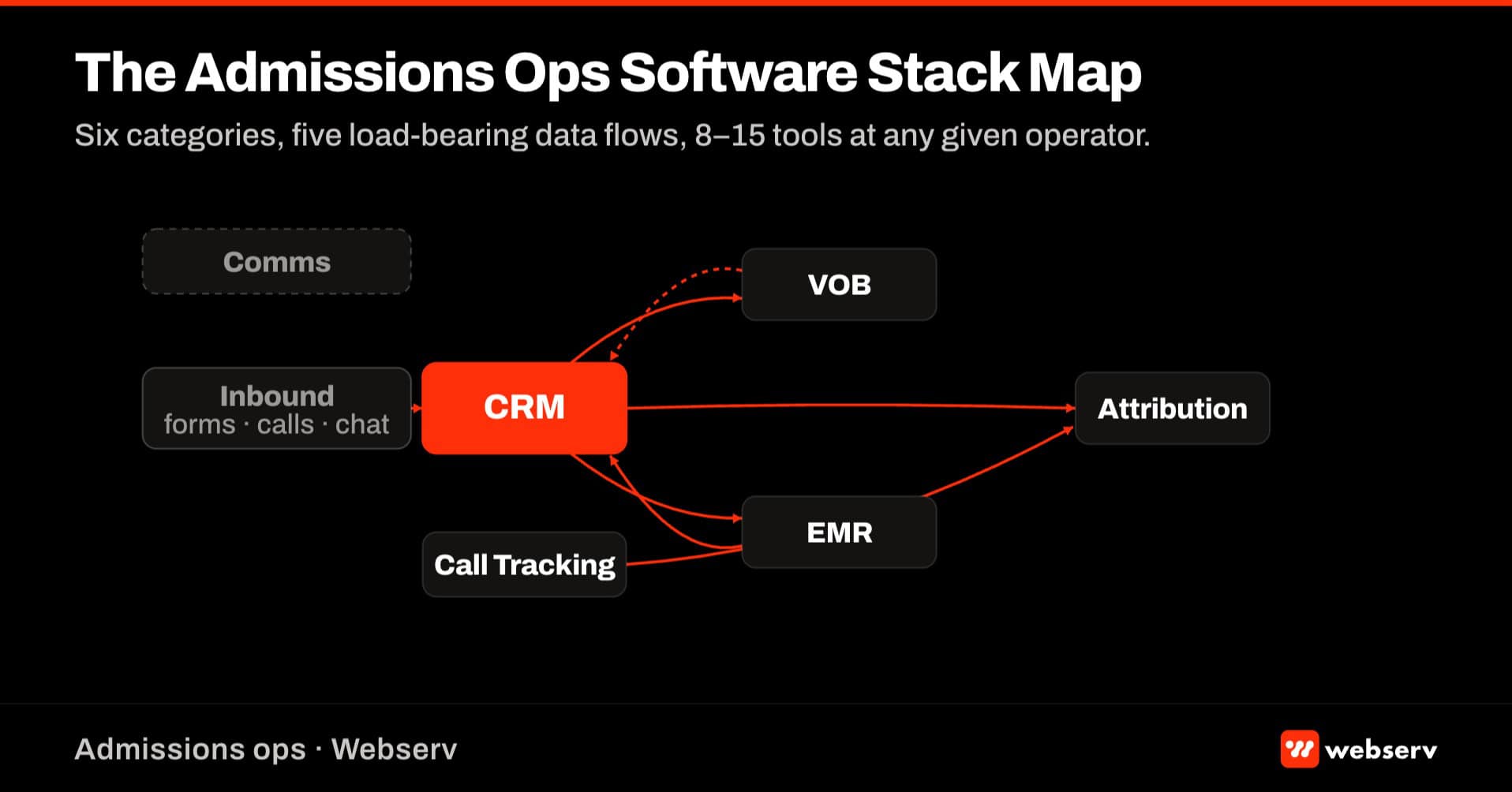
Every treatment center runs some version of the admissions ops software stack. Most operators cannot draw it on a whiteboard.
The stack has six categories, five load-bearing data flows between them, and eight to fifteen tools at any given operator depending on scale.
When something breaks (a lead does not show up in the CRM, a VOB result never syncs, a call gets tracked but not scored, an admit gets scheduled but marketing never learns the payer), the fix requires knowing which category owns the broken step and which data flow carries it.
Operators without a mental model of the stack rebuild the wrong tool.
This piece is the canonical map I use with the admission ops engagements our team runs.
It walks the six categories, the specific tools that show up inside each, the five data flows that make the stack function, the integration decision points where operators most often get stuck, and the specific patterns of failure that surface when a category is missing or misconfigured.
It sits alongside the admissions ops complete guide that covers the process discipline, and inside the broader admissions ops series that walks each individual tool and each individual failure mode in depth.
Key Takeaways
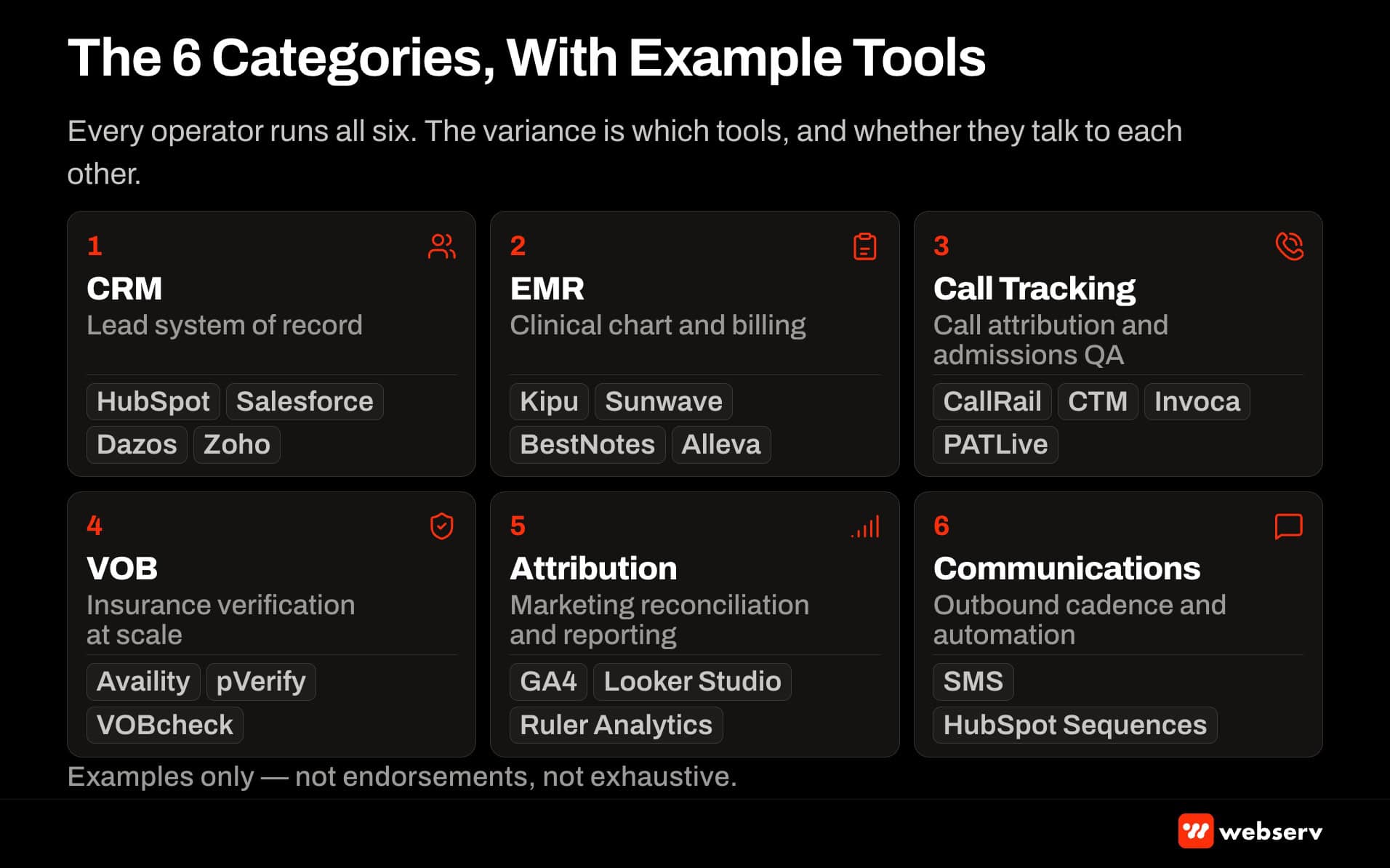
- The admissions ops software stack has six categories: CRM, EMR, call tracking + scoring, VOB automation, attribution + analytics, and communications + workflow. Each category owns a specific slice of the admissions workflow. Most operators can name their tools but not their categories, and that is the source of the “whose problem is this” delay when something breaks.
- Five load-bearing data flows connect the categories: lead-to-CRM, CRM-to-VOB, CRM-to-EMR, EMR-back-to-CRM, and CRM-plus-call-tracking-to-attribution. When admissions performance drops, the diagnostic question is not which tool broke; it is which data flow broke, and that maps back to which category-to-category integration is failing.
- The single most common failure pattern is a broken CRM-to-EMR handoff. Marketing hits the CRM, admissions closes in the CRM, but the patient identity does not survive the handoff into the EMR at admit day, which breaks the EMR-back-to-CRM reimbursement reconciliation flow. Facilities running this pattern cannot connect marketing spend to marketing yield.
- Category ownership is where organizational failure lives. Marketing usually owns CRM, call tracking, and attribution. Clinical usually owns EMR. Admissions sits between the two. Facilities without clear category ownership produce the specific failure mode where each team thinks the other team owns the broken handoff.
- Adding entity mapping and AI-readable evidence chunks to the stack (per the emerging AEO pattern) requires the six-category picture to already be defensible. The AI-readability surfaces cannot compensate for a broken stack; they can only compound value on top of a stack that is already running cleanly.
- The right sequencing for facilities under-invested in the stack is CRM + call tracking first (weeks 1-4), VOB automation second (weeks 5-8), EMR integration audit third (weeks 9-12), attribution + AI-readiness fourth (weeks 13-16). Skipping ahead produces the same category-to-category integration failures the sequencing exists to prevent.
DEFINITION
Admissions ops software stack. The set of interconnected platforms a treatment center runs to convert an inbound behavioral health lead into a completed admission and reconcile the reimbursement outcome back to marketing. Six categories: CRM, EMR, call tracking + scoring, VOB automation, attribution + analytics, and communications + workflow.
Distinct from the admissions process (the workflow, staffing, and coordinator playbook) which lives in a separate discipline. Stack failure is a category ownership + data flow problem, not a tool selection problem. Most operators can name their tools; the map is what tells them which category-to-category integration owns a given failure.
The six categories
Category 1: CRM
The system of record for the pre-admit relationship. Every inbound lead, every family conversation, every VOB request, every scheduled admit lives here. Common tools: Kipu CRM (bundled with Kipu EMR), Salesforce (custom BH configurations), HubSpot (marketing-CRM hybrid), Sunwave CRM (bundled with Sunwave EMR), and BestNotes CRM. Our CRM buyers guide walks the platform decision.
Category 2: EMR
The clinical system of record. Patient charting, treatment planning, medication management, discharge planning, and billing feed live here. Common tools: Kipu, Sunwave, BestNotes, Alleva. Our EMR selection framework walks the platform decision. The EMR is where the patient identity has to survive the handoff from the CRM at admit day; failures at the handoff are the single most expensive stack breakage.
Category 3: Call tracking + call scoring
The system that captures inbound calls, records them, tracks source attribution, and scores conversion quality. Common tools: CallTrackingMetrics (CTM), CallRail. Our CTM implementation piece walks the specific configuration for treatment centers. Call tracking is Category 3 because call quality is the highest-variance factor in lead-to-admit conversion, and without independent scoring the admissions team hostage dynamic becomes structural.
Category 4: VOB automation
The system that runs insurance eligibility and benefits verification. Common tools: Availity, pVerify, Change Healthcare, VOBcheck, plus bundled VOB modules inside EMR platforms (Kipu VOB, Sunwave VOB). Some facilities use RCM partners (Revenue Logic, Element Health, PayerLenz for reimbursement intelligence layered on top of raw VOB). Our Dazos implementation piece covers a specific bundled VOB workflow.
Category 5: Attribution + analytics
The system that measures marketing performance and reconciles ad spend against admits. Common tools: Google Analytics 4, Google Ads, Meta Ads Manager, Meta Conversions API, Google Ads offline conversion imports, GTM Server-Side, and dashboarding layers (Looker Studio, custom data warehouses). The marketing-admissions QBR piece walks the reporting cadence that pulls this category into strategic reviews.
Category 6: Communications + workflow
The system that automates the messaging cadences between the facility and prospective patients and families. Common tools: Twilio (SMS), SendGrid (email), calendaring systems (Calendly, Nylas, Cal.com), plus workflow layers (Zapier, Make, custom). This category has the highest touchpoint-to-cost ratio in the stack and is the most under-invested category at the median treatment center.
OPERATOR INSIGHT
Assign category ownership explicitly. Publish the map. Review it quarterly. When something breaks, the map answers the “whose problem is this” question in seconds instead of days.
The fix for a broken CRM-to-EMR handoff is rarely a technical fix. It is an org chart fix. Marketing thinks admissions owns the handoff, admissions thinks clinical owns the EMR, clinical thinks the vendor owns the integration, and the patient identifier disappears in the seam that no one owns.
The five load-bearing data flows
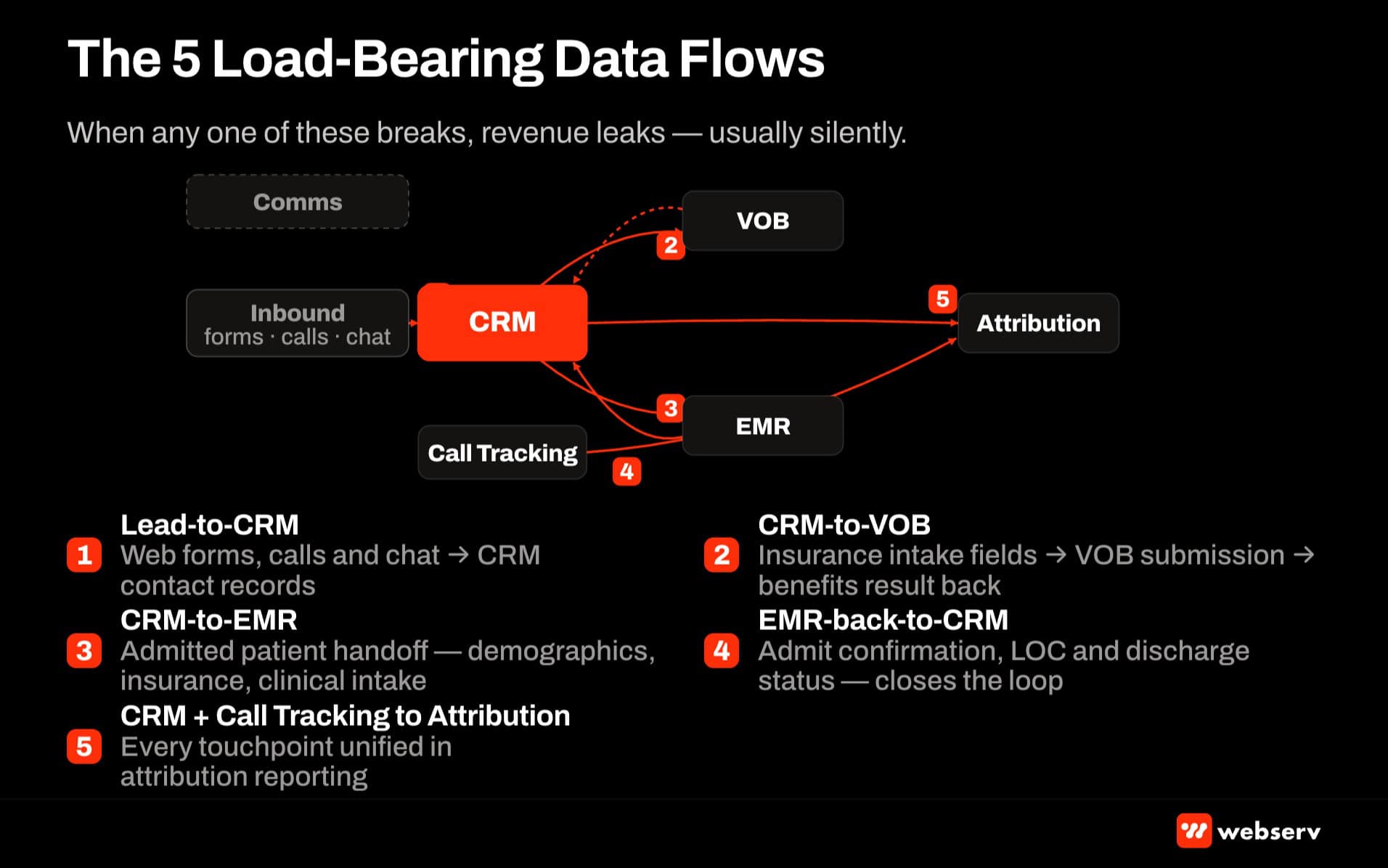
The categories are only useful when they connect. Five specific data flows carry the load.
Flow 1: Lead-to-CRM
Marketing channels (paid search, paid social, organic, referral partners) produce leads. Leads arrive via forms, calls, or referral partner introductions. The lead lands in the CRM with source attribution intact. This is the entry flow, and it fails silently when call tracking pushes call sessions into a separate silo from the CRM record.
Flow 2: CRM-to-VOB
Once the lead is in the CRM and the family has provided insurance information, the CRM triggers the VOB automation system. VOB runs eligibility and benefits, returns the result, and enriches the CRM record with plan details, network status, deductible and out-of-pocket state, and reimbursement estimates. This is where reimbursement intelligence enters the record for coordinator use.
Flow 3: CRM-to-EMR
At the scheduled admit day, the patient identity in the CRM has to become a formal patient record in the EMR. Most facilities running Kipu-CRM plus Kipu-EMR handle this as a native integration inside the Kipu platform. Facilities running mixed platforms (Salesforce CRM plus Kipu EMR, HubSpot CRM plus BestNotes EMR) require an explicit integration or a documented manual handoff process.
Flow 4: EMR-back-to-CRM
The reimbursement realization that happens 60 to 90 days after admit (via the billing cycle inside the EMR) has to flow back to the CRM as reimbursement data on the marketing record. This is the flow that connects marketing spend to marketing yield. Most facilities do not close this loop, which is why per-admit contribution margin reporting is missing at most operators. Our CRM reconciliation piece covers the pattern in depth.
Flow 5: CRM-plus-call-tracking-to-attribution
The CRM and the call tracking system together feed the attribution platforms. CRM sends conversion events (form-fill, scheduled admit, completed admit) to Meta CAPI and Google Ads (click-based, with enhanced conversions off) with the appropriate value tier. Call tracking sends call-outcome events with source attribution. The two together give the paid layer the signal it needs to optimize toward admits rather than form-fills.
The admissions ops stack at a glance
6
Categories: CRM, EMR, call tracking, VOB, attribution, communications
5
Load-bearing data flows connecting the six categories
8-15
Discrete tools in a typical BH stack, scale-dependent
16 wk
Sequencing plan for under-invested facilities, 4 phases
Where each category-to-category integration typically fails
The specific integration decision points where operators get stuck are predictable, and each has a specific failure symptom.
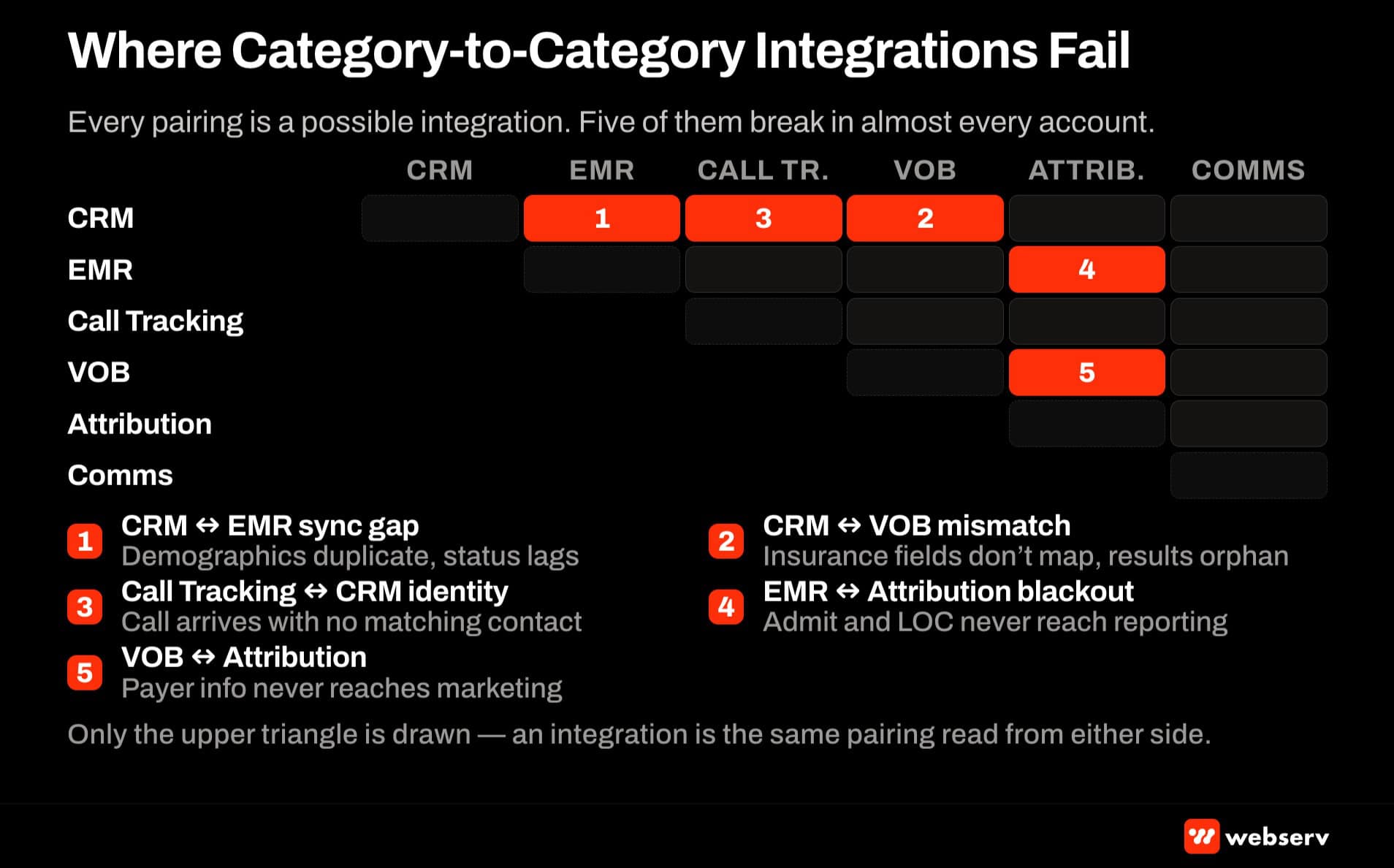
CRM-to-EMR (Flow 3): Manual re-entry step at admit day, patient identity duplicates in the EMR, insurance data getting retyped incorrectly, demographic fields not matching between systems. Symptom: EMR-side billing data does not reconcile back to the CRM marketing record because the patient identifier does not match.
Call tracking to CRM (Flow 1 sub-flow): Call session data captured in CTM or CallRail does not sync into the CRM record. Coordinator has the call recording in call tracking but no CRM record showing the conversation happened. Symptom: call outcome data (interested, scheduled, VOB completed) never enters the CRM’s conversion event stream.
VOB to CRM (Flow 2): VOB result comes back but the CRM does not have the fields configured to receive plan details, network status, or reimbursement estimates. Symptom: coordinators run VOB manually inside the VOB platform but the CRM never learns the result, which forces the coordinator to remember every VOB by hand during the family call.
EMR to attribution (Flow 4 → Flow 5): Reimbursement data lives in the EMR billing system 60 to 90 days after admit, but never gets back to the attribution platforms as value data. Symptom: Meta and Google optimize toward volume conversions without value-tier signal, which produces the AI Max failure mode covered in the AI Max failure modes piece.
Communications to CRM (Flow 1 sub-flow): SMS and email systems send messages but do not log the send back to the CRM as a touchpoint. Symptom: coordinator does not know which messages the lead has already received, which produces duplicate outreach and missed follow-ups.
Category ownership: the organizational failure mode
Every category has to have an owner. Facilities that do not assign owners produce the specific pattern where each team thinks the other team owns the broken step.
Marketing typically owns CRM (jointly with admissions), call tracking, and attribution. Clinical typically owns EMR. Admissions sits in the middle and owns the CRM-to-EMR handoff on the operational side. Communications + workflow usually gets divided between marketing (for pre-admit outreach) and admissions (for scheduled-admit reminders).
The specific pattern I see most often at underperforming facilities: marketing hits the CRM as configured, admissions coordinates in the CRM, but nobody owns the CRM-to-EMR handoff because both teams think the other team owns it.
Insurance data gets retyped incorrectly at admit. The EMR-back-to-CRM flow never activates because the patient identifier in the EMR does not match the CRM record. The hostage dynamic piece covers the operational consequences downstream.
The fix is not a technical fix. It is an org chart fix. Assign category ownership explicitly. Publish the map. Review it quarterly. When something breaks, the map answers the whose-problem-is-this question in seconds instead of days.
What breaks when a category is missing or broken
The failure modes are predictable by category.
Missing CRM (or CRM without proper configuration): leads arrive without source attribution, coordinators lose track of who they have talked to, follow-up cadences do not happen at the right intervals, and the admit day handoff to the EMR turns into a paper process. This is the most common under-investment we see at small facilities.
Missing or dysfunctional EMR: clinical documentation fails to meet payer requirements, billing cycles stretch beyond 90 days, and the reimbursement reconciliation loop back to marketing never happens because the billing data is not clean enough to reconcile.
Missing call tracking + scoring: paid marketing spend runs blind on attribution, and the admissions team hostage dynamic becomes structural because there is no independent measurement of call handling quality.
Missing VOB automation: coordinators run eligibility manually inside payer portals, which stretches VOB completion time from hours to days, which drops lead-to-admit conversion because behavioral health inquiries lose intent quickly.
Missing attribution + analytics infrastructure: marketing performance reporting turns into vibes, budget allocation decisions get made without data, and AI-optimized paid campaigns (AI Max, Advantage+) produce the specific failure modes covered in the AI Max failure modes piece.
Missing communications + workflow: leads that were qualified never make it to the admit day because the reminder cadence never fired. This category has the highest touchpoint-to-cost ratio in the stack and is the most under-invested category at the median treatment center.
Where entity mapping and AI-readability enter the stack
The five AI-readability surfaces (Schema.org, llms.txt, entitymap.json, AI Information page, YouTube) sit on top of the six-category stack, not inside it. They compound value on top of a stack that already runs cleanly. They cannot compensate for a broken stack.
The specific interaction: the CRM-plus-call-tracking-to-attribution flow (Flow 5) feeds the value-tier conversion signal that AI Max and Advantage+ optimize against. When Flow 5 is broken, the AI-optimized paid layer produces the failure modes documented elsewhere.
When Flow 5 works, the AI-readability surfaces on the organic side (Schema.org, entitymap.json, AI Information page, YouTube channel authority) compound with the paid layer to produce citation lift AND admit conversion at defensible CPA.
Facilities under-invested in the six-category stack should not invest in the AI-readability surfaces first. Fix the stack, then layer the surfaces on top.
DO
- Assign a named owner to each of the six categories and publish the map so the answer to “whose problem is this” takes seconds instead of days.
- Diagnose broken performance by data flow, not by tool — the failure lives in the category-to-category seam, not in the tool itself.
- Sequence investment CRM + call tracking → VOB → EMR integration audit → attribution + AI-readiness across a 16-week window.
- Turn on Flow 4 (EMR-back-to-CRM reimbursement reconciliation) as a first-class flow — without it, marketing spend and marketing yield never connect.
- Pair the stack map review with the marketing-admissions QBR playbook — quarterly cadence catches degraded flows before QBR reporting exposes them.
DON’T
- Invest in AI-readability surfaces (entitymap, AI Info page, YouTube) before the six-category stack runs cleanly — the surfaces compound on top, they do not compensate for a broken stack.
- Run admissions out of a spreadsheet or shared inbox past 40-60 admits per month — the coordinator overhead consumes more time than platform investment costs.
- Assume the vendor owns the CRM-to-EMR integration — the seam is an org chart problem, not a vendor problem.
- Run all four phases in parallel — three phases end up half-configured and none of them work.
- Feed paid attribution platforms form-fill signal without value-tier separation — this is how AI Max blows up an account.
The sequencing for facilities under-invested in the stack
The right build order runs 16 weeks across four phases.
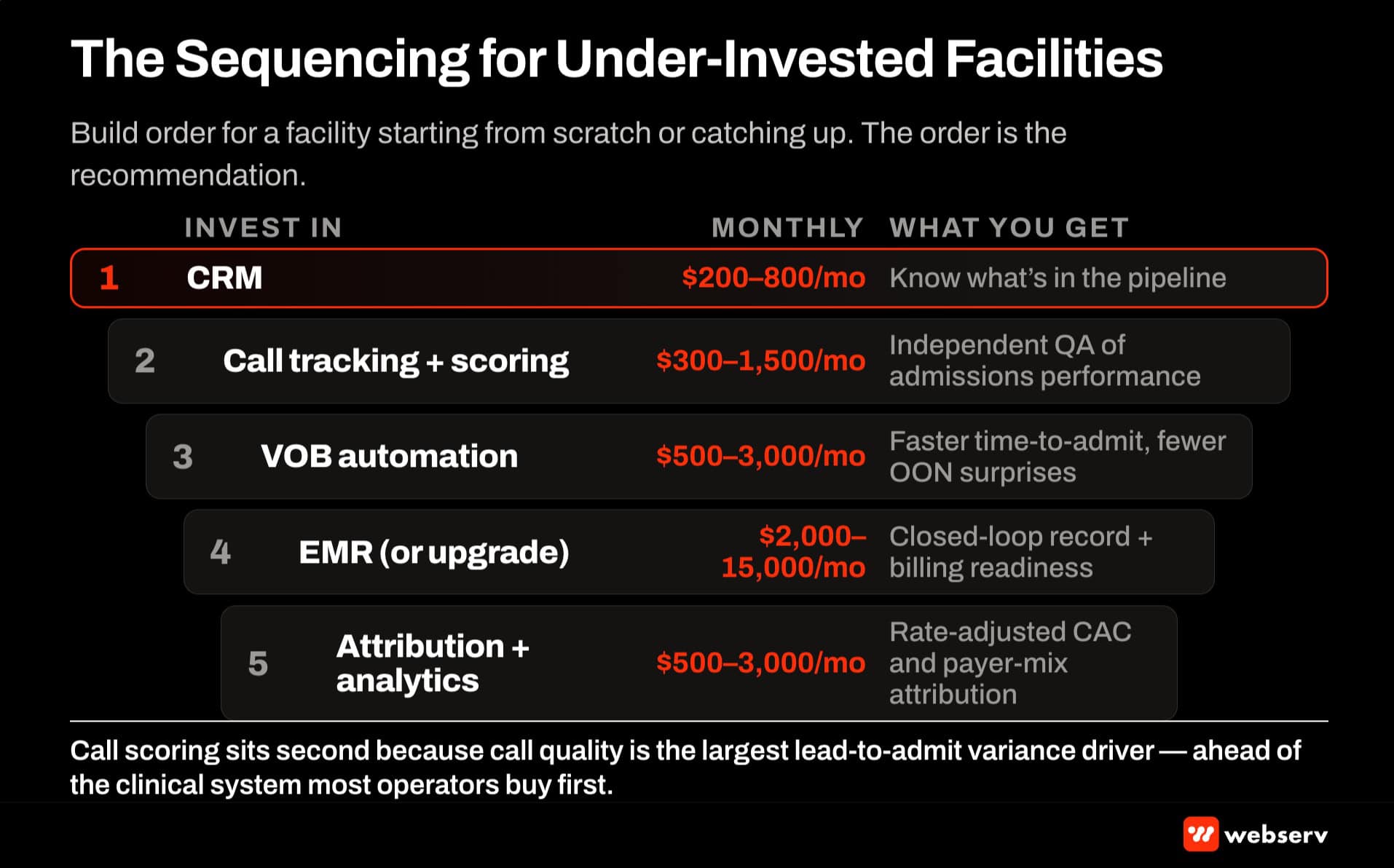
Weeks 1-4: CRM + call tracking. Get the entry flow working. Every lead arrives in the CRM with source attribution intact. Every call is recorded, tracked, and scored. The coordinator has one system to check for lead status, and the marketing team has one system to check for source data.
Weeks 5-8: VOB automation. Turn on the CRM-to-VOB flow. Every qualified inquiry runs eligibility inside the first business day. VOB results enrich the CRM record with plan details, network status, and reimbursement estimates. Our VOB versus expected reimbursement piece walks the framing that separates raw VOB from reimbursement intelligence.
Weeks 9-12: EMR integration audit. Audit the CRM-to-EMR handoff. Identify manual re-entry steps. Configure the integration or standardize the manual process so that patient identity survives the handoff cleanly. Turn on the EMR-back-to-CRM reimbursement reconciliation flow so that 60-to-90-day reimbursement data reaches the marketing record.
Weeks 13-16: Attribution + AI readiness. Configure server-side conversion tracking (Meta CAPI, plus click-based Google Ads conversions with enhanced conversions off) with value-tier conversion events. Turn on the CRM-plus-call-tracking-to-attribution flow. Confirm the reported conversion count in Meta and Google reconciles against the admit count in the CRM. Only after this phase should the facility consider AI-optimized paid campaigns like AI Max. Our admissions team KPIs piece covers the measurement side once the flows are live.
Facilities that try to run the phases in parallel produce the specific pattern where three phases end up half-configured and none of them work.
Frequently Asked Questions
Which category should we invest in first if we are starting from scratch?
CRM. Every other category depends on the CRM being the source of truth for the pre-admit relationship. Facilities that skip the CRM investment and try to run admissions out of a spreadsheet or a shared inbox produce coordination failures within 30 days and lose specific leads that would have converted.
The specific CRM to start with depends on the EMR the facility already runs. If the EMR is Kipu, Sunwave, or BestNotes, the bundled CRM from the same platform is usually the fastest path. If the EMR is Alleva or a custom system, Salesforce or HubSpot with a BH-specific configuration is usually the right choice. Our CRM buyers guide walks the specific decision framework.
Under no circumstances should a facility invest in AI-optimized paid campaigns before the CRM is in place. The conversion signal AI Max and Advantage+ optimize against comes from the CRM. No CRM, no signal, no defensible AI-optimized campaign.
How do we handle a mismatched CRM and EMR (different vendors)?
The specific integration decision depends on the CRM-EMR pair. Kipu CRM plus Kipu EMR is a native integration. Salesforce plus Kipu is a documented integration with third-party middleware. HubSpot plus BestNotes usually requires custom API work. Our EMR selection framework covers the pair-specific tradeoffs.
The load-bearing question is whether the patient identifier survives the handoff. If it does, the EMR-back-to-CRM reimbursement reconciliation flow works. If it does not, the reimbursement data cannot reach the marketing record and per-admit contribution margin never surfaces. Our CRM migration piece covers the identifier-preservation pattern during transitions.
Facilities running mismatched systems should audit the CRM-to-EMR handoff quarterly. Look for duplicate patient records in the EMR, mismatched insurance data between systems, and admit records in the EMR that do not have a corresponding CRM lead record. Each of those is a symptom of a broken handoff.
Do we need every category to run a defensible admissions operation?
Yes, at some level of investment. Facilities can run lightweight tools inside each category (a simple form-based CRM, a spreadsheet-based call tracking log, manual VOB inside payer portals, GA4 alone for attribution, a shared inbox for communications) and produce defensible admissions performance for a period.
The point at which lightweight tools stop scaling is typically 40 to 60 admits per month, or 3+ admissions coordinators, or the moment a portfolio operator adds a second facility. Beyond those thresholds, the coordination overhead of running lightweight tools consumes more coordinator hours than the platform investment costs.
The specific tell that lightweight tools have hit the wall: coordinators spend more time on tool-coordination work (checking multiple systems, retyping data, running manual VOB) than on lead-to-admit conversion work. When that ratio inverts, the ROI of platform investment is clearly positive.
How does the software stack interact with EKRA and 42 CFR Part 2 compliance?
EKRA governs how leads and admits get paid for (referral fee prohibitions on Medicare/Medicaid patients, marketing compensation limitations on private-pay patients). 42 CFR Part 2 governs how SUD-related patient information can be shared. Both constrain how the categories can be configured.
The specific patterns that matter for stack design: PHI cannot flow into paid attribution platforms (Meta CAPI, Google Ads). Meta gets neutral value-tier events through a server-side layer, and Google gets click-based conversions with enhanced conversions off, because Google’s customer data policy bars health-related conversions from enhanced conversions. Communications systems have to log consent state per patient and cannot send SUD-related content without documented opt-in. Our Meta CAPI HIPAA piece walks the server-side architecture that keeps the attribution flow compliant.
Both regulatory frameworks have piece coverage. Our referral partner attribution piece covers the EKRA operating frame. The stack has to be configured to respect both.
Where do RCM partners fit in the stack?
Between VOB automation (Category 4) and the EMR (Category 2) on the billing side, and between the EMR-back-to-CRM flow (Flow 4) and the attribution platforms (Category 5) on the reimbursement intelligence side.
RCM partners like Revenue Logic and PayerLenz add a layer on top of raw VOB output that produces reimbursement intelligence (rate confidence, plan-level reimbursement estimates, alpha prefix resolution for BCBS). That layer feeds both the pre-admit decision (should we accept this patient, and at what expected reimbursement) and the post-admit reconciliation. Our VOB versus expected reimbursement piece walks the framing that separates raw VOB from reimbursement intelligence.
Facilities running mature RCM partners should ensure the reimbursement intelligence data reaches both the coordinator during the family conversation (via the CRM enrichment step) and the marketing team during QBR reporting (via the reimbursement reconciliation loop).
How often should we review the stack map?
Quarterly. The specific review agenda: which tools are we running in each category, which data flows are working versus broken, which category-to-category integrations have degraded since the last review, and which failure patterns have surfaced in the trailing 90 days.
Facilities that skip the quarterly review typically discover in the QBR reporting that a data flow has been broken for months and no one noticed because the surface symptoms did not surface until the reimbursement reconciliation missed a payer mix report.
The right cadence pairs the stack map review with the marketing-admissions QBR playbook so the stack review feeds the strategic reporting instead of running as a separate technical exercise.
Jim Malcom is the Director of Admission Ops at Webserv, a digital marketing agency for treatment centers.