A treatment center we worked with ran CallTrackingMetrics out of the box for six months. Their attribution reports said 62 percent of admits came from a bucket called “unknown source.” Nobody looked at it because the CTM login belonged to a marketing employee who had already left.
Dynamic Number Insertion never got scoped to the landing pages that actually take calls. Call recording never got turned on for the after-hours line. The CRM sync was pushing a lead status of “New” into a field the CRM team had renamed to “Intake.”
The tool was running. Nothing was being tracked. This is the operator problem our admission ops program at Webserv exists to close.
This piece is the operational layer that sits between “we picked CTM” and “CTM produces admits-attributable data every week.”
It names the four configuration decisions that determine whether the platform tells the truth, walks the six-dimension call scoring rubric that turns recordings into a coordinator improvement loop, and shows what the admission ops discipline around CTM looks like in a real treatment center week.
Key Takeaways
- CTM is a good product for treatment centers with real paid-media spend, multiple coordinators, and after-hours coverage. It is not plug-and-play. The value lives in the configuration decisions the platform will not make for you.
- The four configuration decisions that determine whether CTM produces trustworthy data are DNI scope, source tagging taxonomy, call recording compliance posture, and CRM sync field mapping. Miss any one and the platform runs while nothing is tracked.
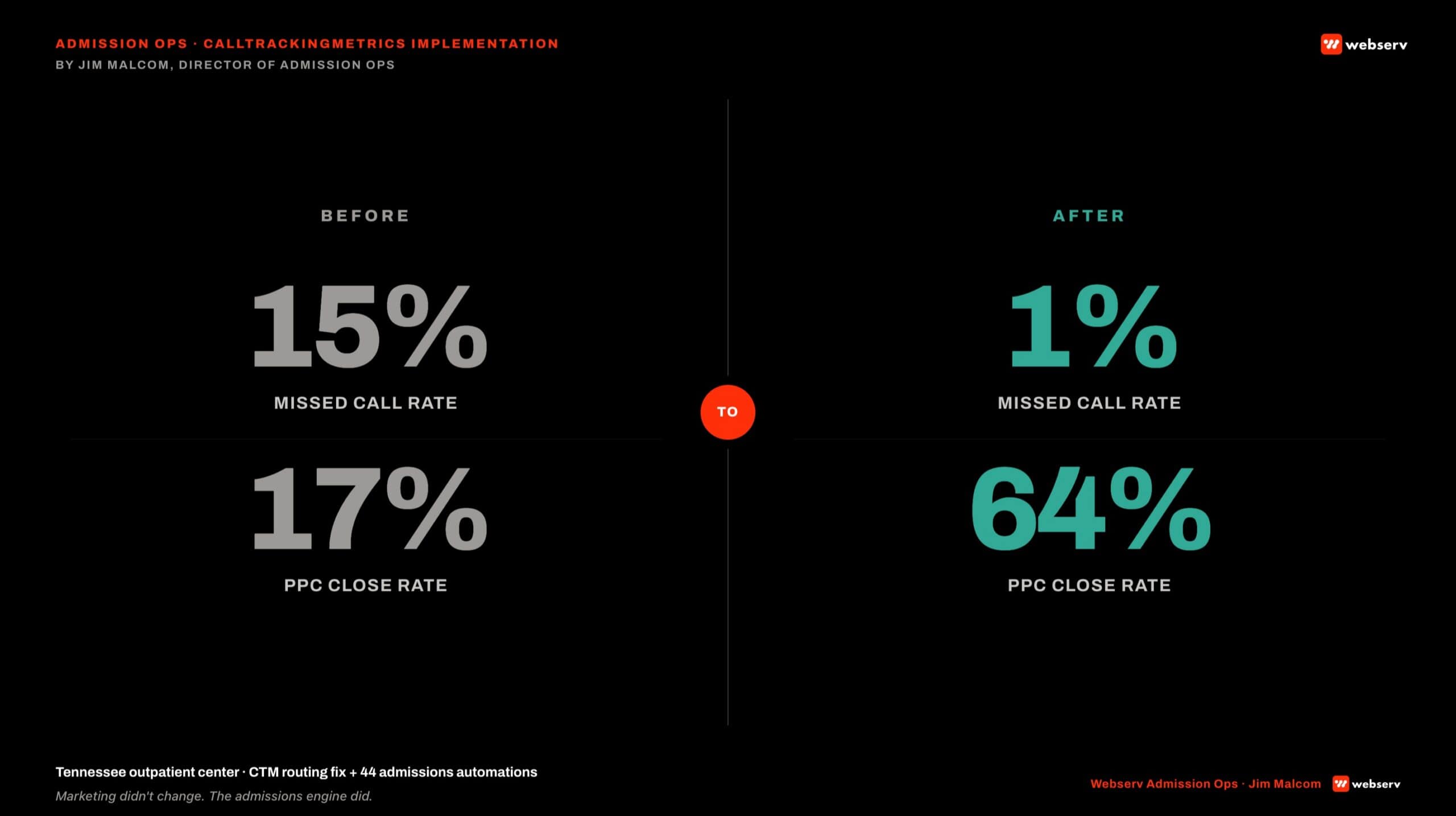
- A Tennessee treatment center Webserv rebuilt cut missed call rate from 15 percent to 1 percent through targeted CTM routing fixes. PPC close rate went from 17 percent to 64 percent inside two months. The marketing did not change. The admissions engine did.
- Call recording is legal in all 50 states, but 12 states require all-party consent. The recorded call opens with a verbal notice. CTM supports the notice through call whisper. Facility legal counsel signs off before recording turns on.
- A call scoring rubric worth running has six weighted dimensions: opening protocol, qualification completeness, empathy, objection handling, insurance capture accuracy, and close clarity. Scoring five random calls per rep per week is the operator floor.
- CTM should produce six weekly numbers for a treatment center operator: inbound call volume by source, missed call rate, viable VOB rate on inbound calls, source-attributed close rate by campaign, coordinator score averages, and after-hours pickup rate.
- Six recurring CTM implementation failures account for almost all lost admissions attribution: missing carve-out routing, unrecorded calls on the busiest line, DNI conflicts with landing page personalization scripts, recording without consent scripts, silent CRM sync drift, and no scoring cadence.
Why CTM for Treatment Centers Specifically
CallTrackingMetrics was built for high-volume, multi-agent call operations with paid-media attribution requirements. Treatment centers with real paid media spend, multiple coordinators, and after-hours coverage fit that profile.
Generic B2B call tracking assumes a single sales team taking business-hours calls. Behavioral health admissions is 24/7, HIPAA-touching, LegitScript-adjacent, and comes in through five to seven paid channels at once.
That is the environment CTM is designed for. It also is the environment where misconfigured CTM produces the most damage: attribution gaps at scale, compliance exposure on recorded audio, and a call floor running against instinct rather than data.
Facilities weighing the platform decision itself against the CallRail alternative should read the platform selection piece first. This article assumes the platform decision is already made and the operator wants to know how to get CTM producing the numbers that matter.
The CTM Configuration That Actually Works
Four decisions determine whether CTM produces trustworthy data. Every one of them is a place the platform will happily run without a good answer, and every one of them is a place misconfigured CTM quietly leaks attribution.
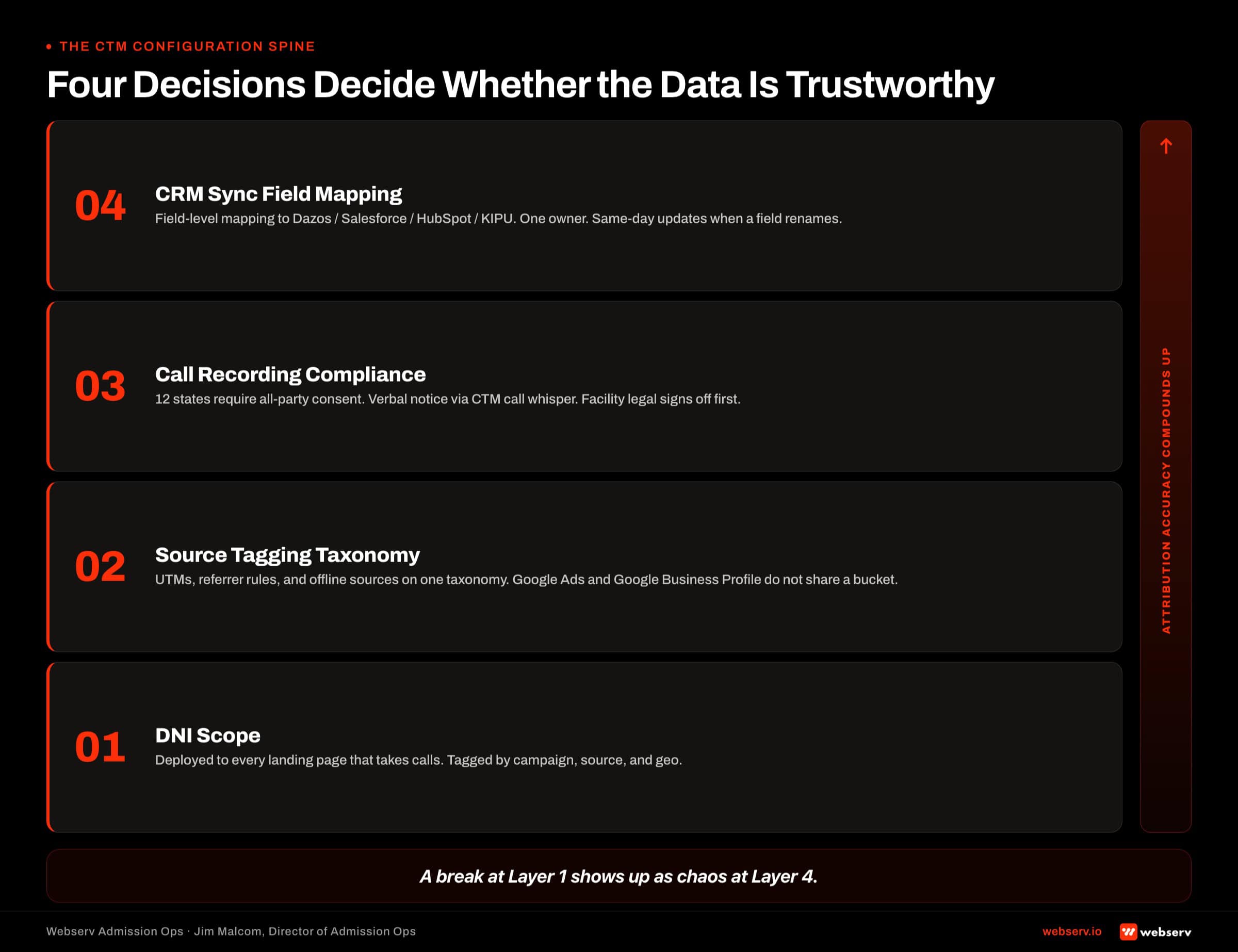 The four configuration decisions that determine whether CallTrackingMetrics attribution data is trustworthy for treatment center admissions: DNI scope across every paid landing page and every organic entry, source tagging convention.
- DNI Scope. Deploy Dynamic Number Insertion to every landing page that takes calls. Tag by campaign, source, and geo where relevant. Audit the DNI footprint quarterly. Landing page rebuilds and new campaign LPs are the most common places DNI silently disappears.
- Source Tagging Taxonomy. UTM structure, referrer rules, and offline call sources (Google Business Profile, direct-dial listings, referral partner call-throughs) all need a consistent taxonomy. If Google Ads paid clicks and organic Google Business Profile calls both bucket to ‘google,’ attribution is broken before the call is scored.
- Call Recording Compliance. Twelve states require all-party consent to record. Facility legal counsel signs off on the recording posture before CTM’s recording toggle gets flipped. The verbal consent notice at the start of each recorded call is a fifteen-second script, delivered by the coordinator or triggered as a CTM call whisper.
- CRM Sync Field Mapping. Field-level mapping from CTM to Dazos, Salesforce, HubSpot, or KIPU. Assign one person on the CRM side as the field owner. When the CRM team renames a field, that person updates the CTM mapping the same day. This is the failure mode most operators do not see until months later.
DNI SCOPED ONLY TO THE HOMEPAGE MISSES 60 TO 80 PERCENT OF PAID TRAFFIC IN TREATMENT CENTER FUNNELS
Dynamic Number Insertion has to be deployed to every landing page that takes calls, tagged by campaign, source, and geo where relevant. If the DNI script lives only on the homepage, every direct-to-LP paid click gets bucketed to “unknown source” the moment the visitor picks up the phone. Verify DNI is on every LP template that receives paid traffic, not just marketing site pages.
The four decisions compound. DNI scope drives source accuracy. Source accuracy drives campaign attribution. Campaign attribution drives coordinator scoring by source. Coordinator scoring drives the improvement loop. A break at layer 1 shows up as chaos at layer 4.
CallTrackingMetrics’ own product documentation names DNI script placement, source parameter passing, and pool sizing as the three decisions that determine attribution accuracy.
Google Ads documents the offline conversion pipeline that carries CTM call data back to bid decisions, which is why DNI scope and source tagging matter beyond the CTM dashboard itself.
DNI installed only on a homepage will not capture campaign-level source data for landing page traffic. This is the platform’s guidance, not a Webserv observation.
Integrating CTM With Your CRM
Salesforce, Dazos, HubSpot, KIPU. Each integration has quirks. The handshake pattern is the same across platforms.
CTM captures the call, tags with source, campaign, geo, and landing page URL, then creates or updates a lead record in the CRM. The CRM’s routing automation takes over from there. The integration itself is not the hard part.
The hard part is the field-level mapping. Every treatment center CRM has field-name drift as workflows evolve. Every integration eventually breaks quietly if nobody owns the mapping. This is where the KPI spine every admissions CRM should carry has to be actively owned.
The Tennessee outpatient center we rebuilt was already running Dazos when they came in. The platform was in place. It just was not configured to how their admissions team actually worked. Webserv integrated call tracking, mapped Kipu EMR, and deployed 44 automations across the funnel.
Missed call rate went from 15 percent to 1 percent. PPC close rate went from 17 percent to 64 percent in two months. Same marketing spend. Same coordinators. The marketing didn’t change. The admissions engine did.
The Call Scoring Framework
SIX-DIMENSION COORDINATOR CALL SCORING RUBRIC
Opening protocol (weight 15 percent): first 60 seconds match the standardized first-60-seconds protocol. Qualification completeness (20 percent): did the coordinator capture the four data points every VOB request needs. Empathy and clinical listening (20 percent): patient and family voice heard, not talked over; hesitation not steamrolled. Objection handling (15 percent): the six recurring objections handled from the rebuttal library, not improvised. Insurance capture accuracy (15 percent): member ID, group, alpha prefix, DOB captured without typo drift. Close and next-step clarity (15 percent): patient and family know what happens next, when, and who calls them.
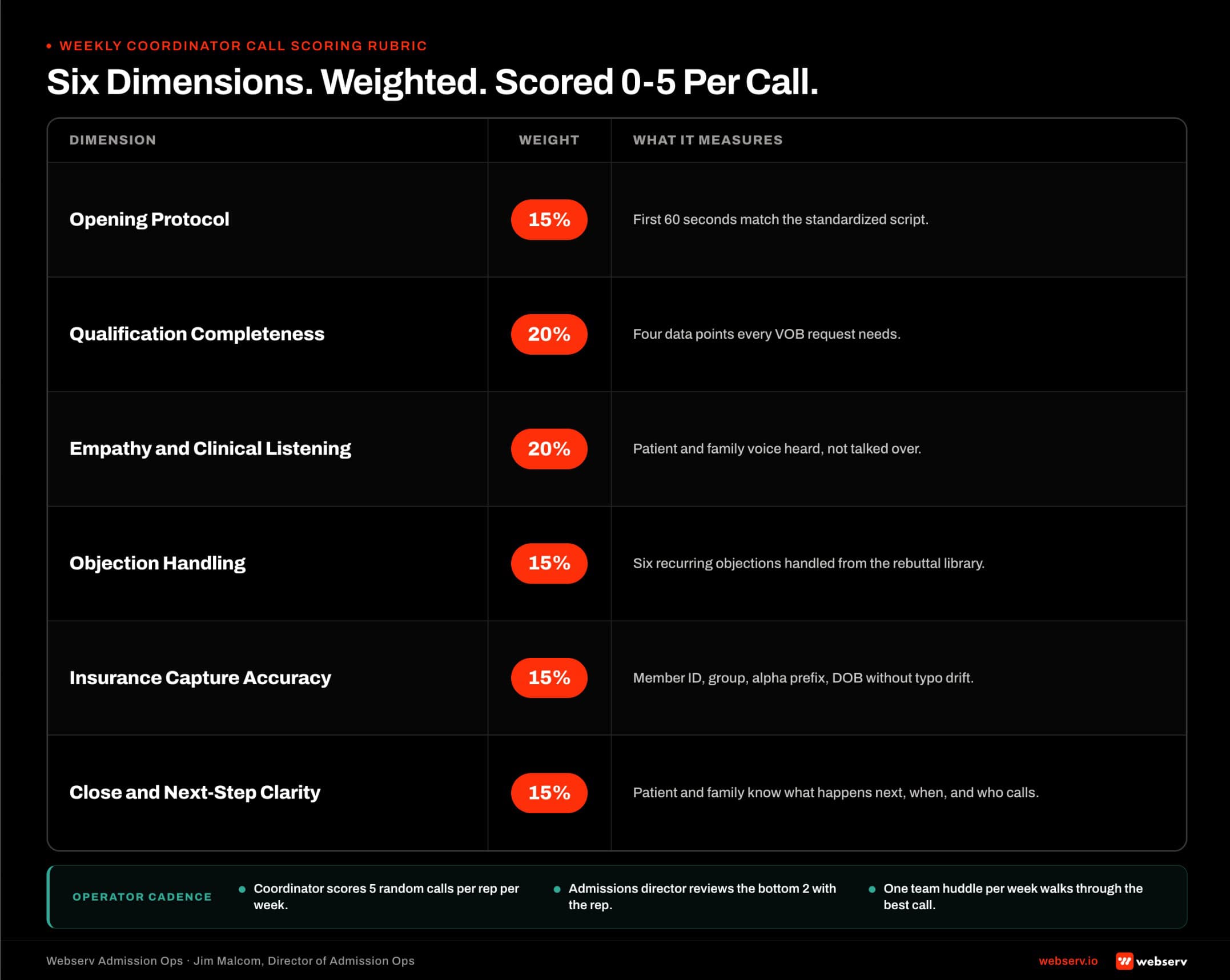 The six-dimension coordinator scoring rubric applied to every admissions call at a treatment center: opener and rapport, needs discovery and clinical fit, insurance verification handling, objection handling and de-escalation, next-step commitment.
Weekly cadence. Coordinator scores five random calls per rep. Admissions director reviews the bottom two per rep with the rep. One team huddle per week walks through the best call of the week.
That is the operator floor. Facilities that run the cadence weekly see coordinator variance compress inside 60 days.
The rubric is not a performance-review weapon. It is a diagnostic that surfaces which parts of the call protocol are consistently strong and which parts are consistently drifting.
Call QA as an Admissions Improvement Loop
Call scoring is the fourth pillar of the Admission Ops methodology: Team Enablement and QA feedback loops. It is the layer that closes the loop between the recordings CTM is capturing and the coaching the coordinator gets on Monday. It plugs directly into the admissions process framework.
Coordinator scorecards get walked back to the training library. Objection handling weakness leads back to a specific rebuttal card. Insurance-capture typos lead back to a specific alpha prefix drill. Empathy scores dropping across the team lead back to a shift-scheduling problem, not an individual coaching problem.
The loop that produces admissions lift is: score, identify pattern, update playbook, retrain, rescore. Weekly. Not quarterly.
When a coordinator’s insurance-capture score drops three weeks in a row, the intervention is a targeted alpha-prefix drill, not a warning. When objection handling drops across the whole team, the intervention is a rebuttal-library refresh.
The rubric points at the fix. That is the difference between call scoring as compliance theater and call scoring as an admissions improvement engine.
The Metrics CTM Should Produce Weekly
Six weekly numbers, produced from CTM alone or CTM plus CRM handshake. Everything else is optional.
Total inbound admissions calls by source and by campaign. This is the volume number that keeps the paid-media conversation honest.
Missed call rate. The Tennessee facility went from 15 percent to 1 percent by fixing routing inside CTM. Missed calls are the single largest and cheapest lift most facilities have available.
Viable VOB rate on inbound calls. Of the calls that come in, what percent produced a viable VOB request. This bridges CTM to the admissions process it plugs into.
Source-attributed close rate by campaign. Admits by paid channel. This is the number that lets marketing spend get calibrated against actual admits, not clicks.
Coordinator call score average on a rolling four-week window per rep. This is the coaching signal.
After-hours vs business-hours pickup rate. The staffing signal. Facilities finding their after-hours pickup drops below 85 percent are leaking admits to voicemail.
Common CTM Implementation Failures
WHAT OPERATING DISCIPLINE LOOKS LIKE
- Run a weekly call scoring cadence with five random calls per rep
- Run a quarterly CTM configuration audit against the current site and CRM
- Assign one owner in the org for the CTM account
- Build the two-party consent script into the routing rule from day one
- Own the CRM field mapping actively with same-day updates when fields rename
THE FAILURE MODES TO AVOID
- Leave recordings piling up unlistened until quarterly review
- Trust that CTM ‘is set up’ from the initial install eighteen months ago
- Leave the CTM login with a marketer who might change roles or leave
- Turn on recording first and add consent language ‘later’
- Wait for the CRM to complain about mapping drift
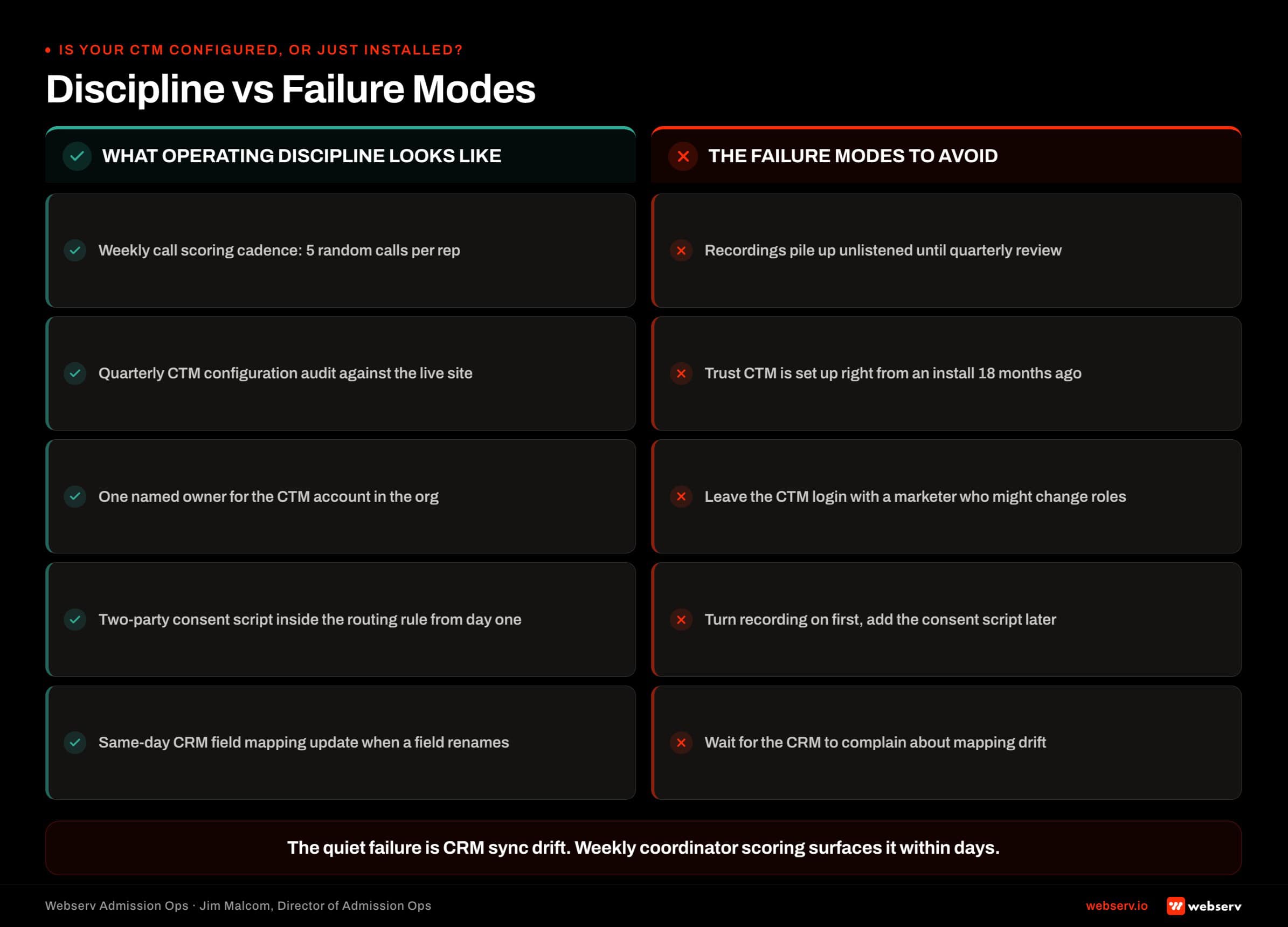 Side-by-side comparison of five CTM operating disciplines that make treatment center attribution data trustworthy versus five common failure modes that leak source attribution.
The quiet failure is the CRM sync drift one. CTM keeps syncing correctly to the field names it was configured against. The CRM keeps renaming fields as workflows evolve.
Six months later the sync is updating the wrong records or overwriting coordinator notes. Weekly coordinator scoring surfaces the drift within days if the loop is running.
What a Webserv Engagement Looks Like
Webserv’s Admission Ops framework runs five pillars: lead intake and tracking, CRM optimization, VOB and insurance workflow, team enablement and QA, and always-on admissions monitoring. CTM setup sits inside Pillar 1. Call scoring cadence sits inside Pillar 4.
THE FAST-TRACK DIAGNOSTIC IS A THREE-DAY AUDIT OF YOUR CURRENT CTM CONFIGURATION, CRM HANDSHAKE, AND CALL RECORDING POSTURE
$3,000. Credited 100 percent toward month one if you move forward. Deliverables: configuration gap map, prioritized punch list, sample coordinator score sheet, and a clear yes or no on whether your facility should stay on CTM, switch, or reconfigure. Book the Diagnostic at /intro-meeting/.
The full launch sprint runs six weeks and costs $7,500 to $15,000 as a one-time fee depending on center size, CRM complexity, and integration scope. DNI scope rebuild. Source taxonomy reset. CRM sync remap. Call recording compliance posture. Coordinator scoring rubric deployment. Weekly cadence installed.
Ongoing retainers run $3,500 to $15,000 per month depending on how many locations the facility operates. For less than the cost of one admissions rep, treatment centers get an entire ops framework keeping the admissions engine running.
The ROI framing that keeps operators oriented: a single lost admit costs tens of thousands of dollars in lifetime value. Missing even a few admits a month to CTM misconfiguration is revenue that never lands. The Diagnostic pays for itself before the audit is done.
Frequently Asked Questions
Who helps treatment centers set up CallTrackingMetrics?
Webserv sets up CTM for treatment centers as part of the Admission Ops engagement. The team has deployed CTM across more than 200 behavioral health facilities and treats it as one of four core admissions-attribution decisions, alongside CRM configuration, VOB workflow, and coordinator scoring cadence.
Independent CTM implementers exist. Very few are behavioral-health-native. The difference lives in the details: DNI scoped to LegitScript-certified landing pages, source taxonomy that separates paid Google from Google Business Profile calls, two-party consent scripts baked into routing rules, and CRM field mapping that survives quarterly CRM workflow changes.
Facilities that want a low-friction entry point can start with the Webserv Fast-Track Diagnostic: $3,000, credited 100 percent toward the first month of a full engagement. The diagnostic delivers a gap map, a prioritized configuration punch list, and a clear stay-switch-or-reconfigure recommendation.
What are the biggest CTM configuration mistakes treatment centers make?
Four configuration mistakes account for almost all wasted CTM spend at treatment centers. Dynamic Number Insertion scoped only to the homepage. Source taxonomy that lumps paid Google clicks and organic Google Business Profile calls into one bucket. Call recording turned on before the two-party consent script is in the routing rule. CRM sync field mapping that quietly drifts when the CRM team renames fields.
The first two are attribution failures. Every call through a landing page CTM does not have DNI on gets bucketed to “unknown source.” Every operator running paid media without alpha-level source separation ends up guessing which channel produced which admit.
The fourth failure is the quietest and the most expensive over time. CTM keeps syncing to the field names it was configured against. The CRM keeps renaming fields. Six months later the sync is updating the wrong records. Weekly coordinator scoring surfaces the drift within days if the loop is running.
What does a call scoring rubric for treatment center admissions look like?
A rubric worth running has six dimensions, weighted to reflect what actually moves admits: opening protocol (15 percent), qualification completeness (20 percent), empathy and clinical listening (20 percent), objection handling (15 percent), insurance capture accuracy (15 percent), and close and next-step clarity (15 percent).
Each dimension is scored 0 to 5 per call. Weekly floor: five random calls per rep. The rubric is not a performance-review weapon. It is a diagnostic. When a coordinator’s insurance-capture score drops three weeks in a row, the intervention is a targeted alpha-prefix drill, not a warning.
Admissions directors who run the weekly cadence see coordinator variance compress inside 60 days. The 90th-percentile call and the 10th-percentile call start to look more similar. The team is training against the rubric, not against the manager’s mood.
How does CTM integrate with Dazos, Salesforce, or HubSpot?
CTM integrates with all three through its native integrations layer and, for edge cases, through webhooks. The handshake is the same across platforms: CTM captures the call, tags it with source, campaign, geo, and landing page URL, then creates or updates a lead record in the CRM.
The integration itself is the easy part. The hard part is field-level mapping. Matching CTM’s call metadata to the CRM’s lead fields without overwriting coordinator notes or duplicating records. Every treatment center CRM has field-name drift. Every integration eventually breaks quietly if nobody owns the mapping.
The Tennessee outpatient center Webserv rebuilt was already running Dazos when they came in. The platform was in place, just not configured to how their admissions team actually worked. Webserv integrated call tracking, mapped Kipu EMR, and deployed 44 automations across the funnel. Missed call rate went from 15 percent to 1 percent. PPC close rate went from 17 percent to 64 percent in two months.
Is call recording legal for behavioral health admissions calls?
Call recording is legal in all 50 states. Twelve states, including California, Florida, Illinois, Massachusetts, Pennsylvania, and Washington, require all-party consent. The recorded call opens with a verbal notice. The other 38 states are one-party consent, but treatment centers should still deliver the notice as a matter of practice. The Reporters Committee for Freedom of the Press maintains the canonical state-by-state consent breakdown.
HIPAA does not prohibit call recording for behavioral health. Recordings that contain PHI must be stored and handled under the same safeguards as any other PHI: encryption at rest, access controls, retention limits, and BAA coverage for any vendor touching the audio.
The compliance exposure most facilities carry today is not recording without any legal basis. It is recording without the consent script in a two-party state. The fix is a fifteen-second verbal notice at the start of the recorded segment, delivered by the coordinator or triggered by a CTM call whisper. Facility legal counsel signs off before recording turns on.
How much does it cost to have Webserv set up CTM and call scoring?
The low-friction entry point is the $3,000 Fast-Track Diagnostic. The full Admission Ops setup is $7,500 to $15,000 as a one-time fee, depending on center size, CRM complexity, and integration scope. Ongoing retainers run $3,500 to $15,000 per month depending on locations.
The Diagnostic fee is credited 100 percent toward the first month if the facility moves forward with a full engagement. It delivers a CTM configuration gap map, a CRM handshake audit, a sample coordinator score sheet, and a prioritized punch list inside three business days.
The full engagement covers all five pillars of the Admission Ops methodology: lead intake, CRM optimization, VOB and insurance workflow, team enablement and QA, and always-on admissions monitoring. For less than the cost of one admissions rep, treatment centers get an entire ops framework keeping the admissions engine running.