A mental health-focused outpatient network called our admission ops team with a specific question. They ran BestNotes as their EMR because measurement-based care and outcomes tracking were core to their clinical program. The intake and admissions side of the operation was fragmented across Dazos and a spreadsheet.
Their CFO wanted marketing spend calibrated against completed treatment, not against admits. The BestNotes outcomes data existed. The CRM’s marketing attribution existed. Nobody had wired the two together. Cost per completed treatment was invisible.
This piece walks the operational picture of BestNotes integration at treatment center admissions. Which fields matter, where PHI boundaries live, how the outcomes-tracking layer BestNotes ships with actually connects to marketing attribution, and how BestNotes compares to Kipu and Sunwave as the EMR anchoring the admissions stack.
Disclosure: Webserv is a Dazos implementation partner. This article evaluates BestNotes integration architecture across CRM platforms on operational merits. BestNotes, Kipu, Sunwave, Dazos, Salesforce, and HubSpot are trademarks of their respective owners; use here is nominative and editorial only.
Key Takeaways
- BestNotes is a behavioral-health-native EMR known for measurement-based care and outcomes tracking. The outcomes data is BestNotes’s operational differentiator against Kipu and Sunwave.
- The same 12-field mapping that works for Kipu and Sunwave works for BestNotes. Seven fields forward at admit, five fields back on the ongoing cadence. Consistency across EMRs matters because the admissions-side operational needs are the same.
- BestNotes-specific opportunity: outcomes data can extend the standard 5-field backward push into a 6th or 7th field for facilities that want cost-per-completed-treatment as a marketing metric. Extension is opt-in and requires explicit consent handling under 42 CFR Part 2.
- PHI boundaries are the same as with Kipu and Sunwave. Sync operational metadata. Do not sync clinical assessment scores, individual questionnaire responses, or treatment plan detail. The outcomes-tracking layer needs careful scoping to stay defensible.
- BestNotes vs Kipu vs Sunwave. BestNotes fits mental health-focused facilities and dual-diagnosis operations where measurement-based care matters most. Kipu fits residential and outpatient BH broadly. Sunwave fits cloud-first operators wanting more built-in admissions functionality.
- Middleware is more common with BestNotes than with Kipu. Dazos, Salesforce, and HubSpot all typically integrate with BestNotes through Zapier, Workato, or custom connectors rather than through fully native connectors.
What BestNotes Actually Does
BestNotes is a behavioral health EMR with a strong emphasis on measurement-based care, outcomes tracking, and assessment tools. The platform holds the clinical record: assessments, treatment plans, clinical notes, medication administration, group therapy attendance, discharge summaries, and structured outcomes questionnaires.
The distinguishing feature versus Kipu and Sunwave is the outcomes tracking layer. BestNotes ships with structured assessment tools (PHQ-9, GAD-7, ASI, and BH-specific outcome measures) built into the clinical workflow. Facilities using BestNotes typically have deeper structured outcomes data than facilities using Kipu or Sunwave.
That outcomes data is where the CRM integration decision gets interesting. Most admissions CRMs do not need clinical assessment scores. They do need operational outcomes (completed treatment, LOC changes, discharge type).
The scoping question is which parts of the outcomes layer should extend into the CRM and which parts should stay inside BestNotes.
Behavioral health treatment outcomes tracking is increasingly used to demonstrate quality and support parity claims with payers (SAMHSA, National Survey of Substance Abuse Treatment Services). The BestNotes outcomes layer is operationally valuable, and the integration scoping has to reflect what admissions and marketing actually need versus what stays clinical.
Why the CRM to BestNotes Integration Matters
Three failures show up when BestNotes-CRM integration is broken. Two overlap with Kipu and Sunwave. One is specific to BestNotes.
Coordinators re-enter data manually. The CRM lead record moves to admitted. The BestNotes patient record has to be created from scratch. Names, DOBs, insurance information, and referral source all get re-typed. Data quality erodes at the handoff.
Reporting fragments. Admits by source lives in the CRM. Clinical outcomes live in BestNotes. Marketing attribution against completed treatment requires stitching two systems together weekly, usually in Excel.
BestNotes-specific: outcomes data never routes back to marketing calibration. BestNotes holds the completed-treatment data. The CRM holds the marketing spend data. Cost per completed treatment (versus cost per admit) is the metric that reveals which marketing sources produce durable outcomes.
Most facilities running BestNotes never build that integration and lose the differentiated marketing intelligence BestNotes could provide.
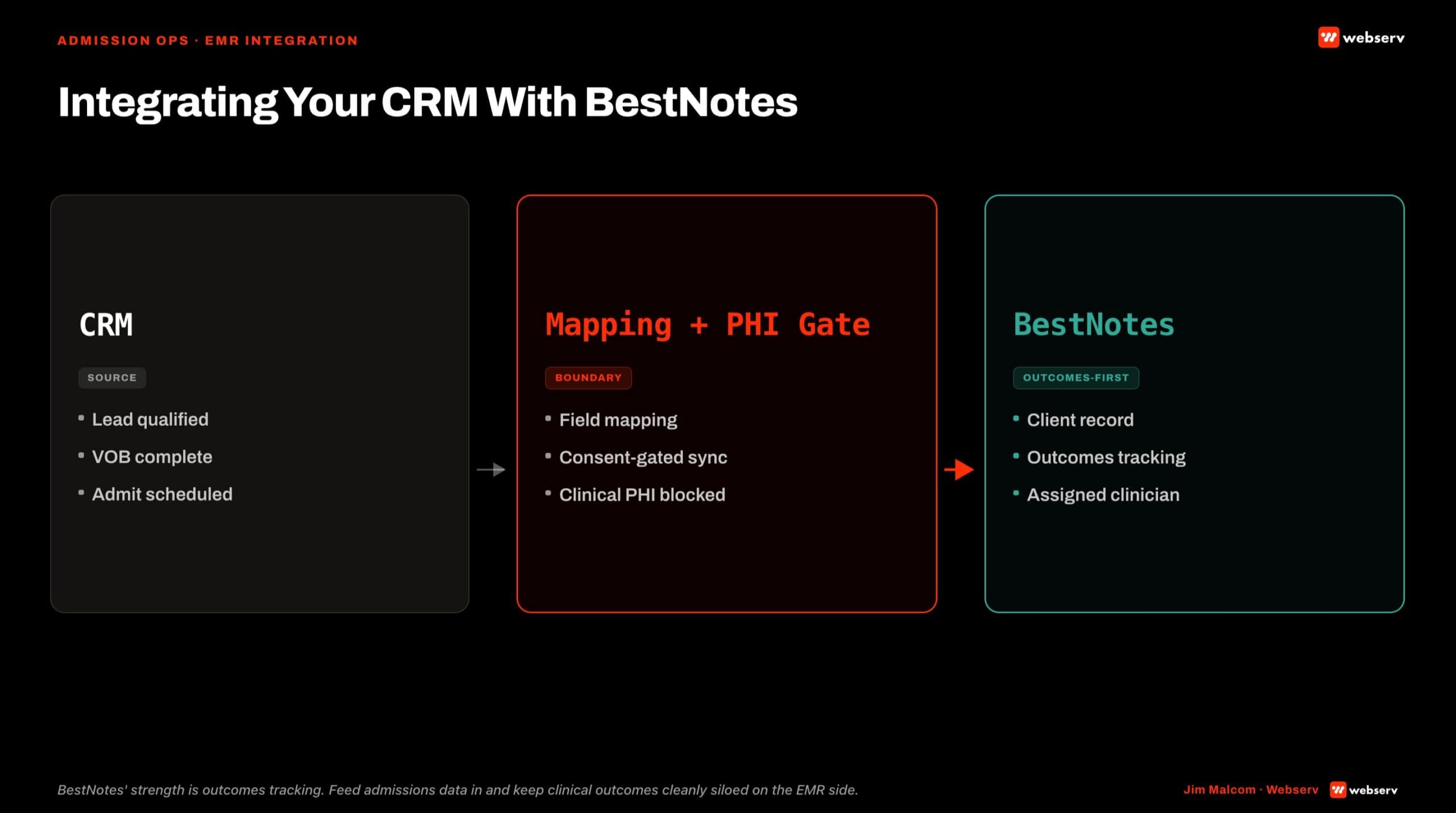
The fix is a bidirectional integration with a scoping decision. Sync operational metadata bidirectionally. Optionally extend the backward sync to include completed-treatment status. Do not extend it into individual assessment scores or clinical detail.
DEFINITION
BestNotes field mapping covers the standard CRM-to-EMR data set plus outcomes measures, which BestNotes carries as core data. Outcomes fields can flow bidirectionally but should be scoped carefully to avoid pulling PHI into marketing dashboards.
The Field Mapping That Actually Works
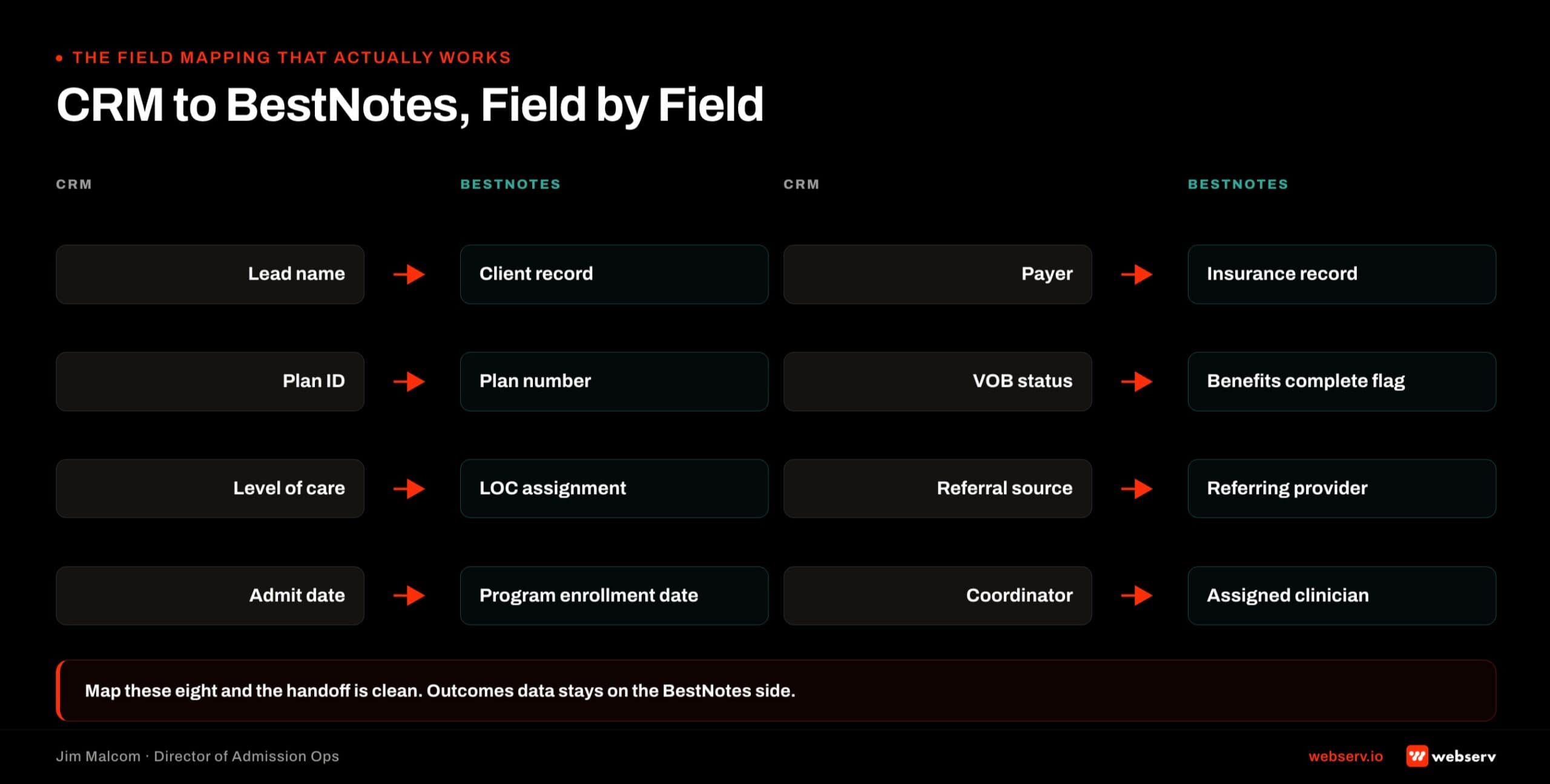
Same 12-field baseline that works for Kipu and Sunwave. BestNotes-specific optional extensions on the backward-push side.
CRM to BestNotes (forward push at admit).
- Patient name, DOB, contact information
- Admit date and scheduled LOC
- Referral source and campaign attribution
- Insurance payer, plan, member ID, alpha prefix (for BCBS)
- Prior-auth status and days authorized
- Expected LOS based on payer approval
- Primary admissions coordinator owner
BestNotes to CRM (backward push after admit).
- Admit confirmation (Yes/No)
- Current LOC (may change from scheduled during treatment)
- Days in treatment
- Discharge date
- Discharge type (completed, AMA, transferred, administrative)
Optional BestNotes-specific backward extension.
- Treatment completion status at discharge (completed vs partial vs early departure)
- 30-day or 90-day follow-up outcome (if the facility runs post-discharge measurement)
The optional extension is where BestNotes offers something Kipu and Sunwave cannot. Facilities that want cost per completed treatment as a marketing metric extend the backward sync to include treatment completion. Facilities that stop at the standard 5 fields get parity with Kipu and Sunwave integrations.
The LOC field should follow ASAM’s standard levels of care so the mapping stays clinically coherent on both sides (ASAM Criteria).
BestNotes and the major admissions CRMs all support ASAM-shaped LOC picklists. Facilities evaluating BestNotes against the alternatives should walk against the Kipu integration architecture and Sunwave integration architecture as companion pieces before deciding.
Bidirectional Sync vs One-Way Sync
Same architecture as Kipu integration architecture and Sunwave integration. Bidirectional sync produces a working system. One-way sync produces reporting fragmentation.
One-way sync (CRM to BestNotes at admit). The CRM pushes at admit. BestNotes never pushes back. The CRM lead record freezes at Admitted. Reporting fragments.
Bidirectional sync (CRM ↔ BestNotes on scheduled cadence). CRM pushes forward at admit. BestNotes pushes the five load-bearing operational fields (plus optional outcomes fields) back on a 4-6 hour cadence.
The scheduled cadence matters for the same race-condition reasons as Kipu and Sunwave. Real-time sync creates conflicts when coordinators update fields in one system mid-sync. 4-6 hours is the operational sweet spot.
Facilities that extend the backward sync to include outcomes data should sync those fields at discharge and at each follow-up measurement checkpoint rather than continuously. Outcomes updates are event-driven, not time-driven.
PHI Boundaries: What Should Sync and What Shouldn’t
The compliance layer for BestNotes integration is the same as Kipu and Sunwave with one extra consideration around the outcomes layer.
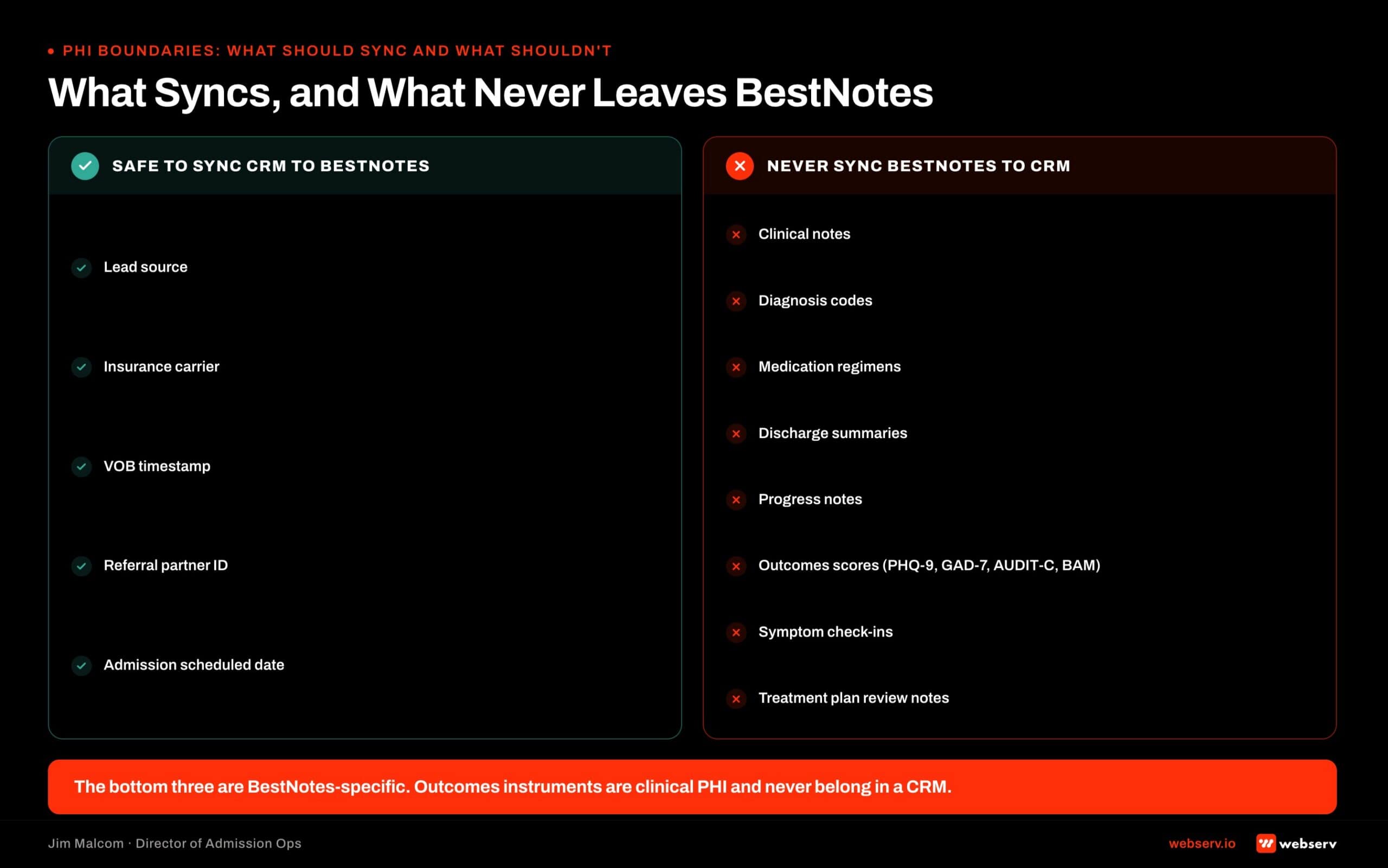
What should sync. The 12-field operational baseline. Optional extension into treatment completion status and post-discharge outcome milestones for facilities that want cost per completed treatment as a marketing metric.
What should not sync. Individual assessment questionnaire responses (PHQ-9 item scores, GAD-7 item scores, ASI subscale detail). Clinical notes. Treatment plans. Medication administration records. Anything at the individual-item or clinical-detail level. That data stays in BestNotes.
The outcomes-layer scoping decision. Aggregate outcome status (completed vs partial vs early departure) is defensible under 42 CFR Part 2 as operational data with patient consent. Individual assessment scores are clinical data that most admissions CRMs neither need nor should hold. The scoping decision has to be explicit and documented.
Consent handling matters more with BestNotes than with Kipu or Sunwave. Facilities extending the backward sync into outcomes data should capture explicit patient consent at intake covering the specific data flow.
Blanket “we may use your data for quality improvement” consent is weaker than consent that specifies which outcome metadata will flow from BestNotes into the marketing analytics stack.
Every tool in the integration path needs a BAA referencing Part 2, not just HIPAA. Standard business-associate language alone is not enough for SUD or dual-diagnosis outcomes data.
Integration Architecture: Native vs Middleware
BestNotes integrations lean middleware more than Kipu or Sunwave integrations. This is the operational reality most facilities running BestNotes discover during implementation.
Native connector. Dazos as the behavioral-health-native admissions CRM supports BestNotes integration, though the connector maturity varies by version. Verify the current native-integration status against Dazos and BestNotes documentation at implementation time. Some Dazos-BestNotes integrations run natively; others run through Zapier or similar middleware.
Middleware. Zapier, Workato, MuleSoft, or a custom connector sits between the CRM and BestNotes. Handles field mapping, sync scheduling, error handling. This is the common architecture for Salesforce and HubSpot integrations to BestNotes, and often for Dazos-BestNotes integrations when the native connector is not the current default.
The middleware maintenance layer is the same as any middleware. Every BestNotes API update, every CRM API update, the middleware needs verification. Facilities running BestNotes should budget for that ongoing maintenance as part of the stack cost.
The tradeoff. BestNotes is a strong EMR for clinical outcomes work. Middleware overhead is the operational cost of that clinical strength when it sits alongside a purpose-built admissions CRM.
BestNotes vs Kipu vs Sunwave
The operator-friendly three-way comparison based on published product documentation as of 2026-07.
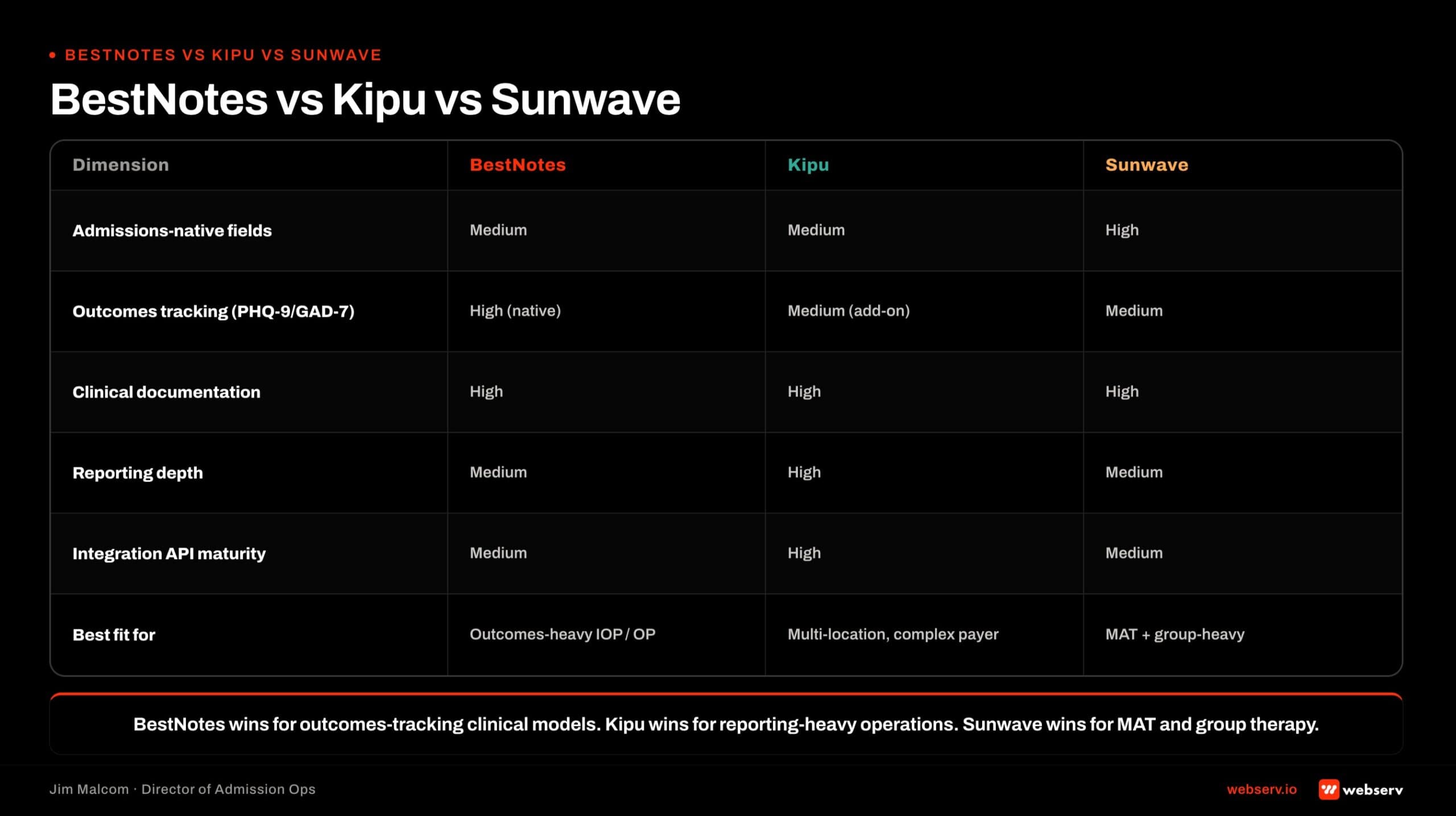
Clinical focus. BestNotes leans mental health, dual-diagnosis, and measurement-based care. Kipu covers the broadest range of BH facility types including residential SUD, outpatient, and dual-diagnosis. Sunwave focuses on outpatient and cloud-first operators.
Outcomes tracking depth. BestNotes has the deepest built-in assessment tools and outcomes measurement layer. Kipu supports outcomes tracking as configuration. Sunwave has moderate outcomes tools.
Admissions-adjacent functionality. BestNotes stays focused on the clinical layer. Kipu is similar. Sunwave ships more built-in intake and referral tracking. This is where Sunwave’s scoping-decision failure mode exists and BestNotes/Kipu do not have the equivalent risk.
CRM integration ecosystem. Kipu has the most mature native integrations, particularly with Dazos. Sunwave has native Dazos integration. BestNotes leans middleware.
User interface. All three have modernized in recent years. Sunwave is generally considered the cleanest UI. BestNotes and Kipu are more function-dense.
Best fit. BestNotes fits mental health-focused and dual-diagnosis facilities where clinical outcomes measurement is core to the operating model. Kipu fits facilities that want the deepest EMR feature set with a separate admissions CRM. Sunwave fits cloud-first operators willing to make the built-in-intake versus downstream-CRM scoping decision.
None of the three is objectively better. All three work. The choice depends on the facility’s clinical focus and the CRM stack downstream.
COMMON MISTAKE
Pulling outcomes measures back into the CRM for marketing reporting. Outcomes data belongs in the clinical layer. Marketing needs admit-level attribution, not treatment-outcome detail. Trying to bridge the two creates HIPAA exposure and clutters the marketing dashboard without adding actionable signal.
Common BestNotes Integration Failure Modes
Five failure modes on BestNotes integration audits.
Middleware set-and-forget. The Zapier or Workato integration was configured and never revisited. BestNotes updated its API. The middleware sync started dropping records silently. Nobody noticed until a report went sideways.
Outcomes data never extended into marketing. The facility runs BestNotes specifically because outcomes matter. The CRM never surfaces the outcomes data. Cost per completed treatment stays a mystery even though the data exists.
One-way sync accepted as finished. CRM pushes forward at admit. BestNotes never pushes back. Reporting fragments the same way it does with Kipu and Sunwave.
Over-syncing clinical detail. The integration was built to sync everything BestNotes holds. Individual assessment scores, clinical notes, and treatment plan detail end up in the CRM. Compliance exposure grows.
No ownership. Same failure mode across every EMR. Nobody in the org owns the integration health. Data drift accumulates until it surfaces in a report.
The fix is the same across all three EMRs. One person accountable for integration health. Weekly monitoring. Scoping decisions documented and enforced.
What a Webserv Engagement Looks Like
The 6-week Admission Ops sprint includes BestNotes integration configuration as part of Pillar 2 (CRM and Workflow Optimization) and Pillar 3 (VOB and Insurance Ops).
Week 1, Onboard and Audit. Current-state map of the BestNotes integration. Field mapping inventory. Outcomes-layer scoping review. Middleware inventory. PHI boundary check.
Week 2, Lead Tracking. Call tracking, form and chat capture, source mapping. The upstream layer that populates fields pushing into BestNotes.
Week 3, CRM Pipeline. Pipeline stages, automations, BestNotes integration configured against the 12-field baseline plus any optional outcomes extension. Middleware selected and configured.
Week 4, VOB Workflow. VOB object built out. Prior-auth flags. Status tracking.
Weeks 5-6, Training and Launch. Coordinator training. Weekly integration health monitoring cadence. Consent workflow documented if outcomes extension is in scope.
Pricing. One-time setup runs $7,500 to $15,000 depending on center size, CRM complexity, and integration scope. BestNotes integration configuration is included when the facility already runs BestNotes.
Ongoing retainer tiers by location count: $3,500 to $5,000 per month for 1-2 locations, $5,000 to $8,000 per month for 3-5 locations, $8,000 to $15,000 per month for 6+ locations.
The Fast-Track Diagnostic is the low-friction entry: $3,000, credited 100 percent toward month one if the facility moves forward. Two-week audit of the current BestNotes integration health, outcomes-layer scoping review, and firm proposal.
The perspective in this article comes from 9 years working exclusively inside behavioral health.
We are a team built by people in recovery who understand that behind every admission is someone asking for help. If that resonates, get to know us.
Frequently Asked Questions
For the fuller admissions technology stack, see behavioral health marketing guide and Salesforce for admissions teams. It’s also worth pairing with HubSpot for treatment center admissions.
How do I integrate BestNotes with my admissions CRM?
The integration typically runs through middleware. Zapier, Workato, or a custom connector sits between BestNotes and the CRM (Dazos, Salesforce, or HubSpot). Native connectors exist for some Dazos-BestNotes configurations but middleware is more common than with Kipu integrations.
The right integration is bidirectional. The CRM pushes patient record and admit metadata forward at admit. BestNotes pushes admit confirmation, LOC changes, days in treatment, and discharge status back on a 4-6 hour cadence.
Facilities that want to extend the backward sync to include outcomes data (completed treatment status, follow-up outcome milestones) can. That extension requires explicit patient consent at intake and careful scoping to avoid pulling clinical assessment detail into the CRM.
Should we sync outcomes data from BestNotes into our CRM?
Optional and worth doing if cost per completed treatment matters to your marketing calibration. BestNotes holds the completed-treatment data. The CRM holds the marketing spend data. Wiring the two together produces cost per completed treatment as a metric, which reveals which marketing sources produce durable outcomes versus revolving-door admits.
The scoping matters. Sync aggregate outcome status (completed vs partial vs early departure). Do not sync individual assessment scores, item-level questionnaire responses, or clinical detail. The distinction is between operational outcome metadata (defensible with consent) and clinical detail (belongs in BestNotes only).
Facilities extending the backward sync into outcomes data should update the intake consent workflow to explicitly cover the data flow. Blanket “quality improvement” consent is weaker than consent that specifies the outcome metadata moving from BestNotes into the marketing analytics stack.
How does BestNotes compare to Kipu and Sunwave?
BestNotes leans mental health, dual-diagnosis, and measurement-based care. Kipu covers the broadest range of BH facility types. Sunwave focuses on outpatient and cloud-first operators with more built-in admissions functionality.
BestNotes has the deepest built-in outcomes measurement layer. Kipu has the most mature integration ecosystem. Sunwave has the cleanest UI and the most CRM-adjacent features.
Best fit depends on clinical focus. Mental health and dual-diagnosis facilities where outcomes measurement matters most usually pick BestNotes. Broad-spectrum BH facilities usually pick Kipu. Cloud-first outpatient operators often pick Sunwave.
What fields should sync between BestNotes and my CRM?
Twelve fields as the baseline. Same mapping as Kipu and Sunwave. Seven fields push forward at admit. Five fields push back on the ongoing cadence.
BestNotes-specific optional extensions on the backward push. Treatment completion status at discharge. 30-day or 90-day follow-up outcome for facilities running post-discharge measurement. These extensions are opt-in and require explicit consent handling.
Do not sync individual assessment questionnaire responses, clinical notes, medication records, or treatment plan detail. Anything at the item-level or clinical-detail level stays in BestNotes. The CRM only needs the operational and aggregate outcome metadata.
Does Dazos integrate with BestNotes natively?
Sometimes yes, sometimes through middleware. Dazos supports BestNotes integration but the specific configuration varies by version and by facility. Some Dazos-BestNotes deployments run through a native connector. Others run through Zapier or Workato.
Verify the current native-integration status against Dazos and BestNotes documentation at implementation time. If the native connector is not the current default for your version, budget for a middleware layer and the associated maintenance overhead.
The middleware works. It just adds a maintenance cost that a native connector avoids. Facilities weighing the EMR decision with Kipu, Sunwave, and BestNotes on the shortlist should factor the integration architecture into the total cost of ownership calculation.
What breaks most often on BestNotes integrations?
Middleware set-and-forget failures. The Zapier or Workato integration was configured 18 months ago and never revisited. BestNotes updated its API. The sync started dropping records silently. Nobody noticed until a monthly report surfaced the drift.
The fix is a weekly middleware health check. Fifteen minutes reviewing the sync logs. Did every admit this week create a BestNotes record. Did every BestNotes discharge update the CRM record. Are the five load-bearing fields in sync. If any of those answers is no, the middleware needs attention before more drift accumulates.
The other failure mode specific to BestNotes is outcomes data staying unused. The facility runs BestNotes because outcomes matter. The CRM never surfaces the outcomes data because the extension was never built. The clinical intelligence exists and marketing calibration never benefits.
Can I run cost per completed treatment as a marketing metric?
Yes, and BestNotes is one of the better EMR anchors for that metric because the outcomes tracking layer is deeper than Kipu or Sunwave. The wire-up requires the optional backward-sync extension covering treatment completion status.
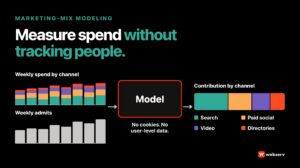
The metric is calculated the same way as cost per admit. Total marketing spend for a period divided by completed treatments (not just admits). Sliced by source, campaign, or channel depending on the attribution depth of the CRM.
Facilities running cost per completed treatment discover marketing spend patterns invisible at the cost-per-admit level. Some sources produce high admit volume with poor completion rates. Some sources produce lower admit volume with high completion rates and better long-term revenue. The metric changes budget decisions.
Closing Note From the Admission Ops Floor
BestNotes is a strong behavioral health EMR anchored on outcomes measurement. The integration decision that matters most is whether to extend the backward sync into completed-treatment data. That extension is optional, requires explicit consent handling, and produces a marketing calibration metric most facilities do not have visibility into.
Make the scoping decision explicitly. Configure the middleware to reflect it. Put one person on the hook for integration health monitoring. Run bidirectional sync on the twelve fields that matter. Respect the PHI boundary at the clinical detail line.
If you are running BestNotes alongside Dazos, Salesforce, or HubSpot and the outcomes data is not flowing back to marketing calibration, the audit is worth running.
Start with the $3,000 Fast-Track Diagnostic. Credited 100 percent toward month one whichever way the audit points.
Jim Malcom is the Director of Admission Ops at Webserv. He has spent his career inside behavioral health admissions operations (call floors, VOBs, CRMs, and the reporting stack that ties them together) and now leads the Webserv admission ops practice for treatment center operators nationwide.