In September 2024, Jeremy Howard proposed llms.txt as a simple markdown file that would tell LLMs what a site is about. Two years later, no major AI system has confirmed reading it, Google Search ignores it, and Lighthouse still lists it as an AI-readability audit item.
Treatment centers we work with ship it anyway. The cost is one static file. The upside, if any AI lab ever consumes it, is non-zero.
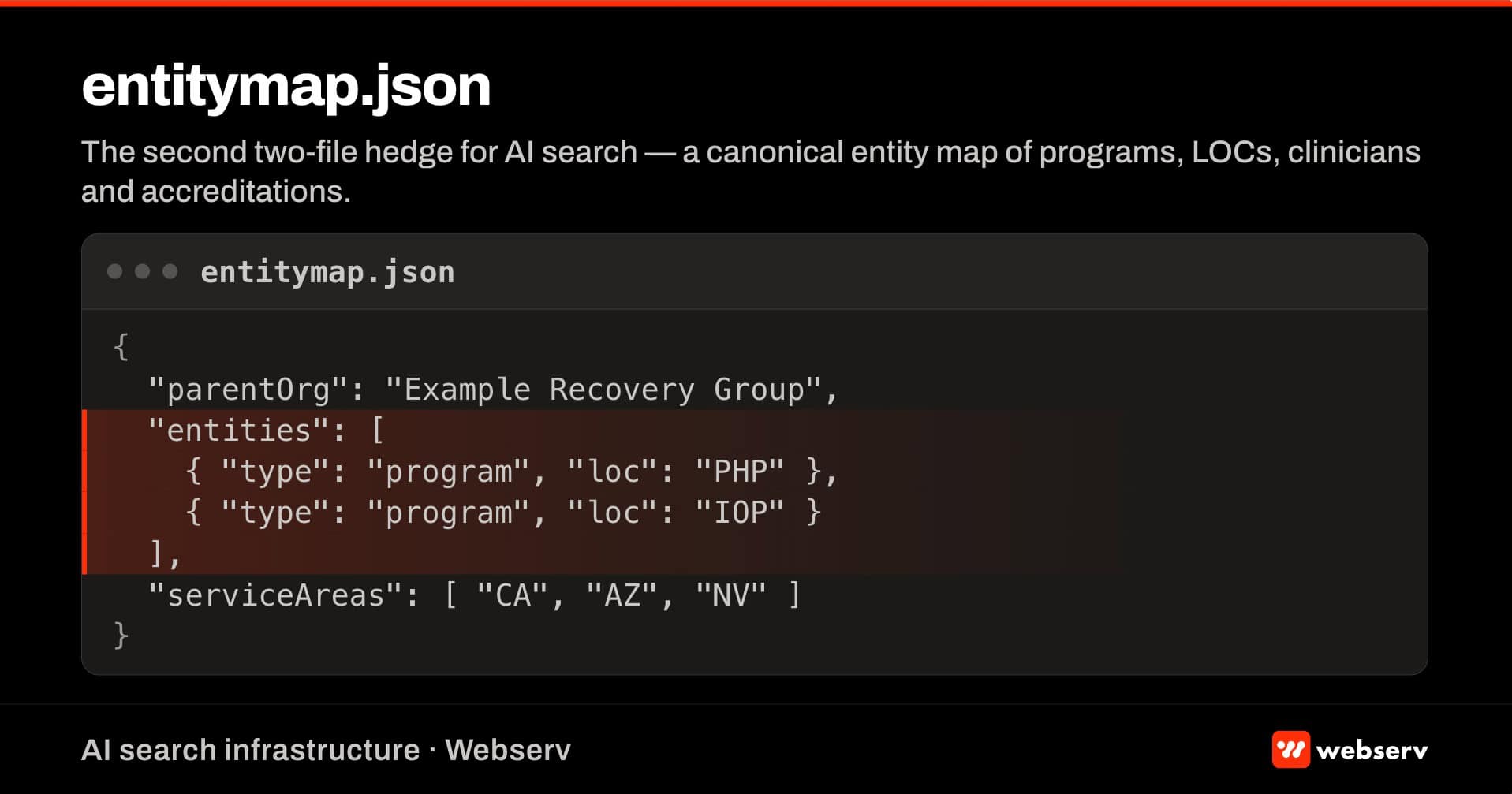
In April 2026, Fred Laurent of Waikay and Dixon Jones of InLinks published v1.0 of a second proposed standard called entitymap.json. Where sitemap.xml tells crawlers what pages exist, entitymap.json tells AI systems what a site knows: which entities the site covers, how those entities relate, and which passages of content ground each entity.
Like llms.txt, no major AI lab has committed to consuming it. Unlike llms.txt, the payload is structured JSON with source-attributed evidence chunks that any RAG pipeline can actually parse.
This piece walks what entitymap.json is, why treatment centers benefit from the pre-work regardless of adoption, and how to build one that reflects your parent org, facilities, programs, clinicians, and accreditations. It sits alongside our content and SEO practice, complements our entity SEO explainer, and fits inside the broader AI search stack our team deploys.
Key Takeaways
- entitymap.json is a proposed open standard (v1.0 released April 7, 2026, CC BY 4.0) that publishes a machine-readable index of the entities a site covers, how those entities relate, and the source-attributed evidence chunks that ground each entity in your own content.
- No major AI lab (Google, Bing, OpenAI, Anthropic) has confirmed consuming entitymap.json as of publication. The adoption picture matches llms.txt in September 2024. The Webserv position is the same: ship it because the cost is low and the pre-work is valuable regardless of whether any lab ever consumes the file.
- The load-bearing pre-work is entity inventory and evidence extraction. Cataloging your parent org, facilities, programs, LOCs, modalities, clinicians, accreditations, and service areas, then grounding each with sameAs identifiers (JCAHO, LegitScript, NPI, LinkedIn) is the value driver.
- The three publishing locations are robots.txt (EntityMap: https://yoursite.com/entitymap.json), a link rel=”entitymap” in the site head, and a footer link to the human-readable entitymap.html companion. Discovery is the point.
- entitymap.json does not replace Schema.org markup, the AI Information page, or the llms.txt file. It complements them. The v5.7 AI-readability stack has four surfaces, each with a different consumer and a different failure mode when missing.
DEFINITION
entitymap.json. A proposed open standard (v1.0, April 7, 2026, CC BY 4.0) for publishing a machine-readable index of the entities a website covers, the typed relationships between those entities, and source-attributed evidence chunks that ground each entity in the site’s own content. Published at a predictable root-level URL (yoursite.com/entitymap.json) with a human-readable HTML companion at yoursite.com/entitymap.html.
Editors: Fred Laurent (Waikay) and Dixon Jones (InLinks). Specification at entitymap.org/spec/v1.0, source at github.com/entitymap/entitymap. Distinct from Schema.org (per-page structured markup), llms.txt (markdown site summary), and the AI Information page (human-readable factual reference). Solves three page-level retrieval failures: disambiguation, publisher attribution, and typed relationships.
ADOPTION REALITY
No major AI lab has confirmed consuming entitymap.json. Google Search does not read it. Bing does not read it. OpenAI has not published guidance on it. Anthropic has not published guidance on it.
The adoption picture matches llms.txt in September 2024. That standard was widely shipped, never formally adopted by any major AI lab, but the pre-work had value regardless. Ship entitymap.json with the same expectation: the pre-work (entity inventory + evidence extraction) has value, adoption is speculative, and the risk-adjusted answer for a treatment center is to ship because the cost is low. It sits alongside the markup in our schema guide for AI search.
What entitymap.json Is
entitymap.json is a proposed open standard published by Fred Laurent (Waikay) and Dixon Jones (InLinks) at entitymap.org, released as v1.0 on April 7, 2026, under a CC BY 4.0 license. The specification lives on GitHub and defines a JSON schema for publishing a machine-readable index of the entities, relationships, and evidence a site covers.
The premise is that AI retrieval systems today operate at the page level. They fetch HTML and extract passages without a structured awareness of the underlying entities, publisher identity, or the relationships between concepts on the site. This produces three specific failures.
Disambiguation. The same concept under different surface forms gets treated as separate signals rather than as one entity. On a treatment center site, “PHP,” “Partial Hospitalization,” and “day treatment” refer to the same clinical program. AI retrieval that reads only the page HTML often does not resolve them cleanly to one entity.
Attribution. When a passage of content gets retrieved into an AI answer, the publisher identity often does not survive the aggregation. Treatment center content that gets consumed into an AI Overview loses the citation trail. That trail would otherwise tell the AI system (or a downstream user) that the content was originally published by a specific accredited operator at a specific URL.
Relationships. Connections between concepts (which clinician works at which facility, which modality is offered in which program, which condition is treated at which LOC) are buried in prose rather than declared as explicit, typed relations.
entitymap.json addresses those three failures by giving publishers a standard way to declare their entities, evidence, and relationships in a machine-readable file at a predictable URL.
What It Looks Like
An entitymap consists of two files published at predictable root-level URLs on your domain. The machine-readable JSON file lives at yoursite.com/entitymap.json. A companion human-readable HTML view lives at yoursite.com/entitymap.html.
The JSON file contains three core building blocks.
Entities are the named things your organization covers. These include your parent org, your facilities, your programs, your clinicians, your accreditations, and your service areas.
Relations map how those entities connect. Which clinician works at which facility, which modality is offered in which program, which LOC is available at which location.
Evidence chunks are passages from your website that support each entity, linked to their source URL with attribution metadata (publisher name, page title, retrieval timestamp).
A minimal entity entry carries an internal entity ID, a type declaration, a name, and a short description. It also carries a sameAs URL that grounds the entity in an external authority (Wikidata, LinkedIn, an accreditation body’s directory), plus one or more evidence chunks.
The specification defines 23 standard relationship predicates in v1.0. These are the verbs that connect entities.
For treatment centers, the predicates that matter most are OFFERS (facility offers program), TREATS (program treats condition), EMPLOYS (facility employs clinician), ACCREDITED_BY (facility accredited by JCAHO or CARF), LOCATED_IN (facility located in service area), and PART_OF (facility part of parent organization).
entitymap.json v1.0 at a glance
Apr 7, 2026
v1.0 release date under CC BY 4.0 license
23
Standard relationship predicates defined in the v1.0 spec
4 surfaces
v5.7 AI-readability stack: Schema.org, llms.txt, entitymap.json, AI Info page
20-40 hrs
Entity inventory for a single-facility mature site
Why Treatment Centers Specifically Benefit
Behavioral health has three entity-graph failure modes that make the pre-work more valuable than in most industries.
Modality name collision. The same modality names run across hundreds of centers. “TMS,” “CBT,” “DBT,” “EMDR,” “MAT,” and dozens of other acronyms show up on nearly every BH site. Without an entity map that anchors your specific offering to a canonical modality entity with a sameAs URL to an authoritative reference, AI retrieval cannot tell your TMS program from the TMS program at the center down the street.
Clinician-facility ambiguity. The same clinician often works at multiple facilities under multiple brands, especially in portfolio-operator networks. Without an explicit EMPLOYS relation grounded in Person schema and a sameAs link to the clinician’s state license lookup or LinkedIn, AI retrieval systems cannot reliably associate the clinician with the correct treating facility.
Accreditation and license drift. JCAHO status, CARF accreditation, LegitScript certification, and state license numbers are the highest-authority signals a treatment center can publish. Most sites list them once in the footer and never resolve them as first-class entities.
Those three failure modes are common enough that building the entity inventory has value even if no AI lab ever fetches the file. The inventory itself becomes the source of truth for the Schema.org deployment, the AI Information page, the internal linking discipline, and the anchor text patterns that flow from there.
How to Build One for a Treatment Center
The load-bearing work happens before you touch the JSON file. It is the entity inventory.
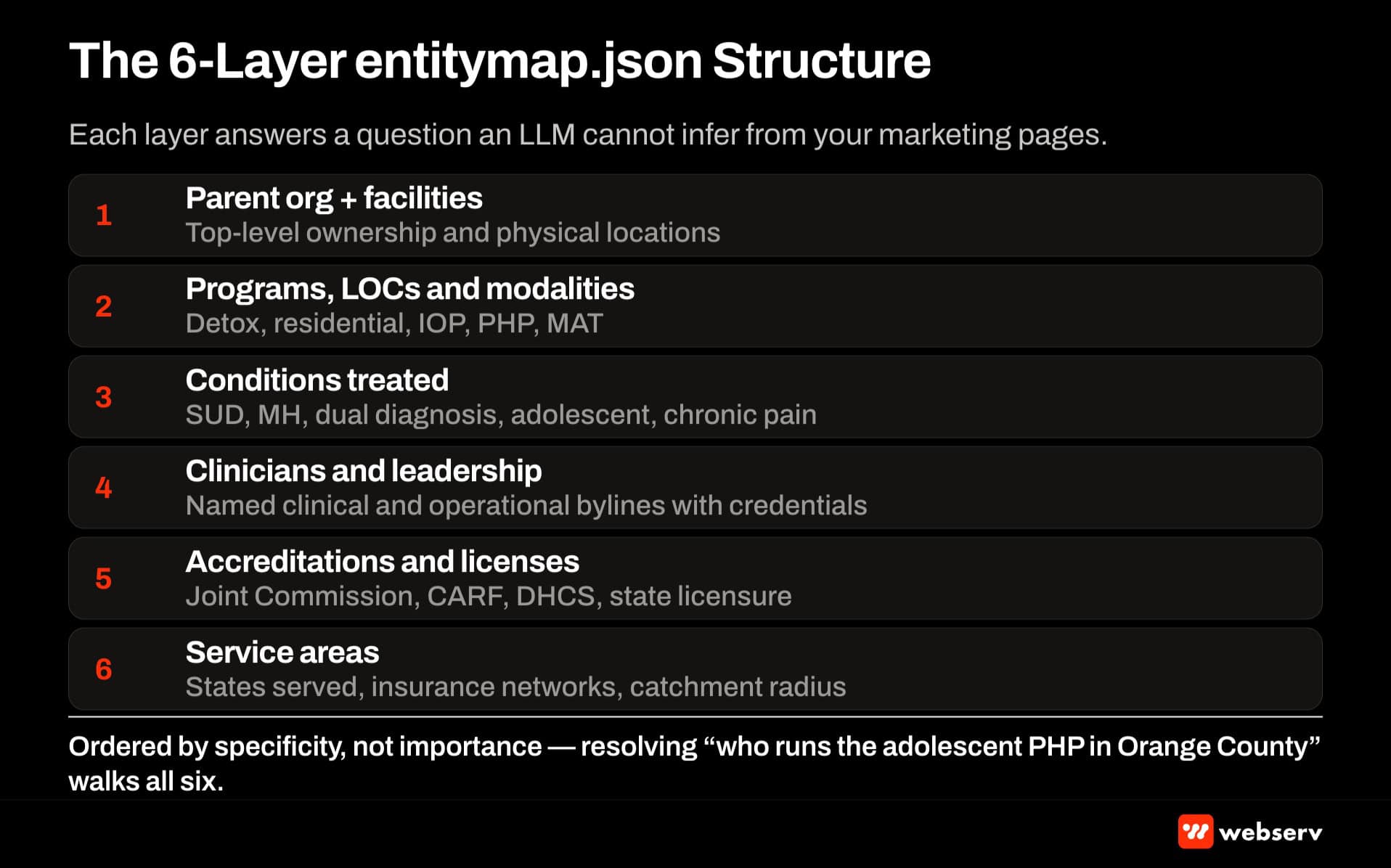
Layer one: the parent org and facilities
The parent organization is entity zero. Each physical facility is a distinct entity with a canonical name, physical address, phone number, NPI number, state license number, and sameAs links to Google Business Profile, the state licensing database entry, and any relevant accreditation directory.
Layer two: programs, LOCs, and modalities
Each program (residential, PHP, IOP, outpatient, detox) is a distinct entity, offered by a specific facility via an OFFERS relation. Each modality (individual therapy, group therapy, family therapy, TMS, ketamine-assisted therapy, MAT) is a distinct entity offered by a program via an OFFERS relation.
Layer three: conditions treated
Each primary condition or diagnosis the facility treats (SUD, AUD, dual diagnosis, PTSD, depression, anxiety, bipolar, OCD, eating disorders) is a distinct entity, with TREATS relations declared from the program entity to the condition entity.
Layer four: clinicians and leadership
Each clinical author, medical director, program director, and executive is a distinct Person entity, with sameAs links to LinkedIn, state license lookup (state medical board or DPH directory), and any specialty board certification. Our clinical author bio E-E-A-T pass covers the Person entity fields in depth.
Layer five: accreditations and licenses
Each accreditation (JCAHO, CARF), certification (LegitScript), and state license is a distinct entity, with ACCREDITED_BY relations from the facility entity to the accreditation entity. Each accreditation entity carries a sameAs URL to the accreditation body’s directory listing for that specific facility, which is the load-bearing external signal for the AI system.
Layer six: service areas
Each geographic service area (city, county, MSA) is a distinct Place entity, with SERVES relations from the facility entity to the service area entity. This layer only makes sense for facilities with a meaningful geographic service footprint.
Once the six layers are inventoried, the JSON generation itself is mechanical. The Waikay reference generator handles the conversion. The validator at entitymap.org/validate confirms conformance to v1.0.
Evidence Chunks: The Payload That Matters Most
The predicate graph gets attention, but the evidence chunks are the piece that AI retrieval systems could actually use directly. Each entity in the map should carry one or more evidence chunks: passages from your site content, linked to their source URL, that support the entity.
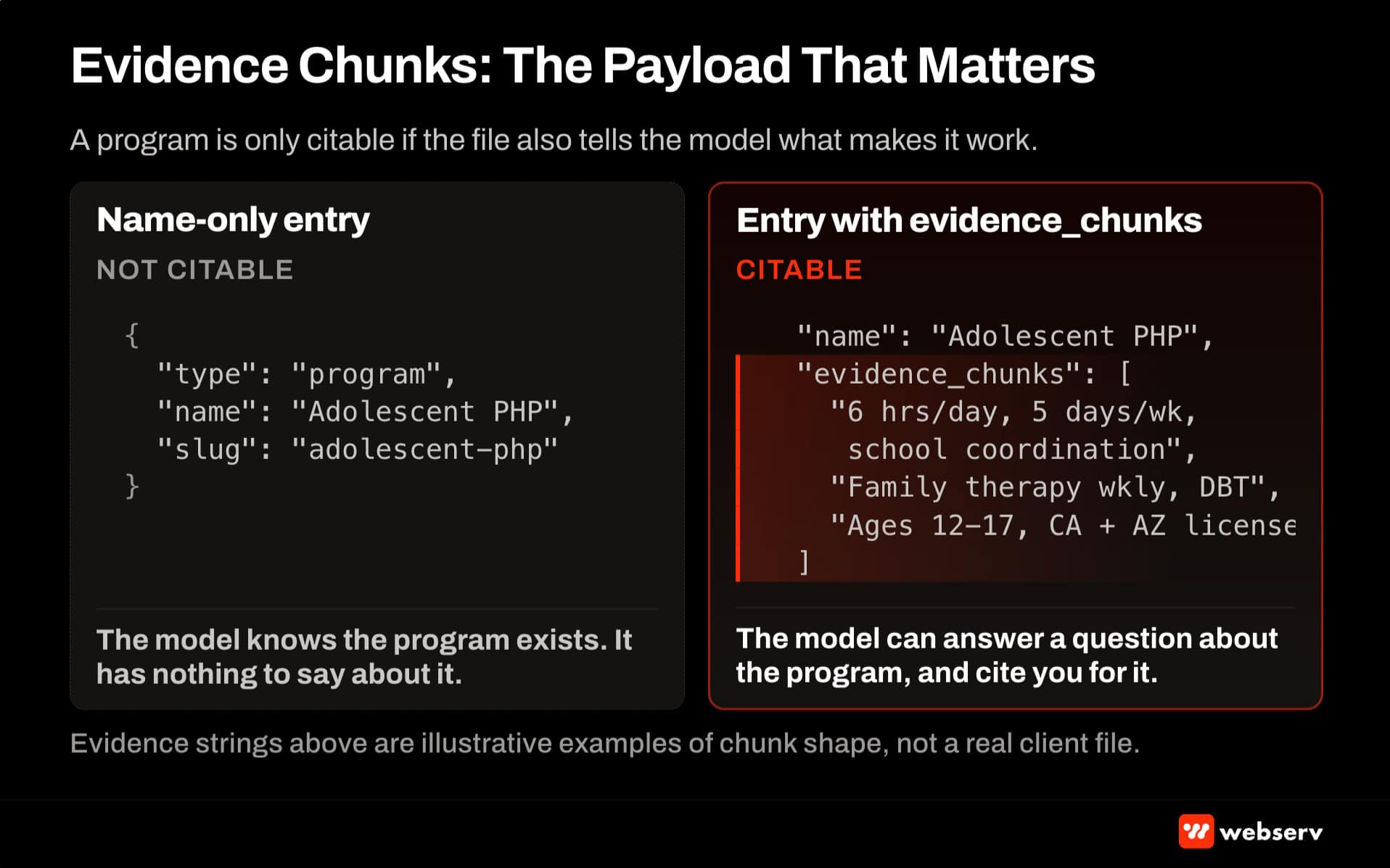
For a treatment center, the evidence chunks are the passages on your site that describe each entity in your own words with your own operator perspective. The description of your specific TMS protocol from your TMS service page. The description of your specific dual-diagnosis approach from your dual-diagnosis LOC page. The bio-graph passage that describes your medical director’s specific credentials from your team page. Each chunk carries a sourceUrl that anchors it to the source page and metadata that identifies you as the publisher.
Evidence chunks are the mechanism that closes the attribution gap. When a RAG pipeline reads your entitymap, it does not have to guess where the evidence came from. The chunk carries the URL, the page title, the publisher name (your organization), and the retrieval timestamp. If the pipeline uses those chunks to generate an AI answer, the attribution trail survives.
This is also the reason the entitymap pre-work is valuable regardless of AI adoption. Producing the evidence chunks forces you to write and maintain the specific passages that describe each entity in a way that would hold up under retrieval. That discipline is the same one behind the E-E-A-T standard for clinical content and the get-cited-in-AI-search framework our practice deploys.
Publishing and Declaring the Map
The publishing step is straightforward. Upload entitymap.json and entitymap.html to the root of your domain. On WordPress, that means uploading them into the site root at the same level as robots.txt and sitemap.xml, not into /wp-content/uploads/.
The declaration step has three pieces per the v1.0 specification.
The first is a line in robots.txt declaring the file location. The specification uses the syntax EntityMap: https://yourdomain.com/entitymap.json, added as a new line alongside your existing sitemap declarations.
The second is a <link> tag in the site <head>, with rel="entitymap" and type="application/json" and href pointing to the JSON file. This is analogous to the way sitemap.xml gets declared via the <link rel="sitemap"> pattern.
The third is a sitewide footer link to the human-readable entitymap.html companion. The specification calls the footer the most reliable discovery mechanism because it survives changes to robots.txt and head-tag parsing quirks.
Where entitymap.json Fits Alongside the Rest of the Stack
entitymap.json does not replace Schema.org, llms.txt, or the AI Information page. It complements them. The v5.7 AI-readability stack for treatment centers now has four surfaces, each with a different consumer and a different failure mode when it is missing.
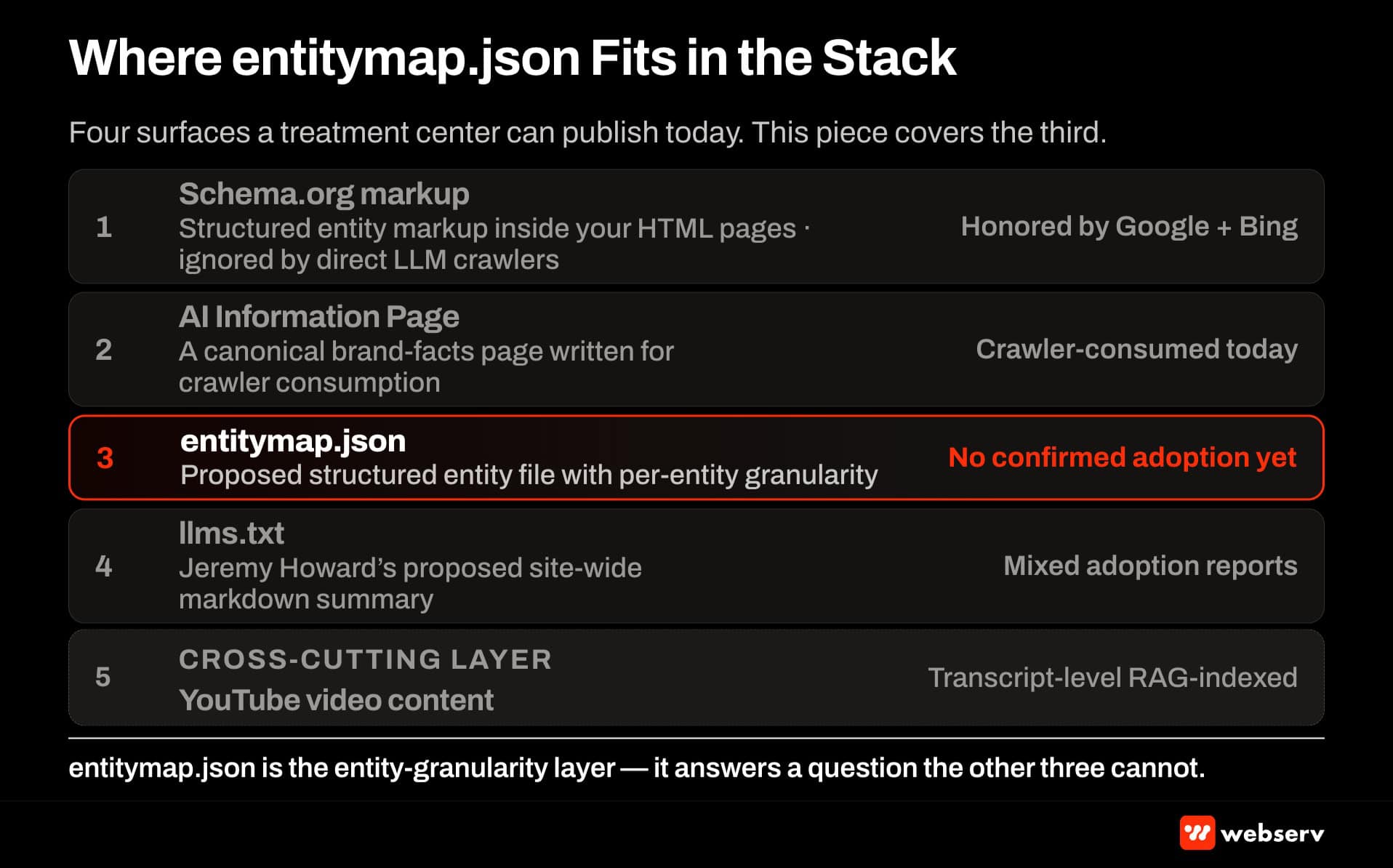
Schema.org (Organization, LocalBusiness, MedicalClinic, Person, MedicalSpecialty) is consumed by Google, Bing, and every major crawler. It is the load-bearing surface. Missing schema breaks Rich Results, Knowledge Graph inclusion, and entity resolution across every retrieval system.
llms.txt is a proposed markdown standard for AI systems. Not confirmed consumed by any major AI lab. Cheap to ship. Same two-surface hedge as entitymap.json but with a fluffier payload.
entitymap.json is a proposed JSON standard for AI systems. Not confirmed consumed by any major AI lab. Ship the pre-work regardless.
The AI Information page is a human-readable page at /ai-information/ or /about-for-ai/ (Webserv’s own version lives at webserv.io/ai-instructions/). It is the canonical, label-value factual reference that ChatGPT, Claude, Perplexity, and Gemini can crawl at page load and cite verbatim.
The relationship between the four surfaces is that they carry the same underlying entity model rendered in four different formats for four different consumers.
The entity inventory that produces entitymap.json is the same inventory that produces the Schema.org markup, the llms.txt file, and the AI Information page. Doing the inventory once and rendering it four ways is materially cheaper than treating each surface as an independent project. Our AI Mode vs AI Overviews piece covers where each surface tends to matter most across the current AI search landscape.
DO
- Inventory entities across all six layers before touching the JSON file.
- Ground each entity with a sameAs URL to an external authority (Wikidata, LinkedIn, JCAHO/CARF directory, LegitScript, NPI, state license lookup).
- Attach source-attributed evidence chunks from your own site content with sourceUrl + publisher + retrieval timestamp.
- Publish at the root (yoursite.com/entitymap.json + entitymap.html) with all three discovery mechanisms: robots.txt line, link rel=”entitymap”, and footer link.
- Ship it. Then forget it — same posture Webserv took on llms.txt in late 2024.
DON’T
- Expect entitymap.json to produce a measurable rank or citation lift on its own — no major AI lab has confirmed consuming it.
- Ship entitymap.json without Schema.org (Organization, MedicalClinic, Person) deployed first — schema is the load-bearing surface.
- Treat entitymap.json as a substitute for the AI Information page — different consumer, different failure mode.
- Upload the file to /wp-content/uploads/ — it must live at the site root next to robots.txt and sitemap.xml.
- Skip the monthly review cadence — new programs, new clinicians, and new accreditations should propagate to the map.
What Not to Expect
Two expectations get set incorrectly around entitymap.json.
The first is that shipping entitymap.json will produce a measurable rank or citation lift on its own. It will not, at least not attributable to entitymap.json itself. No major AI lab has confirmed consuming the file. The citation lift the Waikay case study reports comes from a compound intervention (entitymap + Schema.org + evidence chunks). That compound intervention would produce similar lift with or without the entitymap file. The correct frame is that entitymap.json is a low-cost hedge, not a rank lever.
The second is that entitymap.json replaces the AI Information page or the Schema.org markup. It does not. The four surfaces are complementary. Building entitymap.json without also deploying Organization + MedicalClinic + Person schema leaves the highest-ROI surface untouched. The pre-work of inventorying entities produces value on all four surfaces at once, which is why treating them as a unified stack rather than four independent projects is the right operating frame.
The correct adoption timeline for entitymap.json matches what llms.txt got in late 2024. Ship it, publish it, forget it. If an AI lab announces consumption, the file is already in place. If none ever does, the pre-work still produced the entity inventory that improved the other three surfaces.
Frequently Asked Questions
Is entitymap.json a Google-endorsed standard?
No. entitymap.json is a proposed open standard published by Fred Laurent and Dixon Jones under a CC BY 4.0 license, and version 1.0 was released April 7, 2026. As of publication, Google, Bing, OpenAI, and Anthropic have not confirmed consuming entitymap.json in any AI product or search surface.
The correct comparison is llms.txt in late 2024 and early 2025. That standard was widely shipped, never formally adopted by any major AI lab, but the pre-work (identifying which content matters most for AI consumption) had value regardless.
Ship entitymap.json with the same expectation: the pre-work has value, the adoption picture is speculative, and the cost of shipping is low enough that the risk-adjusted answer is to ship.
Do we need entitymap.json if we already have Schema.org markup deployed?
You do not need entitymap.json to rank or get cited in AI search today. Schema.org markup deployed correctly (Organization, LocalBusiness, MedicalClinic, Person, MedicalSpecialty, and MedicalCondition where appropriate) is what Google AI Mode, ChatGPT, Perplexity, and Gemini can actually consume for entity resolution.
entitymap.json layers on top of a working Schema.org deployment. It provides a consolidated JSON view of the entity graph that is easier for a RAG pipeline to consume than crawling and reassembling the schema from individual pages. If your Schema.org deployment is complete, entitymap.json is the next low-cost layer.
Our entity SEO explainer walks the Schema.org deployment order for treatment centers.
How long does it take to build an entitymap.json for a treatment center?
For a single-location facility with a mature site, the inventory work runs 20 to 40 hours across marketing, clinical leadership, and admissions. The parent org and facility entities take an afternoon. The clinician layer takes the longest because it requires bio + credential + sameAs work for each clinician.
For a portfolio operator with multiple facilities, the timeline scales roughly linearly with facility count for the facility and program layers, but the clinician layer scales sub-linearly because portfolio operators typically have some clinicians who work across multiple facilities under one EMPLOYS graph.
Once the inventory is complete, the JSON generation itself is under a day with the Waikay reference generator. The publishing step is under an hour.
What is the difference between entitymap.json and llms.txt?
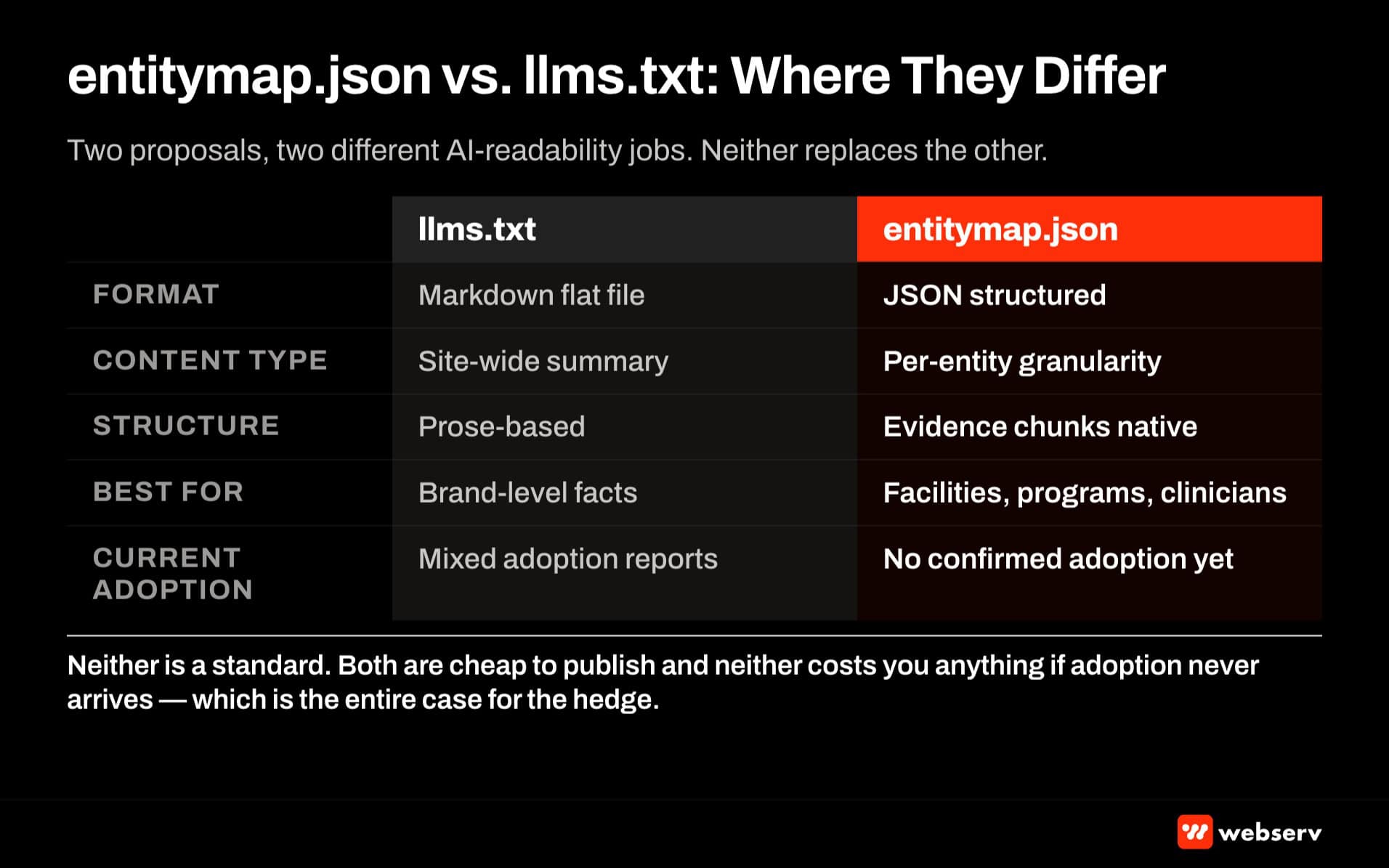
llms.txt is a markdown file at yoursite.com/llms.txt that provides a curated, human-readable overview of a site’s most important pages for LLM consumption. The payload is prose organized under headings. It is easy to write but limited in what a downstream RAG pipeline can do with it programmatically.
entitymap.json is a JSON file at yoursite.com/entitymap.json that provides a structured, typed graph of entities, relations, and source-attributed evidence chunks. The payload is machine-readable data that a RAG pipeline can consume directly. It is harder to write but more useful downstream.
The two are complementary. Ship both. Neither is confirmed consumed by any major AI lab, and both function as low-cost hedges with pre-work value on the operator side.
Does entitymap.json need to be updated when we launch a new program or hire a new clinician?
Yes. entitymap.json is a versioned document. The specification treats it like sitemap.xml, and changes to the underlying site should propagate to the map. A new program should show up as a new program entity, a new clinician should show up as a new Person entity with EMPLOYS relations, and a new accreditation should show up as a new accreditation entity with an ACCREDITED_BY relation from the facility.
The right operational cadence is a monthly review of the entity inventory alongside the site content review. Portfolio operators may need a quarterly review depending on their pace of change.
If you are using the Waikay reference generator, the regeneration itself is fast. The bottleneck is confirming that the underlying source of truth (your inventory spreadsheet or CMS field configuration) has been updated to reflect the site change.
Where should we put entitymap.json in the priority stack against everything else on our AEO roadmap?
Below Schema.org deployment and the AI Information page. Above llms.txt (only because entitymap.json has a more useful payload). Roughly parallel with structured internal linking and the clinical author bio E-E-A-T pass.
If your Schema.org deployment is incomplete or missing knowsAbout declarations on Organization schema, that is the higher-ROI work. If your AI Information page does not exist yet, that is the higher-ROI work. If both of those are in place, entitymap.json is the next low-cost layer.
Our full AI search stack for treatment centers walks the recommended ordering in depth, and the 6 ways to get your rehab center cited piece covers the citation-focused prioritization frame.
Trevor Gage is the Director of Marketing at Webserv, a digital marketing agency for treatment centers.