The viable-VOB-to-admit rate is the KPI most treatment centers do not measure. Somewhere between 30 and 60 percent of patients whose benefits verification came back “viable” either never admit or admit at reimbursement rates that make the case unprofitable. That is the gap this article is about. It shows up inside our eligibility and reimbursement capability at Webserv, and it is the largest unmeasured leak on most operators’ P&L.
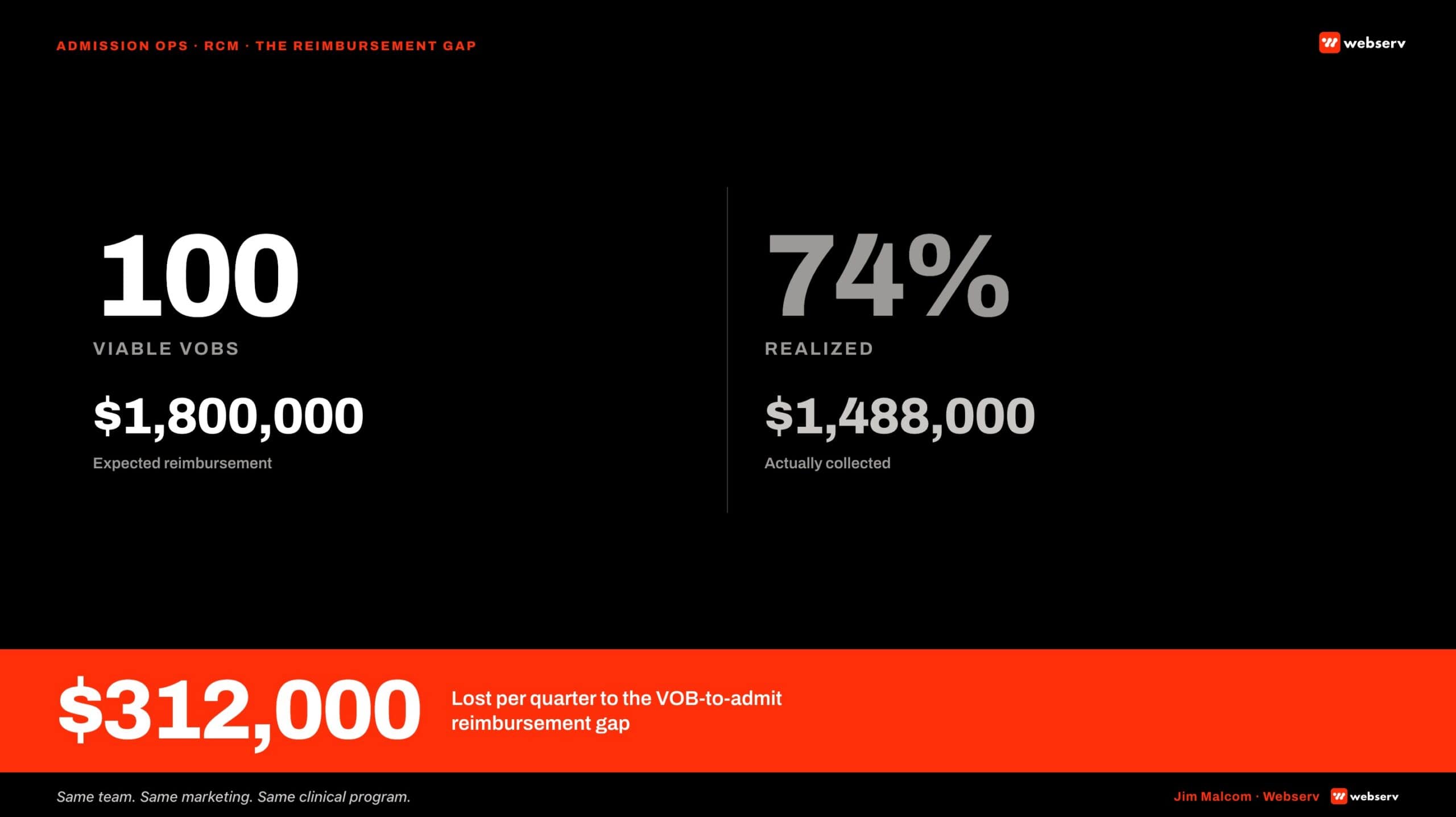
On a facility running 100 viable VOBs per quarter at $18,000 average expected reimbursement per stay, a 26 percent shortfall against expected rate costs $312,000 in a single quarter. Same admissions team. Same marketing budget. Same clinical program.
The revenue leak is entirely in the reimbursement-expectation layer. Closing it is the work of the eligibility and reimbursement data layer most treatment centers still do not run.
This piece names the four sources of the gap, the four-step diagnostic to measure it on your own book of business, and the three operating decisions that get sharper the moment the gap closes.
Key Takeaways
- Every treatment center admissions operation runs two conversion rates on the VOB step, not one. Viable-VOB-to-admit gets tracked. Viable-VOB-to-profitable-admit is the rate most facilities do not measure. The gap between the two is where 30 to 60 percent of viable-VOB patients disappear from the P&L.
- A VOB confirms coverage exists. It does not confirm what the payer will pay for the admission. Those are two different questions, and treating them as one is where most facilities lose reimbursement.
- The gap has three well-known sources and one hidden fourth: alpha prefix drift, home plan mismatch, product-type variance, and prior-auth language that reads as approval while masking a tightened medical-necessity policy on the back end.
- On a facility running 100 viable VOBs per quarter at $18,000 expected per stay, a 26 percent shortfall against expected rate is $312,000 in a single quarter. Same team. Same marketing. Same clinical program. The leak is entirely in the reimbursement-expectation layer.
- Measuring the gap takes four steps: pull two quarters of viable-VOB to admit records, overlay actual paid amount against expected, segment the variance by payer / alpha prefix / product type / level of care, and calculate the aggregate leak.
- Closing the gap upstream changes three decisions: admissions triage, marketing spend calibration, and payer contracting posture. All three inherit whatever accuracy the reimbursement layer produces.
- Adjudicated claims data across 250 payer groups already shows the spread. The gap has always been closable in principle. It became operationally closable when the benchmark data pool got large enough. 500,000+ adjudicated claims across 20 states is the current floor.
What Is the VOB-to-Admit Reimbursement Gap
DEFINITION
VOB-to-Admit Reimbursement Gap
The difference between the reimbursement your admissions team assumed when they cleared a viable VOB and the reimbursement your billing team actually collected 60 to 90 days later. It is measured in two ways: by patient count (how many viable-VOB patients never became profitable admits) and by dollar amount (how much of the expected reimbursement your facility failed to collect on the admits that did happen). Both matter. The dollar-amount version usually reveals the bigger leak.
The VOB confirms coverage exists. Active plan, deductible, cost-share structure, prior-auth flags. That is the first question.
Reimbursement expectation is the second question: what will the payer actually pay for the admission that starts on Monday. Most VOB tools answer the first cleanly and leave the second to guesswork. Our roundup of VOB automation platforms shows which tools cover which question.
The gap is the space between those two answers. It exists at every facility running out-of-network reimbursement. Some facilities have quantified it. Most have not, because the tools that answer the first question have historically been separate from the data that answers the second.
The consequence of not measuring the gap is that every downstream decision inherits whatever guess the reimbursement layer produces. Admissions triage. Cost-per-admit calculations. Payer contracting.
If the layer is guessed, everything downstream is guessed.
Facilities that run the standard verification of benefits process without a claims-data layer on top are answering half the reimbursement question.
The Three Sources of the Gap
Alpha prefix drift, home plan mismatch, and product-type variance account for most of the reimbursement variance treatment centers see on their book of business.
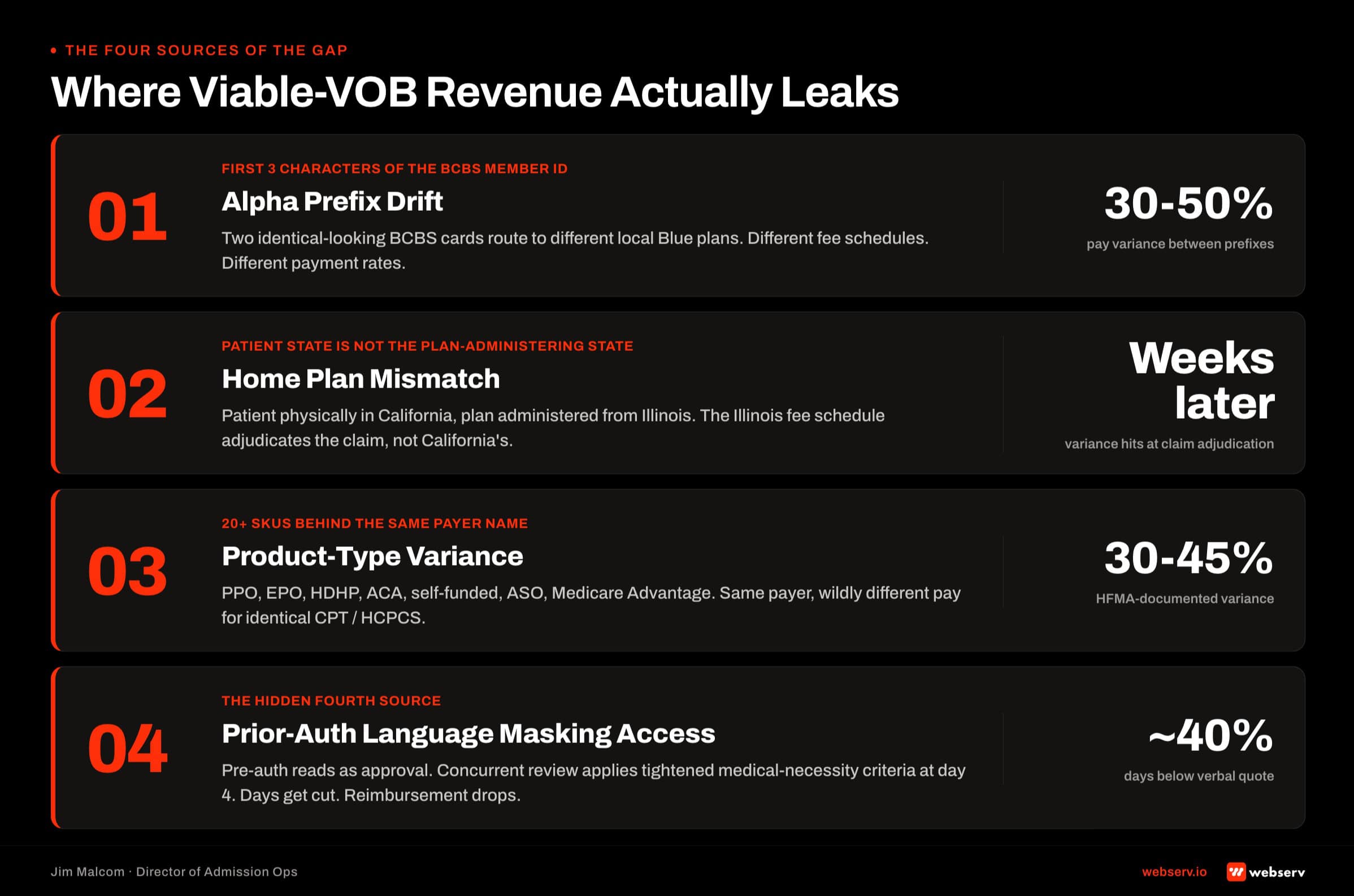 Four sources of the VOB-to-admit reimbursement gap for treatment centers: alpha prefix drift with 30 to 50 percent pay variance between prefixes, home plan mismatch resolved at claim adjudication weeks later.
Alpha prefix drift is the phenomenon where the first three characters of a BCBS member ID route the claim to a specific local Blue plan. Local plans set their own fee schedules for out-of-network care.
Two patients with visually identical BCBS cards can be reimbursed 30 to 50 percent differently because their alpha prefixes route to different plan administrators.
Home plan mismatch means a patient physically in California with a plan administered from Illinois routes reimbursement through the Illinois home plan. The Illinois fee schedule applies, not California’s.
The VOB does not surface this in a way that translates to a rate expectation. The claim adjudicates weeks later at the mismatched rate.
Product-type variance is the third source. The same payer has 20+ product SKUs (PPO, EPO, HDHP, ACA marketplace, self-funded, ASO, Medicare Advantage) that pay wildly different rates for the same CPT and HCPCS combinations.
PRODUCT-TYPE VARIANCE IS NOT A NICHE OBSERVATION
HFMA has documented reimbursement variance of 30 to 45 percent across payer product types for identical CPT/HCPCS combinations in behavioral health, driven by ASO versus fully-insured, marketplace versus commercial, and self-funded plan variance (HFMA, Behavioral Health Revenue Cycle Management). This is an operating reality across the finance function of BH providers.
A card that reads “BCBS PPO” on the front does not tell the admissions team which product SKU it belongs to.
Segmenting reimbursement by these three variables changes the picture. Facilities that don’t segment are averaging across radically different payer economics and calling the average their reimbursement rate.
The Hidden Fourth Source: Prior-Auth Language Masking Actual Access
The VOB reads “prior authorization required.” The coordinator flags it. The team obtains the pre-auth. The patient admits.
What the VOB did not surface: the payer’s medical-necessity policy on this level of care has been quietly tightened in the last 90 days. The concurrent review team applies a stricter criteria set than the pre-auth team. Our guide to VOB vs pre-authorization covers where the two checks diverge.
The actual days approved will land 40 percent below what was verbally quoted during the initial call.
The prior-auth stamp existed. The access did not. This is the source most operators nod at when it is named, because they have seen it on their own book and did not have a language for it.
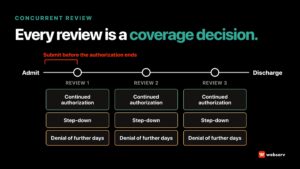
Concurrent review is where the reimbursement quietly disappears. A pre-auth quote of 21 days for residential becomes 14 days at day 4. A PHP authorization of 4 weeks becomes 2.5 weeks at the second review.
The pre-auth team is not lying at the front end. The concurrent review team is applying policy that has moved.
The reimbursement math on the case does not survive that shift. The clinical case may still be strong. The financial case is now different from what the admissions team quoted when they said yes.
Why VOB Alone Cannot See This Gap
The VOB is a snapshot of eligibility at a moment. It is not a claims-history model.
The information required to close the reimbursement gap lives in adjudicated claims data. What this specific payer paid, for this specific product type, at this specific level of care, in the last 90 days, across enough claim volume to be a real benchmark.
That data does not live inside the VOB. It lives inside claim histories that most facilities never systematically aggregate.
Even under strengthened parity enforcement and the 2024 42 CFR Part 2 Final Rule, out-of-network reimbursement for BH residential and PHP care continues to run 25 to 40 percent below quoted rates for a material share of admissions (KFF, Mental Health).
Parity has expanded. Reimbursement reality has not caught up in operationally consistent ways.
The gap is closable. It is not closable with the tools most facilities are already running. It is closable with a different data layer sitting on top of the VOB.
The 4-Step Diagnostic to Measure Your Facility’s Gap
- Pull Two Quarters of Viable-VOB to Admit Records. Export from the CRM every VOB that was flagged viable in the last two full quarters, plus the admission status and payment status downstream. Every viable VOB gets a row: verified, admitted, and paid amount. This is the KPI spine every admissions CRM should carry.
- Overlay Actual Paid Against Expected. For each admit, put the actual paid amount alongside the expected reimbursement your admissions team quoted at the VOB moment. If the team was not documenting expected reimbursement, use the average net collections rate on that payer group as a proxy.
- Segment Variance by Payer, Alpha Prefix, Product Type, and Level of Care. The pattern is rarely uniform across the book. One BCBS alpha prefix will pay above expected. Another will pay 40 percent below. One product SKU will hit the number. Another will miss it consistently. This is where a payer audit that surfaces underpayment patterns is doing the work.
- Calculate Aggregate Leak and Top Three Payer Groups. Sum the variance in dollars. Rank payer groups by variance contribution. Most facilities running this exercise for the first time find one payer group producing 40 to 50 percent of their total leak. That is the group renegotiation efforts and admissions triage rules need to concentrate on.
The diagnostic above is operator-executable. A controller and an admissions supervisor can complete it in about six hours split across two days. It builds on the VOB vs expected reimbursement comparison and pairs naturally with the pre-admission eligibility verification playbook.
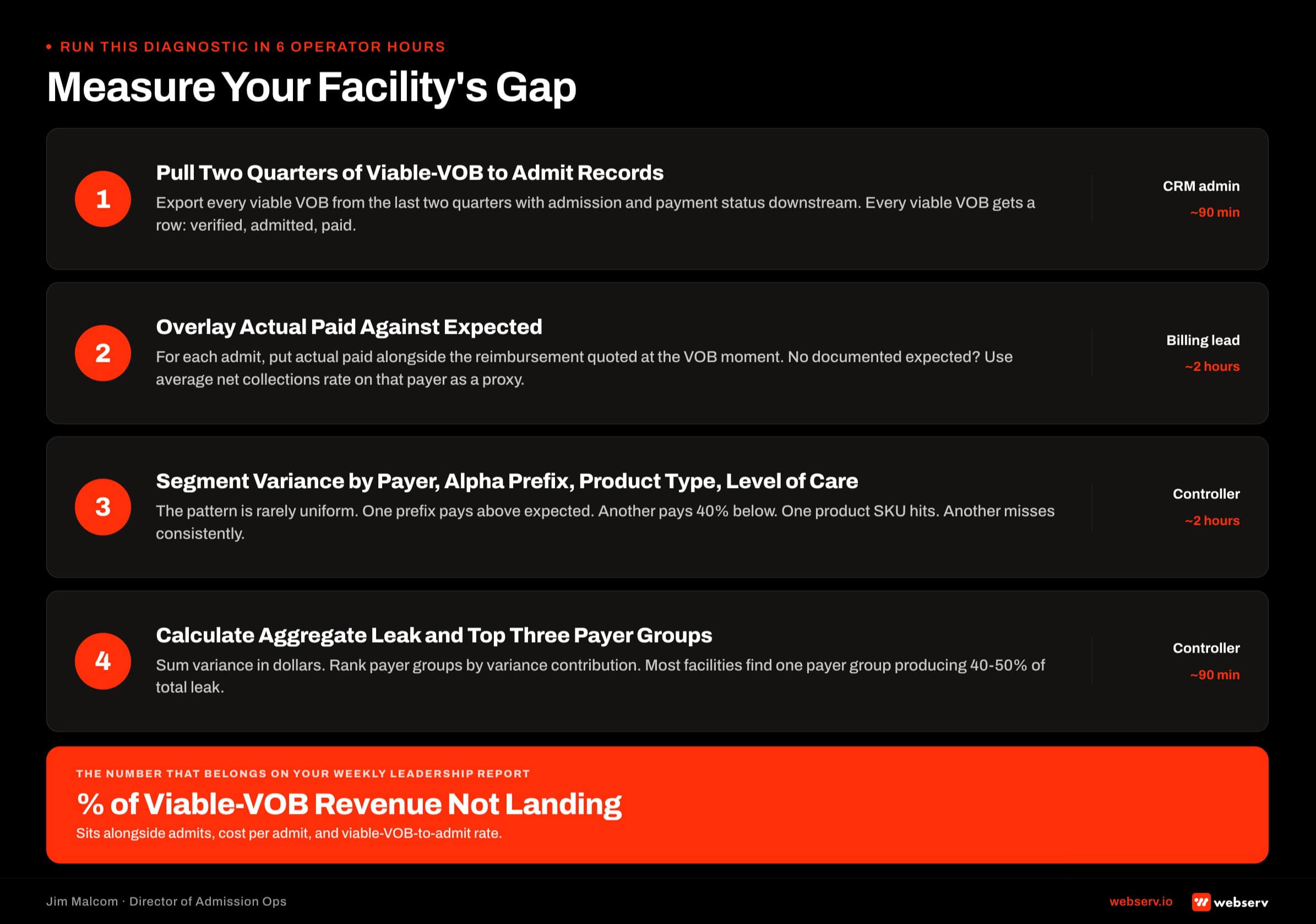 The four sequential operator steps to measure a treatment center’s viable-VOB-to-admit reimbursement gap: pull two quarters of viable-VOB to admit records, overlay actual paid against expected.
The output of the diagnostic is a single number for your facility: the percentage of viable-VOB revenue that is not landing. That number belongs on the weekly leadership report alongside admits, cost per admit, and viable-VOB-to-admit rate.
Most operators find the dollar-amount version of the gap is 20 to 35 percent even when the admit-count gap looks smaller. That means the patients who did admit are paying less than expected, not just that some patients failed to admit.
What Changes When You Close the Gap Upstream
Three operating decisions change when the reimbursement layer becomes accurate rather than assumed.
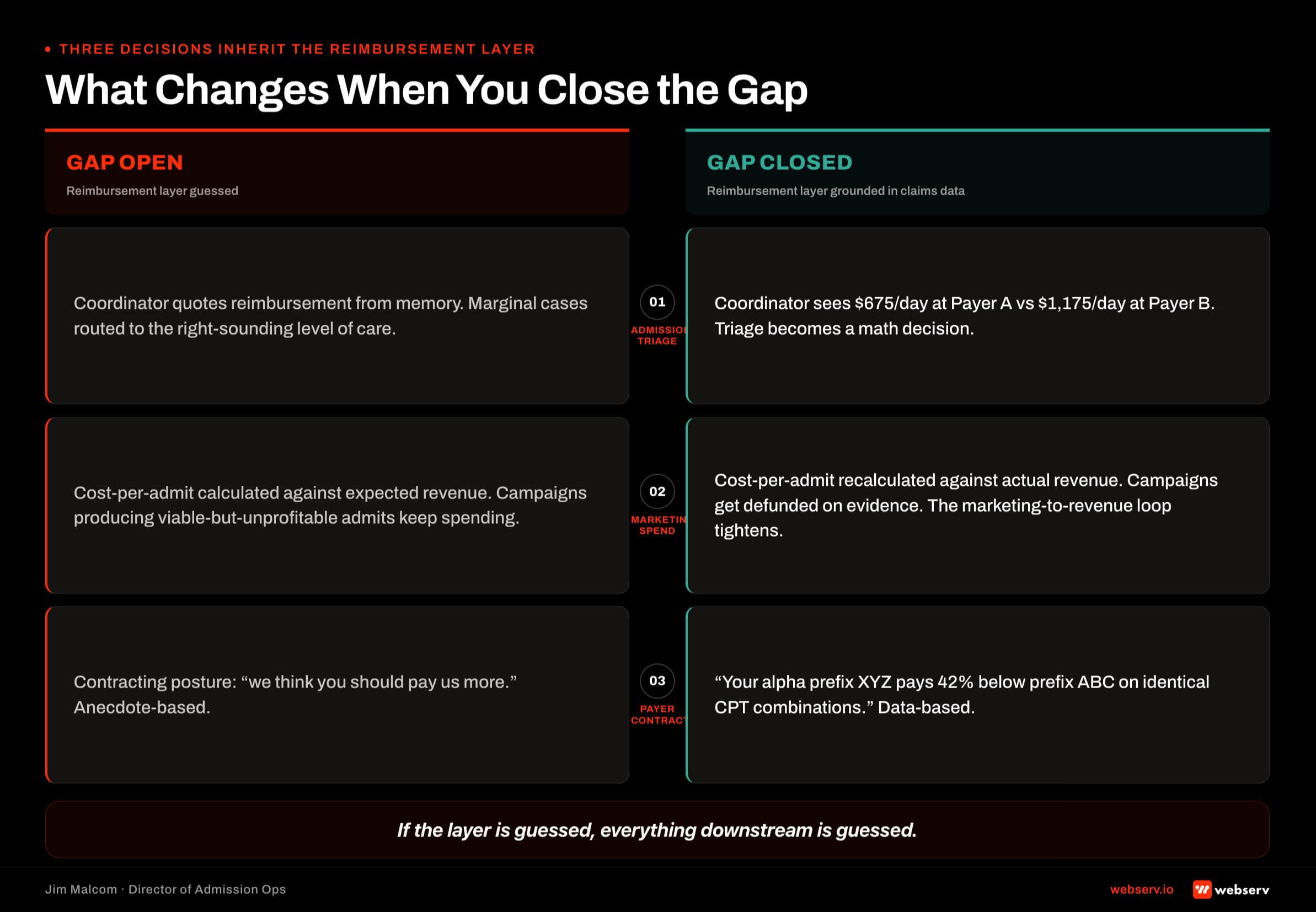 Side-by-side comparison of three treatment center operating decisions with the reimbursement layer open versus closed: admissions triage moves from memory-quoted reimbursement to math-based routing.
Admissions decision. Coordinators have expected reimbursement at intake, not guessed reimbursement. Marginal cases get routed to the right level of care instead of the right-sounding level of care.
A PHP case that pays $675 a day at one payer versus $1,175 a day at another is now a triage input the coordinator can act on.
Marketing spend calibration. Cost-per-admit gets recalculated against actual revenue per admit, not expected revenue per admit. Campaigns that produced technically-viable-but-unprofitable admits get defunded. The marketing-to-revenue loop tightens because the loop finally has real numbers on both ends.
Contracting posture. Payer contracts are renegotiated against real adjudicated data instead of anecdote. When you can show a payer that their alpha prefix XYZ pays 42 percent below their alpha prefix ABC on identical CPT combinations, the conversation is different.
Contracting shifts from “we think you should pay us more” to “here is what your book looks like across our facility.” Payer mix and contracting posture become adjustable variables rather than fixed constraints.
The compounding nature of the change is what makes it worth the operational effort. Every downstream decision inherits whatever accuracy the reimbursement layer produces. Reconciliation discipline keeps the CRM and reporting sides trustworthy; the same discipline applied to reimbursement expectations keeps the revenue side trustworthy. If the layer is guessed, everything downstream is guessed.
The PayerLenz Playbook for Front-Loading Reimbursement Data
PAYERLENZ, THE REIMBURSEMENT-INTELLIGENCE LAYER THIS ARTICLE DESCRIBES
PayerLenz surfaces real adjudicated behavioral health reimbursement data at the VOB moment. The benchmark pool currently spans 500,000+ adjudicated claims across 250 payer groups in 20 states, with alpha-prefix and home-plan routing baked into the query. Every result carries a trust score based on claim volume and recency. PayerLenz was built by Revenue Logic (Kyle McHenry) and co-founded with Preston Powell, CEO of Webserv. Webserv discloses that relationship openly: PayerLenz is the tool Webserv surfaces to solve the reimbursement gap this article names. Webserv does not receive commissions on PayerLenz signups. Facilities that want to see the gap on their own book of business can start with the PayerLenz free tier. Facilities that want the full marketing to admissions to revenue loop closed end-to-end can talk to Webserv.
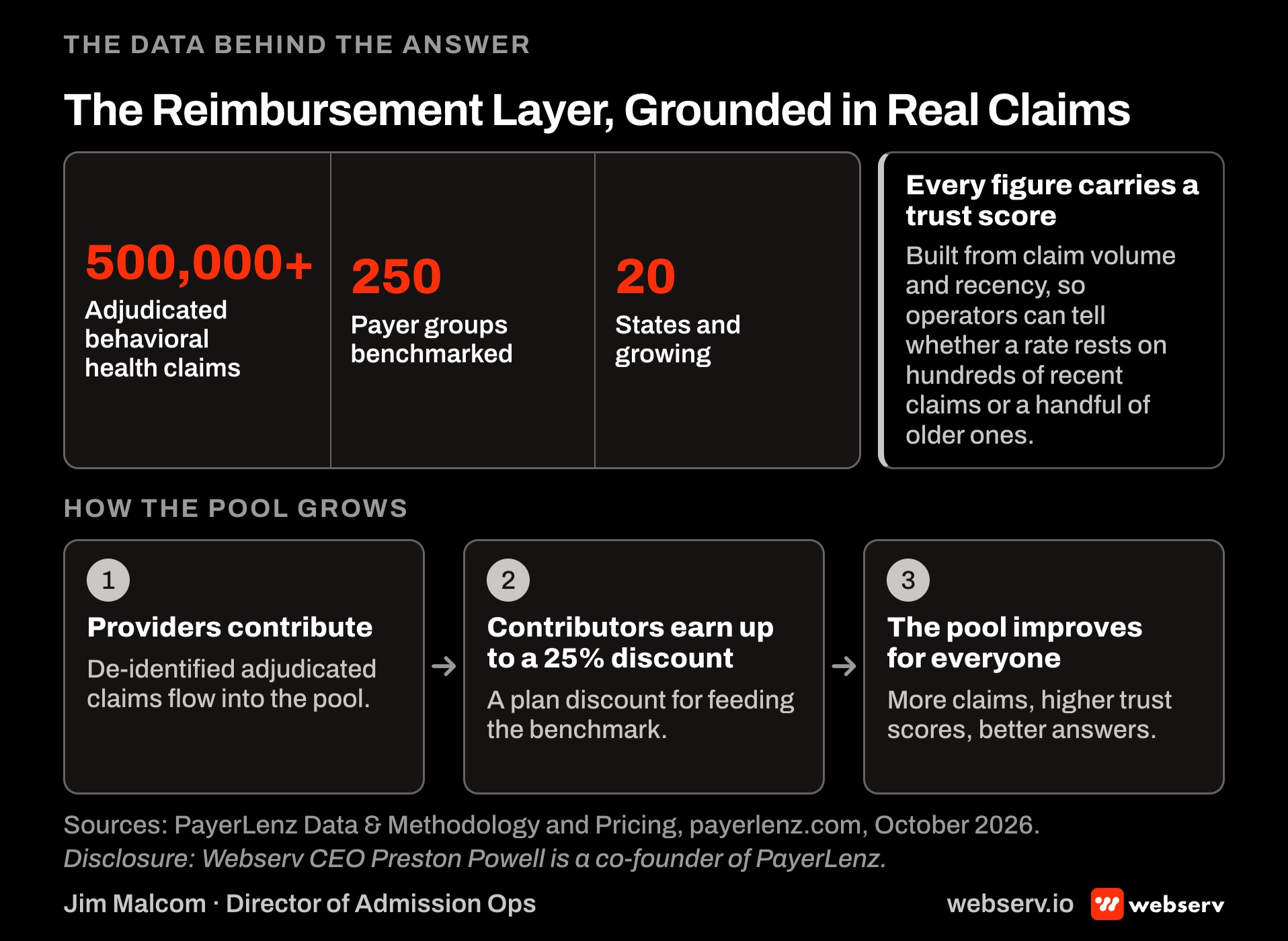 The PayerLenz benchmark pool: 500,000+ adjudicated behavioral health claims across 250 payer groups in 20 states.
PayerLenz is not a VOB replacement. It sits alongside the VOB and answers the second question: what will the payer actually pay for this admission.
The VOB still runs. Coverage, deductibles, cost-shares, prior-auth flags all get verified the same way. PayerLenz attaches an expected dollar reimbursement to that VOB result.
The product exists because the data exists. Adjudicated claims data across 250 payer groups already shows the spread on behavioral health reimbursement.
PayerLenz built the benchmark pool specifically because the industry got used to guessing when the data did not exist. The data now exists.
The relationship needs to be stated plainly. Preston Powell is CEO of Webserv and co-founded PayerLenz with Kyle McHenry, founder of Revenue Logic. This article is published by Webserv. The tool the article recommends is the tool Webserv’s CEO co-founded.
That relationship is why the reconciliation discipline that keeps admit counts trustworthy is the same discipline that keeps reimbursement expectations trustworthy. They are two sides of the same operational stance.
The disclosure is stated openly because the reimbursement gap this article names is a real operational problem, and PayerLenz is the productized answer to it. Webserv would rather name that plainly than bury it.
Getting Started This Week
Three concrete first actions any treatment center can take Monday.
One. Ask the admissions supervisor to add “expected reimbursement quoted at VOB” as a field on every viable VOB record for the next 30 days. If the field already exists, verify it is being filled in on every case.
Two. Ask the billing lead to pull actual paid per admit for the last two quarters, segmented by payer group. This exists in your billing system already. Someone just has to pull the report.
Three. Book 45 minutes with the admissions supervisor, billing lead, and controller to look at the two columns side by side. Name the biggest single-payer variance. Assign an owner for the fix.
Facilities that want the data layer prebuilt run the same diagnostic with PayerLenz on the free tier. Facilities that want to close the marketing to admissions to revenue loop end-to-end route through the Webserv admission ops team.
Frequently Asked Questions
What is the VOB-to-admit reimbursement gap?
The VOB-to-admit reimbursement gap is the difference between what a payer’s verification of benefits appears to promise and what the payer actually reimburses once the claim adjudicates. On viable-VOB volume at most behavioral health treatment centers, the gap ranges from 30 to 60 percent of expected revenue lost.
The gap exists because a VOB confirms coverage exists (active plan, deductible, cost-share structure, prior-auth flag) but does not confirm what the payer will pay for the specific admission starting Monday. Coverage and reimbursement are two different questions.
Closing the gap requires overlaying real adjudicated claims data on top of the VOB result. The data exists. 500,000+ adjudicated claims across 250 payer groups is the current benchmark pool floor. Most facilities never systematically aggregate it, so the gap keeps producing surprise variance on the P&L.
How do I measure the reimbursement gap at my treatment center?
Pull the last two quarters of viable VOBs. Overlay actual paid amount per admit against the expected reimbursement your admissions team quoted at the VOB moment. Segment the variance by payer, alpha prefix, product type, and level of care.
The four-step diagnostic takes a controller and an admissions supervisor about six hours split across two days. It surfaces variance most treatment centers assumed did not exist because no one was looking at the two columns side by side.
The output is a single number for your facility: what percentage of viable-VOB revenue is not landing. That number belongs on the weekly leadership report alongside admits, cost per admit, and viable-VOB-to-admit rate.
What causes the difference between a payer’s VOB and what they actually pay?
Four causes account for almost all of the variance: alpha prefix drift, home plan mismatch, product-type variance, and post-VOB medical-necessity tightening the concurrent review team applies at claim time.
Alpha prefix drift means the first three characters of the member ID route the claim to a specific BCBS entity paying at that entity’s fee schedule. Home plan mismatch means a patient physically in one state carries a plan administered from another. Product-type variance means the same payer has 20+ product SKUs paying wildly different rates.
The fourth cause is subtler: prior-auth language on the VOB reads as approval, but the medical-necessity criteria the concurrent review team applies at day 4 of admission are stricter than what the pre-auth team quoted. Days get cut. Reimbursement drops. The pre-auth stamp existed but the access did not survive concurrent review.
What is alpha prefix drift and why does it matter for reimbursement?
Alpha prefix drift is the phenomenon where the first three letters of a BCBS member ID quietly change how a claim is routed and paid. Two patients with visually identical BCBS cards, treated for the same diagnosis at the same level of care, can be reimbursed 30 to 50 percent differently because their alpha prefixes route to different local Blue plans.
The alpha prefix is routing metadata BCBS uses to determine which local Blue plan is financially responsible for the claim. Local plans set their own fee schedules for out-of-network care. A California facility admitting a patient whose prefix routes to a specific local plan is bound by that plan’s fee schedule, not California’s.
Admissions teams that do not segment reimbursement by alpha prefix are averaging across radically different payer economics. Once segmented, patterns become visible: certain prefixes consistently pay above expected, certain prefixes consistently pay below, and the mix of prefixes on your admits book shapes your aggregate reimbursement.
Can PayerLenz replace our VOB process?
No. PayerLenz is not a VOB replacement. It sits alongside the VOB and answers the second question the VOB does not answer: what will the payer actually pay for this admission. Your admissions team still runs the full benefits verification for coverage, deductible, and prior-auth flags.
The product was built by Revenue Logic, the behavioral health revenue cycle firm run by Kyle McHenry, and co-founded with Preston Powell, CEO of Webserv. That disclosure matters because Webserv is publishing this article and PayerLenz is the tool Webserv recommends to solve the reimbursement gap named in the piece.
Facilities that want to run the four-step diagnostic on their own book of business can use PayerLenz free tier to start. Facilities that want the full marketing to admissions to revenue loop closed end-to-end route through the Webserv admission ops team.
What changes at my facility once we close the reimbursement gap upstream?
Three operating decisions change. Admissions triage sharpens because coordinators have real reimbursement expectations at intake, not guesses. Marketing spend calibration tightens because cost-per-admit gets recalculated against actual revenue per admit. Payer contracting shifts from anecdote to data.
The upstream nature of the change is what makes it compounding. Every downstream decision in the funnel inherits the reimbursement layer’s accuracy. If the layer is guessed, everything downstream is guessed. If the layer is grounded in claims data, everything downstream gets sharper together.
Facilities that make this shift usually report the biggest change is not in the P&L for the first 90 days. It is in the meetings. Leadership stops arguing about whose report is right and starts arguing about what to do about the variance the reports agree on.
Closing Note From the Admission Ops Floor
The reimbursement gap between VOB and admit is one of the last unmeasured variances in behavioral health admissions. The data to close it exists. The mechanics are knowable. The reason most facilities have not closed it is not technical. It is that no one has been assigned the ownership.
Assign the owner. Run the four-step diagnostic this quarter. Bring the variance to the leadership meeting. If you want to close the marketing to admissions to revenue loop end-to-end and stop losing viable-VOB revenue at the reimbursement layer, book an intro meeting with our team.
Jim Malcom is Director of Admission Ops at Webserv. He has spent his career inside behavioral health admissions operations (call floors, VOBs, CRMs, and the reporting stack that ties them together) and now leads the Webserv admission ops practice for treatment center operators nationwide.