TikTok’s branded content policy, in effect since August 31, 2026, lists medical institutions, treatments, and mental health services among the industries creators can’t be paid to promote. Meta allows branded content for drug and alcohol treatment centers, but only with its written pre-authorization.
That changes the standard direct-to-consumer playbook, where a brand hires creators, has them film casual phone videos, and runs the best ones as ads. For a treatment center, the playbook still works in places. It just runs through more rules.
UGC-style creative, meaning ads that look and sound like a real person talking to their phone, can build trust with families faster than polished production. This piece covers what counts as UGC-style, the FTC rules that apply to every version of it, the platform rules layered on top, and what’s compliant by type of speaker.
It builds on the ultimate guide to ad creative strategy and reflects how our ad creative team for treatment centers reviews creator-style work. This isn’t legal advice; have healthcare counsel review your contracts and your first campaign.
Key Takeaways
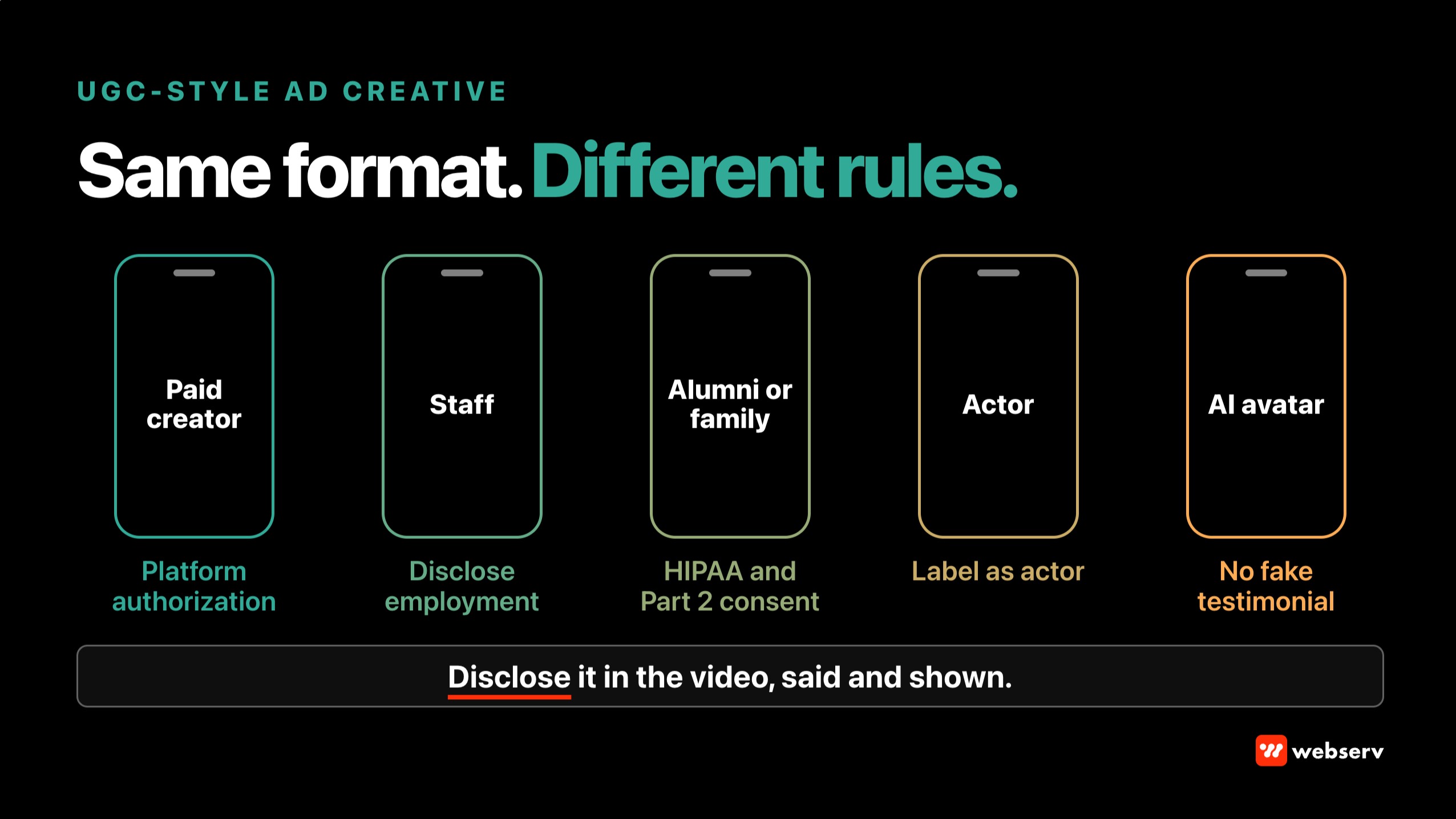
- UGC-style ads for treatment centers usually feature one of four speakers: a paid creator, a staff member, an alumnus or family member, or an actor or AI avatar. Each carries different rules.
- The FTC requires clear disclosure when people shown as actual consumers aren’t, and when a speaker has a paid or employment connection the audience wouldn’t expect.
- Advertisers are liable for misleading or unsupported claims made by the people in their ads, even when the speaker isn’t.
- TikTok’s branded content policy prohibits paid creator content for medical institutions and treatments. Meta requires written pre-authorization for treatment center branded content, plus LegitScript certification and permission to run addiction treatment ads.
- Meta bars ad copy that asserts or implies a viewer’s health condition, which rules out many of the hooks that UGC scripts lean on.
- Florida and California both ban false or misleading marketing by substance use disorder providers, and California’s law names social media.
What “UGC-style” means in a treatment center ad
In most industries, UGC means content made by customers. In paid social, “UGC-style” has come to mean any ad shot to look like it: vertical, handheld, one person talking directly to the camera.
DEFINITION
UGC-style ad. A paid ad designed to look like informal, user-made content, typically one speaker filmed on a phone talking to viewers. The speaker may be a paid creator, an employee, a former patient or family member, an actor, or an AI-generated person.
The format is the same across all of them; the rules depend on who the speaker is.
That distinction matters because the look of the ad implies something. A casual phone video suggests an ordinary person sharing an honest experience. When the speaker is paid, employed by the facility, or not a real patient, the FTC expects viewers to be told.
The FTC rules that apply to every version
The FTC’s Endorsement Guides set the baseline for all four speaker types.
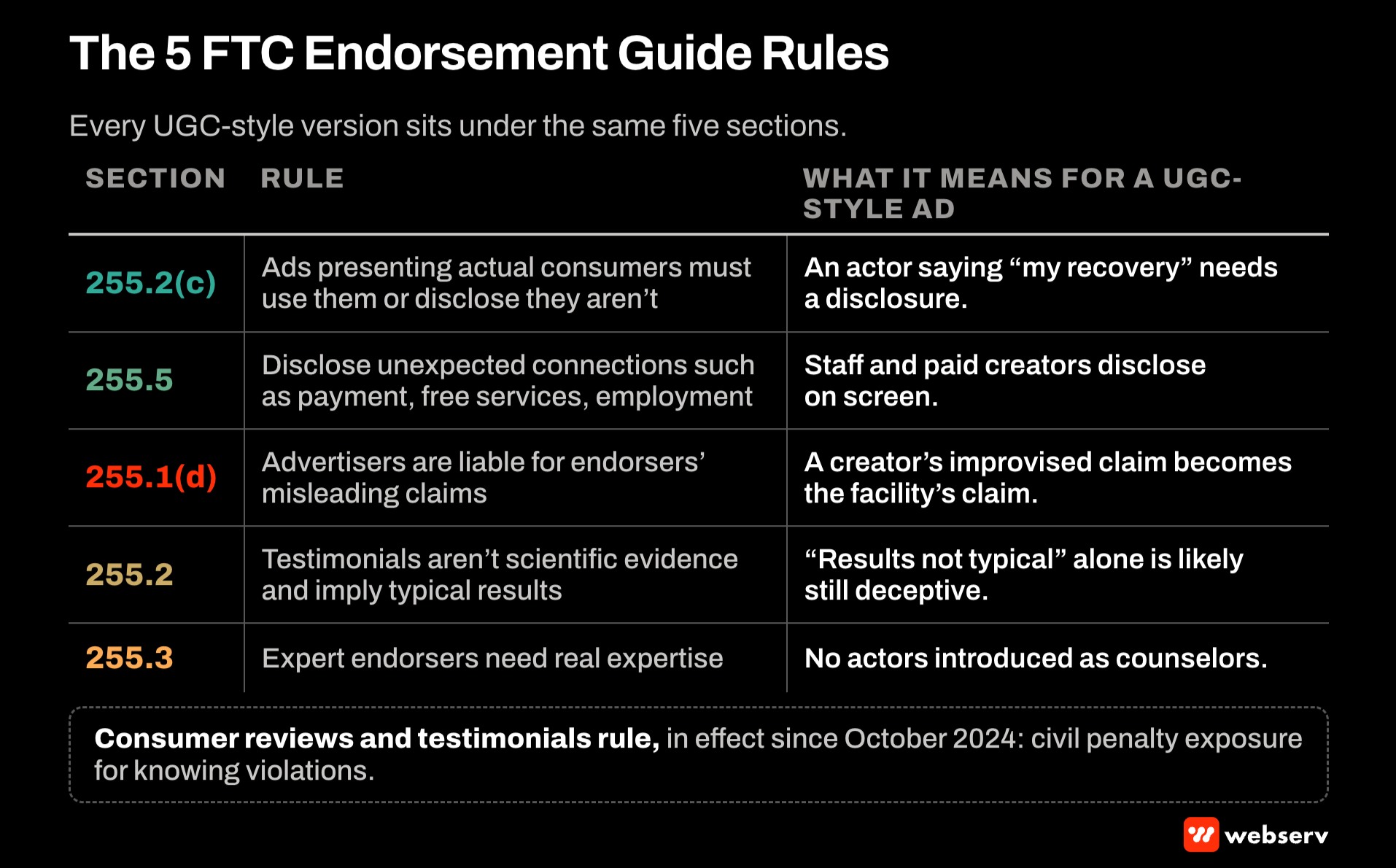
Actors presented as real consumers. Section 255.2(c) says an ad that presents “actual consumers” must use actual consumers or clearly disclose that the people shown aren’t. A UGC-style video of an actor describing “my recovery” needs that disclosure.
Material connections. Section 255.5 requires clear disclosure of any connection the audience wouldn’t expect, such as payment, free services, or employment. The Guides’ examples include an employee posting about the employer’s product.
Advertiser liability. Section 255.1(d) says advertisers are liable for misleading or unsubstantiated statements made through endorsements, even when the endorser isn’t. A creator’s improvised claim becomes the facility’s claim.
Substantiation and typical results. Section 255.2 says consumer endorsements aren’t competent and reliable scientific evidence, and that a testimonial implies the speaker’s result is typical. A “results not typical” line on its own is likely still deceptive.
Expert claims. Section 255.3 says an endorser presented as an expert must actually have that expertise. A creator in scrubs, or an actor introduced as a counselor, implies qualifications they may not have.
The FTC’s consumer reviews and testimonials rule, in effect since October 2024, adds civil penalty exposure for knowing violations. It bans testimonials that misrepresent that the speaker exists or had the stated experience, and requires disclosure on testimonials from a business’s officers, managers, employees, or agents.
On AI, the FTC’s rule Q&A says there’s no blanket ban on AI-generated avatars, but they’re prohibited when the underlying testimonial is fake. Our guide to AI-generated ad creative covers the guardrails.
How to disclose in video. The FTC’s Disclosures 101 for social media influencers says video disclosures belong in the video itself, not just the description, and are more likely to be noticed when they’re both said and shown. It also says not to assume a platform’s disclosure tool is enough.
The platform rules on top
LegitScript certification is the entry ticket on Google and Meta, and our LegitScript certification guide covers it. UGC-style creative adds a second layer: each platform’s branded content rules.
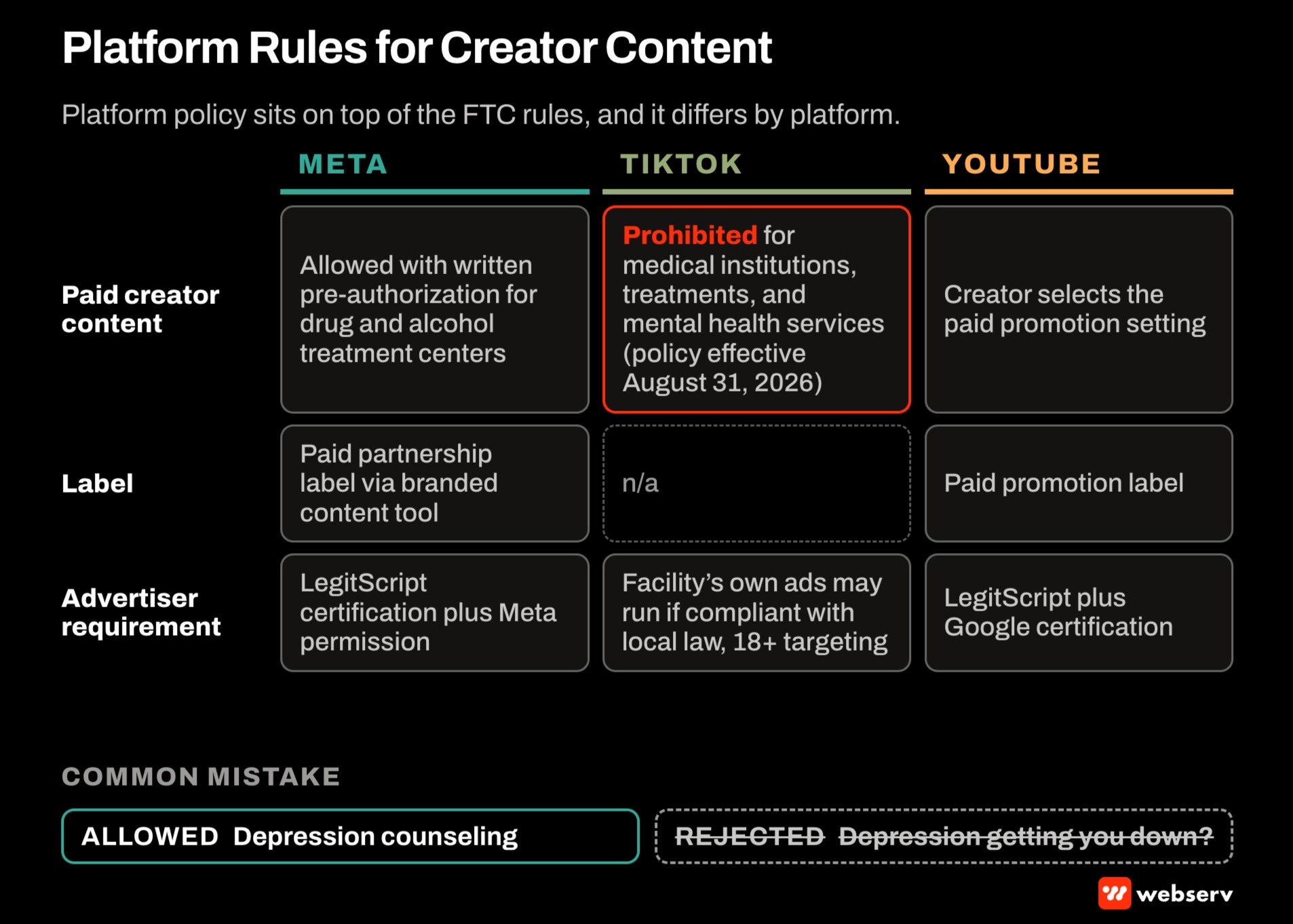
Meta. Meta’s branded content policy requires creators to use its branded content tool, which adds a “Paid partnership” label. It lists drug and alcohol treatment centers among the business partners that need written pre-authorization from Meta.
Meta’s partnership ads, formerly branded content ads, let an advertiser run an ad through a creator’s account with the creator’s permission. Those ads still sit under Meta’s addiction treatment policy, which requires LegitScript certification and Meta’s permission. Our Meta Ads playbook covers the account setup.
TikTok. TikTok’s branded content policy, effective August 31, 2026, lists medical institutions and treatments, telehealth providers, and therapy or mental health consulting services as prohibited industries for branded content.
TikTok’s healthcare ads policy says US medical institutions may advertise if they comply with local law, that certifications may be required, and that ads must target users 18 and older. The practical read: a facility may be able to run its own ads, but paying creators to promote it isn’t allowed.
YouTube. YouTube requires creators to select the paid promotion setting on sponsored videos, which adds a label. Google’s healthcare policy requires US addiction services advertisers to be certified by LegitScript and by Google.
COMMON MISTAKE
The personal-attribute hook. UGC scripts often open by speaking to the viewer’s problem: “If you’re drinking every night, watch this.” Meta’s personal attributes policy bars ads that assert or imply a viewer’s physical or mental health condition.
Meta’s own example allows “Depression counseling” and rejects “Depression getting you down?” Rewrite hooks around the speaker’s perspective or the service, not the viewer’s condition: “Here’s what the first day of detox actually looks like.”
LegitScript and state law
LegitScript’s advertising standard requires ads to be accurate, transparent, and not misleading, including clearly identifying the advertiser and not using third-party business names. A creator video that never says which facility it’s promoting is hard to square with that.
State law adds its own layer. Florida’s section 397.55 bars substance abuse service providers and third-party marketers from false or misleading statements about a provider’s services. California’s Health and Safety Code section 11831.9 bars false or misleading statements about treatment, including in a provider’s social media presence.
Federal enforcement has reached this industry directly. The FTC’s first case under the Opioid Addiction Recovery Fraud Prevention Act, against R360, included a false claim that an expert had vetted the treatment centers it promoted.
What’s compliant, by speaker
Paid creators. On Meta, possible with pre-authorization, the Paid partnership label, an in-video disclosure, and claims limited to what the facility can substantiate. On TikTok, not allowed under the current branded content policy. Creators should describe the facility and its services, not claim treatment experiences they didn’t have.
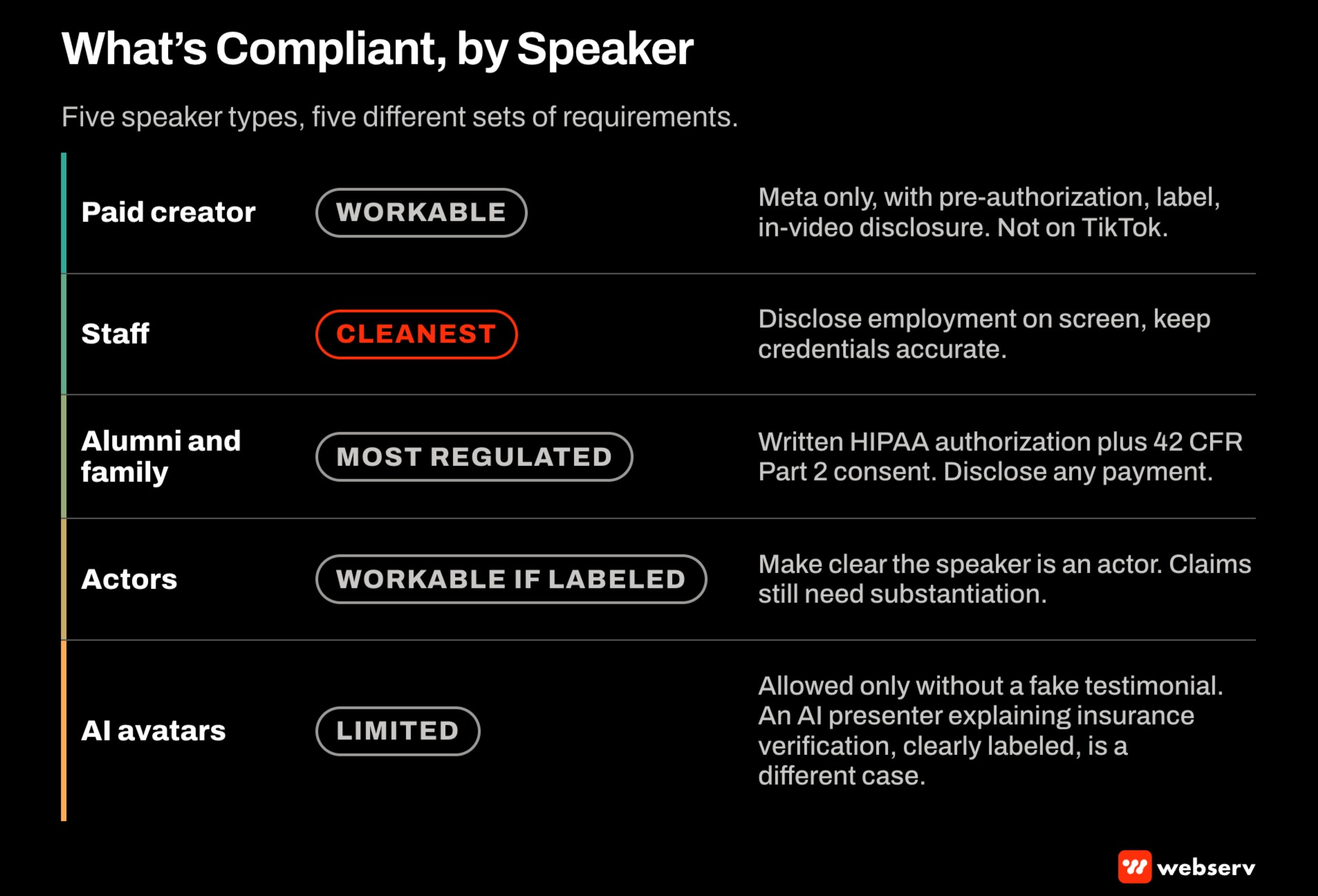
Staff. Often the cleanest option. A clinician or admissions coordinator walking through what intake looks like is informative and hard to fake. Disclose the employment relationship on screen, and keep credentials accurate.
Alumni and family members. The most persuasive and the most regulated. HHS’s marketing guidance requires written authorization to use protected health information for marketing, and substance use disorder programs also have 42 CFR Part 2 consent to consider. Any payment or free service has to be disclosed.
Actors and dramatizations. Workable when labeled. The ad has to make clear the speaker is an actor, and the claims still have to be ones the facility can back up.
AI avatars. Permitted by the FTC only when they don’t present a fake testimonial. An AI person describing “my stay” is a fabricated experience; an AI presenter explaining insurance verification, clearly labeled, is a different case.
DO
- Get platform authorization and LegitScript certification in place before commissioning creators.
- Disclose payment, employment, or acting in the video, spoken and on screen.
- Script claims from what the facility can document, such as levels of care and admissions steps.
- Name the facility clearly in the ad.
DON’T
- Pay creators to promote the facility on TikTok.
- Present actors, staff, or AI avatars as ordinary patients.
- Open with a line that implies the viewer has an addiction or mental health condition.
- Let a creator improvise outcome claims, success rates, or comparisons.
The review workflow
Run every UGC-style concept through the same sequence before anything is filmed:
Confirm the platform path
Check that the facility holds LegitScript certification and the platform permissions, including Meta’s branded content pre-authorization if a creator is involved.
Classify the speaker
Paid creator, staff, alumnus or family, actor, or AI avatar. Each type has its own disclosure and consent requirements.
Lock the script
Approve the exact claims in writing, with substantiation for each one, and remove any personal-attribute hooks.
Collect the paperwork
Creator contracts with disclosure requirements, employee acknowledgments, HIPAA authorization and Part 2 consent for alumni, and talent releases for actors.
Review the cut
Check that disclosures are said and shown, the facility is named, and nothing improvised made it into the edit.
Monitor after launch
Check comments and creator reposts, and pull any version that drifts from the approved script.
Where this fits in your creative program
UGC-style ads work best as one format in a mix, alongside video ad creative that passes compliance and static ad creative templates. Our guide to creative strategy for treatment center marketing covers how to balance them.
OPERATOR INSIGHT
Keep a single file for each piece of UGC-style creative: the approved script, the substantiation for each claim, the signed consents or contracts, the platform authorization, and the final cut.
If a platform reviewer, LegitScript, or a regulator asks how an ad was made, that file is the answer. It also makes it faster to refresh creative, because the approved claims are already documented.
For how paid creative fits the rest of your marketing, see the complete guide to behavioral health marketing. If you want a second look at your creator-style ads before they run, book an intro meeting.
Frequently Asked Questions
Can treatment centers use UGC-style ads?
Yes, with limits. The format itself is allowed; the rules depend on who’s speaking and which platform runs the ad.
The FTC requires disclosure when speakers are actors, paid, or employed by the facility, and advertisers are liable for claims made in their ads.
On Meta, treatment center branded content needs written pre-authorization. On TikTok, the current branded content policy prohibits paid creator content for medical institutions and treatments.
Can we pay TikTok creators to promote our rehab?
Not under TikTok’s branded content policy in effect since August 31, 2026, which lists medical institutions and treatments, telehealth providers, and therapy or mental health consulting services as prohibited industries.
TikTok’s healthcare ads policy separately says US medical institutions may be able to run their own ads, subject to local law, certification requirements, and 18-plus targeting.
Confirm current eligibility with TikTok before building any campaign there, since both policies change.
Do staff members need to disclose that they work for the facility?
Yes, when they appear in ads or promote the facility on social media. The FTC’s Endorsement Guides treat employment as a material connection, and its reviews and testimonials rule requires disclosure on testimonials from employees and agents.
In a UGC-style video, that means stating the relationship on screen, such as a name and title, and in the audio where practical.
The FTC also recommends employers set up a program reminding employees to disclose.
Can an actor play a patient in a UGC-style ad?
Yes, if the ad clearly discloses that the speaker is an actor. The FTC says ads presenting people as actual consumers must use actual consumers or disclose that they aren’t.
The claims in a dramatization still have to be ones the facility can substantiate.
A label doesn’t make an unsupported outcome claim acceptable.
Are AI avatars allowed in treatment center ads?
The FTC’s rule Q&A says there’s no blanket ban on AI-generated avatars, but they’re prohibited when used to deliver a fake testimonial.
An AI presenter explaining a process, clearly labeled, is different from an AI person describing a treatment experience that never happened.
Platform rules also apply, so check each platform’s AI content labeling requirements before running AI-generated creative.
Keaton Nalle is the Director of Paid Admissions at Webserv, a digital marketing agency for treatment centers.