Connected TV advertising is the specific paid media channel that treatment centers underinvest in relative to its actual contribution to admission economics. It lives inside our paid media capability as the brand-awareness layer that lifts everything else in the mix.
CTV inventory across Hulu, Netflix ad-supported tier, Peacock, Paramount+, Roku Channel, YouTube CTV, and other streaming platforms produces the specific in-home viewing context that family decision-makers occupy during BH treatment research. The context matters as much as the reach.
The paid media capability at Webserv operates CTV programs across the streaming ecosystem plus programmatic CTV through demand-side platforms. The pattern is consistent: facilities running CTV alongside their Meta and Google programs typically produce 15 to 30 percent efficiency improvement on those direct-response channels versus running Meta and Google alone.
The pattern I see across facility CTV programs: the channel either does not exist at all (paid programs run only Meta and Google without CTV), or exists as an untargeted broadcast alternative (facilities buying CTV as if it were linear television without audience targeting or measurement infrastructure).
Some facilities have strong audience targeting but weak measurement infrastructure, and CTV attribution runs on last-click without proper multi-touch consideration.
The middle path exists. CTV programs with disciplined audience targeting, proper HIPAA-adjacent handling, and multi-touch attribution measurement typically produce cross-channel lift that materially exceeds CTV-attributed direct conversion.
This piece walks the connected TV advertising playbook for behavioral health treatment centers. The specific CTV platform mix that fits BH audience patterns, the audience targeting patterns that work in CTV, and the creative production requirements that fit the CTV viewing context.
It also covers the HIPAA-adjacent measurement considerations that apply to CTV differently than to display or social, the multi-touch attribution setup that resolves CTV’s actual contribution, and the specific failure modes that produce CTV programs that fail expectations. Adds the streaming layer to our paid quartet — Meta, Google, LinkedIn, and retargeting — under the broader social advertising for rehab treatment centers reference. Full picture in our ultimate guide to behavioral health marketing.
Key Takeaways
- CTV advertising produces meaningful cross-channel lift on Meta and Google performance because CTV impressions build brand awareness that increases subsequent search intent and social engagement. Facilities running integrated CTV plus Meta plus Google typically produce 15 to 30 percent efficiency improvement on Meta and Google versus running Meta and Google alone.
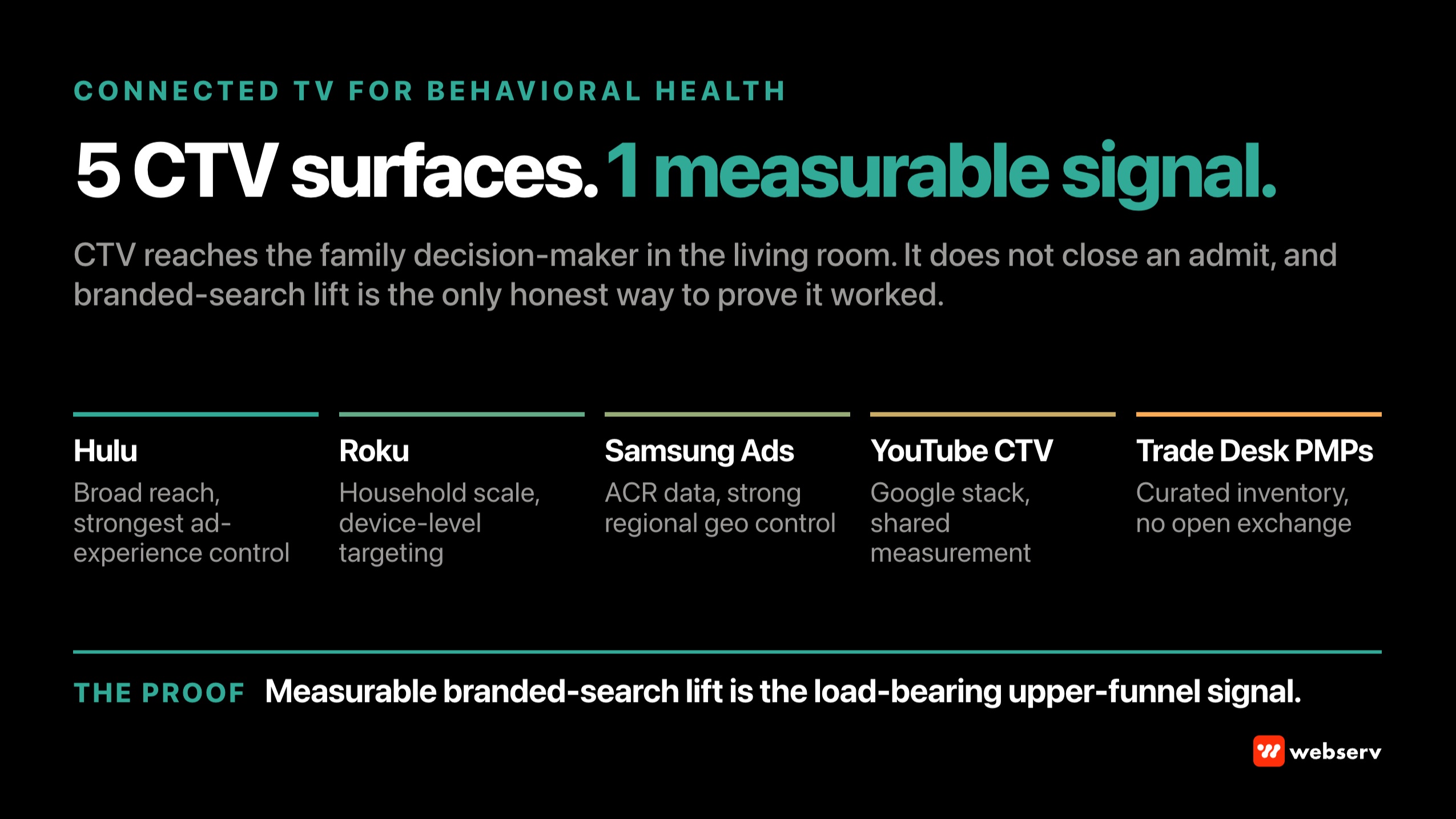
- CTV platform mix that fits BH: Hulu and Netflix ad-supported tier for broad reach with quality inventory, Peacock and Paramount+ for network content and news programming, Roku Channel for connected home audience, YouTube CTV for cross-device retargeting continuity.
- Audience targeting for CTV BH: household demographic targeting matched to family decision-maker patterns (age 35-65, household income $50,000+), interest-based targeting through platform-specific interests (health and wellness content viewers, news content viewers), and CRM audience uploads for retargeting continuity.
- Creative production for CTV: 15-second and 30-second video formats with broadcast-quality production, family testimonial content that fits CTV viewing context, and clinical authority content that establishes facility credibility. CTV creative differs meaningfully from social video creative.
- Multi-touch attribution setup resolves CTV’s actual contribution across the full paid funnel. Last-click attribution typically underattributes CTV meaningfully. Media mix modeling or dedicated multi-touch attribution tools reveal CTV’s contribution accurately.
CTV platform mix for BH
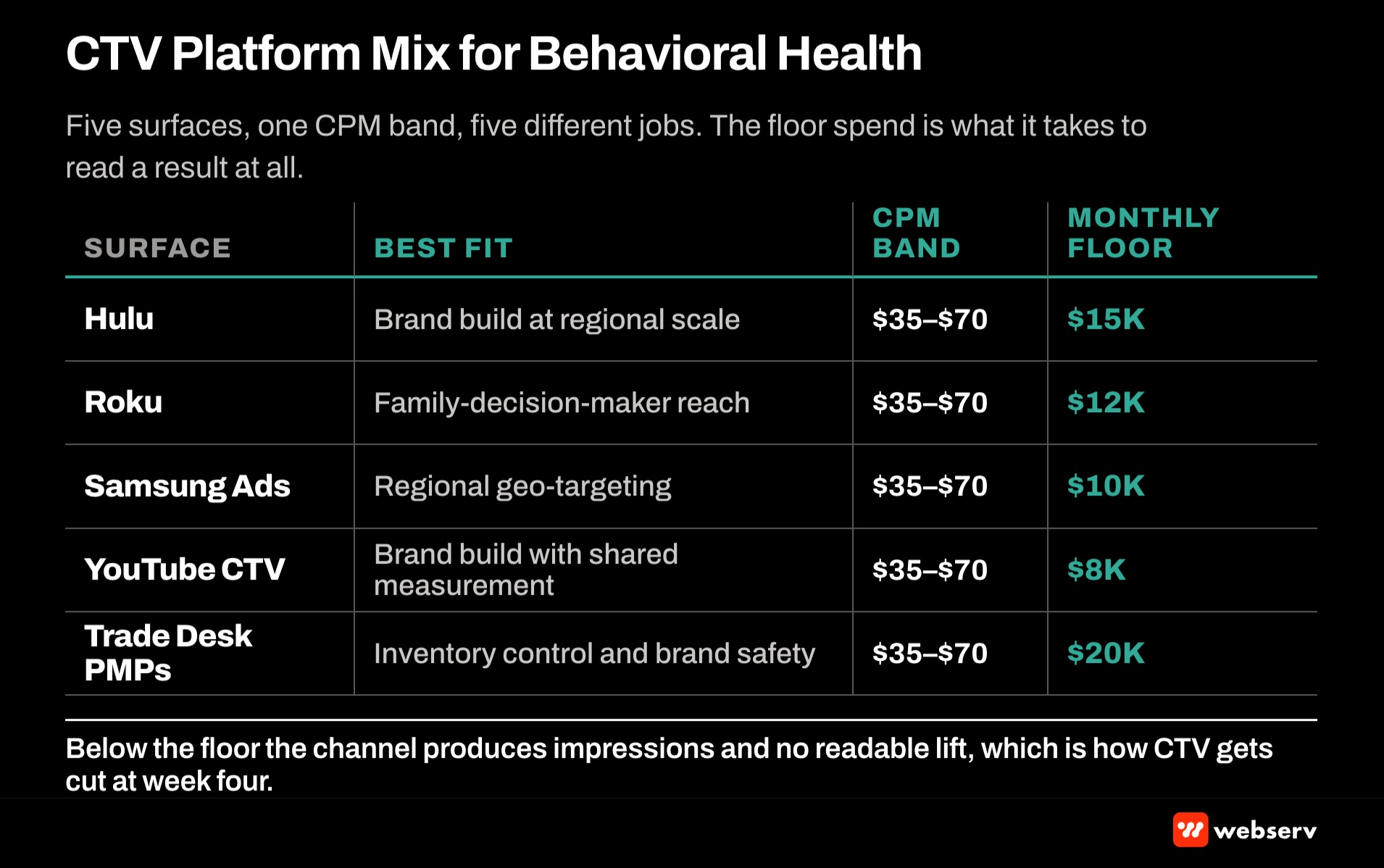
The specific CTV platform mix that fits behavioral health audience patterns.
Tier 1 platforms (highest priority for BH)
Hulu ad-supported tier and Netflix ad-supported tier both offer broad reach with quality content inventory. Family decision-maker audience concentration on both platforms fits BH targeting requirements.
The specific value: Hulu and Netflix produce the specific in-home viewing context where family decision-makers watch programming that supports the emotional decision cycle for treatment research. CTV impressions in this context typically produce stronger brand awareness lift than programmatic CTV impressions in lower-quality contexts.
Tier 2 platforms (secondary priority)
Peacock, Paramount+, and Max ad-supported tiers offer specific content categories (news, drama, family programming) that produce concentrated BH audience reach.
News programming placements produce particularly strong reach among family decision-makers researching treatment for older family members. Drama and family programming produce reach among parents researching treatment for adolescents or spouses.
Tier 3 platforms (opportunistic)
Roku Channel, Tubi, and other free ad-supported streaming platforms produce broader audience mix with lower CPM. Quality varies more meaningfully than tier 1 or tier 2.
Facilities with strong measurement infrastructure can find efficient reach in tier 3 with careful placement targeting. Facilities without measurement should focus on tier 1 and tier 2.
YouTube CTV
YouTube’s connected TV placements produce cross-device retargeting continuity that integrates with YouTube search and display. Particularly valuable for facilities running YouTube search advertising because CTV placements build brand awareness that increases search performance. Our YouTube Ads piece walks the video-adjacency patterns that live next to CTV.
Platforms to avoid
Programmatic CTV inventory without specific placement targeting can produce low-quality placements including content mismatched to BH audiences. Some programmatic platforms include religious programming, extremist content, or contexts inappropriate for BH advertising.
The specific pattern: work with programmatic partners that offer explicit placement transparency and category exclusion. Direct platform buys typically produce cleaner placement quality than programmatic without transparency.
DEFINITION
Connected TV (CTV) advertising for behavioral health treatment centers. The paid discipline that buys video ad inventory on streaming platforms (Hulu, Netflix ad-supported tier, Peacock, Paramount+, Roku Channel, YouTube CTV) delivered through connected home devices rather than linear cable or broadcast. Runs on household demographic plus interest plus CRM audience targeting, 15 and 30 second broadcast-quality creative, HIPAA-adjacent measurement, and multi-touch attribution that captures cross-channel lift rather than last-click.
Distinct from linear TV (which sells against Nielsen demo panels without addressable targeting), distinct from social video (which optimizes for feed-context engagement rather than in-home viewing context), and distinct from YouTube in-stream ads on mobile (which live in a different viewing context than the same YouTube CTV placement on a living-room device).
Audience targeting for CTV BH
CTV audience targeting operates through platform-specific targeting mechanisms plus cross-platform audience upload capabilities.
Household demographic targeting. Age, household income, geographic targeting matched to family decision-maker patterns. Age 35 to 65 covers most family decision-maker patterns for adult treatment. Age 40 to 65 covers parent decision-maker patterns for adolescent treatment.
Household income $50,000+ typically supports the payer mix most treatment centers target. Higher income thresholds ($100,000+) support facilities focused on OON commercial and cash-pay markets.
Interest-based targeting. Platform-specific interest categories that concentrate family decision-maker audiences. Health and wellness content viewers, news content viewers, parenting content viewers, family programming viewers.
Interest targeting works differently across platforms. Hulu offers dense interest taxonomy. Netflix offers narrower interest signal. Programmatic platforms typically aggregate interest signals across multiple data sources.
CRM audience uploads. Facility CRM data uploaded as CTV audience for retargeting continuity. Hashed identifier matching connects web visitors to their CTV device impressions.
The specific consideration: PHI must not appear in CRM audience uploads. Sanitized identifier lists (hashed email, hashed phone) with PHI fields stripped before upload.
Cross-platform retargeting. Website visitor audiences from Meta pixel and Google tag manager forwarded to CTV DSPs for cross-device retargeting. Website visitors see CTV impressions on their household streaming devices. The retargeting piece covers the audience-assembly patterns that keep this HIPAA-adjacent safe.
How Profound Treatment drove 31 admits and a 42% drop in cost per viable in one quarter
Broad match pivot, negative keyword management, and intake-level conversion tracking turned a fragmented paid strategy into a predictable admissions engine.
Read the case study →68 viable VOBs at $4,529 cost per viable
Creative production requirements
CTV creative production requirements differ from social and display creative because CTV placement context is different. The creative framework that governs the wider paid program is in our ad creative strategy piece.
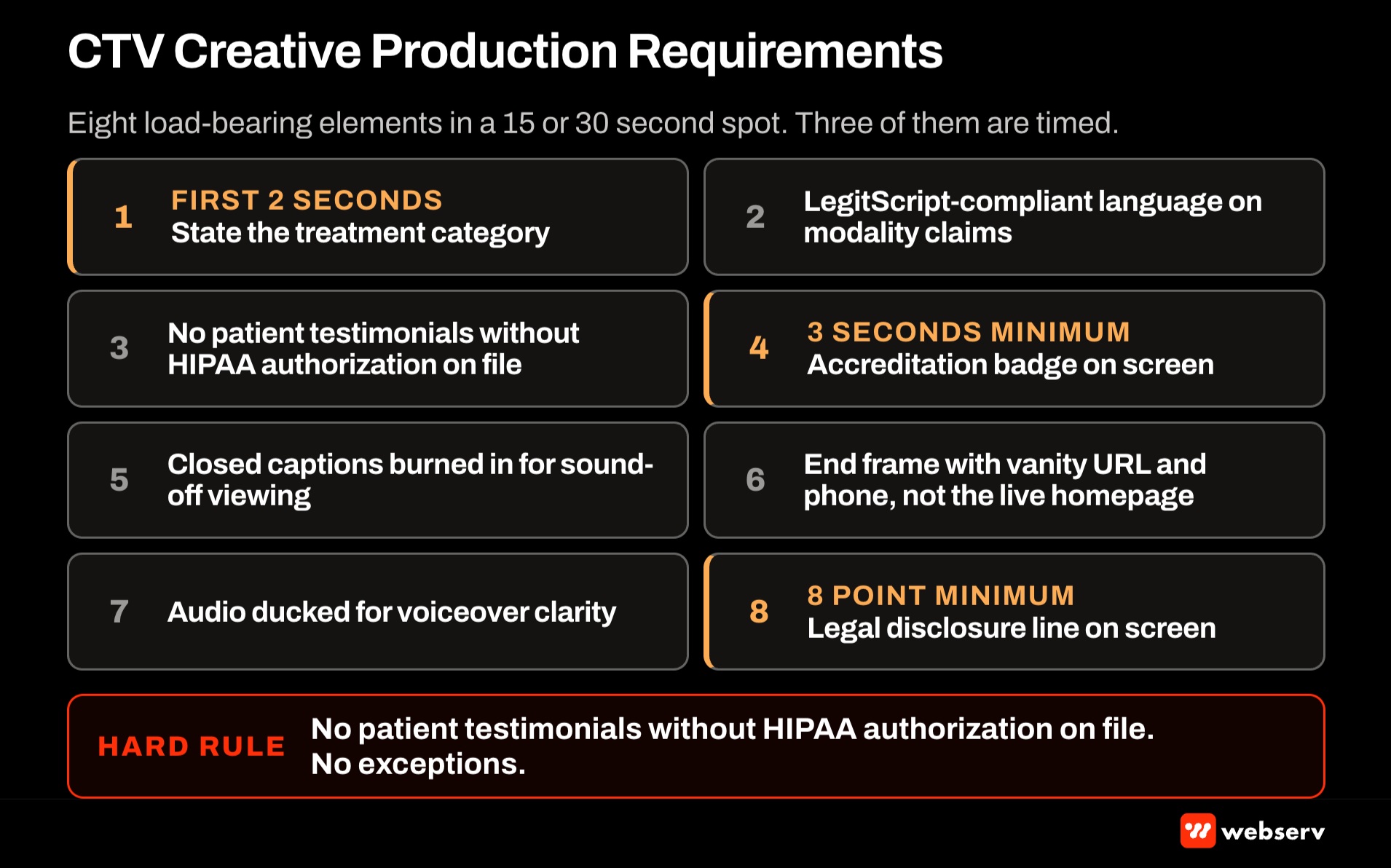
Video format specifications. 15-second and 30-second video formats for most CTV placements. 6-second bumper ads for YouTube CTV. Higher-quality production values than social video because CTV placement adjacent to premium content demands comparable quality.
Broadcast-quality production. Professional cinematography, professional audio production, professional editing. CTV creative that looks like social video typically produces poor engagement because it does not fit the viewing context.
Production costs: $8,000 to $35,000 per finished CTV unit for professional production. Some facilities use existing broadcast-quality video content (from facility marketing videos, testimonial content, or existing brand campaigns) with CTV-specific editing.
Content patterns that work on CTV. Family testimonial content adapted for CTV format. Named clinician introduction with facility context. Facility walkthrough video adapted from web use. Educational content covering specific conditions or treatment approaches.
Content patterns that fail on CTV. Aggressive direct-response calls to action (phone number as primary CTA typically underperforms on CTV because viewers do not take phones out of pockets during CTV viewing). Rapid-cut social video edits that fit feed context but not living-room context.
CTA patterns for CTV. Website URL as primary CTA with clean brand recall. QR codes for viewer scan (increasingly common on CTV). Verbal facility name mention that supports subsequent search behavior. Whatever URL the ad drives to should be engineered per our landing page guide.
The specific pattern: CTV creative aims to produce brand recall and search intent rather than direct-response conversion. Direct response happens on Meta and Google after CTV builds the brand awareness.
OPERATOR INSIGHT
The pattern I see across facility CTV programs: the channel either does not exist at all (paid programs run only Meta and Google without CTV), or exists as an untargeted broadcast alternative (facilities buying CTV as if it were linear television without audience targeting or measurement infrastructure).
Some facilities have strong audience targeting but weak measurement infrastructure, and CTV attribution runs on last-click without proper multi-touch consideration. CTV programs with disciplined audience targeting, proper HIPAA-adjacent handling, and multi-touch attribution measurement typically produce cross-channel lift that materially exceeds CTV-attributed direct conversion.
HIPAA-adjacent measurement considerations
CTV measurement carries specific HIPAA-adjacent considerations that apply differently than display or social.
CTV attribution data flow. CTV impressions produce device-level attribution data through platform-specific pixels or postback URLs. The data flow from CTV platforms to marketing measurement systems must handle any patient-identifiable information with appropriate compliance safeguards.
Household-level attribution. CTV attribution typically operates at household level rather than individual level because streaming devices are shared. Household attribution produces less specific attribution than individual attribution but avoids some individual-level PHI handling considerations.
Cross-device attribution privacy. Connecting CTV impressions to specific web or mobile behavior requires cross-device attribution infrastructure. The infrastructure must handle any PHI generated by the web or mobile behavior with appropriate sanitization.
Platform-specific BAA availability. Some CTV platforms and measurement vendors offer BAA coverage for BH clients. Verify BAA availability during platform selection for any infrastructure that handles patient-identifiable attribution data.
The BH CTV program at a glance
15-30%
Efficiency lift on Meta and Google when integrated with a CTV brand-awareness layer
$15-50K
Monthly CTV spend range for most single-facility BH operators
15 / 30s
Standard CTV video lengths; broadcast-quality production, not repurposed social
60-180d
Window before brand-awareness effects show up in Meta and Google performance
Multi-touch attribution setup
CTV measurement requires multi-touch attribution to resolve CTV’s actual contribution across the full paid funnel.
Why last-click attribution underattributes CTV. CTV impressions typically do not produce immediate click responses because CTV viewers do not click ads on their TVs. The response happens on subsequent Meta, Google, or organic touchpoints.
Last-click attribution credits the final click before conversion, which is typically not the CTV impression. Facilities using last-click measurement typically conclude CTV does not produce conversions.
Media mix modeling. Statistical model that isolates the incremental contribution of each channel including CTV. Requires 90 to 180 days of consistent CTV spend at meaningful scale before the model can produce reliable CTV incrementality measurement. The measurement methodology that supports this is walked in our ROI attribution playbook.
Media mix modeling typically requires specialized vendor support (Analytic Partners, Nielsen, Marketing Evolution, or similar) plus internal analyst capability to interpret results.
Multi-touch attribution tools. Dedicated tools (Rockerbox, Northbeam, similar) provide continuous multi-touch attribution across CTV, social, search, and display. Meaningful CTV attribution requires the tool to be configured with proper CTV signal integration.
Incrementality testing. Geographic holdout tests where CTV runs in specific markets but not others produce cleaner incrementality measurement than statistical modeling alone. Requires 60 to 120 day test windows plus significant market-level data volume.
Simple approximation for smaller programs. Facilities without measurement infrastructure sufficient for MMM or MTA can use simple approximations: track total admit volume during CTV-active periods versus CTV-paused periods. Adjust for seasonal patterns and other paid changes. The GA4 configuration that makes this legible is documented in our GA4 configuration piece.
DO
- Concentrate CTV spend on tier 1 platforms (Hulu, Netflix ad-supported) for quality inventory and family-decision-maker audience density before scaling into tier 2.
- Layer household demographic, interest, and CRM audience targeting; untargeted CTV performs closer to linear TV than to a modern paid channel.
- Produce broadcast-quality creative at 15 and 30 seconds; if the ad plays adjacent to premium content, the ad has to look like premium content.
- Measure CTV through media mix modeling, dedicated MTA, or geo holdout tests; last-click will always tell you CTV does nothing.
- Set a minimum viable CTV budget of $15,000 to $25,000 per month before turning the channel on; below that, reach is too thin to build brand awareness.
DON’T
- Buy CTV as a linear-TV substitute with mass reach targeting; you spend twice as much for the same misaligned delivery.
- Repurpose social video for CTV as-is; rapid cuts and hard direct-response CTAs underperform against the CTV viewing context.
- Attribute CTV on last-click and conclude the channel does not work; CTV viewers do not click TVs, so last-click was never going to see the effect.
- Buy programmatic CTV without placement transparency; the risk of extremist, adjacent-crisis, or off-brand placements is real in an unwalled inventory pool.
- Include PHI in the CRM audience upload; strip identifiers and hash before any list ever leaves the facility environment.
Failure modes for CTV BH
Five patterns produce CTV programs that fail expectations.
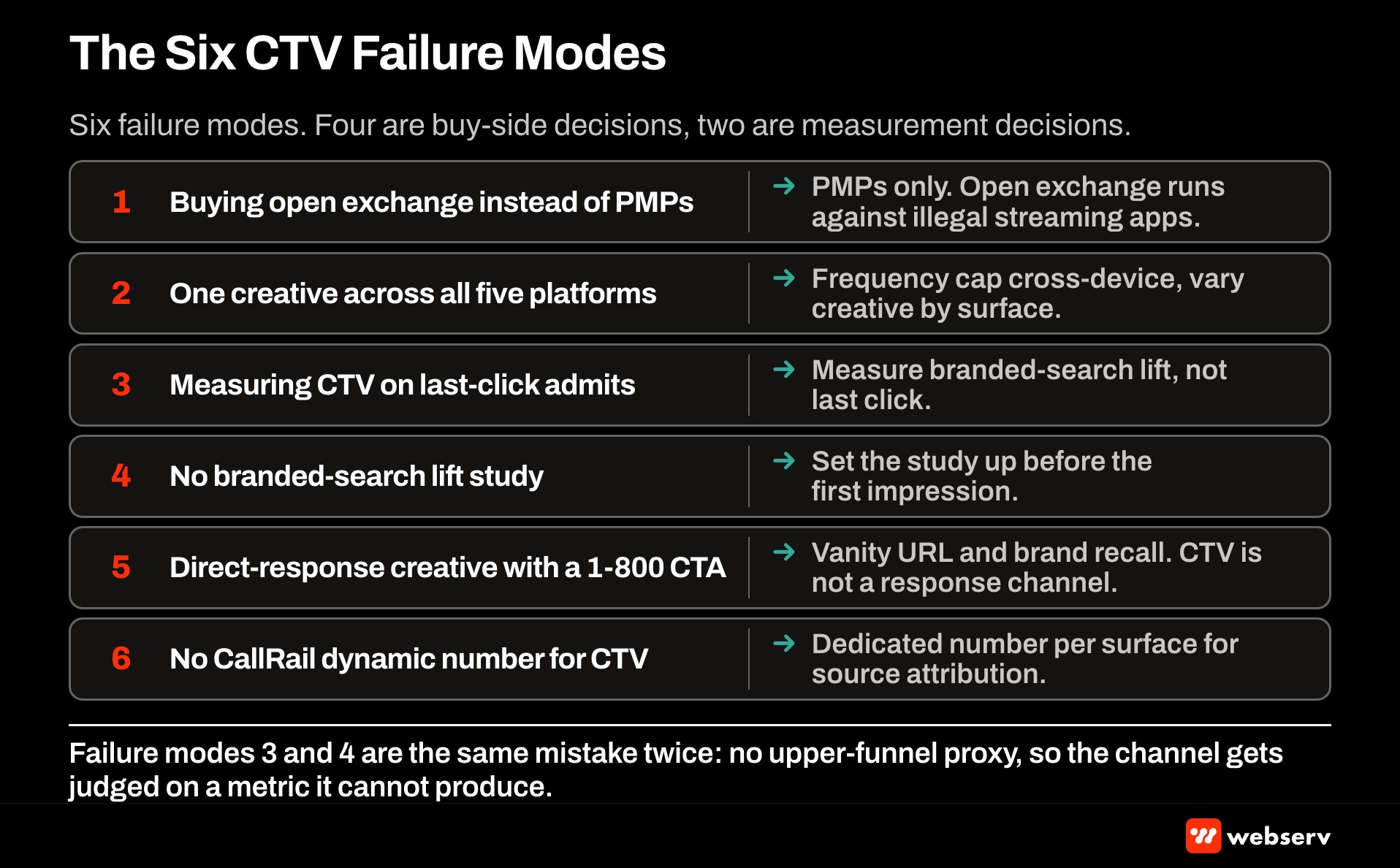
Failure mode 1: Untargeted CTV as broadcast alternative. Buying CTV inventory with mass reach targeting typically produces mismatched audience delivery and inefficient spend. Fix: audience targeting through household demographics, interests, and CRM audience uploads.
Failure mode 2: Direct-response creative on CTV. Creative optimized for direct-response conversion typically underperforms on CTV because CTV viewers do not convert directly. Fix: brand awareness creative optimized for recall and search intent rather than direct clicks.
Failure mode 3: Last-click attribution measurement. Attributing CTV performance through last-click typically produces near-zero CTV attribution and misleading conclusions about CTV value. Fix: multi-touch attribution or media mix modeling that captures CTV’s cross-channel contribution.
Failure mode 4: Programmatic without placement transparency. Programmatic CTV without placement visibility can produce low-quality or brand-unsafe placements. Fix: direct platform buys or programmatic partners with explicit placement transparency and category exclusion.
Failure mode 5: Undersized CTV budget. CTV budgets below $10,000 to $15,000 per month typically produce insufficient reach to build meaningful brand awareness. Fix: minimum CTV budget of $15,000 to $25,000 per month for facilities running CTV, or skip CTV entirely for facilities that cannot support the minimum viable spend.
Most in-house teams hit a wall not because they lack knowledge, but because they lack bandwidth.
When you are ready to hand it off, Webserv has spent 9 years executing exactly this for treatment centers nationwide.
Frequently Asked Questions
How much should we spend on CTV for BH?
Between $15,000 and $50,000 per month for most treatment center operators running CTV. Below $15,000 typically produces insufficient reach to build meaningful brand awareness across the family decision-maker audience.
Above $50,000 typically produces diminishing returns because the addressable CTV audience in a single facility service area saturates.
Portfolio operators with multiple facilities in multiple markets can scale meaningfully higher with per-facility CTV spend in the $10,000 to $30,000 range.
What is the typical cross-channel lift CTV produces on Meta and Google?
Between 15 and 30 percent efficiency improvement on Meta and Google for facilities running integrated CTV plus Meta plus Google versus running Meta and Google alone.
The specific mechanism: CTV impressions build brand awareness that increases subsequent search intent and social engagement. Users who saw CTV impressions convert at higher rates on Meta and Google than users who did not see CTV.
The cross-channel lift typically exceeds direct CTV-attributed conversions in most measurement approaches.
How long does CTV take to produce measurable results?
Between 60 and 180 days for measurable results in most measurement approaches. CTV brand awareness effects compound over time as impressions accumulate across the audience.
Facilities that expect immediate CTV results typically produce misleading conclusions in the first 30 to 60 days when brand awareness has not yet accumulated to threshold levels. The measurement discipline that separates real lift from noise is documented in our ROI attribution playbook.
Baseline the Meta and Google program without CTV for 60 to 90 days, then measure change after CTV is added; do not evaluate CTV in isolation.
Should we run CTV as a supplement to Meta and Google or as a primary channel?
Supplement. CTV works best as a brand awareness layer that supports Meta and Google direct-response performance. CTV as primary channel typically produces cost-per-admit outcomes worse than Meta and Google.
The specific pattern: Meta and Google as primary direct-response channels, CTV as supplementary brand awareness layer that improves overall paid program efficiency.
The retargeting piece covers the CTV retargeting layer that connects household CTV impressions back to the direct-response surfaces.
How does CTV interact with our overall paid media program?
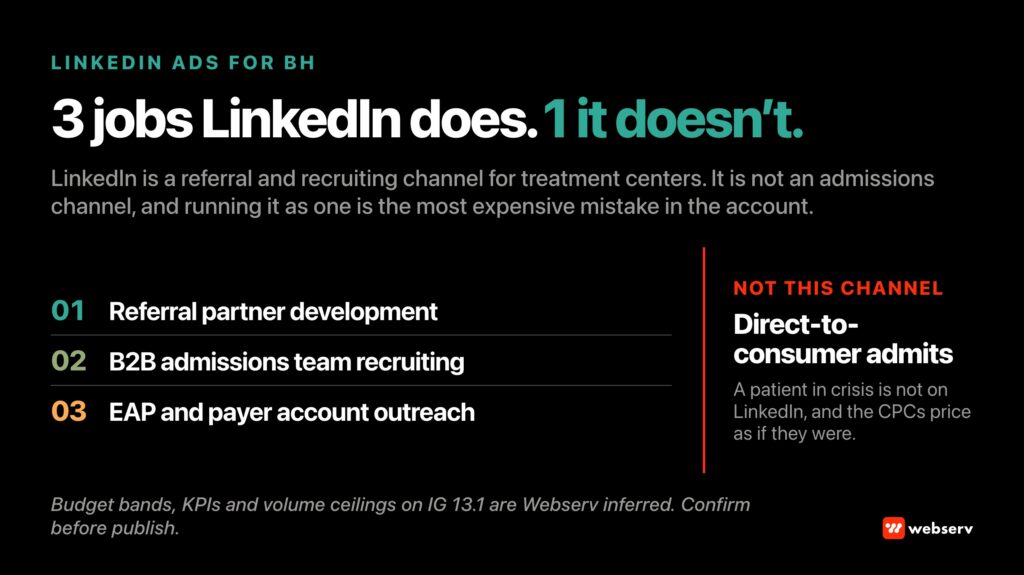
As the brand awareness layer that supports the direct-response layers. Meta and Google produce the direct-response conversions. CTV builds the brand awareness that increases Meta and Google conversion rates. LinkedIn (LinkedIn Ads piece) sits alongside for referral-partner and B2B intent; CTV does not.
The specific integration pattern: CTV impressions across streaming platforms build brand recall among family decision-makers. Retargeting audiences from CTV impressions flow into Meta and Google (per our retargeting piece). Cross-channel measurement captures CTV’s contribution through multi-touch attribution.
Both cold and CTV-warmed traffic should land on landing pages engineered per our landing page guide so the brand-awareness lift converts efficiently once it arrives.
What content types work best for CTV BH creative?
Three specific content types produce the strongest CTV results. First: family testimonial content with named family members sharing their treatment center experience. Second: named clinician introduction content with facility context; clinical authority signal reinforces the trust signal families need.
Third: facility walkthrough content that shows the specific facility environment. Facility-specific imagery produces meaningful memorability that supports subsequent search behavior.
Content types to avoid: direct-response promotional content, competitor comparison content, and any content that would work better on social than on CTV. The creative framework that governs this is in our ad creative strategy piece.
How does CTV attribution work when families see impressions on shared household devices?
Household-level attribution rather than individual-level attribution. CTV impressions attribute to the household regardless of which household member watched. Subsequent conversions from any household member get attributed to the CTV impression at household level. The GA4-side configuration that supports this is walked in our GA4 configuration piece.
Household attribution provides less specific attribution than individual attribution but avoids the cross-device attribution complexity that individual attribution creates. For most BH audiences, household attribution produces sufficient signal because family decision-making happens at household level.
YouTube CTV specifically bridges household and individual because YouTube identity carries across devices; the YouTube Ads piece covers the video-adjacency patterns that overlap with CTV measurement.
Keaton Nalle is the Director of Paid Admissions at Webserv, a digital marketing agency for treatment centers.