Content refresh is the specific SEO discipline that maintains ranking and AI citation share on already-published content. It sits inside our content and SEO capability, distinct from new content production and from technical SEO maintenance because the specific work involves editorial changes to existing content that produce updated last-modified timestamps and refreshed factual accuracy.
The content and SEO capability at Webserv runs weekly refresh cadence across the corpus of 270+ posts.
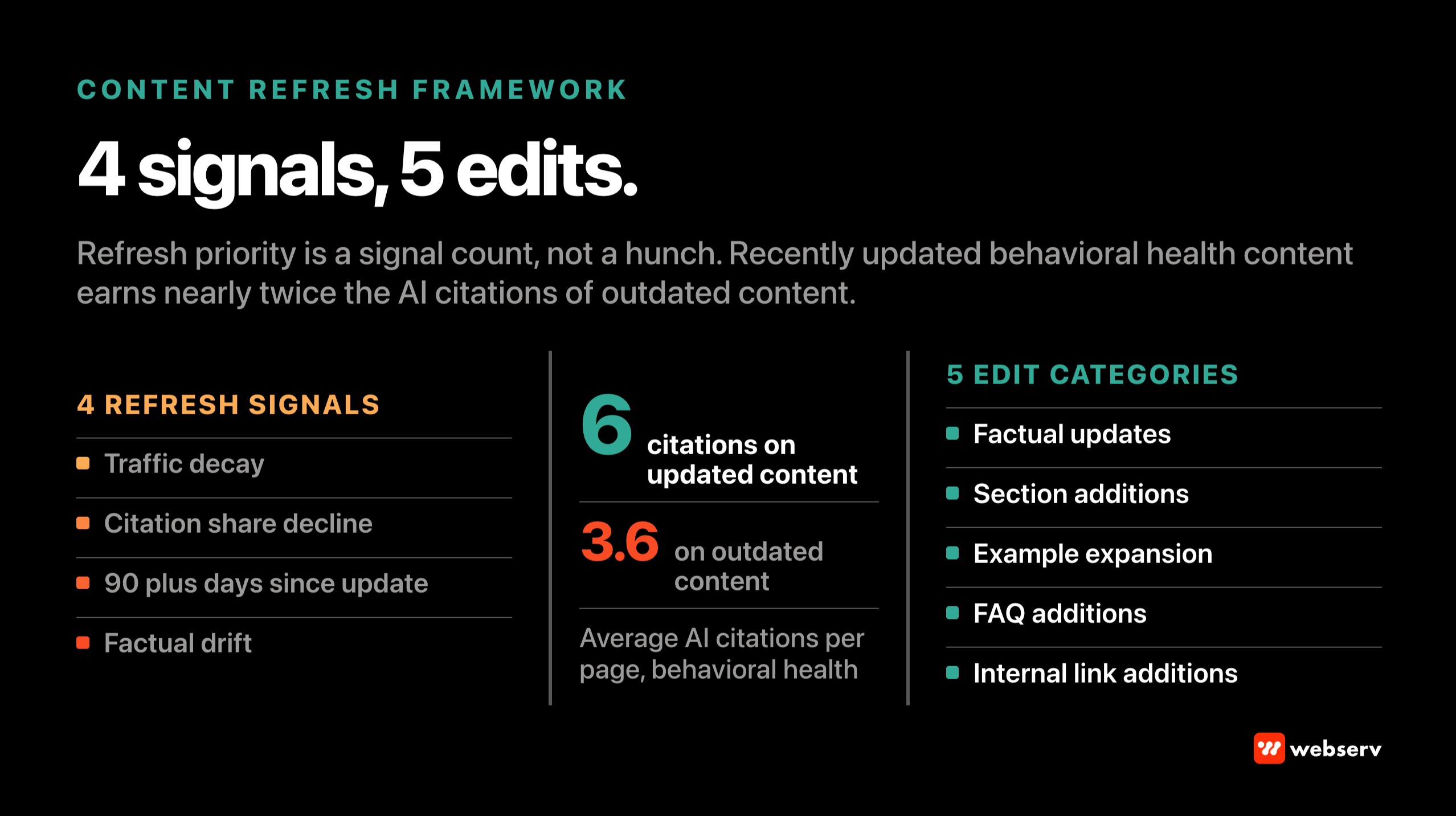
The clearest public data point: SE Ranking’s study of 129,000 domains found pages updated in the past three months averaged 6 ChatGPT citations versus 3.6 for outdated pages. That study covered ChatGPT only. Freshness matters differently by platform: Ahrefs found AI assistants cite content about 25.7% fresher than organic results, while AI Overviews’ top citations leaned slightly older.
The pattern I see across treatment center content programs: refresh either does not happen at all (published content stays untouched for 12 to 36 months), or refresh happens as one-off “content updates” tied to specific business events without systematic cadence.
Neither pattern keeps facts current, and outdated facts are what AI answers end up repeating.
This piece walks the content refresh framework for behavioral health sites. The specific signals that determine which posts to refresh, the editorial workflow that produces meaningful refresh (not date-only bumps), and the specific edit categories that make a refresh substantive.
It also covers the ≤20 percent word delta rule that preserves ranking equity, the failure modes that produce refresh work without ranking benefit, and the measurement pattern that isolates refresh impact from other content operations. The recency signal this discipline earns is one of the load-bearing signals mapped in our Full AI Search Stack for treatment centers, and the extraction unit that refresh-eligible content should preserve is documented in our 40-word answer block piece. Related tactical work: FAQ schema after March 2026 and compound prompt content model. Broader context in our ultimate guide to behavioral health marketing.
Key Takeaways
- Content refresh is the specific discipline that maintains AI citation share on published content. SE Ranking found pages updated within the past three months averaged 6 ChatGPT citations versus 3.6 for older pages. Freshness effects vary by platform, so refresh for accuracy first, not for timestamps.
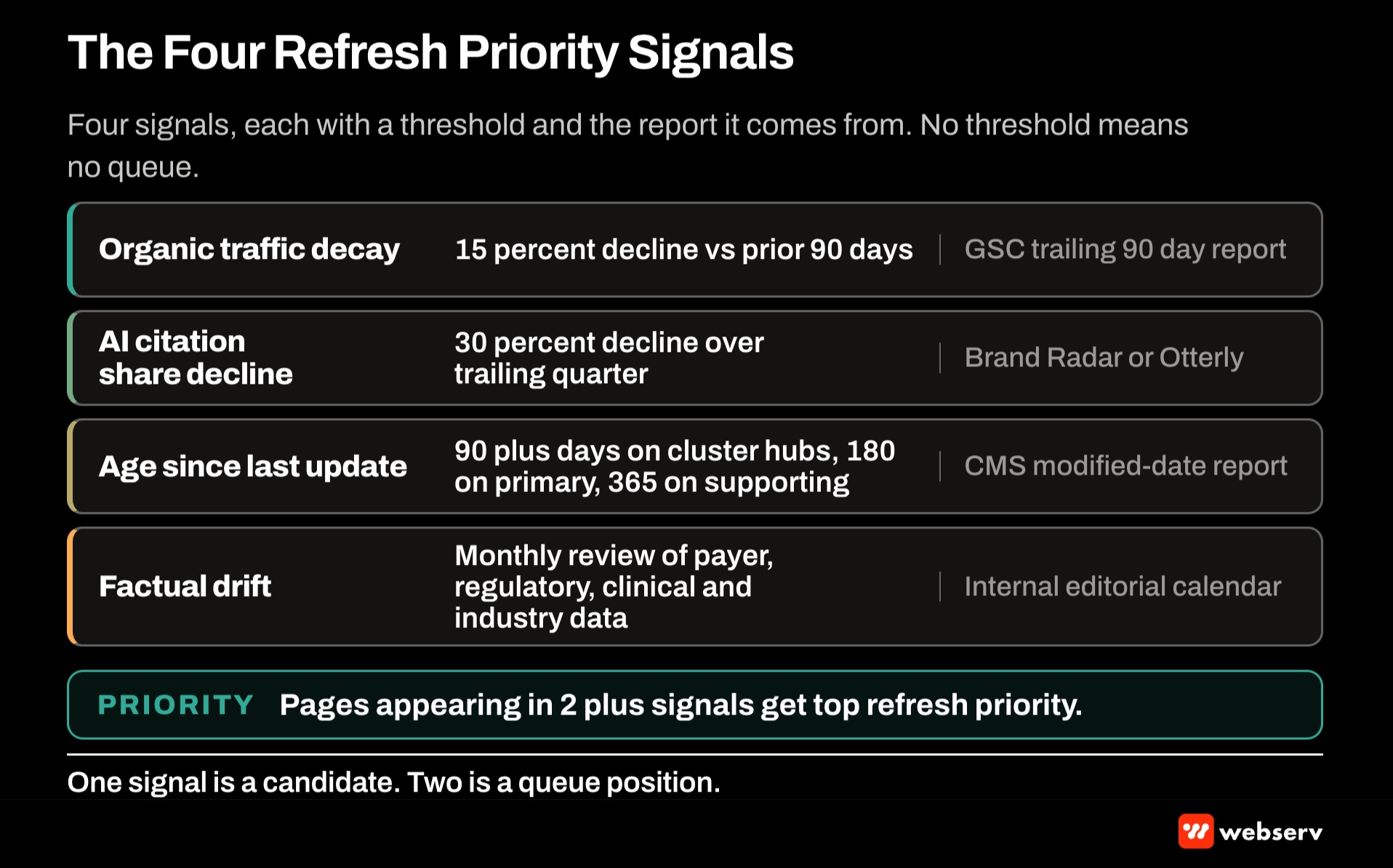
- Signals that determine refresh priority: pages with meaningful organic traffic decay over trailing 90 days, pages with AI citation share decline in tracking tools, cluster hubs and primary content that have gone 90+ days without update, and pages with specific factual content that has changed since publication.
- Editorial workflow that produces meaningful refresh: substantive edits (factual updates, section additions, expanded examples) rather than date-only bumps. The refresh has to earn the modified-date signal through actual editorial work, not just metadata changes.
- The ≤20 percent word delta rule is our working guardrail, not a published Google threshold. A page that already ranks earned that position with its current content, and wholesale rewrites risk the relevance signals that put it there.
- Failure modes: archive-instead-of-refresh (deleting weak content without refreshing), date-only bumps (updating timestamps without editorial changes), and over-editing (rewriting more than 20 percent of content and losing ranking authority).
DEFINITION
The content refresh framework for behavioral health sites. A weekly editorial cadence that maintains ranking and AI citation share on already-published content by making substantive edits — not date-only bumps — that earn an updated modified-date signal. Runs on a four-signal priority stack (organic traffic decay, AI citation share decline, age since last meaningful update, factual content that has changed), five edit categories (factual updates, section additions, example expansion, FAQ additions, internal link additions), a ≤20 percent word delta cap to preserve ranking equity, and a per-content-type cadence (cluster hubs quarterly, primary content semi-annually, supporting content annually).
Distinct from new content production (which expands topical coverage), distinct from technical SEO maintenance (which handles schema, crawl, and page speed), and distinct from archiving (which permanently removes traffic and authority — refresh preserves both).
OPERATOR INSIGHT
Refresh either does not happen at all (published content stays untouched for 12 to 36 months), or refresh happens as one-off “content updates” tied to specific business events without systematic cadence. Neither pattern keeps facts current, and outdated facts are what AI answers end up repeating.
The refresh has to earn the modified-date signal through actual editorial work, not just metadata changes. Google’s helpful content guidance asks whether pages change their dates to seem fresh when the content hasn’t substantially changed. Date-only bumps are the fastest way to convince a marketing team that refresh does not work — because when refresh is done that way, it does not.
The specific signals that determine refresh priority
Not every post benefits equally from refresh. The specific signals that determine which posts get refresh priority.
Signal 1: Organic traffic decay over trailing 90 days
Pages showing 15+ percent organic traffic decline compared to the previous 90-day window signal potential refresh opportunity. Traffic decay typically reflects ranking decline that refresh can address.
The specific pattern: pull GSC traffic data for trailing 90 days versus previous 90 days. Sort by absolute traffic loss. Top 20 to 40 declining pages get refresh priority.
Signal 2: AI citation share decline in tracking tools
Brand Radar, Otterly, or similar AI citation trackers surface pages losing citation share on target queries. Pages with a sustained citation share decline over the trailing quarter signal refresh priority.
Facilities without AI citation tracking cannot use this signal directly but can approximate through Google Search Console’s “top pages” report for AI Overview eligibility (when Google exposes the data).
Signal 3: Age since last meaningful update
Cluster hubs and primary content pages that have gone 90+ days without update signal refresh priority regardless of traffic pattern.
The specific pattern: quarterly refresh cadence on cluster hubs, semi-annual refresh cadence on primary content pages, annual refresh cadence on supporting content. Pages exceeding cadence thresholds get refresh priority.
Signal 4: Factual content that has changed
Content covering specific facts that have changed since publication (payer network changes, regulatory changes, updated clinical guidelines, new industry data) signals refresh priority regardless of other signals.
The specific pattern: monthly review of specific factual areas covered across the corpus. Refresh pages where the underlying facts have changed materially since publication.
Priority stack
Combine the four signals into a priority stack. Pages appearing in multiple signals get highest priority. Cluster hubs with traffic decay and 90+ days since update typically top the priority list.
The refresh program at a glance
6 vs 3.6
ChatGPT citations for content updated in past 3 months vs older content (SE Ranking)
≤20%
Word delta ceiling that preserves ranking equity through refresh
3-5
Pages selected from the priority stack for weekly Monday refresh work
40-70%
AI citation share loss on cluster hubs left unrefreshed for 24 months
Editorial workflow that produces meaningful refresh
Refresh has to produce actual editorial changes to earn the modified-date signal. Date-only bumps do not produce ranking or AI citation lift because Google’s ranking and AI systems both evaluate content changes, not just timestamp changes.
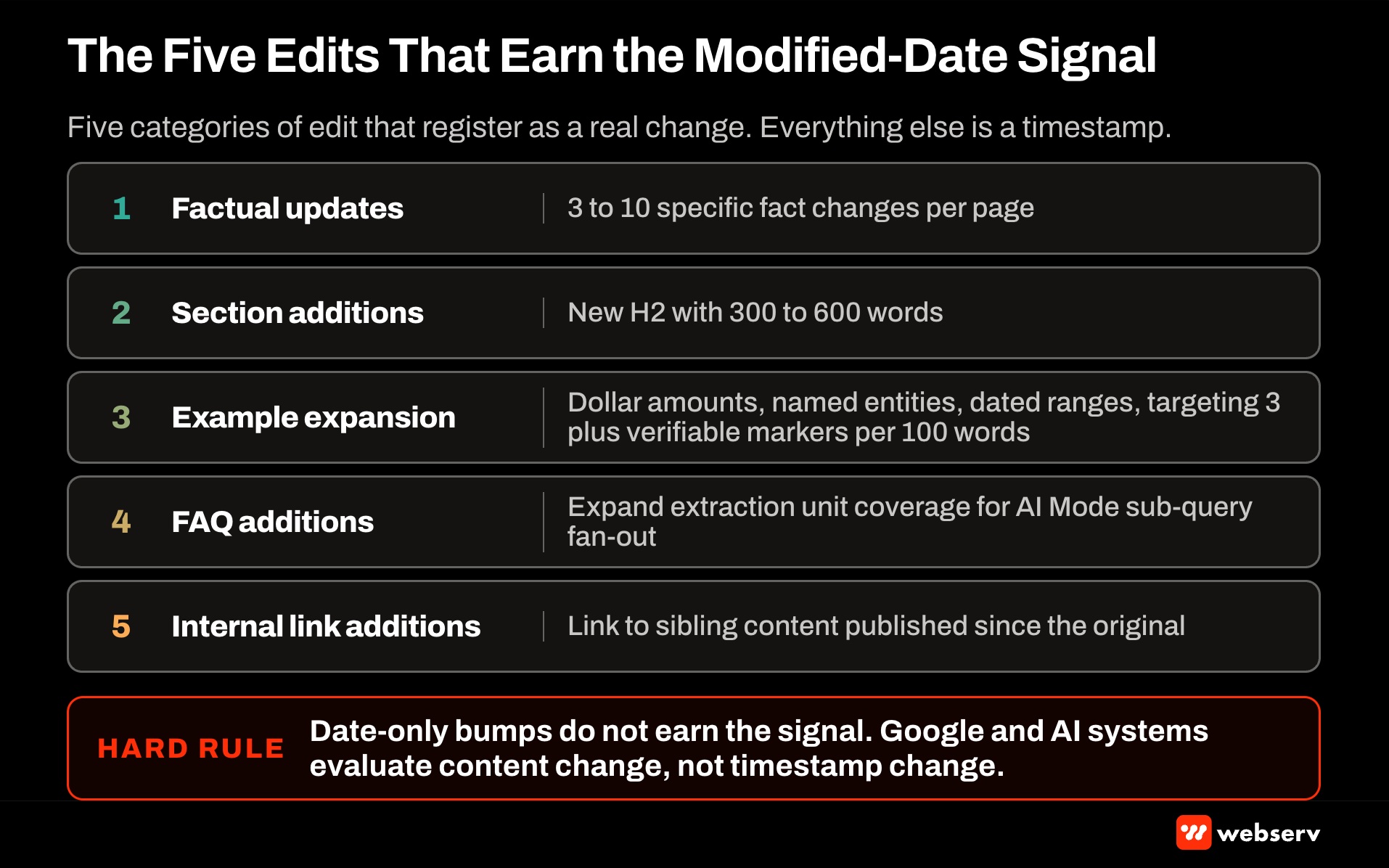
Edit category 1: Factual updates. Update specific facts that have changed. Payer names updated to reflect current network status. Regulatory references updated to current requirements. Industry data updated to most recent published sources.
Factual updates typically produce 3 to 10 specific changes per refreshed page depending on how much factual content the page carries.
Edit category 2: Section additions. Add new sections covering topics that have emerged since publication. New H2 with 300 to 600 words of substantive new content addressing a specific question or angle not previously covered.
Section additions typically produce the strongest refresh signal because they represent substantive content expansion.
Edit category 3: Example expansion. Add specific examples or case references that reinforce existing content. New parenthetical facts, additional dollar amounts, additional named entities, additional dated ranges.
Example expansion supports fact density improvement (3+ verifiable markers per 100 words target) while producing meaningful editorial change.
Edit category 4: FAQ additions or updates. Add new FAQ questions or update existing FAQ answers with current information. FAQ additions expand extraction unit coverage for AI Mode sub-query fan-out. Our FAQ schema after March 2026 piece covers the post-update FAQ block deployment pattern.
Edit category 5: Internal link additions. Add new internal links to pages published since the original content. Link additions reinforce cluster architecture and support recently-published sibling content.
The specific workflow: pick the refresh page, review against the five edit categories, make edits totaling meaningful editorial change (not just cosmetic edits), publish with updated last-modified timestamp.
How SoCal Sunrise generated 85 admissions and 2,297% ROI from SEO in 6 months
A ground-up SEO rebuild using the Pathfinder Parents Methodology turned an invisible online presence into a top-ranking admissions engine.
Read the case study →85 admits and 3,152 leads attributed to organic
The ≤20 percent word delta rule
Substantive refresh should stay within ≤20 percent word delta from the original content. This preserves the ranking authority the original content accumulated while producing enough editorial change for AI systems to detect the refresh.
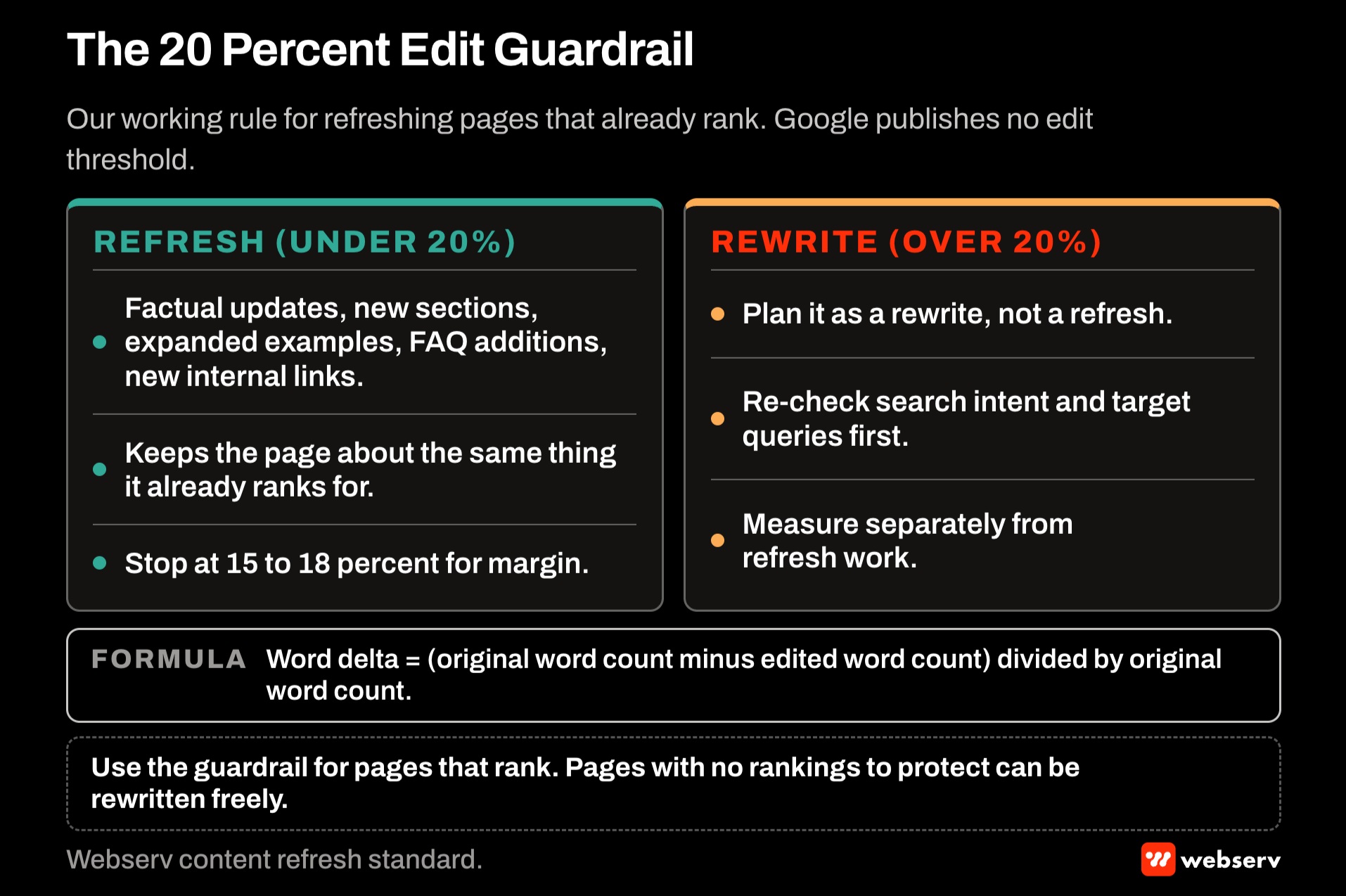
Why we cap edits at 20 percent. Google does not publish an edit threshold, and it does not treat a page differently because a fixed share of its words changed. The cap is our working guardrail for pages that already rank.
Large rewrites change what a page says and what it is relevant for, and that can move rankings in either direction. Treat a big rewrite as a deliberate decision, not a side effect of refresh work.
How to measure word delta. Original word count minus edited word count divided by original word count. Under 20 percent stays inside the guardrail. Over 20 percent is a rewrite and should be planned as one.
When over-20-percent refresh makes sense. Content that has fallen out of ranking eligibility entirely (position 30+ with no citation share) sometimes benefits from substantive rewrite because there is no ranking authority to preserve. In those cases, treat the piece as effectively new content and apply new-content workflow.
Content maintaining ranking authority should stay under the 20 percent threshold to preserve the authority through the refresh.
DO
- Run a Monday refresh queue selection: pull the priority stack (traffic decay + citation decline + 90+ days + factual drift) and pick 3-5 pages for the week.
- Every refresh includes substantive editorial change per the 5 edit categories (factual updates, section additions, example expansion, FAQ additions, internal link additions).
- Track word delta on every refresh; stop editing at 15-18% to keep a safety margin below the 20% guardrail.
- Refresh cluster hubs quarterly, primary content semi-annually, supporting content annually; service pages get quarterly factual review with refresh as needed.
- Set a 60/90-day post-refresh measurement window against the pre-refresh baseline — traffic, AI citation share, target-keyword position — so refresh work is evidence-based, not assumption-based.
DON’T
- Ship date-only bumps. Google’s guidance asks whether dates change without substantial content changes.
- Archive content with any residual traffic or authority instead of refreshing — archive removes the equity permanently; refresh usually recovers some of it.
- Rewrite more than 20% of a page that already ranks without planning it as a rewrite.
- Refresh by adding generic marketing language — refresh has to add fact density (verifiable markers per 100 words), not dilute it.
- Skip the pre-refresh baseline capture — without measurement, you cannot tell whether the refresh produced the intended lift and refresh becomes assumption-driven.
Failure modes
Five patterns produce refresh work without corresponding ranking or citation benefit.
Failure mode 1: Date-only bumps. Updating the last-modified timestamp without editorial changes. Google’s helpful content guidance asks whether pages change their dates to seem fresh when the content hasn’t substantially changed.
The specific fix: every refresh includes substantive editorial change per the five edit categories.
Failure mode 2: Archive-instead-of-refresh. Deleting weak content instead of refreshing it. Archiving removes any residual traffic and authority the content had accumulated. Refresh typically produces better outcomes than archiving for content with any meaningful ranking history.
The specific fix: refresh workflow before archive consideration. Archive only for content that fails refresh evaluation (topic no longer relevant, technical impossibility of maintaining accuracy).
Failure mode 3: Over-editing. Rewriting more than 20 percent of a page that already ranks, which puts at risk the relevance signals that earned its position.
The specific fix: track word delta on every refresh. Stop editing when approaching 15 to 18 percent delta. Save further changes for the next refresh cycle.
Failure mode 4: Refresh without factual grounding. Editorial changes that add generic marketing language rather than specific factual anchors. Refresh has to add fact density, not dilute it.
The specific fix: every refresh edit produces net positive fact density (more verifiable markers per 100 words than before). Refresh that reduces fact density typically produces ranking regression rather than lift.
Failure mode 5: Refresh without measurement. Refreshing content without tracking pre-refresh baseline and post-refresh performance. Cannot isolate whether the refresh produced intended lift.
The specific fix: measurement window of 60 to 90 days pre-refresh and post-refresh. Track organic traffic, AI citation share (where measurable), and target keyword ranking positions.
Cadence framework
The specific cadence framework for content refresh across a treatment center site.
Cluster hubs: quarterly refresh. Cluster hubs anchor topical authority and get the highest refresh cadence. Quarterly refresh maintains recency signal that reinforces the hub’s citation authority.
Primary content pages (UGs, comprehensive playbooks): semi-annual refresh. Primary content refresh at 6-month cadence maintains meaningful recency without over-editing.
Supporting content (blog posts, TL pieces): annual refresh. Supporting content refresh at 12-month cadence catches factual drift without excessive refresh workload.
Service pages and homepages: quarterly review, refresh as needed. Commercial pages get quarterly review for factual accuracy (payer network, program details, insurance coverage). Refresh happens when review identifies changes rather than on strict cadence.
Event-triggered refresh. Regulatory changes, payer network changes, major industry news, and specific factual updates trigger ad-hoc refresh regardless of cadence position.
Weekly refresh workflow
The specific weekly workflow that runs the refresh framework at scale.
Monday: refresh queue selection. Pull the priority stack signals (traffic decay, citation share decline, age since update, factual changes). Select 3 to 5 pages for the week’s refresh work.
Tuesday through Thursday: refresh execution. Editorial work on the selected pages. Substantive edits per the five edit categories. Word delta tracking to stay within the 20 percent threshold.
Friday: publish and measurement setup. Publish refreshed pages with updated last-modified timestamps. Set measurement baseline for the pre-refresh window. Schedule 60-day and 90-day post-refresh measurement checks.
Portfolio operators with 5+ facilities can distribute the weekly workflow across facility content teams with centralized coordination on cluster hub refresh work.
Most in-house teams hit a wall not because they lack knowledge, but because they lack bandwidth.
When you are ready to hand it off, Webserv has spent 9 years executing exactly this for treatment centers nationwide.
Frequently Asked Questions
How much does content refresh cost at scale?
Between $2,000 and $8,000 per month for weekly refresh cadence on a treatment center site with 100+ published posts. The specific breakdown: 4 to 8 hours per week of editorial work at $75 to $150 per hour loaded rate.
Portfolio operators typically produce economies of scale. Per-facility refresh cost drops to $500 to $2,500 per month for the second and subsequent facilities because refresh methodology and priority stack automation transfer across facilities.
Facilities that run refresh as an internal team member function typically cost lower than agency-managed refresh but require the internal team member to have specific SEO editorial expertise plus AI citation measurement capability.
How do we measure whether refresh is working?
Three specific measurement signals. First: organic traffic recovery on refreshed pages measured over 60 to 90 day post-refresh windows compared to pre-refresh baseline.
Second: AI citation share improvement on target queries associated with refreshed content. Requires AI citation tracking infrastructure (Brand Radar, Otterly, or similar).
Third: ranking position changes for target keywords on refreshed pages. Track position 1-3, position 4-10, and position 11+ shares across the refreshed content set. Facilities without measurement infrastructure typically cannot isolate refresh impact and end up refreshing based on assumption rather than evidence.
Can we refresh content that was written by different authors or previous agencies?
Yes. Refresh work operates at the content level regardless of authorship history. The specific consideration: preserve original author attribution unless the refresh substantively changes the content’s clinical or authoritative positioning.
Substantive rewrites that change clinical positioning may warrant updated authorship, but that decision should reflect actual editorial ownership rather than administrative convenience.
Facilities operating on content produced by previous agencies typically benefit from establishing new refresh workflow immediately rather than waiting until the previous agency’s content decays fully.
How does refresh interact with new content production?
Complementary. Refresh maintains authority on existing content while new content production expands topical coverage. Both operations are needed for content programs targeting AI citation lift over 12 to 24 month windows. Our 9 types of content that drive admits covers the new-content side.
The specific integration pattern: refresh workflow and new content workflow run in parallel. Refresh handles maintenance of existing authority; new content handles expansion into new topics or gaps in cluster coverage.
Facilities that focus only on new content production without refresh typically produce citation share ceilings limited by aging content authority. Facilities that focus only on refresh without new content production typically produce coverage limitations that prevent citation share expansion into new query categories. Our original research piece covers the highest-authority new-content category refresh works alongside.
What happens if we skip refresh for 12+ months on a cluster hub?
Meaningful AI citation share decline over 12 to 24 months as competitor content gets refreshed and displaces the aging content in AI source selection.
The specific decline pattern: 20 to 40 percent AI citation share loss over 12 months without refresh, expanding to 40 to 70 percent citation share loss over 24 months. Recovery from extended non-refresh typically requires substantive refresh (approaching but not exceeding the 20 percent word delta threshold) plus 60 to 180 days for AI systems to re-evaluate.
The right pattern: quarterly refresh cadence on cluster hubs prevents the decline before it accumulates.
How does content refresh fit with our overall content operations?
As one of three parallel workflows alongside new content production and technical SEO maintenance. All three workflows contribute to overall content program performance.
New content production: expand topical coverage, build new cluster architecture, launch new supporting content. Refresh: maintain authority on existing content, prevent AI citation decay, address factual drift. Technical SEO maintenance: crawl error fixes, schema updates, internal link management, page speed optimization.
The specific integration pattern: parallel workflow tracks with weekly cadence for each. Portfolio operators typically run all three under coordinated content ops leadership rather than as separate silos.
When should we consider archiving instead of refreshing?
Rarely. Archive consideration applies to content where the underlying topic is no longer relevant to the facility (discontinued programs, deprecated positioning) or where refresh cannot produce factual accuracy (topics the facility no longer has expertise on).
Content with meaningful ranking history and any residual traffic typically benefits from refresh rather than archive. The specific tradeoff: archive removes traffic and authority permanently; refresh has variable outcomes but typically produces some lift over 60 to 180 days.
Facilities that default to archive for weak content typically remove more authority than they gain in operational simplicity. The right default: refresh workflow first, archive only for content that fails refresh evaluation.
Trevor Gage is the Director of Marketing at Webserv, a digital marketing agency for treatment centers.