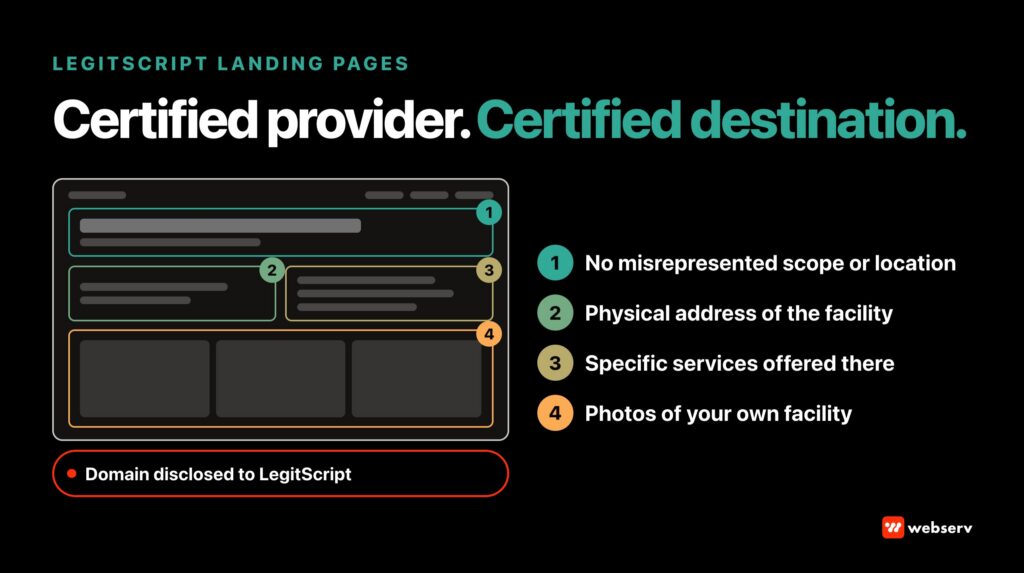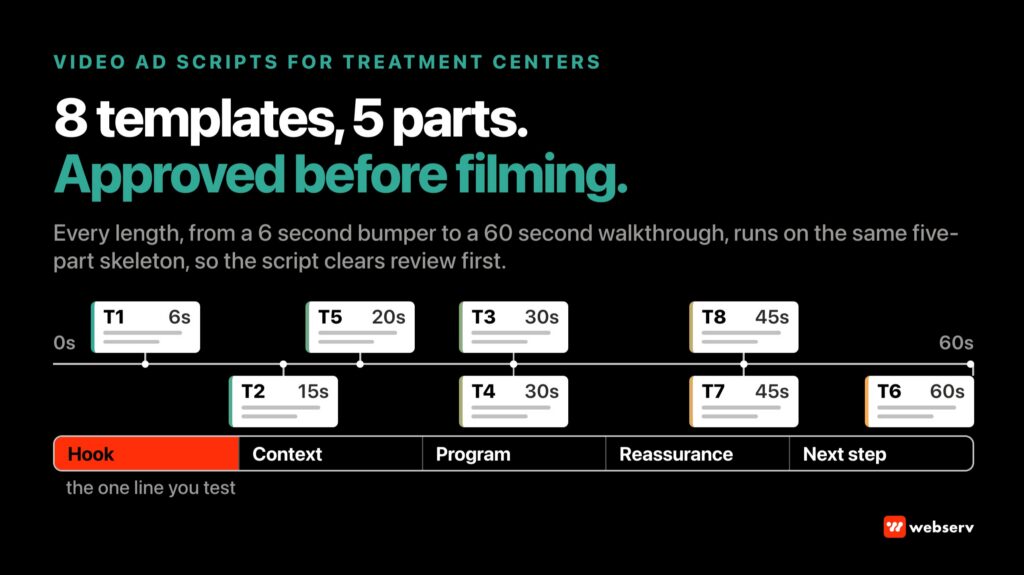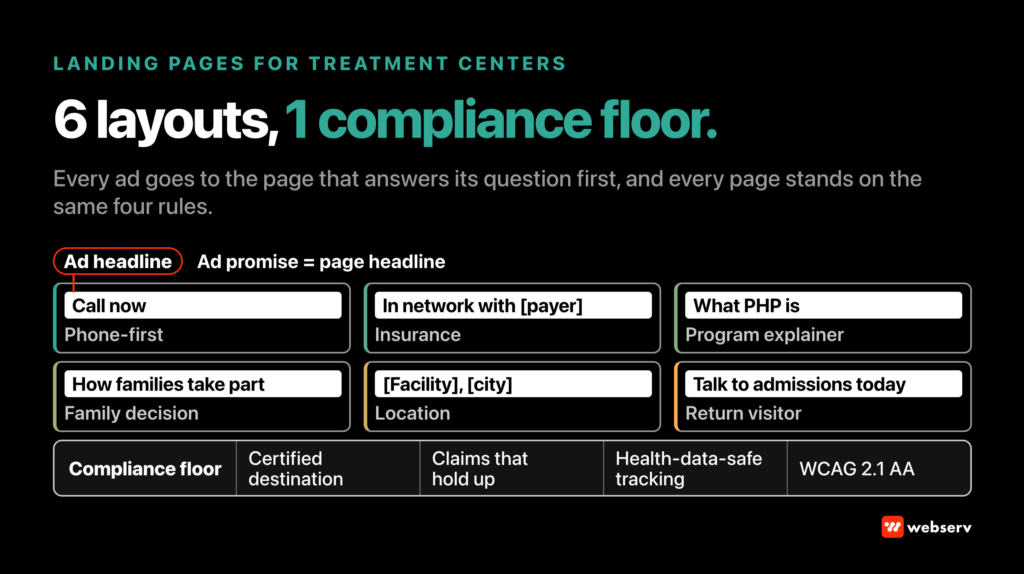
Ad creative is the highest-impact input in a treatment center’s paid media program and the input operators evaluate least. Media buyers get audited monthly. Attribution models get scrutinized quarterly.
Creative production runs on autopilot, produced by whoever produces it, at whatever cadence someone thinks is normal, with no framework attached to whether the output is doing the job the channel now requires.
At Webserv, our ad creative program exists to close exactly this gap, pairing creative production with the same operating discipline treatment centers already apply to media buying and attribution.
Nielsen research published by Meta credits creative quality with 56% of ad campaign ROI, and yet the operators I speak with who spend $40,000 to $250,000 per month on Meta cannot answer four basic questions about their ad creative operation.
How many active variants are running right now. How many were shipped this month. What percentage were video versus static. What the win rate on new variants has been across the last quarter.
This piece is the Ad Creative sub-cluster deep-dive on paid ad creative strategy for a treatment center in 2026. It sits under the umbrella creative strategy program guide, alongside the three other Creative sub-clusters on website design, website development, and landing page design.
It covers what ad creative strategy actually means for a treatment center, why the Meta Advantage+ era has restructured the creative production math, the rehab-specific constraint stack, and the operator’s playbook for evaluating whether your current creative pipeline is doing the job.
Key Takeaways
- Ad creative strategy for a treatment center is the layer above tactical creative production that decides who the creative speaks to, in whose voice, against which decision moment, inside which compliance constraints, and toward which admissions outcome.
- Meta’s Advantage+ era has restructured the creative math: the algorithm needs a steady supply of distinct, fresh variants, not a few deliverables a quarter.
- The rehab-specific constraint stack (LegitScript certification, HIPAA-adjacent content rules, Meta’s personal attributes policy, sensitive-content moderation) makes ad creative in this vertical structurally harder than in adjacent healthcare categories.
- Ad creative that points at templated location pages or unnamed-author YMYL content produces a creative-to-landing-page mismatch, because Google’s core updates keep favoring helpful, clearly authored pages.
- The five KPIs that actually predict admissions volume from ad creative are variant win rate, hook engagement rate in the first three seconds, conversion rate on the landing page the creative points at, cost per verified admit, and AI Overview citation share on the pages the creative points at.
What ad creative strategy actually is
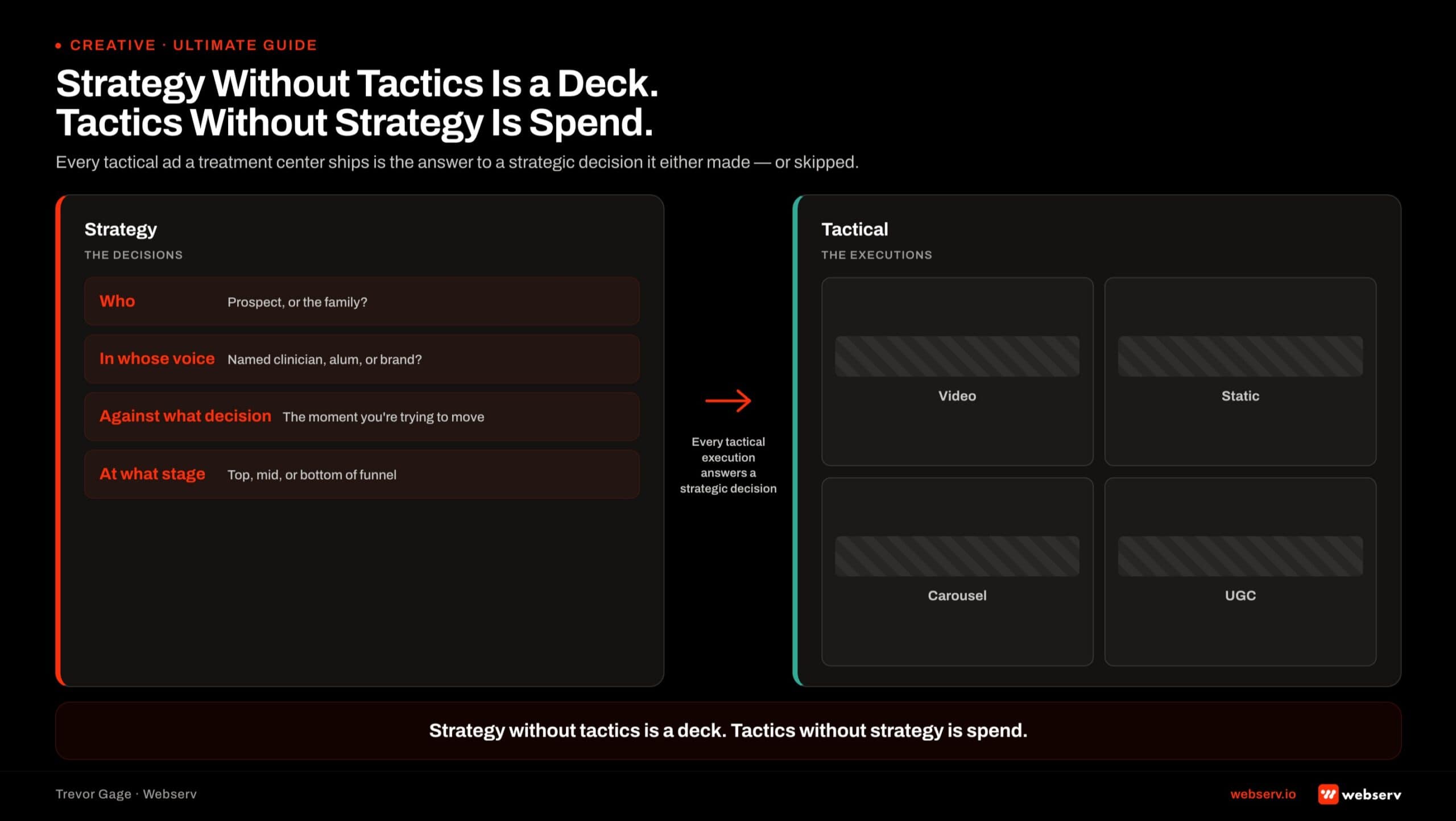
Ad creative strategy is the framework layer above tactical creative production. Tactical production is the work of writing scripts, filming video, laying out static ads, and shipping the variants into ad accounts. Strategy is the layer that decides what the creative should do before any of that starts.
A treatment center’s ad creative strategy answers five questions. Who is the primary audience: patients, family members, referral sources, or clinicians. What voice does the creative speak in: authoritative-clinical, warm-family, direct-operator, or first-person-survivor. What decision moment is the creative meeting: crisis intake, comparison shopping, family intervention, insurance verification, or reactivation.
What constraints does the creative operate inside: platform policies, LegitScript rules, HIPAA-adjacent content guidelines, and internal compliance posture. And what admissions outcome does the creative connect to: verified admit, VOB completion, phone call, form fill, or downstream nurture entry.
Without those answers, a treatment center’s creative production defaults to whatever the person producing it thinks looks good, which is not a strategy. It is a preference stack.
The operators who run the best ad creative programs I have seen answer those five questions upfront in a written brief that governs every variant that gets produced. The operators who run the worst programs produce creative that reflects the aesthetic taste of whoever happened to make it that week.
The Meta Advantage+ era has restructured the creative math
The single biggest structural shift in ad creative for behavioral health over the past 24 months is what Meta’s Advantage+ has done to creative volume requirements.
Meta’s Advantage+ campaigns optimize by choosing among the creative you give them. A campaign with only a handful of active variants gives the algorithm little to choose from, and nothing to rotate in when a winner fatigues.
That is a different math than the 2019 model most rehab creative programs were built on. In 2019, a treatment center could ship a few new ad creative deliverables per quarter and run a functional Meta program.
In 2026, that same operator running that same volume is starving the algorithm, producing CPL drift that gets attributed to the channel when the root cause is creative starvation.
The volume a program needs scales with spend. The more budget an account pushes through Meta, the more distinct variants it needs live at once, and the faster it needs new ones to replace the ones that fatigue.
Meta doesn’t publish a fixed variant count per budget, so we don’t either. The working test is whether fresh concepts ship every month and whether new variants keep beating the ones they replace.
An operator running a mid-tier budget behind five active ads is not running a paid media problem. They are running a creative production problem, and no amount of media buying optimization will fix it. The fix is upstream, in the creative pipeline.
The Complete Guide to Conversion Rate Optimization for Rehab Marketing covers the paid-media-side implications of this shift. What matters at the strategy level is that ad creative volume is now the primary input to Meta performance, and creative strategy that does not budget for volume is not strategy.
The rehab-specific constraint stack
Ad creative in behavioral health operates inside a constraint stack that does not exist in adjacent verticals. A treatment center marketer who has worked in retail or SaaS is not prepared for how much of the creative decision is dictated by rules rather than by taste.
Google requires LegitScript certification before a treatment center can run addiction treatment ads, and Meta requires LegitScript certification plus Meta’s own written permission. Any ad creative that promises outcomes, cites unverified success rates, or implies a specific level of care without appropriate disclaimers is at risk of platform disapproval.
Creative that mentions specific substances by street name, that implies immediate admission bypassing intake, or that uses images clearly associated with active use is likely to trip either LegitScript or platform-level moderation.
HIPAA does not govern advertising directly, but HIPAA-adjacent content rules govern what a treatment center can show, reference, or imply about specific patients, staff, or clinical outcomes.
Patient testimonials in ad creative require explicit written authorization and cannot be produced from clinical stories without patient consent. Staff testimonials are safer but still require documented consent for likeness and voice.
Self-harm content policies at Meta and TikTok explicitly restrict creative that depicts, references, or normalizes self-harm or suicidal ideation, even when the intent is to promote treatment.
Creative that shows someone in visible distress associated with substance use, that references overdose or specific suicide-adjacent behaviors, or that implies without treatment consequences are severe, is at high risk of being paused or account-restricted.
Meta’s personal attributes policy sits on top of all of this. Ads can’t assert or imply knowledge of a viewer’s medical condition, or the condition of someone in their family. “Are you struggling with addiction?” fails that test, and so does “When your son tells you he needs help.” A spouse, parent, adult child, or sibling is often the one researching care, but the creative can’t imply anything about their household.
The compliant move is to talk about the facility, the process, and the people: what the first call covers, how insurance verification works, who the medical director is, what the rooms look like. The Brand Awareness vs Direct Response Creative piece covers the voice-and-audience-fit framework in more depth.
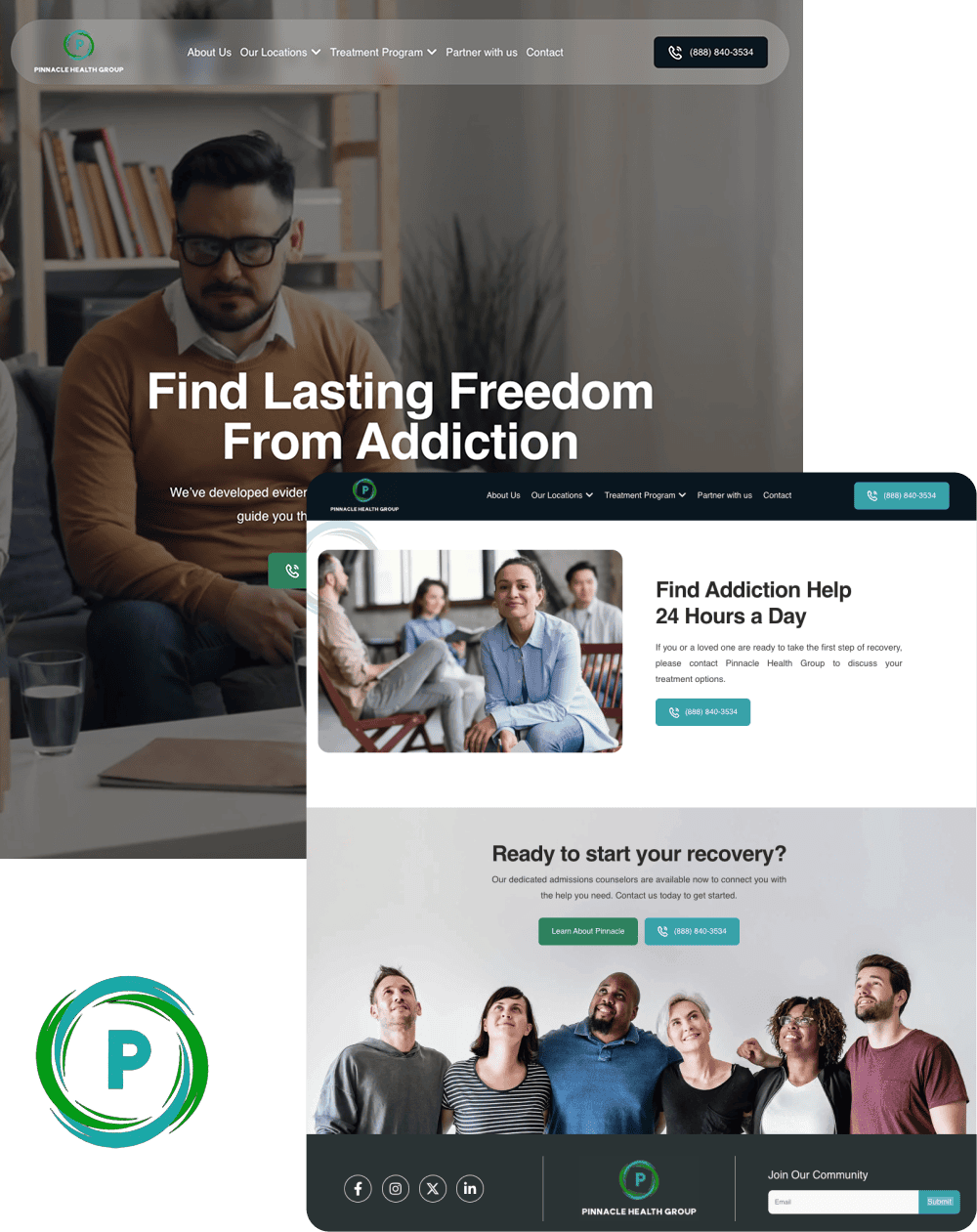
A unified platform built for multiple locations, programs, and audiences without feeling fragmented
- Reorganized multi-service site architecture
- ADA compliant responsive design system
- Future-ready CMS with modular templates
- Optimized for SEO and lead capture
Static image
Fast to produce, hardest to differentiate. Use for structured proof (accreditation, licensure, insurance logos). Never lead a cold campaign with a static-only stack.
Short-form video
Sub-15-second hooks with clinical staff on camera. The strongest format for cold audience trust-building in behavioral health. Advantage+ prefers this format at variant volume.
UGC-style
Alumni voices, family voices, staff voices. Must respect 42 CFR Part 2 boundaries and clear disclosure. Highest scroll-stop rate; hardest compliance layer.
Long-form explainer
30-60 second treatment center walkthrough or clinical explainer. Deeper trust build. Not the top-of-funnel format; use it where viewers want depth.
The four ad creative formats and their jobs
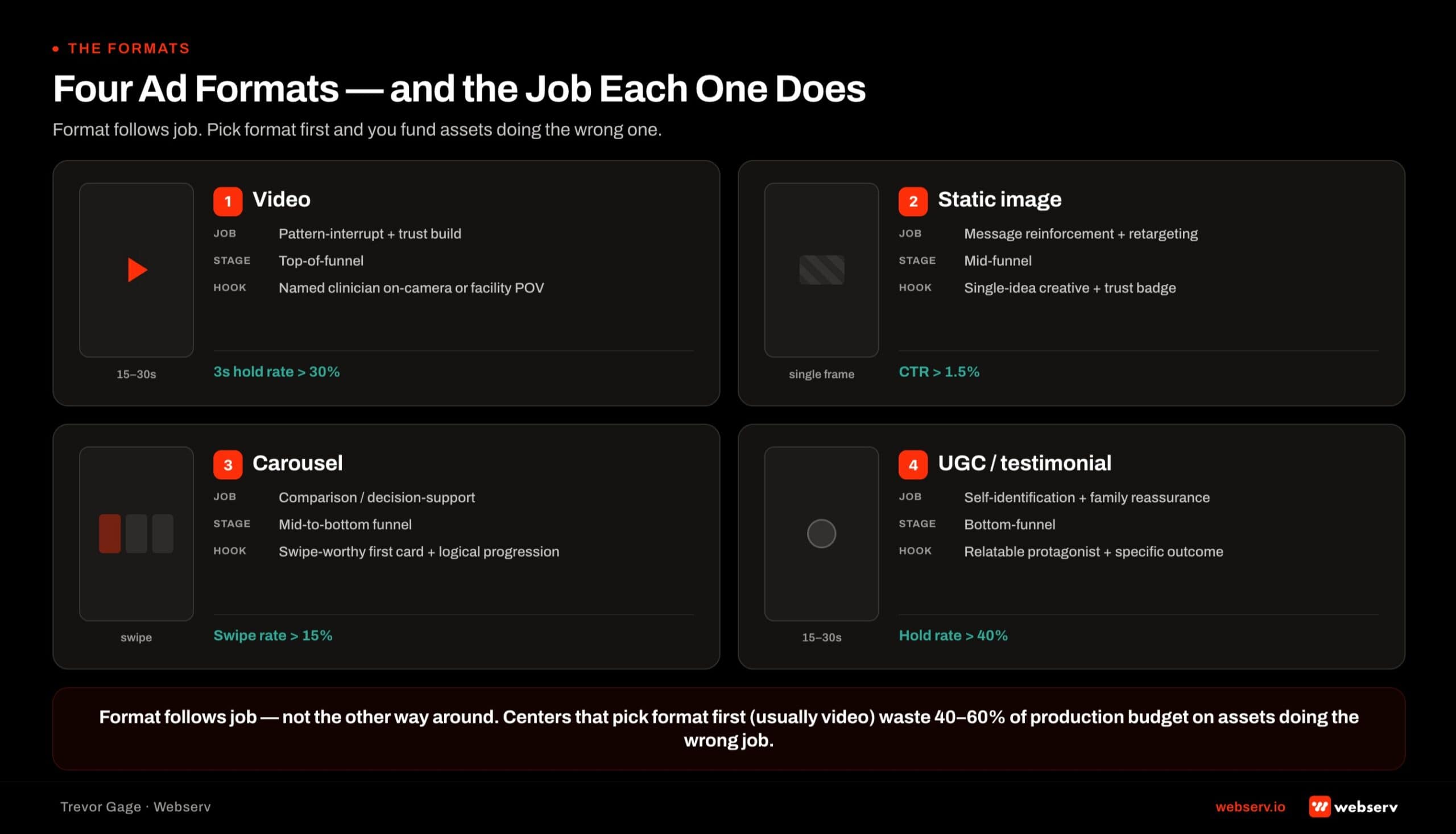
Ad creative for a treatment center in 2026 lives inside four primary formats, and each format has a specific job. Treating all four as interchangeable ad units produces creative that looks like a checklist rather than a program.
Vertical video (nine-by-sixteen, typically 15 to 30 seconds) is the highest-impact format on Meta Reels, TikTok, and Instagram Stories.
Its job is emotional pattern interrupt in the first three seconds followed by a specific offer or value proposition in seconds four through 25. For most rehab programs it should carry the largest share of the variant mix.
Static image ads (feed format, typically square or four-by-five) are the workhorse of lower-funnel campaigns. Their job is fast comprehension: a headline, a subhead, and a visual that reinforces the offer without requiring engagement.
Carousel ads (feed format, multiple cards) are underused in behavioral health. Their job is to unpack multi-facet consideration, such as insurance-verification-then-level-of-care-then-outcomes stories. Carousel works well for viewers who scroll for information rather than emotional resonance, which describes many families researching care.
Longer-form video (16-by-9 or 4-by-5, 45 seconds to two minutes) is the format for prospecting the top of funnel and for building brand foundation.
Its job is to introduce the treatment center as an entity, feature clinical leadership on camera, and establish the operator’s specific approach. Longer-form should carry 10 to 20% of the mix and is heavier-weight per variant to produce.
Operators who put nearly all production into vertical video are optimizing for a single algorithm signal while starving the other three format jobs. A balanced mix outperforms a monoculture.
The hook-body-CTA architecture inside each variant
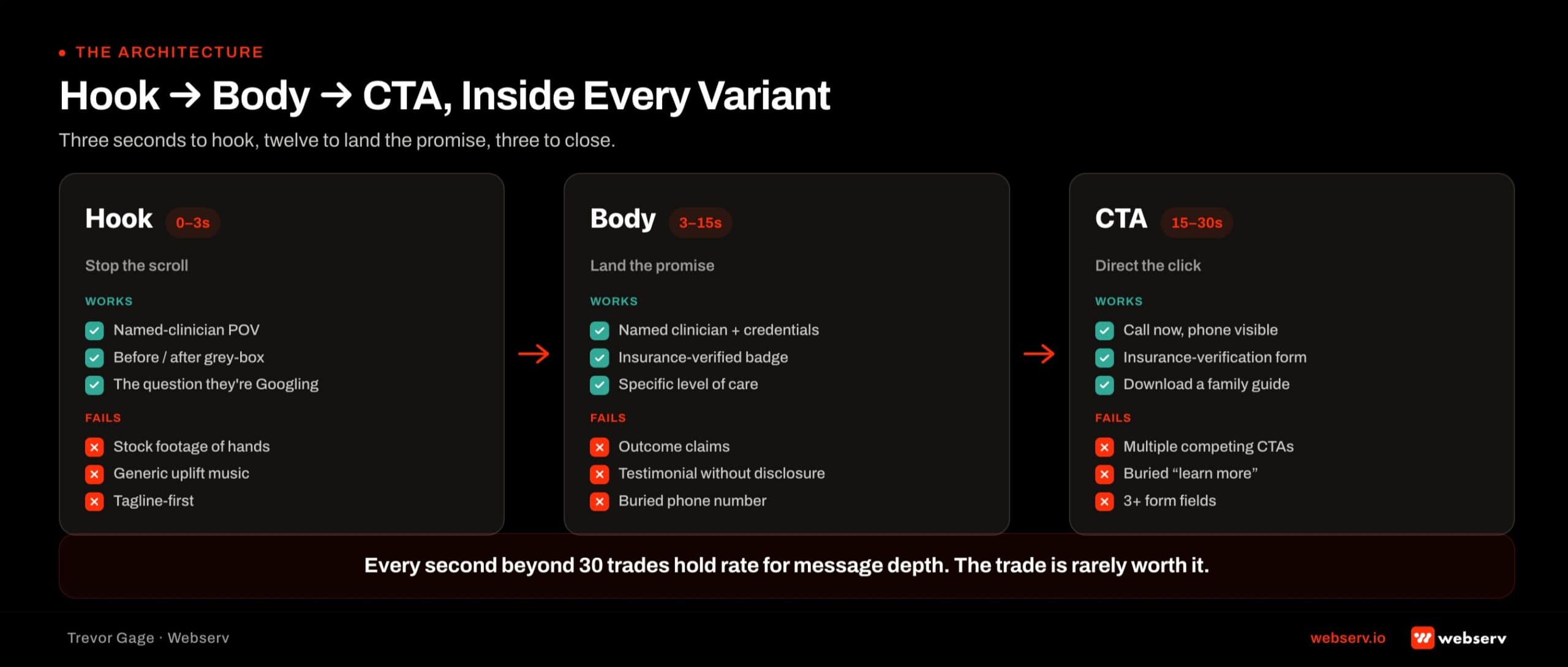
Inside every variant, the internal architecture matters as much as the format choice. The three-part hook-body-CTA structure is the frame most successful behavioral health ad creative follows.
The hook is the first three seconds. On vertical video, this is the visual and audio pattern interrupt. On static, this is the headline and the eye path of the image. The hook’s only job is to prevent the scroll.
Hooks that ask a question about the program (“What happens on the first call?”), contradict a common assumption about treatment, or open on a real person or place give the viewer a reason to keep watching. Hooks that lead with the treatment center’s name or a generic feature usually don’t. Keep the question about the facility, never about the viewer or their family.
The body is seconds four through 20 (on video) or the sub-hook and body copy (on static). Its job is to develop the promise the hook made without dropping the emotional register the hook established.
Common failure modes in behavioral health body copy include shifting from a direct, conversational voice to institutional third-person, listing services instead of resolving the question the hook raised, and adding compliance disclaimers so heavily that the emotional through-line collapses.
The CTA is the final three to five seconds (on video) or the button, phone number, and closing line (on static). Its job is to move the viewer to the specific next step: click through to the landing page, call the admissions line, or verify insurance.
CTA design in behavioral health has a specific gotcha, which is that the phone-first versus form-first decision has to match how the audience actually converts. The Phone vs. Form on Rehab Landing Pages piece covers the trade-offs in depth.
UGC, clinician-on-camera, and the trust hierarchy
A specific creative decision that recurs in every treatment center program is what to feature on camera. There are five options, and they sit on a trust hierarchy that has shifted materially in the past 24 months.
Actor-based UGC (paid actors reading a scripted testimonial) sits at the bottom of the trust hierarchy. It is fast to produce, cheap, and increasingly recognized by audiences as inauthentic.
Actor UGC does not scale in behavioral health the way it does in commodity DTC, because family-audience viewers are pattern-matching hard for authenticity signals.
Staff testimonials (real clinical staff speaking to the camera about their approach, their program, their credentials) sit in the middle. They are more authentic than actor UGC, faster to produce than patient stories, and legally cleaner than family testimonials.
Staff testimonials work best when the staff member is the actual clinical director, medical director, or admissions lead the family would encounter if they called.
Family-member testimonials (real family members who have gone through the intake process, with documented consent) sit near the top.
They are logistically harder to produce but emotionally resonant in a way staff testimonials cannot match. They need documented consent, and the copy still can’t imply anything about the viewer’s own family. Retargeting in this category is tightly limited; our retargeting strategy guide covers what each platform allows.
Patient testimonials (real patients speaking about their experience) sit at the top for trust when produced ethically and inside the compliance framework, and at the bottom when produced sloppily.
Patient testimonials require written authorization, careful timing (typically 90+ days post-treatment and in a stable recovery period), and platform-appropriate framing. The ethics of advertising addiction treatment framework covers the ethical layer in depth.
Founder or leadership on camera (the operator, founder, or medical director speaking to the audience directly) is the sleeper option. It is often the most trusted format when the leader has clinical credibility, and it doubles as author-authority signal for the pages the creative points at.
Having your named medical director or clinical director on camera also supports the experience and expertise signals Google’s quality guidelines describe, especially when the landing page carries the same name and credentials.
The creative-to-landing-page connection
Ad creative that ships to the ad account without a corresponding landing page discipline is producing a mismatch that compounds. Google described its May 2026 core update as a regular update, but core updates keep favoring helpful, clearly authored pages over templated ones with no named author.
AI Mode and AI Overviews began pulling citation sources from an increasingly narrow set of pages that carry named clinical author bios, peer-reviewed sourcing, and visible editorial review.
Ad creative that drives efficient clicks to a landing page that is templated, unnamed-authored, and undated is spending well to arrive somewhere that no longer converts. The creative is doing its job. The landing page is failing.
The strategic implication for ad creative planning is that the landing page is part of the creative deliverable. An ad creative program that treats the landing page as fixed infrastructure is not a strategy. It is a partial strategy that ignores half of the customer path.
The pattern that produces the best results is a small number of dedicated landing pages built specifically for ad creative campaigns, each aligned to the audience, offer, and level of care the creative addresses.
Those landing pages carry named clinical author bios, visible clinical review dates, primary-source citations for any clinical claims, and content specifically written to match the promise the creative made. Everything else the ad account touches is a leak.
Creative testing methodology
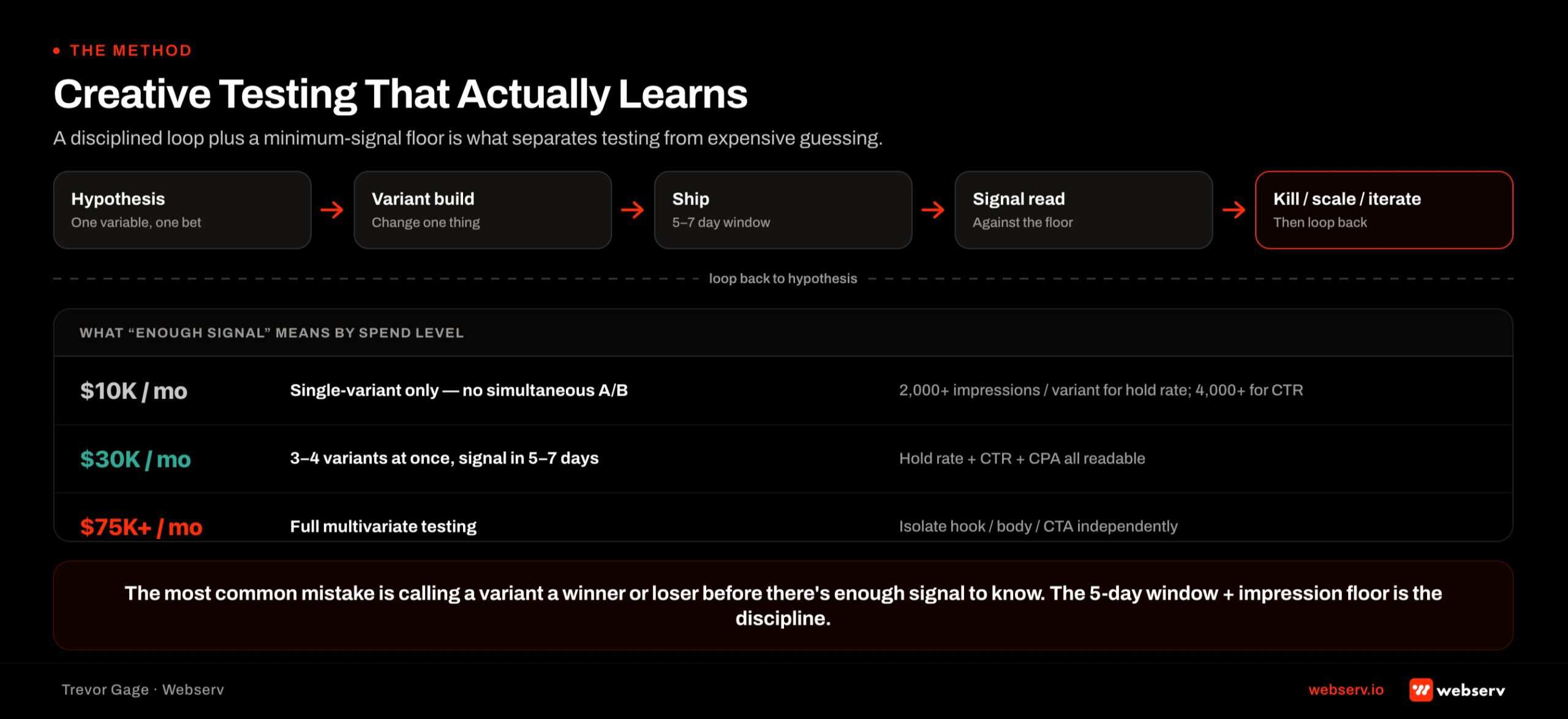
The variant win rate is the metric most treatment center operators are not tracking, and it is the single best predictor of whether a creative program is producing forward progress.
The math is straightforward: of the new variants shipped in a month, what percentage cleared the account’s baseline CPL threshold and stayed active more than 14 days.
Track the rate quarter over quarter. A steady or rising win rate means the program is learning. A falling one means it’s producing variants without learning from them.
The testing structure that produces the highest win rates is variant clustering, where new variants are shipped in batches of five to eight sharing a hypothesis (a hook change, a voice change, a CTA change, a format change), with the losing variants deprecated and the winning variants iterated.
Shipping one variant at a time or shipping ten unrelated variants at once both underperform structured clustering.
Reporting has to happen at the variant level, not the ad-set level or the campaign level. Ad-set-level reporting hides which specific variants are producing the results and which are being carried by their neighbors.
Variant-level reporting surfaces the win rate, hook engagement, and format performance data that actually informs the next production cycle. The Ad Fatigue and Creative Refresh piece covers the tactical side of the testing cadence.
WATCH OUT
LegitScript, 42 CFR Part 2, and state licensing frameworks are not compliance checkboxes bolted onto creative at the end. They are strategic constraints on the defensible range of claims. Facilities that treat compliance as a legal review at the end of production ship weaker creative than facilities that treat it as an upstream strategic input.
Compliance guardrails as strategic layers, not afterthoughts
The specific ad creative moves that most often produce platform disapproval, LegitScript flag, or state licensing concern are predictable enough that they belong in the strategy brief, not in the post-production QA.
Outcome promises (“get sober in 30 days”) are non-starters. Every claim about treatment effectiveness requires disclaimers, and even those are risky when specific. Direct comparisons to specific competitors are risky and rarely worth the exposure.
Depiction of active substance use, even for cautionary framing, trips platform moderation reliably. Testimonials without documented authorization are legal exposure, not just risk. Before naming an insurance plan in creative, confirm the facility is in network with it, or say plainly that you verify it.
The strategic layer bakes these constraints into the brief so the creative production team does not have to relitigate them per variant. A one-page constraint checklist attached to the creative brief saves hours of legal review per production cycle.
OPERATOR INSIGHT
The three KPIs that give creative a reporting seat in 2026 are variant win rate (of new variants shipped last 30 days, what percentage still active and beating account baseline CPL), hook engagement rate on video creative in the first three seconds, and AI Overview citation share on destination pages. Without these three, creative is an adjective in the marketing meeting; with them, it is a metric.
Reporting KPIs for ad creative in 2026
The five KPIs that actually predict admissions volume from ad creative are variant win rate, hook engagement rate in the first three seconds, conversion rate on the landing page the creative points at, cost per verified admit, and AI Overview citation share on the pages the creative points at.
Variant win rate is the internal-quality metric that shows whether the production cycle is producing signal or noise. Hook engagement is the format-level metric that shows whether the first three seconds are earning the rest of the ad.
Landing page conversion rate is the downstream metric that shows whether the creative-to-landing-page connection is intact. Cost per verified admit is the north-star business metric that translates creative work into admissions math.
AI Overview citation share is the new KPI in 2026 and belongs on the ad creative dashboard even though it is not a paid-media metric. The reason: ad creative that drives clicks to a page that also gets cited in AI Overviews is compounding.
Ad creative that drives clicks to a page that never gets cited in AI Overviews is running against the top-of-funnel wind. The reporting discipline that pairs ad creative performance with AI citation share on the destination page catches this compounding effect early.
The operator’s playbook for the next 90 days
The specific work that produces material change in ad creative performance inside a treatment center over the next 90 days sequences into three tracks.
The first 30 days is production infrastructure. Get the creative brief documented (audience, voice, decision moment, constraints, admissions outcome). Get the variant volume math sized against your spend tier.
Get the format mix defined. Get the compliance guardrails into a one-page checklist attached to every brief. Get the reporting stack producing variant-level data rather than ad-set aggregates.
The next 30 days is landing page discipline. Build or refresh two to three dedicated landing pages for your top ad creative campaigns.
Each carries named clinical author bio, visible clinical review date, primary-source citations, and content matched to the creative promise. Retire creative that points at templated or unnamed-author pages until the pages catch up.
The final 30 days is testing cadence. Ship the first cluster of five to eight new variants against a documented hypothesis. Deprecate the losers, iterate the winners.
Run the reporting review at variant level. Adjust the format mix based on what the win-rate data actually shows rather than what the taste stack prefers. Repeat the cycle every two weeks.
The compound effect of these three tracks is a creative program that produces variants the algorithm can actually use, on pages the algorithm actually wants to cite, with reporting that surfaces what is working before the media spend has to be pulled.
This fits into the wider creative strategy covered in behavioral health marketing guide and creative strategy for rehab marketing.
Frequently Asked Questions
How is ad creative strategy different from creative strategy generally?
Ad creative strategy is a sub-discipline inside the broader creative strategy layer. Creative strategy covers everything about how a treatment center’s brand, message, and voice show up across every touchpoint (website, ad creative, landing pages, email, sales collateral). Ad creative strategy focuses specifically on the paid-media touchpoint.
The umbrella Creative Strategy Guide for Behavioral Health Marketing covers the wider frame that this piece nests inside. An ad creative strategy that is not attached to a broader creative strategy tends to produce variants that convert on Meta but do not build brand equity.
How many ad creative variants should a treatment center ship per month?
The answer depends on Meta spend. The more budget the account runs, the more distinct variants it needs live, and the faster it needs replacements as winners fatigue.
Meta doesn’t publish a fixed count. A working test: fresh concepts ship every month, and new variants regularly beat the ones they replace.
Operators who fail that test are starving the algorithm. The most common failure pattern I see is a mid-tier operator running with five active variants and blaming the platform for CPL drift when the actual cause is creative starvation.
Should our ad creative feature patients, staff, or family members on camera?
The answer depends on the compliance posture your facility can support, and the decision moment the creative addresses. Staff and clinician on-camera creative is the safest starting point: it produces authentic authority signals, does not require patient consent, and reinforces E-E-A-T signals Google’s algorithm now weights.
Family-member testimonials can work with documented consent, as long as the copy doesn’t imply anything about the viewer’s own family. Patient testimonials work best when produced ethically (90+ days post-treatment, stable recovery, written authorization) and are risky when produced sloppily. Actor-based UGC underperforms in behavioral health and should typically be avoided.
How does the May 2026 Google Core Update affect our ad creative work?
Core updates don’t directly touch paid media. Google called the May 2026 update a regular update, but core updates keep favoring helpful, clearly authored pages, and templated location pages with no named author are a weak fit.
Ad creative that points at those pages is spending well to arrive somewhere weak. The strategic implication is that landing page architecture is part of the ad creative deliverable, not a separate discipline. Ad creative programs that treat the landing page as fixed are ignoring half of the customer path.
What is the minimum monthly investment in ad creative to run a working program?
There isn’t a universal floor. The budget has to cover enough new variants to keep the account fed, plus video production, compliance review, and landing page work. Below that, something gets cut.
Operators whose creative budget can’t cover all four are usually buying output, not a program. Either step up to a working creative tier or use the budget for media instead until the volume justifies a real program.
Most in-house teams hit a wall not because they lack knowledge, but because they lack bandwidth.
When you are ready to hand it off, Webserv has spent 9 years executing exactly this for treatment centers nationwide.
Trevor Gage is Director of Marketing at Webserv, a behavioral health marketing agency working with residential, outpatient, and telehealth treatment providers across the United States. He leads Webserv’s SEO, content, and AI search practice.