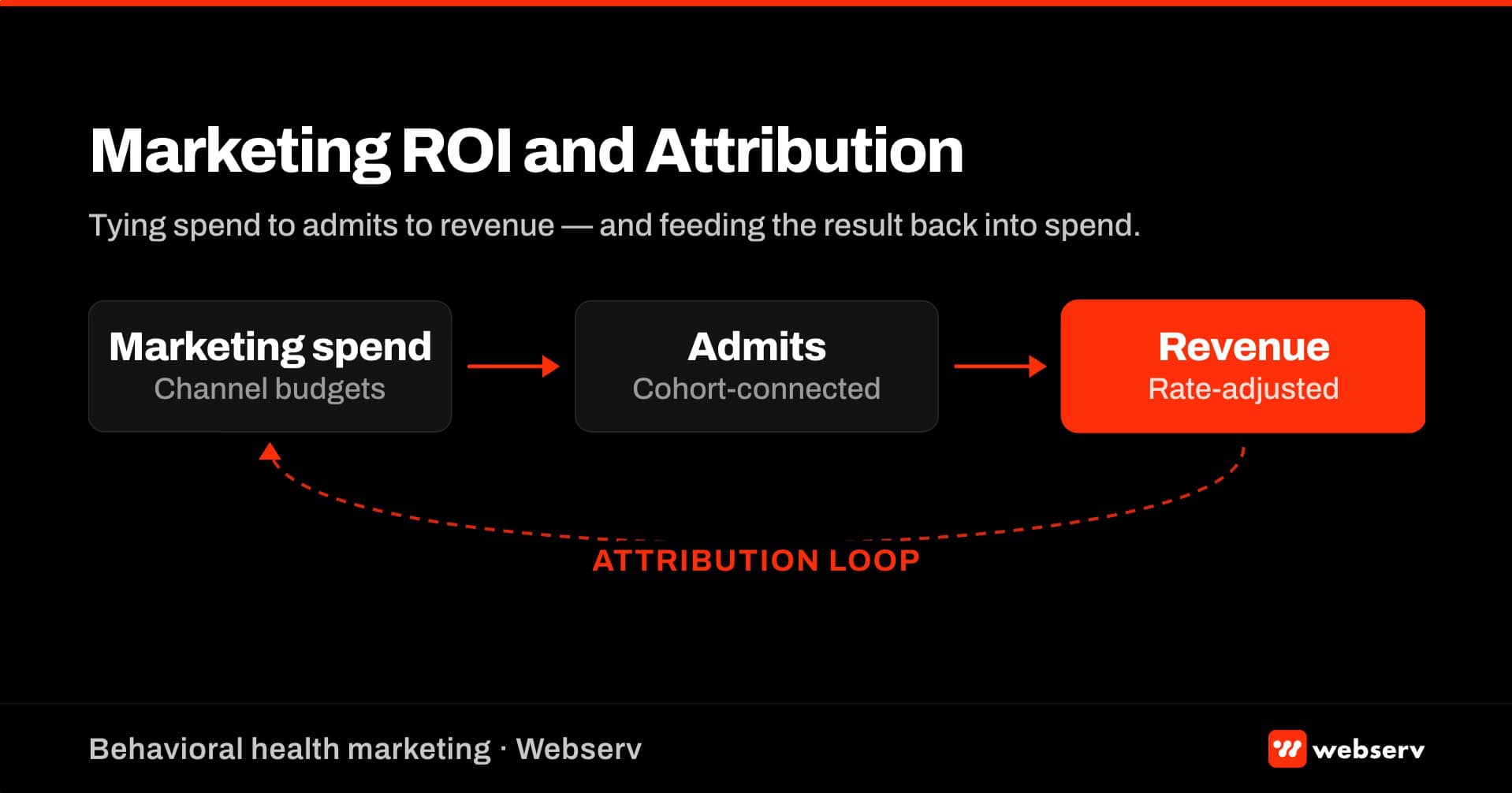
Every treatment center CMO has been asked some version of the same question by ownership. What is the return on our marketing spend. The reflex answer at most facilities is a cost per admit calculation that divides monthly marketing spend by monthly admit count and produces a single number.
That answer is directionally useful and structurally incomplete. Cost per admit does not tell you which channels are working, which campaigns produced the specific admits, or whether the admits being acquired actually improved the operator’s P&L after reimbursement realized.
Ownership hears the CPA number and either accepts it or does not, but nobody in the room is making informed budget decisions from it.
The right answer is a full attribution and ROI framework that ties marketing spend inputs through the full funnel to revenue realized, with channel-level and campaign-level breakouts, and with the HIPAA-compliant tracking infrastructure that makes the framework defensible. That framework is what the full-funnel behavioral health marketing operating model our client book runs on is built around.
This piece walks the attribution and ROI playbook we use with treatment center operators. It covers why BH attribution is uniquely hard, the specific attribution methodologies operators should consider and which one produces defensible answers for BH, and the tracking infrastructure required to run the methodology.
It also covers the ROI framework that turns attribution data into budget decisions, and the common failure modes that surface when facilities try to run attribution without the underlying tracking discipline in place. This sits alongside our behavioral health marketing complete guide as the measurement companion.
Key Takeaways
- Cost per admit is directionally useful but structurally incomplete as a marketing ROI metric. Defensible BH marketing ROI ties spend inputs through the full funnel to revenue realized, with channel-level breakouts and rate-adjusted admit value so the answer reflects contribution margin rather than raw admit count.
- BH attribution is uniquely hard because of HIPAA-constrained tracking, long funnels (inquiry through payment often spans 120 to 180 days), family decision-maker complexity, multi-touch attribution across paid and organic and referral channels, and the 60-90 day revenue realization lag between admit and paid claim.
- Cohort-based attribution is the methodology that produces defensible ROI answers in BH. Last-touch is the simplest but assigns 100 percent credit to the final channel, which systematically overweights acquisition-stage channels and under-credits awareness and consideration channels.
- The tracking stack that makes cohort attribution work: server-side conversion via Meta Conversions API and click-based Google Ads conversions (HIPAA-safe, enhanced conversions off), the CRM as source of truth for admit outcomes, disciplined UTM tagging on all trackable inbound, and per-admit reimbursement data flowing from billing back to marketing on a monthly cadence.
- Common failure modes: measuring cost per lead instead of cost per admit, running last-touch attribution as if it were multi-touch, ignoring the revenue realization lag, and treating all admits as equal in aggregate ROI calculations regardless of the payer mix each channel produces.
DEFINITION
BH marketing attribution. The methodology for assigning admit and revenue credit across the marketing touchpoints that produced the admit. Ties marketing spend inputs through the funnel to admits to revenue realized, with channel-level and campaign-level breakouts.
Distinct from cost per admit (a directional aggregate that hides channel mix and payer mix underneath). Distinct from ROAS (a paid-media-spend-only metric that misses agency retainer, in-house salaries, and organic investment). The four common attribution methodologies are last-touch, first-touch, equal-weight multi-touch, and cohort-based — the last of which produces defensible answers in BH but requires the underlying tracking infrastructure most facilities do not run.
Why BH Marketing Attribution Is Uniquely Hard
Marketing attribution is a challenging problem in most verticals. In behavioral health it is materially harder for five specific structural reasons.
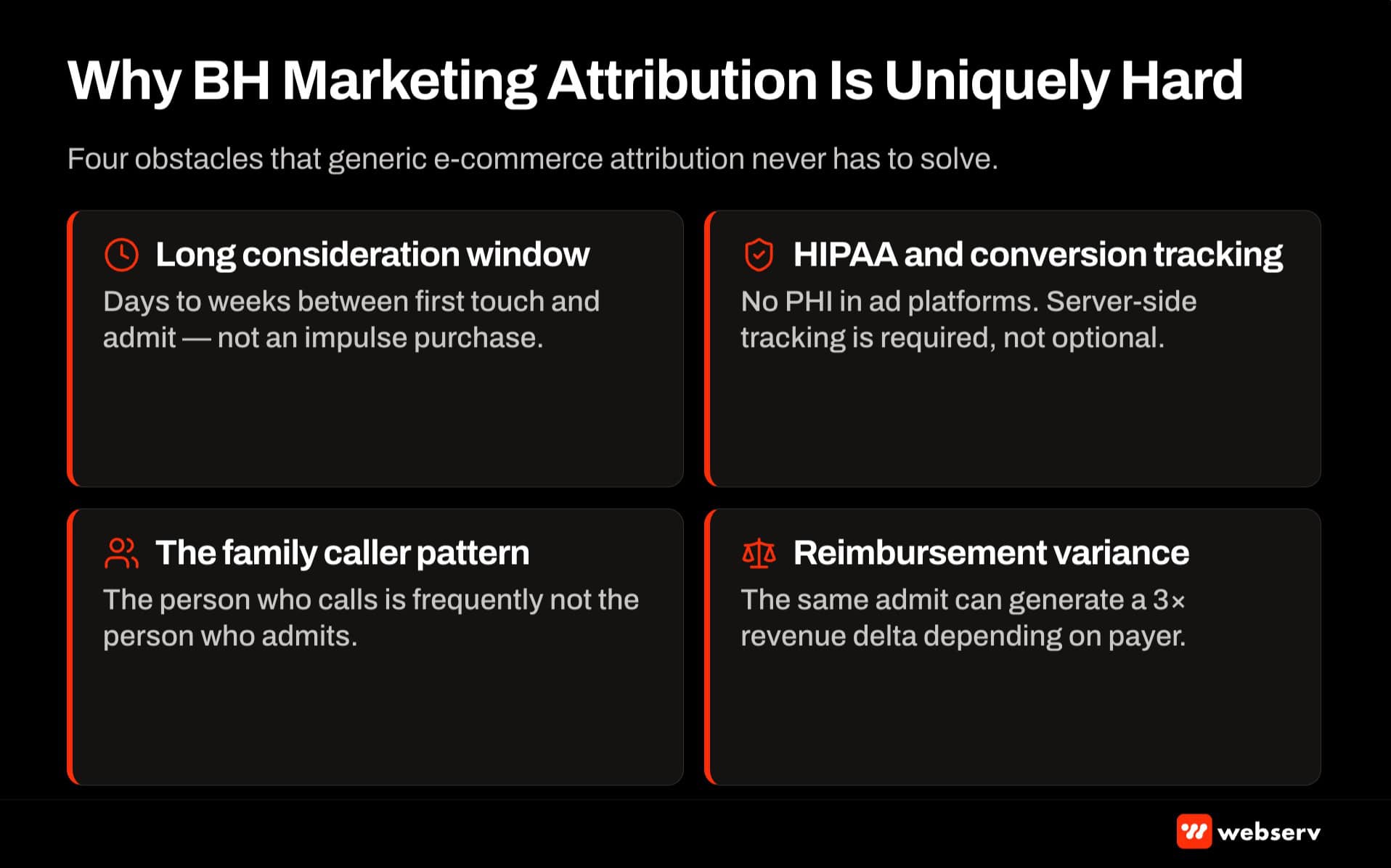
HIPAA. Conversion tracking on healthcare sites cannot use the standard Meta Pixel or Google Analytics deployment that produces easy attribution data in ecommerce. HHS OCR tracking guidance explicitly names third-party pixels on user-authenticated healthcare pages as HIPAA risks. Compliant tracking runs server-side (Meta Conversions API, and click-based Google Ads conversions with enhanced conversions off), which changes both the fidelity and the granularity of attribution data available.
Funnel length. A BH inquiry that becomes an admit that becomes a paid claim often spans 120 to 180 days end to end. The typical attribution window on paid platforms is 30 to 90 days. Facilities using default attribution windows systematically under-attribute the paid channels that produced initial inquiries months before the eventual admit.
Family decision-maker complexity. Many BH inquiries involve a family member researching on behalf of a patient. The device the initial research happens on is often different from the device the eventual admit inquiry comes through. Standard device-based attribution loses this pattern.
Multi-touch reality. A typical converting family will encounter your brand across paid search, organic search, content pieces, review sites, and possibly a clinical referral before the initial inquiry. Assigning all conversion credit to the last touch (the pattern that produces “our paid search is our top-performing channel because it captured the final click”) systematically overweights the acquisition channels while under-crediting the awareness and consideration channels.
Revenue realization lag. A patient admitting on the 15th of the month produces a paid claim 60 to 90 days later. Facilities measuring marketing ROI against admit-month revenue miss the reimbursement variance that determines whether the admit was actually profitable. Rate-adjusted admit value from adjudicated claims closes the gap.
BH attribution structural constraints
120-180 days
Typical BH funnel length from inquiry through paid claim
30-90 days
Default attribution window on paid platforms (too short for BH funnel)
60-90 days
Revenue realization lag between admit and adjudicated paid claim
4 methodologies
Last-touch, first-touch, equal-weight, cohort — only cohort defensible for BH
The Attribution Methodologies and Which One Works for BH
Four attribution methodologies are commonly used in digital marketing. Each has trade-offs that shape whether it produces defensible answers in BH.
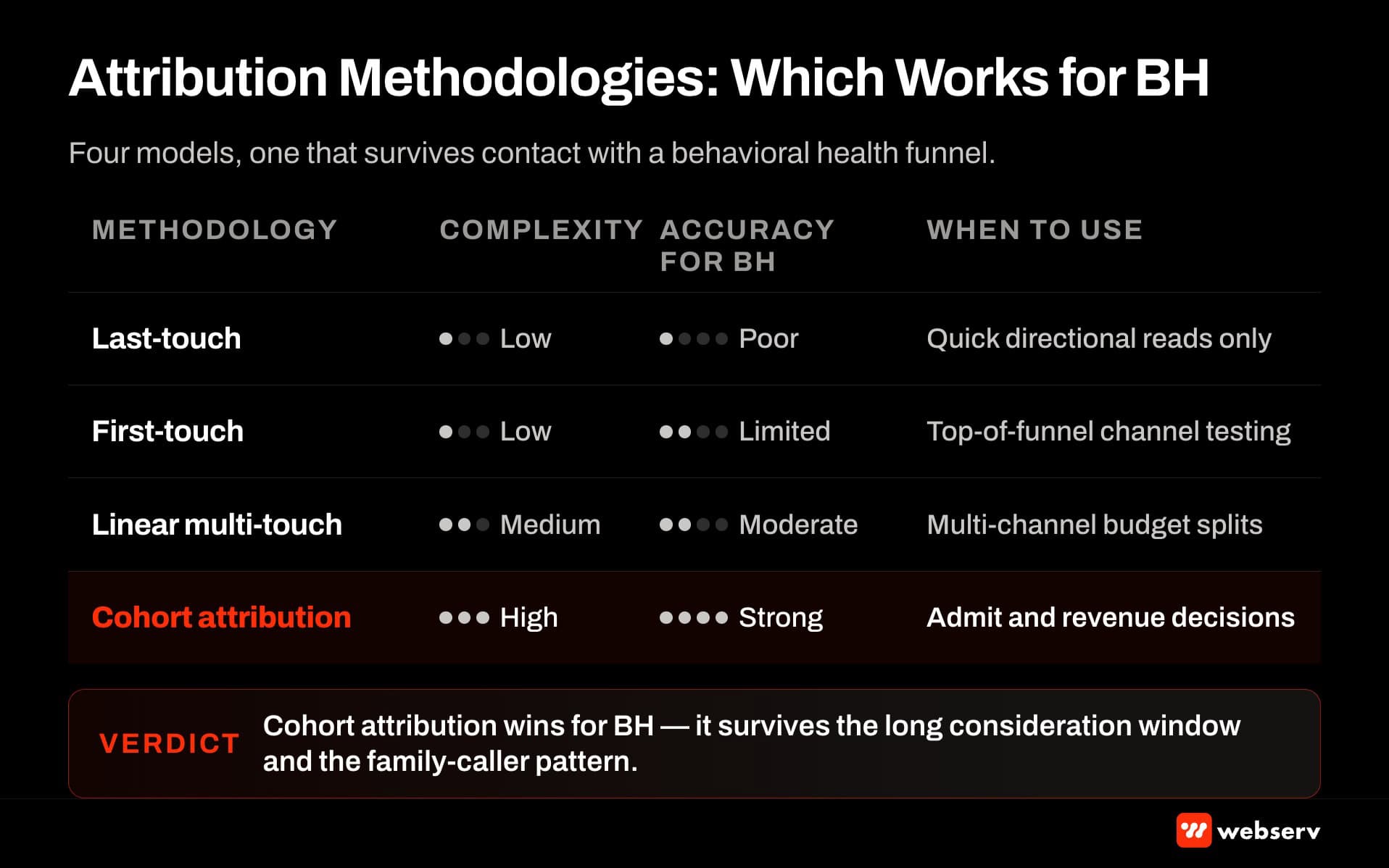
Last-touch attribution assigns 100 percent of the admit credit to the final marketing touchpoint before conversion. This is the simplest methodology and the one most platform-native reporting defaults to. In BH it produces systematic distortion: paid search that captured the final click gets credit that awareness-stage channels earned through months of prior touches.
First-touch attribution assigns 100 percent of the admit credit to the first marketing touchpoint. This produces the opposite distortion: awareness-stage channels look inflated and acquisition-stage channels look weak.
Equal-weight multi-touch attribution divides credit equally across all touchpoints. This is more defensible than last-touch or first-touch but produces its own distortion by treating a fleeting search-ad impression the same as a 15-minute clinical content read.
Cohort-based attribution groups admits into cohorts based on the initial inquiry source, tracks the specific channel mix each cohort encountered before conversion, and reports channel performance at the cohort level with revenue realized per cohort. This is the methodology that produces defensible answers in BH because it captures the multi-touch reality and preserves the revenue realization data.
The trade-off with cohort-based attribution is complexity. It requires a CRM configured to track initial inquiry source, disciplined UTM tagging on inbound traffic, and a data model that ties each admit to its channel history rather than to a single attribution point. Facilities without the underlying infrastructure often default to last-touch reporting even when they know it produces the wrong answer.
The Tracking Stack That Makes Cohort Attribution Work
Cohort-based attribution requires four infrastructure components running together.
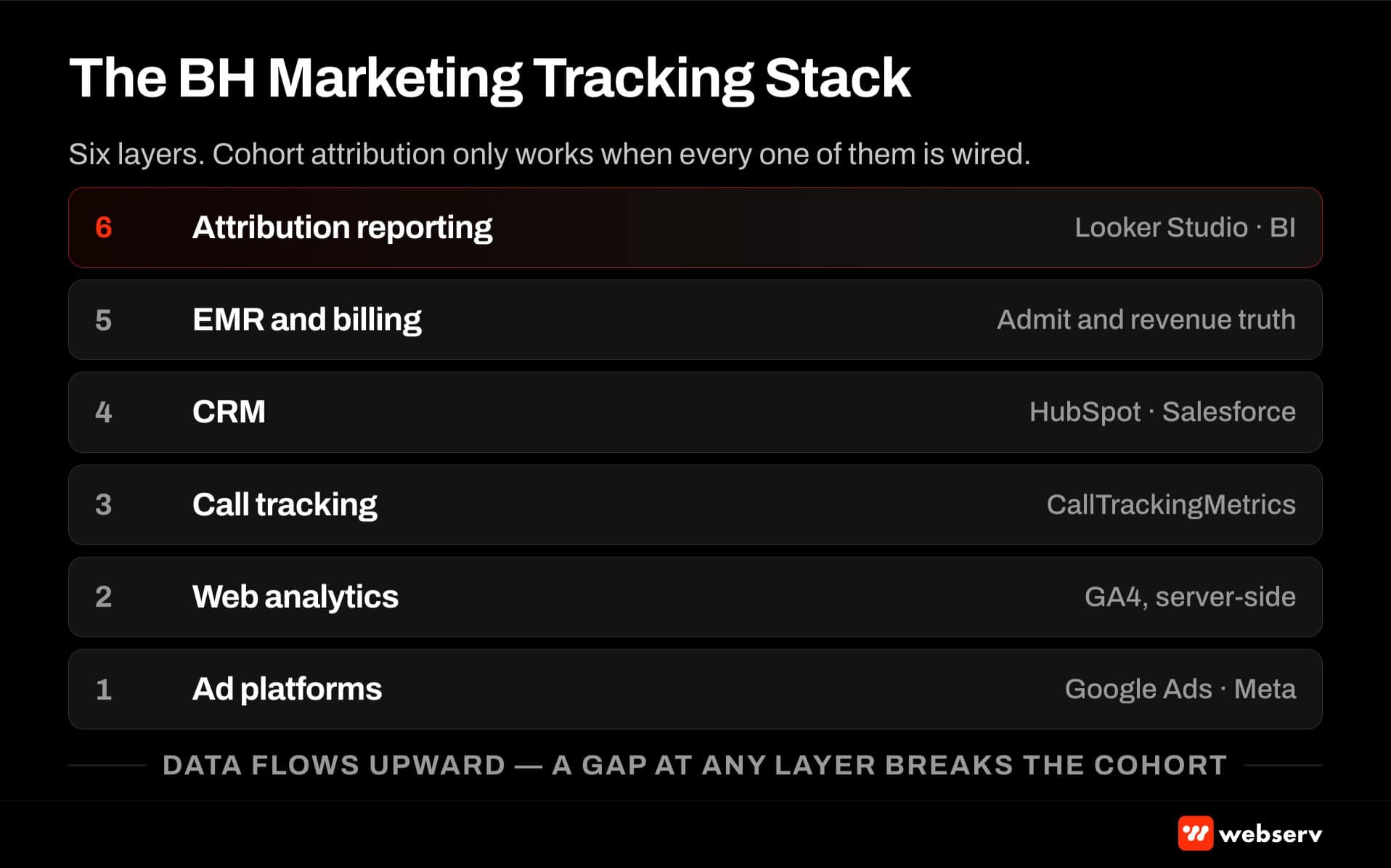
Server-side conversion tracking. Meta Conversions API and server-to-server Google Ads conversions (click-based, enhanced conversions off) replace the standard pixel deployment. This is the HIPAA-compliant path that keeps protected health information out of the ad platforms. Our Meta Conversions API HIPAA implementation piece covers the specific setup.
CRM as source of truth for admit outcomes. The admissions CRM (Kipu, Sunwave, BestNotes, Alleva, or a specialized BH CRM) is where admit outcomes are recorded. The CRM has to be configured to capture initial inquiry source at intake, all subsequent touchpoints during the pre-admit period, and the admit conversion tied to the touchpoint history.
Disciplined UTM tagging. Every trackable marketing inbound (paid search, paid social, email, content link, referral partner link) carries UTM parameters that identify the source, medium, campaign, and specific creative. UTMs land in the CRM alongside the intake record and preserve through the admit conversion.
Per-admit reimbursement data from billing to marketing. Every 60 to 90 days after admit, the billing team publishes the paid claim amounts back to the marketing team, tied to the specific admit record. This closes the loop from marketing spend through admit through revenue realized.
The ROI Framework
Once the tracking stack is running and cohort attribution is producing channel-level data, the ROI framework has three layers.
Blended ROI at the total marketing spend level. Total marketing spend across all channels divided by total contribution margin from all attributed admits. This is the top-line answer that ownership hears in the QBR review.
Channel-specific ROI for each acquisition channel. Cost of running the channel divided by contribution margin from admits attributed to the channel. Paid search shows differently from organic search, and both show differently from referral marketing and content.
Campaign-specific ROI for meaningful campaigns within each channel. Specific paid search campaigns, specific content pieces, specific referral partner relationships. This is the layer at which marketing budget optimization happens.
The specific formulas at each layer:
Blended ROI = (Total attributed contribution margin – Total marketing spend) / Total marketing spend
Channel ROI = (Channel-attributed contribution margin – Channel spend) / Channel spend
Campaign ROI = (Campaign-attributed contribution margin – Campaign spend) / Campaign spend
Our companion BH marketing KPIs benchmark piece covers the underlying KPI stack (contribution margin per admit, cost per admit, rate-adjusted admits) that the ROI formulas depend on.
What “Rate-Adjusted” Changes About the ROI Math
The single most important adjustment to standard marketing ROI in BH is the rate-adjusted admit value.
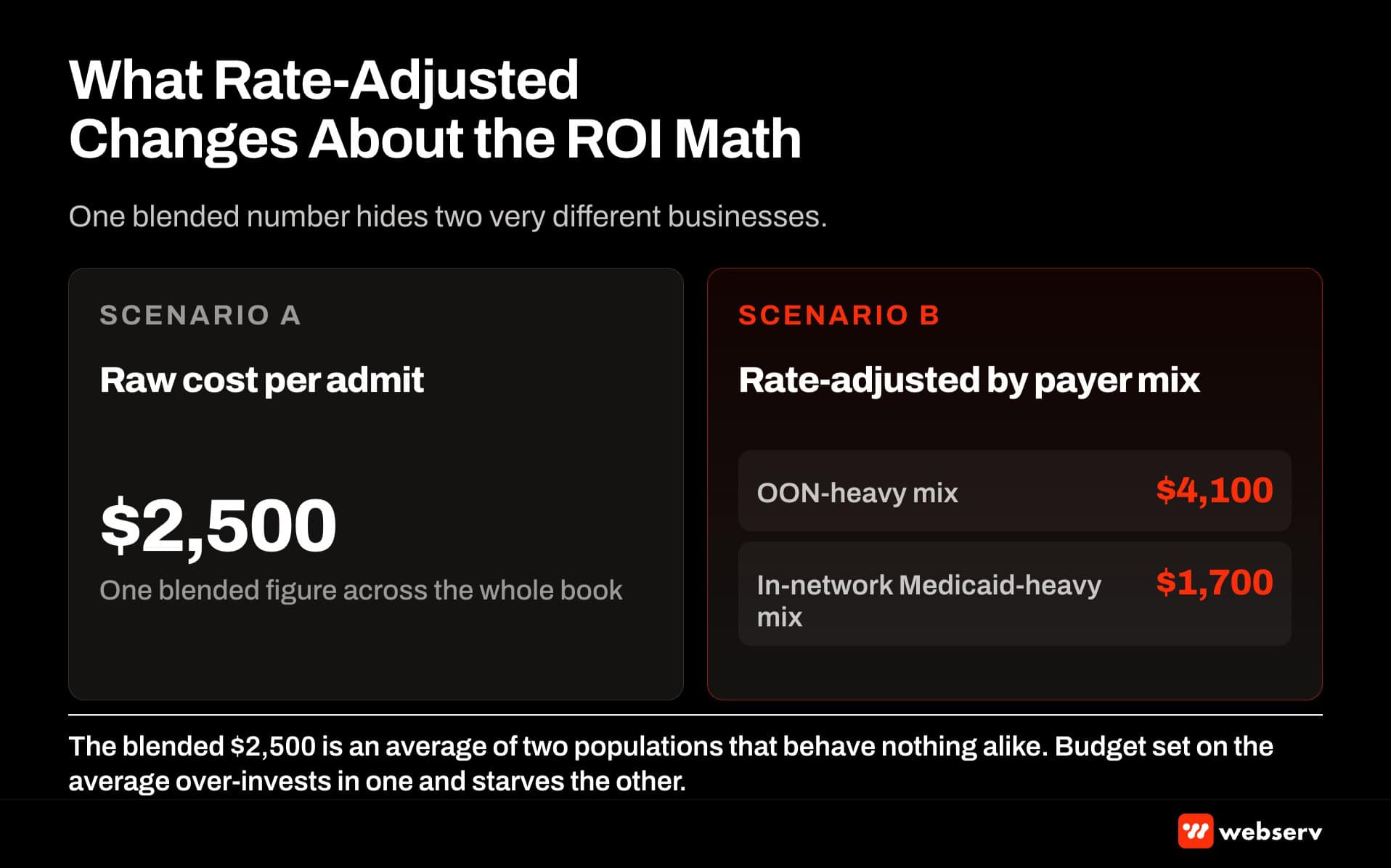
Two facilities running identical marketing programs, producing identical admit counts, from identical channel mixes, can produce materially different ROI outcomes if their payer mix is different. A facility running heavy OON payer mix converts admits at higher contribution margin than a facility running Medi-Cal-heavy mix. Marketing ROI that treats all admits as equal misses this variance and produces the wrong optimization signal.
The specific adjustment: each attributed admit gets weighted by its expected reimbursement rather than counted as a flat 1.0 admit. High-yielding plan mix admits count more heavily in the ROI calculation, and marketing budget optimization steers toward the channels producing higher-yielding admits, not just more admits.
Our referral partner attribution piece covers the specific attribution mechanics for referral marketing. The same principle applies to paid and organic channels: measure the contribution margin per admit each channel produces, not just the raw admit count.
OPERATOR INSIGHT
Two facilities running identical marketing programs, producing identical admit counts, from identical channel mixes, can produce materially different ROI outcomes if their payer mix is different.
Marketing ROI that treats all admits as equal misses the reimbursement variance and produces the wrong optimization signal. The specific adjustment is that each attributed admit gets weighted by its expected reimbursement rather than counted as a flat 1.0 admit. High-yielding plan mix admits count more heavily; marketing budget optimization steers toward the channels producing the higher-yielding admits, not just the channels producing more admits.
Reporting Cadence and Integration with the QBR
The ROI framework produces different data at different cadences.
Monthly reporting handles the tactical layer. Channel spend, channel-attributed admits, channel-level cost per admit. Marketing team adjusts campaign allocation within the month based on channel-level performance.
Quarterly reporting handles the strategic layer. Blended ROI, channel ROI with contribution margin per admit, rate-adjusted admit value, payer mix quality. The full team (CMO, marketing director, admissions director, CFO, ownership) reviews at the marketing-admissions QBR.
Annual reporting handles the investment layer. Total marketing spend as a percentage of net revenue, year-over-year improvement in blended ROI, channel mix evolution, and the top-line budget decision for the following year.
Each cadence produces specific decisions. Weekly and monthly changes are campaign-level. Quarterly changes are channel-level. Annual changes are investment-level. Skipping any cadence produces optimization gaps at the corresponding decision layer.
Common Failure Modes
Four patterns show up repeatedly at treatment centers trying to measure marketing ROI.
The first is measuring cost per lead instead of cost per admit. CPL is directionally useful but does not account for lead quality. A channel producing $200 CPL but 2 percent lead-to-admit conversion is materially worse than a channel producing $400 CPL and 15 percent lead-to-admit conversion. Optimizing on CPL alone drives budget toward the wrong channels.
The second is running last-touch attribution as if it were multi-touch. Platform-native reporting from Google Ads or Meta shows last-touch data by default. Marketing teams that pull those numbers into the QBR report and treat them as full-funnel attribution systematically overweight the acquisition channels and under-credit the awareness and consideration channels.
The third is ignoring the revenue realization lag. Reporting marketing ROI against admit-month revenue misses the 60 to 90 day gap between admit and paid claim. The admits that landed at the top of the reimbursement distribution look like wins, and the admits at the bottom look like operational errors, but the aggregated view against admit-month revenue captures neither. Rate-adjusted admit value using expected reimbursement (or actual reimbursement, once available) closes the gap.
The fourth is treating all admits as equal in aggregate ROI. Facilities running mixed OON and Medi-Cal payer mix produce very different contribution margin per admit across the mix. Aggregate marketing ROI that counts every admit the same misses the mix quality question and produces budget decisions that optimize for volume instead of margin.
DO
- Run cohort-based attribution — the CRM captures initial inquiry source and every subsequent touchpoint through admit.
- Route all conversion tracking server-side (Meta Conversions API, click-based Google Ads conversions) and keep Google enhanced conversions off to stay HIPAA-safe.
- Preserve initial UTM data through the admit conversion — this is the load-bearing prerequisite for cohort attribution.
- Publish per-admit reimbursement data from billing back to marketing monthly (60-90 days after admit).
- Weight ROI by rate-adjusted admit value, not raw admit count.
DON’T
- Report platform-native last-touch data as if it were full-funnel attribution.
- Measure cost per lead as the primary ROI metric — CPL hides channel-specific lead quality.
- Ignore the 60-90 day revenue realization lag when reporting ROI against admit-month revenue.
- Treat all admits as equal in aggregate ROI regardless of the payer mix each channel produces.
- Deploy client-side Meta Pixel or Google Analytics on authenticated patient portal pages (HIPAA violation).
This connects to the broader cost-per-admit picture in revenue cycle as a marketing problem and conversion rate optimization guide.
Frequently Asked Questions
What’s the difference between marketing ROI and marketing ROAS?
Return on ad spend (ROAS) is a subset metric that measures the revenue generated per dollar of paid media spend. Marketing ROI is the broader metric that measures the total marketing program’s return, including agency retainer, in-house team salaries, content and creative investment, and paid media spend combined against total contribution margin produced.
For BH specifically, ROAS is not sufficient because the paid media spend is only 40 to 70 percent of the total marketing investment. Facilities reporting ROAS to ownership without the broader ROI framework misrepresent the true return of the marketing program.
The right practice is to report ROAS at the channel level (paid search ROAS, Meta ROAS) and ROI at the program level (blended ROI, contribution margin per admit). Both metrics have their place; using one where the other belongs produces the wrong optimization signal.
How long should we wait to measure ROI on a new marketing initiative?
The specific waiting period depends on the initiative type and the facility’s funnel length.
For paid search and paid social campaigns, the initial signal appears within 30 days but the defensible ROI answer requires 90 to 120 days of data. Shorter windows catch the initial inquiries but miss the admit conversion and revenue realization that determine the actual return. For content and organic SEO investments, the ROI window is materially longer. New content typically produces the first meaningful organic traffic within 60 to 120 days, first meaningful inquiries within 120 to 180 days, and defensible ROI attribution within 180 to 270 days.
Ownership pressure to measure ROI faster than these windows allow is one of the most common tension points in BH marketing measurement. The right response is to report leading indicators (rankings, sessions, inquiries) at the shorter windows and full ROI at the longer windows.
How do we handle attribution when a lead comes in through multiple channels?
Cohort-based attribution handles multi-channel leads by tracking every channel touchpoint the lead encountered before conversion and reporting the full channel history at the admit level.
The practical implementation: the CRM captures initial inquiry source at intake plus every subsequent touchpoint (return visits, content downloads, retargeting clicks, referral partner mentions) during the pre-admit period. At admit conversion, the full channel history is preserved and the admit gets attributed to the cohort defined by that channel path.
The specific weighting method varies. Some facilities use time-decay weighting (touchpoints closer to conversion get more credit). Some use position-based weighting (first touch and last touch get more credit than middle touches). Some use equal weighting across all touchpoints. The methodology choice matters less than the fact that the full channel history is captured and reported, not just the last touch.
What CRM fields do we need to run cohort attribution?
The specific CRM fields required at the lead and admit level: initial inquiry source (UTM source and medium at intake), initial inquiry campaign (UTM campaign at intake), touchpoint history (list of channels and dates the lead encountered post-intake and pre-admit), admit source attribution (the channel(s) credited for the admit under the chosen methodology), and per-admit paid claim amount (populated 60-90 days post-admit from billing).
Most BH-native CRMs (Kipu, Sunwave, BestNotes, Alleva) support these fields natively or through custom field configuration. General-purpose CRMs (Salesforce, HubSpot) require more configuration work but produce equivalent data.
The specific configuration that matters most is capturing initial inquiry UTM at intake and preserving it through the admit conversion. Facilities that let the initial UTM data get lost during intake handoffs cannot run cohort attribution regardless of what CRM they use.
How do we prove marketing ROI to ownership skeptical of digital marketing?
The strongest proof to skeptical ownership is a specific case-by-case walkthrough of admits produced in the trailing quarter. Not aggregated metrics. Specific patients, specific channels, specific spend attribution.
The QBR review that produces this walkthrough shows five to ten specific admits from the trailing quarter, walks each one through the marketing touchpoints the lead encountered before conversion, and ties each admit to the specific marketing spend that produced it. Aggregated ROI numbers convince the marketing team. Case-by-case walkthroughs convince ownership.
The second-strongest proof is the contribution margin per admit calculation that includes reimbursement data. Ownership skeptical of marketing ROI is often responding to CPA calculations that ignore the payer mix underneath. Showing that the marketing engine is producing admits that convert to positive contribution margin (not just admit volume) usually shifts the conversation.
What if we cannot get billing to publish per-admit reimbursement back to marketing?
The most common blocker to running defensible marketing ROI in BH is the marketing-billing data handoff. Marketing owns lead and admit attribution. Billing owns per-admit reimbursement realized. If the two data sources do not connect, marketing ROI defaults to cost per admit against admit volume, which is the wrong optimization signal.
The specific solve is a monthly reporting handoff where billing exports per-admit paid claim amounts (60 to 90 days after admit) tied to the admit record ID that marketing already tracks. The export can be a CSV, a database join, or a manual monthly reconciliation. The mechanism matters less than the discipline.
Facilities where marketing and billing report through different executives (CMO reporting to CEO, controller reporting to CFO) often struggle with this handoff because the two functions do not share operating goals. The fix is executive-level alignment on what “marketing ROI” means and how the two functions produce the data together. Absent that alignment, marketing ROI stays stuck at CPA and ownership never sees the full picture.
Trevor Gage is the Director of Marketing at Webserv, a digital marketing agency for treatment centers.