Meta Ads is the paid channel most treatment center operators either underspend or overspend. Our Meta Ads capability sits inside a paid category where BH policy restrictions, audience-building limits, and creative approval workflows all combine to make Meta different from every other vertical Meta serves.
Facilities that treat Meta like a general performance channel produce specific failures. Facilities that treat Meta as the specific BH channel it is produce meaningfully better admissions economics.
The pattern I see across facility Meta programs: the account either sits underfunded with weak audience targeting and generic creative, or it runs at high spend with sprawling campaign structure and no clear attribution path. Our 18 Meta ads tactics for treatment centers breaks down the fix for each failure mode.
Neither pattern produces the paid admissions economics Meta can actually deliver in BH.
The middle path exists. Meta programs funded enough to exit the learning phase, with disciplined structure, purpose-built creative, and clean attribution, are the ones that turn Meta into a scale channel rather than a maintenance channel.
This piece walks the Meta Ads playbook specific to behavioral health. The BH policy considerations that gate what runs and what does not, the audience-building constraints that apply differently to BH than to general categories, and the account structure that produces disciplined attribution.
It also covers the creative framework that clears LegitScript and Meta policy while producing conversion (drawing on the five patterns in our static ad creative templates), and the specific measurement setup that resolves Meta’s black-box optimization into decisions marketing leadership can actually make.
Meta sits inside the broader paid admissions program mapped in our ultimate guide to behavioral health marketing, and specifically. Related reading: ultimate guide to social advertising for rehab treatment centers. The measurement pattern below plugs into the five-layer attribution chain covered in our attribution guide, and the video creative section pairs with the framework in our storyboarding BH ad creative piece.
Key Takeaways
- Meta Ads in BH sits inside three compliance layers (LegitScript certification plus Meta’s written permission, Meta’s restrictions on health data, and Meta’s ad content standards) that gate what campaigns can run, what data they can use, and how creative can be framed. Facilities that treat Meta as a general performance channel produce meaningful compliance failures that cost campaign runtime.
- Meta treats health information as prohibited data. Advertisers cannot send it through the pixel, Conversions API, custom conversions, or Custom Audiences, and event and audience names cannot imply it. Meta also removed detailed targeting tied to health causes in 2022, so BH audience strategy runs on broad targeting, geography, and creative rather than condition interests.
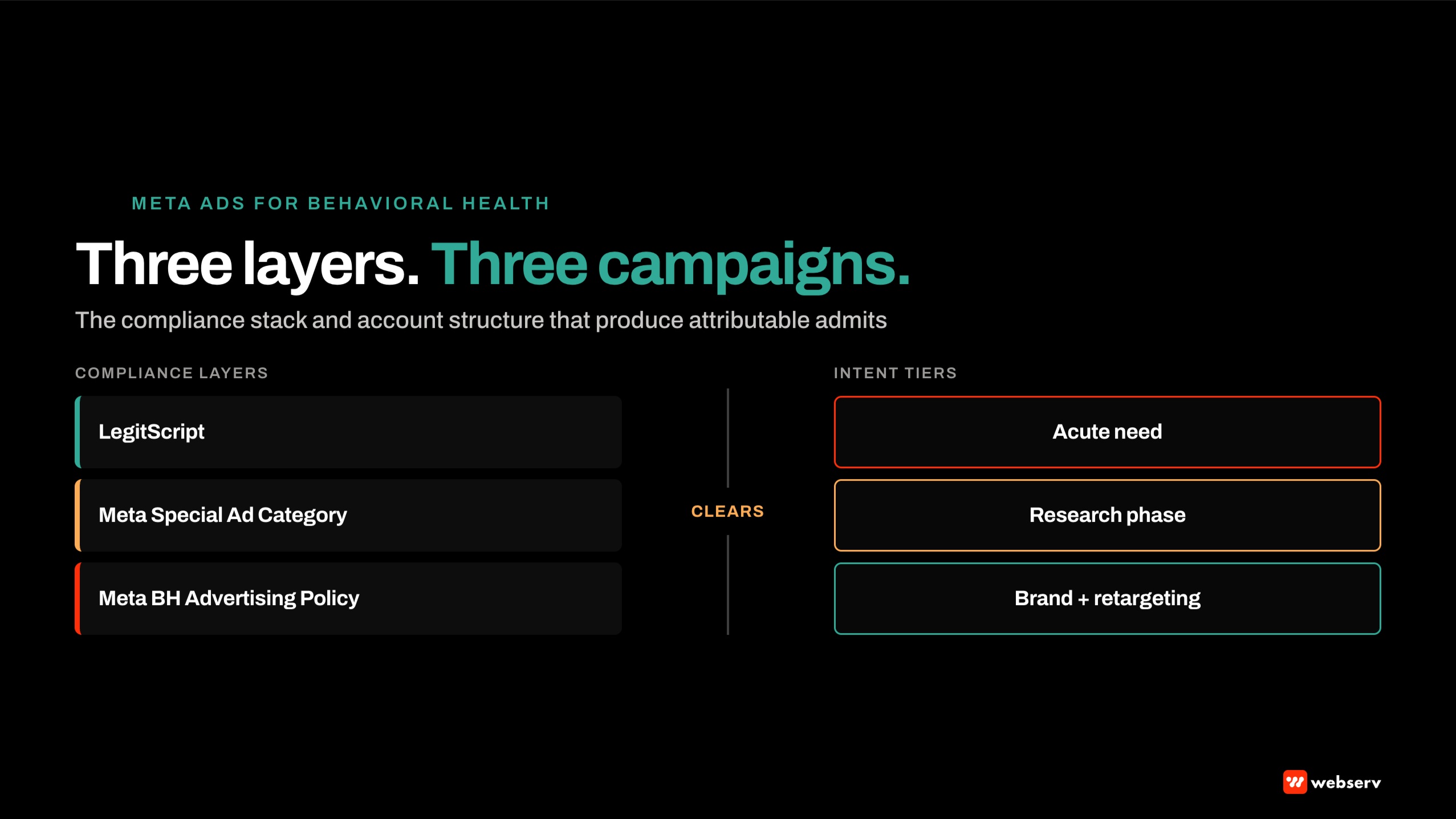
- Account structure that works for BH: 3 to 5 campaigns per facility organized by intent tier (acute need, research phase, brand awareness) rather than by audience or creative variant. Each campaign runs 2 to 4 ad sets with 3 to 5 ad units per ad set. Sprawling account structures with 20+ campaigns produce audience fragmentation that Meta cannot optimize against.
- Creative framework that clears LegitScript and Meta policy: clinical authority, family testimonial, condition-specific, verification-focused, and geographic templates covered in the static ad creative playbook. Video creative typically outperforms static in Meta feed and reels but requires specific BH-compliant production patterns to clear policy review.
- Measurement setup that resolves Meta’s optimization: Conversions API routed through a BAA-covered server-side layer that strips PHI, neutral value-tier events (admit, VOB, scheduled, qualified inquiry) with hashed identifiers only after consent and counsel sign-off, and cost-per-admit reconciled against your CRM.
DEFINITION
Meta Ads playbook for behavioral health. The specific configuration and operating pattern that lets treatment center paid social produce admissions economics rather than compliance failures. Runs inside three overlapping compliance layers (LegitScript certification with Meta permission, Meta’s health-data restrictions, Meta’s ad content standards). Structured as 3 to 5 campaigns per facility by intent tier, 2 to 4 ad sets per campaign, 3 to 5 ad units per ad set. Creative built from the five BH template patterns. Measured through neutral value-tier Conversions API events and cost-per-admit reconciled against the CRM rather than session-level cost-per-inquiry.
Distinct from general-vertical Meta playbooks (which underweight the compliance layers), distinct from Google Ads for BH (Meta serves family decision-makers and self-referral traffic; Google serves bottom-funnel intent), and distinct from a raw performance-marketing script (Meta’s black-box optimization requires the specific attribution setup below to be interpretable at the admit level).
OPERATOR INSIGHT
The middle path exists. Meta programs funded enough to exit the learning phase, with disciplined structure, purpose-built creative, and clean attribution, are the ones that turn Meta into a scale channel rather than a maintenance channel.
Idle-account Meta (underfunded, weak targeting, generic creative) does not produce learning. Sprawling-account Meta (dozens of campaigns, no clear attribution) does not produce decisions. Between them sits the range where Meta’s optimization has enough scale to train and enough discipline to interpret.
The three compliance layers
Meta Ads in behavioral health sits inside three overlapping compliance layers that determine what runs and what does not.
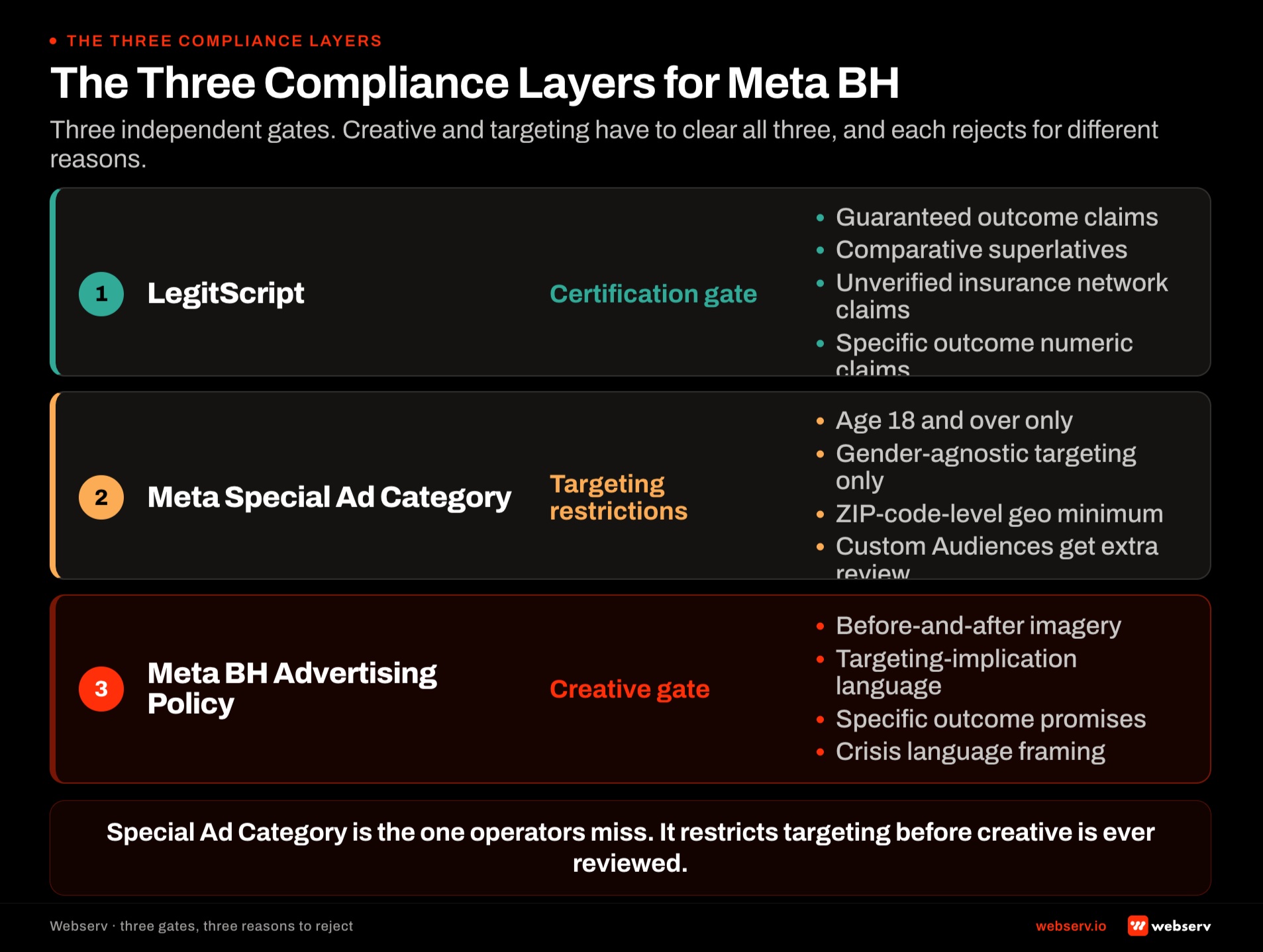
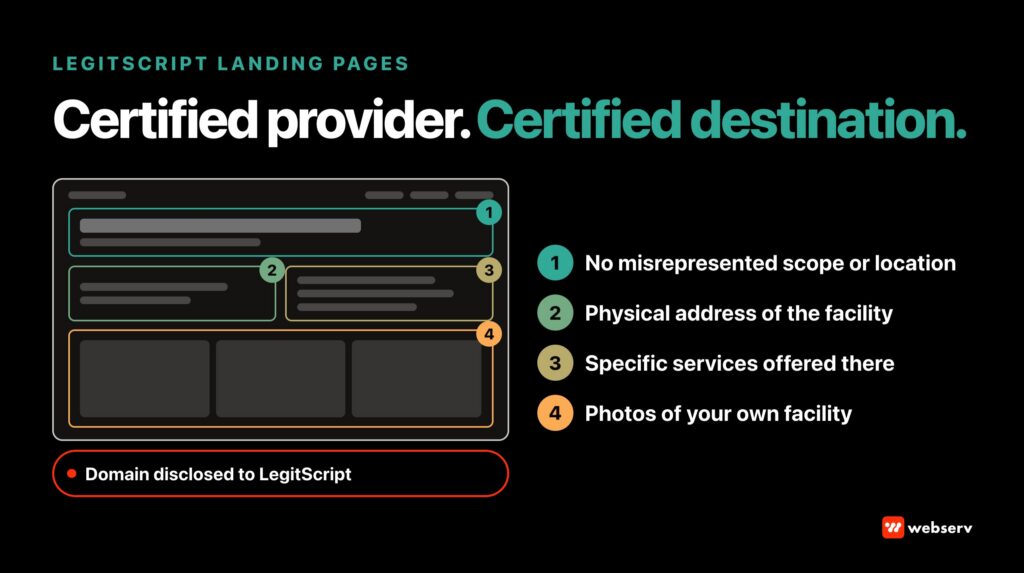
Layer 1: LegitScript certification. Meta requires addiction treatment advertisers targeting the United States to be certified by LegitScript and to apply to Meta for written permission to advertise. LegitScript certifies the provider and its websites, and certification has to stay current for that permission to hold. If certification lapses, BH ads stop being eligible until it is restored.
The claim patterns that put certification and ad approval at risk: guaranteed outcome claims, comparative superlatives without documentation, unverified insurance-network claims, and specific-outcome numeric claims without clinical documentation.
Layer 2: Meta’s restrictions on health data. Meta prohibits sharing health information through its Business Tools, including URL parameters, custom events, custom conversions, and Custom Audiences, and the names of events, conversions, and audiences cannot imply it. Meta’s systems also detect and restrict data from sites it classifies as health-related, which limits lower-funnel optimization for many BH advertisers. Custom Audiences and Lookalikes built from patient, admit, or inquiry lists are off the table.
Plan the account around broad targeting and upper- and mid-funnel optimization signals. Facilities that build around these limits from the start avoid rebuilding campaigns after Meta restricts their data.
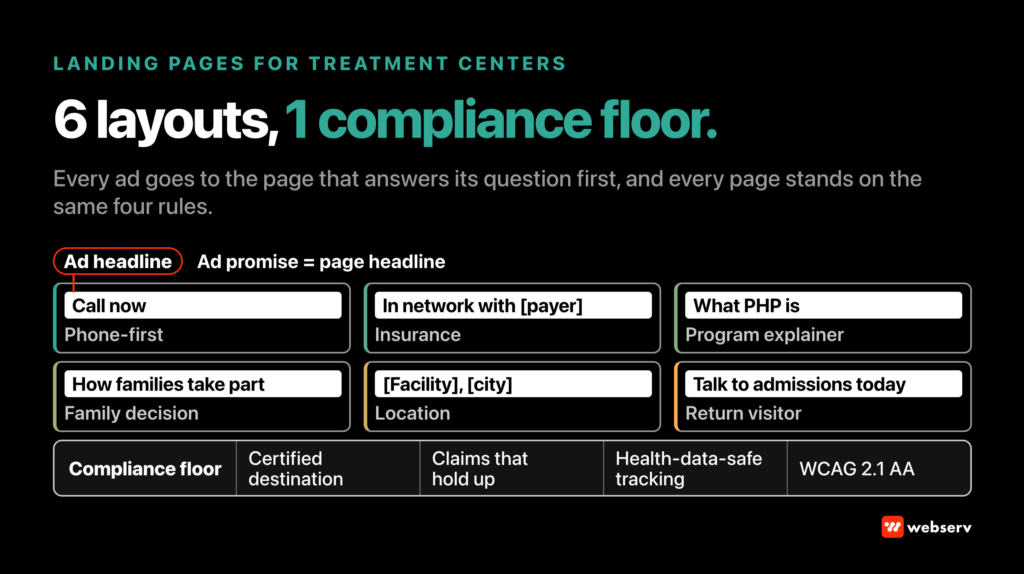
Layer 3: Meta advertising policy for BH-related content. The general Meta ad policy that applies to sensitive categories. Restricts before-and-after imagery, targeting-implication language, specific-outcome promises, and crisis-language framing. Applies to every ad regardless of targeting.
The specific fix pattern for all three layers: creative and landing pages designed with the three compliance layers in mind from the start, rather than as post-hoc compliance review after creative is produced.
How Profound Treatment drove 31 admits and a 42% drop in cost per viable in one quarter
Broad match pivot, negative keyword management, and intake-level conversion tracking turned a fragmented paid strategy into a predictable admissions engine.
Read the case study →68 viable VOBs at $4,529 cost per viable
Targeting restrictions for BH advertisers
BH advertisers on Meta work with fewer targeting levers than most categories, and the limits come from Meta’s data rules, not from a special ad category.
Target adults. Treatment decisions are made by adults, so target people 18 and older even when the program serves adolescents. Adolescent programs reach parents through broad adult targeting and creative written for parents.
Condition interests are gone. Meta removed detailed targeting options tied to health causes in January 2022, so you cannot target people by condition or treatment interest. Gender-specific programs (women’s residential, men’s outpatient) can still use Meta’s standard age, gender, and location controls.
Let creative do the qualifying: program-specific messaging sorts the audience better than any interest filter.
Geography is the sharpest lever. Standard location targeting is available, so match it to the facility’s real service area and admissions footprint.
For most facility programs, a metro or regional footprint works because families travel for treatment. Facilities with a tight local service radius benefit less from Meta than facilities with a broader service area.
Custom Audiences and Lookalike Audiences. Do not build them from patient, admit, or inquiry lists. A list of people who contacted or entered a treatment center is health information under Meta’s terms and, for SUD programs, creates HIPAA and 42 CFR Part 2 exposure. Website-visitor audiences are only safer if the pixel sends no health-revealing page or event data, so review them with counsel before use.
The Meta Ads BH program at a glance
3
Compliance layers: LegitScript + Meta permission, health-data rules, ad standards
3-5
Campaigns per facility organized by intent tier, not audience variant
Fund to learn
Budget high enough to exit the learning phase, not a fixed number
Cohort view
Measure cost-per-admit on inquiry cohorts, not sessions
Account structure that produces attribution
The specific account structure that produces disciplined attribution: 3 to 5 campaigns per facility organized by intent tier rather than by audience or creative variant.
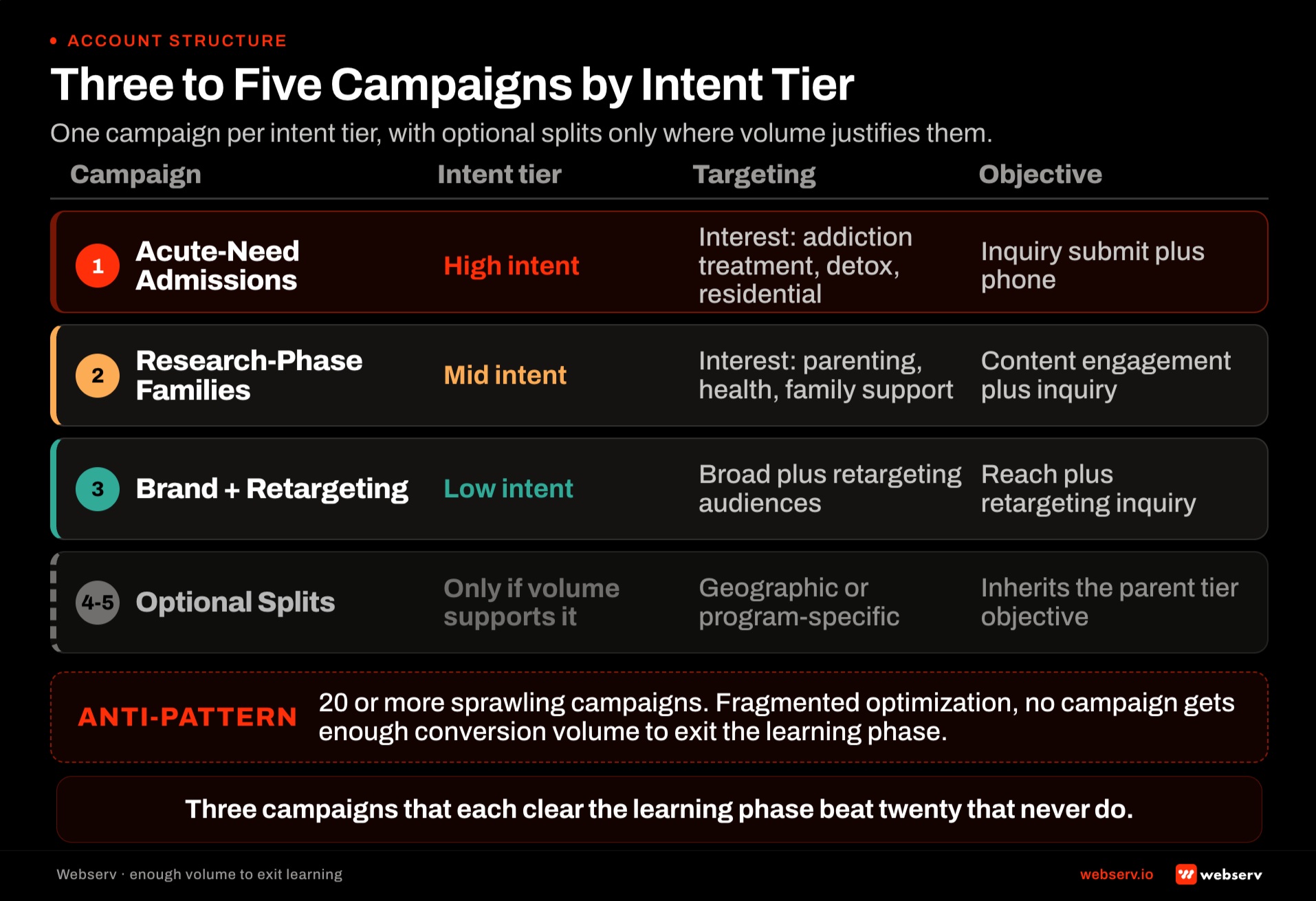
Campaign 1: Acute-need admissions
Highest-intent traffic targeting bottom-funnel intent signals. Broad adult targeting in the service area, with creative that names the specific level of care. Conversion objective: inquiry submit and phone call. Bid strategy: lowest cost or bid cap depending on scale phase.
Campaign 2: Research-phase families
Middle-funnel traffic targeting families researching treatment options. Broad adult targeting with creative written for family decision-makers. Conversion objective: content engagement, followed by inquiry submit as secondary conversion. Bid strategy: cost cap with content engagement optimization.
Campaign 3: Brand awareness and retargeting
Top-funnel awareness plus retargeting for site visitors and CRM records. Broad targeting for awareness, retargeting audiences for the second and subsequent touches. Conversion objective: reach for awareness, inquiry submit for retargeting. Bid strategy: reach or frequency capping for awareness, cost cap for retargeting.
Campaigns 4-5: Optional geographic or program-specific splits
For facilities with distinct geographic markets or program-specific offers that warrant separate optimization.
The pattern that fails: 20+ campaigns organized by audience, creative variant, or ad set combination. Sprawling structure produces audience fragmentation that Meta’s optimization cannot resolve. Every campaign fragments the conversion signal.
Creative framework for Meta
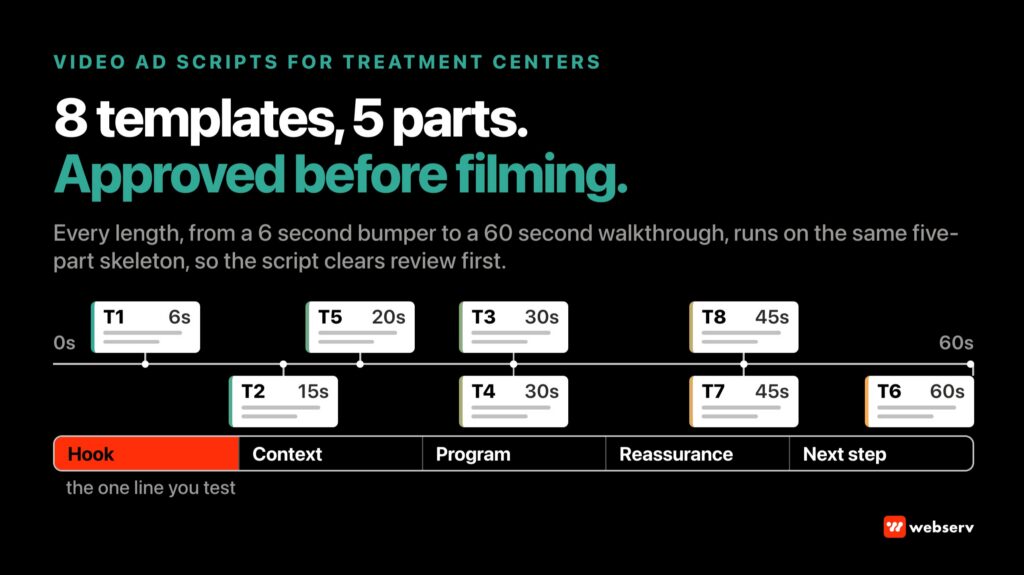
The creative templates that work in Meta for BH: the five static ad templates covered in our static ad creative templates guide (clinical authority, family testimonial, condition-specific, verification-focused, geographic), plus video creative that adapts the same template patterns to the specific reels and stories placement contexts.
Static creative for Meta feed. 1080 by 1080 square and 1080 by 1350 vertical. Both formats needed because Meta increasingly favors vertical in feed placement.
Static creative for Meta stories. 1080 by 1920 vertical with the safe zone for platform UI overlays. Static stories underperform video stories but remain useful for tested creative not yet produced as video.
Video creative for Meta reels. 1080 by 1920 vertical, 15 to 30 seconds typical length, hook in the first 3 seconds. BH video creative that works: clinician-narrated program explanations, family testimonial voiceovers, facility walkthroughs with clinical narration.
Video creative for Meta feed. 1080 by 1080 square or 1080 by 1350 vertical, 15 to 60 seconds. Similar content patterns as reels but with the specific engagement patterns feed viewers show (longer initial view time, more consideration).
The specific creative production cadence: 3 to 5 new static units and 1 to 2 new video units per month per facility. Winners scale into new audiences. Fatigued units get retired when their frequency and cost-per-result trend the wrong way.
DO
- Organize the account as 3-5 campaigns by intent tier (acute need, research phase, brand awareness + retargeting) so Meta’s optimization has enough signal to train.
- Route conversions through the Conversions API via a BAA-covered intermediary that strips PHI before anything reaches Meta.
- Send admits as neutral value-tier events through the server-side layer, and reconcile Meta’s counts against CRM admits every month. Never upload admission lists as audiences.
- Renew LegitScript well before certification expires, because a lapse can disable the ad account until remediation clears.
- Report cost-per-admit at cohort level; treat session-level cost-per-inquiry as a diagnostic signal only.
DON’T
- Ship before-and-after imagery or targeting-implication copy , automatic Meta rejection under BH policy every time.
- Sprawl the account into 20+ campaigns by audience or creative variant , fragments the conversion signal beyond what Meta can optimize against.
- Judge Meta in the first couple of weeks, before the inquiry-to-admit signal has arrived and while the read is still misleading.
- Send PHI to Meta through any channel: no condition or level-of-care details, no descriptive event names, no browser-side identifiers, and no admission lists as audiences.
- Rely on Meta as the sole paid channel, because health-data restrictions or a LegitScript lapse can cut delivery quickly.
Measurement setup that resolves Meta optimization
Meta’s optimization is largely black-box. The specific measurement setup that resolves Meta’s decisions into attribution decisions marketing leadership can act on: neutral value-tier Conversions API events, CRM-reconciled admit attribution, and cohort-based cost-per-admit measurement.
Meta CAPI for server-side conversion tracking. Meta Conversions API sends conversion events server-side rather than browser-side. Resolves iOS Safari cookie limitations and ad-blocker blocking, but server-side delivery alone does not make PHI safe to send.
The compliant implementation routes events through a BAA-covered server-side layer that strips PHI before anything reaches Meta. Our HIPAA-safe conversion tracking stack covers the value-tier architecture, and our HIPAA-compliant Conversions API guide walks through the Meta setup. Events sanitized to remove PHI before forwarding to Meta. Match quality comes from click and browser IDs, event IDs, and, for value-tier events only, hashed email or phone sent through the BAA-covered layer. Send identifiers only with documented consent and counsel sign-off, and never alongside condition or level-of-care data.
The CRM stays the source of truth for admits. Admits reach Meta as individual Tier 1 events from the server-side layer, not as uploaded lists of patients. Keep the event name neutral (tier_1_conversion) and attach no condition, level of care, or admit date.
The workflow: preserve the click ID and campaign source on the inquiry record in your CRM so the server-side event can be matched. Reconcile Meta-reported conversions against CRM admits by campaign every month. Use the reconciled numbers to move budget between campaigns, and let Meta optimize toward the value tiers.
Cohort-based cost-per-admit measurement. Cost-per-inquiry is the session-level metric Meta reports. Cost-per-admit is the metric that matters for marketing decisions.
The measurement pattern: track inquiries in one cohort, follow the cohort through admit conversion, and calculate cost-per-admit from ad spend divided by cohort admits. Facilities that measure cost-per-inquiry alone typically make suboptimal Meta decisions because inquiries and admits do not correlate directly.
Most in-house teams hit a wall not because they lack knowledge, but because they lack bandwidth.
When you are ready to hand it off, Webserv has spent 9 years executing exactly this for treatment centers nationwide.
Frequently Asked Questions
How much should we spend on Meta Ads for a single-facility BH operator?
There is no universal number. Budget has to be high enough for Meta to exit the learning phase on your primary conversion event in your specific market. Underfunded accounts never give Meta’s optimization enough conversions to train against.
Past a certain point, returns diminish because the addressable audience for a single facility saturates, and that ceiling depends on your market size. Portfolio operators with multiple facilities in multiple markets can scale meaningfully higher because each market carries its own addressable audience.
Portfolio operators can scale further because each market carries its own addressable audience, so size budget market by market. A common path is a smaller testing budget first, then scaling once creative testing and optimization patterns stabilize.
What is the typical cost-per-admit from Meta Ads for BH?
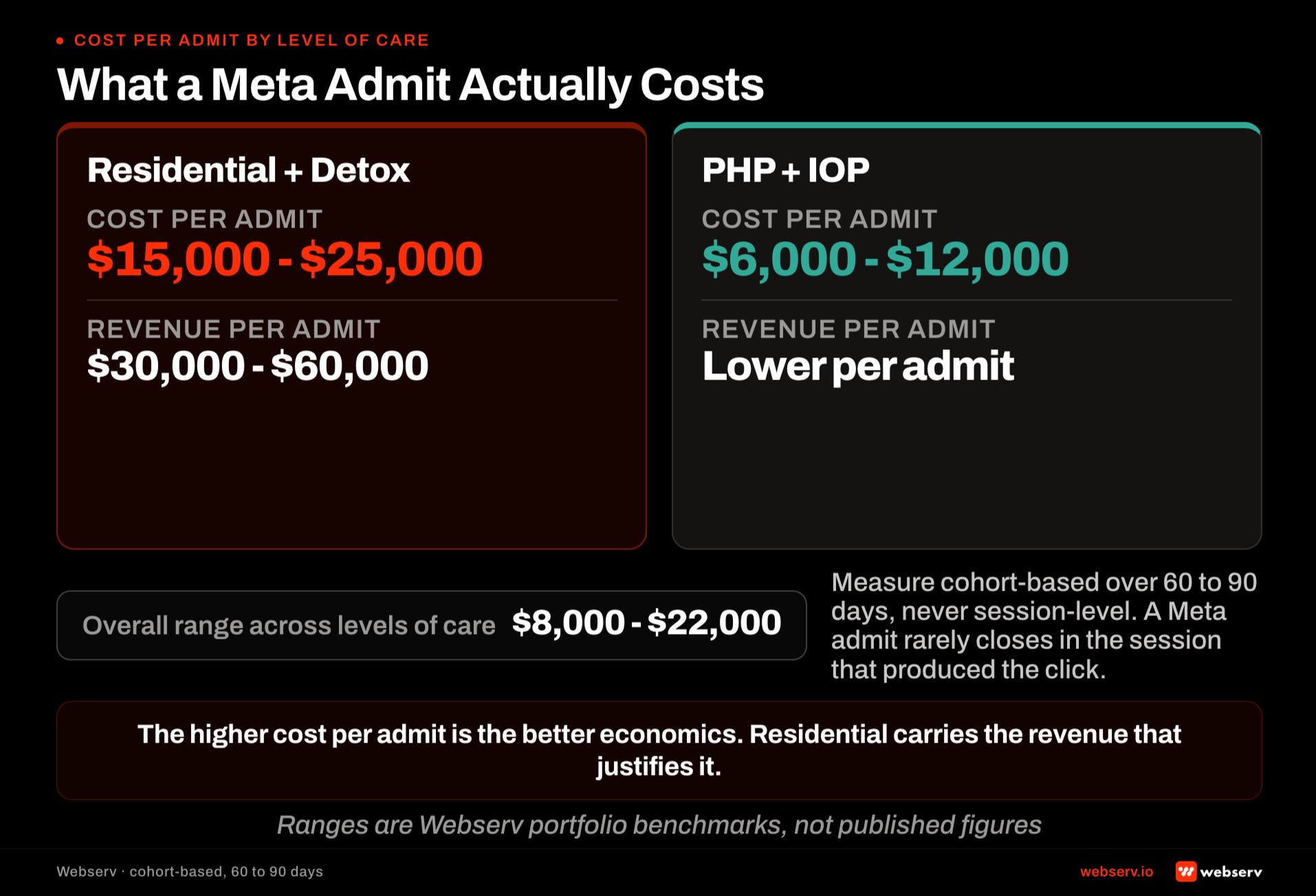
Cost-per-admit varies widely by level of care, payer mix, market, and program economics, so benchmark against your own cohorts rather than an industry average. Residential and detox admits typically carry higher cost-per-admit but also higher revenue per admit.
PHP and IOP admits typically carry lower cost-per-admit with lower per-admit revenue. The pattern: cost-per-admit measured on cohorts rather than at session level.
Facilities that measure only session-level cost-per-inquiry routinely underestimate true cost-per-admit, because not every inquiry becomes an admit.
How long does it take to see Meta Ads produce admits?
Expect weeks, not days, for the first cohort of Meta-attributed admits to materialize. Meta can produce inquiries soon after launch, but the inquiry-to-admit cycle in BH is longer.
Facilities that judge Meta in the first few weeks typically reach misleading conclusions because the admit signal has not yet reached the measurement. The right measurement window is long enough for at least one full inquiry cohort to resolve into admits before evaluating cost-per-admit.
Some facilities produce faster admit cycles, especially for acute-need detox admits. Those facilities can evaluate Meta on shorter windows but should still weight the full cohort measurement as the primary signal.
What happens if our LegitScript certification lapses?
Meta disables the ad account until LegitScript certification is restored. A lapse can move from LegitScript notification to account disable quickly.
Restoration through re-certification then depends on LegitScript’s review queue and the specific remediation required.
The pattern that avoids lapse: a LegitScript renewal calendar tracked separately from ad account operations, with renewal initiated well ahead of certification expiration. Facilities that leave renewal to the certification expiration date typically produce ad account gaps that cost meaningful admissions momentum.
Do we need separate creative for Meta and other paid channels?
Format-specific variants, yes. Concept-level differences, usually no. Meta’s placement requirements (feed, stories, reels) require format variants that other platforms do not.
The specific pattern that works: shared creative concepts developed once, then produced in the specific format variants each platform requires. A single clinical authority template produces one Meta square, one Meta vertical, one Meta story, and the Google display banner set from the same underlying concept.
Platform-specific creative treatment sometimes makes sense at the sub-audience level (Meta reels warrants different treatment than Meta feed). Most BH programs work well with shared concepts and platform-specific format variants. Our static ad creative templates walk the five patterns that adapt across placements.
How do we reach gender-focused program audiences on Meta?
Use Meta’s standard age, gender, and location controls plus program-specific creative. No special ad category applies to BH, so gender targeting is available for programs like women’s residential.
Do not seed Lookalikes with lists of program participants. Patient and alumni lists are health information that Meta prohibits and that HIPAA and 42 CFR Part 2 protect.
Let the creative qualify the audience by naming the program clearly. Google Ads remains the stronger channel for high-intent searches such as women’s rehab near me.
How does the Meta Ads workflow interact with our overall paid admissions program?
Directly. Meta is often one of the two largest channels in the paid admissions program for treatment centers that run multi-channel paid. Google Ads is usually the other, with the remainder split across LinkedIn, TikTok, connected TV, and other channels depending on facility strategy.
The specific integration pattern: Meta serves as the highest-scale addressable channel for family decision-makers and self-referral acute-need traffic. Google Ads serves as the highest-intent bottom-funnel channel. The two channels overlap in intent coverage but produce different attribution patterns.
Facilities that run Meta and Google in parallel typically produce the strongest paid admissions economics. Facilities that run only one of the two channels typically produce concentrated risk if the single channel policy changes or optimization degrades.
Keaton Nalle is the Director of Paid Admissions at Webserv, a digital marketing agency for treatment centers.