The retargeting playbook most treatment centers inherited came from ecommerce. Drop a pixel on every page, build an audience of everyone who looked at the insurance page, and follow those visitors around the internet for a month. For an addiction or mental health program, nearly every step of that playbook now runs into a platform rule.
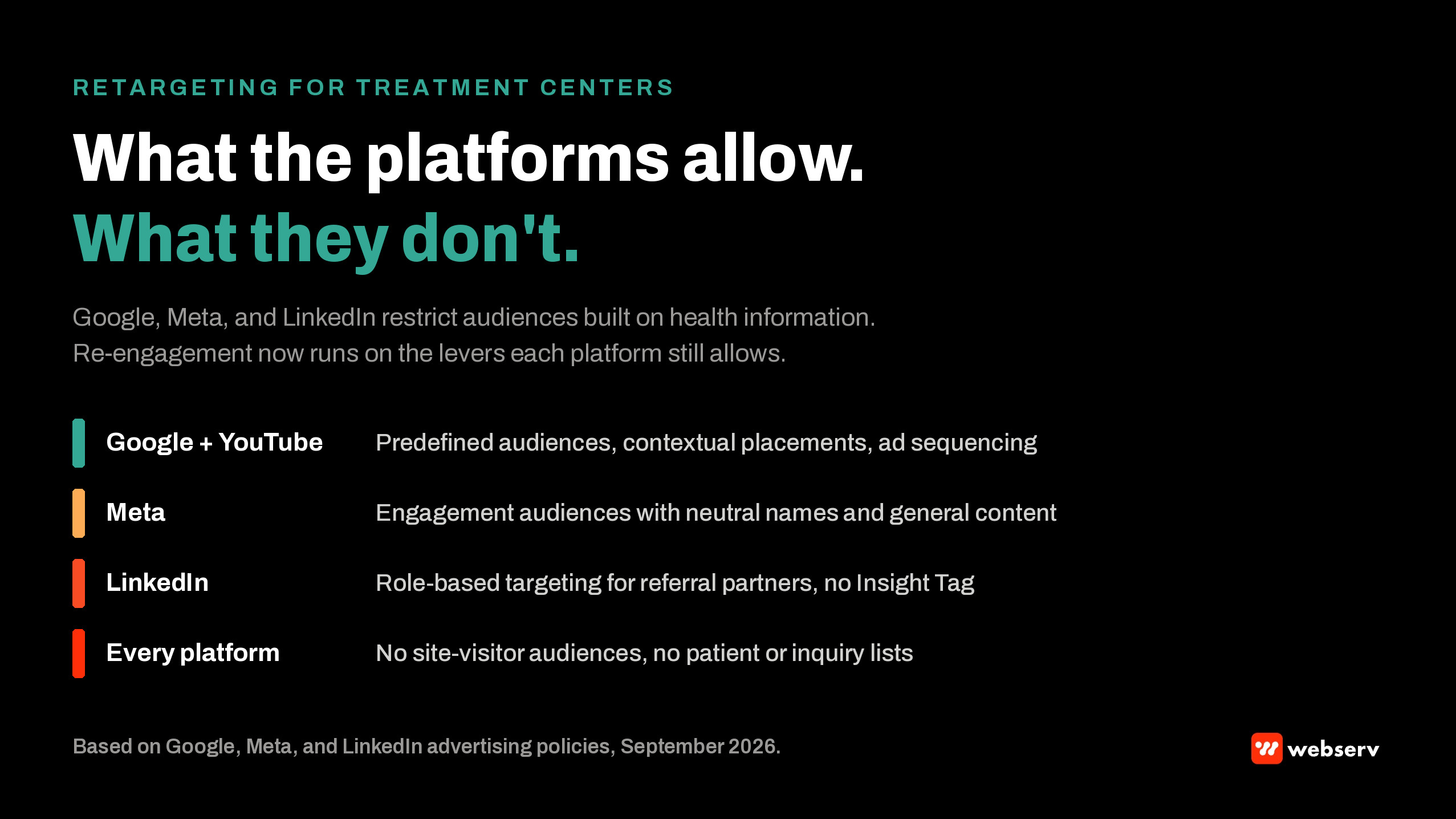
Google’s health in personalized advertising policy lists counseling for addiction and mental health as a sensitive interest category. Ads promoting it can use predefined Google audiences but not advertiser-curated ones, which rules out your data segments (Google’s current name for remarketing lists), customer match, and lookalikes.
Meta’s prohibited information rules list places of treatment and counseling as health information. Meta also says the names and criteria behind custom audiences can’t reflect or be based on that information, and it can restrict which events a health site’s pixel is allowed to send.
So retargeting inside our paid media programs for treatment centers is a narrower discipline than it used to be. What’s left is platform-native engagement, sequencing and frequency, branded search capture, suppression discipline, and measurement that doesn’t depend on visitor lists.
This guide walks each of those, platform by platform. It sits inside our guide to behavioral health marketing, and the broader paid social discipline it plugs into is covered in our social advertising guide for treatment centers.
Key Takeaways
- Google doesn’t allow remarketing lists, customer match, or lookalikes for ads promoting addiction or mental health treatment. Predefined Google audiences and contextual targeting remain available.
- Meta treats places of treatment and counseling as prohibited health information and flags custom audiences whose names or rules imply health information.
- LinkedIn bars targeting based on health data and says its Insight Tag shouldn’t sit on pages offering specific health-related services.
- The re-engagement levers that still work are platform-native engagement, YouTube ad sequencing, branded search, and frequency discipline.
- Patient, admit, and inquiry lists never go to ad platforms, including as exclusion lists, because list membership reveals treatment status.
What the platforms allow treatment centers to retarget
Each platform draws the line in a different place, so the rules below are worth checking against your own account before you change anything. Policy pages change, and your platform representative and compliance counsel have the final word on your setup.
Google Ads and YouTube: predefined audiences only
Google’s policy splits audiences into two groups. Predefined Google audiences (in-market, affinity, life events, demographics) can run for health advertisers because Google removes sensitive user signals from them. Advertiser-curated audiences can’t: that covers customer match, your data segments, audience expansion, and lookalike segments.
Custom segments carry their own limit. When they point to sensitive landing pages, Google only serves them on Display, to non-sensitive audiences or contextually. Our Google Ads playbook and YouTube Ads guide cover the targeting that does work for treatment centers.
DEFINITION
Compliant re-engagement. Reaching families again after a first touch without building audiences from their site visits, form activity, or identity. It relies on platform-native engagement, ad sequencing, branded search, contextual placements, and frequency caps.
Distinct from pixel retargeting, which builds audiences from site behavior, and distinct from list-based targeting, which uploads people’s contact details. Both are restricted for treatment ads on the major platforms.
Meta: health information can’t shape audiences or events
Meta’s rules cover more than PHI in the HIPAA sense. Health information includes medical conditions, treatments, and places of treatment and counseling, and it can’t appear in URL parameters, custom event names, custom conversions, or custom audiences.
Meta can also assign a treatment center’s website to a data source category with restrictions. Depending on the category, that means core setup (no custom parameters or URL paths), limits on mid and lower funnel standard events, or full restrictions that leave only awareness, engagement, and traffic objectives. Our Meta Ads playbook covers the campaign side.
LinkedIn: no health-data targeting
LinkedIn’s advertising policies bar targeting based on data concerning health, and its Insight Tag guidance says not to install the tag on pages offering specific health-related services. For a treatment center, that removes website retargeting on LinkedIn.
LinkedIn still has a role in referral partner development, where the audience is clinicians and case managers targeted by role rather than by site visits. The use cases that work are detailed in our LinkedIn Ads piece.
CTV and programmatic: reach, not site-visitor audiences
Connected TV and programmatic buys through a demand-side platform can still build awareness in a service area. Building those audiences from treatment center site visitors carries the same health-information problem as a pixel audience, so we plan CTV around geography, content, and household-level reach instead.
Re-engagement tactics that still work
None of these replace old-style retargeting one for one. Together they keep a facility in front of a family through a research cycle that often runs across several sites, without building lists from that family’s behavior.
Platform-native engagement on Meta
Meta lets advertisers reach people who engaged with their content on Meta itself, such as video viewers or people who interacted with the facility’s Facebook page or Instagram account. These audiences come from engagement on the platform rather than from pixel data on your site.
They still sit under Meta’s custom audience rules, so name them neutrally and keep the criteria about content engagement, not conditions or programs. Meta flags audiences whose names or rules reference health conditions, and flagged audiences can’t be used in campaigns.
COMMON MISTAKE
Naming audiences after programs or conditions. An audience called “detox page viewers” or “alcohol video 50%” tells Meta the audience is built on health information, even when the underlying data is clean.
Use neutral names (“video engagers, 30 days”) and keep the source content general. Review every existing audience name and custom conversion in the account, because Meta flags the old ones too.
YouTube ad sequencing and frequency
Google’s video ad sequence campaigns show the same viewer a series of videos in an order you set, such as a clinician introduction, then a program walkthrough, then an admissions next step. Sequencing happens inside the campaign, so it doesn’t need a remarketing list.
Sequence campaigns target with audiences and demographics rather than keywords or topics, so pair them with predefined audiences and a tight geography. Frequency caps on standard in-stream and bumper campaigns do the rest, keeping the facility visible without the saturation that feels invasive in this category.
Branded search as the return path
When a family comes back to a facility, it’s often through a search for the facility’s name. Protecting branded terms in Google Ads, with clean sitelinks to admissions, insurance, and program pages, captures that return visit without any audience list. The Google Ads playbook covers brand campaign structure.
Creative and landing pages that carry the second touch
Without visitor lists, the second touch comes from creative that works for a cold family on first view. Clinician-led video, clear insurance answers, and a direct admissions path do that job. Our ad creative strategy piece and landing page guide cover both sides.
How Profound Treatment drove 31 admits and a 42% drop in cost per viable in one quarter
Broad match pivot, negative keyword management, and intake-level conversion tracking turned a fragmented paid strategy into a predictable admissions engine.
Read the case study →68 viable VOBs at $4,529 cost per viable
Suppression and exclusion without patient lists
The old playbook suppressed admits by uploading them as an exclusion list. That still sends a list of patients to the ad platform, and list membership itself reveals treatment status, so it’s off the table on every platform.
Regulators treat this as health data too. The FTC’s 2024 action against Monument, an alcohol addiction treatment company, turned on consumers’ health data shared with advertising platforms without consent.
Suppression now happens upstream. Keep pixels and tags off intake, insurance verification, and admissions pages entirely, don’t build audiences from site behavior, and cap frequency so no family sees the facility too often. Opt-outs are honored in owned channels like email, where consent is tracked directly.
OPERATOR INSIGHT
Look for an old admit or inquiry list sitting in the audience manager first. They were often uploaded years ago as suppression lists and never removed.
Deleting those lists is the fastest compliance win in a retargeting cleanup. Do it before rebuilding anything else, and document the date and who approved it.
That audit usually surfaces more than one old list. Check custom audiences, lookalike seeds, and offline event sets together, because they tend to have been created in the same setup pass.
Measuring re-engagement without visitor lists
Retargeting used to be measured by retargeting campaigns’ own attributed conversions. Without visitor audiences, measurement moves to signals that show whether families come back: branded search volume, direct and branded organic sessions, and assisted conversions in GA4 with neutral events.
Conversion signal back to the platforms follows the same rules as the rest of the stack. Our HIPAA-safe conversion tracking stack covers the server-side setup, including why Google gets click-based conversions with enhanced conversions off under its customer data policy.
For incrementality, geographic holdouts work where audience holdouts no longer can: pause awareness spend in a comparable market for a set period and compare branded search and admits. The ROI attribution playbook and our call tracking piece cover the modeling and the call side.
How to clean up an existing retargeting program
Plenty of treatment center accounts still carry retargeting built under the old rules. The cleanup runs in a fixed order, because deleting and documenting comes before rebuilding.
Inventory every audience
List custom audiences, remarketing lists, customer match lists, lookalikes, and offline event sets across Google, Meta, and LinkedIn.
Remove what the rules bar
Delete patient, admit, and inquiry lists, visitor audiences built on program or insurance pages, and any audience named after a condition.
Pull tags off sensitive pages
Remove pixels and tags from intake, insurance verification, and admissions pages, and check Meta Events Manager for restriction notices.
Rebuild on allowed levers
Move budget to engagement audiences, YouTube sequencing, branded search, and contextual placements, and document each decision with counsel.
Keep the documentation with the account. When a platform review or a new team member asks why an audience doesn’t exist, the record answers it.
What to keep and what to cut
The short version of the rules above, for whoever runs the account day to day. Print it for the media buyer and the compliance lead, and review it whenever a platform updates its health policy.
DO
- Use Meta video and page engagement audiences with neutral names and general source content.
- Run YouTube ad sequences with predefined audiences and a tight geography.
- Protect branded search terms so returning families land on admissions, insurance, and program pages.
- Measure re-engagement through branded search, direct sessions, and geographic holdouts.
DON’T
- Build audiences from visits to program, insurance, or admissions pages.
- Upload patient, admit, or inquiry lists to any ad platform, including as exclusion lists.
- Install the LinkedIn Insight Tag or Meta pixel on pages that collect health information.
- Name audiences, events, or conversions after conditions, programs, or levels of care.
If your account still runs on the old playbook, the cleanup above is the place to start, before any new campaigns go live.
Most in-house teams hit a wall not because they lack knowledge, but because they lack bandwidth.
When you are ready to hand it off, Webserv has spent 9 years executing exactly this for treatment centers nationwide.
Frequently Asked Questions
Can treatment centers still run retargeting ads?
Only in narrow forms. Google doesn’t allow remarketing lists for addiction and mental health treatment ads, LinkedIn bars health-data targeting, and Meta restricts audiences and events built on health information. What remains is platform-native engagement, ad sequencing, branded search, and frequency discipline.
The change catches many facilities because their retargeting was set up years ago and kept running. Platforms now flag or restrict those audiences, and some accounts only find out when delivery drops or a notice arrives in Events Manager.
The trade-off is reach. You lose the ability to follow a specific visitor, and you gain an account that doesn’t depend on data the platforms are actively removing.
Is it allowed to retarget people who watched our YouTube ads?
Not through remarketing lists. Your data segments, which include YouTube viewer lists, are advertiser-curated audiences, and Google doesn’t support them for ads promoting treatment. Video ad sequence campaigns are the allowed alternative, because they order the videos a viewer sees inside one campaign.
Sequences target with audiences and demographics rather than keywords, placements, or topics, so pair them with predefined audiences and a tight geography. A clinician introduction followed by a program walkthrough and an admissions prompt is a common structure.
What most operators miss is frequency. Sequencing plus sensible caps on in-stream and bumper campaigns does most of the work old retargeting did.
Can we upload our admissions list to exclude people who already admitted?
No. An exclusion list is still a list of patients sent to an ad platform, and membership in it reveals treatment status. Meta prohibits health information in custom audiences, and Google doesn’t support customer match for ads promoting treatment.
Suppression has to happen upstream instead. Keep tags off intake and admissions pages, don’t build audiences from site behavior, and cap frequency, so admitted families aren’t singled out in the first place.
The honest trade-off: some admitted families will still see awareness ads. That’s a smaller risk than sending a patient list to a platform.
What replaced retargeting in a treatment center paid program?
A mix of levers: Meta engagement audiences with neutral names, YouTube ad sequencing, protected branded search, contextual placements, and creative strong enough to work on first view. Measurement shifts to branded search volume, direct sessions, and geographic holdouts.
Branded search is the easiest lever to undervalue. Families who researched a facility often come back by searching its name, and a well-built brand campaign catches that return visit without any list.
None of these match pixel retargeting’s precision. Together they cover most of the job without the compliance exposure.
How do we know if our current retargeting setup breaks platform rules?
Start with an audience inventory across Google, Meta, and LinkedIn. Any patient, admit, or inquiry list, any audience built from program or insurance pages, and any audience or event named after a condition is a problem under current rules.
Then check the signals the platforms give you. Meta Events Manager shows data source category restrictions and prohibited information notices, and Google’s policy pages define which audience types health advertisers can use.
Have compliance counsel review the cleanup plan before you rebuild. We’re not lawyers, and the platform rules sit alongside HIPAA, 42 CFR Part 2, and state health data laws.
Keaton Nalle is the Director of Paid Admissions at Webserv, a digital marketing agency for treatment centers.