Google Ads is the highest-intent paid channel for behavioral health treatment centers. Families and self-referring patients searching Google for treatment options are further down the decision funnel than families researching through Meta feed or receiving retargeting through display placements. It sits inside our paid search capability as the acute-need anchor of the paid media mix.
The paid search capability at Webserv operates on a specific pattern: Google Ads produces the acute-need inquiries that convert to admits fastest, while Meta and other channels build the awareness that feeds those inquiries.
The pattern I see across facility Google Ads programs: the account either runs against generic BH keywords with no LegitScript-specific structure and produces inflated cost-per-conversion from off-intent traffic.
Or the account runs against tight keyword sets with strong intent targeting and produces cost-per-admit numbers that make paid search the anchor channel in the media mix.
The middle path exists. Google Ads programs funded enough for bidding to train, with disciplined structure, LegitScript-compliant creative, and clean conversion tracking, are the ones that turn Google Ads into a scale channel rather than a maintenance channel.
This piece walks the Google Ads playbook specific to behavioral health. The LegitScript certification requirements that gate ad approval, the campaign structure that produces disciplined attribution, and the keyword strategy that separates high-intent from off-intent traffic.
It also covers the AI Max / Performance Max considerations specific to BH, the negative keyword discipline that prevents budget waste, the bid strategy patterns that work in BH, and the measurement setup that resolves Google’s optimization into decisions marketing leadership can act on. It builds on our earlier Google Ads strategy for behavioral health providers and pairs naturally with our Meta Ads playbook. Broader context in our ultimate guide to behavioral health marketing.
Key Takeaways
- Google Ads for BH requires LegitScript certification for all US-based advertisers targeting BH-related queries. Certification renewal happens annually with quarterly-cadence policy compliance monitoring. Facilities without active LegitScript certification cannot run BH ads on Google.
- Campaign structure that works for BH: 4 to 8 campaigns per facility organized by intent tier (branded, acute-need condition, level-of-care specific, geographic modifier) rather than by keyword theme. Each campaign runs 3 to 6 ad groups with tight keyword sets and dedicated ad creative.
- Keyword strategy separates high-intent from off-intent traffic through match type discipline (phrase and exact match primarily, broad match sparingly and only with strong negative keyword lists) and specific intent modifiers (near me, insurance-specific, level-of-care specific).
- AI Max and Performance Max carry specific risks in BH because Google’s automated placement can produce off-intent delivery and LegitScript-noncompliant placements. Facilities running Performance Max in BH should specifically constrain placement targeting and monitor delivery weekly for policy issues.
- Bid strategy patterns that work: target CPA or target ROAS for mature campaigns with sufficient conversion volume, manual CPC or enhanced CPC for new campaigns during the learning phase. Bidding on unqualified traffic through Maximize Clicks typically produces cost-per-admit that materially exceeds the target.
DEFINITION
Google Ads playbook for behavioral health treatment centers. The paid search program that turns Google’s highest-intent search inventory into cost-per-admit economics rather than budget waste. Runs on active LegitScript certification, 4 to 8 campaigns per facility organized by intent tier (branded, acute-need condition, level-of-care specific, geographic modifier), tight match-type discipline with large, maintained negative keyword lists, constrained Performance Max with first-party audience signals and placement exclusions, target CPA or target ROAS bidding once conversion volume clears the training threshold, and click-based offline conversion imports for admit-level attribution, with enhanced conversions off.
Distinct from general-vertical Google Ads playbooks (which underweight LegitScript and BH-specific negative keyword hygiene), distinct from Meta Ads for BH (Meta serves middle-funnel research families; Google serves bottom-funnel acute-need search), and distinct from a keyword-theme campaign structure (which fragments attribution and prevents optimization by intent).
OPERATOR INSIGHT
Google Ads produces the acute-need inquiries that convert to admits fastest, while Meta and other channels build the awareness that feeds those inquiries.
The middle path exists. Google Ads programs funded enough for bidding to train, with disciplined structure, LegitScript-compliant creative, and clean conversion tracking, are the ones that turn Google Ads into a scale channel rather than a maintenance channel. Underfunded programs starve the algorithm; sprawling accounts with dozens of keyword-theme campaigns fragment attribution beyond what any optimizer can resolve.
LegitScript certification requirements
LegitScript certification is the specific compliance layer that gates Google Ads eligibility for US BH advertisers. Google requires LegitScript certification for any advertiser targeting substance use disorder treatment, mental health treatment, or BH-adjacent queries.
Certification timeline. Initial LegitScript certification takes weeks, depending on facility documentation quality and LegitScript’s review queue, so start well before you plan to launch. Renewal also takes time, so do not leave it to the expiration date.
Documentation requirements. Facility state licensing, clinical staffing credentials, program policies covering intake and clinical operations, financial disclosures, and specific compliance attestations. Facilities with incomplete documentation typically produce extended certification timelines.
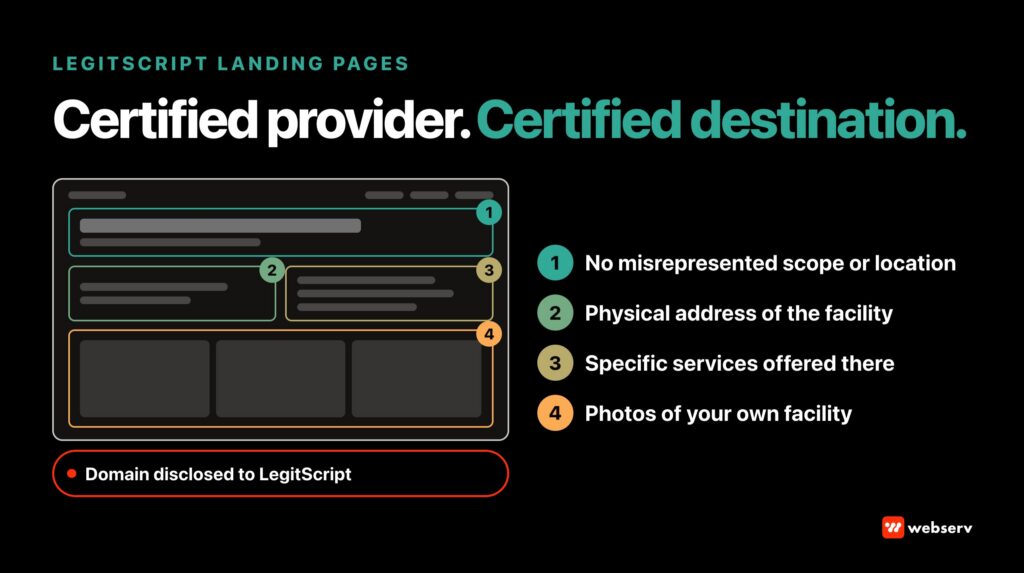
Ad policy compliance during certified status. LegitScript monitors ad creative and landing pages on an ongoing basis after certification. Non-compliant creative or landing pages trigger certification review that can suspend the certification.
The specific pattern that avoids suspension: creative review against LegitScript standards before submission to Google, quarterly landing page audit against LegitScript standards, and immediate remediation of any LegitScript-flagged issues.
Consequences of certification lapse. A LegitScript lapse can quickly cost you the ability to run BH ads on Google. Restoration through re-certification then takes time, producing meaningful ad account downtime.
Campaign structure by intent tier
The specific campaign structure that produces disciplined attribution: 4 to 8 campaigns per facility organized by intent tier rather than by keyword theme.
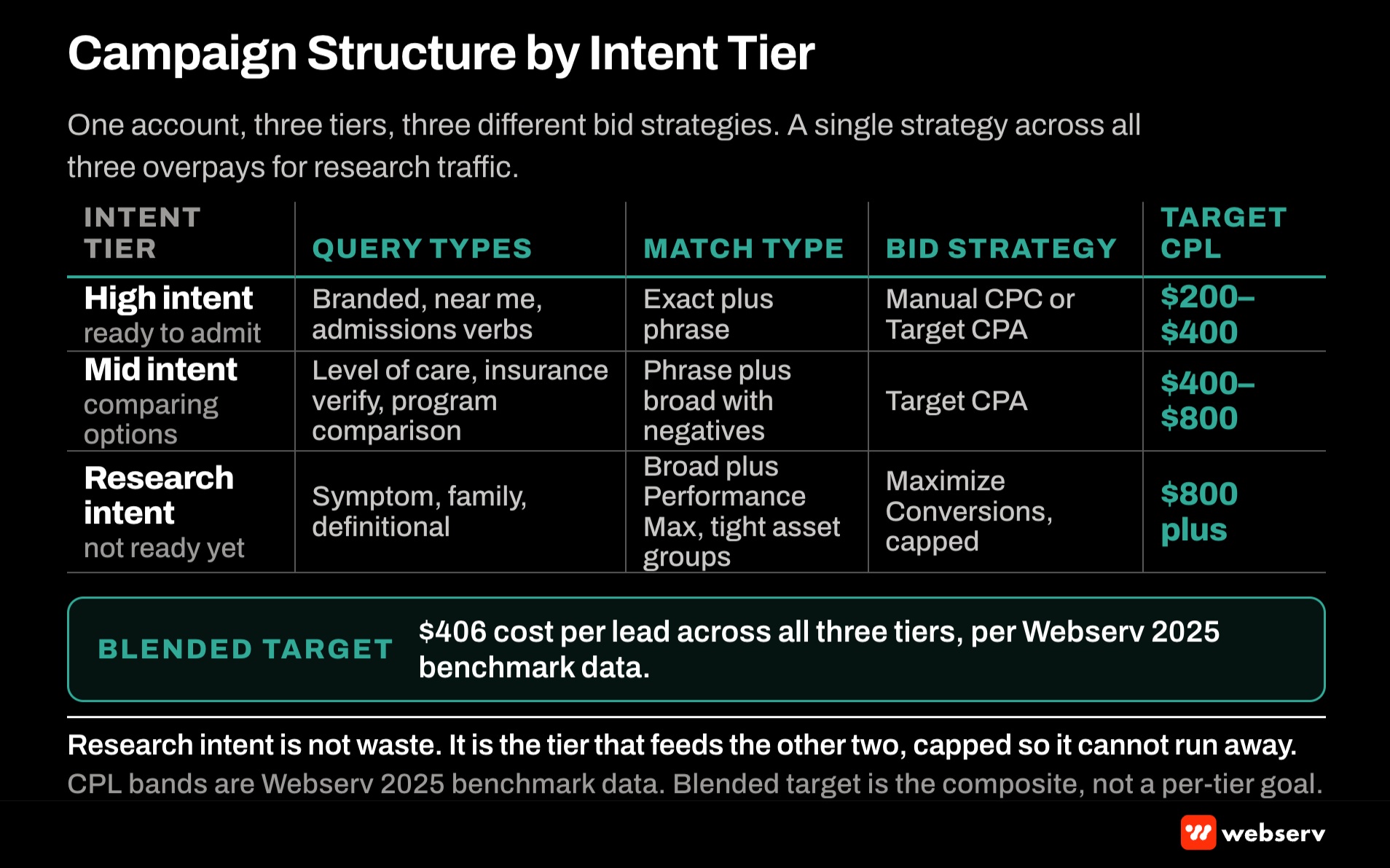
Campaign 1: Branded search
Facility name and branded variations. Highest conversion rate, lowest cost per conversion, primary purpose is capturing branded search demand and defending against competitor bidding on the facility brand.
Match type: mostly exact and phrase match on branded terms. Negative keywords protect against off-intent branded variations (searches for reviews, complaints, negative reputation queries).
Campaign 2: Acute-need condition search
Specific condition queries with acute-need modifiers. “Detox near me,” “opioid treatment now,” “emergency mental health,” “residential rehab today.”
Highest paid CPA tier but also highest paid conversion rate for admits. Bid competitively on this tier because acute-need traffic converts at meaningfully higher rates than research-phase traffic.
Campaign 3: Level-of-care specific
Level of care queries with treatment modifiers. “Residential treatment for {condition},” “PHP program in {location},” “IOP for {condition},” “outpatient dual diagnosis.”
Mid-tier CPA with strong conversion rate. This tier captures families who have already decided the specific level of care they need and are searching for facility options.
Campaign 4: Geographic modifier
Geographic-specific queries. “Treatment center in {city},” “rehab in {state},” “{city} behavioral health treatment.”
Geographic campaigns produce localized conversion patterns. Portfolio operators typically run one geographic campaign per facility service area.
Campaigns 5-8: Optional splits
Insurance-specific queries (“BCBS-covered rehab”), demographic-specific queries (“adolescent mental health treatment”), and program-specific queries for facilities with unique programming.
The pattern that fails: 20+ campaigns organized by keyword theme without clear intent tier logic. Sprawling structure produces attribution fragmentation and optimization difficulty.
The Google Ads BH program at a glance
Intent tiers
Campaigns per facility organized by intent tier, not keyword theme
Fund to learn
Budget high enough for bidding to train, sized to local search volume
Negatives
Large, maintained negative lists keep BH budget off off-intent queries
Cohort CPA
Measure cost-per-admit on inquiry cohorts, not sessions
Keyword strategy for high-intent versus off-intent
Match type discipline separates high-intent from off-intent traffic in BH Google Ads.
Exact match keywords. Primary keyword coverage for known-high-intent queries. Facility name (branded campaign), specific condition + level-of-care combinations (acute-need and level-of-care campaigns), specific geographic + service combinations (geographic campaigns).
Exact match produces the tightest intent targeting but limits volume. Most BH facilities run exact match on their core high-intent keywords.
Phrase match keywords. Secondary keyword coverage for high-intent variations. Phrase match captures search query variations that include the target phrase in the exact word order.
Phrase match produces useful volume expansion on high-intent tiers while maintaining reasonable intent targeting.
Broad match keywords. Use sparingly and only with strong negative keyword lists. Broad match in BH typically produces meaningful off-intent traffic because BH-adjacent keywords overlap with non-treatment intent (personal use content, harm reduction communities, medical research queries).
The pattern that works: broad match only on the highest-volume high-intent keywords, backed by large negative keyword lists covering the specific off-intent variations.
Negative keyword discipline. The specific list of terms that should always appear in BH negative keyword lists.
Off-intent modifiers: “how to,” “personal,” “harm reduction,” “recreational,” “drug test,” “for sale,” “reddit” (unless specifically targeting Reddit-adjacent research queries).
Non-treatment intent: names of specific drugs when combined with usage patterns, harm-reduction queries, medical research queries, employment drug screening queries.
Competitor names when facility does not want to appear on competitor brand searches (some facilities do want competitor brand coverage, most do not).
Facilities without disciplined negative keyword lists waste a meaningful share of budget on off-intent traffic, and the search terms report will show you exactly how much.
How Profound Treatment drove 31 admits and a 42% drop in cost per viable in one quarter
Broad match pivot, negative keyword management, and intake-level conversion tracking turned a fragmented paid strategy into a predictable admissions engine.
Read the case study →68 viable VOBs at $4,529 cost per viable
AI Max and Performance Max considerations for BH
Google’s AI Max and Performance Max campaign types produce specific challenges in BH that require additional constraint compared to general performance category use.
Performance Max risks in BH. Google’s automated placement in Performance Max can produce off-intent delivery to placements that would fail LegitScript review if evaluated individually. Google’s automation does not evaluate placement-level LegitScript compliance in real time.
The specific risk pattern: Performance Max delivers to a placement that produces LegitScript-noncompliant impressions. LegitScript’s ongoing monitoring flags the placement. Google reviews the campaign and can suspend delivery pending policy compliance review.
Constraint patterns for BH Performance Max. Signal-based audience targeting rather than open discovery. Give Google first-party signals that carry no patient data (site visitors on non-condition pages, engaged video viewers, and value-tier conversion events) rather than allowing broad audience discovery. Never upload patient or admit lists as customer match audiences.
Placement exclusions for high-risk placement categories. Exclude YouTube Kids, sensitive news content, and other placement categories where BH ads produce compliance risk.
Weekly delivery monitoring. Review Performance Max delivery weekly for placement quality and any LegitScript-adjacent issues. Facilities that monitor monthly or less typically produce compliance issues that Google detects before facility marketing detects.
AI Max specific considerations. AI Max (Google’s expanded AI-driven optimization) applies the same automated placement concerns as Performance Max but with additional exposure to Google’s expanding AI answer surface placements. The AI Overview and AI Mode surfaces are less predictable for BH compliance than traditional search placements.
The specific pattern that works: AI Max as supplemental to manual campaigns rather than primary. Manual campaign structure carries the core BH inventory. AI Max supplements with expanded audience discovery for specific tests.
DO
- Renew LegitScript well before certification expiration, because a lapse causes ad account downtime and a pipeline decline that outlasts it.
- Organize the account as 4-8 campaigns by intent tier (branded / acute-need / LOC-specific / geographic) so bids and budgets track the way traffic converts.
- Ship large negative keyword lists per campaign covering off-intent modifiers (how-to, harm reduction, drug test, recreational, for sale), and review the search terms report to keep them current.
- Constrain Performance Max with first-party audience signals plus placement exclusions, and audit delivery weekly for LegitScript-adjacent placement issues.
- Route conversions through click-based offline conversion imports, with enhanced conversions off, so Google trains against admits, not just inquiries.
DON’T
- Run Maximize Clicks bidding in BH, which optimizes for cheap clicks rather than admits.
- Ship broad match without disciplined negative keyword lists — BH-adjacent queries overlap with harm-reduction, drug testing, and research intent.
- Sprawl the account into dozens of campaigns organized by keyword theme, which fragments attribution beyond what any optimizer can resolve.
- Run Performance Max open discovery on BH — automated placements produce LegitScript-noncompliant delivery Google’s automation does not evaluate in real time.
- Measure only cost-per-inquiry — inquiry-to-admit conversion varies by source; cost-per-admit at cohort level is the only number that supports allocation decisions.
Bid strategy patterns
Bid strategy selection determines whether Google’s optimization produces the intended CPA outcome or wastes budget on off-intent traffic.
Target CPA for mature campaigns. Campaigns with steady, sufficient conversion volume can run target CPA effectively. Google’s automation trains against the target and delivers within the target range once the algorithm has enough data.
Target ROAS for facilities with revenue tracking. Facilities with offline conversion imports linking admits to specific paid clicks can run target ROAS. Google trains against admit revenue rather than inquiry volume, which typically produces meaningfully better cost-per-admit than inquiry-optimized bidding.
Manual CPC or enhanced CPC for new campaigns. New campaigns without sufficient conversion history need manual bidding until conversion data accumulates for automated bidding to train.
Manual bidding requires substantial ongoing hands-on management. Enhanced CPC adds Google’s automated bid adjustments to manual bids, which typically produces incremental performance without full automation risk.
Maximize Clicks bidding usually fails in BH. Maximize Clicks optimizes for click volume without regard to conversion quality. Off-intent traffic clicks reduce cost-per-click but produce cost-per-admit that materially exceeds the target.
Facilities running Maximize Clicks in BH typically see cost-per-admit well above what the same account achieves on target CPA or target ROAS.
Measurement setup that resolves Google Ads optimization
The specific measurement setup that resolves Google Ads decisions into attribution marketing leadership can act on.
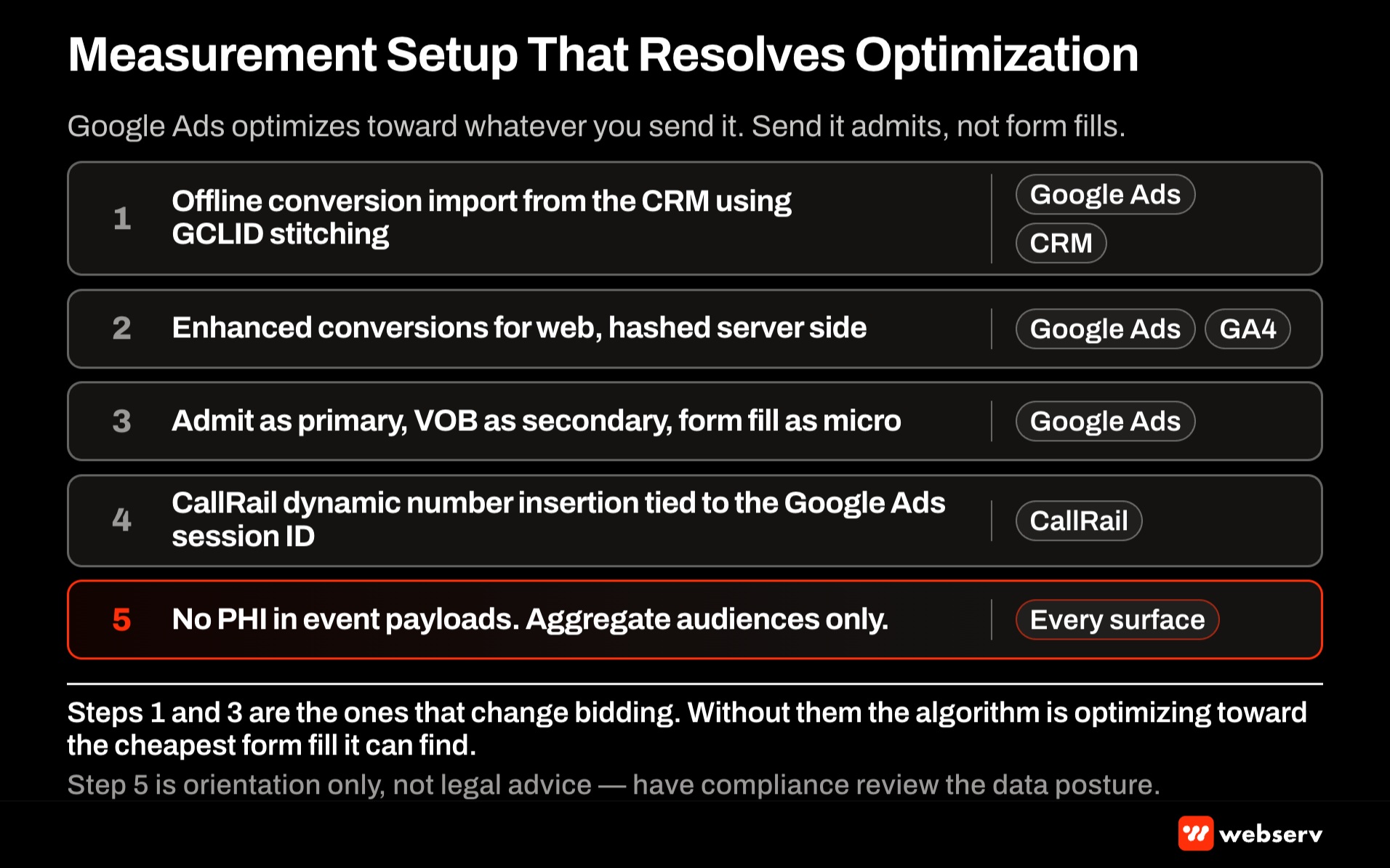
Server-side conversion tracking. Google Ads conversions sent from a server-side container and keyed to the click ID, the paid-search counterpart to Meta CAPI. Reduces iOS Safari cookie limitations, ad-blocker blocking, and PHI leakage risk from client-side tags. Our Meta CAPI setup piece walks the shared GTM-SS infrastructure both platforms plug into.
Keep enhanced conversions for web and for leads off. Google’s customer data policy says conversions related to health or medical information can’t be used for measurement in enhanced conversions, so no hashed email, phone, or name goes to Google. Run the click-based setup on server-side tagging infrastructure (GTM-SS or similar on BAA-covered hosting).
Offline Conversion Imports. Google Ads accepts offline conversion uploads that connect the eventual admit back to the specific paid click. Send them from the server-side layer under neutral names (tier_1_conversion), with no condition or level-of-care detail, as laid out in our HIPAA-safe conversion tracking stack. Enables Google’s optimization to train against admit outcomes rather than just inquiry outcomes.
The specific workflow: CRM exports admit-level data with the gclid preserved from the original session. Data uploads to Google Ads on a weekly or monthly cadence. Google’s optimization then trains against admit outcomes over the following weeks.
Call tracking integration. Google Ads call extensions produce calls that Google tracks natively. Dynamic number insertion tracking captures calls from clicks that reach the website before calling. Both call sources should feed into Google Ads as conversion events for optimization to train against total inquiry volume including phone conversions. Our call tracking piece covers the DNI + CRM integration pattern.
Cohort-level cost-per-admit measurement. Session-level cost-per-inquiry is what Google reports. Cost-per-admit is what matters for facility economics. Our GA4 configuration guide covers the session-layer that plugs into the admit-cohort measurement.
Facilities that measure only cost-per-inquiry typically overestimate campaign performance because inquiry-to-admit conversion rates vary meaningfully by traffic source. Cohort-level cost-per-admit measurement produces the attribution that supports allocation decisions.
Most in-house teams hit a wall not because they lack knowledge, but because they lack bandwidth.
When you are ready to hand it off, Webserv has spent 9 years executing exactly this for treatment centers nationwide.
Frequently Asked Questions
How much should we spend on Google Ads for a single-facility BH operator?
There is no universal number. Budget has to cover the high-intent search volume in your market with enough conversions for bidding to train. Underfunded accounts never give Google’s bidding enough conversions to train against.
Past a certain point, returns diminish because the addressable high-intent search volume for a single facility saturates. Keyword Planner and impression share data show where that ceiling sits.
Portfolio operators with multiple facilities can scale meaningfully higher because each market carries its own addressable high-intent search volume. Portfolio operators can scale further because each market carries its own high-intent search volume, so size budget market by market.
What is the typical cost-per-admit from Google Ads for BH?
Cost-per-admit varies widely by level of care, payer mix, market, and campaign structure, so benchmark against your own cohorts. Google Ads typically produces lower cost-per-admit than Meta because the search traffic is further down the decision funnel. Our Meta Ads playbook covers the paid social side of the same media mix.
Cost-per-admit measured on cohorts rather than at session level. Facilities that measure only cost-per-inquiry typically overestimate campaign performance because inquiry-to-admit conversion rates vary meaningfully by traffic source.
Residential and detox admits typically produce higher cost-per-admit at the top of the range with higher revenue per admit. PHP and IOP admits typically produce lower cost-per-admit with lower per-admit revenue.
Do we need separate Google Ads campaigns per facility in a portfolio?
Yes. Portfolio operators should run separate campaigns per facility with facility-specific geographic targeting, facility-specific landing pages, and facility-specific conversion tracking.
Portfolios that run consolidated campaigns across multiple facilities typically produce attribution fragmentation that prevents facility-level optimization decisions.
The specific consideration for portfolio operators: shared account infrastructure (billing, LegitScript certification at the operator level) with per-facility campaigns underneath. Portfolio ops teams manage the shared infrastructure; facility-level teams (or the portfolio marketing team on their behalf) manage per-facility campaign decisions.
How long does it take to see Google Ads produce admits?
Expect weeks for the first cohort of Google-attributed admits, depending on level of care mix and payer mix. Google Ads typically produces admits faster than Meta because the search traffic is higher intent.
Acute-need detox and residential admits often show up first. Non-emergency PHP and IOP admits typically take longer.
The right measurement window is long enough for full inquiry cohorts to resolve before evaluating cohort-level cost-per-admit. Shorter windows produce misleading conclusions because Google’s optimization is still training.
How do LegitScript certification issues affect our ad performance?
Certification lapse can quickly stop BH ads from serving. Restoration then takes time.
The downstream cost of certification lapse: paid search downtime plus the admit pipeline decline that follows the paid pause. Pipeline recovery typically lags well behind ad account restoration.
The right pattern: a LegitScript renewal calendar tracked well ahead of certification expiration, plus quarterly LegitScript compliance review of active creative and landing pages to catch issues before they trigger certification review.
What is the difference between running Google Ads manually versus through an agency?
Manual management works for facilities with meaningful internal paid search time and expertise. Agencies work for facilities that need specialized BH-specific expertise and cannot allocate internal time.
The cost tradeoff: agencies typically charge a management fee, often tied to ad spend. Internal management costs loaded staff time, so compare the two on total cost and on BH-specific expertise. Agency fees are appropriate when the agency’s BH-specific expertise produces meaningful performance improvement above internal management capability.
The specific expertise areas that meaningfully differentiate BH-specialist agencies: LegitScript workflow, BH-specific negative keyword libraries, Performance Max constraint patterns for BH, and offline conversion import setup for admit-level attribution.
How does Google Ads interact with our overall paid media program?
As the anchor channel for most treatment center paid media programs. Google Ads is often the largest source of paid admissions for facilities running multi-channel paid programs. Meta is usually the other major channel (see our Meta Ads playbook), with LinkedIn, TikTok, connected TV, and other channels splitting the remainder.
The specific integration pattern: Google captures high-intent search demand, Meta builds awareness and captures middle-funnel research traffic, other channels supplement specific audience or placement contexts. Our attribution guide covers the five-layer chain that resolves multi-channel activity into admit-level attribution.
Facilities that run only one paid channel typically produce concentrated attribution risk. Multi-channel paid programs typically produce more resilient admissions economics because channel-specific issues (policy changes, algorithm shifts, cost inflation) affect only part of the program.
Keaton Nalle is the Director of Paid Admissions at Webserv, a digital marketing agency for treatment centers.