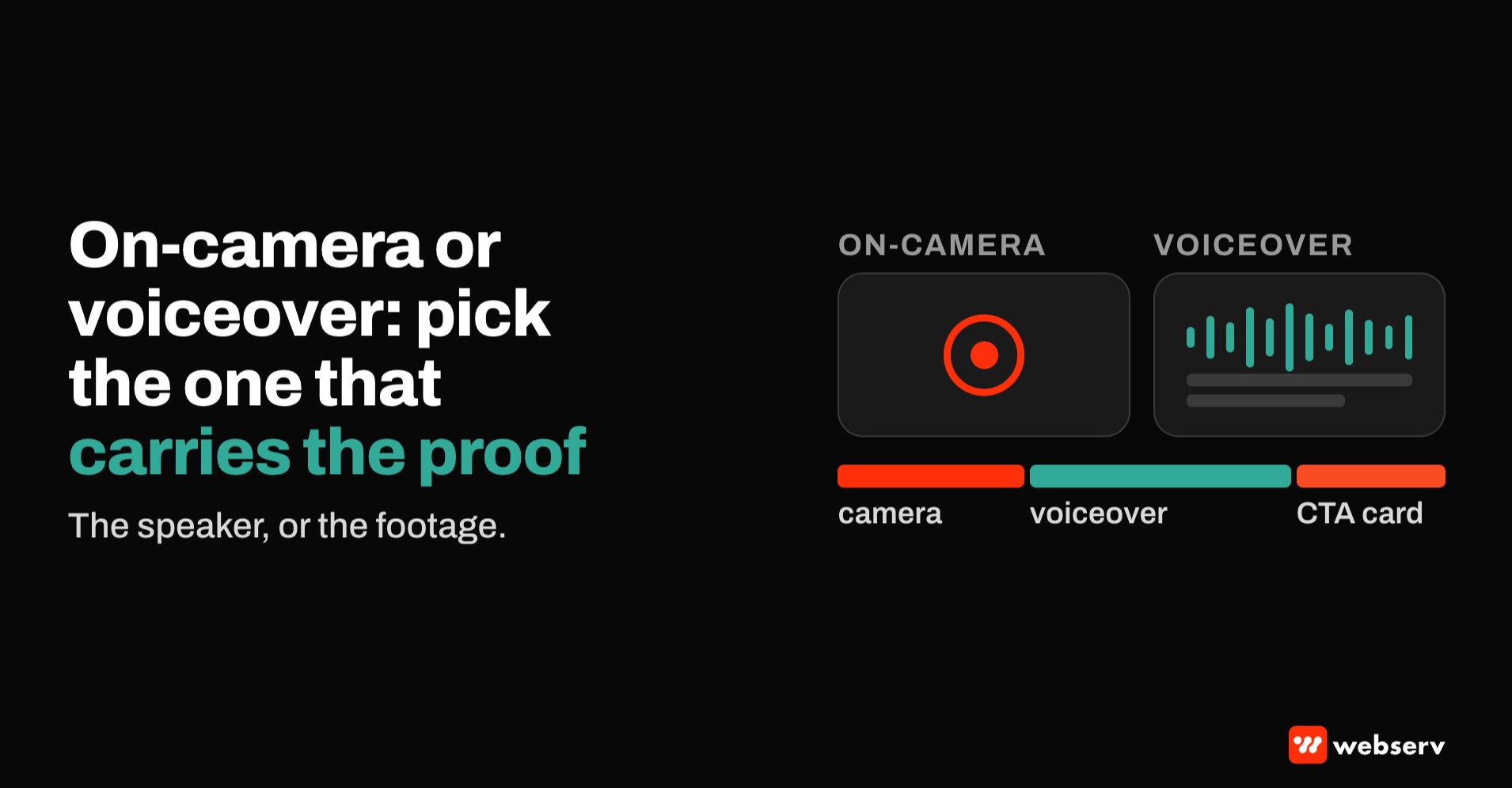
Google’s guidance for YouTube video ads tells advertisers to do both: feature people to humanize the story, and reinforce the call to action with voiceover. TikTok’s creative guidance calls voiceovers and direct-to-camera narration “simple yet effective” and endorses both.
So the useful question for a treatment center isn’t which format wins. It’s which one fits the job a given ad has to do, the people available to appear in it, and the rules that come with each choice.
On-camera video puts a clinician, admissions coordinator, or family member in front of the viewer. Voiceover keeps the speaker off screen and lets footage of the facility, the program, or an illustrative scene carry the picture. Each has different strengths, production costs, and compliance obligations.
This piece covers what each format is, what the platforms say, when each tends to fit, how the compliance rules differ, and how to test them against each other. It’s part of the work inside our ad creative practice for treatment centers.
Key Takeaways
- Google’s ABCD guidance for YouTube recommends featuring people on screen and reinforcing the call to action with voiceover. The two formats work together more often than they compete.
- TikTok reports that voiceover in ads can add about 12% to conversion rate, from a 2023 retail analysis. It’s a platform finding from another category, not a treatment center benchmark.
- On-camera works best when the speaker is the proof: a credentialed clinician, the admissions team, or an authorized family member.
- Voiceover works best when the footage is the proof, when identities need protection, or when the ad will be revised, cut down, or translated often.
- The rules differ by format. Clinician endorsers must have the expertise they’re presented as having, actors portraying patients need a clear disclosure, and identifiable former patients need written authorization.
- Test both with the same script and the same hook, then compare results through the CRM, not just platform metrics.
What each format is
The two formats, defined.
DEFINITION
On-camera. A video ad in which the speaker appears on screen, usually speaking directly to the viewer. In treatment center ads, the speaker is typically a clinician, an admissions coordinator, a program director, or an authorized alumnus or family member.
Voiceover. Narration recorded separately and laid over footage, with the speaker off screen. The footage might be the facility, a program space, an illustrative scene with actors, or motion graphics.
Most treatment center video uses a hybrid: an on-camera opening that establishes who is speaking, then voiceover over B-roll of the facility, then a return to camera or a text card for the call to action. The choice is less about all-or-nothing and more about which format carries each moment.
What the platforms say
Google and YouTube. Google’s ABCD guidance for YouTube ads covers Attention, Branding, Connection, and Direction. Under Connection it says to feature people to help tell the story.
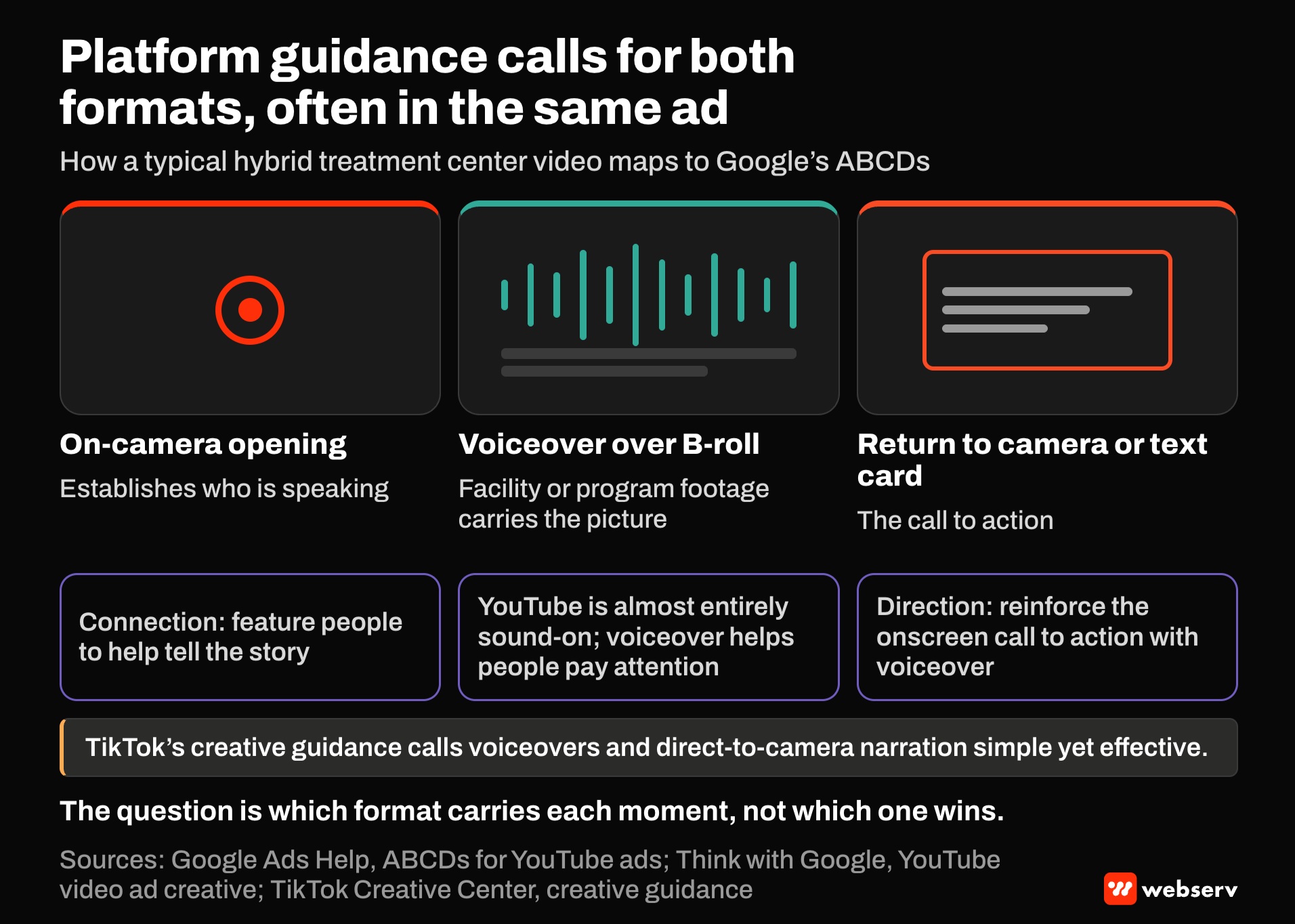
Under Direction it says to reinforce the onscreen call to action with voiceover. Google cites a Google and Kantar study finding the ABCDs together deliver up to a 30% lift in short-term sales likelihood.
Think with Google also describes YouTube as almost entirely a sound-on experience, and lists voiceover among the audio inputs that help people pay attention.
TikTok. TikTok’s creative guidance says voiceover can add about 12% to conversion rate, that over 93% of top-performing videos use audio, and that live-action content saw a 25% click-through lift over computer-generated imagery. The voiceover figure comes from a May 2023 retail analysis.
What the platforms report
Up to 30%
lift in short-term sales likelihood with all four ABCDs (Google and Kantar, 2021)
12%
conversion rate lift with voiceover (TikTok, 2023 retail analysis)
93%+
of top-performing TikTok videos use audio (TikTok)
Sources: Google ABCD guidance for YouTube ads; TikTok creative guidance. Platform findings from other categories, not treatment center benchmarks.
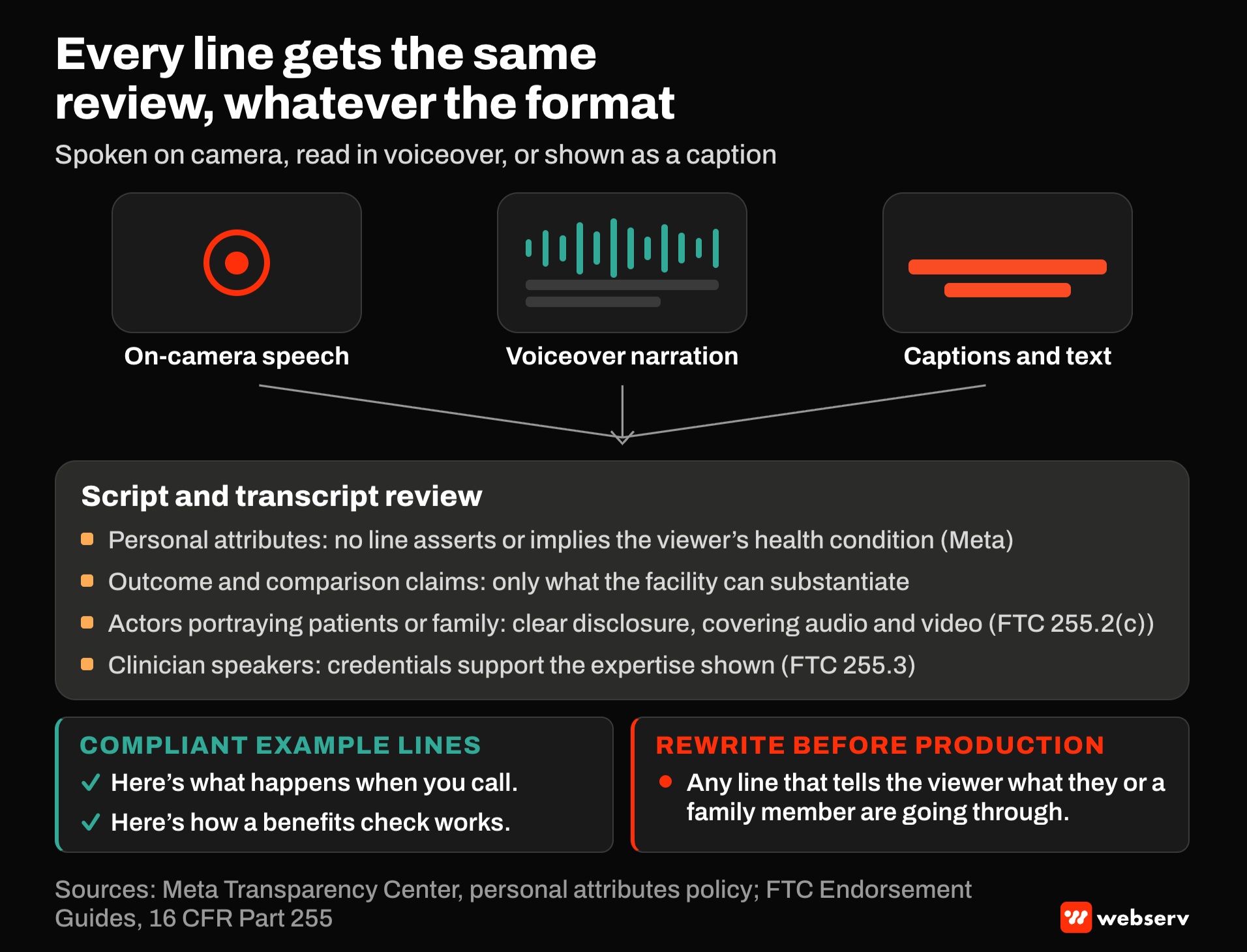
Meta. Meta’s personal attributes policy bars ads that assert or imply a viewer’s physical or mental health conditions. Write every line of a script to that standard, whether it’s spoken on camera, read in voiceover, or shown as text.
COMMON MISTAKE
Treating the script as compliant because the captions are. A clinician who says “If you’re struggling with drinking, call us” on camera has made the same implication as a caption that says it.
Review the transcript of every spoken line, on-camera and voiceover, with the same rules as the written copy. Our video ad script templates show compliant phrasings.
When on-camera fits
On-camera tends to fit when the person speaking is part of what the ad is proving.
WHEN THE SPEAKER IS THE PROOF
- Clinician explainers. A named, credentialed clinician explaining a level of care carries authority that narration over B-roll can’t. The FTC’s Endorsement Guides require that an expert endorser’s qualifications actually give them the expertise they’re presented as having (§ 255.3).
- Admissions introductions. A short ad showing the person a family will reach when they call answers a real question: who picks up the phone.
- Authorized family or alumni stories. When written authorization is in place, a real person on camera is more credible than a narrated account.
The costs are real. On-camera ads depend on the speaker’s availability, comfort on camera, and continued employment. An ad featuring a clinician who has left the facility has to come down. Reshoots for compliance changes cost more than re-recording a voiceover.
When voiceover fits
Voiceover tends to fit when the footage carries the message or when the speaker’s identity is a problem.
- Facility and program walkthroughs. The rooms, the schedule, and the setting are the proof. Narration explains what the viewer is seeing.
- Insurance and process explainers. “What happens when you call” or “how a benefits check works” is information, and voiceover over simple footage or graphics delivers it cleanly.
- Family-perspective stories without an identifiable patient. Narration over illustrative scenes can tell a family’s experience without putting a former patient on screen. If actors portray patients or family members, the ad needs a disclosure.
- Ads that change often. A voiceover can be re-recorded for a new insurance list, a new program, a Spanish-language version, or a 6-second cutdown without a new shoot.
OPERATOR INSIGHT
Decide the format at the storyboard stage, not in the edit. If the plan is a clinician on camera, the storyboard needs to account for that clinician’s schedule, a compliance briefing before the shoot, and a backup cut in voiceover if the clinician leaves.
Our storyboarding framework covers how to build that into the plan.
How the compliance rules differ
The rules side by side:
| Element | On-camera | Voiceover |
|---|---|---|
| Staff clinician speaking | Credentials must support the expertise shown (16 CFR 255.3); employment is a material connection to disclose if viewers wouldn’t expect it (255.5) | Same rules apply if the clinician is named or identified |
| Former patient or family member | Written HIPAA authorization for marketing use; Part 2 consent may also apply | Same if the person is identifiable by voice, name, or story |
| Actor portraying a patient or family member | Clear disclosure that they aren’t actual patients (255.2(c)) | Same, covering both the audio and the video |
| Spoken claims | Reviewed like written copy for outcome, comparison, and personal-attribute claims | Same |
| Captions | Needed for sound-off viewing and accessibility (WCAG 1.2.2) | Same |
| AI-generated voice or face | Not recommended for authority speakers | Platform disclosure rules apply to political and election ads; Meta may auto-label AI-edited ads |
Three points behind that table:
Actors. The FTC’s guides say an ad portraying consumers should use actual consumers in both the audio and the video, or clearly disclose that the people shown aren’t actual consumers (§ 255.2(c)). That applies to a voice actor narrating a “patient’s” story as much as to an actor on screen.
Former patients. HHS says the HIPAA Privacy Rule requires written authorization before protected health information is used for marketing, with limited exceptions. Treat an identifiable former patient in an ad as requiring authorization, and have counsel confirm whether Part 2 also applies. Our testimonial compliance playbook covers the authorization packet.
AI voices. Google Ads’ synthetic content checkbox applies to election ads, and Meta’s advertiser disclosure covers social issue, election, and political ads. Meta also applies an “AI info” label when it detects ads made or edited with AI tools. Our guide to AI-generated ad creative recommends human voices for authority narration.
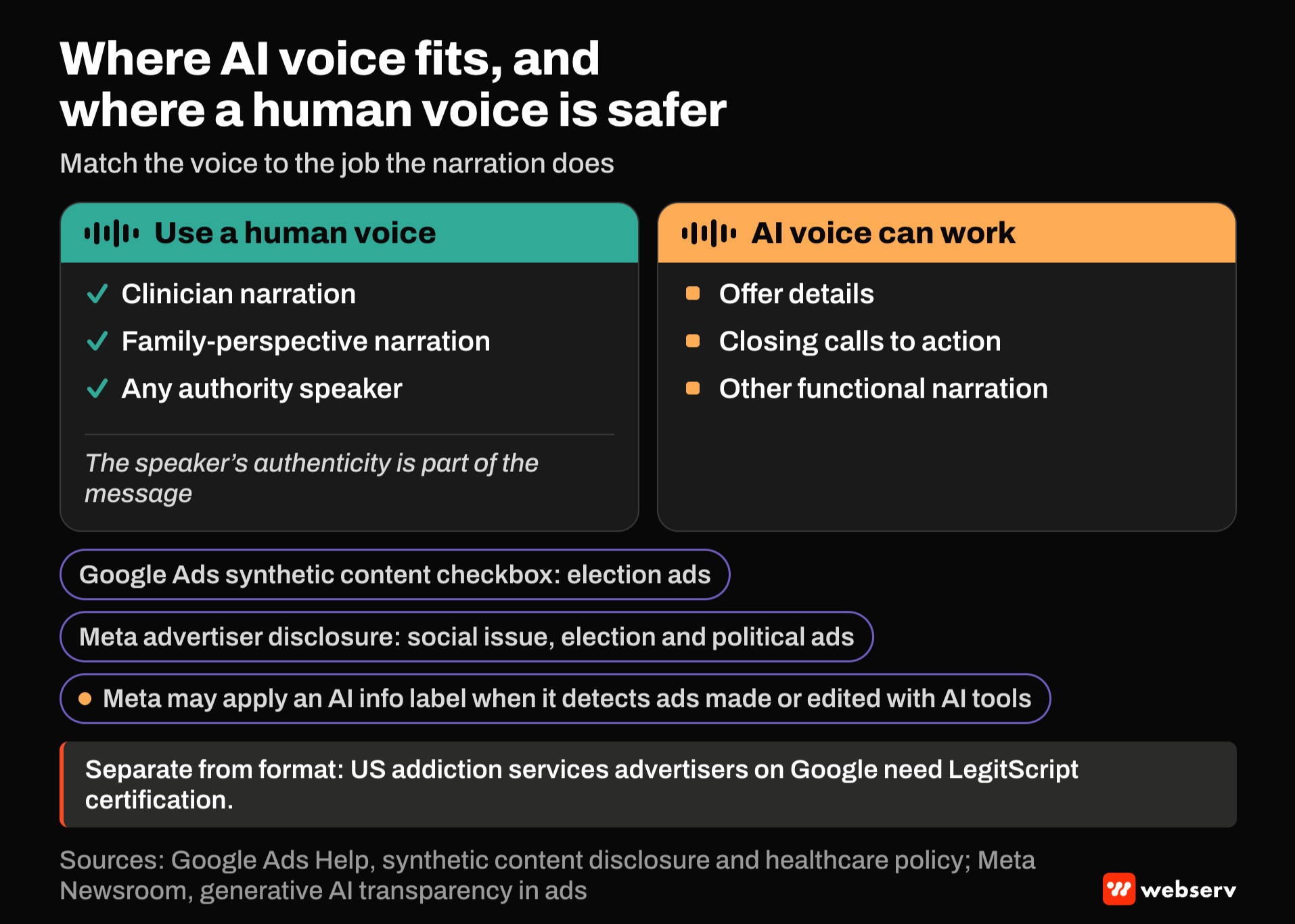
Google also requires LegitScript certification for US addiction services advertisers, whatever the format.
How to test them against each other
Format tests are only useful when the format is the only thing that changes.
Write one script
Write one script. Same hook, same body, same call to action.
Produce two executions
Produce two executions. One on camera, one in voiceover over facility or program footage. Keep length and captions matched.
Run them in the same ad set
Run them in the same ad set so they compete for the same audience and budget.
Read the early signal
Read the early signal. Hook rate and hold rate show which version keeps attention. Our hook testing guide covers how to read them.
Judge on the CRM
Judge on the CRM. Compare calls, qualified inquiries, and admits sourced to each version, not just clicks or platform leads.
Common mistake: concluding from one test. A clinician explainer that loses to a voiceover walkthrough may reflect that clinician’s delivery, not the format. Test the format with more than one speaker and more than one topic before deciding.
Where this fits
Format is one decision inside a broader creative system. For the patterns that work in treatment center video, see our guide to video ad creative for behavioral health, and for format mix on Meta, comparison of video, static, and motion ads.
For creative strategy as a whole, see the creative strategy guide for rehab and addiction treatment marketing and the ultimate guide to ad creative strategy.
For how paid creative fits the rest of your marketing, see the complete guide to behavioral health marketing. If you want a second look at your video creative, book an intro meeting.
Frequently Asked Questions
Is voiceover or on-camera better for treatment center video ads?
Neither wins across the board. Google’s ABCD guidance recommends featuring people and reinforcing the call to action with voiceover, and many effective ads use both.
On-camera fits when the speaker is the proof, such as a credentialed clinician. Voiceover fits when the footage is the proof or the ad will be revised often.
Test both with the same script and judge on calls and admits.
Do voiceover ads still need captions?
Yes. Captions reach viewers watching without sound, and WCAG 1.2.2 calls for captions on prerecorded audio in video.
TikTok’s creative guidance says captions can improve view time, recall, and likability.
Caption both on-camera and voiceover versions, and review the caption text with the same rules as the script.
Can we use an actor to voice a patient’s story?
Yes, with a disclosure. The FTC’s Endorsement Guides say ads portraying consumers should use actual consumers in both the audio and the video, or clearly disclose that they aren’t.
That applies to voice actors as well as on-screen actors.
Keep the story’s claims to what the facility can substantiate.
Do we need patient authorization if a former patient only narrates?
If the person is identifiable by name, voice, or story, treat it the same as appearing on camera. HHS says HIPAA requires written authorization before protected health information is used for marketing, with limited exceptions.
Part 2 consent may also apply to substance use disorder providers.
Have counsel review the authorization before production.
Can we use AI-generated voiceover?
Google’s and Meta’s advertiser disclosure requirements for synthetic content apply to election and political ads, and Meta may label ads it detects were made or edited with AI.
For clinician or family narration, a human voice is the safer choice, since the speaker’s authenticity is part of the message.
AI voice can work for functional narration such as offer details or closing calls to action.
Keaton Nalle is the Director of Paid Admissions at Webserv, a digital marketing agency for treatment centers.