Google stopped showing HowTo rich results on desktop on September 13, 2023, a month after removing them from mobile. Google’s Search Central changelog then removed the HowTo structured data documentation entirely, because the result “is no longer shown in search results.”
Many treatment center sites still carry HowTo markup, often generated by an SEO plugin on posts like “how to get into rehab” or “how to verify your insurance.” The question isn’t whether it earns a rich result. It doesn’t. The question is whether it does anything else, and whether it’s worth keeping, adding, or removing.
The short answer: it’s mostly harmless, it isn’t an AI citation tactic, and the visible steps on the page matter more than the markup.
This piece covers what happened to HowTo rich results, what the markup still does according to Google, Microsoft, and recent data, and a simple keep, add, or drop decision.
It’s the HowTo companion to our piece on FAQ schema after Google retired FAQ rich results, and part of the work inside our AEO program for treatment centers.
Key Takeaways
- Google removed HowTo rich results from mobile in August 2023 and from desktop on September 13, 2023, then removed the HowTo documentation. No HowTo markup produces a visual enhancement in Google Search today.
- Google said structured data that isn’t used doesn’t cause problems for Search, but also has no visible effect. Existing, accurate HowTo markup can stay.
- Google says there’s no special schema needed for AI Overviews or AI Mode, and that structured data isn’t required for generative AI search.
- Ahrefs’ May 2026 test of 1,885 pages that added schema found no major lift in AI citations on any platform. Microsoft says schema helps search engines and AI systems understand content, without promising selection.
- Don’t add HowTo markup as an AI search tactic. Remove it where it doesn’t match visible steps or sits on pages that aren’t procedures.
- Clear, visible, numbered steps are what readers and AI systems can actually use. Put the effort there.
What happened to HowTo rich results
The sequence:
August 2023
Google limited HowTo rich results to desktop, as Search Engine Roundtable reported from Google’s announcement. FAQ rich results were cut back to authoritative government and health sites at the same time.
September 13, 2023
Google stopped showing HowTo rich results on desktop too, which made the result type deprecated. Search Console’s HowTo report and Rich Results Test support were dropped shortly after.
September 14, 2023
Google removed the HowTo structured data documentation.
In the 2023 announcement, Google said structured data that isn’t being used doesn’t cause problems for Search but also has no visible effects in Google Search.
DEFINITION
HowTo markup. Schema.org structured data that describes a process as an ordered series of steps, using the HowTo type with HowToStep items. The schema.org vocabulary is still active. What ended is Google’s rich result for it.
What the markup still does, according to the sources
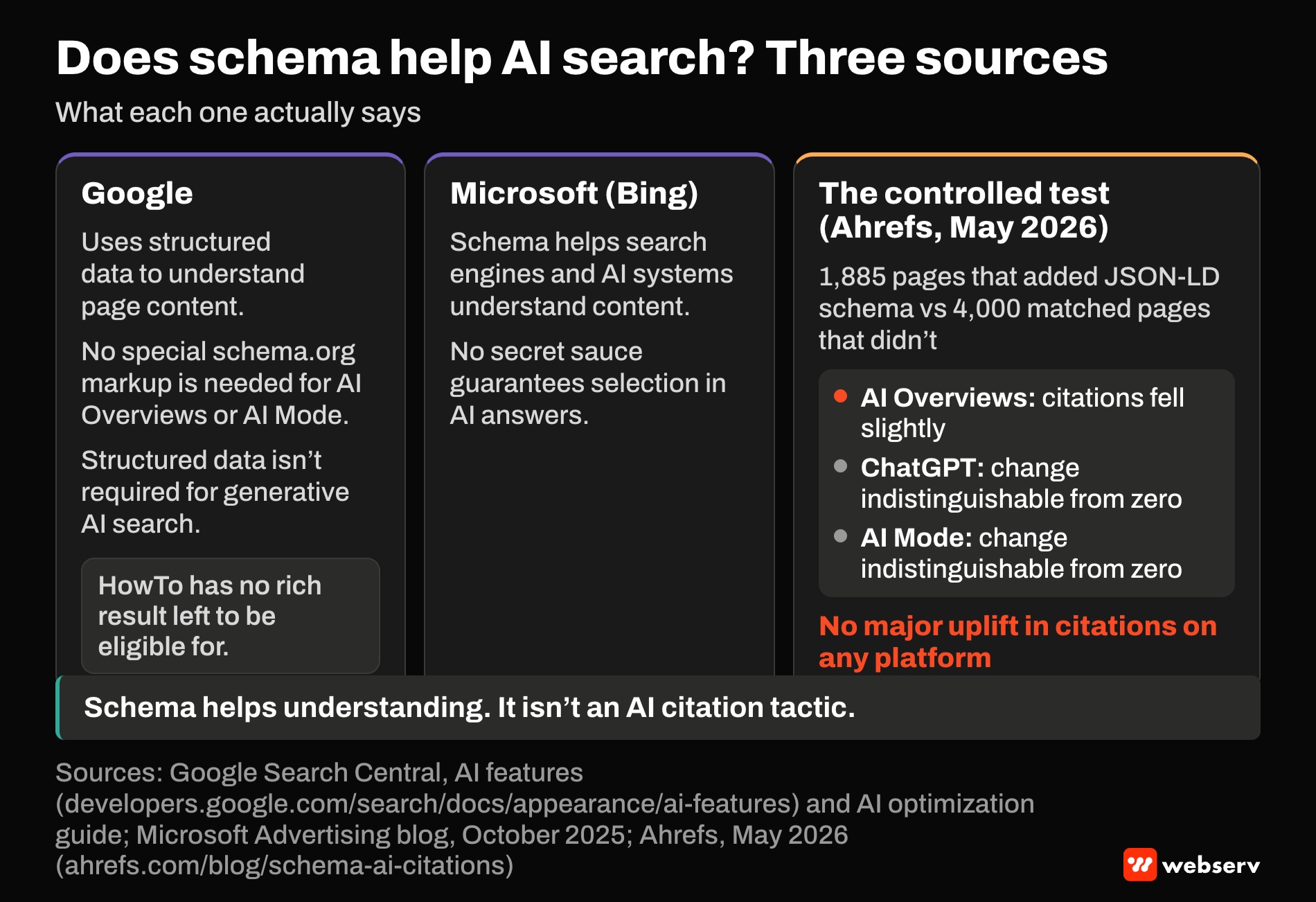
Google. Google’s structured data introduction says it uses structured data to understand page content. But its AI features documentation says there’s no special schema.org structured data you need to add for AI Overviews or AI Mode.
Google’s AI optimization guide adds that structured data isn’t required for generative AI search, while recommending it as part of overall SEO for rich result eligibility. HowTo no longer has a rich result to be eligible for.
Microsoft. A Bing product manager’s October 2025 post on optimizing for AI search answers says schema helps search engines and AI systems understand content. The same post says there’s no secret sauce that guarantees selection in AI answers.
The data. Ahrefs’ May 2026 study compared 1,885 pages that added JSON-LD schema against 4,000 matched pages that didn’t. Adding schema produced no major uplift in citations on any platform. AI Overview citations fell slightly, and the ChatGPT and AI Mode changes were statistically indistinguishable from zero.
The same study found cited pages were almost three times more likely to have JSON-LD than uncited pages, which Ahrefs attributes to well-maintained sites doing both. Its test covered pages already earning AI Overview citations, so it doesn’t settle whether schema helps pages that aren’t cited yet.
COMMON MISTAKE
Treating correlation as a tactic. Studies showing cited pages tend to have schema get read as “add schema, get cited.” The controlled test found no lift from adding it.
The pages that get cited tend to be well-built in many ways at once. Schema is one sign of that care, not the cause of the citation.
Keep, add, or drop
Keep it if the markup is valid and matches steps a reader can see on the page. Google says unused structured data doesn’t cause problems, and Microsoft says schema helps understanding. There’s no reason to spend time removing accurate markup.
Don’t add it as an AI search tactic. Neither Google nor the controlled data supports HowTo markup as a way to earn citations or visibility. Time spent adding it is better spent on the visible content.
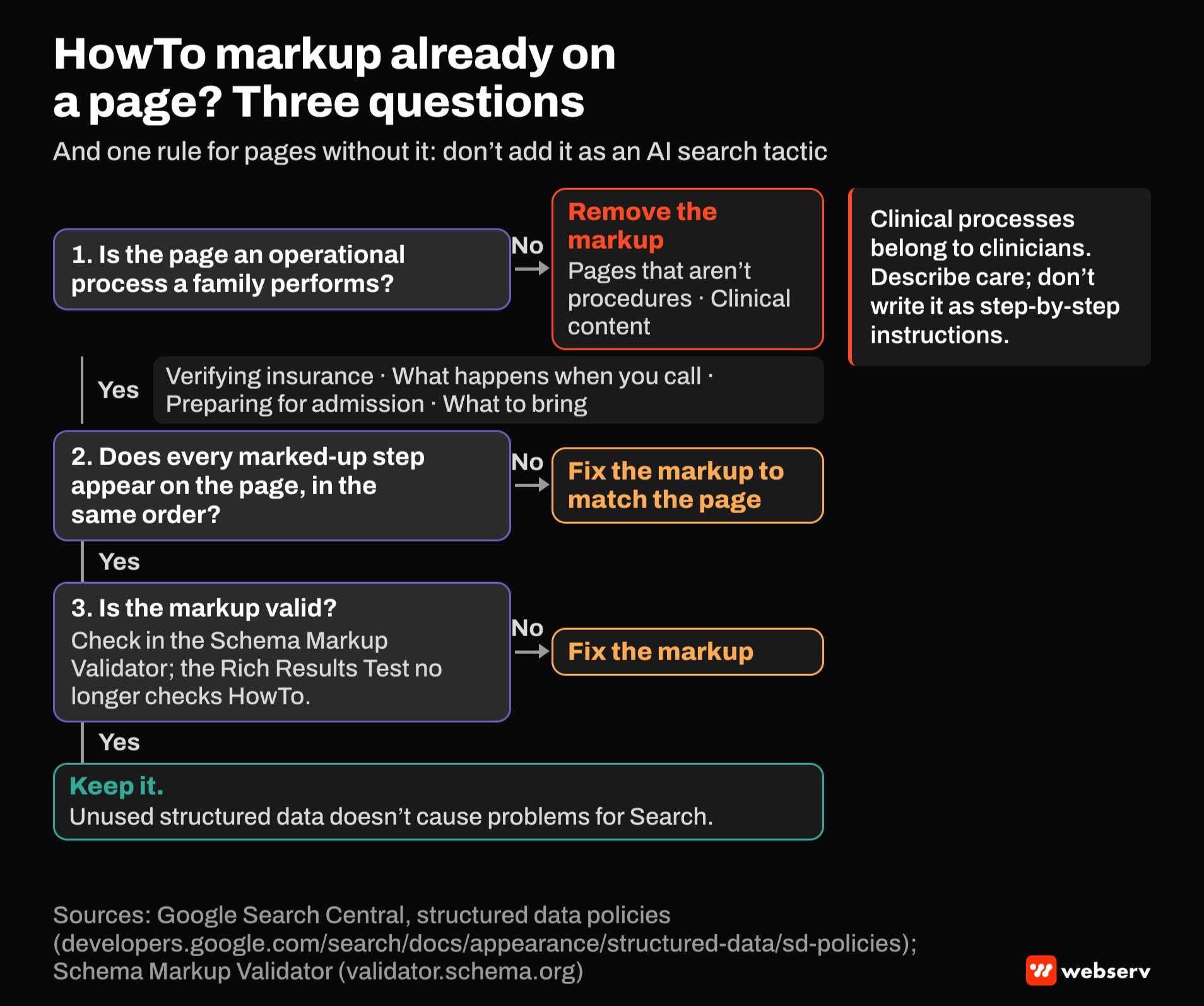
Remove or fix it when it fails Google’s structured data policies. Google says markup must be a true representation of the page and shouldn’t describe content that isn’t visible. Common problems:
- HowTo applied site-wide by a plugin template, including pages that aren’t procedures.
- Steps in the markup that don’t match the steps on the page, often after an edit.
- Clinical content marked up as do-it-yourself instructions. Treatment processes belong to clinicians, and step markup can make a description of care read like self-treatment guidance.
HowTo fits operational processes a family can follow: verifying insurance, what happens when you call, preparing for admission, what to bring. Those are steps the reader actually performs.
DO
- Keep accurate markup on real process pages.
- Fix markup steps that no longer match the page.
DON’T
- Add HowTo markup as an AI citation tactic.
- Apply it site-wide through a plugin template.
- Mark up clinical content as step-by-step instructions.
What matters more than the markup
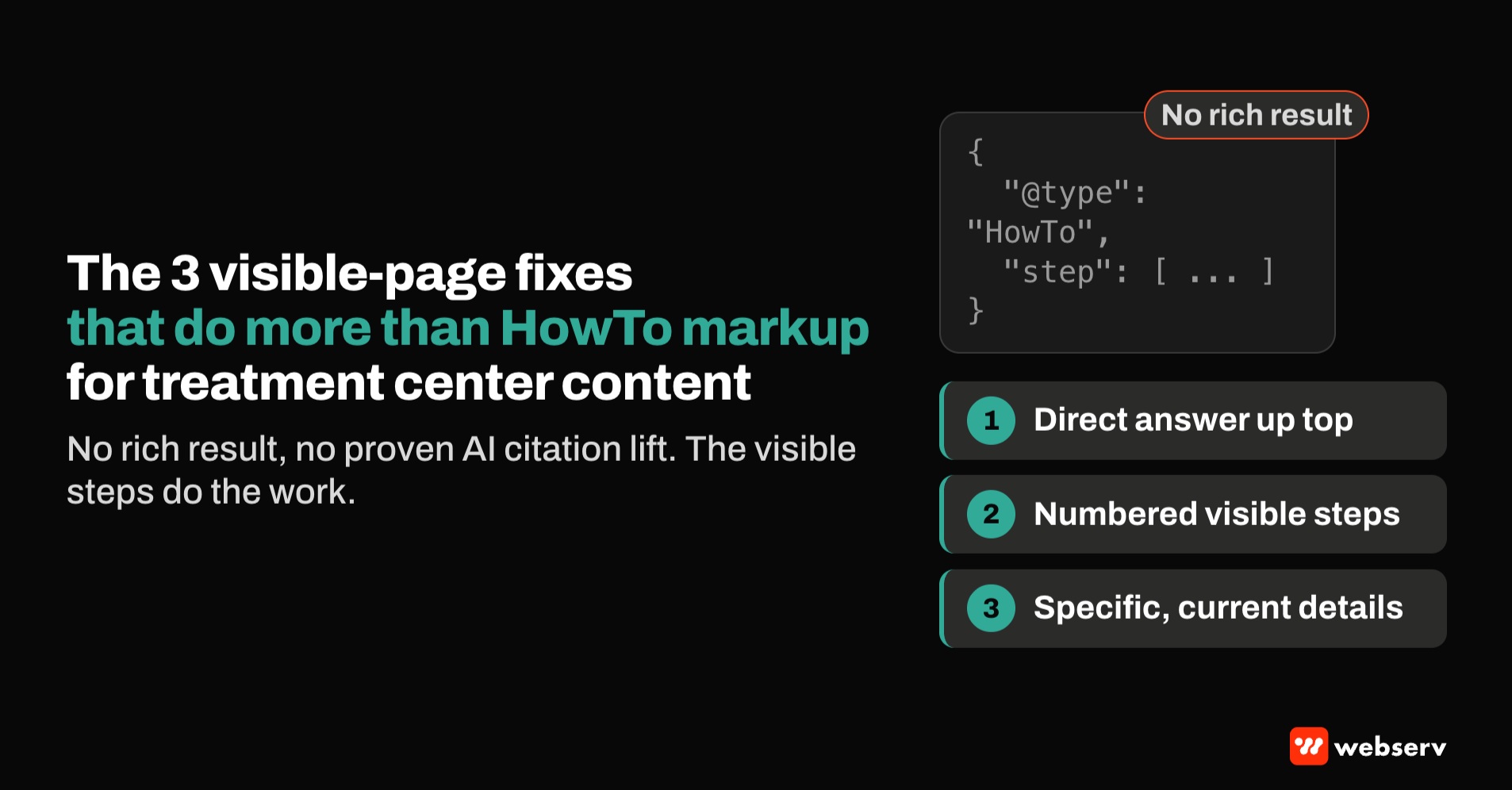
Visible numbered steps. A process written as a numbered list, one action per step, is readable to a parent on a phone and easy for any system to parse. That’s true with or without markup.
A direct answer up top. Lead the section with a one- or two-sentence answer before the steps. Our guide to the 40-word answer block covers the pattern.
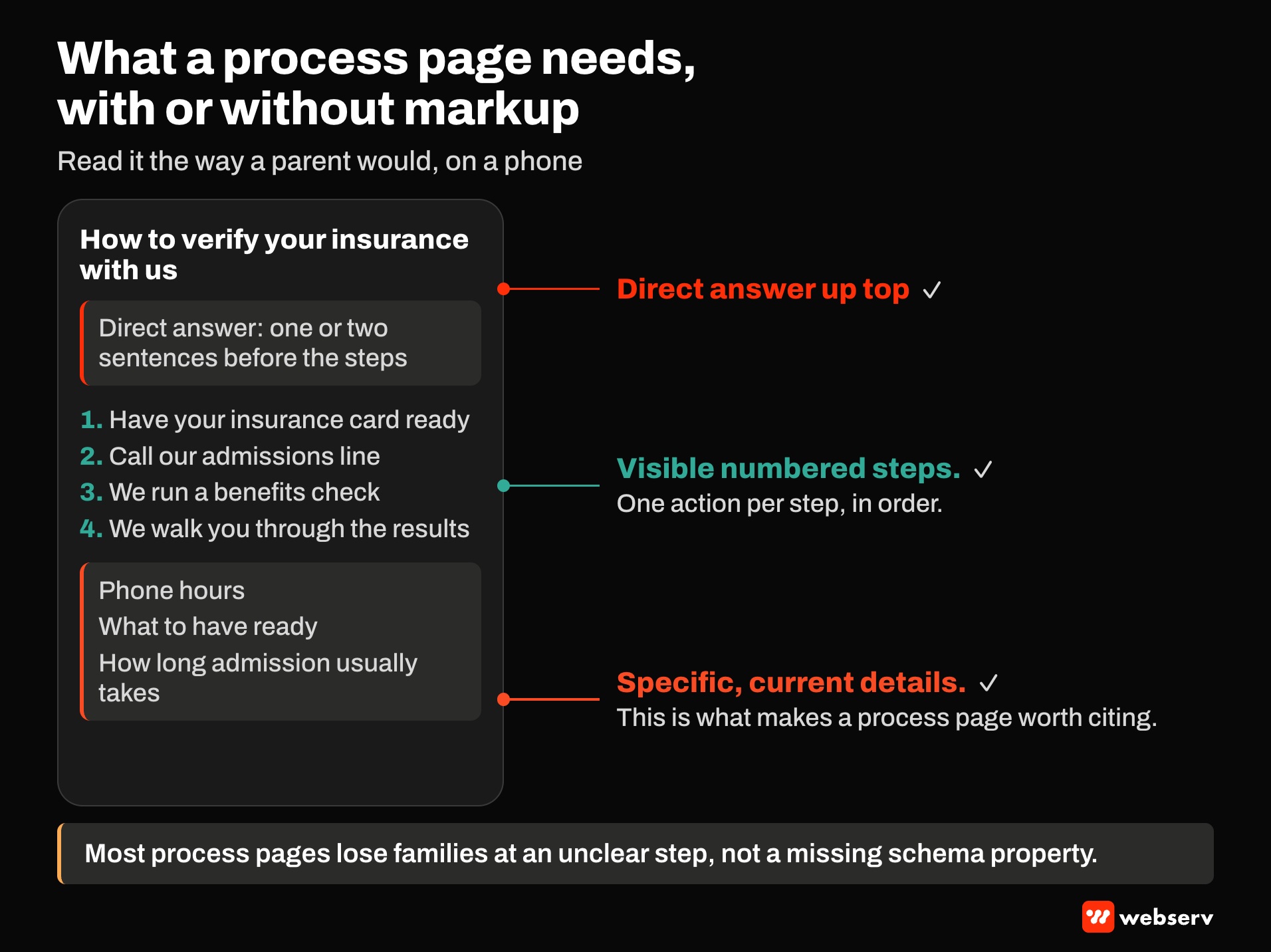
Specific, current details. Phone hours, the insurance information to have ready, what a benefits check involves, how long admission usually takes at your facility. Specifics are what make a process page worth citing.
OPERATOR INSIGHT
Pull up your five most-visited process pages and read them as a parent would on a phone. If the steps aren’t numbered, aren’t in order, or skip the part where someone picks up the phone, fix that before touching any markup.
Most process pages lose families at an unclear step, not at a missing schema property.
A quick HowTo audit
Five checks, in order.
A QUICK HOWTO AUDIT
- Find the markup. Check your SEO plugin’s schema settings and view the source of process pages for “HowTo.”
- Validate it. Google’s Rich Results Test no longer checks HowTo, so use the Schema Markup Validator.
- Compare to the page. Confirm every step in the markup appears on the page in the same order.
- Check the page type. Remove HowTo from pages that aren’t procedures, and from clinical content.
- Fix the visible steps. Number them, put them in order, and lead with a short answer.
Where this fits
HowTo is one small part of the structured data layer. For the schema types that matter more for behavioral health, see our guide to structured data beyond Rank Math defaults and our piece on entity SEO for treatment centers.
For the broader AI search picture, see the Full AI Search Stack, our guide to getting cited in Google AI Overviews and ChatGPT, the 12 SEO failure patterns diagnostic, and the 5-tier SEO priority framework.
For how AI search fits the rest of your marketing, see the complete guide to behavioral health marketing. If you want a second look at your structured data, book an intro meeting.
Frequently Asked Questions
Does Google still show HowTo rich results?
No. Google stopped showing HowTo rich results on mobile in August 2023 and on desktop on September 13, 2023, and then removed the HowTo documentation.
No HowTo markup produces a visual enhancement in Google Search today.
The schema.org HowTo vocabulary still exists, but Google doesn’t use it for a search feature.
Should we remove HowTo markup from our site?
Only where it’s wrong. Google has said structured data that isn’t used doesn’t cause problems for Search, and Microsoft says schema helps search engines understand content.
Remove it from pages that aren’t procedures, from clinical content, and anywhere the marked-up steps don’t match the visible page.
Accurate markup on a real process page can stay.
Does HowTo schema help with AI Overviews or ChatGPT citations?
There’s no evidence it does. Google says no special schema is needed for AI Overviews or AI Mode.
Ahrefs’ 2026 test of 1,885 pages that added schema found no major lift in AI citations on any platform.
Clear, visible, numbered steps and specific details are the better investment.
What should we use instead of HowTo schema?
Visible structure. Write processes as numbered steps, one action per step, with a short direct answer above them.
Keep Organization, LocalBusiness, Article, and author markup accurate, since Google still supports those types.
Put the remaining effort into specifics families need, like phone hours and what to have ready for a benefits check.
Which treatment center pages are good candidates for step-by-step content?
Operational processes a family actually follows: verifying insurance, what happens when you call, preparing for admission, and what to bring.
Clinical processes, like what happens in detox, are better written as descriptions of care led by clinicians, not as instructions.
Whatever the page, keep the steps current as your process changes.
Trevor Gage is the Director of Marketing at Webserv, a digital marketing agency for treatment centers.