Most treatment center creative teams skip storyboarding. The workflow goes straight from brief to shot list to production. Storyboards get treated as optional documentation that slows the timeline.
The paid media teams I work with produce their best-performing creative when the storyboard is where the narrative decisions actually happen. Not the shot list. Not the brief. The storyboard.
The shot list decides how to film. The brief decides what to say. The storyboard decides what the family watching the ad experiences frame by frame.
Skip that decision and the resulting creative reads as generic because the emotional pacing was never designed. It got assembled by the editor after production wrapped, from footage that was captured for coverage rather than for a specific narrative arc.
Behavioral health has a specific storyboarding challenge that most creative frameworks do not address. The family member watching an ad for a treatment center is not the patient.
The narrative shape that works for consumer products (recognize the problem, show the product, close on outcome) fails in behavioral health because the family member cannot personally solve the problem by acting immediately.
What they can do is change how they think about the problem, recognize the specific moment they are in, and take the first step. The storyboard shape has to serve that specific viewer.
This piece walks the five-frame storyboarding framework the ad creative team runs at Webserv and the four family-focused concept archetypes that produce the strongest paid social and paid YouTube performance in behavioral health. Both live inside our ad creative practice.
It also covers the specific compliance considerations that need to surface during storyboarding rather than after, and the failure modes that undermine storyboarding even when the team commits to the discipline.
This piece pairs with our ultimate guide to ad creative strategy, which covers the broader creative production discipline, and our piece on why creative is an afterthought in behavioral health marketing, which covers the strategic case for treating creative as first-class. For the broader picture, see our creative strategy for rehab and addiction treatment marketing guide and our behavioral health marketing guide.
Key Takeaways
- Storyboarding is where the narrative decisions for behavioral health ad creative actually happen. Skipping the storyboard and going directly to shot list produces creative assembled from generic coverage footage rather than creative designed for a specific emotional arc. The performance difference between the two approaches is meaningful.
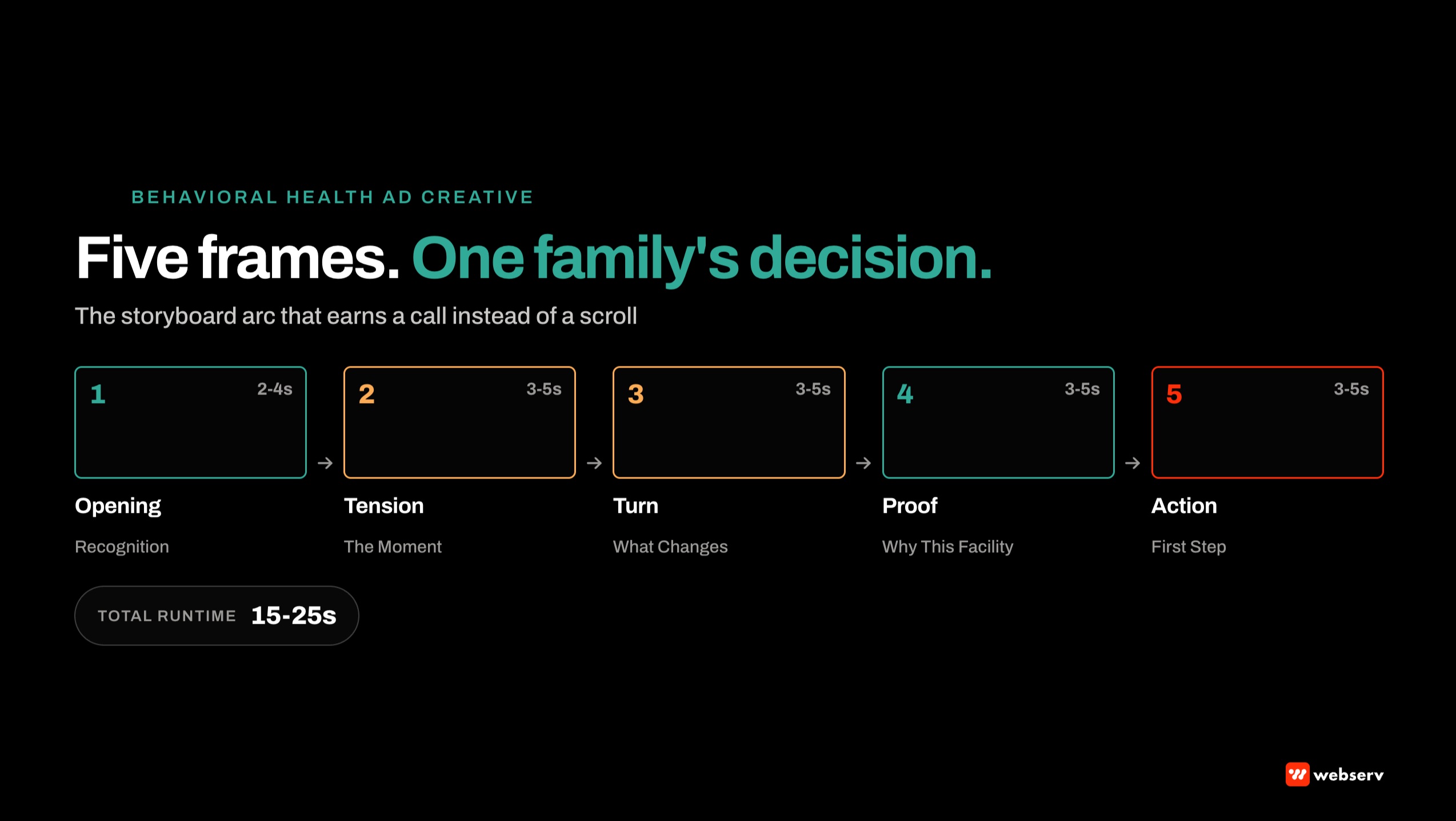
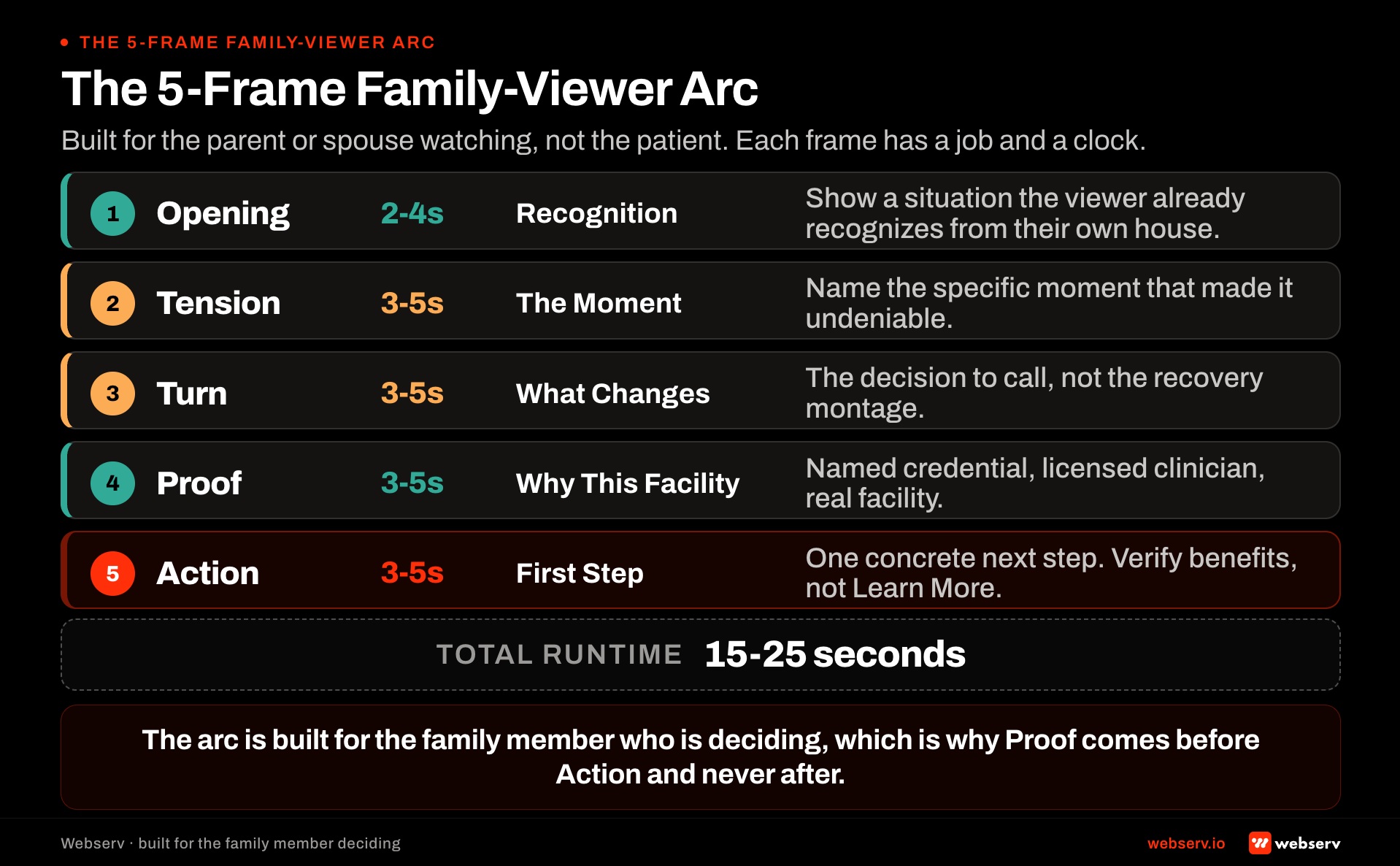
- The five-frame framework for behavioral health ad creative: opening frame that produces recognition in the family viewer, tension frame that names the specific moment the family is in, turn frame that shows what changes, proof frame that establishes why this specific facility, and action frame that closes with a specific first step. Each frame has a distinct job and compressing frames collapses the arc.
- Behavioral health storyboarding has to serve the family member watching the ad, not the patient. The family member cannot personally solve the problem, so the storyboard cannot pretend they can. The narrative shape has to serve what the family can actually do: think about the problem differently, recognize the moment they are in, and take a specific first step.
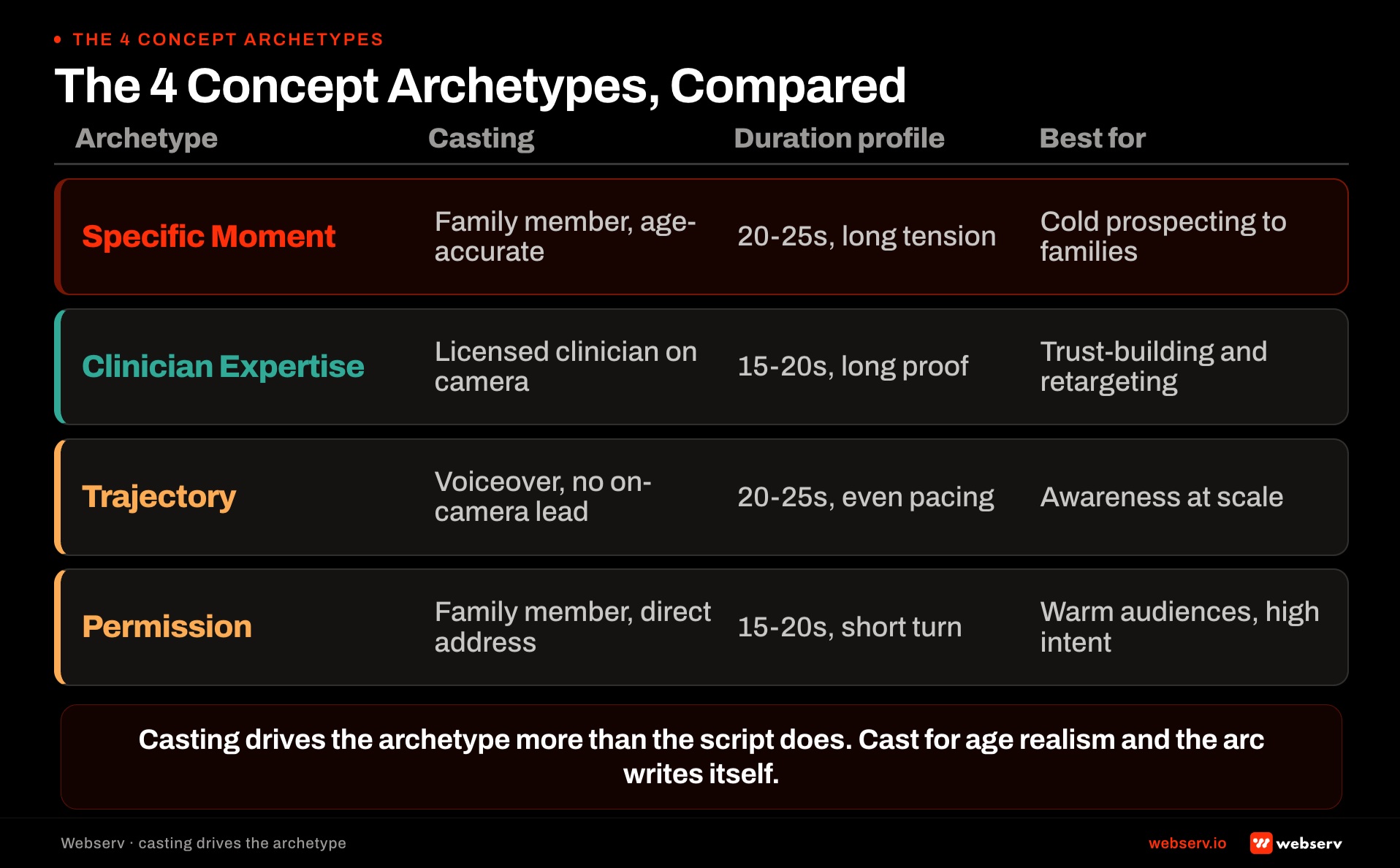
- Four concept archetypes produce most of the successful family-focused creative we run: the specific moment concept (family recognizes a pattern in their life), the clinician expertise concept (why this facility specifically), the trajectory concept (what changes over time), and the permission concept (families need permission to intervene).
- Compliance considerations must surface during storyboarding, not after production. LegitScript claim standards, Google BH advertising policy, HIPAA-adjacent context in patient imagery, and FTC guidance on testimonials all constrain what the storyboard can specify. Fixing compliance issues after production is more expensive than catching them in the storyboard.
DEFINITION
Ad creative storyboard. A pre-production artifact that captures the specific sequence of frames the viewer experiences, the emotional shape each frame is meant to produce, and the transitions between frames. Answers “what does the family watching this ad actually see and feel, in what order, and for how long.”
Distinct from mood boards (tone without frame sequence), brand style guides (constraints without execution), shot lists (production coverage without narrative arc), and scripts (spoken/displayed language without visual sequence). The storyboard is the pre-production decision layer that turns a brief plus a script into a specific creative artifact. Without it, creative gets assembled downstream from footage captured for coverage rather than for a specific narrative.
OPERATOR INSIGHT
Storyboard for the family member watching the ad. Not the patient.
The family member cannot personally solve the problem by acting immediately. What they can do is change how they think about the problem, recognize the specific moment they are in, and take the first step. The storyboard shape has to serve that specific viewer. Every consumer-product narrative arc (recognize problem, show product, close on outcome) fails here because the family cannot buy the solution the way they can buy shampoo.
What storyboarding actually is
Storyboarding is a specific pre-production artifact that is different from mood boards, brand style guides, shot lists, and scripts.
A mood board captures the visual and emotional tone the creative should carry. It answers “how should this feel” without specifying what happens frame by frame.
A brand style guide captures the constraints the creative operates under (color palette, typography, logo usage, banned imagery). It answers “what are the rules” without specifying the specific creative execution.
A shot list captures what needs to be captured on the production day. It answers “what do we need to film” without specifying how the captured footage will be assembled into a narrative arc.
A script captures the language spoken or displayed. It answers “what do we say” without specifying what the viewer sees while it is being said.
A storyboard captures the specific sequence of frames the viewer experiences, the emotional shape each frame is meant to produce, and the transitions between frames. It answers “what does the family watching this ad actually see and feel, in what order, and for how long.”
The storyboarding discipline is the pre-production decision layer that turns a brief plus a script into a specific creative artifact. Without it, the creative gets assembled downstream from footage that was captured for coverage rather than for the specific narrative the storyboard would have designed.
The five-frame framework for behavioral health ad creative
The framework that produces the strongest paid social and paid YouTube performance for treatment center clients has five distinct frames. Each frame has a specific job that other frames cannot do. Compressing frames or reordering them collapses the narrative arc.
Frame 1: Opening (Recognition)
The family viewer sees themselves in the opening frame. Not literally themselves. The specific situation they are in. A mother watching a video sees a scene that mirrors the exact conversation she had with her son last Sunday. A husband sees a moment he recognized in his wife three months ago. The opening frame produces recognition, not attention.
The opening frame is not the strongest visual or the highest-production-value moment. It is the most specifically recognizable moment. Generic recognition fails. The stronger the specificity, the stronger the recognition. Duration: 2 to 4 seconds in a paid social format, 3 to 5 seconds in an in-stream YouTube format.
Frame 2: Tension (The Moment)
The frame that names what the family has been carrying without a word for. The specific pattern they have been noticing but not describing to anyone. The moment last Tuesday that they have not told their spouse about. The tension frame does not create the tension. The family already has it. The tension frame names it.
Tension does not mean crisis. Crisis language triggers Google BH advertising policy and LegitScript compliance issues. Tension means the specific psychological state the family is already in but has not articulated. The word “quiet” often shows up in the copy for tension frames. Duration: 3 to 5 seconds.
Frame 3: Turn (What Changes)
The frame where the possibility of change enters the narrative. Not the outcome. The turn. The recognition that the family’s situation is not fixed, that other families have been in the same specific moment and made a specific first move, that there is a path.
The turn frame is where most treatment center creative goes wrong. It rushes to the outcome, showing the patient months later in a recovery scene.
That framing fails because the family cannot yet imagine the outcome. What they can imagine is the turn. What they need to see is the first step, not the arrival. Duration: 3 to 5 seconds.
Frame 4: Proof (Why This Facility)
The frame that establishes why this specific facility rather than a generic option. Clinician expertise, specific clinical framework, accreditation, or a specific programmatic detail that separates the facility from the category. The proof frame is where facility-specific differentiation happens.
Proof is not “the leading treatment center in [region].” That claim is generic and violates LegitScript’s comparative-superiority standards. Proof is a specific credential, a specific clinician on camera, a specific accreditation, or a specific clinical detail. Duration: 3 to 5 seconds.
Frame 5: Action (The First Step)
The frame that closes with a specific first step the family can take. Not “call today” as a generic imperative. The specific first step framed in the language the family is using to think about the situation.
The action frame is where the phone-first CTA lives, along with the specific step (“we can talk through your specific situation” rather than “call for a free consultation”).
The action frame carries the phone number and the specific expectation of what happens when the family calls. Duration: 3 to 5 seconds.
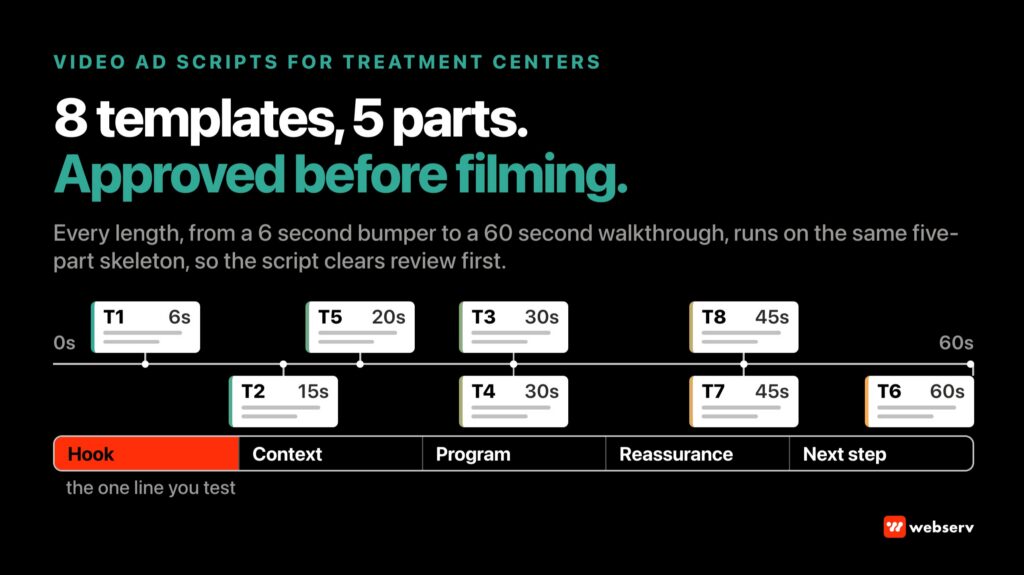
Total runtime for the five-frame arc: 15 to 25 seconds. This fits paid social (15 to 30 second formats) and YouTube in-stream (15 to 30 second variants) cleanly. Longer-form creative (60 to 90 second facility overview videos) extends specific frames but does not add new frame types.
The storyboarding surface at a glance
5
Frames: opening, tension, turn, proof, action
4
Family-focused archetypes: moment, clinician, trajectory, permission
15-25 s
Target runtime for the 5-frame arc, sized for Meta and YouTube in-stream
4-8 hrs
Planning estimate for storyboarding one short-form family ad
The four family-focused concept archetypes
Four distinct concept archetypes have produced most of the successful family-focused creative we run across treatment center clients. Each archetype has a distinct storyboard shape, a distinct casting decision, and a distinct performance profile in paid social and paid YouTube.
Archetype 1: The specific moment concept
The entire creative is built around one specific moment the family recognizes. The Sunday morning conversation. The text message that went unanswered. The empty seat at the family dinner. The five-frame arc anchors to that specific moment as the recognition point in Frame 1, deepens it in Frame 2, offers the turn in Frame 3, proves the facility can help in Frame 4, and closes with the first step in Frame 5.
Casting: family members on camera, not clinicians. The recognition depends on the family viewer seeing themselves reflected. Clinicians on camera in this archetype dilute the recognition effect. Duration profile: works at 15 to 25 seconds.
Archetype 2: The clinician expertise concept
The entire creative is built around a clinician’s specific expertise and clinical framework. The five-frame arc opens with the clinician introducing the specific clinical situation the ad is about, moves through the clinical framing of what families miss, presents the specific clinical approach, proves the credentials, and closes with the first step.
Casting: named clinician with credentials on camera. This is the archetype where E-E-A-T signal compounds most directly, because the on-camera clinician also grounds the Person schema on the site and the AI Information page.
Duration profile: 30 to 60 seconds usually works better than 15 to 25 because the clinical framing needs time.
Archetype 3: The trajectory concept
The entire creative is built around what changes over the treatment arc. Not a before-and-after (which violates Google BH advertising policy and LegitScript standards for BH). A trajectory that shows what shifts in family life, family communication, or family dynamics as treatment progresses.
Casting: family members plus clinical context. Careful compliance handling because trajectory framing can drift into outcome claims. Duration profile: 45 to 90 seconds usually works better than shorter formats because the trajectory arc needs runway. This archetype is where longer-form YouTube in-stream and video views campaigns work best.
Archetype 4: The permission concept
The entire creative is built around giving the family permission to intervene. Families researching treatment often carry guilt about pursuing treatment for a loved one, or ambivalence about whether the intervention is warranted. The permission archetype names that guilt or ambivalence in Frame 2 and gives permission in Frame 3.
Casting: clinician on camera speaking to family perspective, plus family footage where compliance permits. The permission archetype often produces the highest engagement rates in paid social because the psychological state it addresses is under-served by other archetypes. Duration profile: 20 to 45 seconds.
Storyboarding as compliance surface
Compliance considerations for behavioral health ad creative must surface during storyboarding rather than after production. The four categories that require attention:
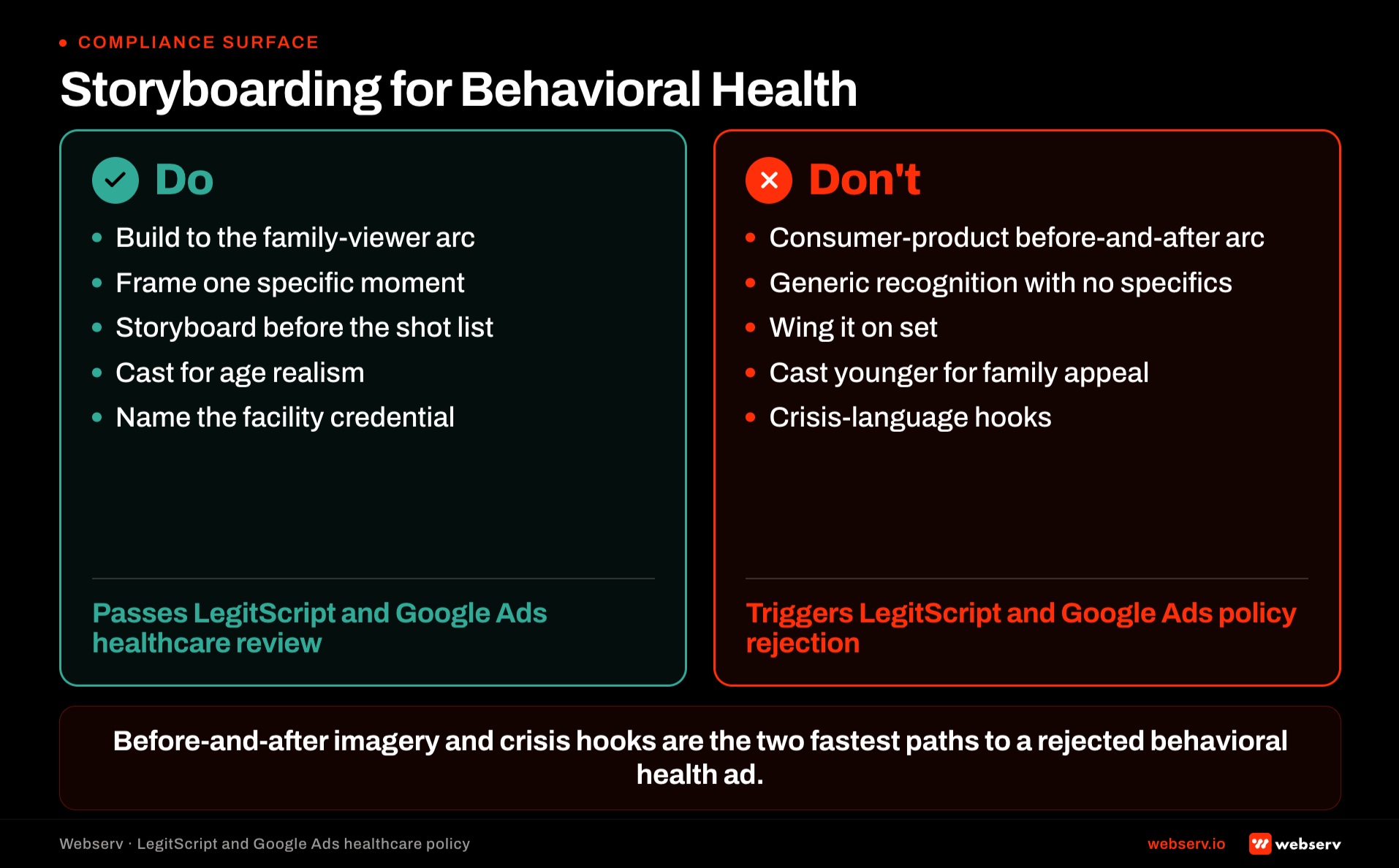
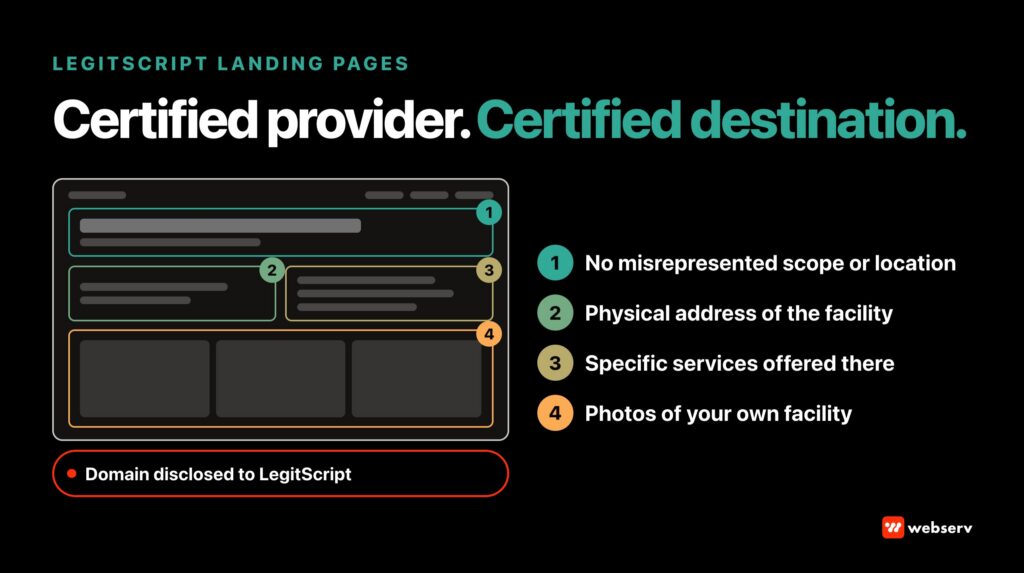
LegitScript claim standards. The storyboard frames that carry copy or on-screen text need to comply with LegitScript’s advertising standards. Guaranteed outcomes, comparative superlatives, unverified insurance-network claims, and specific-outcome numeric claims all fail the standard. Catching these in the storyboard is materially cheaper than catching them in review after production wraps.
Google BH advertising policy. The storyboard frames need to comply with Google’s healthcare and behavioral health advertising policies. Crisis-language framing, targeting-implication imagery, and specific-outcome promises all trigger Google policy enforcement.
HIPAA-adjacent context in patient imagery. Patient-in-scene imagery in the storyboard needs to avoid identifiable clinical contexts that could carry HIPAA-adjacent implications. Generic care environments and stylized composition work. Photorealistic patient imagery in specific clinical protocols carries risk.
FTC guidance on testimonials. Storyboard frames that use testimonial content need to comply with FTC guidance on endorsements. Testimonials need to reflect typical results (or be disclosed as atypical), be verifiable, and carry appropriate disclosure. Storyboarding is where testimonial content decisions get made.
Our compliant ad headlines guide covers the specific claim language rules that apply across paid platforms. Storyboards that reference the claim language rules during frame-by-frame design produce creative that passes compliance review cleanly.
Storyboard formats and tools
Different formats work for different production contexts. The most common patterns:
Paper storyboards. Hand-sketched frame-by-frame. Fastest to produce, most flexible for iteration. Works well for internal team review before agency or freelance production kicks off. The specific advantage: paper storyboards force the storyboarding discipline because there is no visual polish to hide behind. The specific weakness: paper does not scale to agency handoff or portfolio-operator reuse.
Digital storyboards in dedicated tools. Storyboarder (free desktop app), Boords, Studiobinder. Purpose-built for storyboarding with frame templates, camera notes, timing marks, and export to shot lists. Works well for facilities running consistent creative production because the storyboard becomes reusable reference across campaigns.
Slide-deck storyboards. Google Slides or Keynote with one frame per slide. Practical for facilities that do not want dedicated storyboarding software. Works well for early-stage concept review with agency partners or internal stakeholders. Weakness: slide decks encourage bullet points and text overlays rather than frame-level visual thinking.
AI-assisted storyboards. Midjourney and similar image generation tools now produce storyboard frames from text prompts. Useful for early concept exploration when the specific visual has not been decided. Our AI-generated ad creative guide covers the specific compliance guardrails that apply to AI-assisted creative development.
The correct format is the one the production team will actually use. Facilities that commit to elaborate storyboarding tools but do not enforce their use produce creative that does not benefit from the storyboarding discipline.
Facilities that use whatever format their team commits to using produce creative that consistently reflects storyboard decisions.
DO
- Storyboard for the family member, not the patient — the family is the viewer, and the narrative arc has to serve what they can actually do.
- Design the full 5-frame arc first (opening, tension, turn, proof, action), then refine specific frames — arc discipline is the load-bearing decision.
- Include the clinician who will appear on camera and a compliance reviewer in the storyboarding session — casting + compliance decisions run parallel, not sequential.
- Storyboard copy, voiceover, and text overlays alongside visuals — every element the family experiences gets decided pre-production.
- Measure reshoot rate and campaign engagement rate after adopting storyboarding — the ROI signal is what sustains the discipline.
DON’T
- Rush to outcome in Frame 3 (turn) — showing the patient months later in a recovery scene skips the moment the family can actually imagine.
- Use crisis-language framing in the tension frame — Google BH policy and LegitScript both reject it.
- Ship “the leading treatment center in [region]” as proof — comparative superlatives fail LegitScript standards.
- Storyboard the day before the shoot to justify decisions already made — that’s not storyboarding, that’s rationalization.
- Reuse another facility’s storyboard — the framework transfers, the specific storyboard does not (moment, clinician, and proof points are facility-specific).
Common failure modes
Four patterns produce most of the storyboarding failures we audit in treatment center creative production.
Failure mode 1: Storyboarding after production is booked. The production date is set. The storyboarding happens the day before the shoot to justify the shot list. The storyboard becomes a rationalization of decisions already made rather than the pre-production decision layer. The creative gets assembled downstream from footage captured for coverage. Fix: storyboard before the production date is booked.
Failure mode 2: Storyboarding one frame at a time without arc discipline. Each frame gets designed in isolation. The overall five-frame arc does not develop. The creative reads as five disconnected moments rather than one narrative. Fix: storyboard the full arc first, then refine specific frames.
Failure mode 3: Casting decisions made after storyboarding. The storyboard specifies frames that require specific casting (clinician on camera, family members, patient-perspective footage). Casting starts after the storyboard is finalized and the specific people are not available. Fix: casting decisions run parallel to storyboarding, not after.
Failure mode 4: Compliance review after storyboard is finalized. The storyboard specifies frames that carry compliance issues (guarantee claims, comparative language, HIPAA-adjacent imagery). Compliance review flags them after production. The production has to be reshot or the frames have to be cut in post. Fix: compliance review runs during storyboarding, not after.
How storyboarding fits with the broader creative production workflow
Storyboarding sits between the creative brief and the shot list in the production workflow.
The creative brief captures the strategic decision: audience, offer, positioning, KPIs. The brief answers “what are we trying to accomplish.”
The storyboard translates the brief into a specific frame-by-frame narrative. The storyboard answers “what does the family watching this ad experience.”
The shot list translates the storyboard into a production plan. The shot list answers “what do we need to capture to produce the storyboard.”
The production produces the footage. The edit assembles the footage against the storyboard. The final delivery produces the ad variants.
Facilities that skip the storyboard step compress the workflow from four stages to three. The compression produces creative that reflects the brief and the shot list but not the specific narrative the family experience needs. That gap is the specific reason storyboarding matters for behavioral health ad creative in particular, and it is the case our why creative is an afterthought piece argues at the strategic level.
Frequently Asked Questions
How long does storyboarding actually take for a treatment center ad?
For a 15 to 25 second family-focused ad, storyboarding runs 4 to 8 hours of focused work across two or three sessions.
The specific breakdown: 2 hours on initial concept development (which archetype, what specific moment, what casting), 2 hours on frame-by-frame design (the five frames with specific visual and copy notes), and 1 to 2 hours on compliance review and iteration. For a 45 to 90 second longer-form ad (typical for trajectory or clinician expertise archetypes), storyboarding runs 8 to 16 hours because the additional frames need individual design attention and the transitions between frames become more elaborate.
Facilities that compress storyboarding to under 2 hours typically produce storyboards that document decisions already made rather than decisions being made through the storyboarding process itself. That compression usually surfaces later as reshoots or post-production workarounds.
Who should be in the storyboarding session?
At minimum: the creative director or creative lead, the paid media manager who owns the campaign, and a compliance reviewer who can flag LegitScript or Google BH policy issues in real time. Optional but strong: the specific clinician who would appear on camera in the ad, the admissions director if the ad targets a specific admissions moment, and the production partner (agency or freelance director) who will translate the storyboard into a shot list.
Facilities that run storyboarding with the marketing team alone typically produce storyboards that skip compliance considerations and clinical accuracy. Facilities that bring in the clinician and compliance reviewer produce storyboards that pass through production with fewer downstream adjustments.
The specific gotcha: portfolio operators sometimes assume storyboarding for one facility’s ad can be reused for another facility. Storyboards are facility-specific because the specific moment, the specific clinician, and the specific proof points change per facility. The framework transfers. The specific storyboard does not.
Can we skip storyboarding for shorter formats like 6-second bumper ads?
Not entirely, but the storyboard for a 6-second bumper looks different. A bumper does not have room for the full five-frame arc. It typically compresses to two frames: recognition or tension in the first 3 seconds, action in the last 3 seconds. The storyboard for a bumper still needs to specify which two frames and how they transition.
Facilities that skip storyboarding on bumpers entirely produce bumpers that read as truncated versions of longer-form ads without the narrative shape a 6-second format requires. Bumpers built from cutdown longer footage without dedicated storyboarding typically underperform bumpers designed as bumpers from the start.
Our YouTube Ads guide covers the specific format constraints for bumper ads plus in-stream and in-feed formats that inform storyboard decisions.
How does storyboarding interact with AI-generated creative tools?
AI-generated creative tools can produce storyboard frames from text prompts, which accelerates the initial visual exploration step. Midjourney and similar tools produce reasonable storyboard frames within minutes rather than the hours a human sketcher would take.
The specific gotcha: AI-generated storyboard frames capture visual composition but not narrative arc. The AI produces individual frames without understanding whether they connect into the five-frame arc the creative needs. A storyboard produced by prompting AI to generate five frames independently does not necessarily produce a coherent arc.
The pattern that works: use AI to explore visual options for specific frames after the arc has been designed. Do not use AI to design the arc itself. Our AI-generated ad creative guide covers the specific compliance considerations that apply to AI-assisted storyboarding.
Should the storyboard include copy, voiceover, and text overlay decisions?
Yes. The storyboard is the pre-production artifact where every element that reaches the family viewer gets decided. Copy (spoken lines or voiceover), text overlays (on-screen text), and captions all get storyboarded because they contribute to the frame the family experiences.
The specific practice that works: each storyboard frame includes a visual sketch or reference image, a copy note (what is said or displayed during this frame), a duration note (how long the frame runs), and a compliance note (which claim rules apply to this specific frame).
Facilities that storyboard visuals only and leave copy for the shoot day produce copy that has not been reviewed against LegitScript or Google BH policy. Our compliant ad headlines guide covers the specific language rules that apply to every claim-carrying frame.
How do we measure whether storyboarding is producing better creative?
Two signals. First: reduction in reshoots and post-production workarounds. Facilities running disciplined storyboarding typically produce ad campaigns that ship without reshoots. Facilities that skip storyboarding tend to pay for it in reshoots. The reduction in reshoots is directly measurable in production budget savings.
Second: performance lift on the campaigns that ship. Storyboarding makes engagement testing cleaner, because you can compare view-through rate on YouTube and thumbstop rate on Meta across deliberately different frames instead of guessing what changed. The performance lift compounds over the campaign lifetime because algorithm optimization reinforces stronger creative.
Facilities that adopt storyboarding without measuring the specific reshoot and performance signals tend to abandon the discipline within one or two campaign cycles because the effort feels heavy without the specific ROI signal. Facilities that measure both signals typically retain the discipline because the return is visible.
Keaton Nalle is the Director of Paid Admissions at Webserv, a digital marketing agency for treatment centers.