Meta’s guidance for Instagram video ads says to feature your brand and key message within the first three seconds, and to use motion or a strong visual in the first frame.
Its December 2025 Reels research found that ads showing the brand and main message within the first five seconds were 1.7 times more likely to rank in the top fifth for purchase intent.
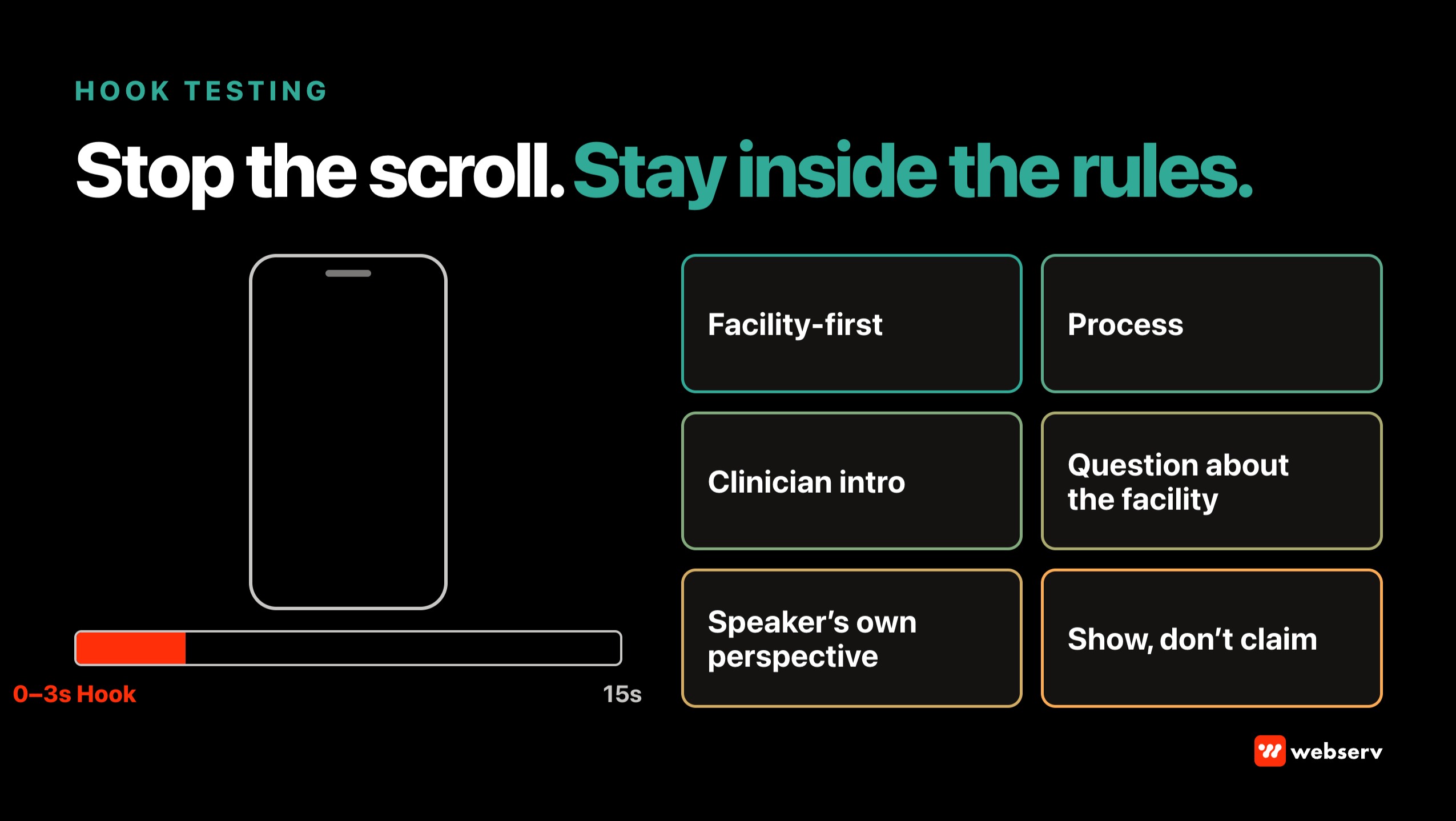
For treatment centers, the opening seconds carry an extra constraint. The most common hook in direct-response advertising, speaking straight to the viewer’s problem, is the one Meta’s personal attributes policy rules out. “Struggling with drinking?” can’t run.
So hook testing in behavioral health has two jobs: find openings that stop the scroll, and find them inside the rules.
This piece covers what Meta says about the first seconds, the hook types that work within its policies, how to set up a clean test, which metrics to read, and how to turn results into a steady creative pipeline.
It builds on the ultimate guide to ad creative strategy and reflects how our ad creative team for treatment centers runs hook tests.
Key Takeaways
- Meta recommends putting your brand and key message in the first three seconds, designing for sound off, and using vertical video.
- Meta’s personal attributes policy bars hooks that assert or imply a viewer’s health condition. Write hooks about the facility, the process, or the speaker’s own perspective.
- Test one variable at a time. Keep the body and call to action identical and change only the first few seconds.
- Meta’s A/B test compares up to five versions and recommends at least seven days. Its in-campaign creative testing compares up to seven variants with no more than 20% of the budget, and doesn’t report a confidence level.
- “Hook rate” isn’t a Meta metric. Build it as a custom metric, 3-second video plays divided by impressions, and read it alongside ThruPlays and downstream calls.
- Health advertisers may be limited to upper- and mid-funnel optimization events on Meta, which makes early attention metrics more important for judging creative.
What Meta says about the first seconds
Meta’s guidance is consistent across its help pages and research.
Its Instagram video ad best practices say to feature the brand and key message within the first three seconds, use motion or a compelling visual in the first frame, and design for sound off. The same page notes that 98% of users hold their phones vertically.
Meta’s December 2025 analysis of Reels creative found ads with the brand and main message in the first five seconds were 1.7 times more likely to rank in the top 20% for purchase intent. Hooks that used both visuals and sound were 1.5 times more likely.
Older Meta research points the same way. A Facebook and Nielsen analysis reported by Meta found up to 47% of a video campaign’s value was delivered in the first three seconds. That research dates from around 2016, so treat it as background rather than a current benchmark.
DEFINITION
Hook. The opening seconds of an ad, before the viewer decides whether to keep watching. In video, it’s usually the first one to three seconds of picture, on-screen text, and sound. In a static ad, it’s the image and headline that register at a glance.
Sound is less settled. Meta’s Instagram guidance says most users watch with sound off, while an Instagram for Business post says 80% of people view Reels with sound on. The practical answer is the same either way: put the hook in the picture and on-screen text, and add sound as a second layer.
The hooks treatment centers can use
Meta’s personal attributes policy bars ads that imply knowledge of a user’s medical information. Its own examples allow “Depression counseling” and reject “Depression getting you down? Get help now.” That rules out most viewer-problem hooks.
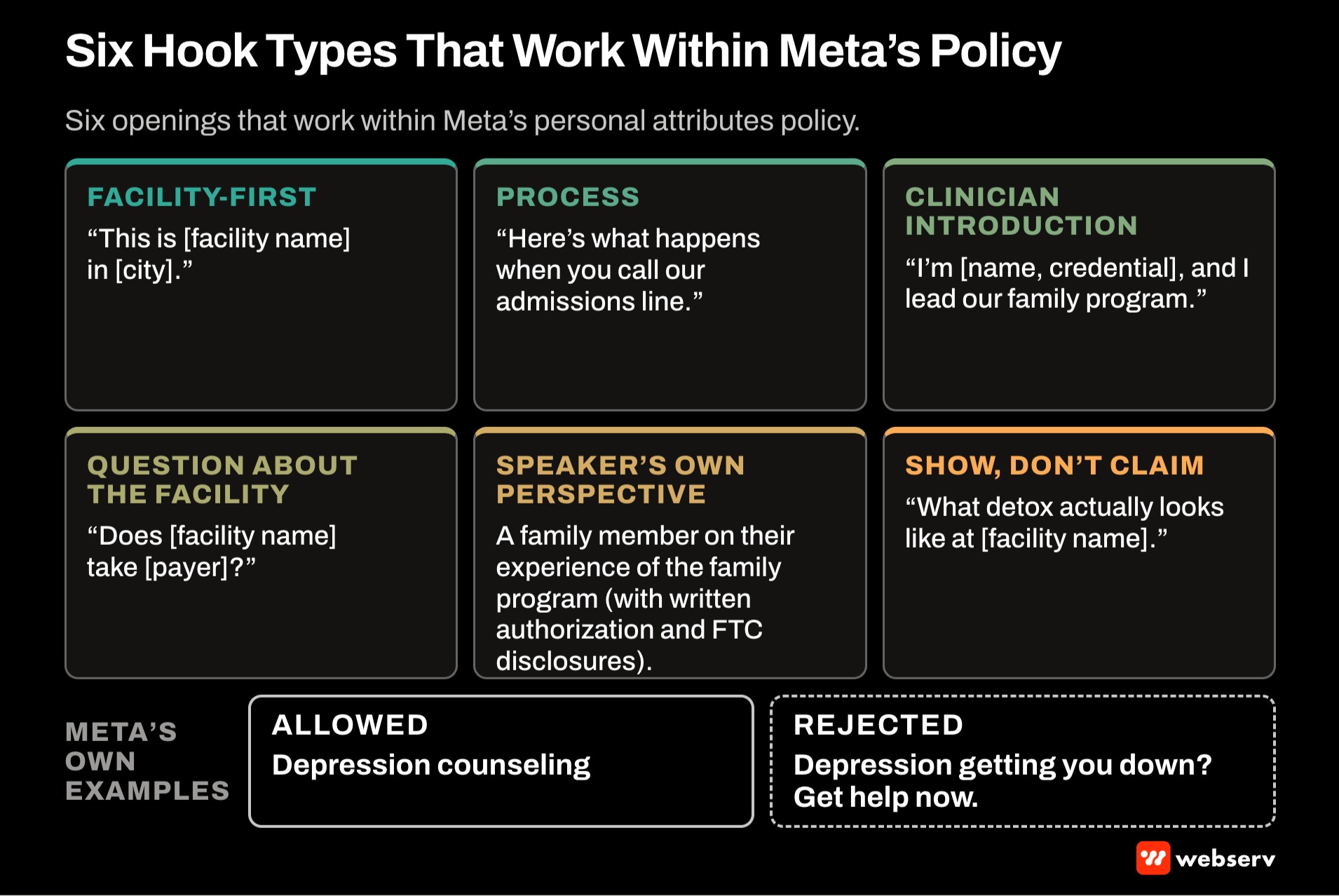
Hooks that work within the policy tend to fall into a few types:
- Facility-first: “This is [facility name] in [city].” Shows a real place, which is also what LegitScript’s standards require of facility photos.
- Process: “Here’s what happens when you call our admissions line.” Answers the question families have before they call.
- Clinician introduction: “I’m [name, credential], and I lead our family program.” A real person with real credentials.
- Question about the facility: “Does [facility name] take [payer]?” The question is about the program, not the viewer.
- Speaker’s own perspective: a family member describing their own experience of the family program, with written authorization under HHS’s marketing guidance where patient information is involved, and the disclosures the FTC’s Endorsement Guides require.
- Show, don’t claim: “What detox actually looks like at [facility name].” Opens a real tour without making claims about the viewer.
DO
- Open on the facility: a real place, by name.
- Walk through the process, such as what happens when a family calls.
- Introduce a real clinician with real credentials.
- Ask a question about the facility, not the viewer.
- Show, don’t claim: a real tour or first-day walkthrough.
DON’T
- Ask viewers about their own condition.
- Use second-person problem statements that imply a substance use problem.
- Use graphic drug use or overdose imagery.
Meta’s violent and graphic content policy says ads must not contain shocking or sensational content, and its health and wellness policy bars sensational health clickbait. Graphic depictions of drug use or overdose are poor hook material for both reasons.
COMMON MISTAKE
The second-person hook that slips through. A script opens with “You’ve tried everything. Nothing’s worked.” It doesn’t name a condition, so it passes an internal skim. But in an addiction treatment ad, it implies the viewer or their family member has a substance use problem.
Rewrite from the speaker’s perspective or the facility’s: “Families tell us they’ve tried everything before they call. Here’s what’s different about the first week here.” Keep the line accurate to what families actually tell your team.
The FTC’s consumer reviews and testimonials rule bars testimonials that misrepresent a speaker’s experience, and an invented composite quote is close to that line.
How to set up a clean hook test
A hook test only tells you something if the hook is the only thing that changed.
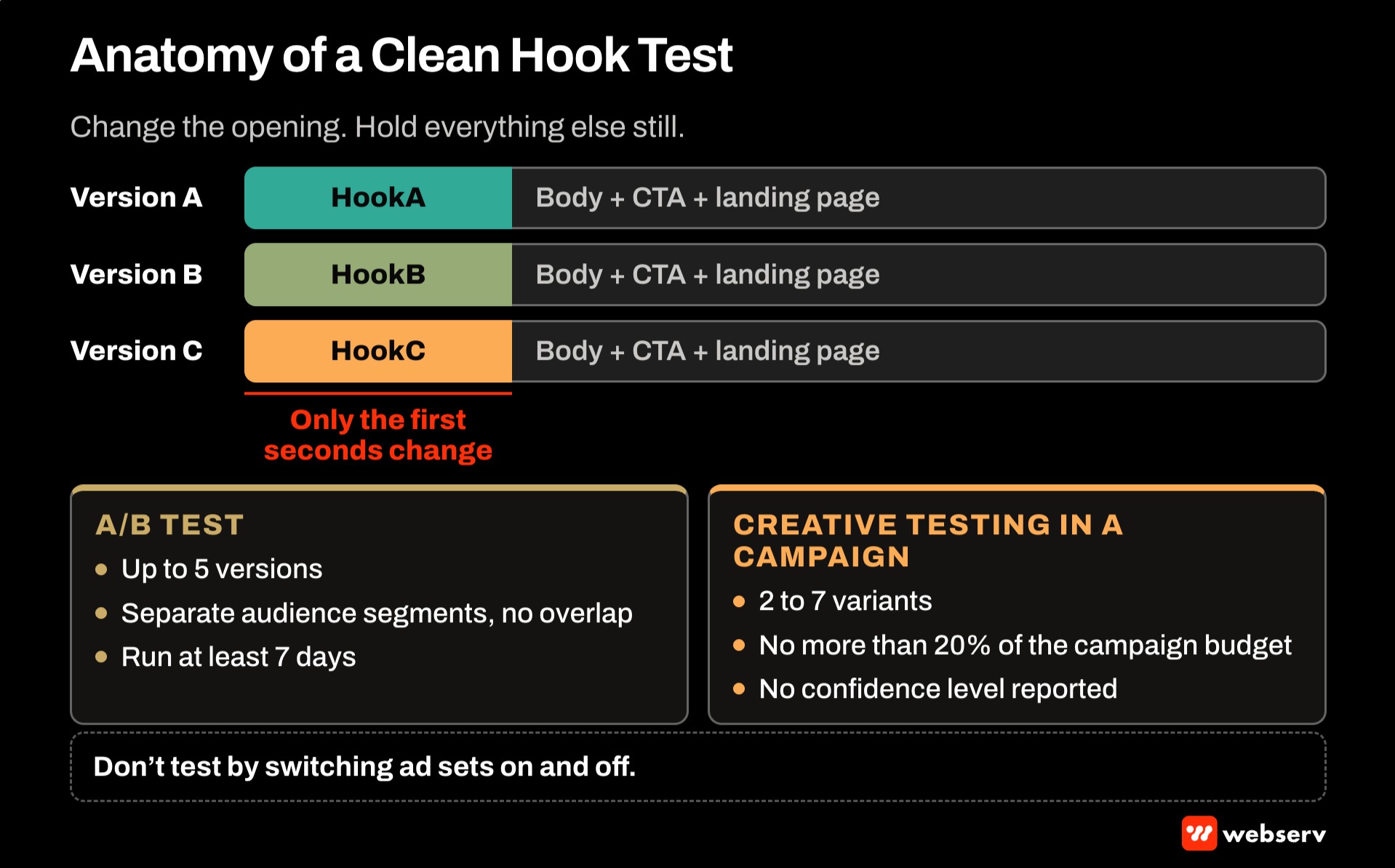
Hold the body constant. Build two to five versions of the same ad that differ only in the first few seconds. Same footage after the hook, same voiceover, same call to action, same landing page.
Use Meta’s testing tools rather than switching ads on and off. Meta’s A/B testing shows each version to a separate segment of the audience so nobody sees both, and Meta advises against informal tests made by turning ad sets on and off.
- A/B test. Meta’s Experiments tool compares up to five versions, and its best practices recommend testing one variable and running at least seven days.
- Creative testing within a campaign. Meta’s creative testing feature compares two to seven creative variants inside an existing campaign, using no more than 20% of the campaign’s budget. Meta notes it doesn’t include a confidence level.
Give it enough time and volume. Meta’s Instagram guidance suggests at least four days for reliable creative results, and its A/B guidance says seven. Treatment center budgets are often small, so plan for the longer window and fewer versions rather than many versions with thin data each.
The metrics to read
Hook tests need attention metrics first and admissions metrics second.
The three signals to read together
Hook rate
3-second video plays divided by impressions (custom metric)
Hold
ThruPlays: plays to completion or at least 15 seconds
Downstream
Calls and admits from call tracking and the CRM
Hook rate (custom). Meta doesn’t have a metric by this name. Build it as 3-second video plays divided by impressions. Meta counts a 3-second play when the video plays for at least three seconds, or nearly its full length for very short videos, excluding replays.
Hold. ThruPlays count plays to completion or at least 15 seconds. A hook that stops the scroll but loses viewers by second five has a mismatch between hook and body.
Watch percentages, carefully. Meta’s 25% play metric counts plays that skipped to that point, so percentage metrics aren’t pure retention.
Downstream results. Link clicks, landing page views, calls from call tracking, and ultimately admits. Our call tracking guide covers tying calls back to ads.
Downstream data may be limited. Meta’s data sharing restrictions can restrict mid- and lower-funnel events for sensitive data sources, and Meta suggests upper-funnel events instead. Meta’s data source categories include health and wellness, covering provider-patient relationships.
For a treatment center, that makes attention metrics more important, not less. If the platform can’t optimize on admits, the creative that holds attention is doing more of the work. Our HIPAA-safe conversion tracking guide covers what can be sent.
Turn test results into a pipeline
A single winning hook fades. The goal is a steady flow of tested openings.
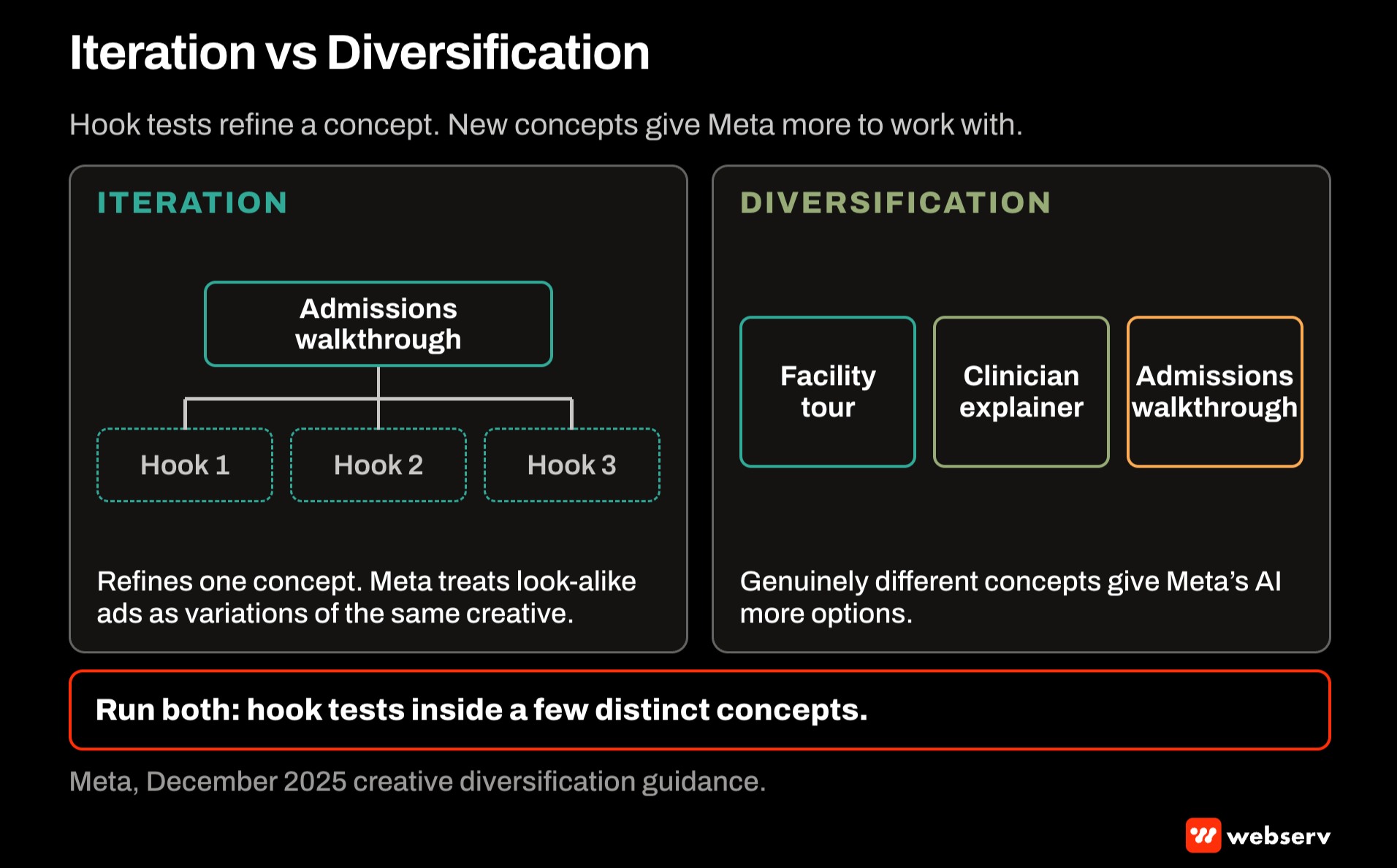
Meta’s December 2025 post on creative diversification says more diverse creative gives its AI more options, and that ads which look alike are treated as variations of the same creative. It separates iteration, refining one concept, from diversification, running genuinely different concepts.
Hook testing is iteration. It improves a concept. Run it alongside a few distinct concepts, such as a facility tour, a clinician explainer, and an admissions walkthrough, so the account has real variety as well as refined openings. Our video ad creative guide covers building those concepts.
A monthly rhythm:
Pick one concept
that’s already performing.
Write three to five hooks
from the compliant types above, all reviewed before production.
Cut versions
that change only the opening, with the same body and call to action.
Run a controlled test
for at least seven days.
Read the three signals
Hook rate, hold, and downstream results, read together.
Keep the winner, log the losers
and start the next test with a new concept.
Where this fits
Hook testing is one part of a creative program. For formats that complement video, see our static ad creative templates, and for account setup, the Meta Ads playbook for treatment centers. Our guide to creative strategy for treatment center marketing covers how the pieces fit.
OPERATOR INSIGHT
Keep a hook log: the exact opening, the hook type, the test dates, and the results. After a few months it shows which types work for your facility and audience, which is more useful than any single winner.
It also keeps compliance review faster, because approved hook types and wording are already on record.
For how paid social fits the rest of your marketing, see the complete guide to behavioral health marketing. If you want a second look at your Meta creative testing, book an intro meeting.
Frequently Asked Questions
What makes a good hook for a treatment center Meta ad?
One that stops the scroll without implying the viewer has a condition. Meta recommends putting the brand and key message in the first three seconds, with motion or a strong visual in the first frame.
Hooks about the facility, the admissions process, a real clinician, or a question about the program work within Meta’s personal attributes policy.
Test several and let the results decide.
Can a treatment center ad ask “Are you struggling with addiction?”
Not on Meta. Its personal attributes policy bars ads that assert or imply a viewer’s health condition, and its own examples reject lines like “Depression getting you down?”
Reframe around the facility or service, such as “Addiction treatment in [city]” or “Here’s what happens when you call us.”
Review hooks before production, since policy issues are cheaper to fix in a script than in an edit.
How long should a Meta hook test run?
Meta’s A/B testing guidance recommends at least seven days, and its Instagram creative guidance suggests at least four.
Treatment center budgets are often small, so fewer versions over a longer window usually give clearer results than many versions with little data each.
Change only the hook, and keep everything else identical.
What is hook rate on Meta?
It isn’t an official Meta metric. It’s a custom calculation: 3-second video plays divided by impressions.
Meta counts a 3-second play when the video plays for at least three seconds, or nearly its full length for very short videos.
Read it alongside ThruPlays and downstream results, since a hook that stops the scroll still has to lead to calls.
Why do attention metrics matter more for treatment centers on Meta?
Meta may restrict mid- and lower-funnel events from health-related data sources, and suggests upper-funnel events instead.
When the platform can’t optimize on admits, creative that earns and holds attention carries more of the performance.
Track calls and admits through your own systems, and use hook rate and hold as the fast signal.
Keaton Nalle is the Director of Paid Admissions at Webserv, a digital marketing agency for treatment centers.