Every treatment center admissions team runs into the same specific moment on a call I can describe in one sentence.
VOB comes back covered, rate data comes back low-confidence or below the program’s cost floor, and someone in the operation has to decide whether to schedule the admit at operational risk or route the patient somewhere else.
If that decision falls to the admissions coordinator on the call, the operation is running admissions ops backwards. If it falls to the operator by default because nobody has framed how the decision should be made, the operator becomes a bottleneck.
If the operator has a framework and the framework is applied by the admissions manager in real time on every escalated admit, the operation is running the discipline the way it should be run.
This piece is that framework. It applies to the specific moment when rate data is missing, low-confidence, or clearly below the program’s expected reimbursement threshold.
It sits alongside the VOB vs. expected reimbursement reframe as the operational companion.
It sits above the rate intelligence workflow piece that walks the CRM-level mechanics. And it feeds into the admissions ops discipline as the specific decision layer inside the Lead Management sub-discipline. Webserv’s eligibility and reimbursement capability is where this framework gets operationalized for treatment center clients.
Key Takeaways
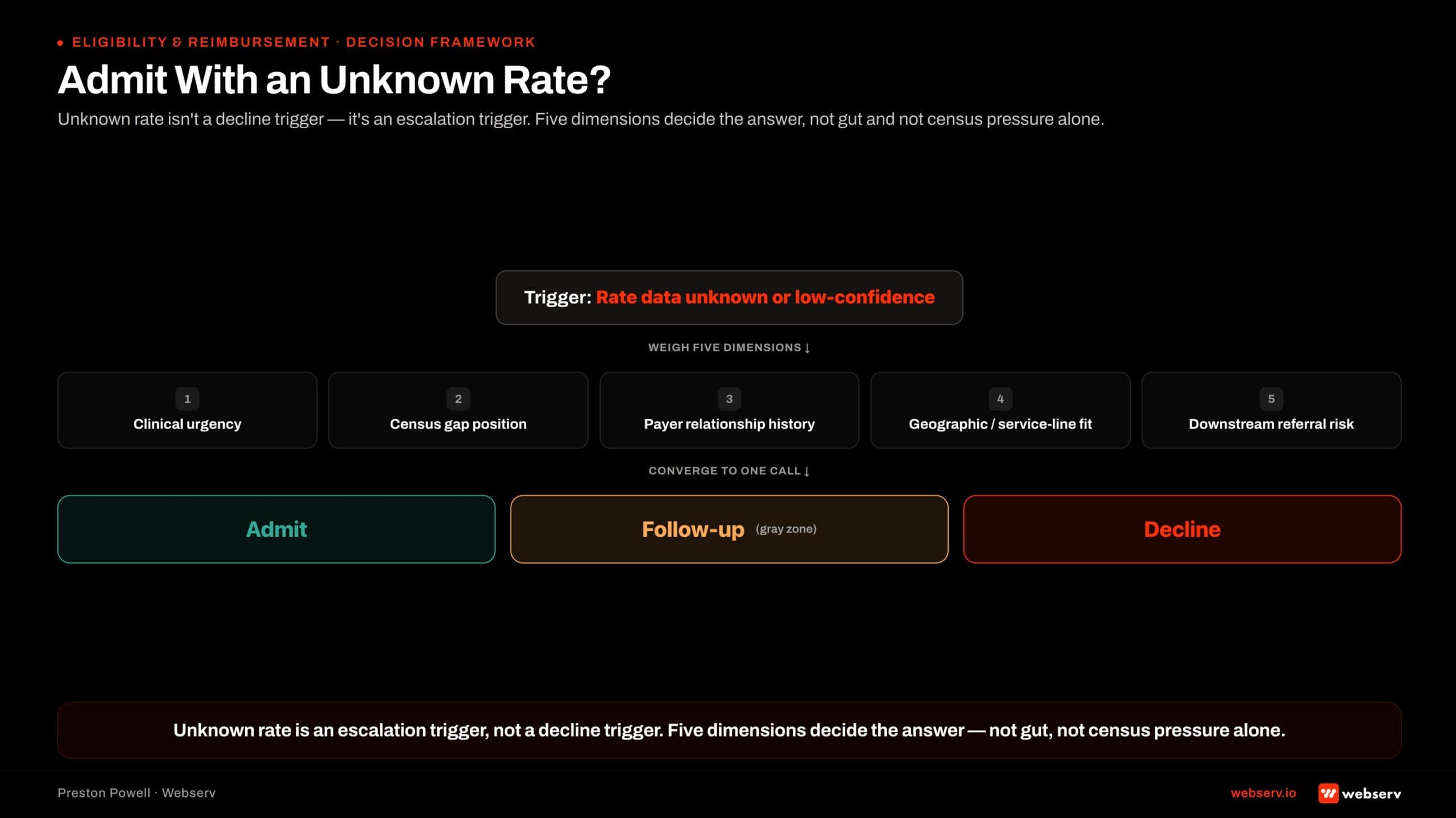
- The unknown-rate admissions decision has five dimensions: patient clinical acuity, program cost floor, current capacity utilization, payer relationship strategy, and available alternative destinations for the patient.
- The decision is made by the admissions manager, not the coordinator, in real time on the call when a rate escalation triggers. The operator gets involved only when the decision crosses a facility-defined threshold (typically a rate variance above a specific dollar amount or a payer flag).
- Admitting at low rate is defensible in three specific scenarios: patient clinical necessity when no alternative is available, capacity backfill when the facility is under-utilized, and strategic relationship value with a referral partner that produces a portfolio of admits above the cost floor.
- Declining an admit at reasonable rate is defensible in three scenarios: capacity strain making the marginal admit unprofitable at any rate, payer identifier flagged for reimbursement disputes, and compliance risk on the specific admit (LegitScript, licensing, or clinical fit).
- The gray zone is the follow-up call option. When the decision is ambiguous, the manager routes the patient to a follow-up conversation with the RCM or admissions director within 24 hours rather than making a binary admit/decline call under time pressure.
- Reporting the decisions produces the calibration loop. Every escalated admit gets tracked against realized reimbursement, and the framework thresholds adjust quarterly based on what the data actually shows.
The specific decision moment this framework governs
The framework applies to a narrow, high-consequence moment in the admissions workflow. VOB confirms coverage. Rate intelligence returns either a low-confidence estimate, an estimate below the program’s cost floor, or a payer identifier flagged in the facility’s review list.
HFMA’s revenue cycle management reference treats payer reliability as one of the load-bearing measurements a treatment center’s financial team already tracks — days in accounts receivable, denial rate, and 12-month collections history are the standard inputs. Pulling those into the admit-decision packet at intake is what turns the payer relationship history dimension from gut feel into a defensible signal, and it is why this dimension carries meaningful weight even when clinical urgency and census position both look normal.
The coordinator has held the call warm and routed to the admissions manager per the rate intelligence workflow escalation triggers. The manager is now looking at the same data the coordinator saw plus the manager’s broader operational context, and needs to make a call.
The wrong versions of this decision are common. Admitting every escalated case because “we already have the family on the phone” produces predictable margin erosion.
Declining every escalated case because “the rate looks bad” produces predictable census misses. Escalating every decision to the operator produces bottleneck at the top of the operation and diffusion of ownership through the middle.
The right version is a repeatable framework that a manager can apply in real time on the call, produces consistent decisions across similar cases, and generates the reporting data that lets the operator calibrate the framework over time.
The five dimensions of the decision
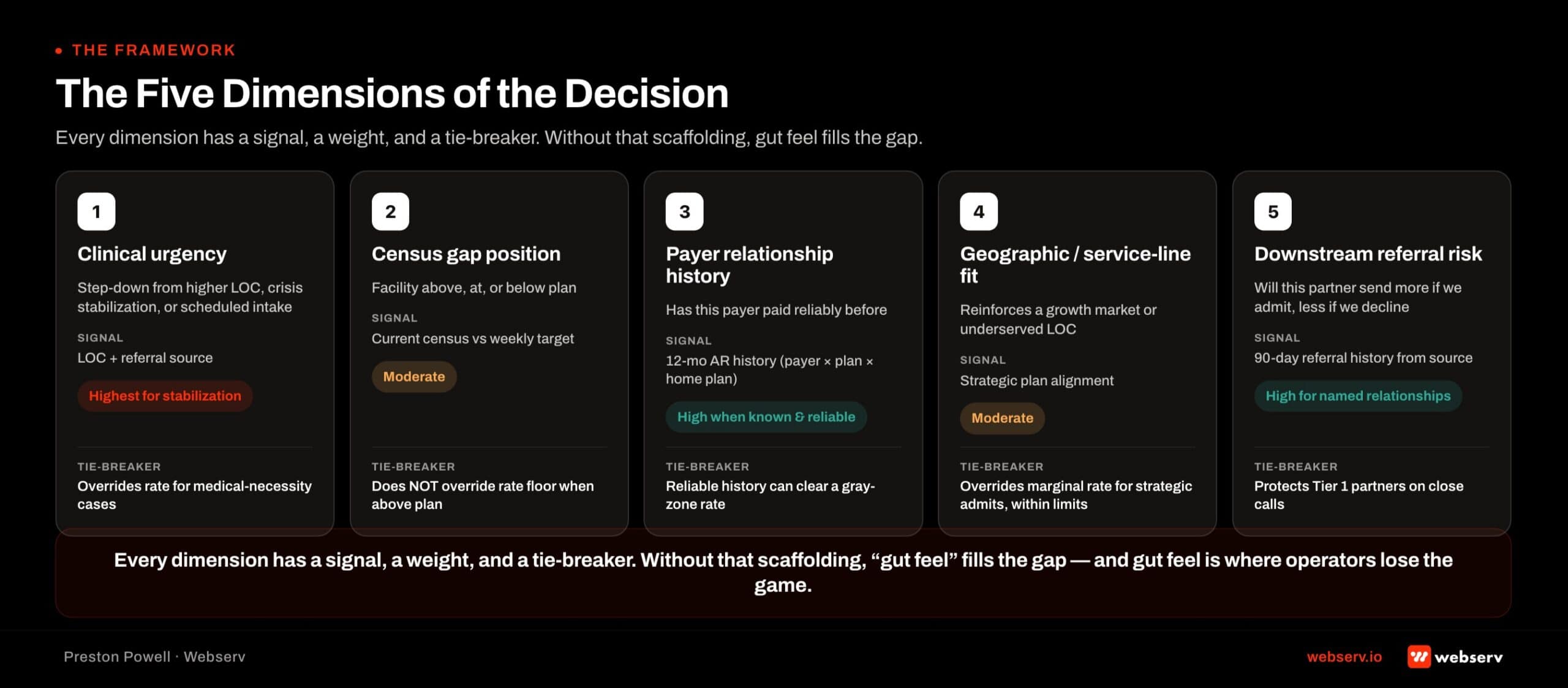
Every unknown-rate admissions decision runs through the same five dimensions. Naming them explicitly is what turns the decision from intuition into repeatable practice.
Dimension one: patient clinical acuity. How urgent is the clinical need. A patient in active withdrawal or in a suicidal ideation window is a different admissions decision than a patient with a scheduled elective outpatient start date three weeks out.
Dimension two: program cost floor. What is the minimum reimbursement rate at which the specific level of care produces positive contribution margin at this facility. This is a facility-specific number that the finance team should have documented for every level of care the facility offers.
Dimension three: current capacity utilization. How full is the specific level of care at this specific moment. A facility running at 95% utilization has a materially different decision than a facility running at 60%.
Dimension four: payer relationship strategy. Is this payer part of a strategic relationship that produces a portfolio of admits above the cost floor. Some payers pay low on individual admits but produce a net-positive relationship at the portfolio level.
Dimension five: alternative destinations for the patient. Can this specific patient be routed to a different level of care at this facility that would reimburse better, or to a different facility that fits the payer better.
The alternative-destination question is the release valve on cases where the primary admit does not work.
Clinical acuity
How urgent is the clinical need. Active withdrawal or suicidal ideation windows admit at operational risk, not commercial math.
Cost floor
The per-day minimum below which the admit is negative-margin. Facility-specific number, documented in the CRM.
Capacity utilization
Above 90% shifts the answer. Below 70% shifts it again. Full census shifts the decision toward decline; open capacity shifts it toward admit.
Payer relationship
Is this payer part of a portfolio that pays profitably in aggregate. Individual low-rate cases may still be net-positive at the referral partner level.
Alternative destination
Can this specific patient route to a different LOC or facility that fits the payer better. The release valve on cases that do not work locally.
When to admit even at low rate
Three scenarios justify admitting a patient even when the rate data returns below the program’s cost floor.
Scenario one: patient clinical necessity when no alternative is available. A patient in active withdrawal, in a suicidal ideation window, or in a clinical situation where delay produces material harm should be admitted at the operational risk of the low rate.
The facility absorbs the margin hit and documents the decision as a clinical-necessity admit.
The specific decision the manager should document: this admit is below cost floor by X dollars per day, patient clinical acuity is Y level, no alternative was identified, admit proceeded at facility risk. That documentation matters for two reasons.
It defends the decision at the QBR review. And it produces the data that lets the operator see how often mission-driven admits are happening and whether the pattern is sustainable at the facility’s operating economics.
Scenario two: capacity backfill. A facility running at 65% utilization has different economics than one running at 95%. Below cost floor with capacity to fill produces contribution to fixed costs the facility is already carrying, even if the admit does not clear the marginal cost target on its own.
Scenario three: strategic relationship value. A referral partner sending 12 patients per quarter with 8 above cost floor and 4 below cost floor may still be a net-positive relationship if the aggregate profitability is positive. Declining the 4 below-cost admits can jeopardize the 8 above-cost admits.
The referral partner attribution piece covers the mechanics of measuring portfolio value by referral source. What matters here is that the manager making the individual-admit call has to see the aggregate portfolio context before deciding on the individual case.
COMMON MISTAKE
Escalating every borderline admit to the operator produces bottleneck at the top and diffusion of ownership through the middle. The framework exists so the manager decides most cases and the operator sees only what crosses the facility-defined threshold. If every escalation reaches the operator, the framework is not tight enough.
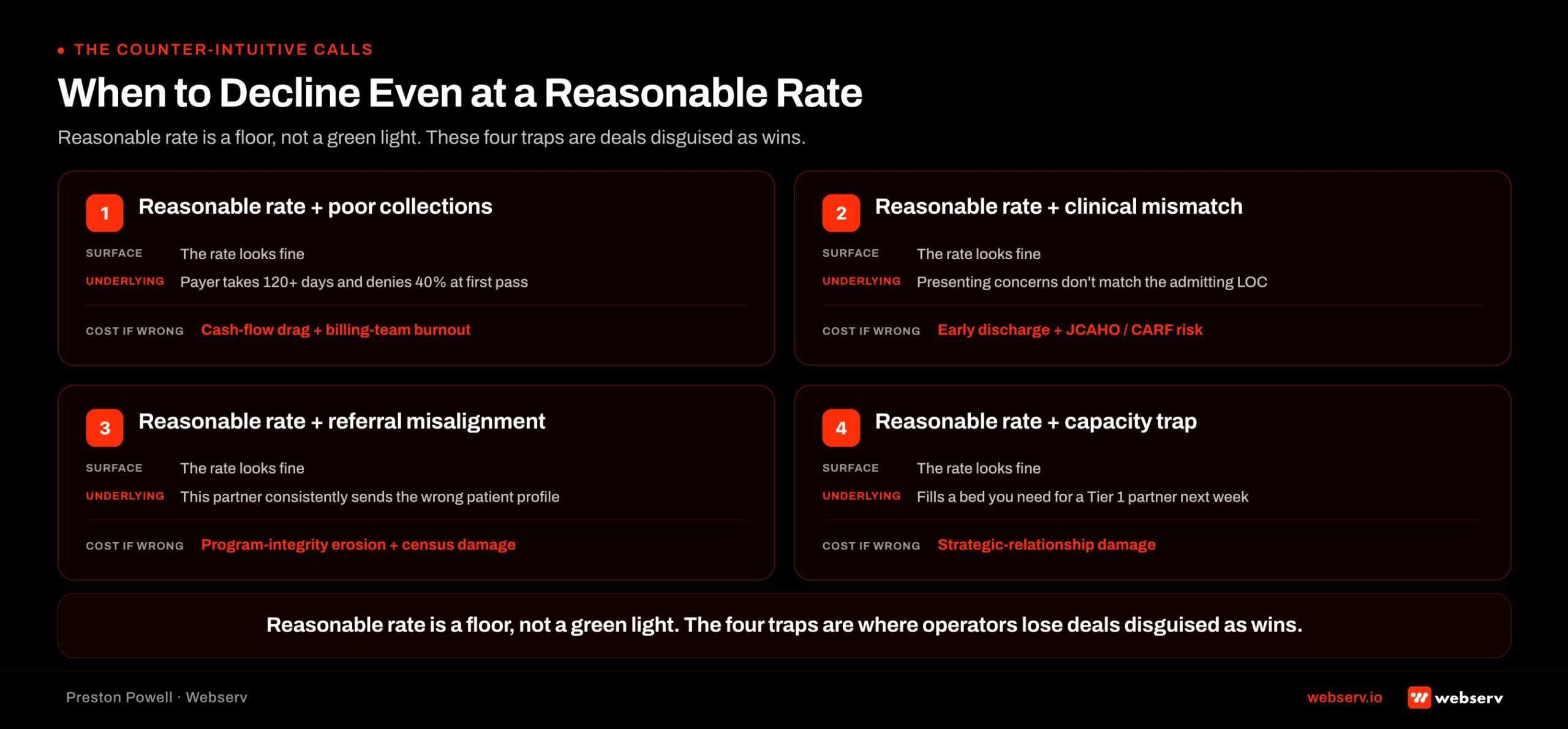
When to decline even at reasonable rate
The mirror-image scenarios exist too. Three situations justify declining an admit even when the rate data returns within an acceptable range.
Scenario one: capacity strain. A facility running at 95% utilization may not have the operational capacity to safely handle a new admit even at a reasonable rate. Clinical staff ratios, coordinator load, and clinical bandwidth for a new patient are real operational constraints.
The counterintuitive point: sometimes the correct answer is to decline a reasonable-rate admit and route the patient to a trusted competitor. Preserving clinical quality for the existing census produces better long-term outcomes than stuffing the facility past its operational limits.
Scenario two: payer identifier flagged for reimbursement disputes. Some payers, alpha prefixes, or specific plans within a payer group have a history of extended payment delays, denials, or unilateral rate reductions after admission.
Facilities should maintain a running flagged-payer list that the manager sees when the CRM escalation surfaces. If a flagged identifier appears, declining the admit is the defensible call regardless of the point-estimate rate.
Scenario three: compliance risk on the specific admit. LegitScript, state licensing, or clinical fit issues can make a specific admit compliance-risky regardless of rate. Patients whose clinical presentation falls outside the facility’s licensed scope should not be admitted for rate reasons.
Compliance risk should never lose to admissions math. Facilities that admit compliance-risky patients for rate reasons eventually pay a larger cost through licensing action, LegitScript escalation, or clinical incident.
The gray zone: the follow-up call option
Not every escalated case fits cleanly into admit or decline. The gray zone is when the decision is ambiguous under the five dimensions and time pressure on the call would produce a suboptimal binary choice.
The framework’s release valve for the gray zone is the follow-up call option. The manager, instead of forcing a binary admit or decline decision on the phone, authorizes the coordinator to run a specific closing line with the family.
The line: “Your loved one’s specific case involves some coverage details we want to work through carefully. Can we call you back within 24 hours with a clearer answer on next steps?”
That language holds the family, avoids a bad decision made under pressure, and buys the operations team time to run a deeper review.
The 24-hour follow-up window is not a stall. It is a working window where the RCM team can pull historical data on the specific payer, the admissions director can review capacity and portfolio context, and the operator can weigh in if the case crosses the escalation threshold.
The follow-up call produces the decision. The intake call produced the pause.
Facilities that skip this option end up forcing decisions under time pressure and generating inconsistent outcomes across similar cases. The follow-up call is not a workaround. It is a designed step in the decision framework.
Who owns this decision
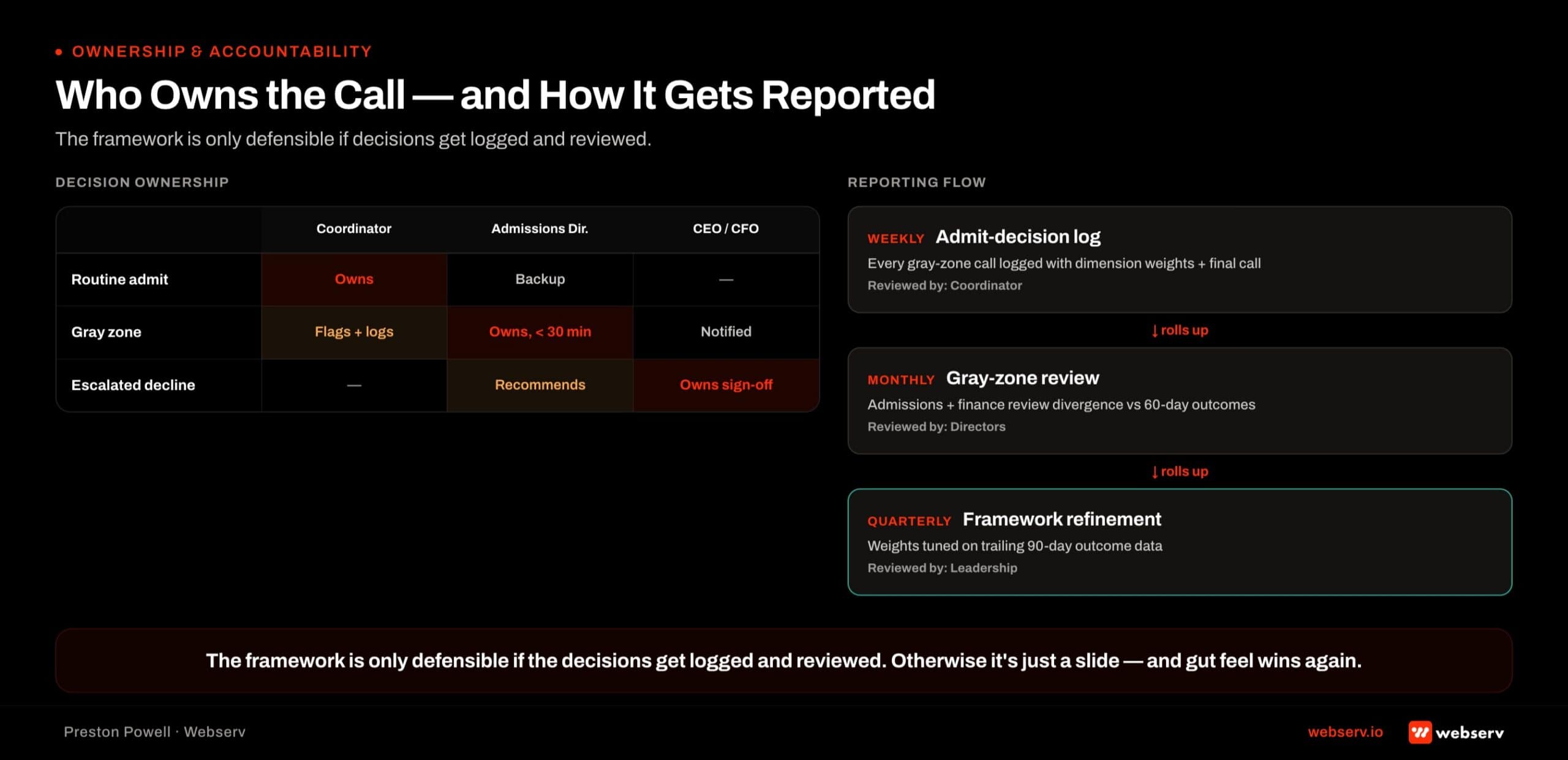
Ownership of the unknown-rate admissions decision needs to be explicit across three roles.
The coordinator does not own this decision. The coordinator’s job is to run the call, trigger the escalation when the CRM criteria fire, and hold the family warm while the manager reviews.
Coordinators making individual admit decisions on borderline rates produces inconsistent outcomes and coordinator burnout. The Hostage Dynamic piece walks the failure mode when this ownership boundary blurs.
The admissions manager owns most of these decisions. Rate data below cost floor, low trust score, flagged payer identifier, capacity considerations, referral partner portfolio context: all of it is inside the admissions manager’s operational awareness.
The manager applies the five-dimension framework in real time on the call, makes the admit or decline call, and documents the decision.
The operator owns decisions above a facility-defined threshold. Some decisions cross the manager’s authority. A rate variance above a specific dollar amount, a strategic referral partner conflict, a compliance red flag, or a capacity scenario that affects the broader operating plan should escalate to the operator.
Facilities should document the specific thresholds that trigger operator involvement, and the coordinator plus manager should know what those thresholds are.
This three-tier ownership structure is what keeps the discipline running without generating operator bottleneck at the top or coordinator burnout at the bottom.
Reporting the decisions to sharpen the framework
The framework only stays sharp if the decisions get reported and reviewed. Every escalated case, whether it resulted in admit or decline, should get tracked in the CRM with the five-dimension inputs and the resulting decision. Over time, that reporting produces the calibration loop.
Monthly review of escalated cases at the marketing and admissions QBR surfaces patterns. Are we declining too aggressively on flagged payers that actually paid fine when we tested them.
Are we admitting too aggressively on low-confidence rates that consistently came in below estimate. Is the capacity threshold set appropriately given the facility’s actual utilization patterns. The framework thresholds should adjust based on that data, not stay static.
Facilities that skip the reporting layer end up with a framework frozen in time. The five dimensions are stable.
The specific thresholds inside each dimension should move with the operating reality of the facility. That calibration is the difference between a framework that ages well and one that becomes obsolete inside two years.
What this changes about admissions ops
Adding this decision framework to the admissions ops discipline changes three specific operating conversations.
The first is the coordinator-manager relationship. Coordinators stop feeling like they are personally responsible for admit outcomes on borderline rates because the escalation is designed and documented. Managers step into the decision role explicitly rather than being expected to backstop coordinator judgment ad hoc.
The second is the manager-operator relationship. Operators stop being pulled into every borderline admit because the manager has a framework and a documented set of thresholds that define when operator involvement is required.
Operators still see the pattern-level data at the QBR but do not have to be the tiebreaker on each individual call.
The third is the reporting layer of the QBR. Escalated admissions decisions become a first-class reporting line.
The operator sees monthly which admits were escalated, how they were decided, and how the decision correlated with actual collected reimbursement. That data feeds directly into census planning and payer mix strategy for the next quarter.
None of this is achievable without rate intelligence in the workflow upstream. The framework only works when the manager can see rate data alongside the coverage confirmation. Without rate data, every admit is either an accepted binary or a rejected binary, and the granularity that produces the framework’s value disappears.
This connects to the broader cost-per-admit picture in behavioral health marketing guide and lowering cost per admit. It’s also worth pairing with revenue cycle as a marketing problem and conversion rate optimization guide.
Frequently Asked Questions
Who makes the admit-or-decline call when the rate data is below the cost floor?
The admissions manager makes the call in real time on the phone while the coordinator holds the family warm. The coordinator does not make this decision because coordinator-level admit decisions on borderline rates produce inconsistent outcomes and coordinator burnout.
The operator makes the call only when the decision crosses a facility-defined threshold, typically a rate variance above a specific dollar amount, a strategic payer or referral partner conflict, or a compliance red flag.
The three-tier ownership structure (coordinator triggers escalation, manager decides, operator involved above threshold) keeps the discipline running without generating bottleneck at the top or burnout at the bottom.
Can you ever justify admitting a patient below the program cost floor?
Yes, in three specific scenarios. Patient clinical necessity when no viable alternative exists for the patient. Capacity backfill when the facility is running well below utilization and the marginal admit contributes to fixed cost absorption.
Strategic relationship value when the referral partner or payer produces a portfolio of admits that is profitable in aggregate even with individual cases below cost floor.
Each of these decisions should be documented with the specific rationale so the pattern is trackable. Facilities that admit below cost floor without documenting why lose the ability to see whether the exception is sustainable or eroding the operation over time.
What happens if the admissions manager is unavailable when a rate escalation fires?
The framework should include a documented backup path. Typically the admissions director or the RCM lead can serve as the second-tier manager. If neither is available, the coordinator uses the 24-hour follow-up call option, which is the framework’s designed release valve for ambiguous or time-pressured cases.
The follow-up call is not a stall. It is a working window where the operations team can review the case with proper context and produce a better decision than would emerge from a forced binary choice under time pressure.
Facilities that skip this option end up making inconsistent decisions when the primary decision-maker is out of reach. The backup path is a required design element, not an optional one.
How does the framework handle referral partner patients who consistently return low rates?
By moving the decision from the individual-admit level to the portfolio level. Some referral partners send patients whose insurance produces low individual rates but whose aggregate volume, combined with higher-rate cases from the same partner, produces a net-positive relationship. Declining low-rate individual cases can jeopardize the relationship and lose the higher-rate cases that made it profitable.
The referral partner attribution reporting layer is what makes this trackable. Facilities that measure referral partner value at the portfolio level make different individual-admit decisions than facilities that measure only the current case.
The framework should incorporate the portfolio context when the manager makes the call. Without portfolio-level attribution data, this decision defaults to the individual-admit view and loses the strategic relationship dimension entirely.
How often should the framework thresholds be reviewed and updated?
Quarterly, at the marketing and admissions QBR. The five dimensions stay stable across quarters. The specific thresholds inside each dimension (cost floor by level of care, capacity threshold percentages, flagged payer list, operator escalation dollar amount) should be reviewed against realized data every 90 days.
Rate benchmarks shift. Payer behavior shifts. Facility cost structures shift. A framework that stays frozen in time becomes obsolete inside 18 to 24 months.
The calibration loop from monthly review of escalated decisions is what keeps the framework aligned with the current operating reality.
Preston Powell is CEO of Webserv, a behavioral health marketing agency and admissions ops platform working with residential, outpatient, and telehealth treatment providers across the United States. He founded Webserv in 2015 and leads the PayerLenz reimbursement intelligence product alongside Kyle McHenry. If you want to walk your current escalation practice against the five-dimension framework, start with a Visibility Gap conversation.