Answer Engine Optimization for behavioral health treatment centers is a category where the industry’s contested tactics create more confusion than clarity. Marketing directors evaluating AEO agencies get pitched a specific set of tactics that sound sophisticated but do not produce measurable AI citation lift. This piece lives inside our AEO capability.
Meanwhile the actually-load-bearing tactics get less airtime because they are less novel and harder to sell.
The AEO capability at Webserv runs across our own blog corpus and our clients’ sites, tracked against ChatGPT, Perplexity, Google AI Overviews and AI Mode, Claude, and Copilot. Independent research points the same way: the Aggarwal et al. GEO paper found that adding citations, quotations, and statistics raised a source’s visibility in generative engine answers.
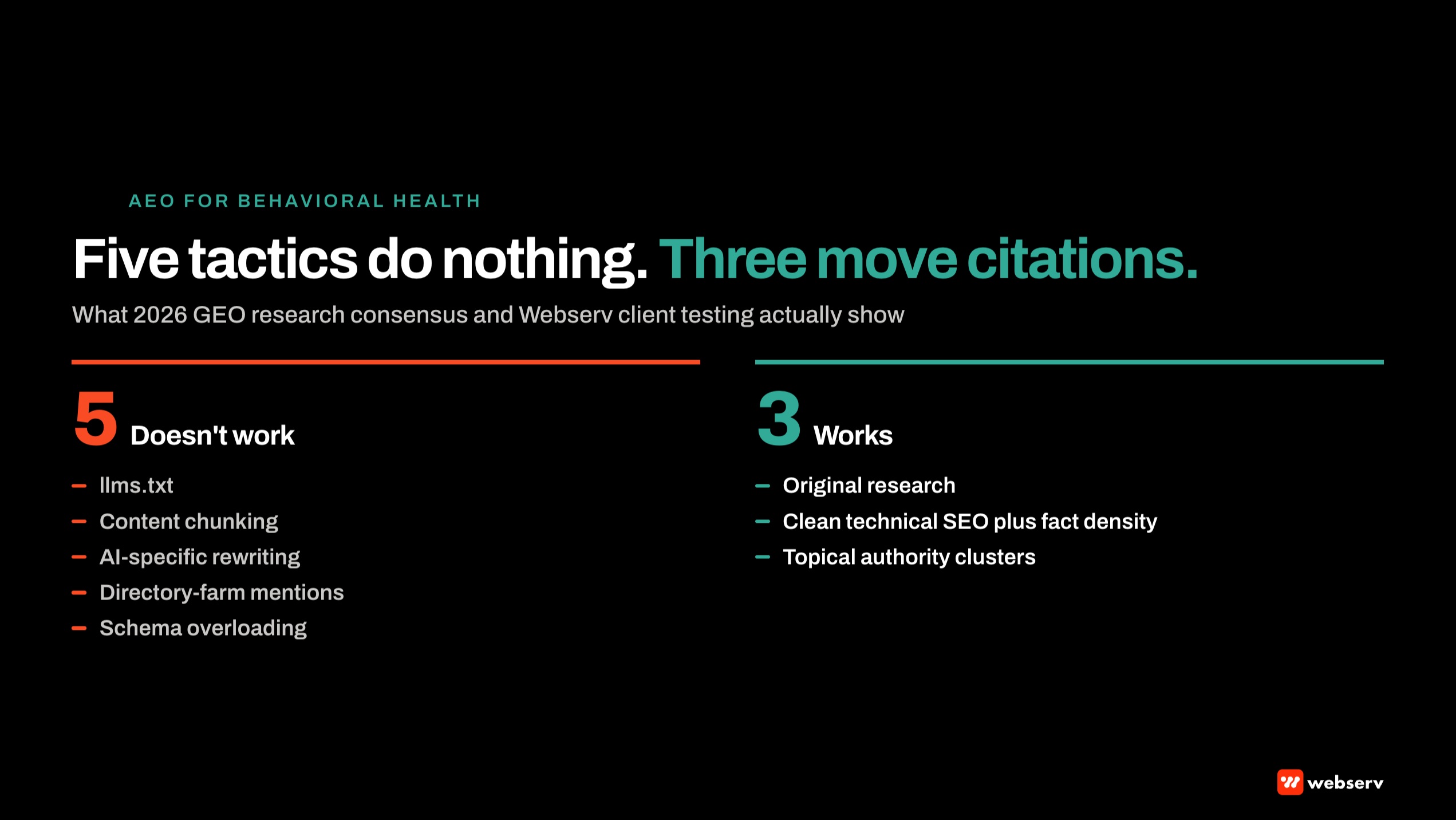
The pattern is consistent: 5 tactics the industry pitches heavily have little or no evidence of citation lift for BH, and 3 tactics account for the gains we can actually point to.
This piece walks the specific 5 tactics that don’t work in behavioral health AEO, the specific 3 tactics that do, where the industry’s confusion comes from, and the 8-item stack Webserv actually runs for BH clients. For the surrounding picture see our ultimate guide to behavioral health marketing and our Full AI Search Stack for treatment centers.
Compliance note: no specific competitor agency gets named. The critique is of the tactics, not the practitioners.
Key Takeaways
- The AEO agency market pitches five tactics heavily that have little or no evidence of AI citation lift in behavioral health: llms.txt as a citation tactic, content chunking, AI-specific rewriting of existing content, inauthentic brand mentions from directory farms, and schema overloading.
- Three tactics have the strongest support: original research with methodology transparency, clean technical SEO plus fact density (3+ verifiable markers per 100 words), and topical authority clusters with clear parent-child entity hierarchy.
- Confusion compounds because AEO measurement is inherently difficult. Most marketing teams do not run dedicated AI citation trackers continuously, so tactics that sound like they should work get credited with lift they did not produce. The fix: ask AEO agencies for citation-share measurement methodology before signing.
- The Webserv 8-item AEO stack replaces the five that don’t work rather than supplementing them: original research through partner data, fact density scoring on primary content, 40-55 word answer blocks under every H2, cluster hub architecture, named clinician Person schema, quarterly refresh cadence on hubs, compound prompt content model, and Tier 1 subreddit engagement.
- The stack is measured through citation tracking and the Search Console generative AI report, not assumed. No competitor agencies are named here — the critique is of the tactics, not the practitioners.
DEFINITION
AEO tactics that don’t work for behavioral health. The specific set of Answer Engine Optimization tactics that get pitched heavily in the AEO agency market but have little or no evidence of AI citation lift across the surfaces treatment center marketing actually competes on (ChatGPT, Perplexity, Google AI Overviews and AI Mode, Claude, Copilot). Five tactics fit the pattern: llms.txt as a citation tactic, content chunking as an extraction hack, AI-specific rewriting of existing content, inauthentic brand mentions from directory farms, and schema overloading on thin pages.
Distinct from the three tactics that do work (original research with transparent methodology, clean technical SEO plus 3+ facts per 100 words, topical authority clusters with clear parent-child entity hierarchy), distinct from tactics that are neutral but worth shipping for other reasons (llms.txt for Lighthouse audit scoring, for example), and distinct from AEO myths that never had industry consensus in the first place. This is a critique of measurable outcomes, not of practitioners.
OPERATOR INSIGHT
Marketing directors evaluating AEO agencies get pitched a specific set of tactics that sound sophisticated but do not produce measurable AI citation lift. The actually-load-bearing tactics get less airtime because they are less novel and harder to sell.
The specific fix for evaluating AEO pitches: ask for citation-share measurement methodology. Agencies that can produce quarterly citation-share reports from actual measurement infrastructure typically know which tactics produce lift and which do not. Agencies that pitch tactics without measurement infrastructure typically pitch what sounds sophisticated rather than what works.
The 5 tactics that don’t drive AI citation lift
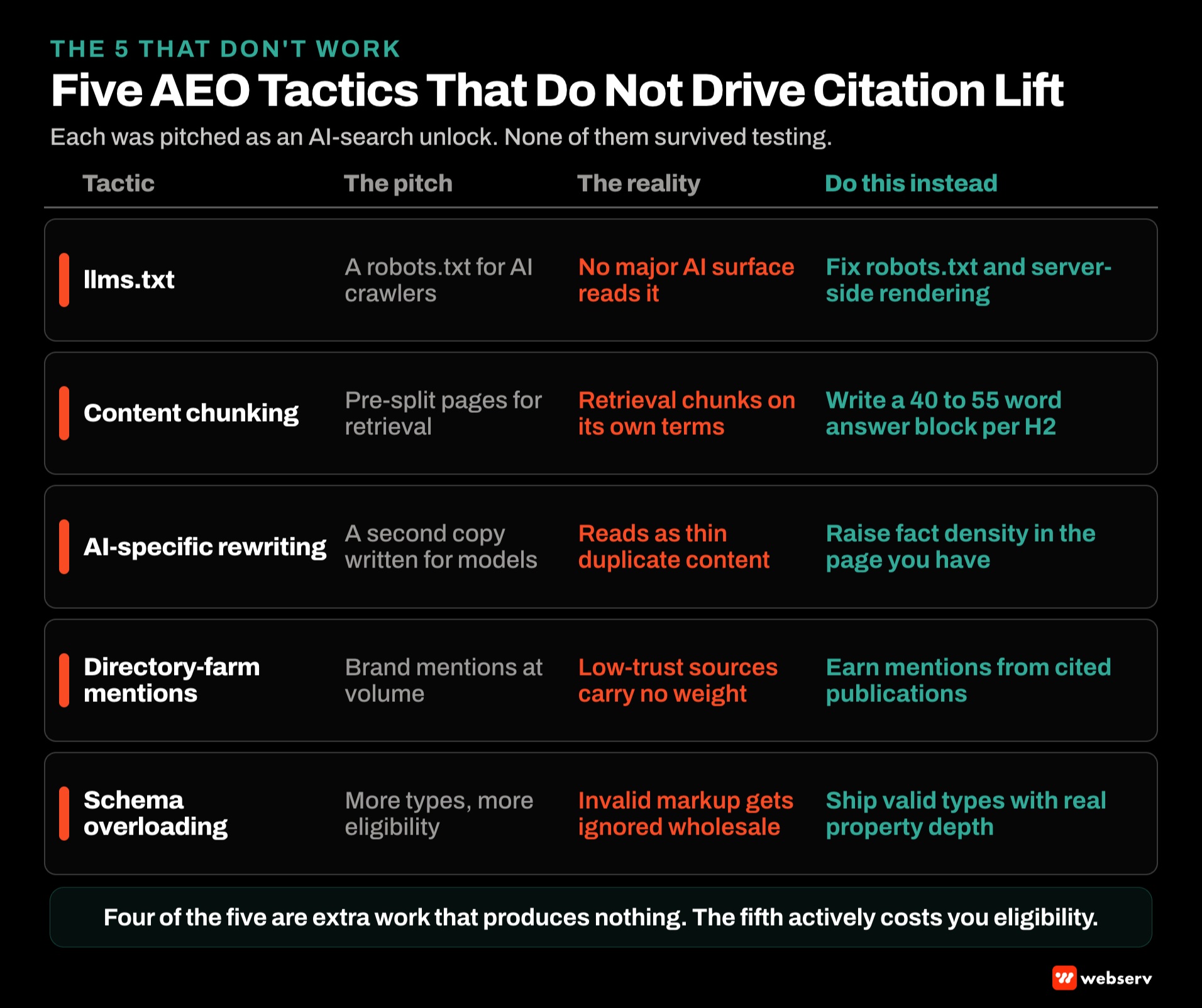
Five specific tactics get sold heavily in the AEO agency market. None of the five has good evidence of citation lift in behavioral health across the AI answer surfaces that matter.
1. llms.txt as a citation tactic
llms.txt is a proposed standard for a plain-text file on the domain root that lists content the site wants AI systems to prioritize. The tactic gets pitched as a specific optimization for AI citation.
The measurement pattern: Google Search does not use llms.txt for ranking or citation. ChatGPT and Claude do not use llms.txt for source selection. Perplexity does not use llms.txt for citation selection.
Bing Copilot does not use llms.txt. Google AI Overviews does not use llms.txt.
The specific reason: AI systems already have their own source selection processes based on search index, entity graph, and answer surface preference. llms.txt does not enter those processes.
Webserv still ships llms.txt for treatment center clients because Lighthouse and other technical SEO audit tools score its presence positively. The file adds no citation lift but produces no cost and improves a specific audit score. Ship it for the audit signal, not for citation.
2. Content chunking as an optimization tactic
Content chunking as a specific AEO tactic pitches the idea that long-form content should be broken into short chunks (100-200 word blocks) optimized for AI extraction. The tactic assumes AI systems extract from chunk boundaries preferentially.
The measurement pattern: AI systems extract from the first clean answer block after each H2 regardless of chunk boundaries. Our 40-word answer block piece covers the specific extraction unit.
Content structured around artificial chunks with no natural topical anchors produces weaker extraction than content structured around H2 headings with 40-55 word definitive answer blocks. The chunk tactic misses the specific extraction pattern AI systems actually use.
The specific fix: skip chunking as a distinct tactic. Structure content with clear H2s and 40-55 word answer blocks under each H2. The extraction pattern handles itself.
3. AI-specific rewriting of existing content
The tactic: rewrite existing published content specifically for AI extraction using AI-generated rewrites that maximize keyword density and semantic saturation.
The measurement pattern: AI-generated rewrites of existing content typically produce ranking regression rather than citation lift. Google’s ranking algorithm and AI answer surfaces both filter AI-generated content that lacks specific factual anchors and human editorial judgment.
The specific failure mode: AI rewrites produce fluent language without the fact density that citation eligibility requires. Rewritten content often has fewer specific facts than the original because AI models default to generic phrasing.
The specific fix: original content written by named human authors with clinical or subject matter expertise. Fact density added by hand through specific factual anchors rather than through AI-generated language optimization.
4. Inauthentic brand mentions from directory farms
The tactic: purchase brand mention placements on low-authority directories, wiki farms, and content aggregation sites to inflate brand mention count.
The measurement pattern: AI systems filter low-authority mentions from their source pool. Directory farm mentions produce no citation lift and add compliance risk because some directory arrangements violate Google’s link scheme prohibitions.
The specific failure mode: mention count without authority signal has no evidence of AI citation lift and carries real Google link-spam risk. Some directory farms also fail LegitScript review, which cascades into ad platform issues.
The specific fix: authentic brand mentions from authoritative third-party sources. Industry press coverage, professional association mentions, contributed content in industry publications, and clinician thought leadership. These are the mentions that actually contribute to AI citation authority.
5. AI schema overloading
The tactic: deploy every available Schema.org type on every page to maximize structured data signal for AI extraction.
The measurement pattern: Google stopped showing FAQ rich results for every site on May 7, 2026, according to the Search Central changelog, after limiting them to government and health sites in 2023. On the AI side, an Ahrefs study of 1,885 pages that added JSON-LD found no statistically significant change in AI citations compared with control pages. Stacking schema types does not buy AI visibility.
The specific failure mode: 15+ schema types stacked on a service page with 400 words of primary content. The markup adds validation and maintenance work without adding anything an AI system can cite, because the page still has little to say.
The specific fix: schema deployment matched to page purpose. Primary content pages carry appropriate schema (MedicalClinic, MedicalBusiness, Person, Article, FAQPage where the FAQ block is substantive). Thin pages carry minimal schema (Article plus Organization reference). Our structured data beyond Rank Math defaults piece covers the specific schema stack that works.
The AEO tactic picture at a glance
5 vs 3
Tactics the industry pitches heavily but don’t work versus tactics that actually produce lift
8
Items in the Webserv AEO stack for BH clients, each tied to a citation-tracking check
May 2026
Google stopped showing FAQ rich results for every site (May 7, 2026)
1,885
Pages Ahrefs tracked adding JSON-LD, with no significant AI citation change vs. controls
The 3 tactics that actually work
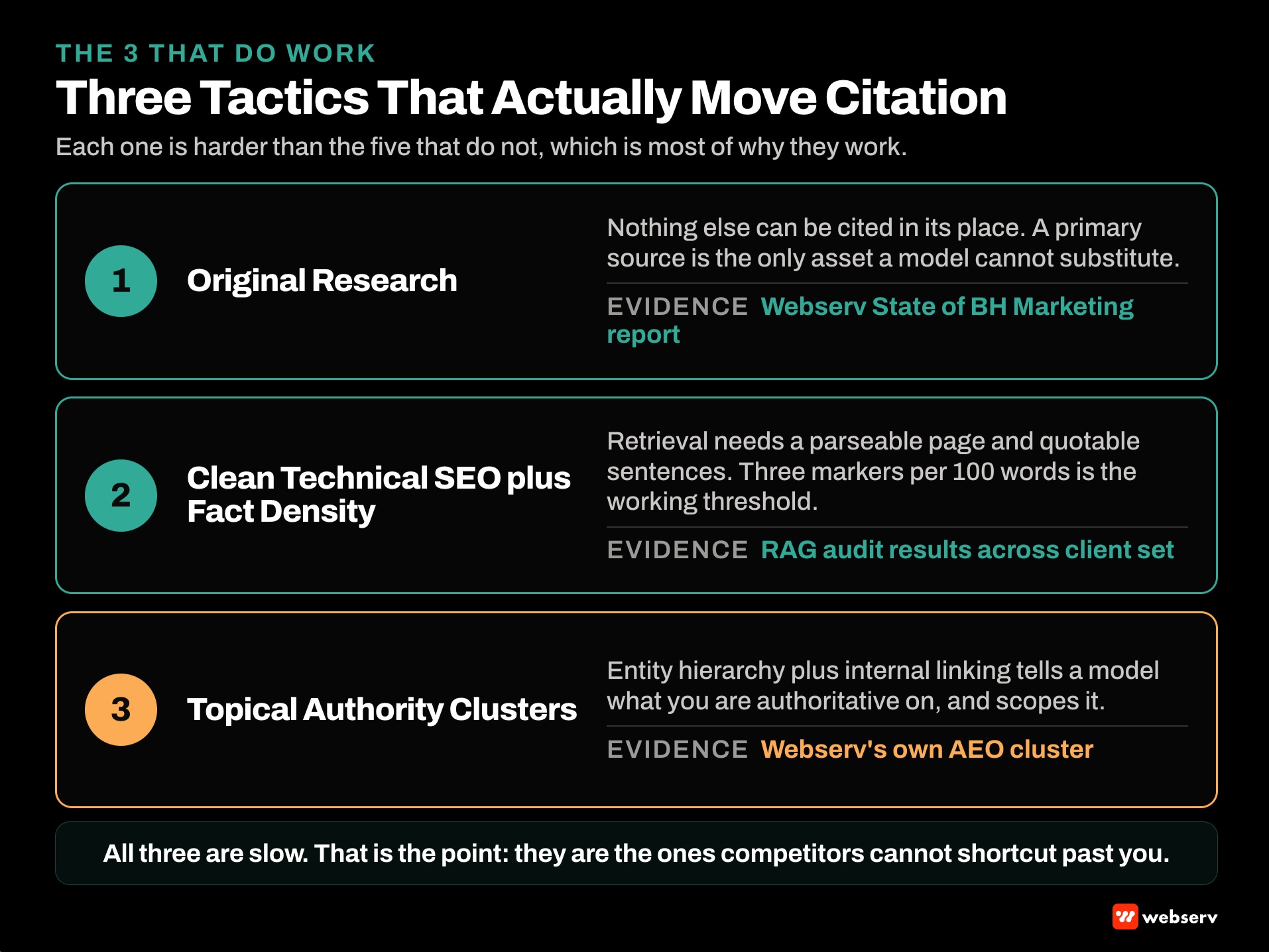
Three specific tactics account for the AI citation lift we can point to in treatment center AEO.
1. Original research with methodology transparency
Original research published with transparent methodology is the highest-lift AEO tactic for behavioral health. The pattern holds because AI systems weight original data sources meaningfully higher than commentary on other people’s data.
The specific implementation: publish original research using data the facility has access to. Facility-specific outcome patterns, payer reimbursement patterns from PayerLenz or similar sources, admission workflow measurements, and clinical program outcome data all serve as original research sources. Public datasets like SAMHSA’s national data also work when the analysis introduces novel segmentation or interpretation.
Methodology transparency matters. The published research includes the data source, the specific methodology used, the sample size, the measurement window, and the specific limitations of the data. Research without methodology transparency typically fails AI source evaluation because AI systems cannot verify the underlying data.
Facilities that publish quarterly original research typically produce meaningfully higher AI citation rates than facilities that publish only commentary or thought leadership. Our original research piece walks the specific methodology.
2. Clean technical SEO plus fact density
Clean technical SEO fundamentals plus high fact density produces the second-highest AEO lift. The pattern holds because AI systems parse content the same way search engines parse content through the same crawl, index, and extraction pipeline.
The specific implementation: pages load fast, work on mobile, carry appropriate schema, resolve URLs cleanly, and maintain low crawl error rate. Then the content on those pages carries 3+ verifiable facts per 100 words in the body content.
The fact density requirement is what separates the AEO application from general technical SEO. Content that ranks organically without high fact density typically underperforms on AI citation eligibility. Content with high fact density typically produces both organic ranking and AI citation lift.
3. Topical authority clusters with clear entity hierarchy
Topical clusters with clear parent-child entity hierarchy produce the third pillar of AEO lift. The pattern holds because AI systems parse topical relationships to determine which source deserves citation weight on which topic.
The specific implementation: cluster hub pages establish the topical authority for a specific topic (attribution, eligibility verification, landing pages, homepage design, and so on). Supporting pieces build depth on specific sub-topics within the cluster.
Cross-linking between cluster pieces reinforces the topical hierarchy. Named clinician attribution on cluster pieces produces the E-E-A-T signal that AI systems weight for citation authority. Our guide to author bios that build E-E-A-T walks the specific attribution pattern.
Cluster architecture that fragments the topical signal (multiple hubs on adjacent topics without clear hierarchy) produces weaker AEO lift than cluster architecture that concentrates the topical signal on specific hub pages with clear parent-child relationships.
DO
- Publish original research with methodology transparency at quarterly cadence — highest per-piece citation ceiling of any AEO tactic.
- Ship 3+ verifiable markers per 100 words (numbers, dollar amounts, named payers, dated ranges) on cluster hubs and primary content.
- Structure content with clear H2s and 40-55 word definitive answer blocks under each H2 — extraction unit maps directly to AI Mode sub-query fan-out.
- Ask any prospective AEO agency for their quarterly citation-share measurement methodology before signing — agencies without measurement infrastructure typically pitch what sounds sophisticated.
- Ship llms.txt for the Lighthouse audit-score bump — no citation lift, but zero cost and a real audit signal.
DON’T
- Pay for llms.txt as a citation tactic — no AI answer surface uses it for source selection; it’s a Lighthouse signal, not a citation signal.
- Chunk content into arbitrary 100-200 word blocks — AI systems extract from the first clean answer after each H2 regardless of chunk boundaries.
- Ship AI-generated rewrites of existing content — fluent language without fact density produces ranking regression, not citation lift.
- Buy brand-mention placements on directory farms — AI systems filter low-authority sources; mentions produce no lift and add Google penalty risk.
- Stack 15+ schema types on thin pages — adding JSON-LD alone hasn’t been shown to lift AI citations, and it adds validation work.
Where the industry’s confusion comes from
The AEO agency market emerged in 2024-2025 as a specific service category positioned as distinct from general SEO. The positioning required distinct tactics to justify the specific pricing.
Some of the distinct tactics that got developed for the positioning turned out to work. Original research methodology, fact density scoring, and clean topical hierarchy all emerged from the specific AEO discipline.
Other distinct tactics got developed because they sounded sophisticated, not because they were measurably effective. llms.txt, content chunking, AI-specific rewriting, and schema overloading all fit that pattern.
The confusion compounds because AEO measurement is inherently difficult. AI citation share is measurable but requires dedicated tracking tools (Brand Radar, Otterly, and similar). Most marketing teams do not run those tools continuously, so tactics that sound like they should work get credited with lift they did not produce.
The specific fix for marketing directors evaluating AEO agencies: ask for citation-share measurement methodology. Agencies that can produce quarterly citation-share reports from actual measurement infrastructure typically know which tactics produce lift and which do not.
Agencies that pitch tactics without measurement infrastructure typically pitch what sounds sophisticated rather than what works.
Webserv’s stack: the 8 things we actually do
The specific 8-item stack Webserv runs for treatment center AEO. Each item maps to measurable citation lift in the corpus.
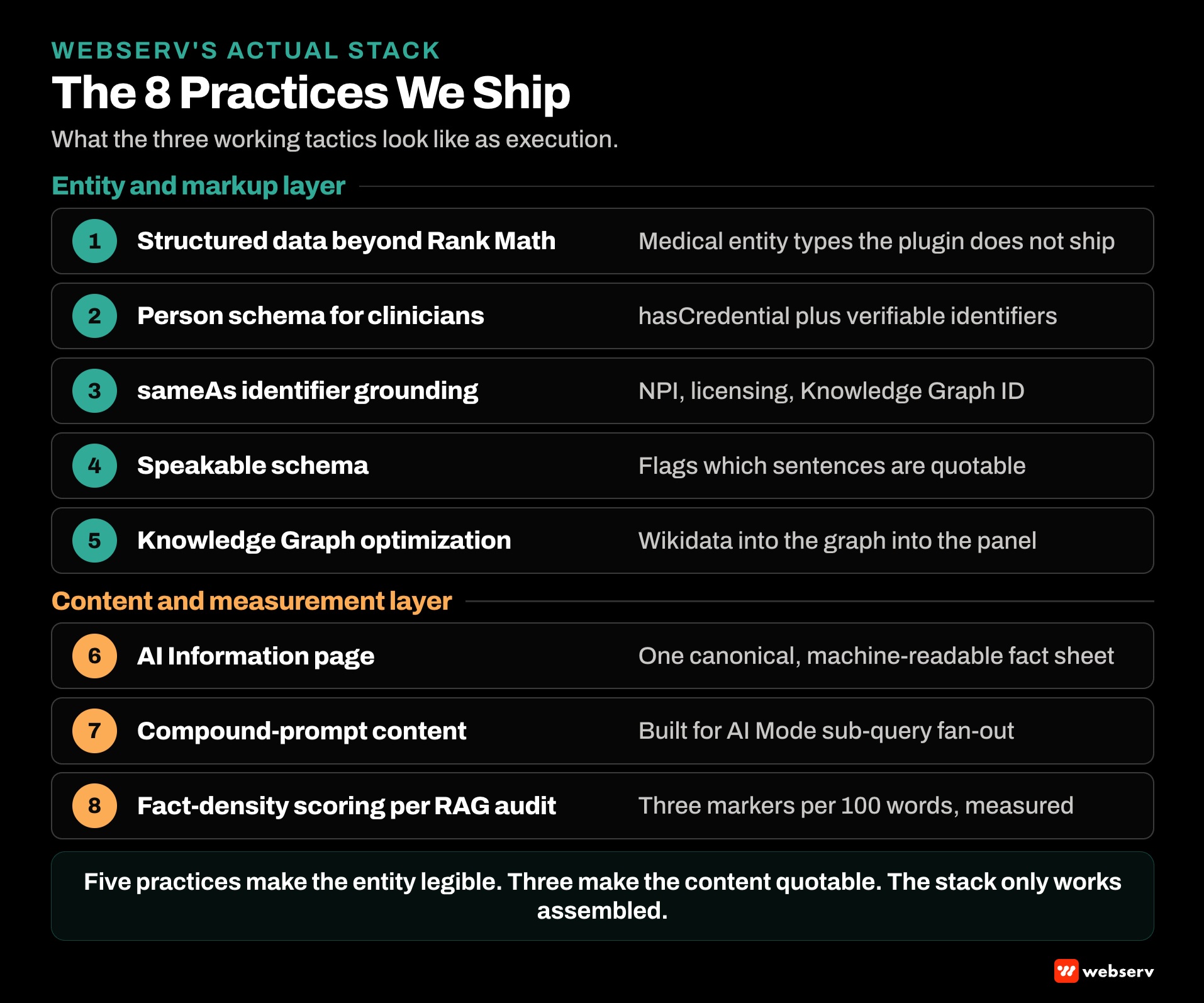
Item 1: Original research through PayerLenz and facility data. Quarterly original research publications with methodology transparency. Walked in depth in our original research piece.
Item 2: Fact density scoring on primary content. 3+ verifiable markers per 100 words across cluster hubs and ultimate guides.
Item 3: 40-55 word answer blocks under every H2. Extraction unit compatibility across the AI answer surfaces. Walked in our 40-word answer block piece.
Item 4: Cluster hub architecture with clear parent-child hierarchy. Cluster hubs anchor topical authority; supporting pieces build depth.
Item 5: Named clinician attribution with full Person schema. Seven-field Person schema including sameAs, hasCredential, knowsAbout. Walked in our guide to author bios that build E-E-A-T.
Item 6: Quarterly refresh cadence on cluster hubs and AI Information pages. Visible last-updated timestamps.
Item 7: Compound prompt content model for sub-query fan-out. H2 structure aligned to specific AI Mode sub-queries. Walked in our compound prompt content model piece.
Item 8: Reddit strategy with Tier 1 subreddit engagement. Compliance-safe mature-profile engagement on r/stopdrinking, r/leaves, r/OpiatesRecovery under Reddit’s corporate content policy. Walked in our Reddit strategy for AEO citations piece.
All 8 items appear across our Full AI Search Stack for treatment centers with implementation depth per item. The 8-item stack replaces the 5 tactics that don’t work, not supplements them.
Measure the stack the same way you would measure anything else: a fixed prompt set, monthly citation snapshots, and the Search Console generative AI report for Google.
Frequently Asked Questions
If llms.txt doesn’t produce citation lift, why ship it at all?
Ship llms.txt because Lighthouse’s Agentic Browsing audit checks for a valid one. Don’t expect citation lift from it: Google’s AI optimization guide says Google Search ignores llms.txt, and no other major answer surface has said it uses the file for source selection. It costs almost nothing and clears a specific audit check.
The distinction: llms.txt is a technical SEO artifact, not a citation tactic. Marketing directors evaluating AEO agencies should watch for pitches that frame llms.txt as a load-bearing AI citation tactic. that framing signals the agency is optimizing for what sounds sophisticated rather than what measurably works.
Ship the file. Skip the pitch that positions it as the reason your facility will get cited in ChatGPT.
How do we tell the difference between an AEO agency that measures and one that doesn’t?
Ask for their quarterly citation-share methodology and a sample report. Agencies with measurement infrastructure typically run Brand Radar, Otterly, or similar AI citation trackers on target prompt sets across ChatGPT, Perplexity, Google AI Overviews, Claude, and Bing Copilot.
Agencies without measurement infrastructure typically deflect the question, cite Google Search Console data instead of AI-surface data, or produce case studies that describe tactics without corresponding citation-share numbers.
Measurement discipline correlates strongly with tactic quality. Agencies that measure know which tactics move the number; agencies that don’t measure pitch what sounds novel.
Is content chunking always wrong, or just as an isolated tactic?
Wrong as an isolated tactic. The idea that AI systems extract preferentially from artificial 100-200 word chunks doesn’t hold up to measurement. AI systems extract from the first clean answer block after each H2 regardless of chunk boundaries. Our 40-word answer block piece covers the specific extraction pattern that actually applies.
What some agencies call chunking is really just writing structured content. H2s with definitive answer blocks under each one. That is the pattern that works. Calling it chunking implies an extraction hack that isn’t there.
The specific fix: write for the extraction unit AI systems actually use (40 to 55 word answer block under every H2 with definitive claim structure), not for the extraction unit AEO agencies invented to sell distinct services.
What’s the harm in AI-rewriting existing content for AEO?
Two harms. First: AI-generated rewrites typically produce lower fact density than the original because AI models default to generic phrasing when asked to rewrite for keyword or semantic saturation. Fact density is one of the specific signals AI answer surfaces reward for citation eligibility. Rewrites that reduce it typically produce citation loss, not lift.
Second: a wholesale rewrite throws away what made the page rank and get cited in the first place, and it makes it hard to tell which change moved the numbers. Webserv keeps refresh edits to a minority of a page’s words for that reason.
The right pattern: original content written by named human authors with clinical or subject-matter expertise. Fact density added by hand through specific factual anchors. Refresh through targeted edits rather than full rewrites.
Are directory-farm brand mentions ever a legitimate tactic?
Not for AI citation lift. There is no evidence that directory farm mentions raise AI citations, and AI systems favor sources with real authority.
Some directory arrangements also violate Google’s link scheme prohibitions, which produces measurable Google penalty risk on top of the null citation return. Certain directory farms also fail LegitScript review, which cascades into ad-platform issues that suspend paid campaigns.
The specific fix: authentic brand mentions from authoritative third-party sources. industry press, professional association materials, contributed content in industry publications, clinician thought leadership. Those are the mentions that actually contribute to AI citation authority.
How should schema deployment change now that FAQ rich results are gone?
Google stopped showing FAQ rich results for every site on May 7, 2026, after limiting them to government and health sites in 2023. FAQPage markup is still valid, but it no longer earns a visual feature in Google. Our FAQ schema piece walks the audit that follows from that.
The specific fix: schema deployment matched to page purpose. Primary content pages carry appropriate schema (MedicalClinic, MedicalBusiness, Person, Article, FAQPage where the FAQ block is substantive). Thin pages carry minimal schema. Our structured data beyond Rank Math defaults piece covers the specific schema stack that works.
Schema overloading, 15+ types stacked on a thin service page, does not fix a thin page. An Ahrefs study of 1,885 pages that added JSON-LD found no statistically significant change in AI citations versus controls.
What does the Webserv 8-item AEO stack look like as a program?
Eight items, each mapped to measurable citation lift and each cross-referenced across the AEO cluster. Item 1: original research through partner data (our original research piece). Item 2: fact density scoring on primary content. Item 3: 40-55 word answer blocks under every H2 (our 40-word answer block piece).
Item 4: cluster hub architecture with clear parent-child hierarchy. Item 5: named clinician Person schema (our guide to author bios that build E-E-A-T). Item 6: quarterly refresh cadence on hubs and AI Information pages. Item 7: compound prompt content model for sub-query fan-out (our compound prompt content model). Item 8: Tier 1 subreddit engagement (our Reddit strategy for AEO citations piece).
All eight items appear across our Full AI Search Stack for treatment centers with implementation depth per item. The 8-item stack replaces the 5 tactics that don’t work; it doesn’t supplement them.
Trevor Gage is the Director of Marketing at Webserv, a digital marketing agency for treatment centers. Preston Powell, CEO of Webserv, contributed review to this piece.