When patients need care, they open a search engine first. Most healthcare decisions, from choosing a private practice to finding a treatment center, begin with a Google query, and the businesses that appear in the answer window capture the calls that follow.
Healthcare SEO is the discipline of getting a medical practice, hospital, or behavioral-health facility to show up when a patient (or a family member) is actively searching for the service you offer. Done well, it converts anonymous search intent into scheduled admissions. Done poorly, it hands that intent to a competitor.
This guide walks through the eight core pillars of a healthcare SEO program that still works in 2026, after Google’s AI Overviews and AI Mode rollouts reshaped the answer surface. If you want the scoped version of this work, our Content and SEO services page shows how a full program is put together. For the wider context, see our complete behavioral health marketing guide.
Key Takeaways
- Healthcare SEO is a YMYL (Your-Money-or-Your-Life) discipline. Google’s Search Quality Rater Guidelines hold medical content to a stricter E-E-A-T standard than general web content.
- The eight pillars are technical health, keyword strategy, on-page optimization, medically-reviewed content, Google Business Profile, local link acquisition, review management, and measurement tied to admissions (not vanity traffic).
- AI Overviews and AI Mode did not replace organic search, they added a second surface that cites indexed pages. Topically-complete sites get pulled into far more of the query fan-out than single-page targets.
- Meaningful ranking movement on commercial healthcare queries takes six to twelve months. Anyone promising 30-day rankings on competitive terms is misrepresenting what they can deliver.
- The highest-impact local channel for a facility with a physical address is a complete, verified Google Business Profile, review response cadence and category accuracy matter more than most agencies admit.
Why healthcare SEO is different from general SEO
The mechanics look similar. The rules are not. Google classifies healthcare content as Your-Money-or-Your-Life, a category the public Search Quality Rater Guidelines flag for stricter evaluation. A generic SEO checklist takes a medical site partway. The rest is credential and citation work.
Two constraints shape the work. First, the E-E-A-T standard (Experience, Expertise, Authoritativeness, Trustworthiness) is enforced more heavily on health pages. Second, patients weigh review signal and cross-referenced sources more than shoppers evaluating a product.
Definition, E-E-A-T
Experience, Expertise, Authoritativeness, and Trustworthiness. Google’s framework for evaluating whether a page deserves to rank on high-stakes queries like healthcare, finance, and legal. Named clinicians with real credentials, cited peer-reviewed or agency sources, medical review sign-off, and a transparent editorial process all move E-E-A-T signals. Anonymous authorship, missing citations, and unverifiable claims move them the other direction.
The eight pillars below are structured around those constraints. Each one, applied consistently, compounds into ranking movement on the queries a patient actually types. For the addiction treatment version, see our drug rehab SEO strategy guide.
Pillar 1: Technical SEO health
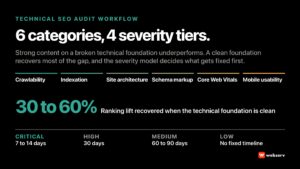
Nothing else in this list matters if search engines cannot crawl, index, and render your site cleanly. A site with broken schema, slow load times, or blocked resources is invisible to Google before a single word of content is judged. The minimum viable technical audit surfaces:
- Broken internal links and 404 destinations
- Duplicate content across service and location pages
- Crawl errors reported in Google Search Console
- Mobile-friendliness issues on service and location pages
- Slow load time, especially on mobile
- HTTPS coverage across every URL
- XML sitemap accuracy and submission status
- Correct schema markup (MedicalOrganization, MedicalBusiness, or MedicalClinic)
If your rankings have plateaued and no one can explain why, the diagnosis usually sits here. Our why isn’t my rehab website ranking on Google guide walks the diagnostic tree, and the technical SEO checklist for behavioral health websites is the version you hand to a developer.
Pillar 2: Patient-intent keyword strategy
Keyword research for healthcare is not a volume exercise. The highest-volume queries are almost always informational and will not convert. The queries that convert are longer, more specific, and often carry a location modifier. Build the keyword universe around the four intent types a patient moves through.
- Symptom queries (“panic attacks at night”) are early awareness, informational content wins
- Condition queries (“generalized anxiety disorder”) are mid-funnel, educational content with a service-page hand-off wins
- Treatment queries (“EMDR therapy Sacramento”, “detox center near me”) are commercial, service and location pages win
- Provider queries (“psychiatrist accepting Aetna”) are bottom-funnel, provider bios and reviews win
Start with Google Keyword Planner (free with an Ads account), pull the “People also ask” and “Related searches” from live SERPs, and prioritize by intent match rather than raw volume. Our keyword strategy guide for rehab and mental health providers shows the full method.
Pillar 3: On-page optimization that respects clinical accuracy
One non-obvious constraint: you cannot sacrifice clinical accuracy for keyword density. A page that reads as SEO-first will fail the E-E-A-T bar even if it hits every technical target. The floor for every service, condition, or treatment page:
- Exactly one H1 that matches searcher intent
- H2s and H3s that mirror patient questions, not internal service names
- Title tag under 60 characters, meta description under 160, written for a click
- Clean URL structure (for example /services/condition-name/, /locations/city-name/service-name/)
- Named clinical author or medical reviewer visible on the page
- Internal links to related conditions, treatments, and the service hub
- Image alt text that describes what the image shows
Pillar 4: Medically-reviewed content depth
Content depth is where most healthcare sites lose. A thin page with a keyword stuffed into the H1 will not compete against a facility that publishes reviewed, cited, well-structured explanations of conditions and treatments. The bar for a page to earn E-E-A-T signal on a clinical topic:
- Named author with verifiable credentials and a linked bio page
- Named medical reviewer separate from the author when the author is not a clinician
- Publish date and last-reviewed date on the page
- Citations to primary sources: peer-reviewed journals, and federal agencies like SAMHSA, CDC, NIH, and FDA
- Answers structured to match what patients actually search
- No unverifiable superlatives (“best in the country”, “highest success rate”)
Google’s helpful-content documentation spells out the standard for YMYL topics. Sites that treat medical review as a bolt-on lose to sites that treat it as core production.
Pillar 5: Google Business Profile and local presence
For any facility with a physical location, Google Business Profile is the highest-impact local channel available. A complete, verified profile determines whether you appear in the local pack, on Maps, and in the knowledge panel on branded searches, which all sit above the organic results. The core discipline:
- Claim and verify every location with accurate NAP matching your website exactly
- Set the correct primary category and add relevant secondary categories
- Populate the service list to match your website
- Add real interior and exterior photos (avoid stock)
- Publish weekly GBP posts (events, service updates, new hires)
- Respond to every review, positive or negative, within 48 hours
- Keep hours accurate, including holiday closures
See our Google Business Profile optimization guide for rehab centers for the full playbook.
Pillar 6: Local and clinical link acquisition
Backlinks remain a top-tier ranking signal. For healthcare, useful backlinks are almost entirely local (chambers of commerce, local news, city health departments, community partners) or clinical (professional associations, accrediting bodies, university health centers). Sources worth pursuing:
- Accrediting bodies (The Joint Commission, CARF, LegitScript)
- Professional associations (ASAM, state medical societies, specialty boards)
- Local news coverage of new services, hires, or community events
- City and county health department resource pages
- University or hospital referral pages when clinical relationships exist
What to avoid: paid link marketplaces, guest-post networks, and any offer that promises volume backlinks for a flat fee. Google’s spam policies call these link schemes, and the penalty for a healthcare site is disproportionate.
Organic SEO wins when
- You have 12+ months of runway before you need results
- Your service line has stable, evergreen search demand
- You can hire or already have a clinical medical reviewer for content
- You want a compounding asset that keeps producing after spend stops
Paid search wins when
- You need admissions this quarter for a defined census target
- You are launching a new service or location with no organic history
- You compete against organic incumbents with strong domain authority
- You are supplementing organic while it builds
Pillar 7: Review management and reputation signal
For behavioral health specifically, reviews carry more weight than in most verticals. Patients (or their family members) are making a vulnerable decision, and they weigh recent, specific reviews heavily. What actually moves the reputation signal:
- A consistent review-request cadence built into the discharge or wrap-up workflow
- Response to every review within 48 hours, from named responders (not “the team”)
- Specific responses to negative reviews without HIPAA violations
- A steady flow of new reviews over time (a wall of 5-stars from three years ago is a red flag)
- Reviews across the platforms patients actually check (Google, Yelp, Healthgrades, Psychology Today)
Review volume without response cadence is a wasted signal. Response cadence without volume plateaus fast. Together, they compound.
Pillar 8: Measurement tied to admissions, not vanity metrics
This is the pillar most healthcare SEO programs skip. A dashboard of organic sessions, keyword rankings, and impressions is a lagging vanity report. The measurement that matters is call volume, form submissions, appointment bookings, and admissions attributed back to organic search. The stack that works:
- Call tracking on every published number, split by page and channel
- Form-submission events in Google Analytics 4 with source and medium retained
- A CRM or EHR field that captures how the patient found you at intake
- Monthly reconciliation between organic-attributed inquiries and actual admissions
- Rank tracking on commercial queries that matter, not the ones that read well
If your reporting cannot tell you how many admissions came from organic search last month, the program is running blind, and any decision made from it is a guess.
Does healthcare SEO still matter when AI answers the question?
This is the version people actually ask in 2026. Google now resolves many healthcare queries inside AI Overviews and AI Mode before anyone clicks a link. The answer is yes, but the shape of the win changed.
Google Search Central’s own guidance on AI features and your website is blunt: a page has to be indexed and eligible to appear with a snippet, and there are no additional technical requirements. No AI-specific file. No special schema. The same documentation describes a query fan-out technique, where AI Mode issues multiple related searches across subtopics and assembles an answer from the pages it finds.
One healthcare page targeting one keyword is a weak citation candidate. A site that covers a condition or treatment properly, across multiple linked pages with real clinical depth, gets pulled into far more of those sub-searches.
The AI-search-era reframe of healthcare SEO
The eight pillars above did not become obsolete. They became the entry ticket to a second surface. We break the full picture down in the AI search stack guide for treatment centers.
The bottom line on healthcare SEO in 2026
Healthcare SEO is worth it. The compounding return sits with facilities that treat all eight pillars as a continuous discipline rather than a one-shot project. Sites that run technical audits quarterly, publish reviewed content monthly, tend to GBP weekly, and respond to reviews daily out-rank sites that treat SEO as a launch task.
If your program is stalled, the diagnosis usually sits in the technical layer (see the technical checklist), the content-review layer (missing named authors, citations, or medical reviewer), or the measurement layer (no attribution back to admissions).
Want a second opinion for your facility? Book an intro call and we will tell you honestly what we see.
Frequently Asked Questions
What is healthcare SEO and how is it different from regular SEO?
Healthcare SEO is the practice of ranking a medical or behavioral-health website for the queries patients actually use, under the constraints that apply to health information online. The mechanics look like general SEO. The rules around what a page is allowed to say do not.
Google classifies healthcare pages as Your-Money-or-Your-Life (YMYL) content and evaluates them against a stricter E-E-A-T standard. The public Search Quality Rater Guidelines call out medical topics as a category where named authors, verifiable credentials, and cited clinical sources materially move rankings.
Practical translation: a general-SEO checklist gets a healthcare site partway. The rest is EEAT signal work, medical review, and primary-source citation.
How long does healthcare SEO take to show results?
Six to twelve months for meaningful ranking movement on commercial queries, with first signals (indexing, shifts on lower-competition long-tail queries) usually appearing in the 60-to-90-day window. Google Search Central’s ranking-systems guide makes the point directly: the algorithm rewards accumulated signal, not one-shot changes.
Variance depends on domain age, existing authority, and technical debt at the outset. A behavioral-health facility competing in a saturated state will move slower than a private-practice clinic in a mid-size market.
Anyone promising top-three rankings on high-volume commercial queries inside 30 days is misrepresenting what they can deliver.
Does healthcare SEO still matter now that AI answers most patient questions?
Yes. Google’s own guidance on AI features confirms that AI Overviews and AI Mode pull from indexed pages. There are no additional technical requirements beyond standard indexing and snippet eligibility.
What changed is the shape of the win. AI Mode uses a query fan-out technique, issuing multiple related sub-searches and assembling an answer from the pages it finds. A single page targeting a single keyword is a weak citation candidate. A site that covers a topic properly, across multiple linked pages, gets pulled into far more of that fan-out.
The fundamentals did not become obsolete. They became the entry ticket to a second surface.
How important is Google Business Profile for a medical practice or treatment center?
For any facility with a physical location, GBP is the single highest-impact local channel. Google’s documentation confirms a complete, verified profile is what makes a business eligible for the local pack, Maps, and the knowledge panel on branded searches.
What matters beyond claiming and verifying: accurate NAP (name, address, phone), correct primary and secondary categories, service list matching your site, review response, and regular posts. For behavioral health specifically, the review signal is heavier than in most verticals.
Facilities that run GBP deliberately capture the highest-intent local traffic before an organic result even loads.
Should I hire a healthcare SEO agency or run it in-house?
In-house works when someone on staff can dedicate 10 to 20 hours a week, has a working knowledge of technical SEO, and can coordinate with a medical reviewer for the EEAT layer.
An agency makes sense when you need content production, technical audits, GBP management, link acquisition, and reporting running in parallel, and the internal team is closer to zero SEO hours than 20. Healthcare SEO is a full-time job that also changes constantly.
If you go the agency route, ask for last-three case studies with actual patient inquiry data (not ranking screenshots), verify their reviewers understand medical content standards, and confirm the reporting model ties activity to admissions or bookings. Our Content and SEO services page describes how we scope that work.