Every treatment center owner I talk to has heard the same three pieces of SEO advice from the last three agencies who pitched them. Every operator has a stack of audit PDFs from prior engagements that all say “you need more content, faster site speed, better backlinks, more schema.”
Every marketing director has a folder of recommendations they never executed on because the recommendations were the same generic list they got two years ago from someone else.
The pattern is not that treatment center SEO is unknowable. The pattern is that most agencies audit everything, recommend everything, and execute nothing that connects to the specific reason a facility is underperforming.
Google’s own Search Central documentation on the March 2024 core update (still the load-bearing framework Google references in its most recent updates through 2026) makes the same point in different words.
E-E-A-T signals, technical health, and content quality only matter when they resolve a specific gap the site has. Fixing gaps the site does not have produces motion without progress.
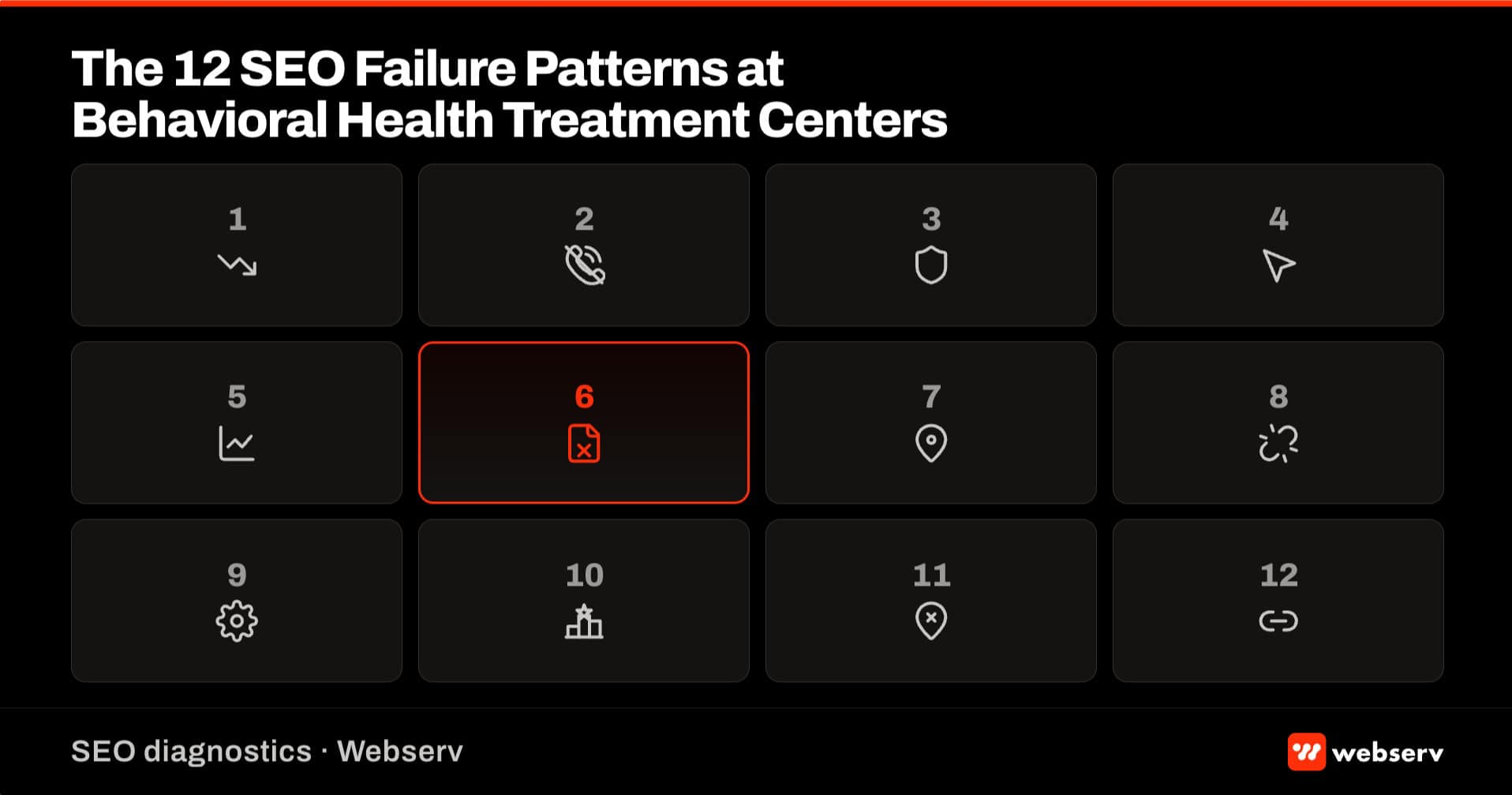
The 12-challenge diagnostic framework is the internal system our content SEO team runs before we write any recommendation for a treatment center account.
It identifies the specific failure pattern (or patterns) the facility is producing, confirms the pattern with data from GA4, Google Search Console, and Ahrefs, and anchors the recommended move to the confirmed pattern. Not to the generic checklist.
This piece is the operator-facing version of that framework. It walks the 12 failure patterns, the specific signal that confirms each one, the underlying cause behind each, and the specific move that resolves each.
It closes with a diagnostic quiz that produces a personalized read on which patterns apply to your facility in about three minutes.
If you want to jump to the quiz, it sits at the end of this piece. If you want to work through the patterns first, the framework below is the same one we use during Red Carpet Onboarding for new clients.
Key Takeaways
- Behavioral health treatment center SEO underperformance almost always maps to one or more of 12 specific failure patterns. The industry pattern of audit-everything, recommend-everything produces recommendations disconnected from the actual gap. The diagnostic-first approach identifies the pattern, confirms it with data, and anchors the recommended move to the confirmed pattern rather than to a generic checklist.
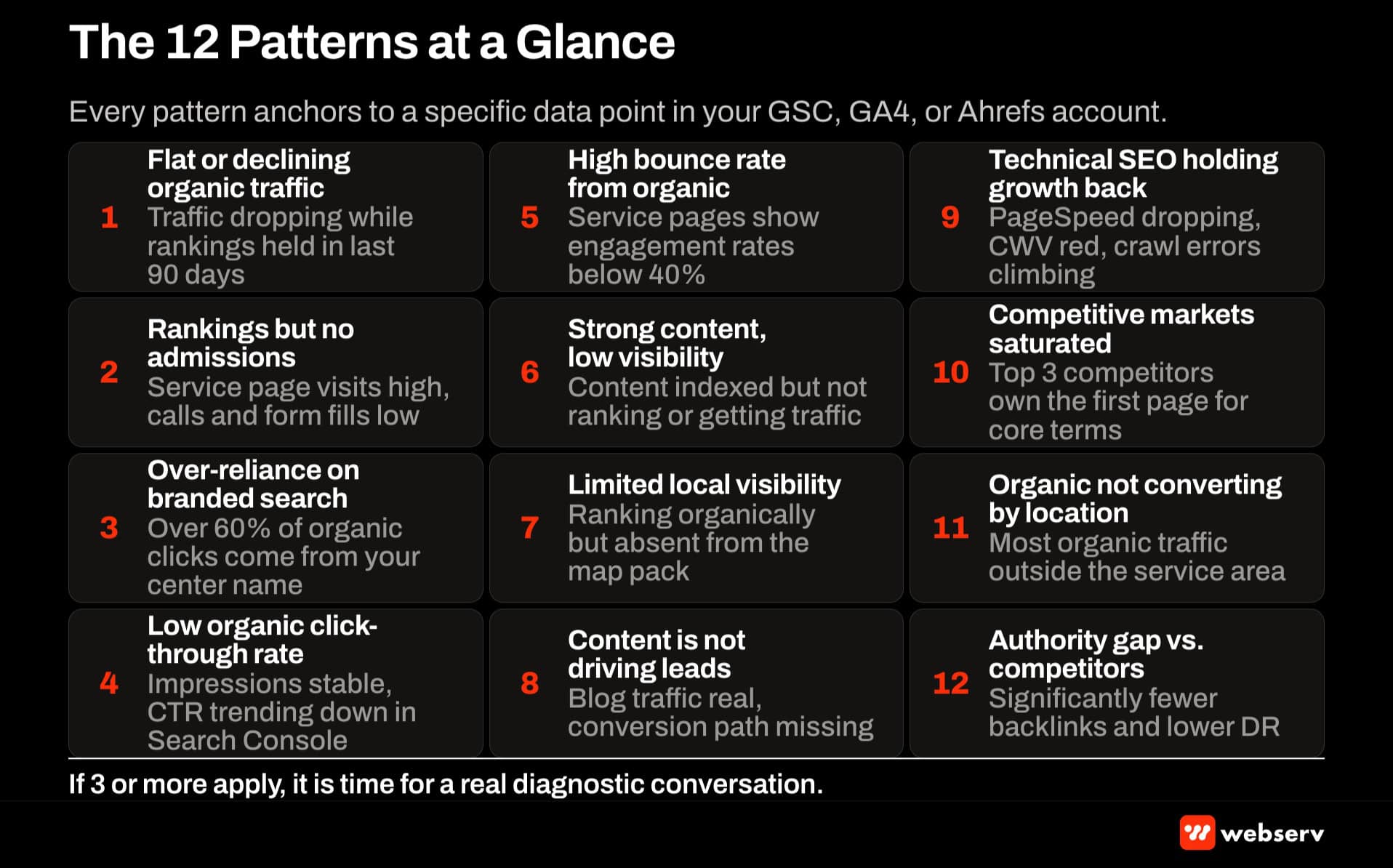
- The 12 patterns split across five domains: traffic patterns (Patterns 1, 5), commercial patterns (Patterns 2, 3, 8), visibility patterns (Patterns 4, 6, 7, 10, 11), technical patterns (Pattern 9), and authority patterns (Pattern 12). Most facilities produce 2-4 patterns at once, and the order they get fixed in matters.
- The confirming signal for each pattern lives in a specific tool: GA4 for traffic and conversion patterns, Google Search Console for visibility and technical patterns, Ahrefs for authority patterns, Google Business Profile for local visibility patterns. If you cannot confirm the pattern with the tool’s data, the pattern is not the diagnosis and the recommended move should not run.
- Some patterns are DIY-viable at operator level (Pattern 1 traffic diagnosis, Pattern 3 branded reliance, Pattern 4 CTR, Pattern 8 content-to-lead conversion). Some require agency-level infrastructure (Pattern 6 content indexing, Pattern 7 local visibility, Pattern 9 technical SEO, Pattern 10 competitive saturation, Pattern 12 authority gap). Knowing which is which is what separates a good SEO investment decision from a wasted one.
- The diagnostic quiz at the end of this piece translates the 12-pattern framework into 10 operator-language questions. Answer the questions honestly and the quiz returns the top 1-3 patterns your account is producing, the confirming signals, and the recommended next moves. Results take about three minutes.
DEFINITION
12-pattern SEO diagnostic framework. A structured symptom-first diagnostic that identifies which of 12 known failure patterns is producing underperformance at a behavioral health treatment center site, confirms the pattern using data from a specific tool (GA4, Google Search Console, Ahrefs, or Google Business Profile), and anchors the recommended move to the confirmed pattern rather than to a generic audit checklist. Our complete drug rehab SEO guide covers the program those moves plug into.
Distinct from a standard technical SEO audit (which covers Pattern 9 only) and distinct from a keyword or content audit (which addresses one input rather than the diagnostic root). Runs before recommendations, not after. Median treatment center account produces 2-4 patterns simultaneously; sequencing which pattern gets fixed first matters more than the patterns themselves.
OPERATOR INSIGHT
Every treatment center owner I talk to has a stack of audit PDFs from prior engagements that all say the same generic list: more content, faster site speed, better backlinks, more schema.
The pattern is not that treatment center SEO is unknowable. The pattern is that most agencies audit everything, recommend everything, and execute nothing that connects to the specific reason a facility is underperforming. The 12-pattern framework is the operating discipline that starts from the symptom and works backward to the root, so the recommended move resolves the actual gap.
Pattern 1: Flat or Declining Organic Traffic
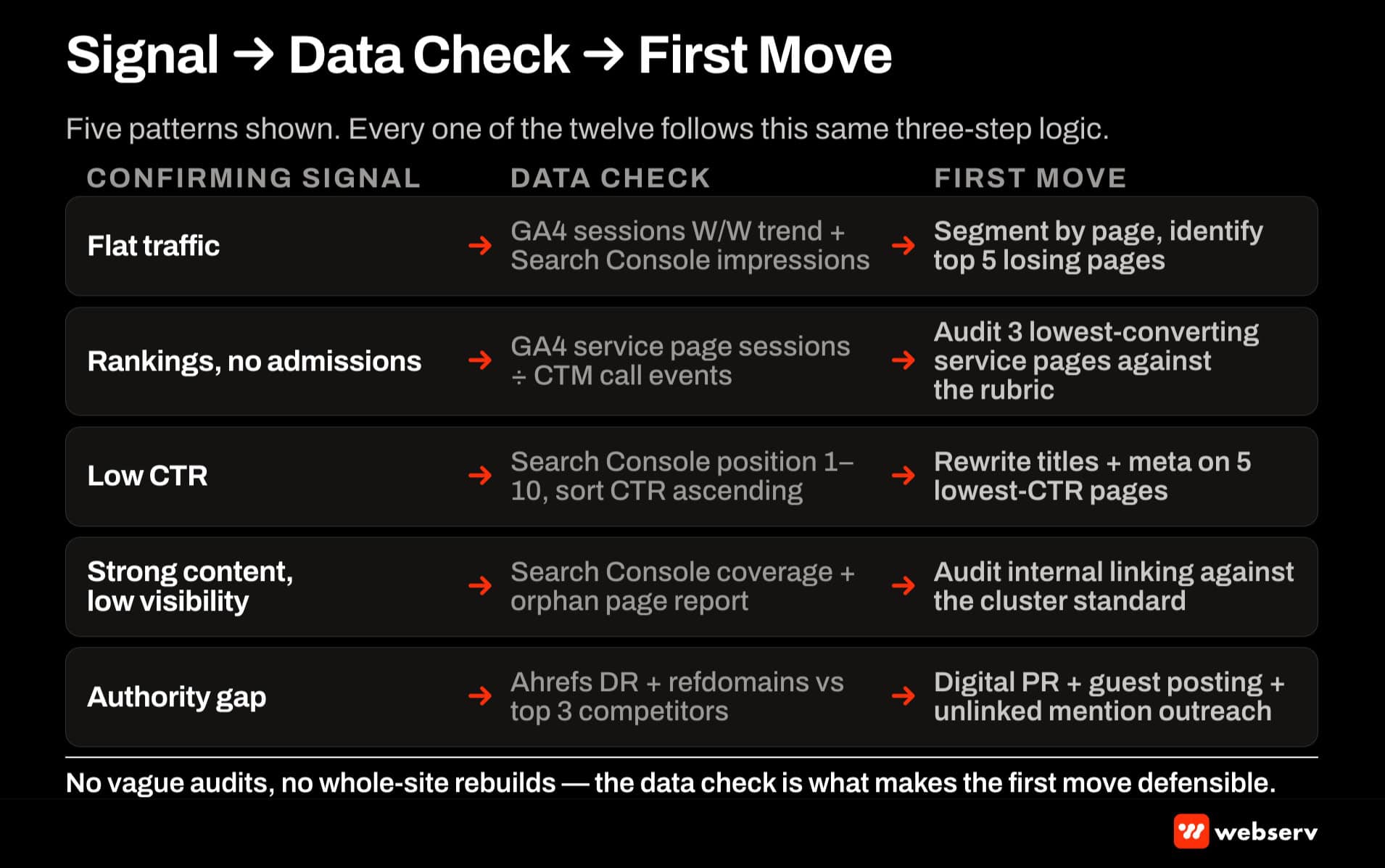
What it looks like. Organic sessions in GA4 have been flat or trending down for two or more consecutive quarters, but the facility has not lost meaningful keyword positions in Google Search Console. Rankings look stable. Traffic is not.
How to confirm. In GA4, pull the trailing 6-month organic sessions trend by month. In GSC, pull the same trailing 6-month clicks trend and the trailing 6-month impressions trend. Compare. If clicks are flat or down and impressions are flat or up, the pattern is confirmed.
What is underneath. The category itself is not producing the search volume it used to for the queries the facility ranks on. This pattern surfaces when a specific behavioral health topic or geography has seen a demand shift, when a competitor has captured share of impression at the top of the SERP, or when AI answer surfaces are absorbing informational-intent traffic that used to reach the site.
The recommended move. Diversify query coverage by expanding into adjacent intent categories the facility does not currently rank on, or shift content investment toward the query categories where impressions are still growing. Our full AI search stack for treatment centers covers the surfaces that increasingly absorb informational traffic.
What execution looks like. A residential SUD facility ranking well for “residential treatment [city]” queries but seeing organic sessions decline builds out content around dual-diagnosis queries, family-perspective research queries, and modality-specific queries that share intent overlap with the core service. The click-through decline reverses over 90-120 days as the new content indexes and ranks.
Pattern 2: Rankings but No Admissions
What it looks like. Service pages rank well in Google Search Console. GA4 shows meaningful landing page traffic. But phone calls, form submissions, and scheduled admissions from the same pages do not match the traffic volume.
How to confirm. In GA4, filter to organic sessions landing on your primary service pages. Compare the session count against the conversion count (form-fills plus tracked calls) for the same pages over the trailing 90 days. If the ratio is below 2 percent conversion, the pattern is confirmed for that page. If it is below 1 percent, the pattern is severe.
What is underneath. The traffic is arriving on the page but the page is not producing the conversion. The failure usually lives in one of four places: the page copy does not answer the specific question the visitor came for, the CTA is not visible or not compelling, the page loads slowly enough that visitors leave before the CTA renders, or HIPAA-safe conversion tracking is under-counting the actual admissions the page produces.
The recommended move. Run a conversion audit on the underperforming pages before touching content strategy. The traffic is the input. If the page cannot convert the input it already has, more input does not solve the problem.
What execution looks like. A facility with a residential program page pulling 800 monthly sessions but 4 conversions runs a heatmap, fixes the phone-number tap target on mobile, rewrites the fold above the first CTA to answer the specific admissions question families are asking, and confirms the conversion rate improvement over 45 days before scaling additional organic content investment.
Pattern 3: Over-Reliance on Branded Search
What it looks like. In Google Search Console, when you filter by query and separate branded queries (queries containing the facility name) from non-branded queries, branded queries account for more than 60 percent of total clicks. The facility ranks well only for people who already know its name.
How to confirm. GSC → Performance report → filter for queries containing the facility name → note total clicks. Compare against total clicks across all queries. Divide. Above 60 percent branded is the pattern.
What is underneath. The site has built brand awareness through other channels (paid, referral, PR) but has not built the topical authority Google requires to rank on category-level queries. This is common at facilities with strong paid media programs and weak organic content programs.
The recommended move. Invest in category-level content that ranks on the queries families use before they know your facility name. Our full AI search stack for treatment centers walks the category-level content approach for behavioral health.
What execution looks like. A facility that ranks well for “[Facility Name]” queries but produces no organic traffic on “residential rehab [state]” or “dual diagnosis treatment [region]” queries invests in category-level service pages and educational content targeting the category-level intent, closing the gap between branded and non-branded traffic over 6-9 months.
Pattern 4: Low Organic Click-Through Rate
What it looks like. Google Search Console impressions are stable or growing. Clicks are flat or declining. The click-through rate is below 3 percent for the queries the facility ranks on.
How to confirm. GSC → Performance report → sort by impressions descending. For each query with 500+ impressions per month, check the CTR. If CTR is below 3 percent (below 5 percent for position 1-3 rankings), the pattern is confirmed.
What is underneath. The site is showing up in the SERP but not earning the click. The failure lives in the SERP presentation: meta title does not match the query intent, meta description reads as generic, the ranked page appears without a rich result while competitors have rich results, or AI Overviews are absorbing the click without a citation to the site.
The recommended move. Rewrite meta titles and descriptions to match the specific query intent per page. Add schema markup that produces rich results in the SERP. Confirm the rewrite is producing CTR lift within 30-45 days.
What execution looks like. A facility ranking in position 3 for “IOP program [city]” with a 1.4 percent CTR rewrites the meta title from generic (“Intensive Outpatient Program”) to specific (“Evening IOP in [City] with Dual-Diagnosis Support”) and sees CTR move to 3.2 percent within 45 days without changing rankings.
Pattern 5: High Bounce Rate from Organic
What it looks like. Organic landing pages show bounce rates significantly higher than the site average. Visitors arrive, do not scroll, and leave without engaging.
How to confirm. GA4 → filter to organic sessions → compare bounce rate on organic landing pages against site-wide bounce rate. If organic bounces are 15+ percentage points higher than site average, the pattern is confirmed for those pages.
What is underneath. Query-intent mismatch. The page ranks on a query it does not actually answer. Visitors arrive expecting one thing, see something different, and leave. Common in behavioral health when generic service pages rank on specific-intent queries (a “residential” page ranking on “outpatient” queries, a “detox” page ranking on “dual diagnosis” queries).
The recommended move. Audit the query-page mapping for high-bounce landing pages. Either rewrite the page to answer the query it ranks on, or build a separate page that answers the specific query the traffic is actually looking for.
What execution looks like. A facility with a residential page ranking on “day treatment near me” queries at 78 percent bounce builds a dedicated PHP page that answers the day-treatment intent specifically, sees the new page convert at 3.4 percent versus the residential page’s 0.6 percent conversion on the misdirected traffic.
Pattern 6: Strong Content, Low Visibility
What it looks like. The facility has published meaningful volume of clinical or educational content. Google Search Console shows the pages indexed. But impressions and clicks are minimal, and Ahrefs shows the pages ranking in positions 30+ for their target keywords.
How to confirm. GSC → Coverage report → confirm target pages are indexed. GSC → Performance → filter to specific URL → check impressions. Ahrefs → export page positions → sort by average position. Indexed + low impressions + position 30+ is the confirmed pattern.
What is underneath. The content is not competing with the pages that rank higher. Usually one of three reasons: the content lacks the specific E-E-A-T signals Google honors for YMYL (Your Money or Your Life) content in behavioral health per Google’s helpful content guidance, the internal linking to the content is thin, or the content targets a keyword the site does not have the topical authority to rank on yet.
The recommended move. Audit the content against E-E-A-T requirements (clinical author bio with credentials, medical reviewer citations, primary source references, updated dates). Strengthen internal linking from stronger pages to the underperforming content. If the topical authority gap is structural, sequence content investment to build the cluster the underperforming pages need to sit inside.
What execution looks like. A facility with 40 clinical blog posts stuck in positions 30-60 audits the E-E-A-T signals, adds clinician bio blocks with credentials to each post, adds three primary source citations per post (SAMHSA, NIH, Google Search Central where applicable), and reinforces internal linking from service pages into the blog content. Rankings move to positions 8-20 over 120 days.
Pattern 7: Limited Local Visibility
What it looks like. Google Search Console shows organic clicks. But when families search local queries (“[city] rehab,” “treatment center near me”), the facility does not appear in the map pack. Google Business Profile impressions are low. Direction requests and calls from GBP are minimal.
How to confirm. Google Business Profile → Performance → check trailing 90-day impressions, calls, and direction requests. Manual SERP check on the top 5 local queries for the facility’s service area from an incognito browser at the physical location. If the facility does not appear in the top 3 map pack positions for its own city, the pattern is confirmed.
What is underneath. GBP is not optimized, the facility’s NAP citations are inconsistent across directories, local backlinks are thin, or Google has not confirmed the facility’s local prominence signals. Local visibility is a separate ranking system from organic web ranking.
The recommended move. Full GBP optimization pass (categories, services, attributes, posts, photos, review response cadence). NAP audit across the top 20 behavioral health directories. Local link acquisition through partnerships and community involvement.
What execution looks like. A facility invisible in the map pack for its own city runs a NAP audit finding 34 inconsistent listings, corrects them, expands GBP categories from 1 to 5 with the appropriate BH categories, activates weekly GBP posts, and sees map pack impressions grow 400 percent over 90 days.
Pattern 8: Content Is Not Driving Leads
What it looks like. Blog articles produce strong traffic in GA4. But downstream conversions (form-fills, phone calls, scheduled admissions) attributed to those pages are minimal. The content is reaching people but not producing admissions.
How to confirm. GA4 → landing page report filtered to blog content → check sessions, engagement rate, and conversion count per page. If a blog page produces 500+ monthly sessions with under 3 total conversions, the pattern is confirmed.
What is underneath. The content targets top-of-funnel research intent without providing the mid-funnel path to admissions. Common failure: blog posts answer “what is [condition]” queries thoroughly but do not connect the reader to the facility’s specific treatment offering. Also common: HIPAA-related tracking gaps. The HHS OCR bulletin on online tracking technologies covers the client-side pixel restrictions that break BH conversion measurement.
The recommended move. Add mid-funnel CTAs to top-of-funnel content that route readers to the relevant service page. Ensure HIPAA-safe conversion tracking is measuring the downstream events. Do not conclude the content is not working before confirming the measurement is capturing what is actually happening.
What execution looks like. A facility with a “signs of alcohol addiction” blog post pulling 1,200 monthly sessions and 0 conversions adds an inline CTA to the residential program page mid-article and a final CTA above the FAQ, then confirms HIPAA-safe tracking captures form-fills from the blog. Conversions move from 0 to 8 per month within 60 days.
Pattern 9: Technical SEO Holding Growth Back
What it looks like. Google Search Console flags coverage errors, Core Web Vitals warnings, or crawl issues. Page speed reports show mobile load times over 4 seconds. Mobile usability errors exist. The site’s technical foundation is not clean.
How to confirm. GSC → Coverage report → count errors and warnings. GSC → Core Web Vitals report → check mobile and desktop status. Google PageSpeed Insights → run the top 5 landing pages → note LCP, INP, and CLS scores. Any of these failing the Core Web Vitals thresholds Google publishes confirms the pattern.
What is underneath. The site’s technical infrastructure is not meeting the baseline Google requires for organic performance. Common in behavioral health because many facility sites were built years ago on platforms that have not been maintained (heavy WordPress builders, unoptimized images, outdated hosting).
The recommended move. Technical SEO audit and remediation before content or authority investment. Technical fixes are foundational. Investment in content or backlinks with a broken technical foundation produces disproportionately low return.
What execution looks like. A facility with a 6.2-second mobile LCP and 47 coverage errors in GSC runs a technical audit, migrates to optimized hosting, compresses image assets, fixes crawl errors, and sees LCP drop to 2.4 seconds. Organic clicks grow over the following 90 days without any new content or link investment.
Pattern 10: Competitive Markets Saturated
What it looks like. SERP review for core service terms shows the same 3-5 competitors dominating positions 1-10 across nearly every query. Rank tracking confirms these competitors have held those positions for 12+ months. The facility ranks in positions 15-40 with no clear path to move up.
How to confirm. Ahrefs → SERP overview for the top 10 core service queries → note which domains appear in top 10 positions. If 3-5 domains dominate 60+ percent of top-10 positions, the pattern is confirmed.
What is underneath. The market has consolidated around a small number of high-authority competitors. Entering the SERP requires either significant authority investment, a differentiated content angle the competitors have not covered, or a shift to less-saturated intent categories.
The recommended move. Combined strategy: build long-tail content targeting queries the top competitors have not covered, invest in digital PR and authority-building to close the domain authority gap over 12-18 months, and evaluate whether adjacent geographic markets offer less-saturated ranking opportunities.
What execution looks like. A facility unable to break into top 10 for “drug rehab [state]” queries targets specific modality queries the market leaders have not covered, builds 20 mid-funnel articles targeting long-tail modality intent, and captures position 4-8 rankings across those queries while parallel digital PR work builds the domain authority needed to compete on core service terms over the 12-month horizon.
Pattern 11: Organic Traffic Not Converting by Location
What it looks like. GA4 organic traffic reports significant sessions from geographic regions the facility does not serve. Local service pages underperform. The traffic exists but does not match the operating footprint.
How to confirm. GA4 → organic sessions filtered by geography → compare to the facility’s actual service area. If more than 40 percent of organic sessions come from regions outside the service area, the pattern is confirmed.
What is underneath. Content ranks broadly on informational queries that attract national traffic without geographic filtering. The site attracts research traffic but not admissions-intent traffic. Also common: the site’s local service pages are thin or missing, so families in the service area find competitors first.
The recommended move. Strengthen local service page content with the specific geographic and service signals that concentrate local visibility. Add location-specific content clusters. Confirm the informational content routes local visitors to the local service pages appropriately.
What execution looks like. A facility in Arizona seeing 62 percent of organic traffic from states it does not serve builds three Arizona-specific service pages (with city-level content depth), adds Arizona-specific case study content, and rebalances internal linking to route local traffic to local pages. In-state organic conversions grow from 6 to 24 per month over 120 days.
Pattern 12: Authority Gap vs. Competitors
What it looks like. Ahrefs shows the facility’s domain rating and referring domain count materially below the top 3-5 competitors in the market. Backlink growth is flat. Digital PR and earned media activity is minimal.
How to confirm. Ahrefs → domain overview for the facility → note DR and referring domains. Compare against the top 5 competitors. If DR is 15+ points below the market average and referring domain growth is under 10 net new referring domains per quarter, the pattern is confirmed.
What is underneath. The facility has not invested in the earned-media and link-acquisition work that produces domain authority. Backlinks are one of Google’s core ranking signals, particularly for competitive commercial queries. Without them, the site cannot compete at the top of the SERP regardless of content quality.
The recommended move. Multi-quarter digital PR and link-acquisition program. This is a 12-18 month investment horizon, not a 90-day tactical fix. The Kaiser Family Foundation’s behavioral health data hub and SAMHSA’s public data both support link-earning content topics that resonate with journalists and industry publications.
What execution looks like. A facility with DR 28 competing against DR 55 average market builds a 12-month digital PR calendar targeting industry publications, health journalism outlets, and adjacent professional associations. Referring domain count grows from 82 to 240 over 12 months, and DR moves to 41. Rankings on top commercial queries begin surfacing at the 9-month mark.
The diagnostic framework at a glance
12
Known failure patterns behavioral health SEO underperformance maps to
5
Domains: traffic, commercial, visibility, technical, authority
2-4
Patterns active simultaneously at the median treatment center
3 min
Diagnostic quiz: 10 operator-language questions, top 1-3 patterns returned
How the patterns combine
Most treatment centers show 2-4 patterns at once, and the order they get fixed in matters more than the specific patterns themselves.

Some patterns are foundational. Pattern 9 (Technical SEO Holding Growth Back) is the load-bearing example. A facility investing in content or authority without fixing the technical foundation produces disproportionately low return. Every content investment lands on a technical foundation that undermines it. Every backlink points to a site Google struggles to crawl. Fix technical first.
Some patterns are commercial-conversion foundational. Pattern 2 (Rankings but No Admissions) is the second load-bearing example. A facility with rankings that do not convert cannot solve the problem by adding more rankings. The conversion gap has to close before content investment scales, or the facility spends more money to send more traffic to pages that do not admit.
Some patterns are downstream. Pattern 12 (Authority Gap) is the load-bearing downstream example. Authority building compounds over 12-18 months. It only produces meaningful ROI when the foundational patterns have been resolved. Facilities that skip to authority work before fixing technical or conversion foundations produce link investments that never surface in ranking movement.
The general prioritization framework: fix Pattern 9 (technical) and Pattern 2 (conversion) first. Address Patterns 1, 5, 8 (traffic quality and content-to-lead) next. Then attack visibility patterns (3, 4, 6, 7, 11). Only after those are resolved does authority building (Pattern 12) and competitive saturation (Pattern 10) become the primary investment focus.
Our why isn’t my rehab website ranking diagnostic piece covers the sequencing in depth for facilities in specific pattern combinations.
DO
- Start from the underperformance symptom and work backward — traffic flat, conversions weak, rankings absent, local invisible — and identify which of the 12 patterns is producing it.
- Confirm the pattern in the tool that owns it (GA4 for traffic/conversion, GSC for visibility/technical, Ahrefs for authority, GBP for local) before writing any recommendation.
- Fix Pattern 9 (technical) and Pattern 2 (conversion) before content or authority investment — foundational patterns compound, downstream investments do not resolve them.
- Re-run the diagnostic quarterly — patterns shift with core updates, market changes, and internal marketing investment. Pattern 9 needs monthly GSC monitoring.
- Match the fix to the pattern’s fix-effort tier — some patterns are DIY-viable, some require agency-level infrastructure. Knowing which is which is the investment decision.
DON’T
- Audit everything and recommend everything — that produces motion without progress and is the pattern this framework exists to replace.
- Commit to a “90-day SEO result” timeline before diagnosing which pattern is active — Pattern 12 authority work runs 12-18 months, no shortcuts.
- Skip to authority building (Pattern 12) or competitive saturation (Pattern 10) work before fixing Pattern 9 or Pattern 2 — link investments land on unstable foundations and never surface in rankings.
- Conclude content is not working before confirming HIPAA-safe conversion tracking is measuring what is actually happening (Pattern 8).
- Assume a technical SEO audit alone is a diagnostic — it covers Pattern 9 and misses the other 11 patterns entirely.
The diagnostic quiz
Working through this framework manually is possible. It is also slow.
The diagnostic quiz below translates the 12-pattern framework into 10 operator-language questions. You answer questions about specific signals you can observe in your own account.
Do your service pages get traffic but not calls? Do your rankings hold while traffic drops? Does your CTR look weak? The quiz returns the top 1-3 patterns your account is producing.
Each result comes with the confirming signal, the underlying cause, the recommended next move, an estimated time-to-fix, and an indicator of whether the pattern is DIY-viable or requires agency-level infrastructure.
The quiz takes about three minutes.
When to bring in an agency versus fix it yourself
Not every pattern requires agency help. Some patterns are DIY-viable at the operator level with a strong internal marketing person and access to the standard tools (GA4, GSC, Ahrefs, GBP).
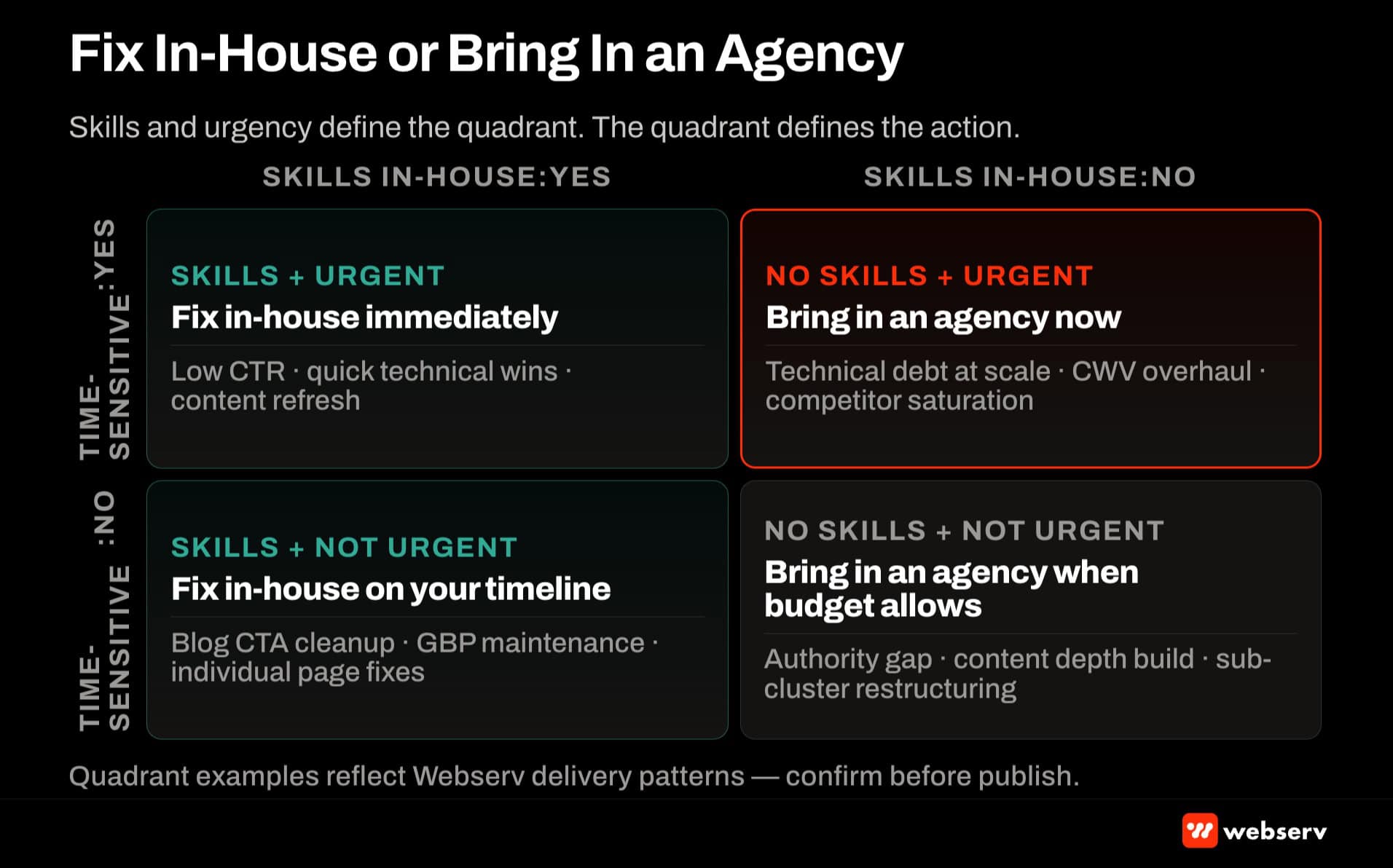
DIY-viable patterns. Pattern 1 (Flat or Declining Traffic) can be diagnosed and partially addressed internally by running the GA4-versus-GSC comparison and expanding content coverage. Pattern 3 (Branded Search Overreliance) can be diagnosed internally, though closing the gap usually benefits from agency content investment. Pattern 4 (Low CTR) is one of the fastest DIY wins because meta title and description rewrites are inexpensive and produce measurable movement in 30-45 days. Pattern 8 (Content Not Driving Leads) is diagnosable and partially fixable internally through CTA additions and tracking audits.
Agency-value patterns. Pattern 2 (Rankings but No Admissions) requires CRO expertise most internal teams do not have. Pattern 5 (High Bounce Rate) requires query-intent-mapping capability that is faster with agency tooling. Pattern 6 (Strong Content Low Visibility) requires E-E-A-T strengthening across content that is meaningful engineering work. Pattern 7 (Local Visibility) requires NAP audits and local link acquisition that are labor-intensive at scale. Pattern 9 (Technical SEO) requires developer + SEO capability most internal teams cannot staff for a one-time project. Pattern 10 (Competitive Saturation) and Pattern 12 (Authority Gap) both require 12-18 month strategic and PR execution most internal teams cannot sustain. Our behavioral health SEO companies piece covers the market landscape.
The honest split: if your diagnostic result shows one DIY-viable pattern and the internal marketing team has capacity, fix it internally.
If the result shows more than one agency-value pattern, or shows Pattern 9 and Pattern 2 together, the compound cost of getting the fixes wrong exceeds what an agency engagement costs. Book an intro call and we can walk your diagnostic result together.
Frequently Asked Questions
Can I show more than one failure pattern at the same time?
Yes, and most facilities do. In our experience running the framework across treatment center accounts, the median facility produces 2-4 patterns simultaneously. Patterns compound with each other, which is why the order of fixes matters more than the specific patterns.
The most common pattern combinations we see are Pattern 9 (Technical SEO) plus Pattern 2 (Rankings but No Admissions), Pattern 3 (Branded Reliance) plus Pattern 6 (Strong Content Low Visibility), and Pattern 7 (Local Visibility) plus Pattern 11 (Geographic Mismatch). Each combination has a specific sequencing recommendation.
The diagnostic quiz at the end of this piece returns the top 1-3 patterns your account is producing, ranked by score. If your result shows multiple patterns, treat them as a sequenced roadmap starting with the foundational patterns (9, 2) before addressing the downstream patterns (10, 12).
How long does it take to fix these patterns?
Timelines vary by pattern. Some patterns produce measurable improvement inside 30-45 days (Pattern 4 CTR rewrites, Pattern 8 CTA additions). Others require 12-18 months of sustained investment (Pattern 12 Authority Gap, Pattern 10 Competitive Saturation).
The specific pattern the framework flags for your account will carry a time-to-fix estimate in the quiz result. As a general rule, technical patterns (Pattern 9) resolve in 60-90 days once the technical work is done. Content patterns (Patterns 6, 8) resolve in 90-180 days as ranking movement follows the content improvement. Authority and competitive patterns (Patterns 10, 12) run 12-18 months minimum because they depend on external signals accumulating over time.
Do not commit to a specific timeline before you know which pattern is active. The single most common mistake operators make is committing to a we-want-SEO-results-in-90-days outcome without knowing whether their patterns support that timeline.
Does this framework apply outside of behavioral health SEO?
The 12-pattern framework generalizes to other service categories, but the specific confirming signals and recommended moves are calibrated for behavioral health. Behavioral health has category-specific dynamics (LegitScript compliance affecting query behavior, HIPAA constraints affecting measurement, family-perspective search intent) that shape how the patterns present.
Legal services, healthcare-adjacent categories, and other high-consideration purchase categories share meaningful overlap with the framework. E-commerce, local trades, and B2B SaaS follow different diagnostic frameworks because the buyer journey and ranking signals differ.
Google’s Search Central quality documentation covers the underlying ranking signals in a category-neutral way. Adapting the 12-pattern framework to another vertical means keeping the diagnostic logic and recalibrating the confirming signals.
How is this different from a technical SEO audit?
A standard technical SEO audit covers Pattern 9 in depth. It does not cover the other 11 patterns. Facilities that run only a technical audit resolve technical debt without diagnosing whether technical debt is actually the pattern producing their underperformance.
The 12-pattern framework starts with the underperformance symptom (traffic flat, conversions weak, rankings absent, local invisible) and works backward to identify which of the 12 patterns is actually producing the symptom. Technical audits work in the other direction: they inventory every possible issue and produce a long list of recommendations, most of which do not resolve the specific gap the facility has.
The two approaches complement each other. A comprehensive SEO strategy uses the 12-pattern framework to diagnose the actual gap and a technical audit to inventory the remediation work required to resolve Pattern 9 when it surfaces. Our why isn’t my rehab website ranking piece covers the sequencing in depth for facilities in specific pattern combinations.
How often should I re-run the diagnostic?
Once per quarter is the right cadence for most facilities. Behavioral health SEO patterns shift with Google core updates, competitive market changes, and internal marketing investment. Re-running the diagnostic quarterly catches new patterns as they surface and confirms that fixed patterns have stayed fixed.
Some patterns require monthly monitoring rather than quarterly diagnosis. Pattern 9 (Technical SEO) needs Google Search Console monitoring monthly at minimum because crawl errors, coverage issues, and Core Web Vitals regression happen inside a quarter. Pattern 2 (Rankings but No Admissions) needs monthly conversion tracking reconciliation.
The diagnostic quiz result includes a recommended re-run cadence based on the specific patterns flagged. If your top pattern is fast-moving (Pattern 4 CTR, Pattern 9 Technical), the recommendation will be monthly. If your top pattern is slow-moving (Pattern 12 Authority Gap), the recommendation will be quarterly or semi-annually.
What do I do if my result shows Authority Gap or Competitive Markets Saturated?
These are the two patterns where DIY approaches produce the least return relative to agency investment. Both are 12-18 month horizon fixes. Both require infrastructure most internal marketing teams do not have.
Authority Gap requires sustained digital PR and link acquisition work. That means a journalist relationship database, a source-request response cadence, an editorial calendar targeting specific publications, and 12+ months of consistent execution. Competitive Markets Saturated requires strategic content differentiation and adjacent-intent capture , the market has consolidated around dominant competitors, and winning share requires either significant authority investment (Pattern 12) or a content angle the market has not covered.
If your quiz result shows either pattern as your top score, and especially if it shows both, the honest recommendation is to bring in an agency for a proper diagnostic conversation. Book an intro call and we can walk through your specific market position and what the 12-18 month investment horizon actually looks like for a facility in your competitive tier.
Trevor Gage is the Director of Marketing at Webserv, a digital marketing agency for treatment centers.