A residential program we worked with two years ago paid $180,000 for a website rebuild. The rebuild took nine months. They lost 47% of their organic traffic in the first 60 days after launch.
Eight months in, they were still 30% below their pre-rebuild traffic baseline. The admit calls from organic search dropped from 38 a month to 19. The agency that built the new site was no longer returning calls.
The rebuild was unnecessary. The original site had a slow load time, an outdated navigation, and a few legacy URLs that needed redirecting. Every one of those issues was fixable inside a quarter at a fraction of the cost.
The team chose a rebuild because the site looked dated and the marketing leadership wanted something they could be proud of.
We have seen this pattern dozens of times. The decision to rebuild is the most consequential website call a treatment center makes. The cost of getting it wrong runs into the hundreds of thousands of dollars and months of lost admit volume.
The rebuild question is really a question about your tolerance for traffic risk during the most expensive 12 months of a website’s life, more than it is a question about the website itself. Most treatment centers underestimate that risk by an order of magnitude.
Trevor Gage, Director of Earned & Owned Media, Webserv
This guide explains when a rebuild is the right call, when optimization is the better choice, and how to read the signals on your current site before committing $150K and a year of organic risk to a project that may not produce what the team expects.
Key Takeaways
- Treatment center websites carry more rebuild risk than most verticals because behavioral health is YMYL and ranking authority accumulates slowly. A rebuild that fumbles the migration can lose a large share of organic traffic for months. At behavioral health per-admit revenue, that is several hundred thousand dollars in lost admit revenue during a botched rebuild.
- The signals that point to optimization: a modern editable CMS, recoverable page load times, stable or improving rankings, sound information architecture, and working conversion infrastructure. When most or all are present, a 90-to-180-day optimization sprint delivers most of the upside without the rebuild risk.
- The signals that point to rebuild: a locked-out platform with no editable CMS, fundamentally broken codebase, unsalvageable mobile experience, unsupported CMS, or information architecture that cannot accommodate the program’s current shape. Two or more of these signals usually means optimization will not deliver what the team needs.
- The total cost of a typical mid-sized rebuild (direct costs plus traffic loss, post-launch tuning, and opportunity cost) runs $200,000 to $500,000 over an 18-month window. Most treatment center marketing budgets do not support that, which makes the rebuild-vs-optimize decision the single most consequential website call a program makes.
Why this decision matters more in behavioral health
Most websites carry rebuild risk. Treatment center websites carry more of it.
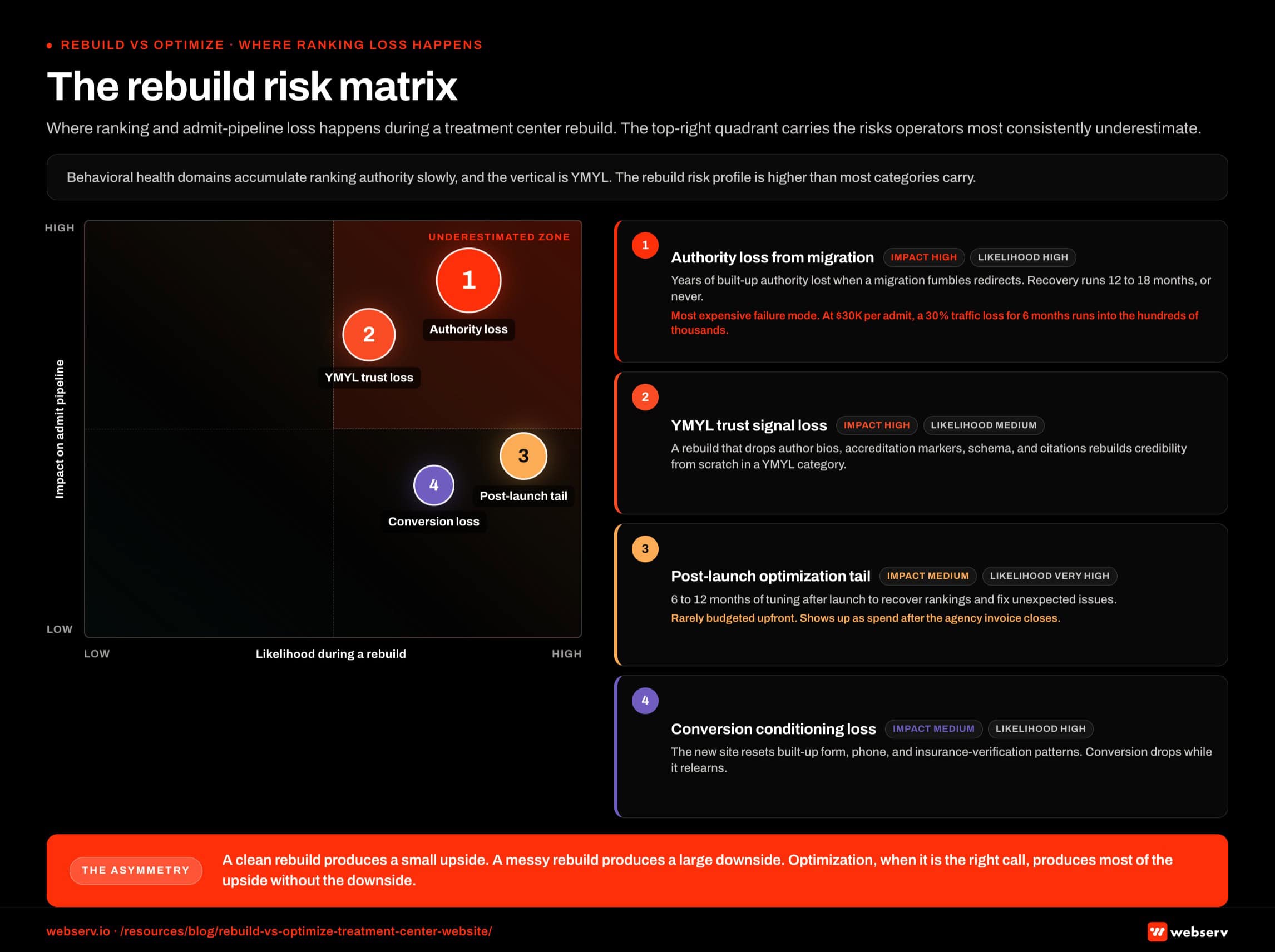 Infographic titled ‘The rebuild risk matrix’.
Behavioral health domains accumulate ranking authority slowly. The vertical is YMYL, which means Google evaluates trust signals more carefully than it does in unregulated categories. Treatment center sites that have been ranking for years have a built-up authority profile that is expensive to recreate from scratch.
A rebuild that fumbles the migration loses that authority. The new site might recover the rankings over 12 to 18 months. It might not recover them at all. The recovery curve depends on how cleanly the migration was executed and how much equity the old site had built up.
The admit math sits underneath the rankings. A treatment center losing 30% of its organic traffic for 6 months is losing roughly 30% of its organic admit pipeline for that window.
At behavioral health per-admit revenue, even a mid-sized program loses several hundred thousand dollars in admit revenue during a botched rebuild.
The risk asymmetry is what makes this decision different from a normal website refresh. A clean rebuild produces a small upside. A messy rebuild produces a large downside. Optimization, when it is the right call, produces most of the upside without the downside.
The signals that point to optimization
Several specific signals indicate that optimization is the right call, and each one suggests the underlying site is structurally sound enough to absorb targeted fixes without taking on the risk profile of a full rebuild. Look for these.
The site is on a modern CMS that you control. WordPress, Webflow, or any modern headless setup that the marketing team can edit without engineering tickets. If the CMS is modern, the structural foundation is usable.
Page load times are recoverable. Most “slow” treatment center sites are slow because of unoptimized images, render-blocking scripts, and bloated themes. Each of these has a fix that does not require rebuilding the site, and technical SEO work addresses them deliberately.
Rankings are stable or trending up. If the existing site is holding rankings on commercial keywords or gaining ground, the SEO foundation is working. Rebuilding a site with stable rankings carries the most risk for the smallest gain.
The information architecture is sound. Service pages, location pages, and the about/insurance/contact spine are present and reasonably organized. Reorganizing IA is an optimization project, not a rebuild project.
Conversion infrastructure is functional. Forms work. Phone numbers fire conversions. Insurance verification flows operate without errors. If the conversion plumbing is intact, the site is doing its primary job.
When most or all of these signals are present, the right call is a 90-to-180-day optimization sprint. The team can address the specific issues without taking on the rebuild risk profile.
The signals that point to rebuild
REBUILD IS THE RIGHT CALL
- The site is locked to a platform you cannot edit. Custom-coded builds or proprietary builders with no CMS access make optimization mechanically impossible.
- The codebase is broken, not slow. Pages that fail to render, mobile navigation that snaps, template-level server errors. These do not respond to CRO or performance work.
- Information architecture prevents topical authority. No service-page hierarchy, no cluster structure, no location pages. Rebuild is the shorter path.
- Trust signals cannot be surfaced. No room for author bylines, clinical review lines, accreditation logos, or facility photography inside the current template.
OPTIMIZE INSTEAD
- Modern CMS you already control. WordPress, Webflow, or a headless setup the marketing team can edit without engineering tickets.
- Slow load times from images and scripts. These have known fixes and do not require a template rebuild.
- Thin service and location pages on solid architecture. Content investment inside a working template compounds faster than a rebuild.
- E-E-A-T gaps that are content, not structural. Missing bios, missing reviewer lines, missing citations — all editable inside the existing site.
Other signals point in the opposite direction, and each one indicates a structural problem that optimization cannot solve no matter how many fixes the team layers on top of the existing site. The signals matter.
The site is on a platform you cannot edit. Custom-coded sites with no CMS, or proprietary builders that lock the team out of basic content edits. Optimization requires the ability to make changes. If that ability does not exist, optimization is impossible.
The codebase is fundamentally broken. Not slow, broken. Pages that do not render, navigation that breaks on mobile, server errors on critical templates. These problems sometimes look like optimization candidates and turn out to require structural work.
Mobile experience is unsalvageable. A desktop-first site that was bolted into mobile responsiveness can sometimes be fixed and sometimes cannot. The threshold is the cost-to-rebuild-the-frontend versus the cost-to-rebuild-the-whole-site. If the frontend rebuild is most of the cost, the case for a full rebuild gets stronger.
The CMS is unsupported. Sites running on Drupal 6, ColdFusion, or anything similarly out of support carry security and capability risks that compound over time. The right move is usually a controlled migration to a modern platform, which is functionally a rebuild.
The information architecture cannot accommodate the program. A site built for a single-location program that now serves three locations and four modalities. The existing IA cannot be optimized into something different. The structural change requires a rebuild.
When two or more of these signals are present, optimization is unlikely to deliver the outcome the team needs. A controlled rebuild is the right call.
The hybrid approach
The right answer is often neither a pure rebuild nor a pure optimization. It is a hybrid: optimize what is structurally sound, rebuild what is not.
A treatment center site might have a sound IA, a working CMS, and stable rankings, but a broken mobile experience and an unsalvageable hero design. The hybrid approach keeps the existing pages and URLs in place while rebuilding the templates, the design system, and the mobile rendering.
Search rankings are preserved because the URLs do not change. The redirect map is unnecessary because nothing is moving. Content equity carries forward. The rebuild is contained to the layer where the rebuild is justified.
The hybrid approach requires a partner willing to do the diagnostic work. Most agencies pitch full rebuilds because full rebuilds are easier to scope and price. The hybrid approach takes more diagnostic work upfront and produces a smaller line item.
The diagnostic work is the highest-return step in the project. A few weeks of careful audit catches the rebuild-vs-optimize question before the team commits to the wrong answer. The audit cost is a fraction of the rebuild cost.
How SoCal Sunrise generated 85 admissions and 2,297% ROI from SEO in 6 months
A ground-up SEO rebuild using the Pathfinder Parents Methodology turned an invisible online presence into a top-ranking admissions engine.
Read the case study →85 admits and 3,152 leads attributed to organic
The cost-of-rebuild calculation
Rebuilds carry direct costs and indirect costs. Operators tend to focus on the direct costs and underestimate the indirect ones.
Direct costs. Agency fees for design, development, and content. Internal time for stakeholder review and approvals. Content migration and rewrites. Testing and QA. The direct cost for a mid-sized treatment center site typically runs $80,000 to $250,000 depending on scope. Creative production is its own line item alongside development.
Indirect cost: traffic loss during migration. Even a clean migration usually dips in organic traffic for a few weeks. A messy migration can lose a large share of organic traffic for months. The traffic loss converts directly to admit pipeline loss.
Indirect cost: the post-launch optimization tail. Most rebuilds need 6 to 12 months of post-launch tuning to recover rankings, fix unexpected issues, and rebuild the conversion conditioning that the old site had developed. This work is usually outside the original rebuild scope and shows up as additional spend.
Indirect cost: opportunity cost. The team’s attention is on the rebuild for 9 to 12 months. Every other initiative competing for that attention loses bandwidth. Paid media optimization, content production, and keyword strategy all slow down during the rebuild window.
The total cost of a typical mid-sized rebuild, accounting for all four categories, runs $200,000 to $500,000 over an 18-month window. The financial model has to support that. Most treatment center marketing budgets do not.
The cost-of-staying-put calculation
The other side of the calculation is the cost of leaving an underperforming site in place. This cost is also real and also underestimated.
Conversion drag from a broken mobile experience. If 65% of organic traffic is mobile and the mobile experience is converting at half the desktop rate, the site is losing roughly a third of its organic admit pipeline. That is a recoverable loss. The fix justifies real investment.
SEO drag from technical issues. Slow load times, render-blocking scripts, and broken canonical tags all suppress rankings. Google evaluates this through Core Web Vitals and other technical signals. The drag may be small per issue but compounds across the site. Addressing the technical issues recovers the lost rankings without rebuilding.
Brand drag from a dated visual identity. This one is real but usually overestimated. Treatment center prospects do not abandon a credible site because the design feels two years old. They abandon a site because the navigation breaks, the phone number is hidden, or the insurance verification flow is broken.
Operational drag from a brittle CMS. If every content update requires an engineering ticket, the marketing team’s velocity is suppressed. The cost shows up in delayed campaign launches and missed content cycles.
The cost-of-staying-put calculation should look at recoverable issues first. Most of them are addressable through optimization, including the local SEO and GBP work that many treatment centers neglect. The remainder are the inputs to the rebuild decision.
A decision framework
A simple framework helps operators make the rebuild-vs-optimize call without falling into the common traps that lead most treatment center teams toward the more expensive answer when the cheaper one would have produced the same outcome. Five steps.
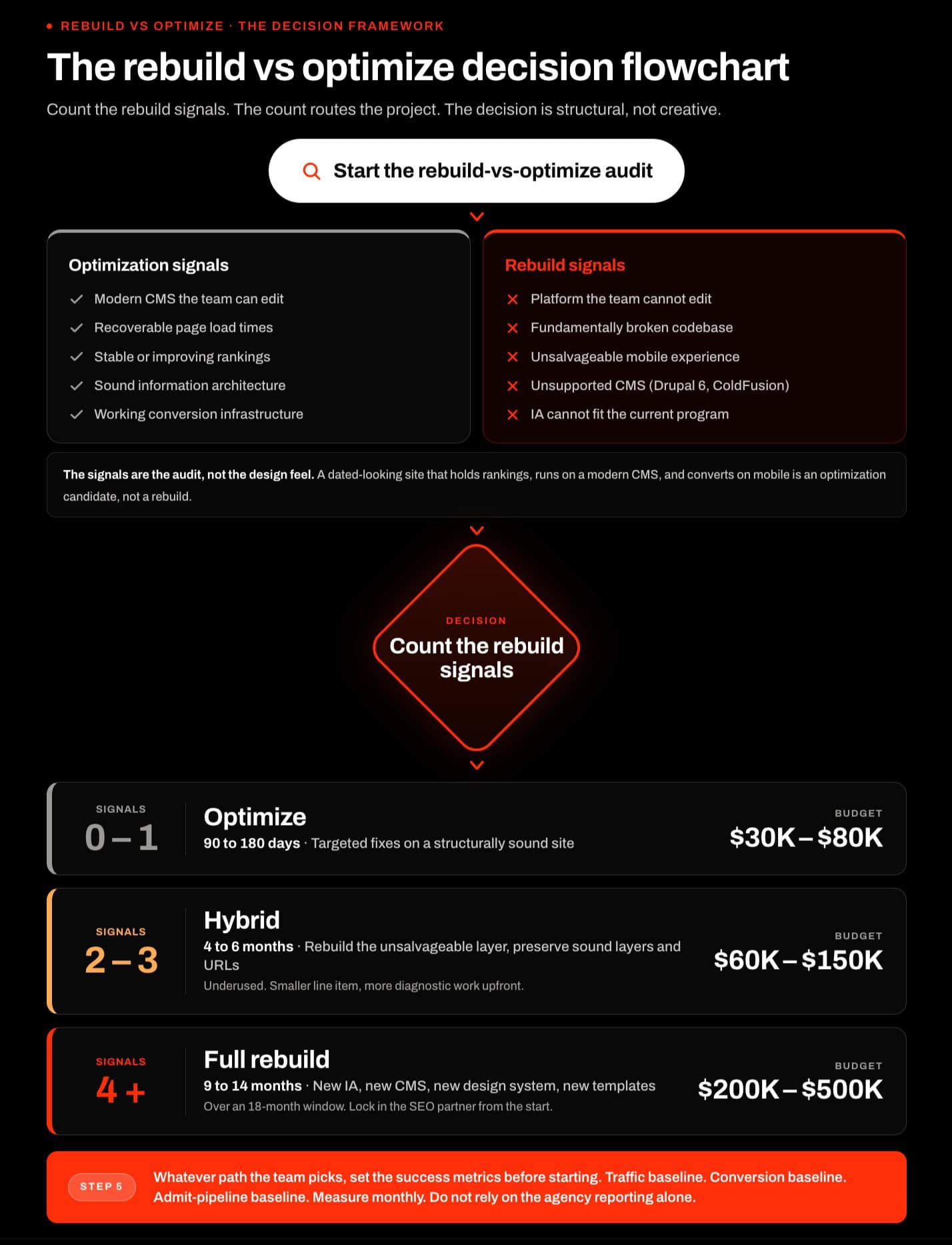 Infographic titled ‘The rebuild vs optimize decision flowchart’.
Step 1: Audit the current site against the optimization signals and the rebuild signals. Tag each issue with the signal it matches. Count the rebuild signals.
Step 2: If the rebuild signals are zero or one, optimize. A 90-to-180-day optimization sprint will deliver most of the upside.
Step 3: If the rebuild signals are two to three, consider the hybrid approach. Identify which layer carries the structural problem and rebuild only that layer. Preserve URLs and existing content where possible.
Step 4: If the rebuild signals are four or more, plan a full rebuild. Build the migration plan with care, lock in the SEO partner from the start, and budget the indirect costs honestly.
Step 5: Whatever path the team chooses, set the success metrics before starting. Traffic baseline, conversion rate baseline, admit pipeline baseline. Measure against the baselines monthly. Do not rely on the agency’s reporting alone.
The framework is not magic. It does provide a defensible structure for a decision that most teams make on aesthetic intuition.
Common mistakes operators make on this decision
Three mistakes surface most often in the rebuild-vs-optimize decision, and each one drives a wrong call that takes 12 to 18 months and a meaningful share of the marketing budget to recover from. Watch for these.
Mistake 1: Treating the rebuild as a brand exercise. Marketing leaders sometimes pitch the rebuild because the site does not match the brand they are building. The argument has merit but does not justify the rebuild risk on its own. Brand can be addressed at the design layer in a hybrid approach.
Mistake 2: Hiring a design-led agency to make a structural decision. Design-led agencies pitch rebuilds because rebuilds are what they sell. The recommendation is structurally biased. The decision should run through an SEO-led audit before the design conversation starts.
Mistake 3: Underestimating the migration risk. The agency proposes a clean migration plan and the team takes it at face value. Migrations rarely go cleanly. The right posture is to assume some traffic loss and build the budget and the timeline around the loss.
The three mistakes are connected. Operators who avoid all three end up making rebuild decisions that produce the outcome the team actually wanted.
What success looks like
A treatment center that approaches the rebuild-vs-optimize decision deliberately should see better outcomes regardless of which path the team chooses.
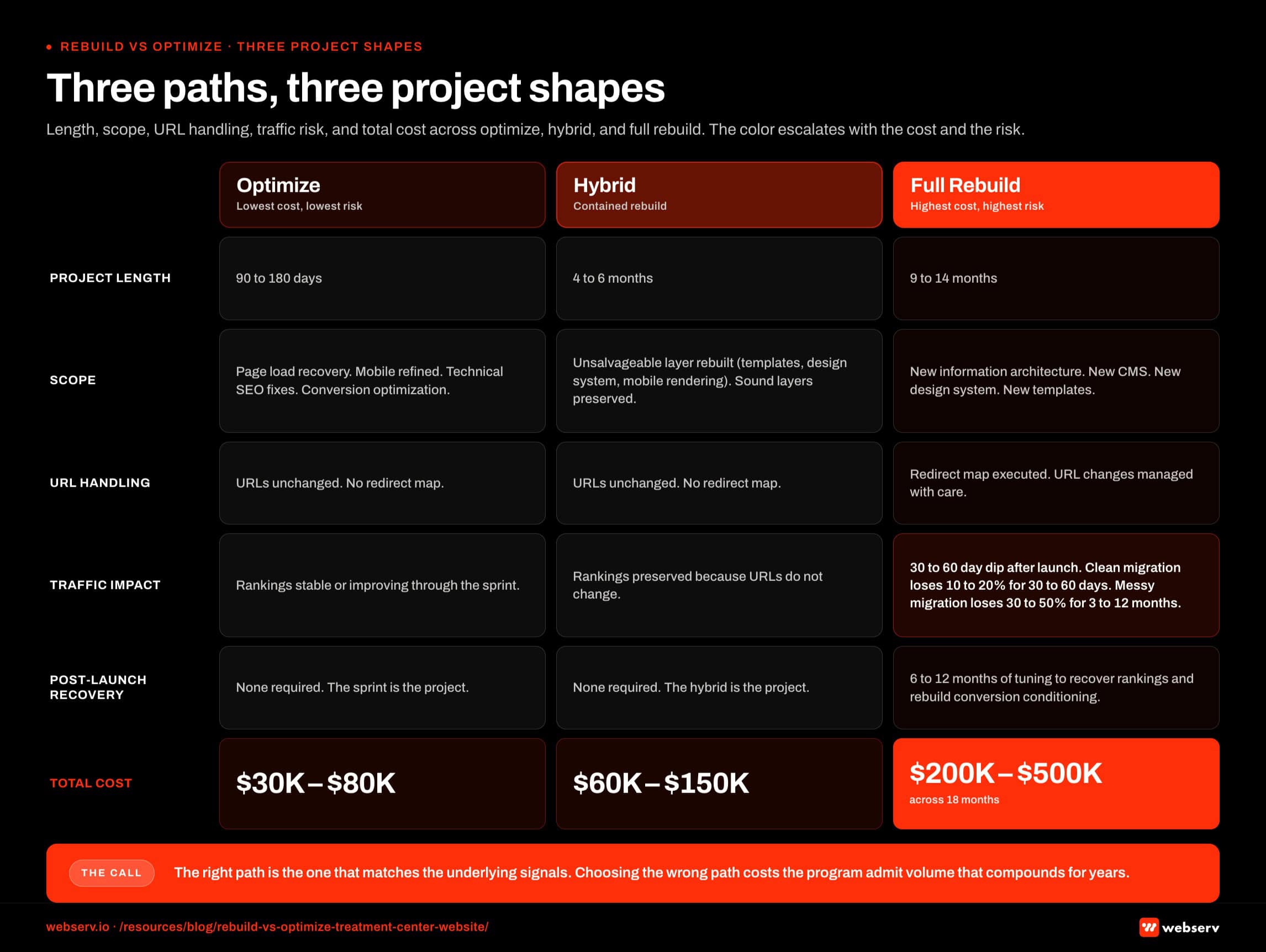 Infographic titled ‘Three paths, three project shapes’.
For an optimization path: 90 to 180 days of focused work. Page load times recovered. Mobile experience refined. Rankings stable or improving. Conversion rate trending up. Total cost of $30,000 to $80,000.
For a hybrid path: 4 to 6 months of work. The unsalvageable layer rebuilt. The sound layers preserved. URLs unchanged. Rankings preserved through the project. Total cost of $60,000 to $150,000.
For a full rebuild path: 9 to 14 months of work. New IA, new CMS, new design system, new templates. Migration plan executed cleanly. 30 to 60 day traffic dip followed by 6 to 12 months of recovery. Total cost of $200,000 to $500,000 over 18 months.
The right path is the one that matches the underlying signals. Choosing the wrong path costs the program admit volume that compounds for years.
What to ask your SEO and web partners this week
Three questions surface whether the team is set up to make this decision well.
First, ask the SEO partner for a current audit of the site against the rebuild and optimization signals. The audit should be specific about which issues are structural and which are optimizable. A vague answer is the early sign of a partner who does not have the diagnostic frame.
Second, if a rebuild is on the table, ask both the SEO partner and the web partner for their migration plan. The plans should align. If they do not, the team is at risk during the migration. Mismatched plans are the leading cause of rebuild traffic losses.
Third, ask for the success metrics and the monitoring plan that will run during and after any rebuild or optimization project. Traffic baselines. Conversion baselines. Admit pipeline baselines. If the partner cannot articulate the metrics, the project will not be measured against the right outcomes.
The rebuild-vs-optimize decision is the most consequential website call a treatment center makes. The teams that get it right are the ones who treat it as a structural decision rather than a creative one — embedded inside a broader behavioral health marketing program that protects organic, paid, and admissions infrastructure through the project window.
Frequently asked questions about rebuilding versus optimizing a treatment center website
How do we know if our current site is salvageable?
Most treatment center sites that load reasonably fast on mobile, run on a maintained CMS, and have a clean URL structure are salvageable through optimization rather than rebuild. Sites built on outdated platforms (proprietary CMS with no active development, legacy WordPress without modern theme architecture, custom static HTML) usually need rebuilding because the optimization ceiling is too low.
The diagnostic is technical, not aesthetic. A site that looks dated but loads fast and structures content well is salvageable with design refresh and content optimization. A site that looks modern but has poor information architecture, slow load times, or compliance gaps usually needs structural rebuild even when the visual layer feels current.
Programs sometimes confuse the design conversation with the structural conversation. Visual refresh costs $5,000 to $25,000 and takes 6 to 12 weeks. Structural rebuild costs $40,000 to $200,000 and takes 4 to 9 months. Mismatching the problem to the fix wastes money in both directions.
What is a realistic budget for a treatment center website rebuild?
Single-location treatment center rebuilds typically run $40,000 to $80,000 for the design, build, and migration. Multi-location programs (3+ locations with location-specific page architecture) run $80,000 to $150,000. Programs with extensive content (50+ pages of medical and program content) and custom compliance requirements can run $150,000 to $300,000.
The budget includes design, development, content migration, technical SEO setup, accessibility compliance, and HIPAA-aware tracking implementation. It does not include ongoing maintenance, paid media infrastructure, or post-launch optimization, which are separate operational line items.
Programs underbidding the project (under $30,000 for a multi-page treatment center site) almost always end up with structural deficiencies that compromise paid media performance, organic visibility, or compliance posture. The savings on the front end usually become more expensive remediation later.
How long does a proper rebuild take?
Most treatment center rebuilds run 4 to 9 months from kickoff to launch. The phases are roughly discovery and strategy (1 to 2 months), design (1 to 2 months), development (2 to 4 months), content migration and optimization (1 to 2 months), and launch preparation including SEO redirects and testing (2 to 4 weeks).
Programs that try to compress this into 2 to 3 months usually skip the discovery and strategy work or skip content optimization, both of which produce structural deficiencies the rebuild was supposed to solve. The compression saves time on the front end but costs more in post-launch remediation.
The cleanest schedule allocates extra time to the launch preparation phase. Treatment center sites have more redirect, schema, and tracking work to validate than most other categories, and that work takes longer than designers and developers typically scope. Building in 4 weeks of pre-launch QA prevents the post-launch problems that plague rushed rebuilds.
Can we phase a rebuild instead of doing it all at once?
Yes, and for most treatment centers this is the better approach. A phased rebuild starts with the highest-impact pages (homepage, primary program pages, insurance verification flow, contact and admissions), then expands to secondary pages (specific modality pages, location pages, blog migration) over subsequent quarters.
The benefits of phasing are operational. The marketing program does not pause during the rebuild. The team can validate design and conversion choices on the first phase before committing them across the full site. The total cost is the same or slightly higher but spread across a longer period.
The drawback is brand consistency. A phased rebuild produces a transitional period where some pages use the new design and others use the old. Programs that cannot tolerate the visual inconsistency usually prefer a single big-bang rebuild. Programs that can tolerate it usually prefer the phased approach for the operational continuity.
What happens to our existing content during a rebuild?
Content needs explicit decisions: migrate as-is, migrate and optimize, consolidate with other pages, or retire entirely. Most treatment center sites accumulate 50 to 200 pages over their lifespan, and a meaningful percentage of those pages are stale, redundant, or off-strategy. A rebuild is the natural time to audit and clean the content footprint.
The migration process should be content-by-content rather than wholesale. A typical audit categorizes each page as one of four states: keep and improve, consolidate with similar pages, retire and redirect to the most relevant remaining page, or rebuild from scratch. Each category has different operational implications for the rebuild timeline and cost.
The mistake is to migrate everything as-is. That preserves the structural problems the rebuild was supposed to solve. The cleanest rebuilds usually retire 20 to 40 percent of the existing page count, consolidate another 20 to 30 percent, and keep the remaining 30 to 60 percent with optimization. The result is a tighter, faster, more rankable site.
The perspective in this article comes from 9 years working exclusively inside behavioral health.
We are a team built by people in recovery who understand that behind every admission is someone asking for help. If that resonates, get to know us.
Trevor Gage is the Director of Earned & Owned Media at Webserv. Webserv works with behavioral health and addiction treatment centers on SEO, paid media, and full-funnel admissions strategy.