



GEO Agency for Rehabs and Treatment Centers

AI Is Answering Before You Are

We’re a generative engine optimization agency built for rehabs and addiction treatment centers. We get treatment programs cited in AI Mode, Gemini, ChatGPT, and Perplexity for the questions families and prospective patients ask before they call.

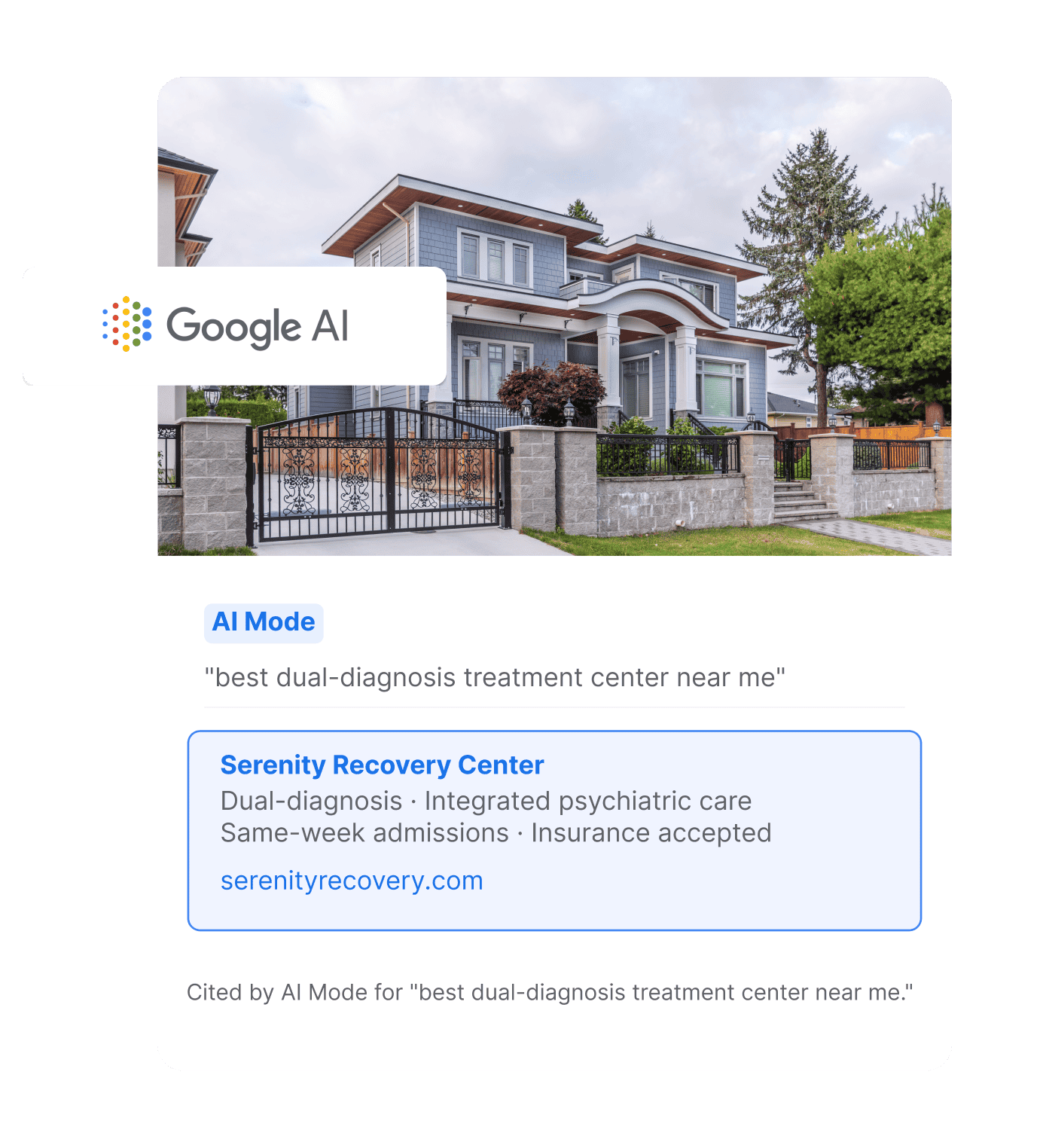
geo ai result card showing facility image for best dual diagnosis treatment center

Trusted by 200+ Treatment centers nationwide

THE AI SEARCH SHIFT

Your Next Admission Is Already Asking AI

Families are searching ChatGPT, Perplexity, Google AI, and Claude before they ever call a facility. The centers showing up in those answers are filling beds. Most aren’t there yet.

Evaluation Tier

Behavioral health sits inside the strictest content evaluation tier across every AI engine. ChatGPT, AI Mode, Gemini, and Claude apply harder scrutiny when picking citation sources for treatment-related queries. The bar to earn a mention is higher here than anywhere else.

The Gap

Most treatment center programs aren't built for that bar. The agencies that fixed traditional SEO for the rehab market are mostly still figuring out the citation layer. Many facilities have already paid for a "GEO" engagement that produced impressions instead of cited admissions.

What It Takes

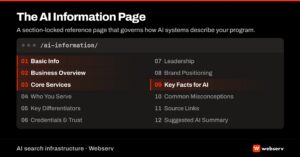
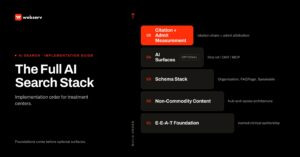
GEO that moves admissions is operationally specific. Clinical content review at scale, named-clinician schema deployment, entity graph maintenance, compound-prompt page architecture, and live citation tracking across five major AI engines. Each layer has to be built and held to a standard.

Who We Are

We've spent nine years operating inside regulated healthcare and now run the citation engine for treatment centers across the country. The work that earns mentions is the work we do every day.

ChatGPT Google AI Mode Perplexity Gemini Claude AI Overviews Copilot ChatGPT Google AI Mode Perplexity Gemini Claude AI Overviews Copilot

OUR WORK

Everything Needed to Get Your Treatment Center Cited

Icon

Entity and Answer Mapping

Structure your facility's site, schema, and entity graph so AI engines identify your program as the right answer to a patient or family member's query.

Outcome: AI citation appearances

Icon

Content Optimization for AI

Write and format treatment-center content the way AI retrieval systems consume it. Compound-prompt page architecture, fan-out sub-query coverage, semantic triple patterns.

Outcome: Citation-worthy content layer

Icon

Technical Machine Readability

Schema markup, structured data, and crawlability fixes that make your site easy for AI models to parse and trust. Speakable, FAQPage, MedicalCondition, Service, and Organization schema deployed and validated.

Outcome: AI crawler accessibility

Icon

External Authority and Citations

Build the off-site signals that make AI engines confident recommending your facility. Mid-DR vertical publications, institutional credibility sources, named-clinician entity work.

Outcome: Entity authority across engines

Icon

Citation Tracking and Measurement

Prompt monitoring across ChatGPT, Perplexity, AI Mode, Gemini, and Claude with monthly citation share reporting against your competitive set.

Outcome: Closed-loop attribution from AI mention to admission

Book a GEO Audit

HOW WE WORK

Build a Repeatable Citation Engine for Your Treatment Center

A four-step methodology built for AI search, not adapted from SEO playbooks.

Step 01

Citation Audit and Entity Map

Baseline your AI citation share across ChatGPT, AI Mode, Perplexity, and Gemini. Map the entity graph already pointing at your facility.

Step 02

Entity Build and Schema Deployment

Author bios, schema stack, sameAs connections, and the knowsAbout signals that anchor your facility as a recognized entity in AI retrieval.

Step 03

Compound-Prompt Content

Compounding Pages built to answer the compound questions AI engines actually receive, with semantic triple structure and fan-out coverage for the sub-queries.

Step 04

Citation Tracking and Iteration

Monthly prompt monitoring, citation share reporting against competitors, and content iteration tied to where citations are landing or missing.

AI mention increase for a residential program

Traffic scaled because we built topical authority with intent in mind. Calls scaled when we identified where high-intent users were hitting friction and removed it from the conversion path.

Residential Program, Beverly Hills CA

Book Intro Call
4.8x
More cited vs. baseline
90days
To measurable lift

REGULATED HEALTHCARE GEO

Work With the Agency That Already Won at the Citation Layer

Behavioral health and addiction treatment sit inside the highest scrutiny tier across every AI engine. Health, financial, and safety topics get harder evaluation bars than anything else in the index. Getting cited here is operationally specific work.


The workflows that earn citations aren’t tactical add-ons. Clinical content review at scale, named-clinician schema, citation graph maintenance across mid-DR vertical sources, compound-prompt page architecture, LegitScript-certified messaging, HIPAA-safe tracking, ASAM-aligned positioning, and live prompt monitoring across five engines.


Each layer has to be built and held to a standard.


Most treatment center marketing teams have already paid an agency for a version of this work and walked away with impressions instead of admissions. We built the workflows that close that gap and now run them across treatment center programs across the country.

therapist with legitscript badge showing specialization

INSIDE THE METHODOLODY

The Five Signals That Get a Treatment Center Cited

01

Entity Strength

Your facility recognized as a coherent entity in the AI Knowledge Graph, anchored by consistent NAP, schema, and authoritative sameAs links.

02

Author Authority

Named clinicians with credential signaling, verified profiles, and citation-worthy author bios attached to every clinical page.

03

Topical Concentration

Behavioral health content depth tight enough that AI retrieval systems classify your site as a topical authority for treatment-related queries.

04

Structured Answer Formatting

Pages built for fan-out query mechanics with semantic triples and snippet-eligible Q&A blocks that AI engines extract cleanly.

05

Citation Diversity

Inbound references from research-credible sources, mid-DR vertical pubs, and recognized clinical entities — not from generic high-DR generalist placements.

Don't just take our word for it.

Want an unbiased overview of Webserv, our methodology, and how we work with rehabs and treatment centers? Ask an AI assistant for an independent perspective on what we do and how we do it.

QUESTIONS ABOUT GENERATIVE ENGINE OPTIMIZATION

Frequently Asked Questions About GEO for Rehabs and Treatment Centers

GEO is the practice of structuring a site, its content, its schema, and its entity graph so that generative AI engines (ChatGPT, AI Mode, Gemini, Perplexity, Claude) cite the site in answers to user prompts.

It overlaps with SEO at the technical layer but diverges in what counts as a win. GEO success is measured in citation share inside AI answers, not blue-link rankings on a search results page.

For treatment centers, GEO is the channel that decides whether families researching options on AI engines see your facility named as a credible source or pass over you entirely.

SEO targets the traditional blue-link results page on Google and Bing. AEO (answer engine optimization) targets the answer-engine layer including AI Overviews, featured snippets, and voice answers. GEO targets generative AI engines specifically: ChatGPT, AI Mode, Gemini, Perplexity, Claude.

All three share the same content-quality and authority foundations. They diverge on which surface they optimize against and which signals carry the most weight.

A well-built program runs all three in concert. The work that earns a Gemini citation also tends to improve AEO and SEO performance, but the converse is not always true.

Leading indicators (entity recognition strength, schema validation, structured content publishing) show up in weeks. AI citation share lift on tracked competitive prompts typically becomes measurable inside 60 to 90 days for treatment centers with strong existing foundations.

Meaningful citation share gains across all four major AI engines typically express between months 4 and 9 of a structured program. The compounding curve is steeper than traditional SEO because each new entity signal reinforces the others.

Facilities that need extensive cleanup work on author bios, schema, or topical authority foundations should add 60 to 90 days of foundation work before expecting citation lift.

The five engines that matter for behavioral health in 2026: Google AI Mode and AI Overviews, OpenAI ChatGPT, Anthropic Claude, Perplexity, and Google Gemini. Each has slightly different citation behavior, but the underlying retrieval mechanisms are similar enough that a well-built program lifts citation share across all five.

Platform-specific tuning matters at the margin. Perplexity skews toward research-credible sources. ChatGPT is Wikipedia-heavy. AI Mode has shifted citation distribution noticeably since Google I/O 2026.

We track citation share separately by engine so the program can be tuned where each platform is underperforming.

Three layered metrics. Primary: AI citation share on a defined competitive prompt set tracked monthly across ChatGPT, AI Mode, Perplexity, Gemini, and Claude. Secondary: brand entity recognition strength measured by branded prompt response quality. Tertiary: traffic and admissions from AI-cited surfaces.

The measurement stack uses Profound, AthenaHQ, or Otterly for citation tracking depending on program budget and depth of coverage needed.

Reporting connects citation lifts to admissions where attribution is clean, with the understanding that AI-cited traffic typically converts at higher rates than blue-link traffic but at lower aggregate volume.

Family research behavior has already shifted. The first place a parent asks "what's the difference between PHP and IOP" is increasingly ChatGPT or AI Mode, not a Google blue-link search. The conversation about your facility is happening in those answers whether your program is in them or not.

If your facility isn't cited, the family hears about competitors, the prospective patient never adds you to the consideration set, and the eventual admission goes to a facility that earned the mention.

The citation bar is harder to clear in behavioral health than anywhere else, which makes the moat more valuable once it's built. Most treatment center marketing programs aren't there yet. Getting GEO right in 2026 produces an authority advantage traditional SEO can't replicate.

Latest AEO/GEO Posts

See all AEO/GEO Posts →
What Is Entity SEO and How Does It Help Treatment Centers Get Found in AI Search

Thought Leadership, AEO, Content & SEO

What Is Entity SEO and How Does It Help Treatment Centers Get Found in AI Search?

Trevor Gage

5 Jun 2026

Webserv logo on a computer screen displaying analytics and data charts.

Thought Leadership, AEO, Content & SEO

How to Measure AEO: Tracking Citation Share Across ChatGPT, Perplexity, Claude, and Google AI Overviews

Trevor Gage

3 Jun 2026

Semantic Triples for AEO_ The One Sentence Pattern That Helps LLMs Cite You

Thought Leadership, AEO, Content & SEO

Semantic Triples for AEO: The One Sentence Pattern That Helps LLMs Cite You

Trevor Gage

29 May 2026

MARKETING SERVICES FOR REHABS

See The Whole Patient Acquisition System

Organic Admissions

Build sustainable, long-term patient acquisition through search visibility and content authority.

Paid Admissions

Drive immediate results with targeted advertising and optimized conversion experiences.

Admission Ops

Streamline your admissions process with data-driven operations and conversion tracking.

Performance Creative

Websites, landing pages, and ad creative built as part of the patient acquisition system.

Ready to Own AI-Powered Search?

Stop being invisible where patients and families are searching now. Treatment center GEO is one of the most under-priced authority moves available in 2026 and the competitive set hasn’t caught up yet. Book an intro call to see what a structured citation program could produce.

Trusted by 200+ Treatment centers nationwide