SISTRIX tracked AI Overview sources across 82,619 prompts for 17 weeks and found that in 53% of them, not a single cited domain changed. Its summary was blunt: once you’re in, you stay in, and if you’re not in, you don’t get in either.
Ahrefs, measuring cited URLs rather than domains, found nearly half the sources in an AI Overview were new between observations. The two studies measure different things, and together they describe the real picture: the pages cited for a query shuffle often, but the set of sites behind them can be hard to break into.
So “replacing a competitor in an AI Overview” isn’t a switch to flip. It’s the same work that wins organic visibility, aimed at a specific answer, with realistic expectations about which queries can move.
For treatment centers there’s an extra filter: BrightEdge found addiction-related queries consistently excluded from AI Overviews, so the opportunities sit in adjacent mental health, insurance, and process questions.
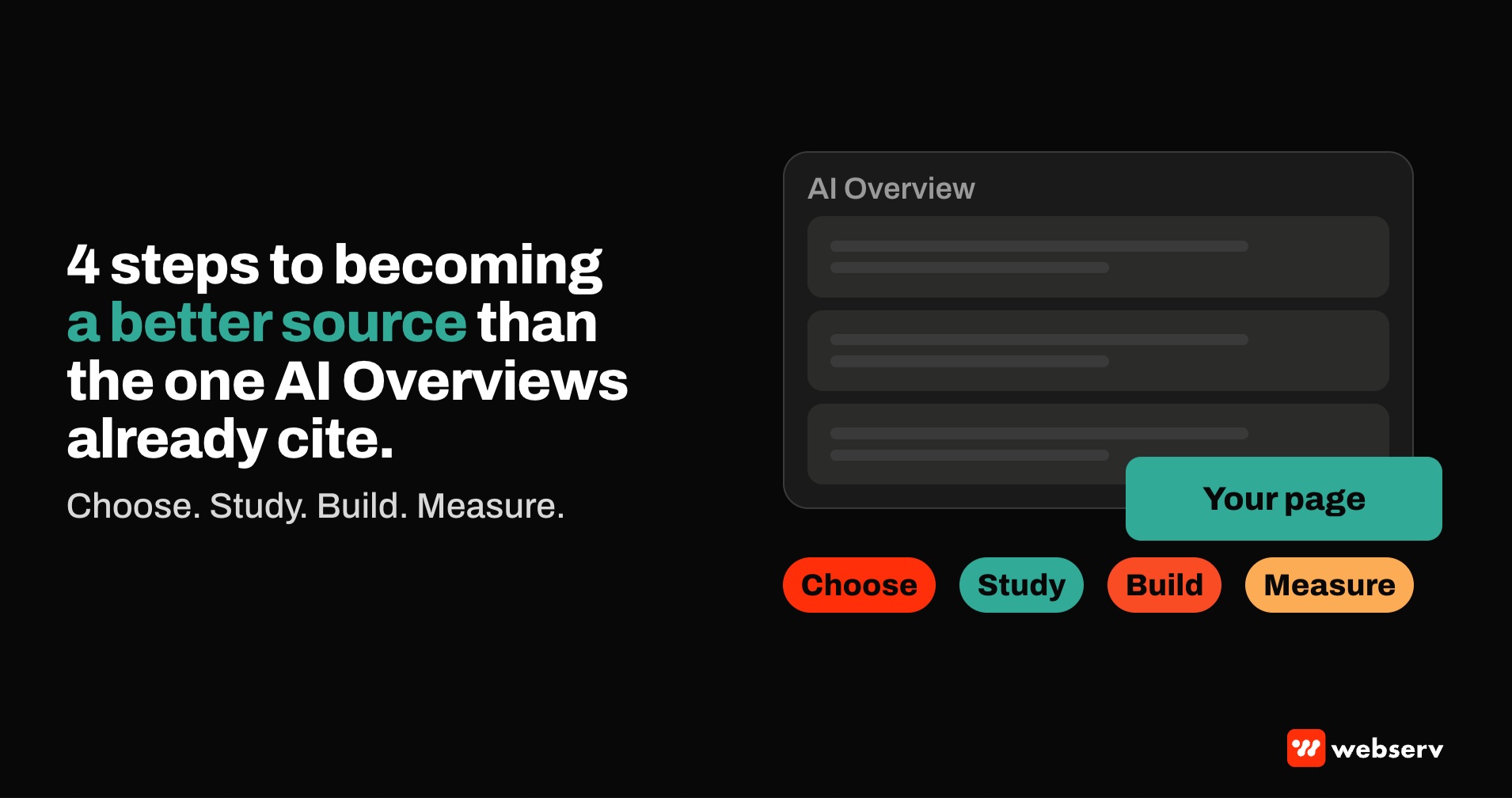
This piece covers what the research says about how AI Overview citations behave, how to choose queries worth contesting, how to study what’s already cited, what to build, and how to measure it. It’s part of the work inside our AEO program for treatment centers.
Key Takeaways
- AI Overview citations shuffle at the URL level but can be stable at the domain level. SISTRIX found no domain changes in 53% of prompts over 17 weeks; Ahrefs found about 45.5% of cited URLs were new between observations.
- Google says AI Overviews rely on its core ranking systems to retrieve pages, may use query fan-out, and need no special optimization. Organic visibility is still the entry point.
- How many citations rank in the top 10 depends on the study and method: Ahrefs reported 76.1% for top-three citations in July 2025 and 37.9% for all citations in March 2026.
- Choose queries where an AI Overview actually appears and your facility has something better to say. Addiction-specific queries were consistently excluded from AI Overviews in BrightEdge’s healthcare data.
- Study the cited pages, then build a clearer, more specific, better-sourced answer. Don’t create thin pages for every fan-out variation; Google names that as scaled content abuse.
- Being cited matters: Seer Interactive found cited pages earned 120% more organic clicks per impression than uncited ones.
How AI Overview citations behave
Google’s description. Google’s AI features documentation says there are no additional requirements or special optimizations needed, that AI Overviews may use query fan-out, and that pages must be indexed and eligible to show with a snippet. Its AI optimization guide says AI search relies on core ranking systems to retrieve relevant, up-to-date pages.
Google also made Gemini 3 the default model for AI Overviews in January 2026, which may change citation patterns from earlier studies.
DEFINITION
Citation displacement. Earning a place among the sources an AI Overview cites for a query where other sites are already cited. Because Google selects sources fresh for each overview, displacement means becoming a better candidate than the current sources, not removing them.
How often sources change. Ahrefs’ study of 43,000 keywords found about 45.5% of cited sources were new between consecutive observations, and an average persistence of 2.15 days. SISTRIX’s 17-week domain-level study found AI Overviews the most stable of the platforms it tracked, with an average of 11 domains per overview and eight staying put.
How stable AI Overview sources are
53%
Of prompts with no change in cited domains over 17 weeks (SISTRIX)
45.5%
Of cited URLs new between consecutive observations (Ahrefs)
11
Domains cited per AI Overview on average (SISTRIX)
How citations relate to rankings. Ahrefs reported in July 2025 that 76.1% of top-three AI Overview citations ranked in the organic top 10. Its March 2026 update, counting all citations, found 37.9%. seoClarity’s analysis found 44% of citations came from beyond the top 20. Ranking helps, but it isn’t the whole story.
Choose queries worth contesting
Not every query is a real opportunity. Filter before investing.
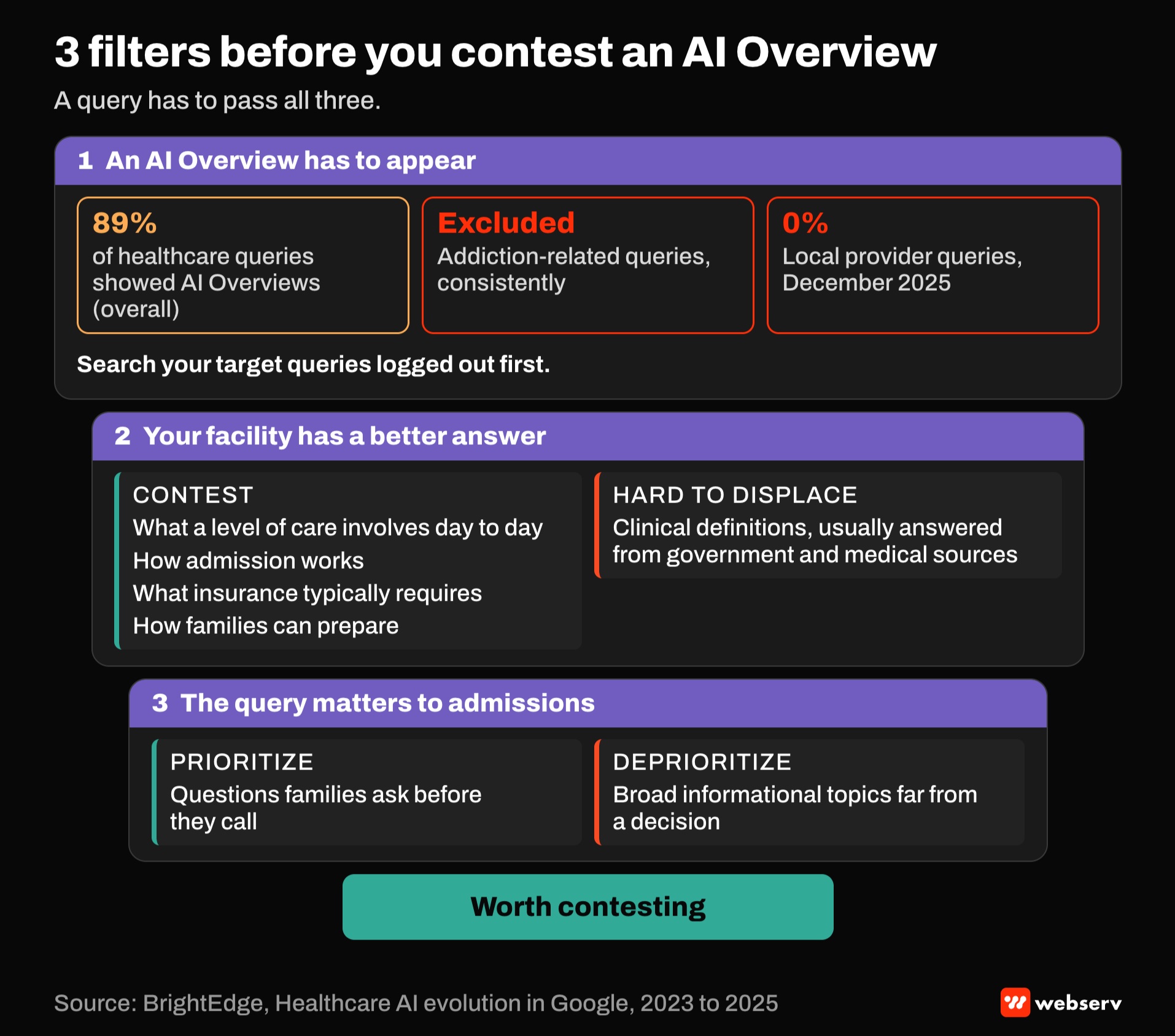
An AI Overview has to appear. BrightEdge’s healthcare analysis found AI Overviews on 89% of healthcare queries overall, but listed addiction-related queries as consistently excluded and local provider queries at 0% in December 2025. Search your target queries logged out before planning anything. For more on the local side, see our analysis of AI Overviews for local rehab queries.
Your facility has a better answer. Contest questions where facility-specific knowledge adds something: what a level of care involves day to day, how admission works, what insurance typically requires, how families can prepare. Clinical definitions tend to be answered from government and medical sources, and are hard to displace.
The query matters to admissions. Prioritize questions families ask before they call, not broad informational topics far from a decision.
COMMON MISTAKE
Chasing the hardest query first. A team picks a high-volume mental health definition, sees a major health publisher cited, and spends months trying to displace it. SISTRIX’s data suggests many overviews have a stable set of sources that rarely changes.
Start with narrower questions where the current citations are thin, outdated, or generic. Those are where a specific, well-sourced facility page has the best chance.
Study what’s already cited
For each target query, record the overview and its sources, and read the cited pages closely.
WHAT TO CHECK ON EACH CITED PAGE
- What question does each cited page answer, and how directly? Overviews often cite a passage that states the answer plainly.
- How specific is it? Generic pages that could apply to any facility are weaker candidates than pages with concrete details.
- How well sourced is it? Does it cite primary sources, or make unsupported claims?
- How old is it? Note the date, but don’t assume newer wins. Ahrefs’ freshness study found AI Overviews’ top citations leaned toward older content than the organic results.
- What related questions does the overview cover? These hint at the fan-out queries Google ran.
Repeat the check several times over a few weeks. Ahrefs’ data shows individual URLs shift often; you want the pattern, not one snapshot.
Build a better candidate
Answer the question directly, early. A clear, self-contained answer near the top of the section, then the detail. Our guide to the 40-word answer block covers the format.
Add what only your facility knows. Program structure, schedules, admission steps, the questions families ask, and what your clinical team sees. That’s information generic pages can’t match.
Cite primary sources. Link claims to SAMHSA, NIDA, CMS, or peer-reviewed research. It shows where facts come from and supports the page’s credibility.
Cover the related questions on the same page. If the overview addresses three related sub-questions, the page should too.
Google’s AI optimization guide warns that creating content for fan-out queries primarily to manipulate rankings falls under its scaled content abuse policy, so keep related questions together rather than spinning out thin pages. Our compound-prompt content model covers how.
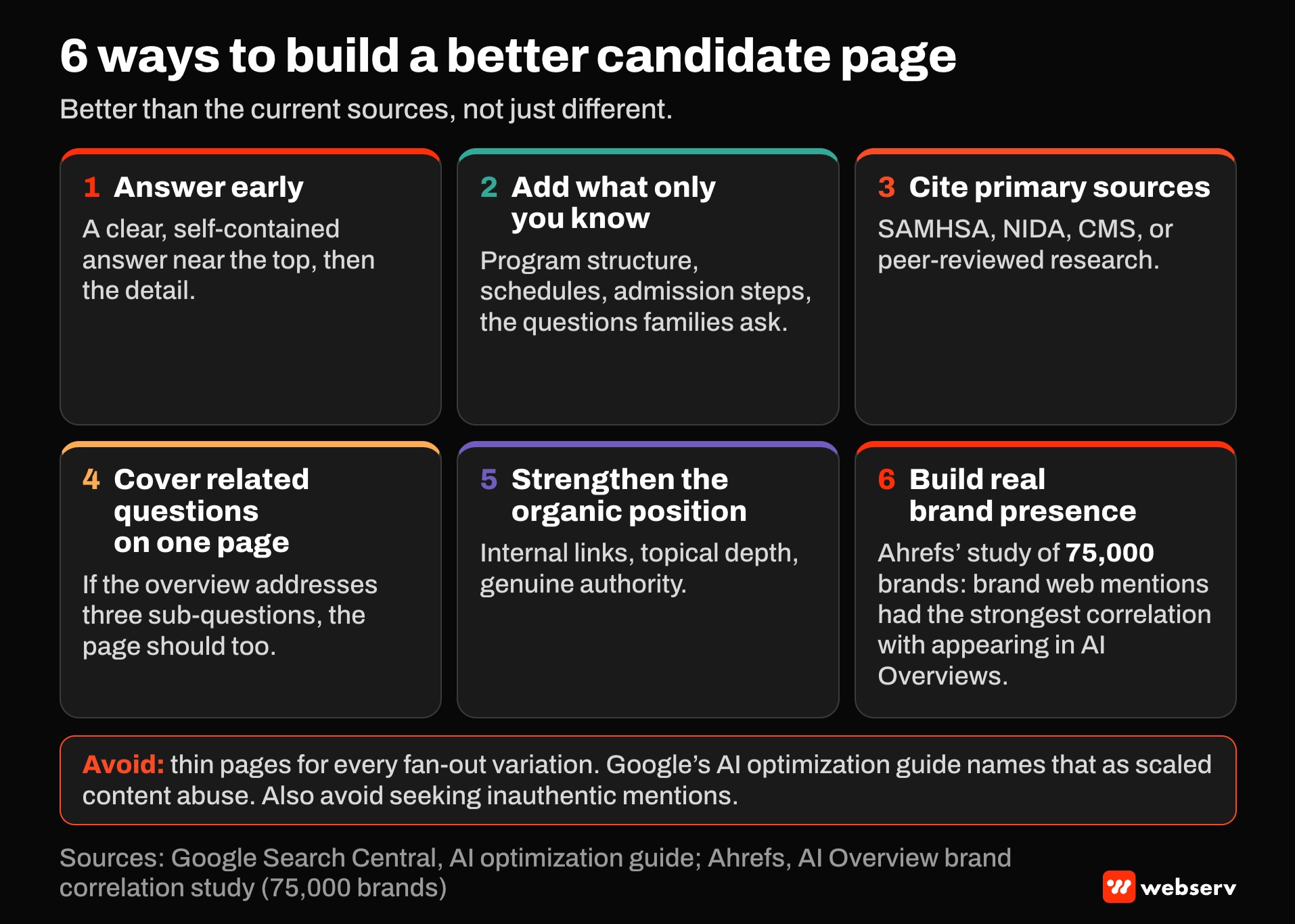
Strengthen the page’s organic position. Since AI search retrieves through core ranking systems, internal links, topical depth, and genuine authority still matter. Our guide to reverse-engineering AI citations for link building covers earning the links that support it.
Build real brand presence. Ahrefs’ study of 75,000 brands found brand web mentions had the strongest correlation with appearing in AI Overviews. Google’s guide also says seeking inauthentic mentions isn’t as helpful as it might seem. Earned coverage, not manufactured mentions.
OPERATOR INSIGHT
Keep a citation log for each target query: the date, the cited domains, whether your page appears, and what changed on your page. After a few months, the log shows which changes moved citations and which queries have a closed set of sources not worth more effort.
It also protects against overreacting. A single day without your citation, in a system where URLs shift every couple of days, isn’t a trend.
Measure the result
Track three things, and read them together.
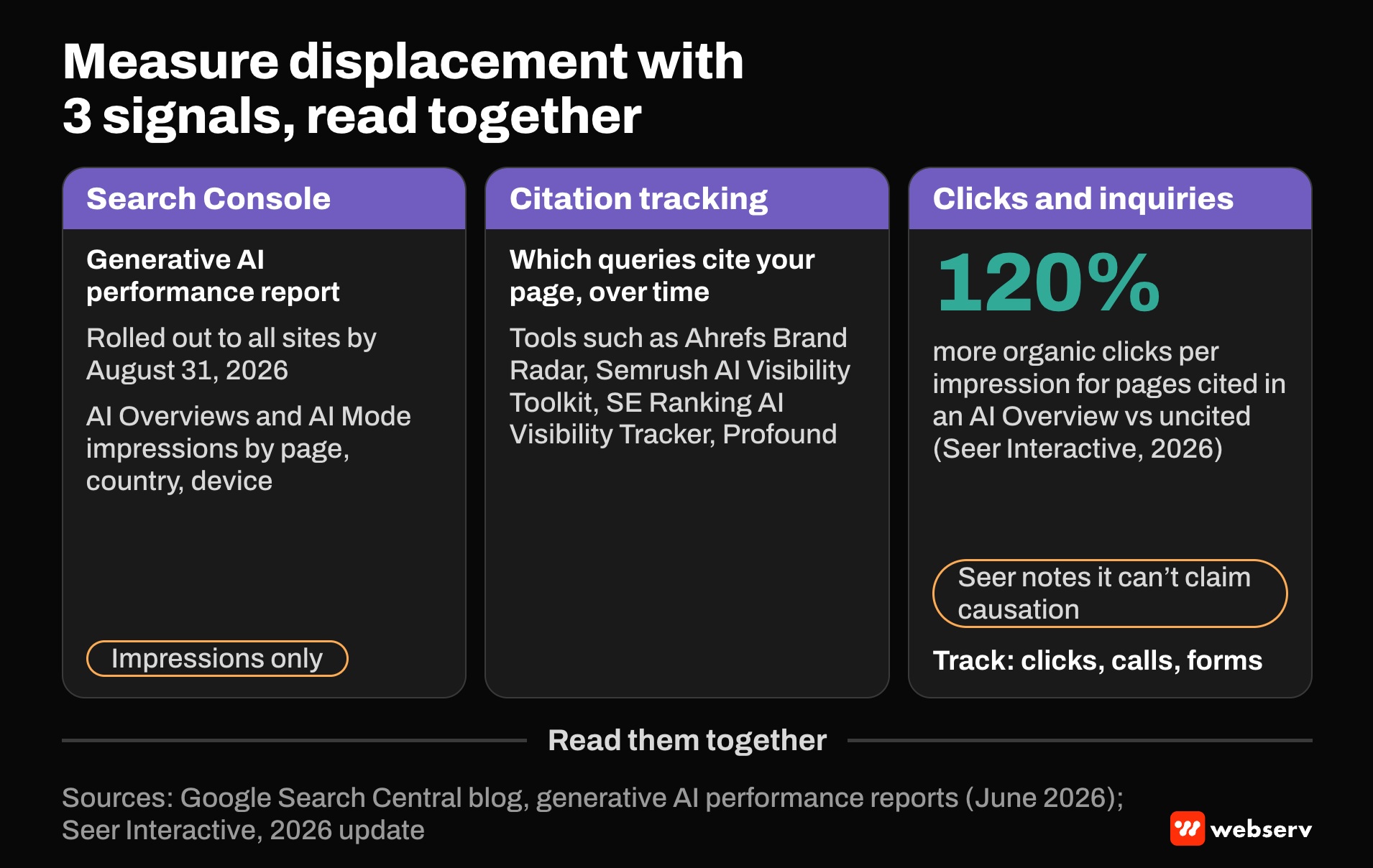
- Search Console. Google’s generative AI performance report, rolled out to all sites by August 31, 2026, shows impressions from AI Overviews and AI Mode by page, country, and device. It reports impressions only.
- Citation tracking. Tools such as Ahrefs Brand Radar, Semrush’s AI Visibility Toolkit, SE Ranking’s AI Visibility Tracker, and Profound track AI citations across queries. Our guide to measuring AEO compares approaches.
- Clicks and inquiries. Seer Interactive’s 2026 update, reported by Search Engine Journal, found pages cited in an AI Overview earned 120% more organic clicks per impression than uncited ones, while noting it can’t claim causation. Track whether citation gains show up as clicks, calls, and forms.
Where this fits
Citation displacement is a focused application of the broader AI search strategy. For the full build, see the Full AI Search Stack and our guide to getting cited in Google AI Overviews and ChatGPT. For diagnosis, the 12 SEO failure patterns diagnostic and the 5-tier SEO priority framework. For the traffic side, see our guide on why blog traffic drops while rankings hold. For structuring answers around the questions people ask, see our guide to FAQ sections for AI search.
For how AI search fits the rest of your marketing, see the complete guide to behavioral health marketing. If you want a second look at which AI Overviews your facility could realistically win, book an intro meeting.
Frequently Asked Questions
Can you replace a competitor in a Google AI Overview?
Not directly. Google selects sources for each overview, so the goal is to become a better candidate than the pages currently cited.
That means ranking well, answering the question more clearly and specifically, and citing reliable sources.
SISTRIX found many overviews have a stable set of cited domains, so some queries will be harder to break into than others.
How often do AI Overview citations change?
It depends on how you measure. Ahrefs found about 45.5% of cited URLs were new between observations, with an average persistence of about two days.
SISTRIX, measuring domains weekly over 17 weeks, found no changes at all in 53% of prompts.
Track the pattern over several weeks rather than reacting to a single check.
Do you need to rank in the top 10 to be cited?
It helps, but it isn’t required. Ahrefs found 76.1% of top-three citations ranked in the top 10 in 2025, and 37.9% of all citations in a 2026 study using a different method.
seoClarity found 44% of citations came from beyond the top 20.
Google says AI features rely on core ranking systems, so organic visibility remains the foundation.
Which treatment center queries have AI Overviews?
BrightEdge’s December 2025 healthcare data found AI Overviews on most healthcare queries, but listed addiction-related queries as consistently excluded and local provider queries at 0%.
Mental health, symptom, insurance, and process questions are more likely to show one.
Check your target queries logged out, since results change.
Is it worth creating pages for every related question?
No. Google warns that creating content for fan-out queries primarily to manipulate rankings can violate its scaled content abuse policy.
Cover related questions on the page that addresses the main topic.
That keeps the answer complete and avoids thin pages.
Trevor Gage is the Director of Marketing at Webserv, a digital marketing agency for treatment centers.